Exercise Motivation Exercise in a recovery context Everyone knows that exercise is good for our bodies and physical health. In addition to weight control, exercise improves and maintains overall health by supporting the immune system.
"Exercise Motivation Exercise in a recovery context" is the property of its rightful owner. Permission is granted to
download and print the materials on this website for personal, non-commercial use only, and to display it
on your personal computer provided you do not modify the materials and that you retain all copyright
notices contained in the materials. By downloading content from our website, you accept the terms of this
agreement.
Presentation Transcript
01
Exercise Motivation<br>
02
Exercise in a recovery context Everyone knows that exercise is good for our bodies and physical health.
In addition to weight control, exercise improves and maintains overall health by supporting the immune system. Weight-bearing exercises keeps bones strong and aerobic exercises strengthens the heart and lungs.
But did you know that exercise is also good for our mental health?
One of the best things about exercising for mental health is that anyone can do it, so long as they respect their individual circumstances.<br>
03
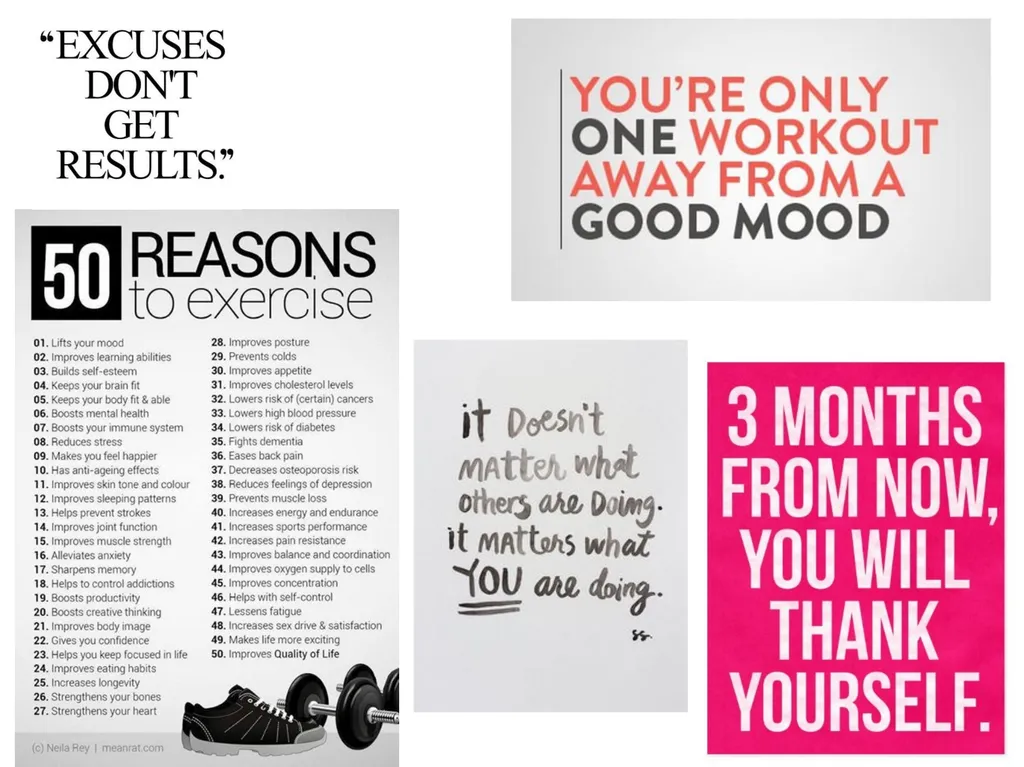
Regular participation in exercise has shown to have significant benefits on our health. Benefits include:
Enhanced mental health and well-being
Improved physical health
Reduced symptoms of anxiety and depression
Improved self-esteem and confidence
Reduced risk of developing serious physical health conditions
(including cardiovascular disease, diabetes and cancer)
Healthy weight loss
Provides a positive focus and sense of purpose – a key element in combating depression
Encourages social inclusion
Reduced feelings of anger and frustration
Enhanced concentration and sleeping patterns Benefits of exercise<br>
04
Before we begin to train the body, we have to train the mind.
You want to get fit. But do you know why? List as many reasons as you can.
Whatever it is that drives you, motivation matters as your willingness to engage with exercise will only ever be as strong as that motivation. Think yourself fit<br>
05
Consider the following questions:
What do you think the results of exercising your mind and body will be?
How much do you value those results?
How do you feel about doing it (confident, embarrassed, frightened, determined)?
What do others think about it, and do they influence you?
How easy do you think it will be to regularly train the body and mind for a short time?
How much control do you have over your ability to make that happen? Exercise motivation<br>
06
What are the some of the common barriers to doing exercise? Barriers to exercise<br>
07
Cost
Safety considerations
Lack of time
Non-enjoyment
Lack of motivation
Overly self-conscious/embarrassed to exercise
Poor body image
Lack of energy
Fear of injury
No exercise partner
Little support to exercise Barriers to exercise Look at the above reasons. Which if any apply to you? Are there other factors which are making it difficult to exercise? What can you do to overcome these?<br>
08
“I should do some exercise.” Reframe the way you conceive doing exercise. Exercise motivation<br>
09
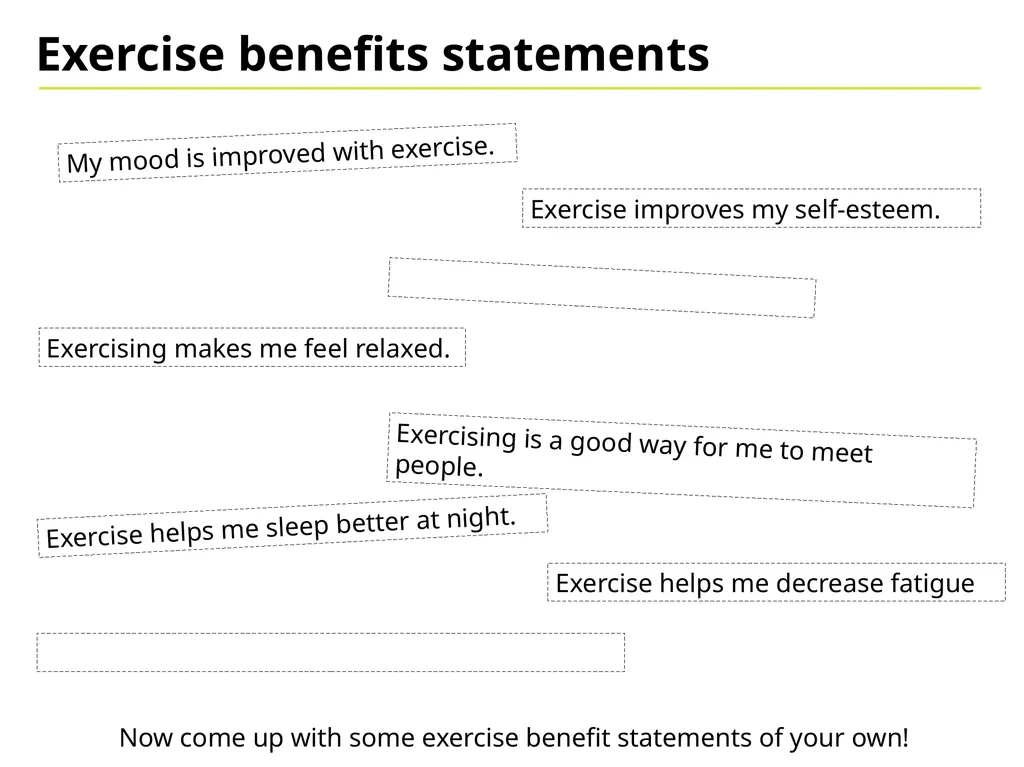
My mood is improved with exercise. Exercising makes me feel relaxed. Exercise improves my self-esteem. Exercising is a good way for me to meet people. Exercise helps me sleep better at night. Exercise helps me decrease fatigue Exercise benefits statements Now come up with some exercise benefit statements of your own!<br>
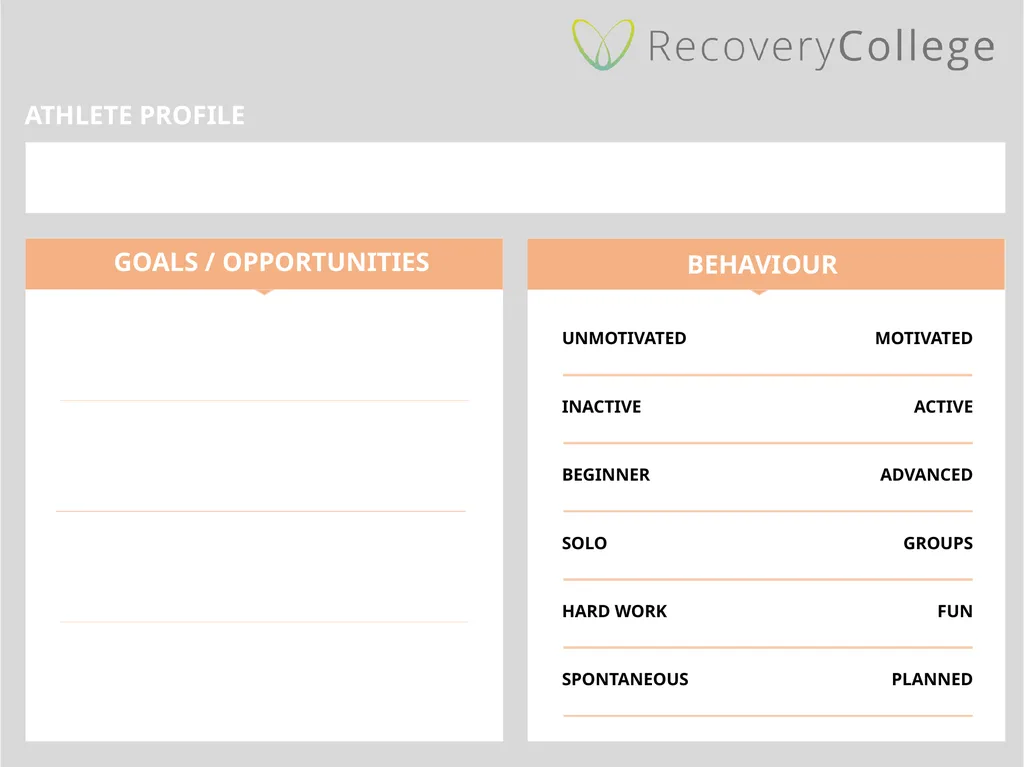
GOALS / OPPORTUNITIES ATHLETE PROFILE MOTIVATION BEHAVIOUR UNMOTIVATED MOTIVATED INACTIVE ACTIVE BEGINNER ADVANCED SOLO GROUPS HARD WORK FUN SPONTANEOUS PLANNED<br>
12
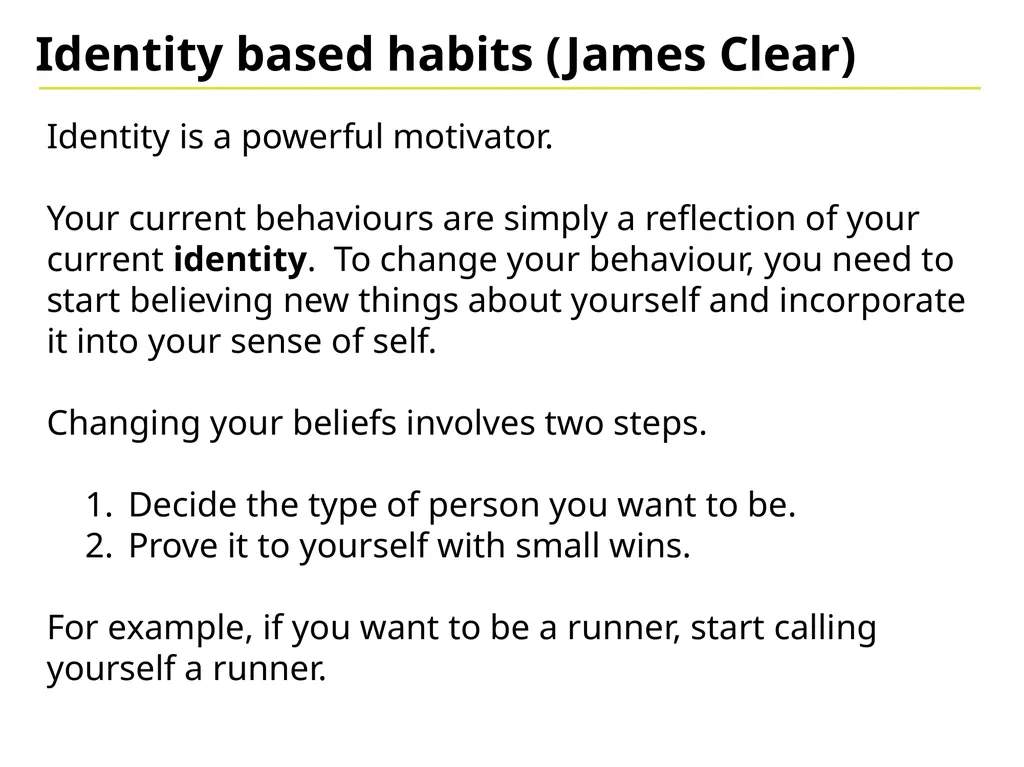
Identity based habits (James Clear) Identity is a powerful motivator.
Your current behaviours are simply a reflection of your
current identity. To change your behaviour, you need to start believing new things about yourself and incorporate it into your sense of self.
Changing your beliefs involves two steps.
Decide the type of person you want to be.
Prove it to yourself with small wins.
For example, if you want to be a runner, start calling yourself a runner.<br>
13
Activity: Look to Future Imagine you have become more active, how would you feel? What would you be doing differently than you aren’t doing now? What would you be doing less off? What would you say to yourself? What would others notice about you that is different?<br>
14
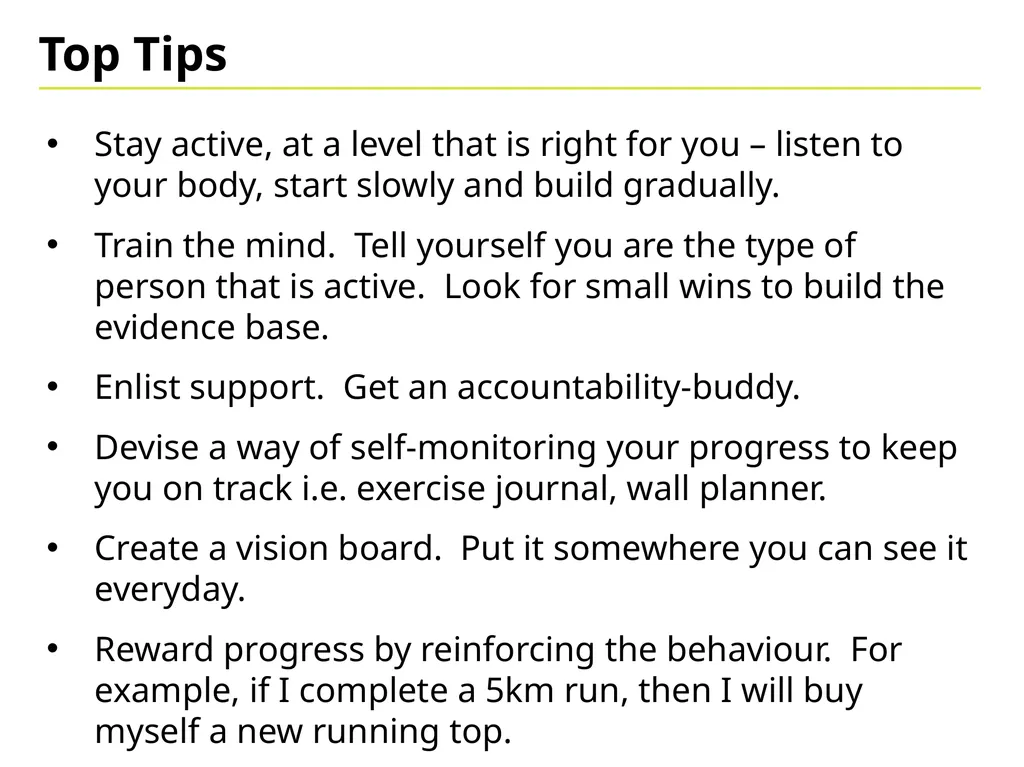
Stay active, at a level that is right for you – listen to your body, start slowly and build gradually.
Train the mind. Tell yourself you are the type of person that is active. Look for small wins to build the evidence base.
Enlist support. Get an accountability-buddy.
Devise a way of self-monitoring your progress to keep you on track i.e. exercise journal, wall planner.
Create a vision board. Put it somewhere you can see it everyday.
Reward progress by reinforcing the behaviour. For example, if I complete a 5km run, then I will buy myself a new running top. Top Tips<br>