03
Introduction In the workplace, when we hear the word harassment, many of us think only of harassment based on sex. However, illegal harassment under federal law also occurs based on an employee’s race or color, religion, national origin, age, disability, genetic information, or military or veteran status. 3<br>
04
Agenda What is Illegal Harassment?
Illegal Harassment Versus Inappropriate Conduct or Behavior (Bullying)
The Importance of Preventing Workplace Harassment
Federal Laws Prohibiting Harassment
Our Policy and Procedure
Your Responsibilities as a Supervisor 4<br>
05
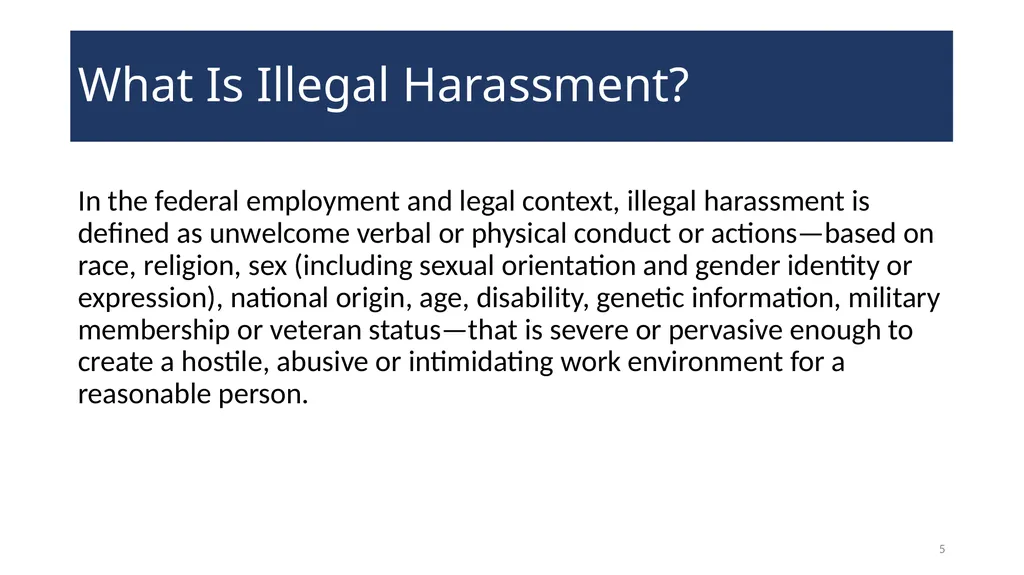
What Is Illegal Harassment? In the federal employment and legal context, illegal harassment is defined as unwelcome verbal or physical conduct or actions—based on race, religion, sex (including sexual orientation and gender identity or expression), national origin, age, disability, genetic information, military membership or veteran status—that is severe or pervasive enough to create a hostile, abusive or intimidating work environment for a reasonable person. 5<br>
06
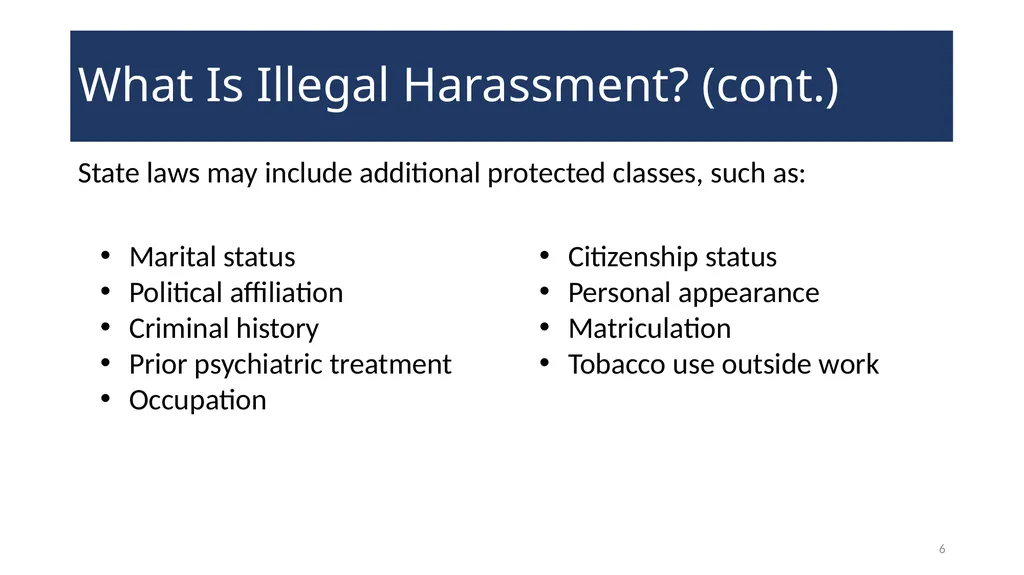
What Is Illegal Harassment? (cont.) State laws may include additional protected classes, such as: 6 Citizenship status
Personal appearance
Matriculation
Tobacco use outside work Marital status
Political affiliation
Criminal history
Prior psychiatric treatment
Occupation<br>
07
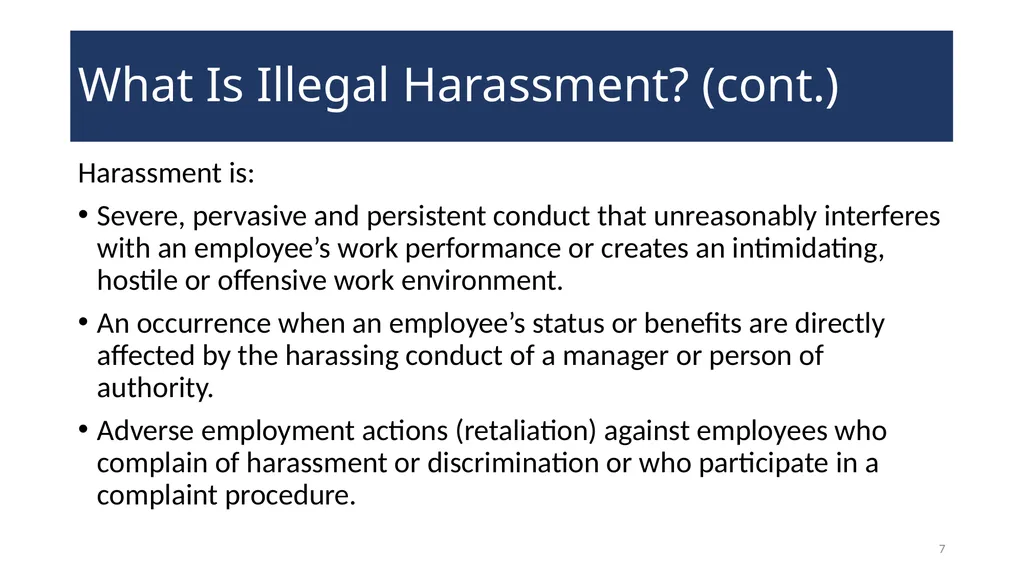
Harassment is:
Severe, pervasive and persistent conduct that unreasonably interferes with an employee’s work performance or creates an intimidating, hostile or offensive work environment.
An occurrence when an employee’s status or benefits are directly affected by the harassing conduct of a manager or person of authority.
Adverse employment actions (retaliation) against employees who complain of harassment or discrimination or who participate in a complaint procedure. What Is Illegal Harassment? (cont.) 7<br>
08
Questions? Comments? 8<br>
09
As used in this presentation, the term “harassment” refers to the illegal form of discrimination.
Employees may say they are being harassed, however, when they are subjected to inappropriate conduct or behavior that is not illegal but that is unacceptable in the workplace.
This may often be described as “workplace bullying,” though bullying techniques can also be used against employees based on their legally protected status.
While all harassment is not illegal, no form of harassment should be acceptable in the workplace. Illegal Harassment Versus Inappropriate Conduct or Behavior 9<br>
10
Workplace bullying is repeated and unwanted actions by an individual or group intending to intimidate, harass, degrade or offend.
Bullying behavior can exist at any level of an organization. Bullies can be superiors, subordinates, co-workers and colleagues. Workplace Bullying 10<br>
11
Examples of workplace bullying include:
Verbal abuse and profanity.
Humiliation.
Constant criticism or teasing.
Gossip.
Stealing the credit for work performed by someone else.
Personal and professional denigration. Workplace Bullying (cont.) 11<br>
12
A supervisor in the accounting department constantly and publicly criticizes his employees and calls them stupid and lazy. Is this illegal harassment or workplace bullying? Explain your answer.
The same accounting supervisor refers to one of his employees as an “old gal” who is “over the hill” and has problems using a computer because of her age. Is this illegal harassment or workplace bullying? Why? Group Discussion 12<br>
13
Questions? Comments? 13<br>
14
Harassment harms us all. The most important part of our corporate values is to ensure all employees are treated with respect and dignity.
Engaging in, condoning or not reporting any type of harassment is in direct conflict with our values. The Importance of Preventing Workplace Harassment 14<br>
15
We must ensure compliance with federal discrimination laws and state fair employment laws.
Liability for the employer may be under federal or state law or civil litigation. A company is always responsible for harassment by a supervisor that results in a tangible employment action such as a hiring, firing, promotion, demotion, change in pay or benefits, or change in work duties. The Importance of Preventing Workplace Harassment (cont.) 15<br>
16
Questions? Comments? 16<br>
17
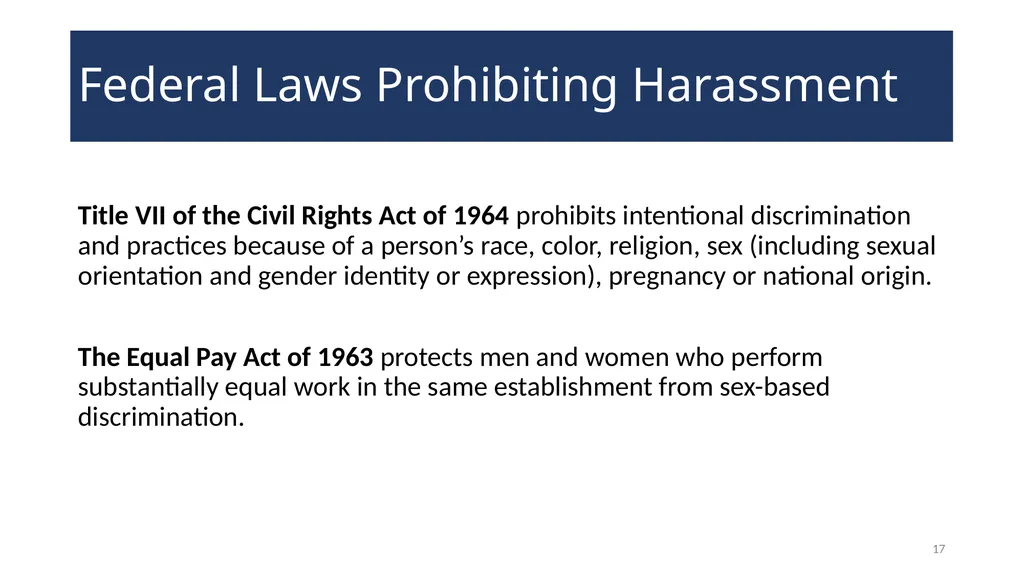
Title VII of the Civil Rights Act of 1964 prohibits intentional discrimination and practices because of a person’s race, color, religion, sex (including sexual orientation and gender identity or expression), pregnancy or national origin.
The Equal Pay Act of 1963 protects men and women who perform substantially equal work in the same establishment from sex-based discrimination. Federal Laws Prohibiting Harassment 17<br>
18
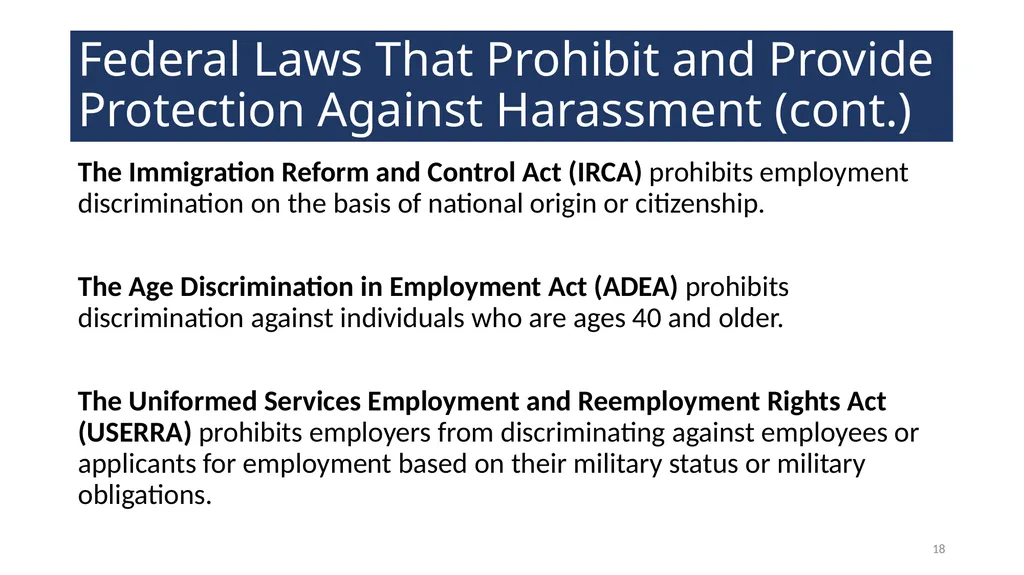
The Immigration Reform and Control Act (IRCA) prohibits employment discrimination on the basis of national origin or citizenship.
The Age Discrimination in Employment Act (ADEA) prohibits discrimination against individuals who are ages 40 and older.
The Uniformed Services Employment and Reemployment Rights Act (USERRA) prohibits employers from discriminating against employees or applicants for employment based on their military status or military obligations. Federal Laws That Prohibit and Provide Protection Against Harassment (cont.) 18<br>
19
The Civil Rights Act of 1991 provides for damages in cases of intentional employment discrimination to clarify provisions regarding disparate impact actions and for other purposes.
The Americans with Disabilities Act (ADA) as amended protects individuals with disabilities and those regarded as having disabilities.
The Genetic Information Nondiscrimination Act (GINA) prohibits employers from discriminating against employees in hiring, firing or any other terms and conditions of employment based on a worker’s genetic information. Federal Laws That Prohibit and Provide Protection Against Harassment (cont.) 19<br>
20
Questions? Comments? 20<br>
21
Our Policy and Procedures on Harassment 21<br>
22
Questions? Comments? 22<br>
23
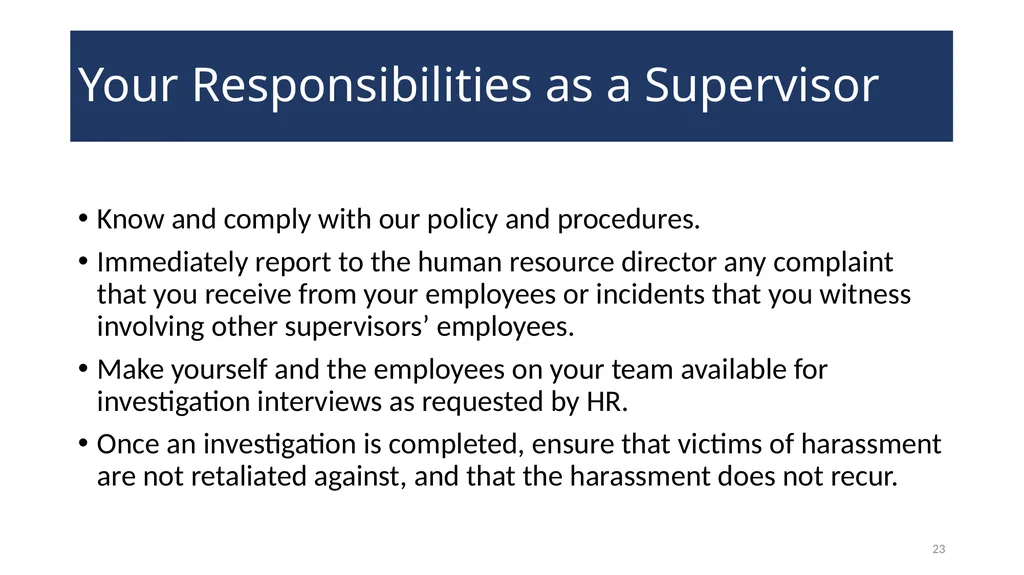
Know and comply with our policy and procedures.
Immediately report to the human resource director any complaint that you receive from your employees or incidents that you witness involving other supervisors’ employees.
Make yourself and the employees on your team available for investigation interviews as requested by HR.
Once an investigation is completed, ensure that victims of harassment are not retaliated against, and that the harassment does not recur. Your Responsibilities as a Supervisor 23<br>
24
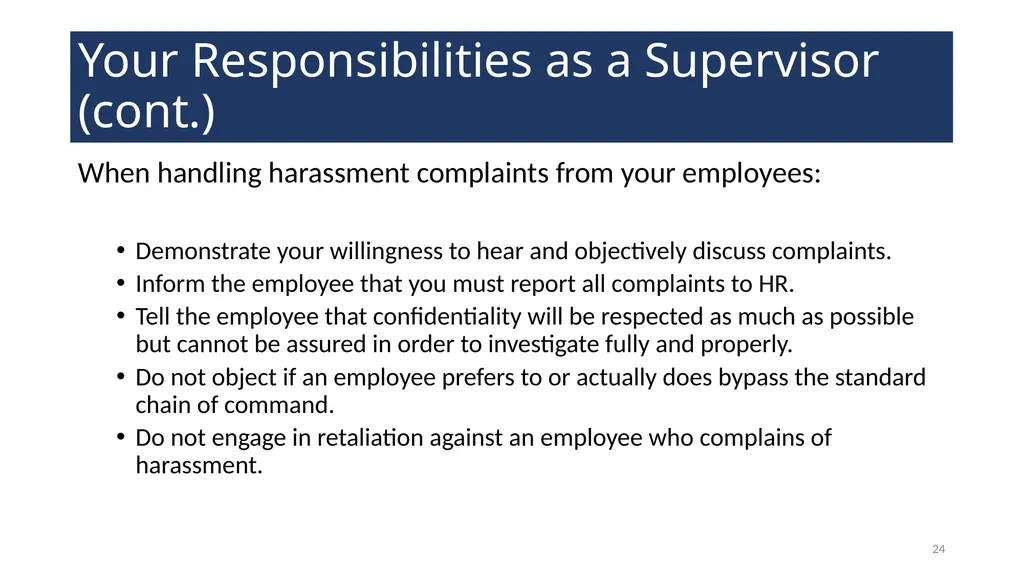
When handling harassment complaints from your employees:
Demonstrate your willingness to hear and objectively discuss complaints.
Inform the employee that you must report all complaints to HR.
Tell the employee that confidentiality will be respected as much as possible but cannot be assured in order to investigate fully and properly.
Do not object if an employee prefers to or actually does bypass the standard chain of command.
Do not engage in retaliation against an employee who complains of harassment. Your Responsibilities as a Supervisor (cont.) 24<br>
25
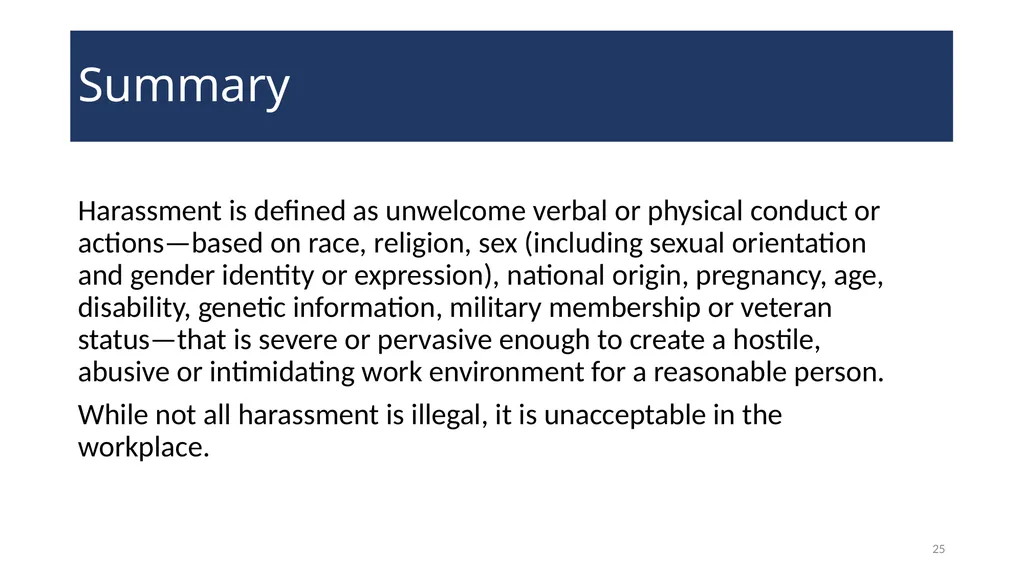
Summary 25 Harassment is defined as unwelcome verbal or physical conduct or actions—based on race, religion, sex (including sexual orientation and gender identity or expression), national origin, pregnancy, age, disability, genetic information, military membership or veteran status—that is severe or pervasive enough to create a hostile, abusive or intimidating work environment for a reasonable person.
While not all harassment is illegal, it is unacceptable in the workplace.<br>
26
Questions? Comments? 26<br>
27
Training Evaluation Please complete the training evaluation sheet included in the handouts.
Thank you for your interest and attention! 27<br>