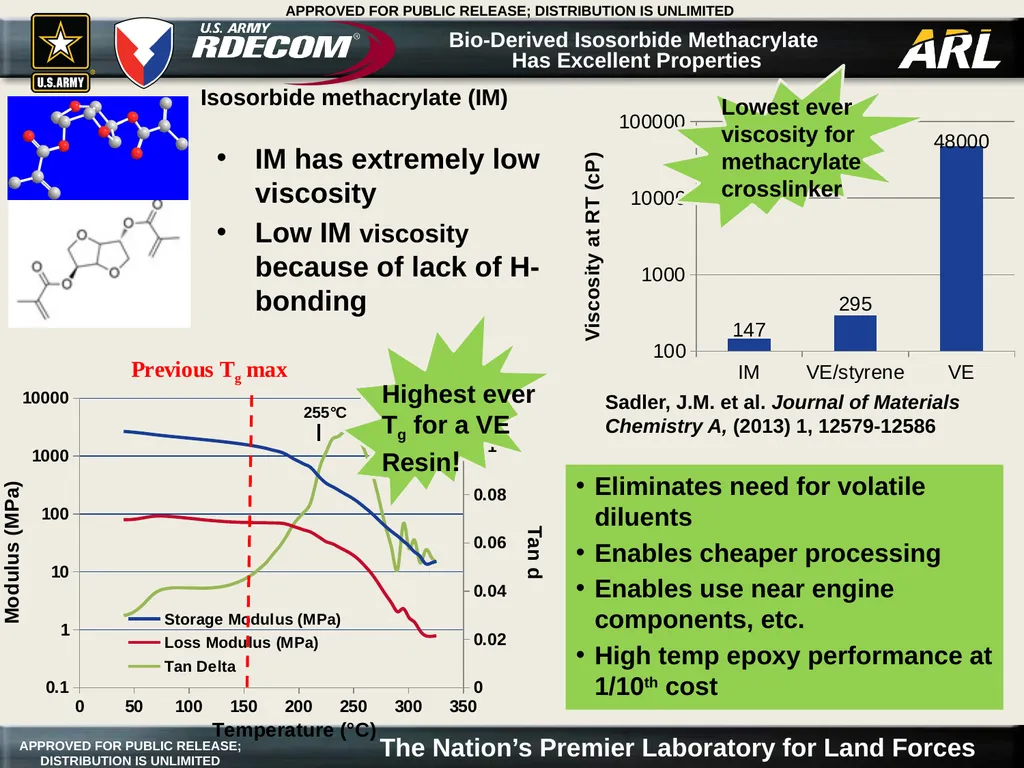
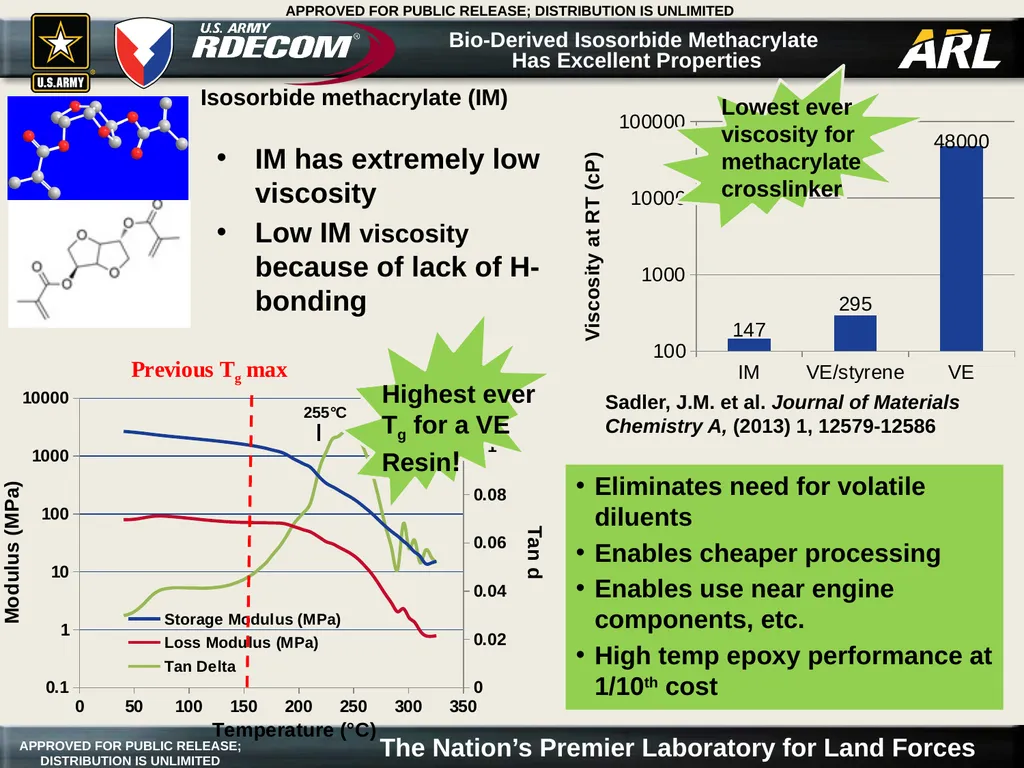
IM has extremely low viscosity Low IM viscosity because of lack of H-bonding Sadler, J.M. et al. Journal of Materials Chemistry A, (2013) 1, 12579-12586 Lowest ever viscosity for methacrylate crosslinker Bio-Derived Isosorbide Methacrylate
"IM has extremely low viscosity Low IM viscosity" is the property of its rightful owner. Permission is granted to
download and print the materials on this website for personal, non-commercial use only, and to display it
on your personal computer provided you do not modify the materials and that you retain all copyright
notices contained in the materials. By downloading content from our website, you accept the terms of this
agreement.
Presentation Transcript
01
IM has extremely low viscosity
Low IM viscosity because of lack of H-bonding Sadler, J.M. et al. Journal of Materials Chemistry A, (2013) 1, 12579-12586 Lowest ever viscosity for methacrylate crosslinker Bio-Derived Isosorbide Methacrylate Has Excellent Properties Isosorbide methacrylate (IM) Highest ever Tg for a VE Resin! Eliminates need for volatile diluents
Enables cheaper processing
Enables use near engine components, etc.
High temp epoxy performance at 1/10th cost<br>
02
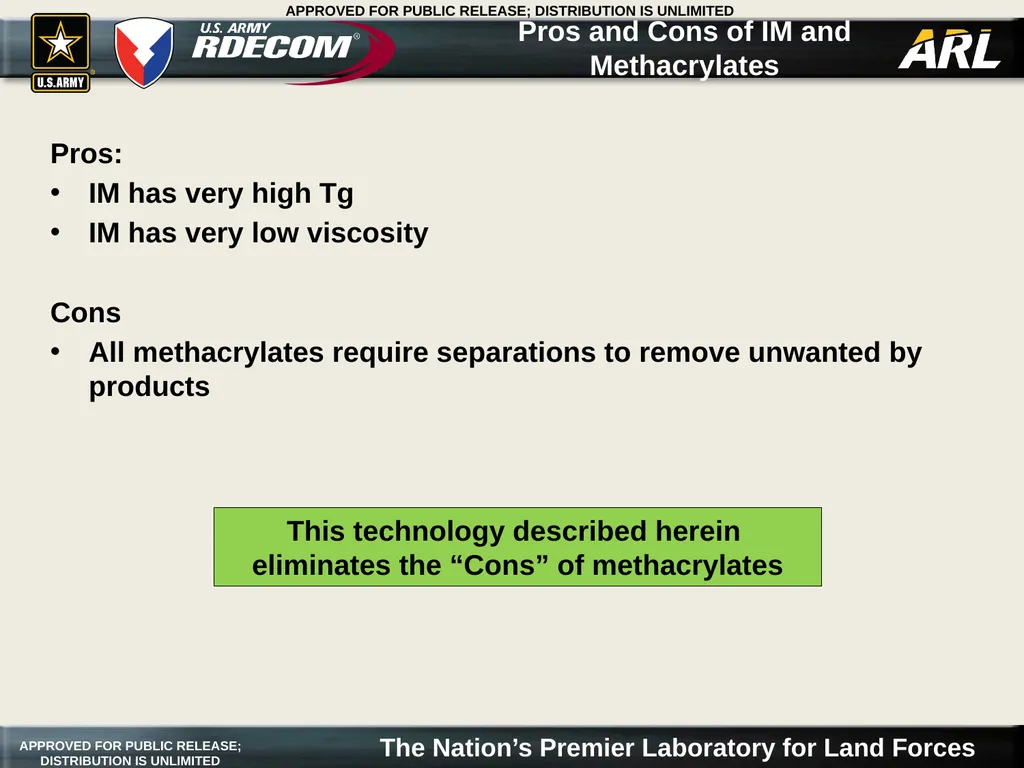
Pros:
IM has very high Tg
IM has very low viscosity
Cons
All methacrylates require separations to remove unwanted by products Pros and Cons of IM and Methacrylates This technology described herein
eliminates the “Cons” of methacrylates<br>
03
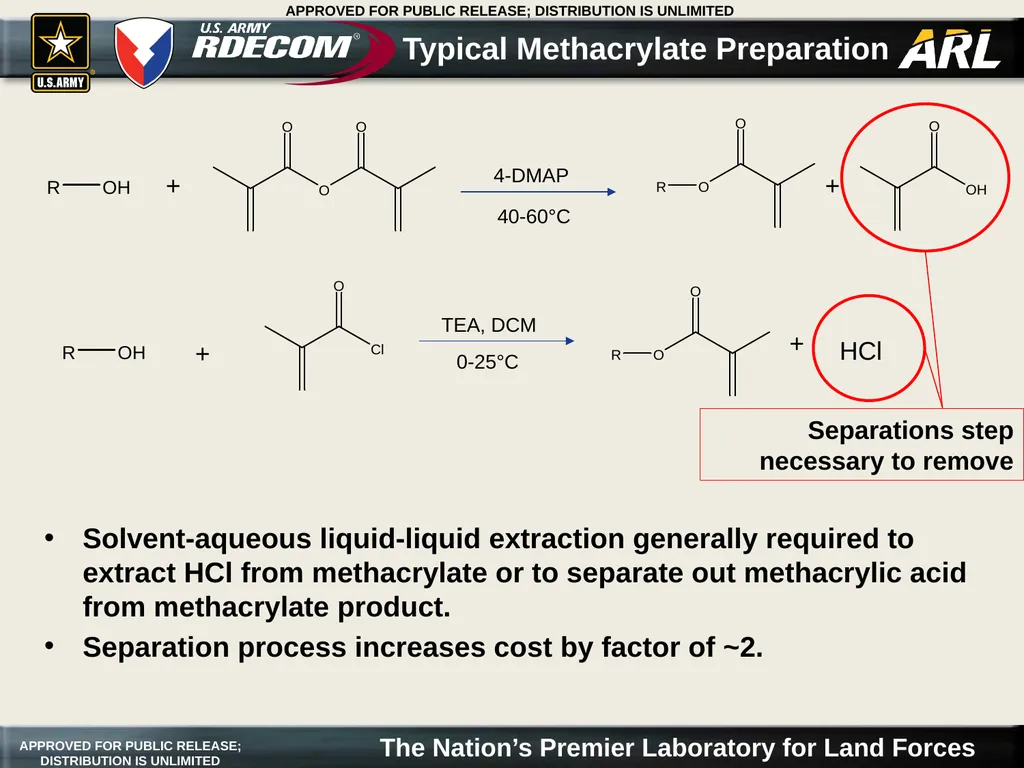
Solvent-aqueous liquid-liquid extraction generally required to extract HCl from methacrylate or to separate out methacrylic acid from methacrylate product.
Separation process increases cost by factor of ~2. Typical Methacrylate Preparation HCl TEA, DCM 0-25°C + + + + Separations step necessary to remove 4-DMAP 40-60°C<br>
04
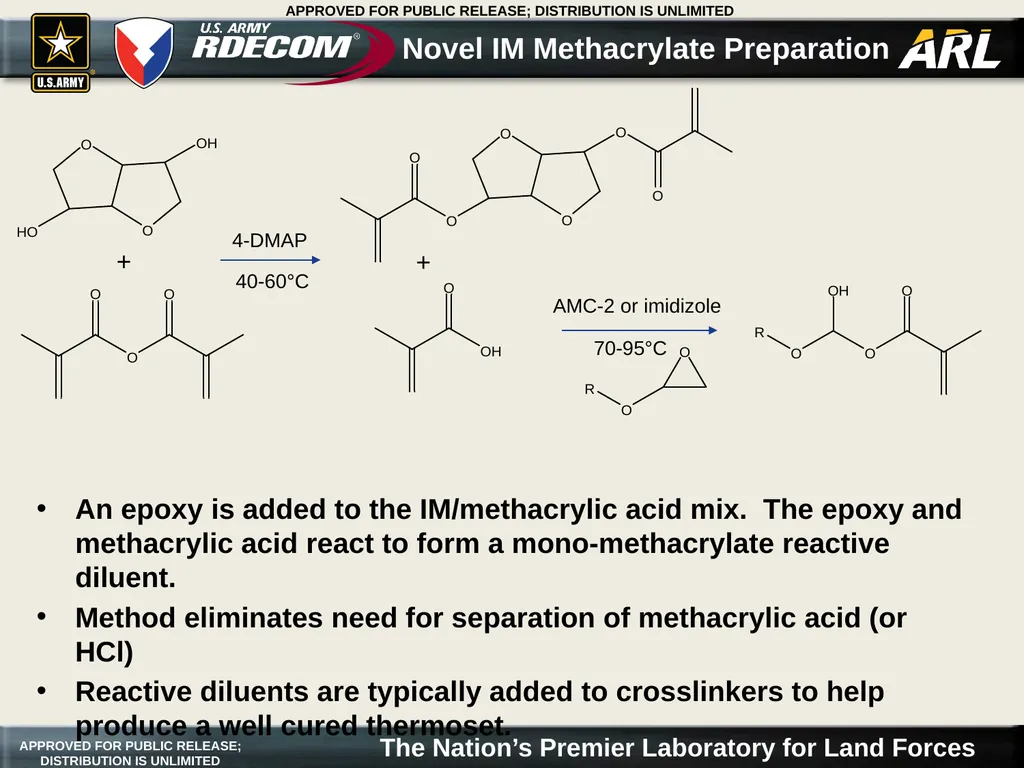
An epoxy is added to the IM/methacrylic acid mix. The epoxy and methacrylic acid react to form a mono-methacrylate reactive diluent.
Method eliminates need for separation of methacrylic acid (or HCl)
Reactive diluents are typically added to crosslinkers to help produce a well cured thermoset. Novel IM Methacrylate Preparation AMC-2 or imidizole 70-95°C + + 4-DMAP 40-60°C<br>
05
Mono alcohols will produce reactive diluents
Diols will produce crosslinking agents
Both will modify the resulting resin properties Use of other Alcohols AMC-2 or imidizole 70-95°C + 4-DMAP 40-60°C + + + +<br>
06
Mono epoxies produce reactive diluent
Diepoxies react to produce dimethacrylate crosslinkers
Use of mono- and di-epoxies allow tuning of the resin composition, crosslinker content, viscosity, and polymer properties. Novel IM Methacrylate Preparation<br>
07
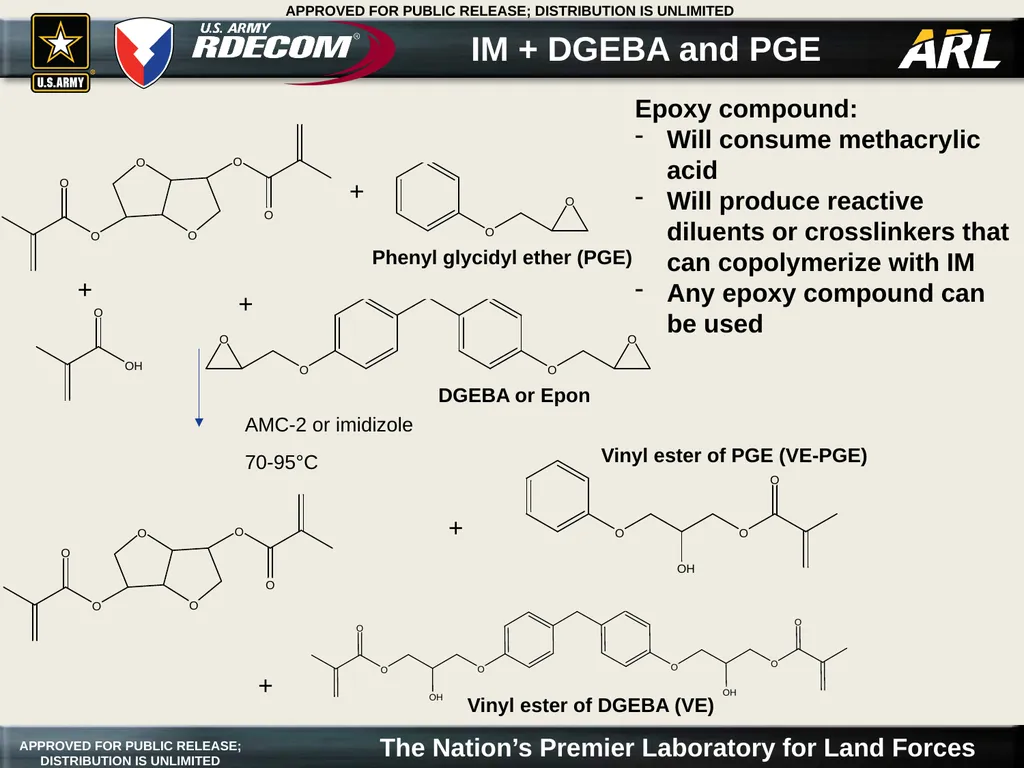
IM + DGEBA and PGE + AMC-2 or imidizole 70-95°C + + Phenyl glycidyl ether (PGE) DGEBA or Epon Vinyl ester of DGEBA (VE) + + Epoxy compound:
Will consume methacrylic acid
Will produce reactive diluents or crosslinkers that can copolymerize with IM
Any epoxy compound can be used Vinyl ester of PGE (VE-PGE)<br>
08
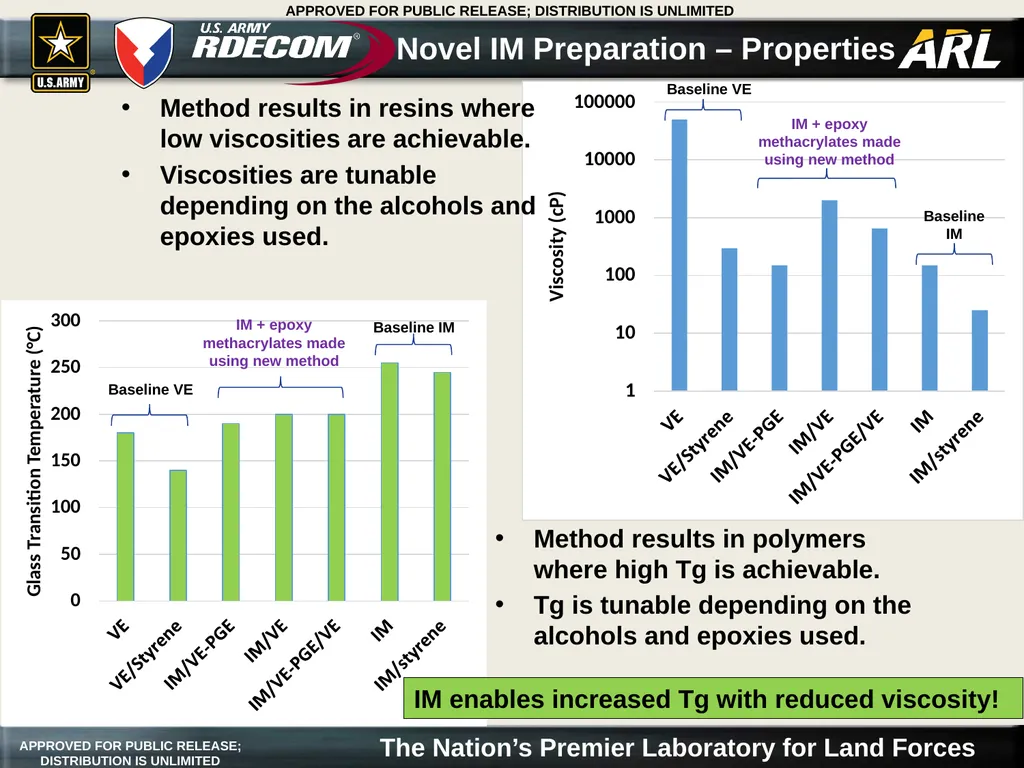
Method results in resins where low viscosities are achievable.
Viscosities are tunable depending on the alcohols and epoxies used. Novel IM Preparation – Properties Method results in polymers where high Tg is achievable.
Tg is tunable depending on the alcohols and epoxies used. Baseline VE Baseline IM IM + epoxy methacrylates made using new method Baseline VE Baseline IM IM + epoxy methacrylates made using new method IM enables increased Tg with reduced viscosity!<br>
09
IM-based formulations have similar or lower viscosities than standard vinyl esters
Viscosities are tunable depending on the alcohols and epoxies used. Novel IM Preparation: Properties as VE replacement Method produces alternative VE resins with higher Tg than standard VE resins.
Tg is tunable depending on the alcohols and epoxies used. Baseline VE Baseline IM Baseline VE Baseline IM IM-based Resin as VE Alternative IM-based Resin as VE Alternative IM resins are effective alternatives to VE resins<br>
10
IM-based diluents enable sufficient viscosity reduction in VE resins.
Viscosities are tunable depending on the alcohols and epoxies used. Novel IM Preparation: Properties as Styrene Replacement IM-based diluents increase the polymer Tg relative to VE/styrene.
Tg is tunable depending on the alcohols and epoxies used. Baseline VE Baseline IM Baseline VE Baseline IM IM as Styrene Replacement IM as Styrene Replacement IM diluents are effective replacements of styrene in VE resins<br>
11
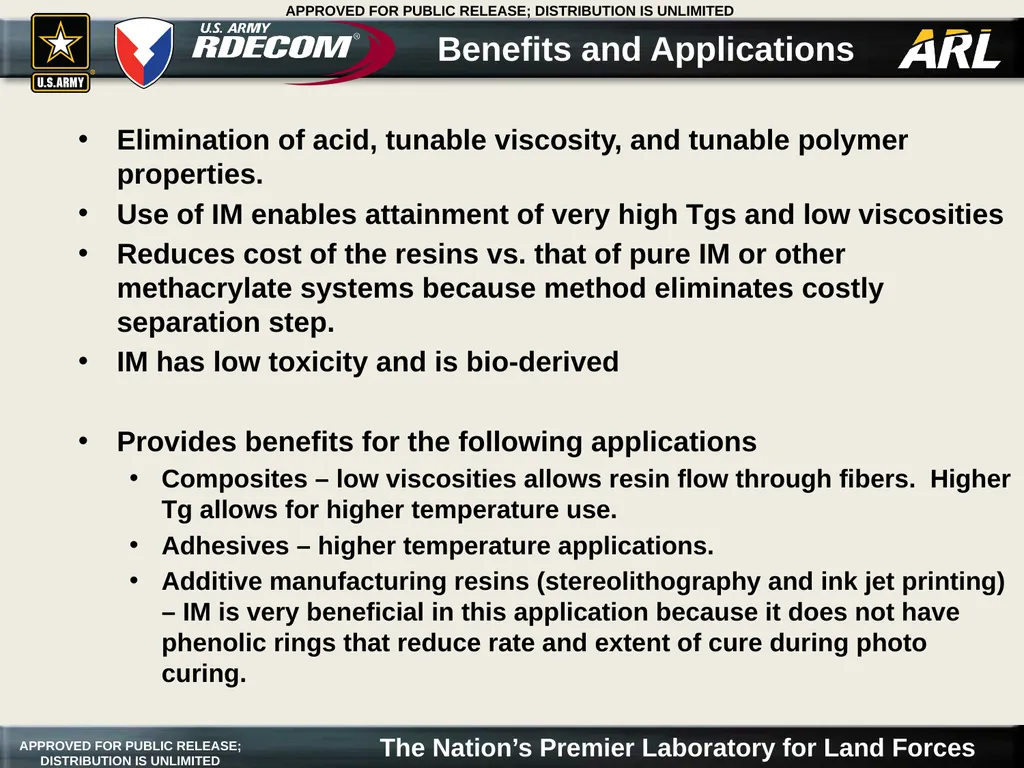
Elimination of acid, tunable viscosity, and tunable polymer properties.
Use of IM enables attainment of very high Tgs and low viscosities
Reduces cost of the resins vs. that of pure IM or other methacrylate systems because method eliminates costly separation step.
IM has low toxicity and is bio-derived
Provides benefits for the following applications
Composites – low viscosities allows resin flow through fibers. Higher Tg allows for higher temperature use.
Adhesives – higher temperature applications.
Additive manufacturing resins (stereolithography and ink jet printing) – IM is very beneficial in this application because it does not have phenolic rings that reduce rate and extent of cure during photo curing. Benefits and Applications<br>