
Improving Reading Comprehension K-3 Timothy
TG
Published · 54 slides · 0 views
1 / 1
Description
Improving Reading Comprehension K-3 Timothy Shanahan University of Illinois at Chicago www.shanahanonliteracy.com Introduction Reading achievement in the U.S. has been stagnant over the past 40 years Despite increases in the demand for
Related Topics
Share
Embed code
Download this presentation From Below
"Improving Reading Comprehension K-3 Timothy" is the property of its rightful owner. Permission is granted to download and print the materials on this website for personal, non-commercial use only, and to display it on your personal computer provided you do not modify the materials and that you retain all copyright notices contained in the materials. By downloading content from our website, you accept the terms of this agreement.
Presentation Transcript
01
Improving Reading Comprehension K-3 Timothy Shanahan
University of Illinois at Chicago
www.shanahanonliteracy.com<br>
University of Illinois at Chicago
www.shanahanonliteracy.com<br>
02
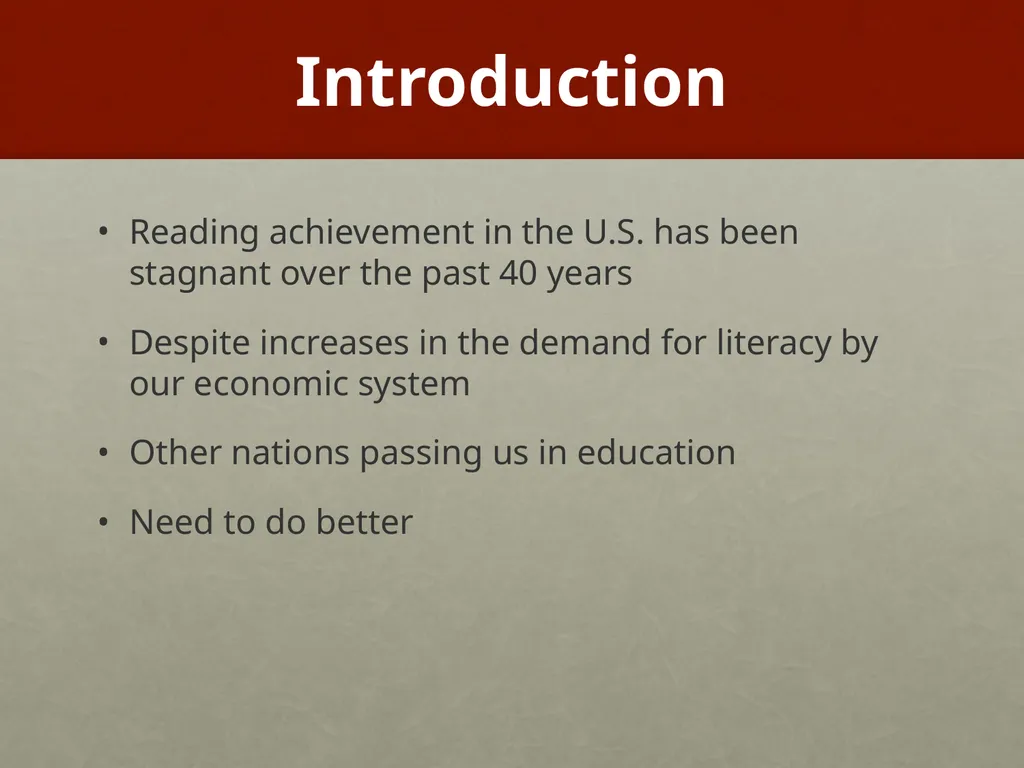
Introduction Reading achievement in the U.S. has been stagnant over the past 40 years
Despite increases in the demand for literacy by our economic system
Other nations passing us in education
Need to do better<br>
Despite increases in the demand for literacy by our economic system
Other nations passing us in education
Need to do better<br>
03
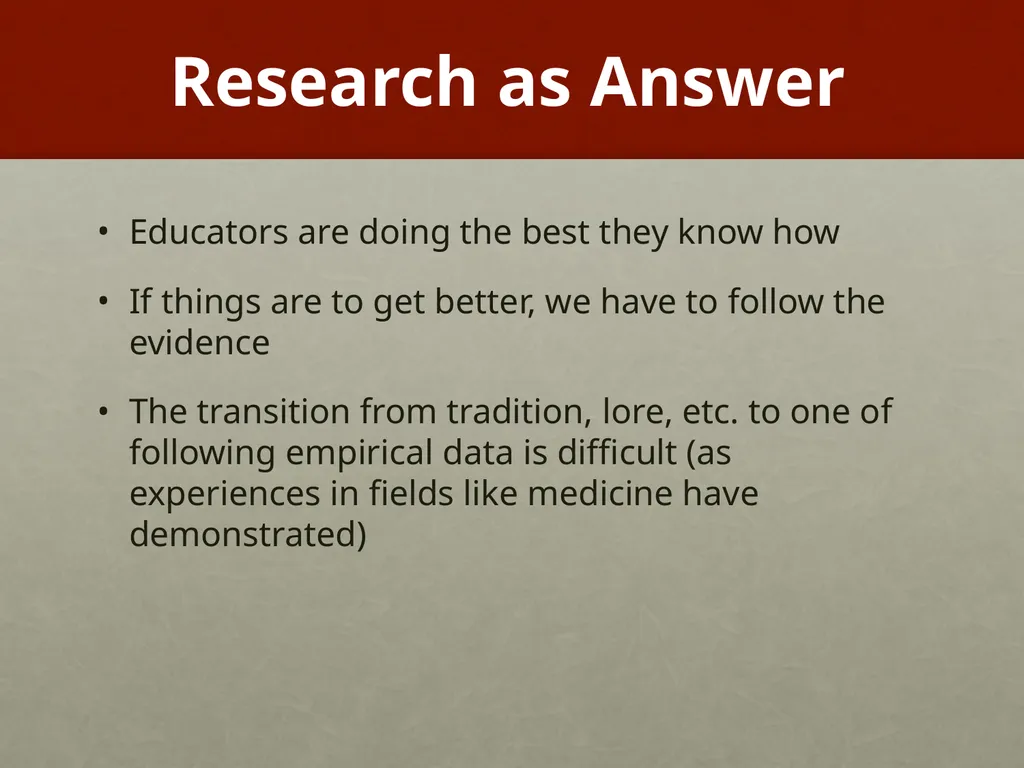
Research as Answer Educators are doing the best they know how
If things are to get better, we have to follow the evidence
The transition from tradition, lore, etc. to one of following empirical data is difficult (as experiences in fields like medicine have demonstrated)<br>
If things are to get better, we have to follow the evidence
The transition from tradition, lore, etc. to one of following empirical data is difficult (as experiences in fields like medicine have demonstrated)<br>
04
Federal Role U.S. government has increasingly played a role in trying to get schools to follow research evidence because of the economic, health, civic, and social concerns
National research review panels
Institute of Education Sciences
What Works Clearinghouse
Practice Guides/Doing What Works http://dww.ed.gov/<br>
National research review panels
Institute of Education Sciences
What Works Clearinghouse
Practice Guides/Doing What Works http://dww.ed.gov/<br>
05
National Research Review Panels National Reading Panel (NICHD)
National Early Literacy Panel
National Literacy Panel on Language Minority Children and Youth
National Math Panel
Extensive public research reviews using objective methodologies<br>
National Early Literacy Panel
National Literacy Panel on Language Minority Children and Youth
National Math Panel
Extensive public research reviews using objective methodologies<br>
06
Institute of Education Sciences Semi-autonomous research arm of the U.S. Department of Education
Substantial research and dissemination budget (~$700 million)
Reading for Understanding initiative
10 Regional Educational Labs<br>
Substantial research and dissemination budget (~$700 million)
Reading for Understanding initiative
10 Regional Educational Labs<br>
07
What Works Clearinghouse What Works Clearinghouse (WWC) has developed several consumers guide for educators (adolescent literacy, beginning reading, character education, dropout prevention, early childhood, elementary, middle, and high school math, English language learners, students with disabilities)
http://ies.ed.gov/ncee/wwc/<br>
http://ies.ed.gov/ncee/wwc/<br>
08
WWC Practice Guides Practical guides that offer educators a nuanced look at research support in particular topic areas
WWC brings together a group of experts who indicate what they think the important claims are that could be drawn from research
The WWC then rigorously reviews the research evidence that could logically be used support these claims<br>
WWC brings together a group of experts who indicate what they think the important claims are that could be drawn from research
The WWC then rigorously reviews the research evidence that could logically be used support these claims<br>
09
WWC Practice Guides (cont.) Practice guides make recommendations based on these claims and provide ratings of the levels of evidence supporting them
Strong evidence means that the studies were well designed to show whether an approach “caused” improvement across a range of students and circumstances
Moderate evidence may show strong causality or generalizability, but not both
Low (Minimal) evidence means that expert opinion is not sufficiently supported directly by research<br>
Strong evidence means that the studies were well designed to show whether an approach “caused” improvement across a range of students and circumstances
Moderate evidence may show strong causality or generalizability, but not both
Low (Minimal) evidence means that expert opinion is not sufficiently supported directly by research<br>
10
DOING WHAT WORKS Website that provides more detailed implementation information on the practice guides
Includes interview videos, classroom application slide shows and audios, examples of student work and other materials
http://dww.ed.gov/<br>
Includes interview videos, classroom application slide shows and audios, examples of student work and other materials
http://dww.ed.gov/<br>
11
Today’s presentation Our presentation today will focus specifically on one practice guide:
Improving Reading Comprehension in Kindergarten Through 3rd Grade
But I will also draw information from other practice guides and research reviews to make this more complete (practice guides are focused somewhat narrowly)<br>
Improving Reading Comprehension in Kindergarten Through 3rd Grade
But I will also draw information from other practice guides and research reviews to make this more complete (practice guides are focused somewhat narrowly)<br>
12
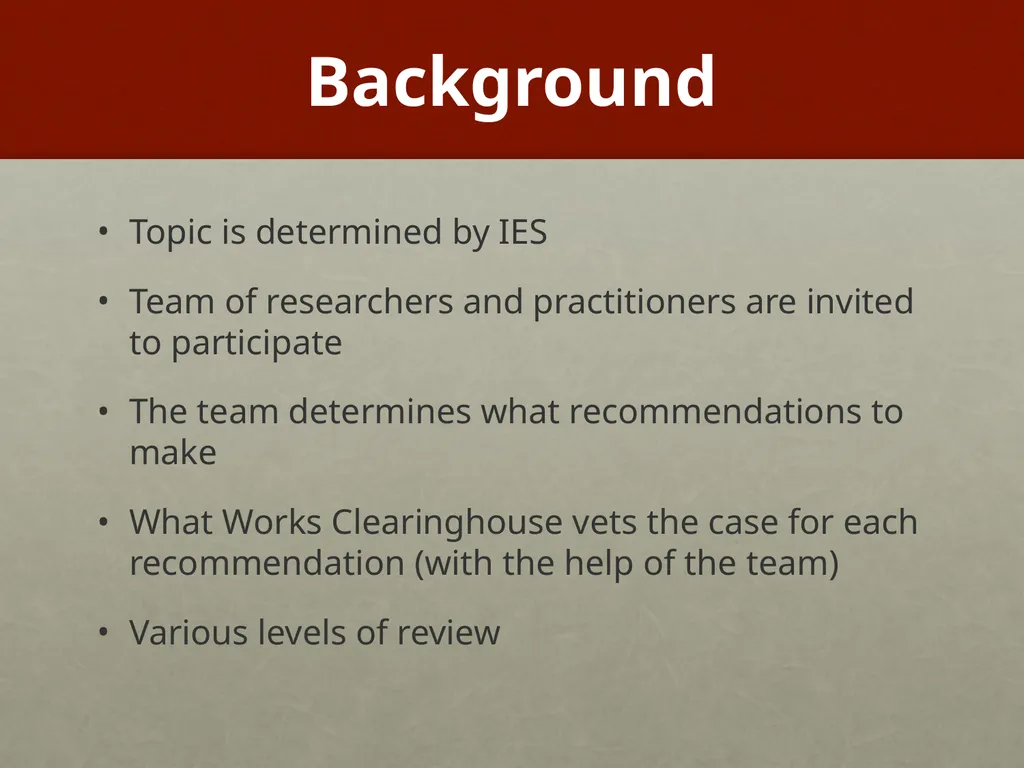
Background Topic is determined by IES
Team of researchers and practitioners are invited to participate
The team determines what recommendations to make
What Works Clearinghouse vets the case for each recommendation (with the help of the team)
Various levels of review<br>
Team of researchers and practitioners are invited to participate
The team determines what recommendations to make
What Works Clearinghouse vets the case for each recommendation (with the help of the team)
Various levels of review<br>
13
Recommendation 1 Teach students how to use reading comprehension strategies.
Level of Evidence: STRONG<br>
Level of Evidence: STRONG<br>
14
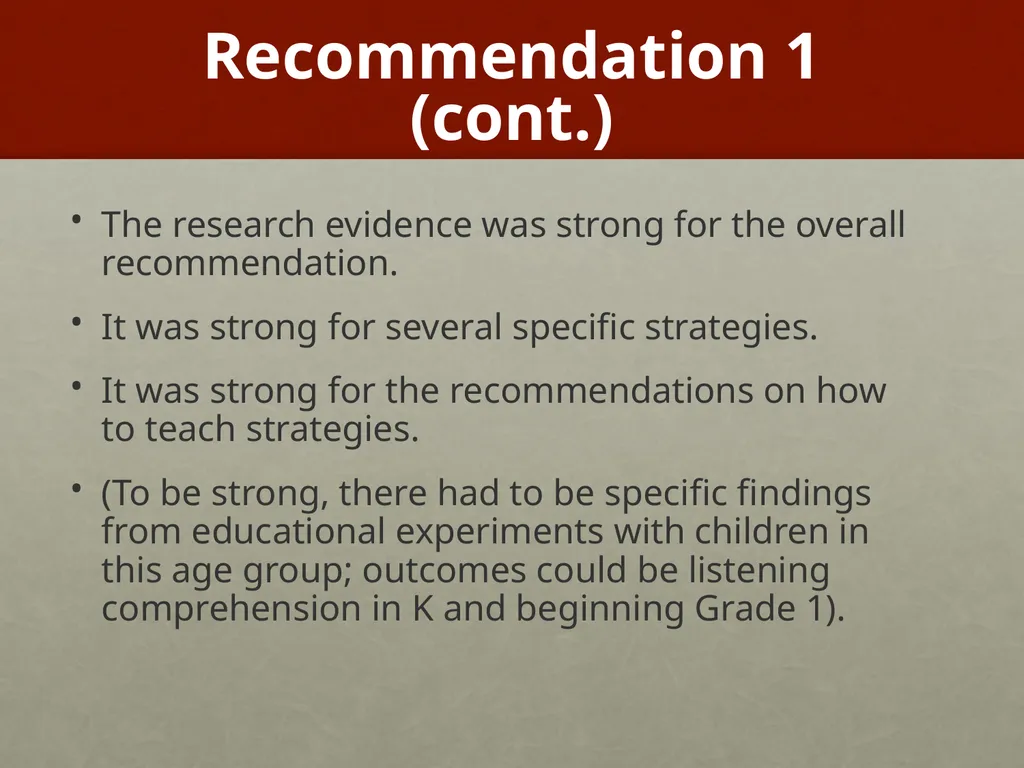
Recommendation 1 (cont.) The research evidence was strong for the overall recommendation.
It was strong for several specific strategies.
It was strong for the recommendations on how to teach strategies.
(To be strong, there had to be specific findings from educational experiments with children in this age group; outcomes could be listening comprehension in K and beginning Grade 1).<br>
It was strong for several specific strategies.
It was strong for the recommendations on how to teach strategies.
(To be strong, there had to be specific findings from educational experiments with children in this age group; outcomes could be listening comprehension in K and beginning Grade 1).<br>
15
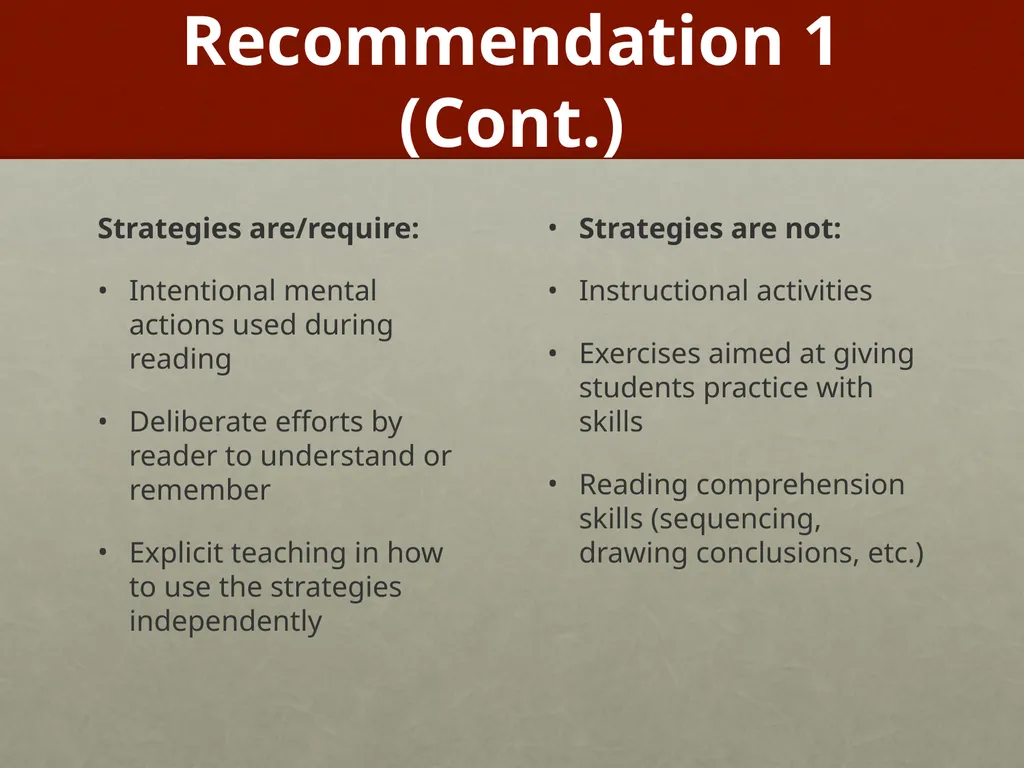
Recommendation 1 (Cont.) Strategies are/require:
Intentional mental actions used during reading
Deliberate efforts by reader to understand or remember
Explicit teaching in how to use the strategies independently Strategies are not:
Instructional activities
Exercises aimed at giving students practice with skills
Reading comprehension skills (sequencing, drawing conclusions, etc.)<br>
Intentional mental actions used during reading
Deliberate efforts by reader to understand or remember
Explicit teaching in how to use the strategies independently Strategies are not:
Instructional activities
Exercises aimed at giving students practice with skills
Reading comprehension skills (sequencing, drawing conclusions, etc.)<br>
16
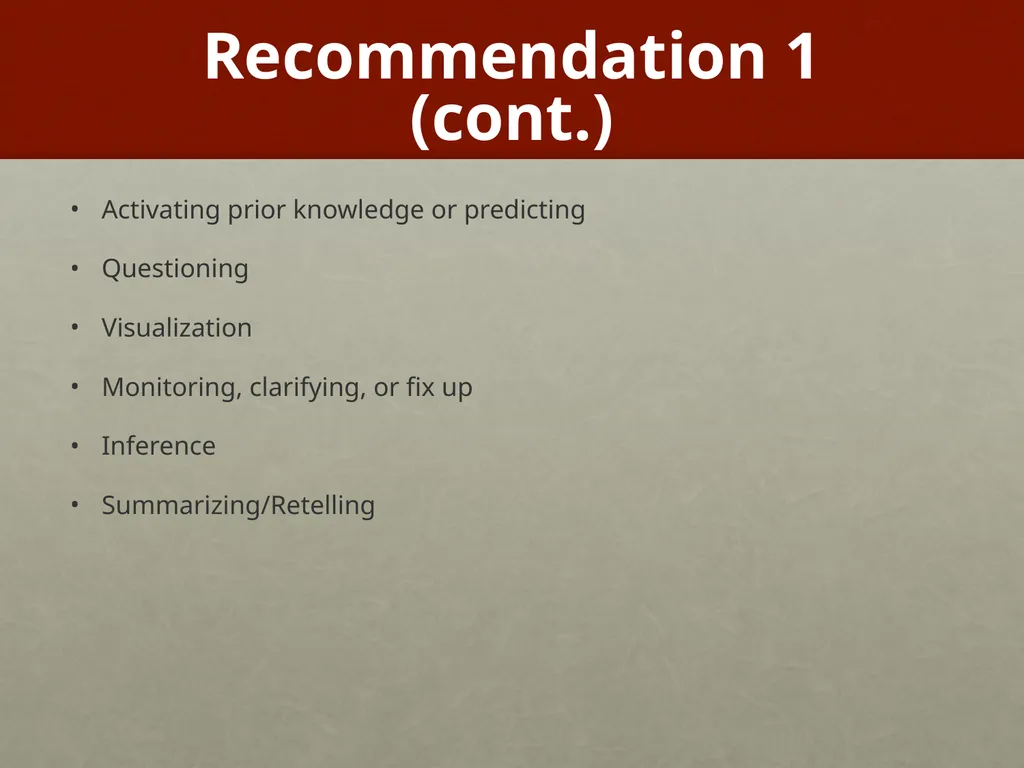
Recommendation 1 (cont.) Activating prior knowledge or predicting
Questioning
Visualization
Monitoring, clarifying, or fix up
Inference
Summarizing/Retelling<br>
Questioning
Visualization
Monitoring, clarifying, or fix up
Inference
Summarizing/Retelling<br>
17
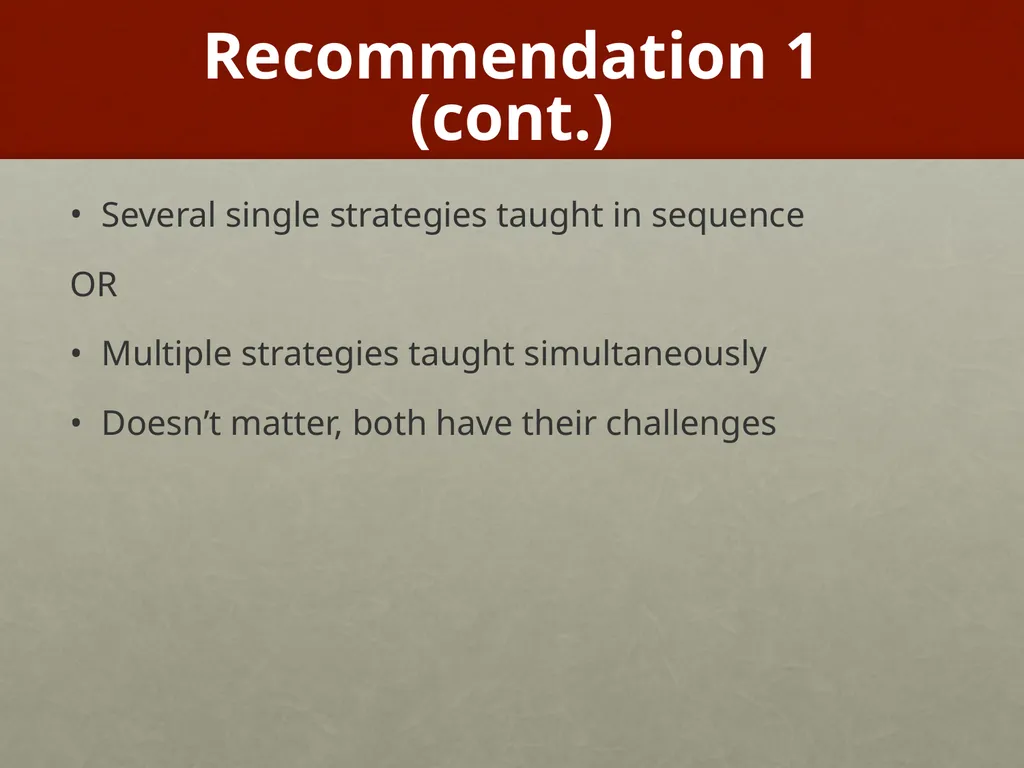
Recommendation 1 (cont.) Several single strategies taught in sequence
OR
Multiple strategies taught simultaneously
Doesn’t matter, both have their challenges<br>
OR
Multiple strategies taught simultaneously
Doesn’t matter, both have their challenges<br>
18
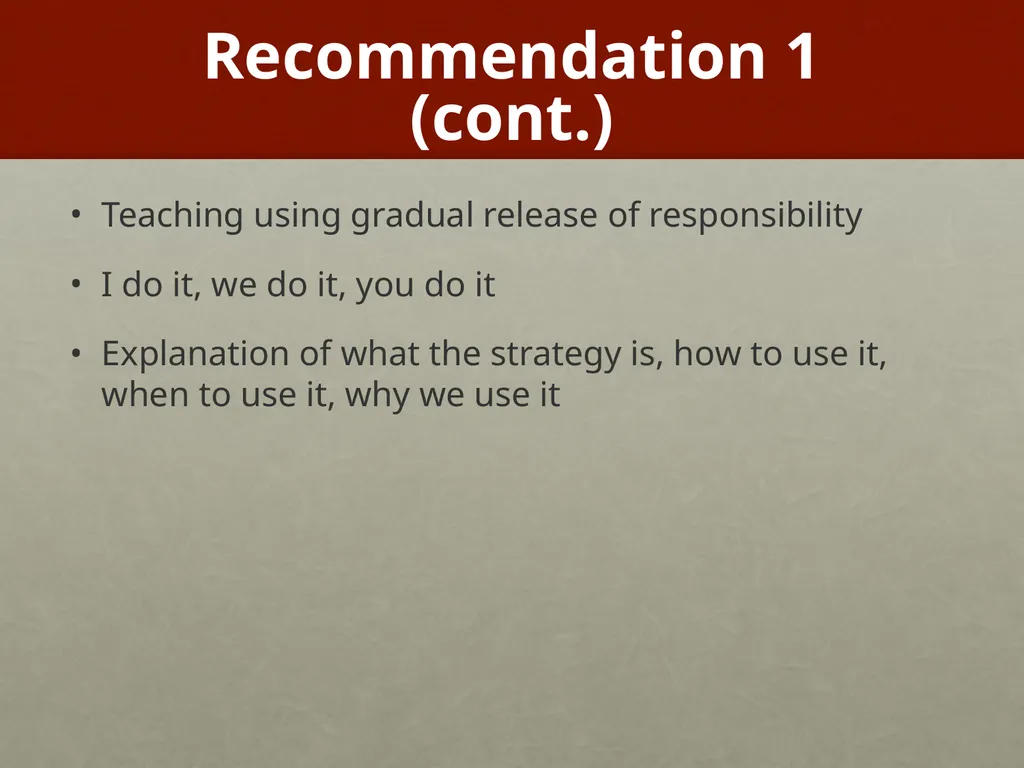
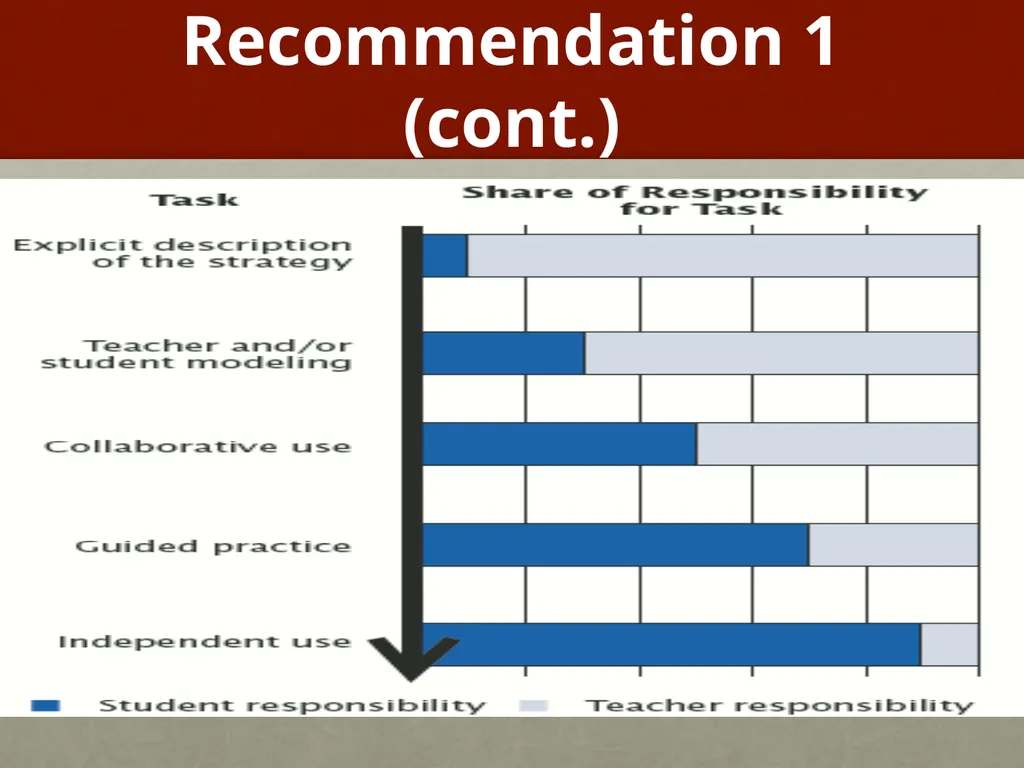
Recommendation 1 (cont.) Teaching using gradual release of responsibility
I do it, we do it, you do it
Explanation of what the strategy is, how to use it, when to use it, why we use it<br>
I do it, we do it, you do it
Explanation of what the strategy is, how to use it, when to use it, why we use it<br>
19
Recommendation 1 (cont.)<br>
20
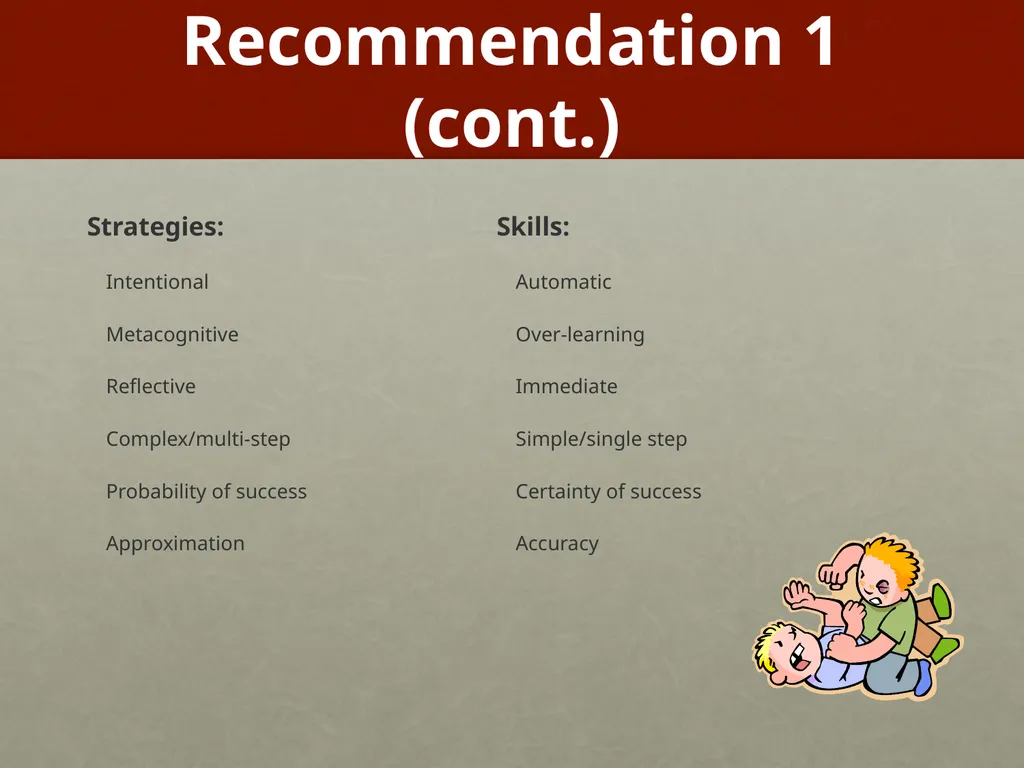
Recommendation 1 (cont.) Strategies:
Intentional
Metacognitive
Reflective
Complex/multi-step
Probability of success
Approximation Skills:
Automatic
Over-learning
Immediate
Simple/single step
Certainty of success
Accuracy<br>
Intentional
Metacognitive
Reflective
Complex/multi-step
Probability of success
Approximation Skills:
Automatic
Over-learning
Immediate
Simple/single step
Certainty of success
Accuracy<br>
21
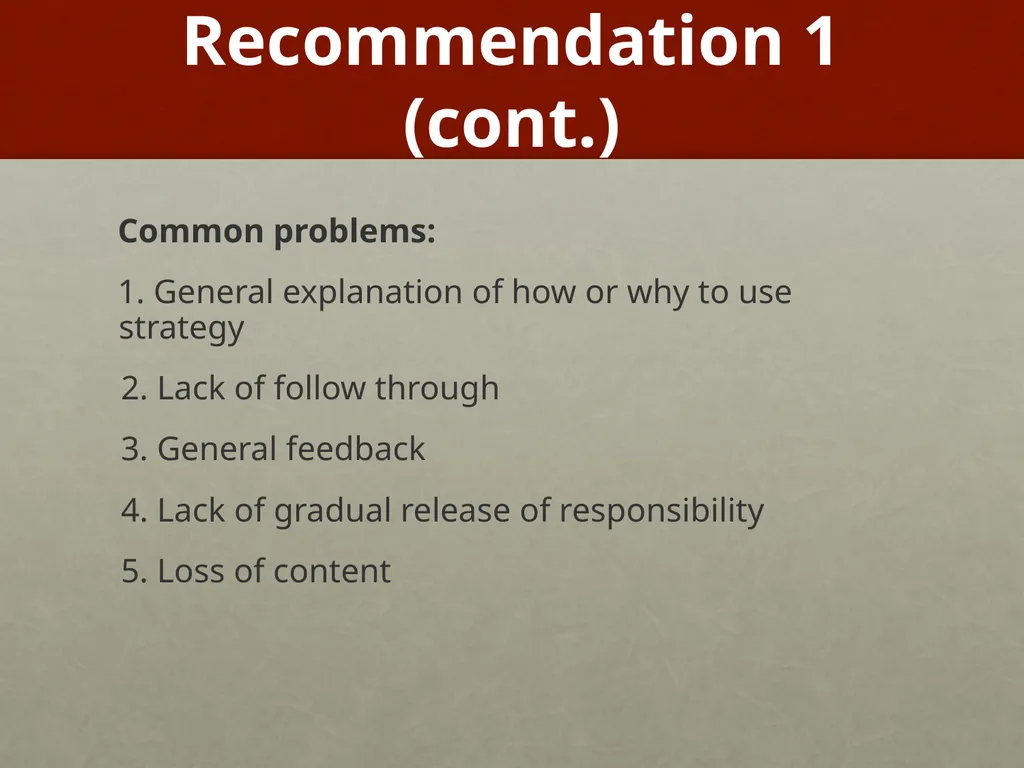
Recommendation 1 (cont.) Common problems:
1. General explanation of how or why to use strategy
2. Lack of follow through
3. General feedback
4. Lack of gradual release of responsibility
5. Loss of content<br>
1. General explanation of how or why to use strategy
2. Lack of follow through
3. General feedback
4. Lack of gradual release of responsibility
5. Loss of content<br>
22
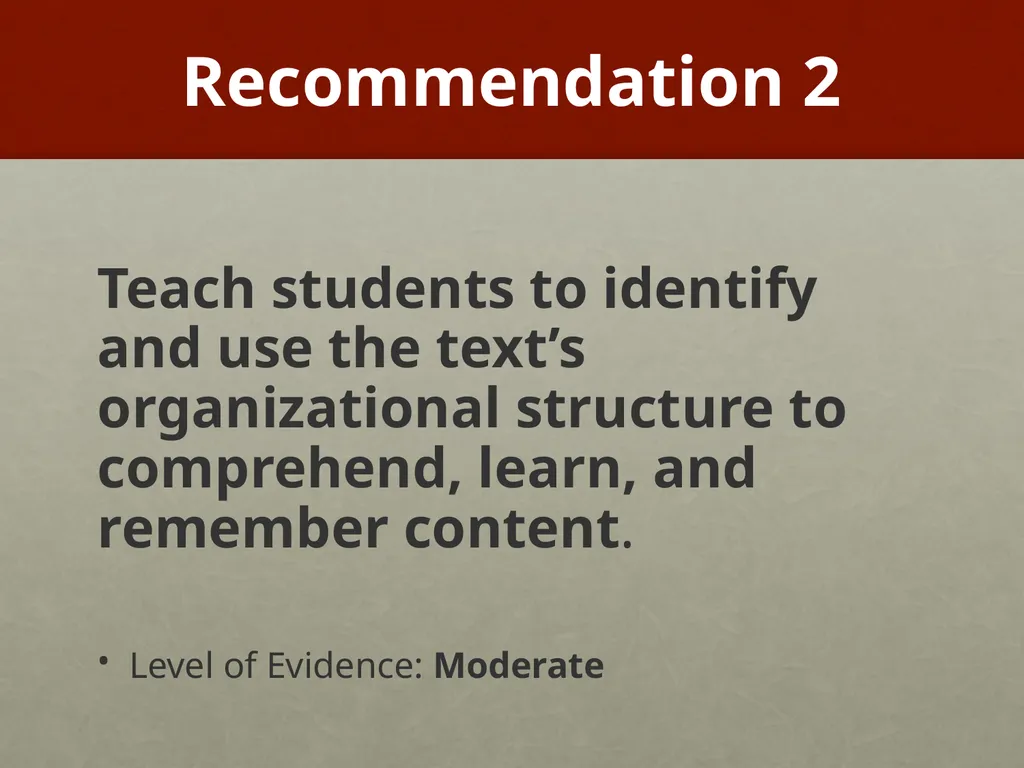
Recommendation 2 Teach students to identify and use the text’s organizational structure to comprehend, learn, and remember content.
Level of Evidence: Moderate<br>
Level of Evidence: Moderate<br>
23
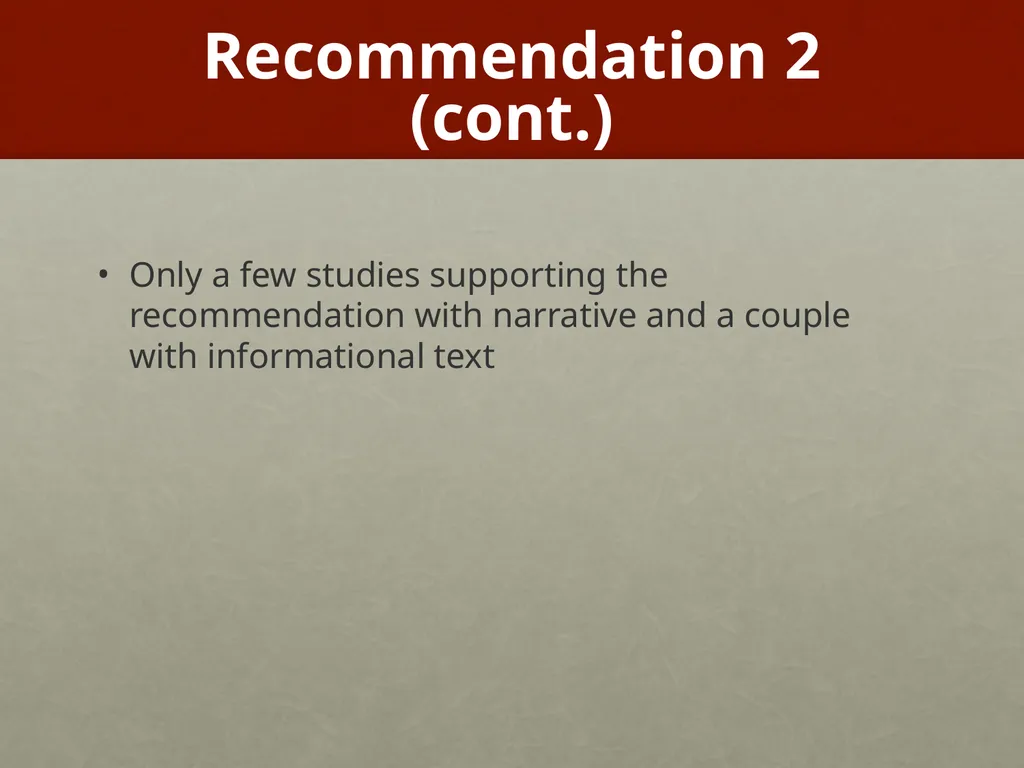
Recommendation 2 (cont.) Only a few studies supporting the recommendation with narrative and a couple with informational text<br>
24
Recommendation 2 (Cont.) Authors organize texts in particular ways
We can teach students to recognize how a text is organized and to use this organization to think about and remember the text<br>
We can teach students to recognize how a text is organized and to use this organization to think about and remember the text<br>
25
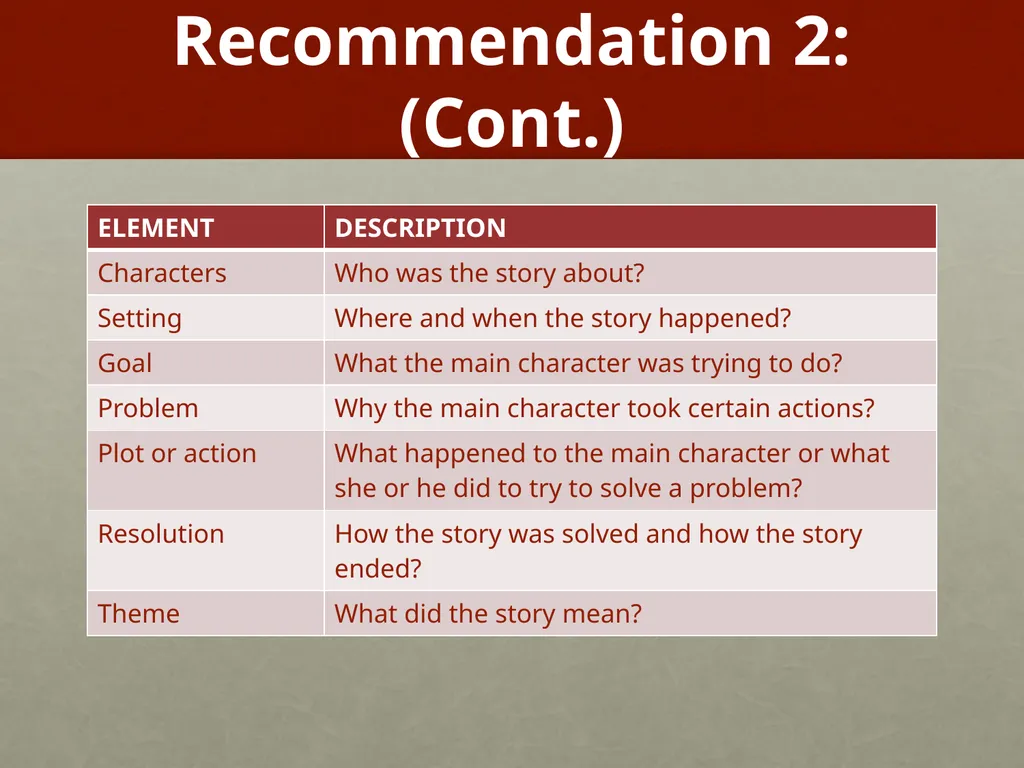
Recommendation 2 (CONT.) Children can be taught to think about how stories are organized
Narrative structure is fairly consistent<br>
Narrative structure is fairly consistent<br>
26
Recommendation 2: (Cont.)<br>
27
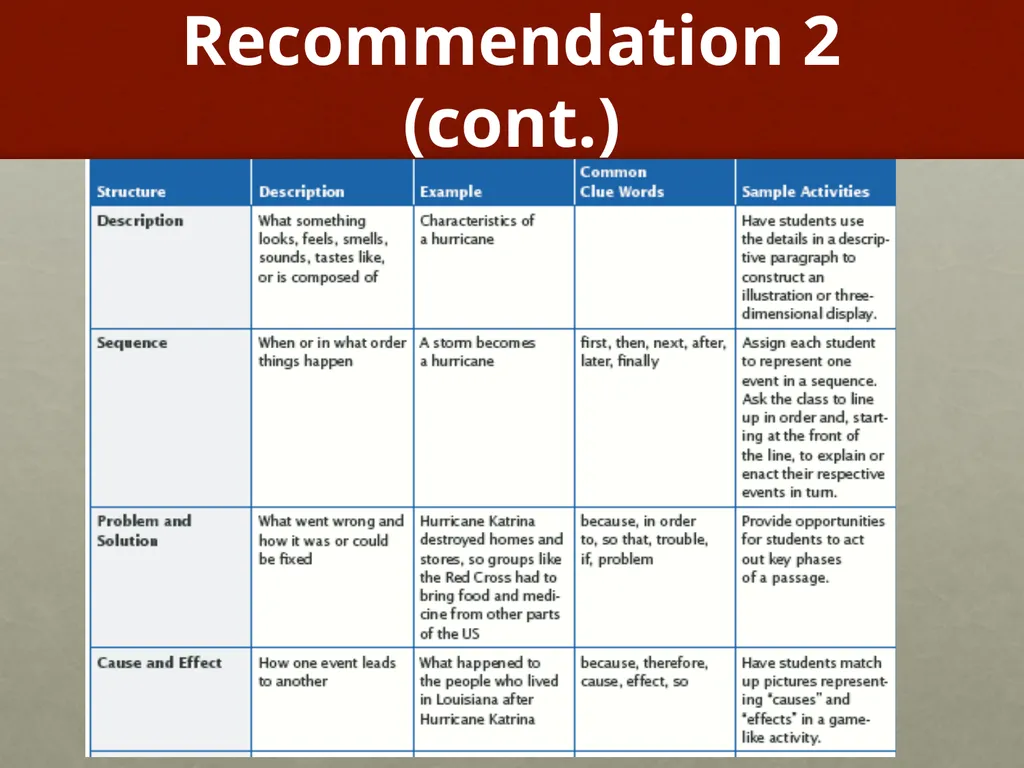
Recommendation 2 (CONT.) Children can be taught to think about common structures of informational texts.
These are less consistent than narrative structures and can be presented in combination<br>
These are less consistent than narrative structures and can be presented in combination<br>
28
Recommendation 2 (cont.)<br>
29
Recommendation 2 (CONT.) http://dww.ed.gov/Reading-Comprehension/Focus-on-Text-Structure/see/index.cfm?T_ID=36&P_ID=98&c1=2073#cluster-1<br>
30
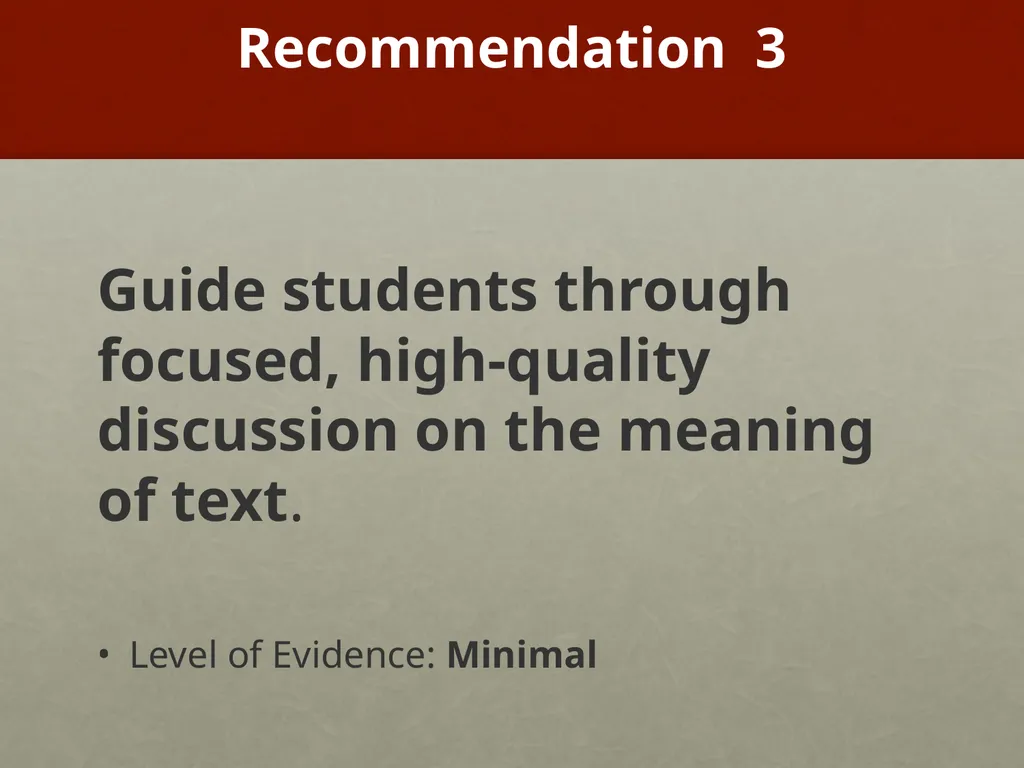
Recommendation 3 Guide students through focused, high-quality discussion on the meaning of text.
Level of Evidence: Minimal<br>
Level of Evidence: Minimal<br>
31
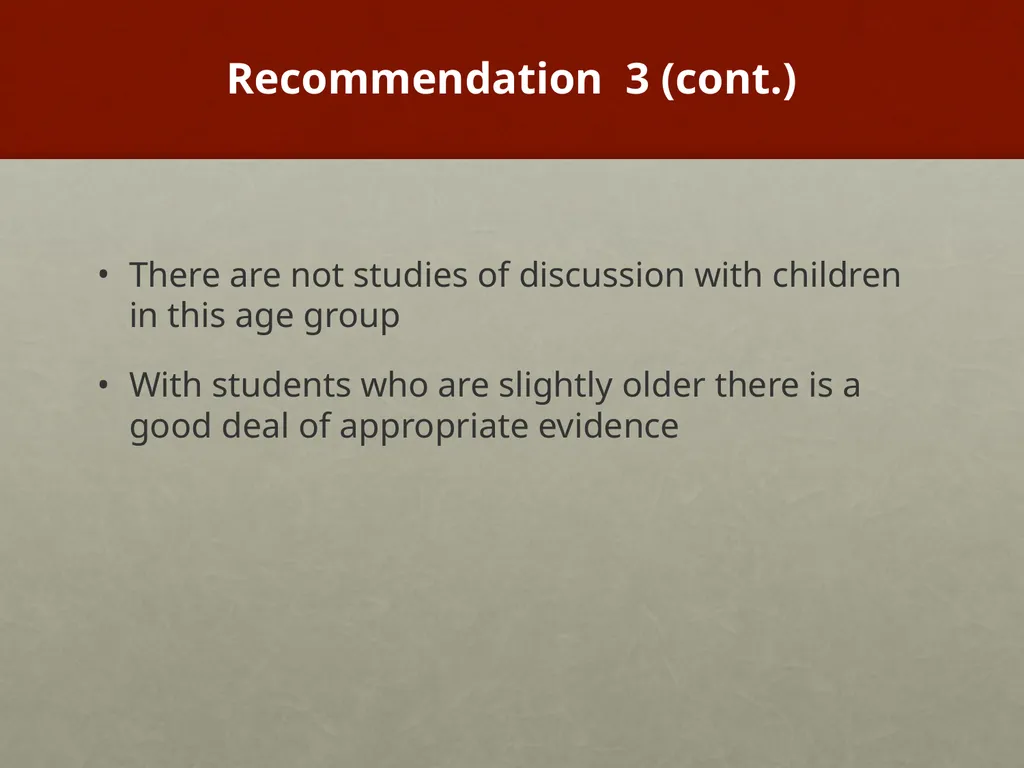
Recommendation 3 (cont.) There are not studies of discussion with children in this age group
With students who are slightly older there is a good deal of appropriate evidence<br>
With students who are slightly older there is a good deal of appropriate evidence<br>
32
Recommendation 3
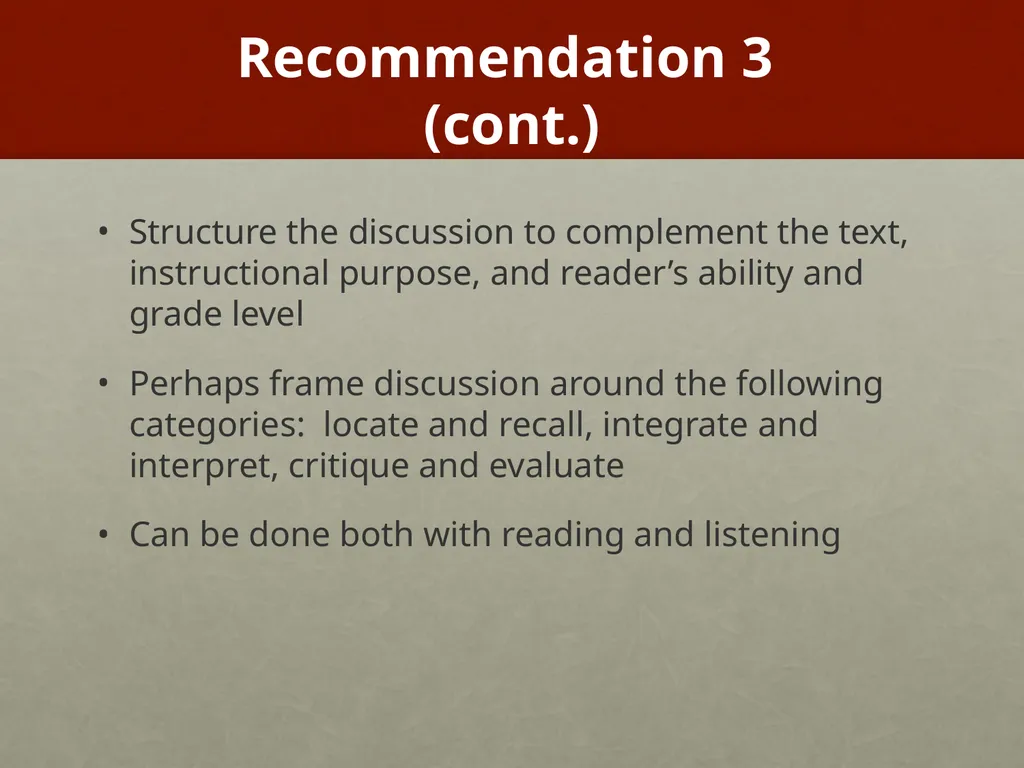
(cont.) Structure the discussion to complement the text, instructional purpose, and reader’s ability and grade level
Perhaps frame discussion around the following categories: locate and recall, integrate and interpret, critique and evaluate
Can be done both with reading and listening<br>
Perhaps frame discussion around the following categories: locate and recall, integrate and interpret, critique and evaluate
Can be done both with reading and listening<br>
33
Recommendation 3
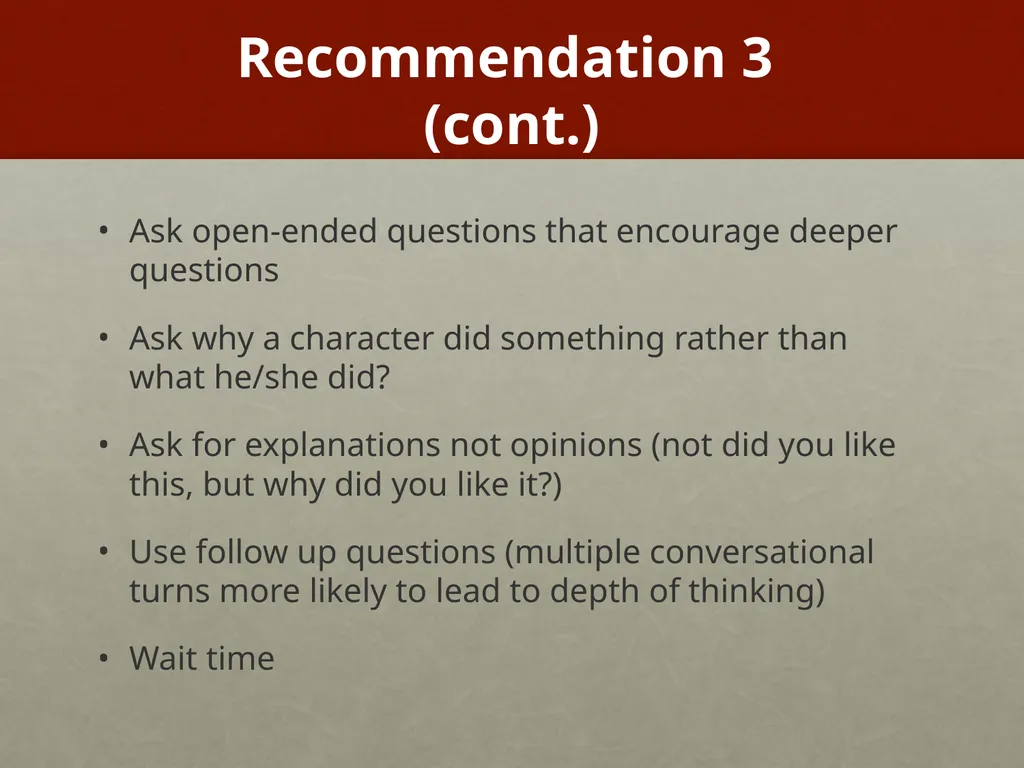
(cont.) Ask open-ended questions that encourage deeper questions
Ask why a character did something rather than what he/she did?
Ask for explanations not opinions (not did you like this, but why did you like it?)
Use follow up questions (multiple conversational turns more likely to lead to depth of thinking)
Wait time<br>
Ask why a character did something rather than what he/she did?
Ask for explanations not opinions (not did you like this, but why did you like it?)
Use follow up questions (multiple conversational turns more likely to lead to depth of thinking)
Wait time<br>
34
Recommendation 3
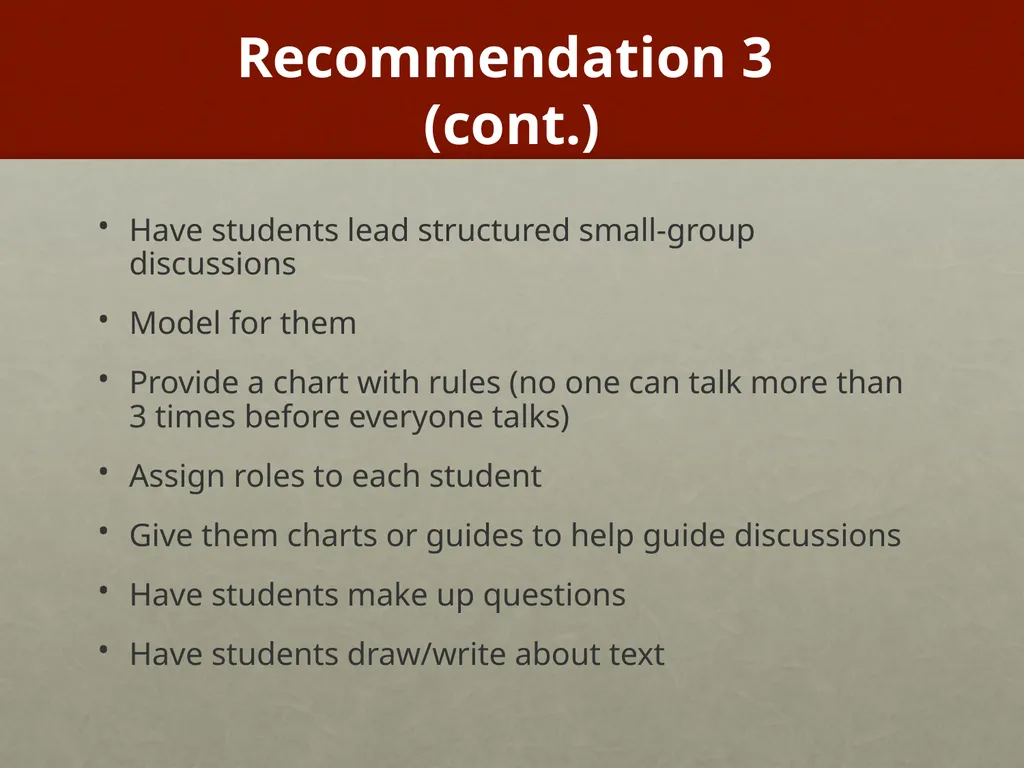
(cont.) Have students lead structured small-group discussions
Model for them
Provide a chart with rules (no one can talk more than 3 times before everyone talks)
Assign roles to each student
Give them charts or guides to help guide discussions
Have students make up questions
Have students draw/write about text<br>
Model for them
Provide a chart with rules (no one can talk more than 3 times before everyone talks)
Assign roles to each student
Give them charts or guides to help guide discussions
Have students make up questions
Have students draw/write about text<br>
35
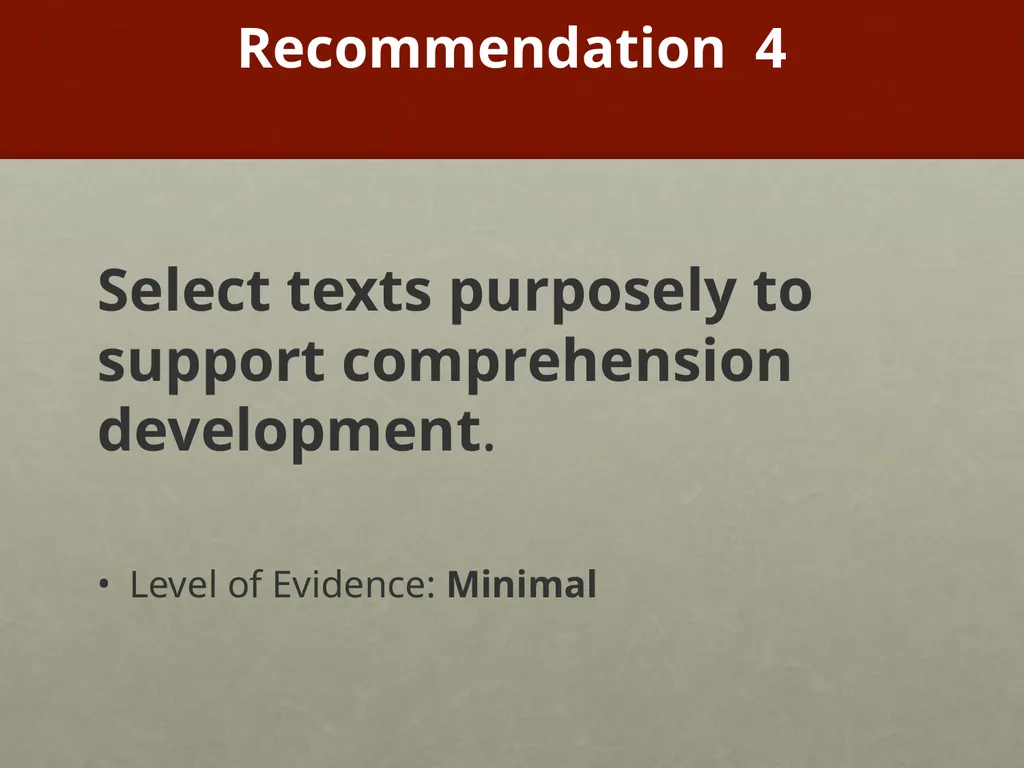
Recommendation 4 Select texts purposely to support comprehension development.
Level of Evidence: Minimal<br>
Level of Evidence: Minimal<br>
36
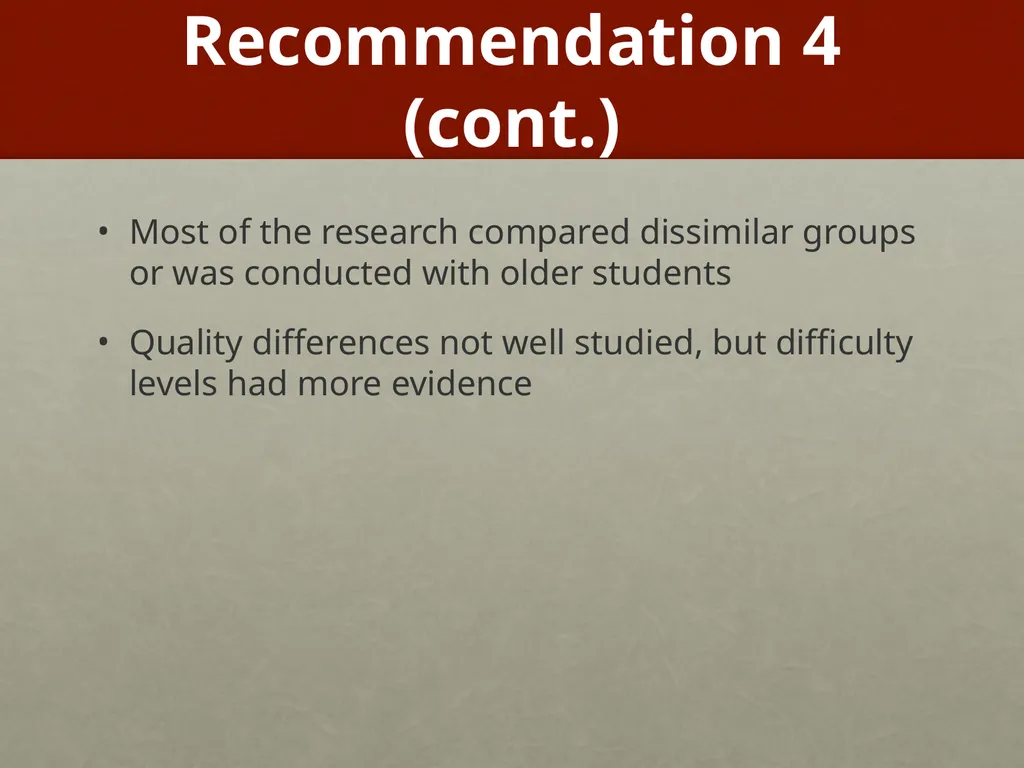
Recommendation 4 (cont.) Most of the research compared dissimilar groups or was conducted with older students
Quality differences not well studied, but difficulty levels had more evidence<br>
Quality differences not well studied, but difficulty levels had more evidence<br>
37
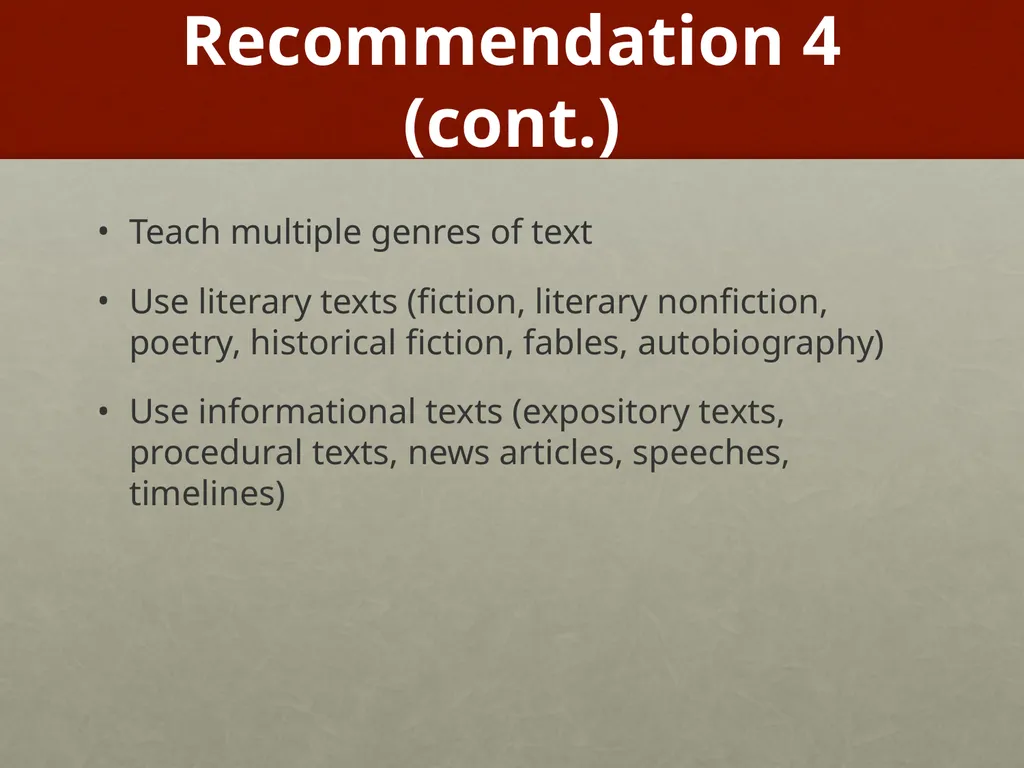
Recommendation 4 (cont.) Teach multiple genres of text
Use literary texts (fiction, literary nonfiction, poetry, historical fiction, fables, autobiography)
Use informational texts (expository texts, procedural texts, news articles, speeches, timelines)<br>
Use literary texts (fiction, literary nonfiction, poetry, historical fiction, fables, autobiography)
Use informational texts (expository texts, procedural texts, news articles, speeches, timelines)<br>
38
Recommendation 4 (cont.) http://dww.ed.gov/Reading-Comprehension/Teach-Comprehension-Strategies/learn/?T_ID=36&P_ID=97&intID=2099&t=1#learn<br>
39
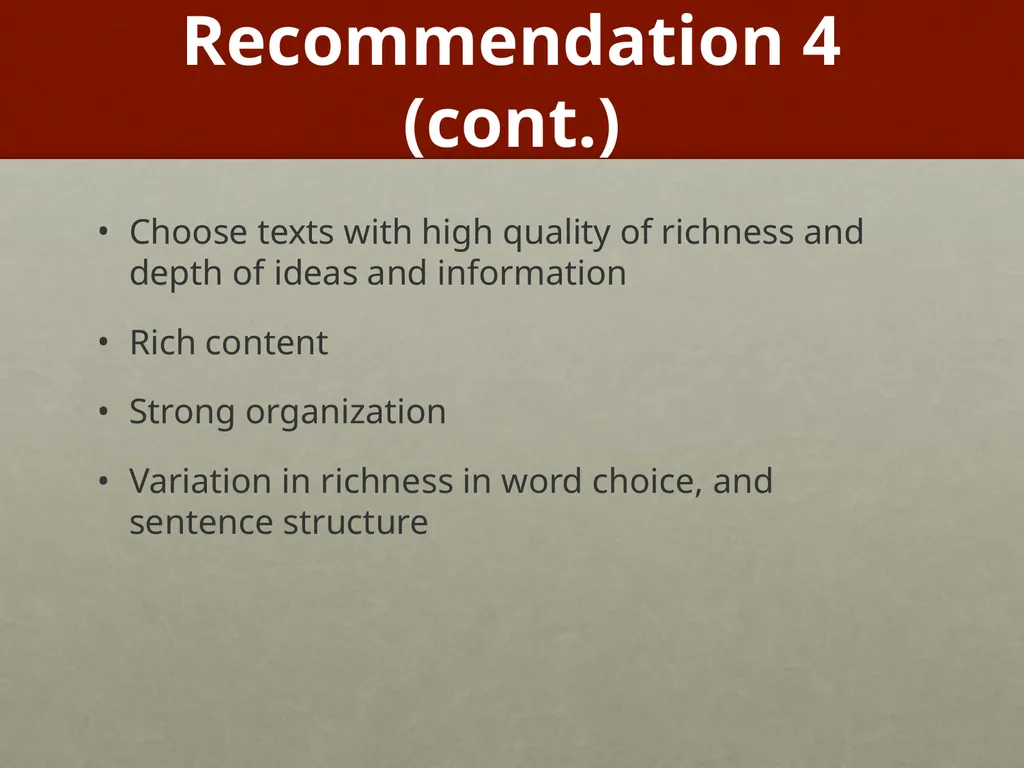
Recommendation 4 (cont.) Choose texts with high quality of richness and depth of ideas and information
Rich content
Strong organization
Variation in richness in word choice, and sentence structure<br>
Rich content
Strong organization
Variation in richness in word choice, and sentence structure<br>
40
Recommenation 4
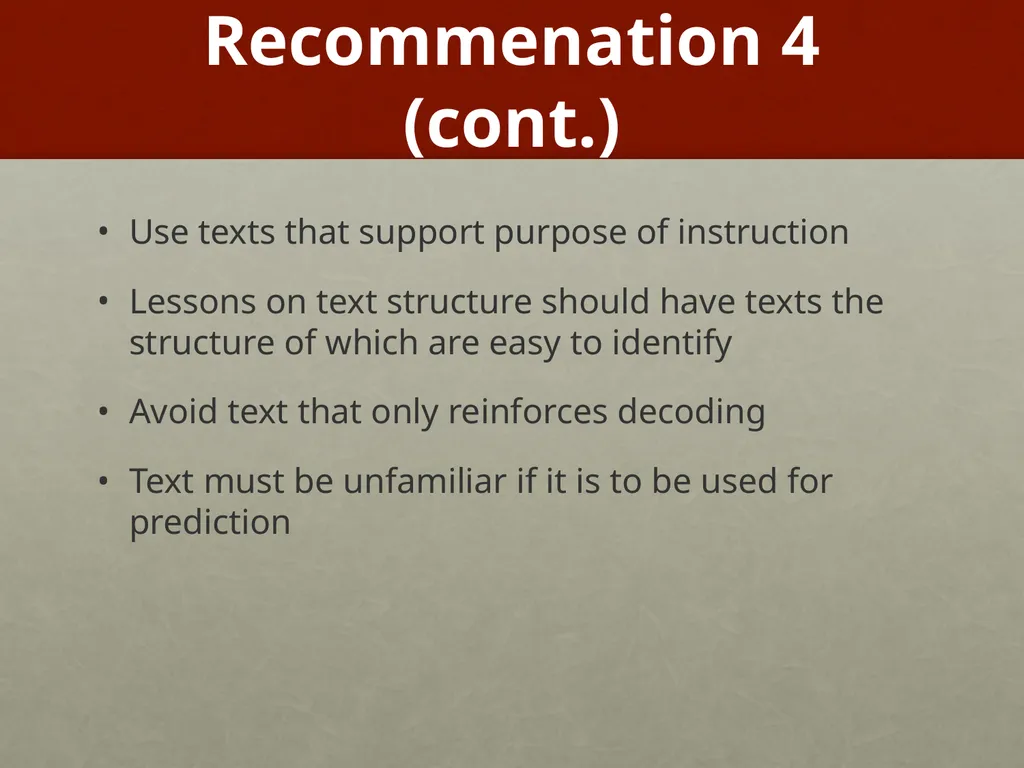
(cont.) Use texts that support purpose of instruction
Lessons on text structure should have texts the structure of which are easy to identify
Avoid text that only reinforces decoding
Text must be unfamiliar if it is to be used for prediction<br>
Lessons on text structure should have texts the structure of which are easy to identify
Avoid text that only reinforces decoding
Text must be unfamiliar if it is to be used for prediction<br>
41
Recommenation 4
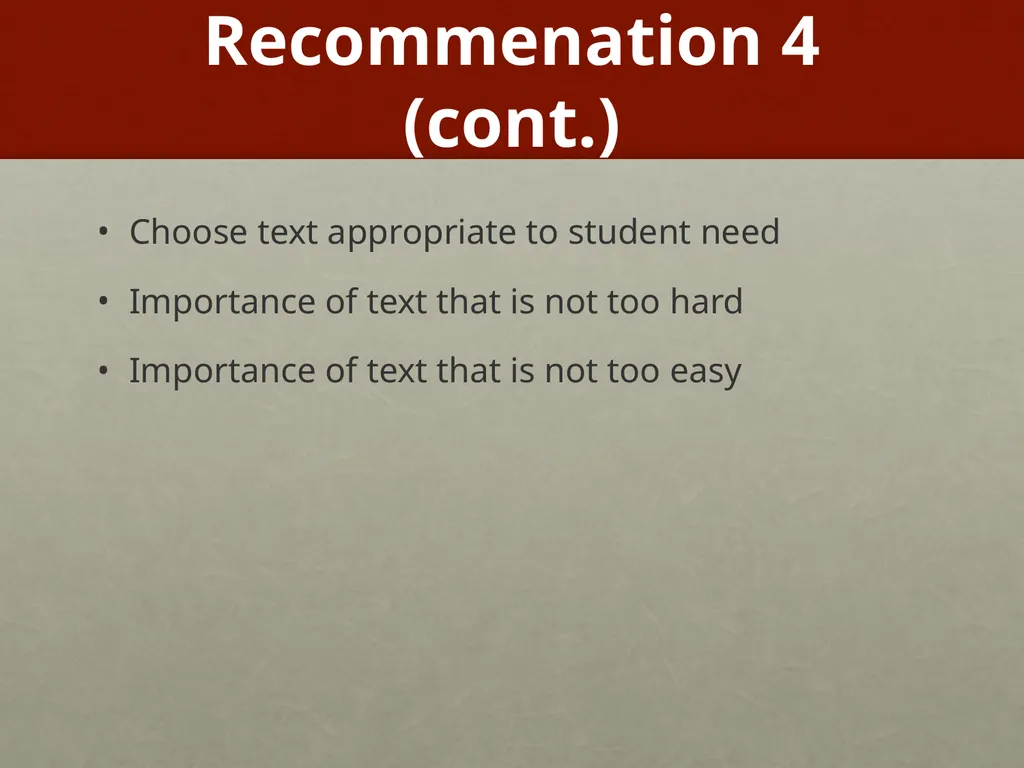
(cont.) Choose text appropriate to student need
Importance of text that is not too hard
Importance of text that is not too easy<br>
Importance of text that is not too hard
Importance of text that is not too easy<br>
42
Recommendation 5 Establish an engaging and motivating context in which to teach reading comprehension.
Level of Evidence: Moderate<br>
Level of Evidence: Moderate<br>
43
Recommendation 5
(cont.) Evidence for some approaches were strong
Motivation rarely studied on its own<br>
Motivation rarely studied on its own<br>
44
Recommendation 5
(cont.) http://dww.ed.gov/Reading-Comprehension/Engage-Students-With-Text/learn/?T_ID=36&P_ID=99<br>
45
Recommendation 5
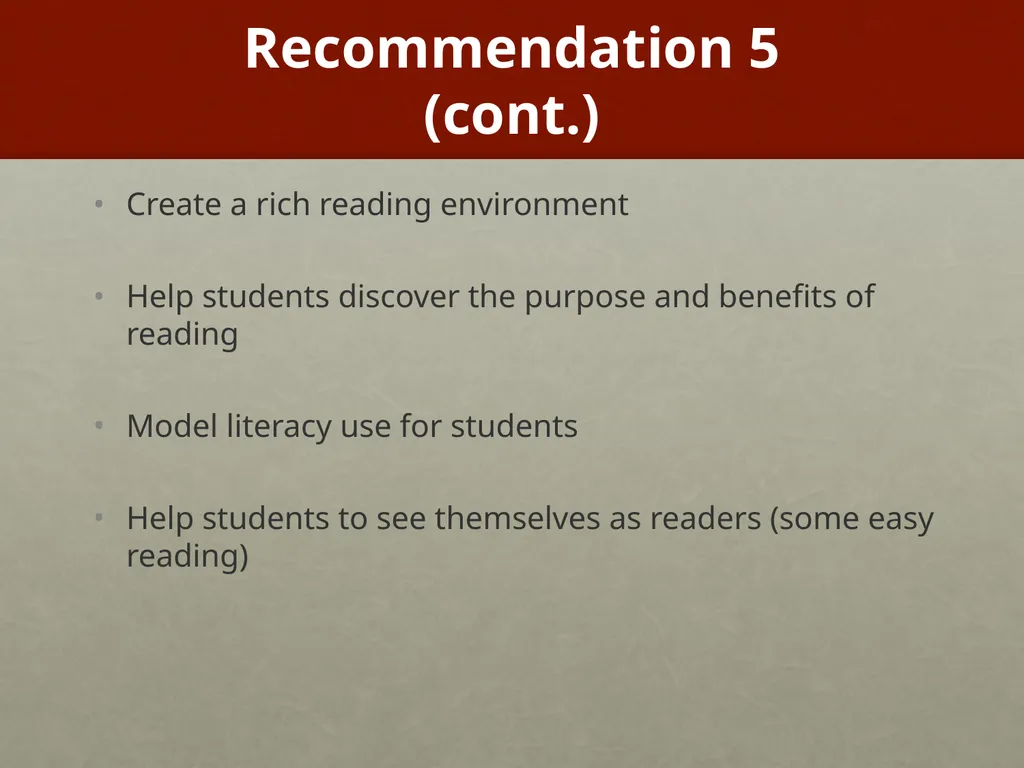
(cont.) Create a rich reading environment
Help students discover the purpose and benefits of reading
Model literacy use for students
Help students to see themselves as readers (some easy reading)<br>
Help students discover the purpose and benefits of reading
Model literacy use for students
Help students to see themselves as readers (some easy reading)<br>
46
Recommendation 5
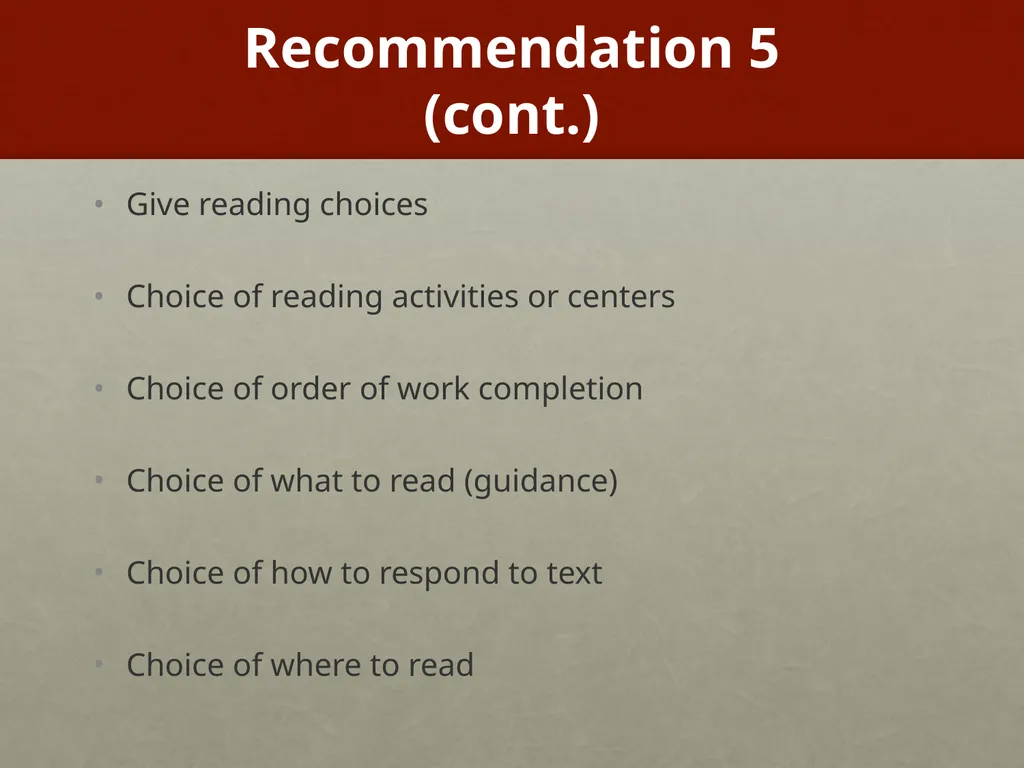
(cont.) Give reading choices
Choice of reading activities or centers
Choice of order of work completion
Choice of what to read (guidance)
Choice of how to respond to text
Choice of where to read<br>
Choice of reading activities or centers
Choice of order of work completion
Choice of what to read (guidance)
Choice of how to respond to text
Choice of where to read<br>
47
Recommendation 5
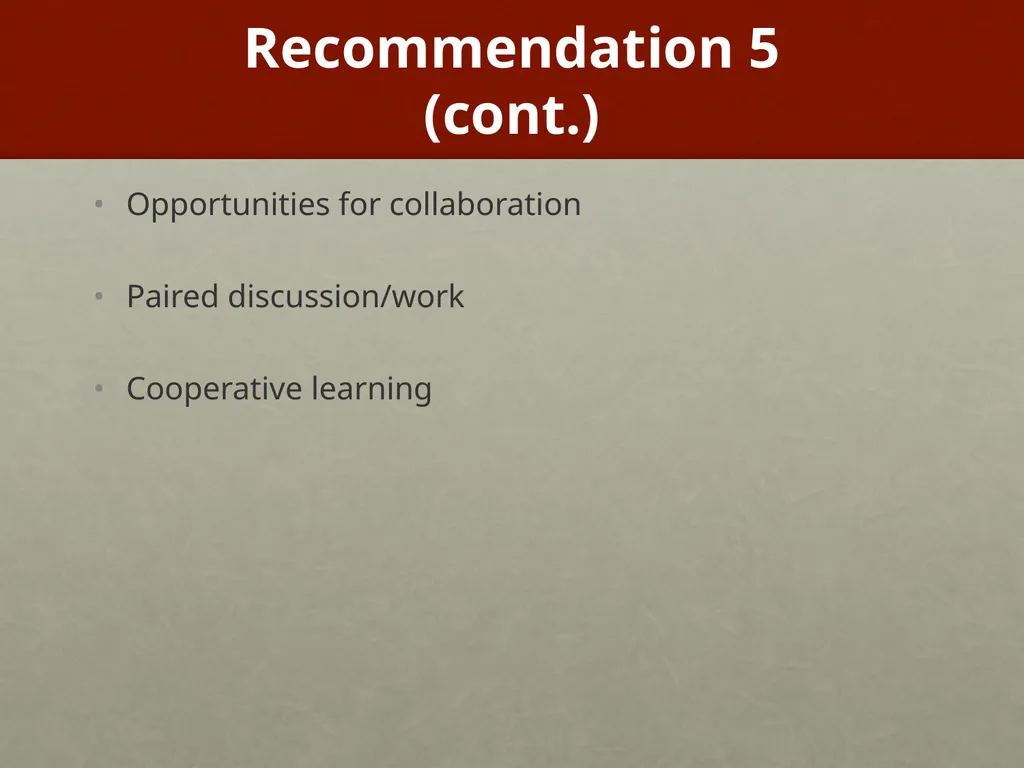
(cont.) Opportunities for collaboration
Paired discussion/work
Cooperative learning<br>
Paired discussion/work
Cooperative learning<br>
48
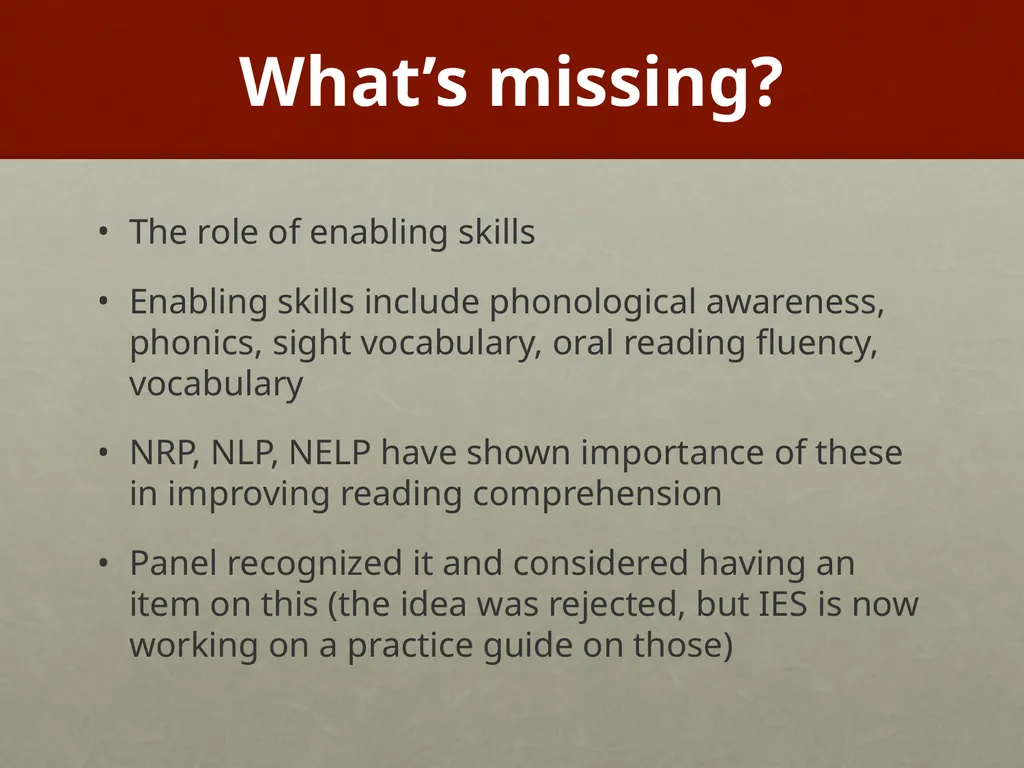
What’s missing? The role of enabling skills
Enabling skills include phonological awareness, phonics, sight vocabulary, oral reading fluency, vocabulary
NRP, NLP, NELP have shown importance of these in improving reading comprehension
Panel recognized it and considered having an item on this (the idea was rejected, but IES is now working on a practice guide on those)<br>
Enabling skills include phonological awareness, phonics, sight vocabulary, oral reading fluency, vocabulary
NRP, NLP, NELP have shown importance of these in improving reading comprehension
Panel recognized it and considered having an item on this (the idea was rejected, but IES is now working on a practice guide on those)<br>
49
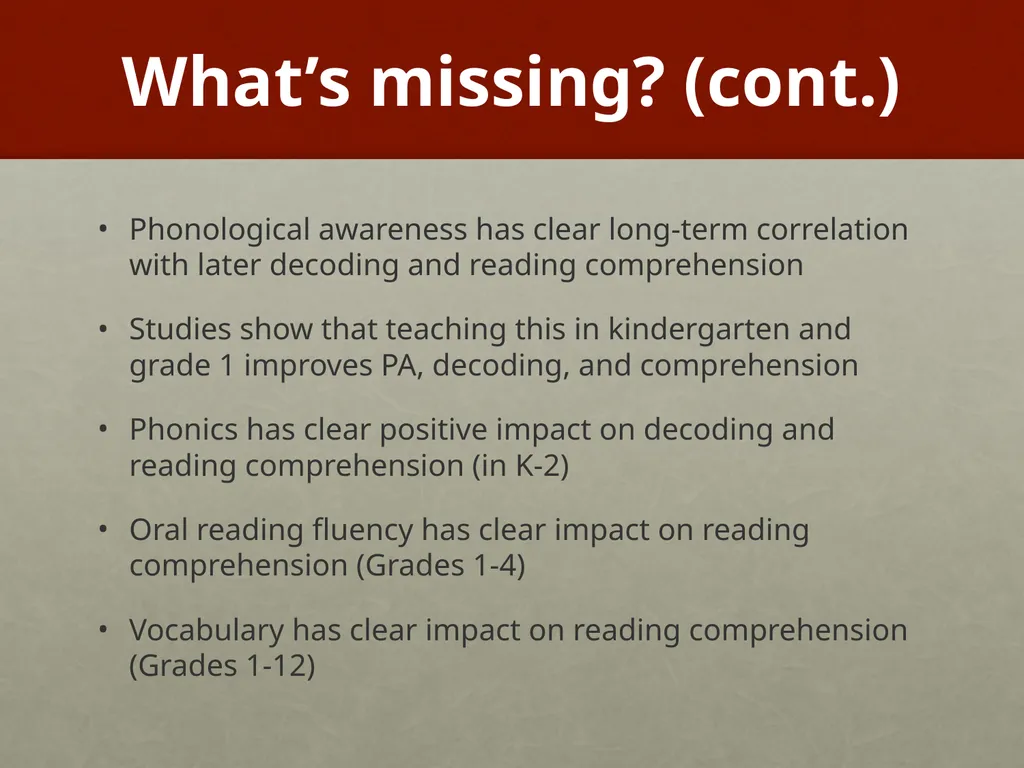
What’s missing? (cont.) Phonological awareness has clear long-term correlation with later decoding and reading comprehension
Studies show that teaching this in kindergarten and grade 1 improves PA, decoding, and comprehension
Phonics has clear positive impact on decoding and reading comprehension (in K-2)
Oral reading fluency has clear impact on reading comprehension (Grades 1-4)
Vocabulary has clear impact on reading comprehension (Grades 1-12)<br>
Studies show that teaching this in kindergarten and grade 1 improves PA, decoding, and comprehension
Phonics has clear positive impact on decoding and reading comprehension (in K-2)
Oral reading fluency has clear impact on reading comprehension (Grades 1-4)
Vocabulary has clear impact on reading comprehension (Grades 1-12)<br>
50
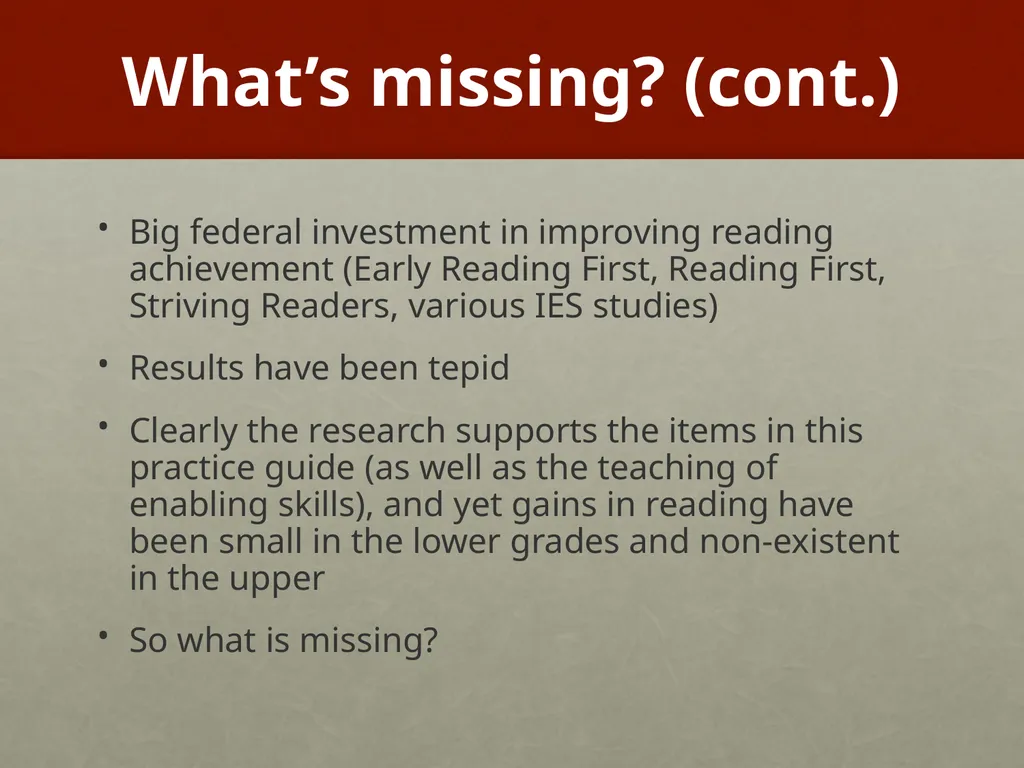
What’s missing? (cont.) Big federal investment in improving reading achievement (Early Reading First, Reading First, Striving Readers, various IES studies)
Results have been tepid
Clearly the research supports the items in this practice guide (as well as the teaching of enabling skills), and yet gains in reading have been small in the lower grades and non-existent in the upper
So what is missing?<br>
Results have been tepid
Clearly the research supports the items in this practice guide (as well as the teaching of enabling skills), and yet gains in reading have been small in the lower grades and non-existent in the upper
So what is missing?<br>
51
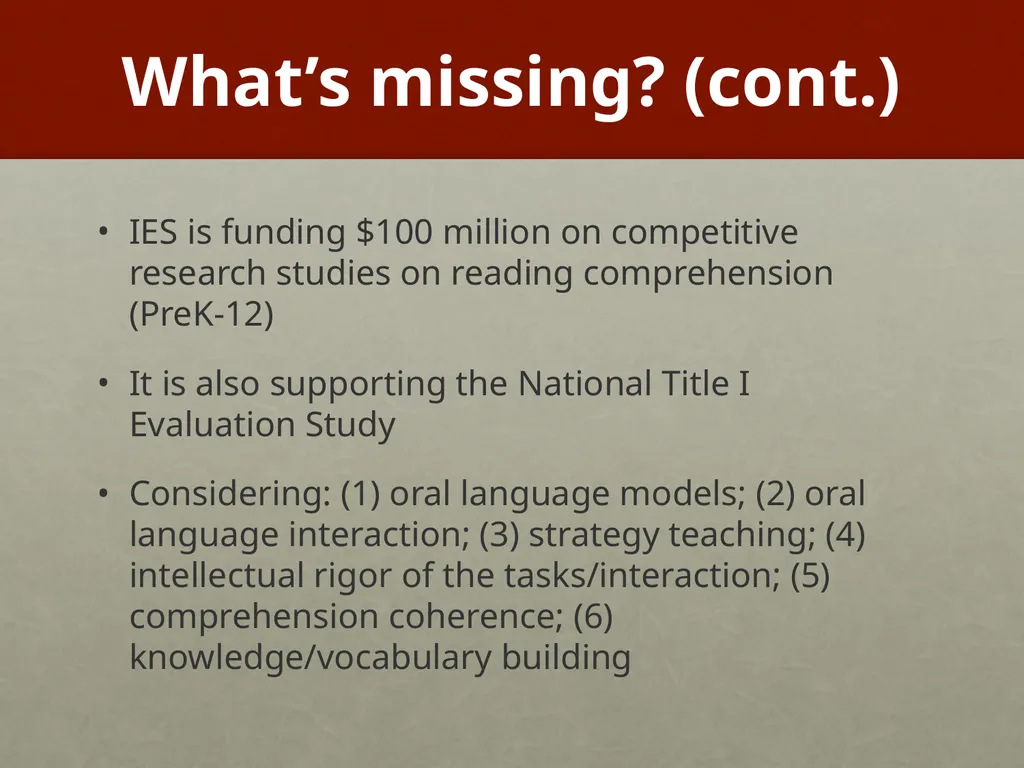
What’s missing? (cont.) IES is funding $100 million on competitive research studies on reading comprehension (PreK-12)
It is also supporting the National Title I Evaluation Study
Considering: (1) oral language models; (2) oral language interaction; (3) strategy teaching; (4) intellectual rigor of the tasks/interaction; (5) comprehension coherence; (6) knowledge/vocabulary building<br>
It is also supporting the National Title I Evaluation Study
Considering: (1) oral language models; (2) oral language interaction; (3) strategy teaching; (4) intellectual rigor of the tasks/interaction; (5) comprehension coherence; (6) knowledge/vocabulary building<br>
52
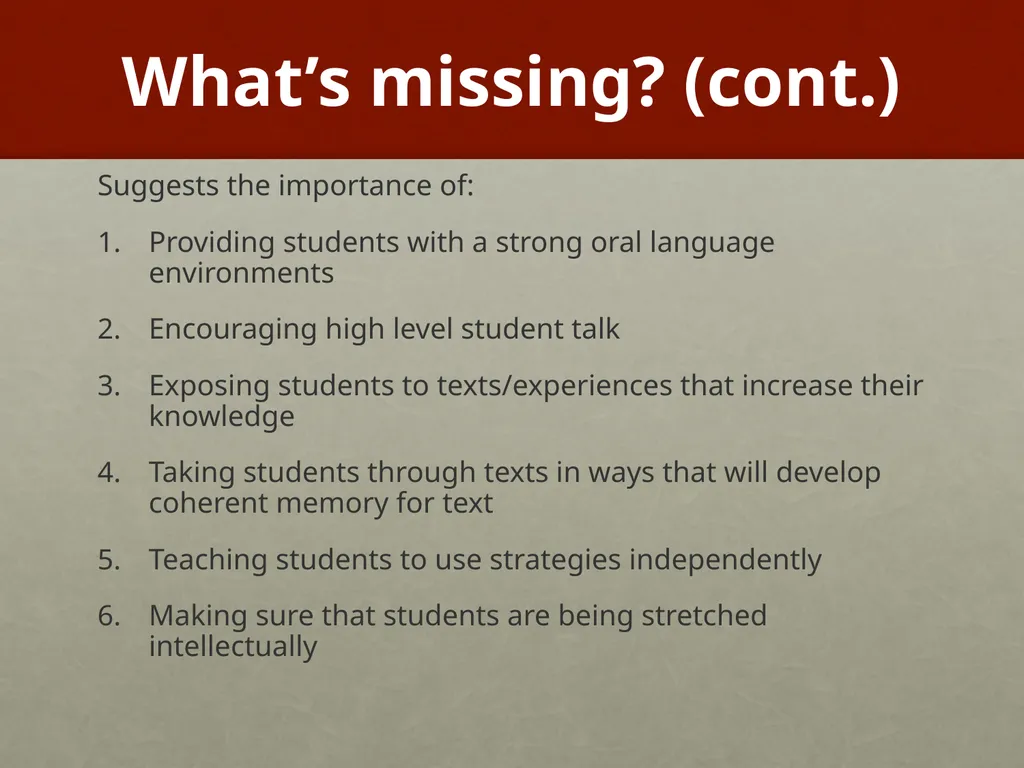
What’s missing? (cont.) Suggests the importance of:
Providing students with a strong oral language environments
Encouraging high level student talk
Exposing students to texts/experiences that increase their knowledge
Taking students through texts in ways that will develop coherent memory for text
Teaching students to use strategies independently
Making sure that students are being stretched intellectually<br>
Providing students with a strong oral language environments
Encouraging high level student talk
Exposing students to texts/experiences that increase their knowledge
Taking students through texts in ways that will develop coherent memory for text
Teaching students to use strategies independently
Making sure that students are being stretched intellectually<br>
53
WWC Practice Guide Shanahan, T., Callison, K., Carriere, C., Duke, N. K., Pearson, P. D., Schatschneider, C., & Torgesen, J. (2010). Improving reading comprehension in kindergarten through 3rd grade: A practice guide (NCEE 2010-4038). Washington, DC: National Center for Education Evaluation and Regional Assistance, Institute of Education Sciences, U.S. Department of Education. Retrieved from whatworks.ed.gov/publications/practiceguides<br>
54
Improving Reading Comprehension K-3 Timothy Shanahan
University of Illinois at Chicago
www.shanahanonliteracy.com<br>
University of Illinois at Chicago
www.shanahanonliteracy.com<br>