
Infectious and epidemiological diseases Assistant.
MJ
Published · 22 slides · 0 views

1 / 1


Description
Infectious and epidemiological diseases Assistant. Prof. Dr. Mohammed Mijbas Mohammed 2020-2021 Diseases Infectious Non-Infectious Introduction to infectious disease Infections are series of reaction that occur within the host by invaders
Related Topics
Share
Embed code
Download this presentation From Below
"Infectious and epidemiological diseases Assistant." is the property of its rightful owner. Permission is granted to download and print the materials on this website for personal, non-commercial use only, and to display it on your personal computer provided you do not modify the materials and that you retain all copyright notices contained in the materials. By downloading content from our website, you accept the terms of this agreement.
Presentation Transcript
01
Infectious and epidemiological diseases Assistant. Prof. Dr. Mohammed Mijbas Mohammed
2020-2021<br>
2020-2021<br>
02
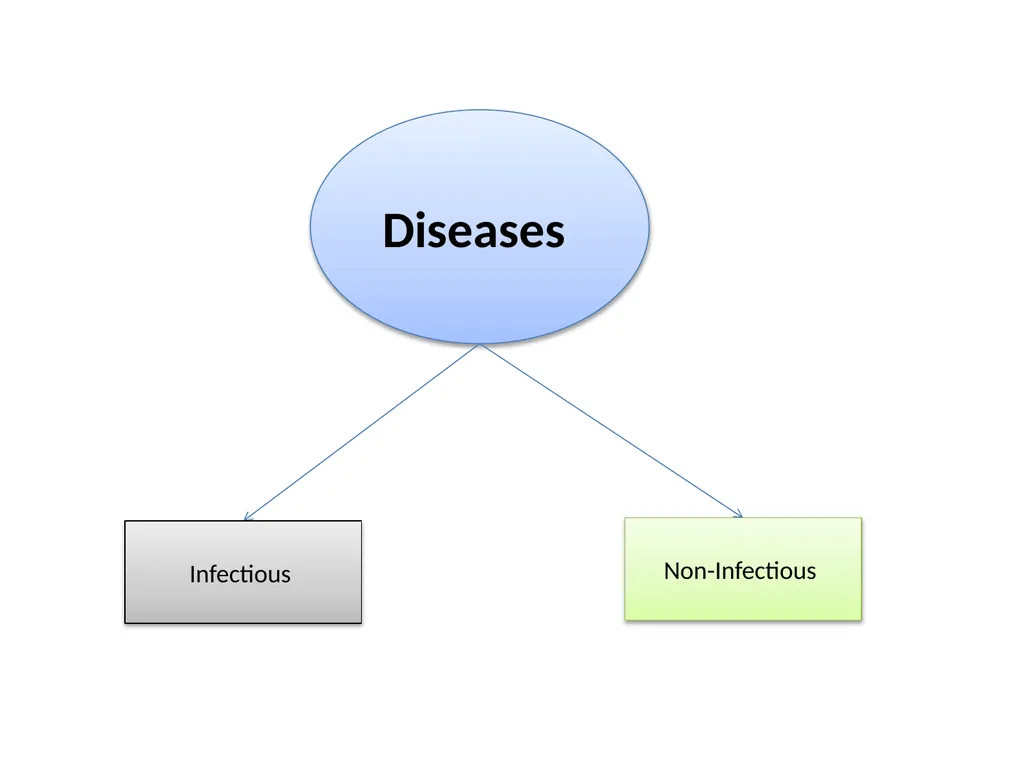
Diseases Infectious Non-Infectious<br>
03
Introduction to infectious disease
Infections are series of reaction that occur within the host by invaders and host defenses of animals,and human. The infections may be Latent due to balance between invaders and host defenses, this type of infections can detected by present of invaders in immunological and biochemical changes of infected animal via special seriological and chemical tests.
The are several factors affect on development of infections
Sensitivity of body to infections.
Environmental conditions.
Virulence of pathogenic agents.
Age, species
Type of pathogens.
Others not listed above.<br>
Infections are series of reaction that occur within the host by invaders and host defenses of animals,and human. The infections may be Latent due to balance between invaders and host defenses, this type of infections can detected by present of invaders in immunological and biochemical changes of infected animal via special seriological and chemical tests.
The are several factors affect on development of infections
Sensitivity of body to infections.
Environmental conditions.
Virulence of pathogenic agents.
Age, species
Type of pathogens.
Others not listed above.<br>
04
The infectious diseases are disorders caused by organisms such as (bacteria, viruses, fungi or parasites). The infectious diseases are a major importance in animals. The infectious diseases are capable of affecting many animals in a short period of time and the case fatality rate in some diseases can be very high and the economic losses may be very large.
Certain infectious diseases, especially the viral diseases, are endemic in some countries and pose a threat to other countries considered to be free of them.
The veterinary profession has made a major contribution in developing reliable diagnostic techniques and effective control procedures for many of these diseases.
Some of the infectious diseases assume major importance because they are directly transmissible to humans.<br>
Certain infectious diseases, especially the viral diseases, are endemic in some countries and pose a threat to other countries considered to be free of them.
The veterinary profession has made a major contribution in developing reliable diagnostic techniques and effective control procedures for many of these diseases.
Some of the infectious diseases assume major importance because they are directly transmissible to humans.<br>
05
REPORTABLE DISEASES (OlE LISTINGS)
A disease that must be reported to federal, state, or local health officials when diagnosed.
Several infectious diseases of livestock have the potential for serious and rapid spread, implications for international trade and/or risk for significant zoonotic disease. Because of the nature of these diseases and the risk to regional or national animal health, their control is beyond the capability of the individual practitioner and requires the intervention of state and possibly national veterinary personnel and organizations. In most countries, diseases of this nature are listed as reportable diseases or notifiable diseases and these must be reported (notified) to the state or national veterinary authority immediately they are diagnosed.
A world organization for animal health, called the Office International des Epizooties (OIE), has been in existence for many years and its major objectives have been the collection, analysis, and dissemination of scientific veterinary information on animal diseases of significant veterinary importance. Member countries have traditionally reported to the OIE, on a regular basis, the occurrence, or absence, of these diseases in their respective countries. The purpose has been to ensure transparency in the global animal disease and zoonotic disease situation, and to provide expertise and encourage international solidarity in the control of animal diseases.<br>
A disease that must be reported to federal, state, or local health officials when diagnosed.
Several infectious diseases of livestock have the potential for serious and rapid spread, implications for international trade and/or risk for significant zoonotic disease. Because of the nature of these diseases and the risk to regional or national animal health, their control is beyond the capability of the individual practitioner and requires the intervention of state and possibly national veterinary personnel and organizations. In most countries, diseases of this nature are listed as reportable diseases or notifiable diseases and these must be reported (notified) to the state or national veterinary authority immediately they are diagnosed.
A world organization for animal health, called the Office International des Epizooties (OIE), has been in existence for many years and its major objectives have been the collection, analysis, and dissemination of scientific veterinary information on animal diseases of significant veterinary importance. Member countries have traditionally reported to the OIE, on a regular basis, the occurrence, or absence, of these diseases in their respective countries. The purpose has been to ensure transparency in the global animal disease and zoonotic disease situation, and to provide expertise and encourage international solidarity in the control of animal diseases.<br>
06
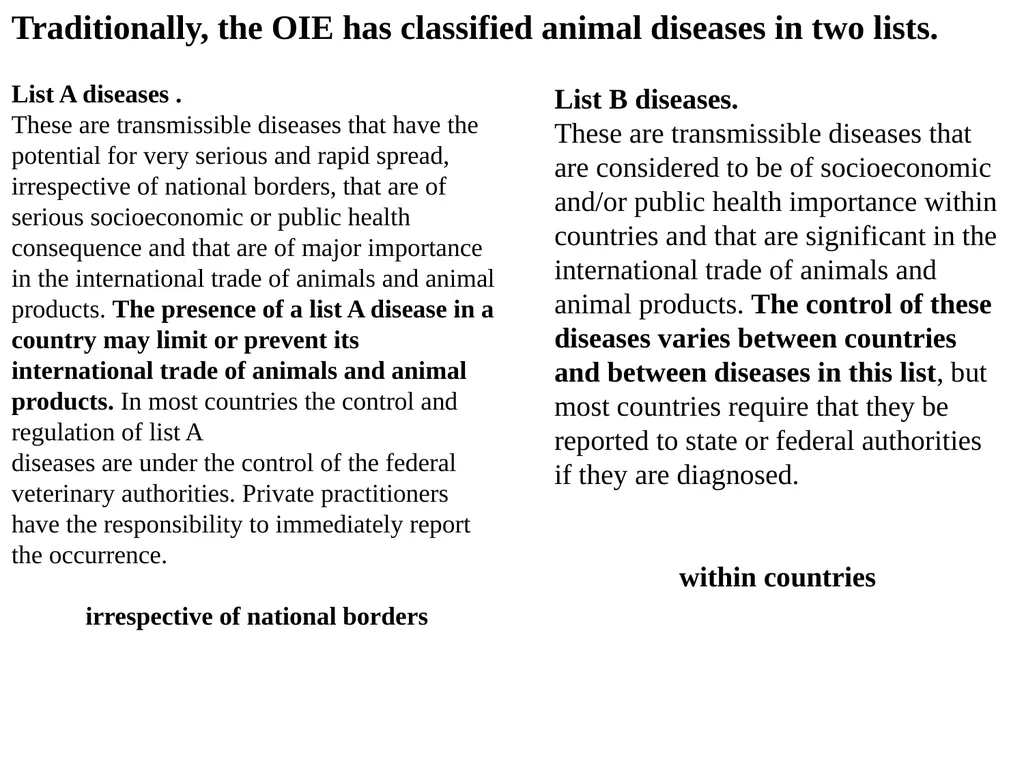
Traditionally, the OIE has classified animal diseases in two lists. List A diseases .
These are transmissible diseases that have the potential for very serious and rapid spread, irrespective of national borders, that are of serious socioeconomic or public health consequence and that are of major importance in the international trade of animals and animal products. The presence of a list A disease in a country may limit or prevent its international trade of animals and animal products. In most countries the control and regulation of list A
diseases are under the control of the federal veterinary authorities. Private practitioners have the responsibility to immediately report the occurrence.
irrespective of national borders List B diseases.
These are transmissible diseases that are considered to be of socioeconomic and/or public health importance within countries and that are significant in the international trade of animals and animal products. The control of these diseases varies between countries and between diseases in this list, but most countries require that they be reported to state or federal authorities if they are diagnosed.
within countries<br>
These are transmissible diseases that have the potential for very serious and rapid spread, irrespective of national borders, that are of serious socioeconomic or public health consequence and that are of major importance in the international trade of animals and animal products. The presence of a list A disease in a country may limit or prevent its international trade of animals and animal products. In most countries the control and regulation of list A
diseases are under the control of the federal veterinary authorities. Private practitioners have the responsibility to immediately report the occurrence.
irrespective of national borders List B diseases.
These are transmissible diseases that are considered to be of socioeconomic and/or public health importance within countries and that are significant in the international trade of animals and animal products. The control of these diseases varies between countries and between diseases in this list, but most countries require that they be reported to state or federal authorities if they are diagnosed.
within countries<br>
07
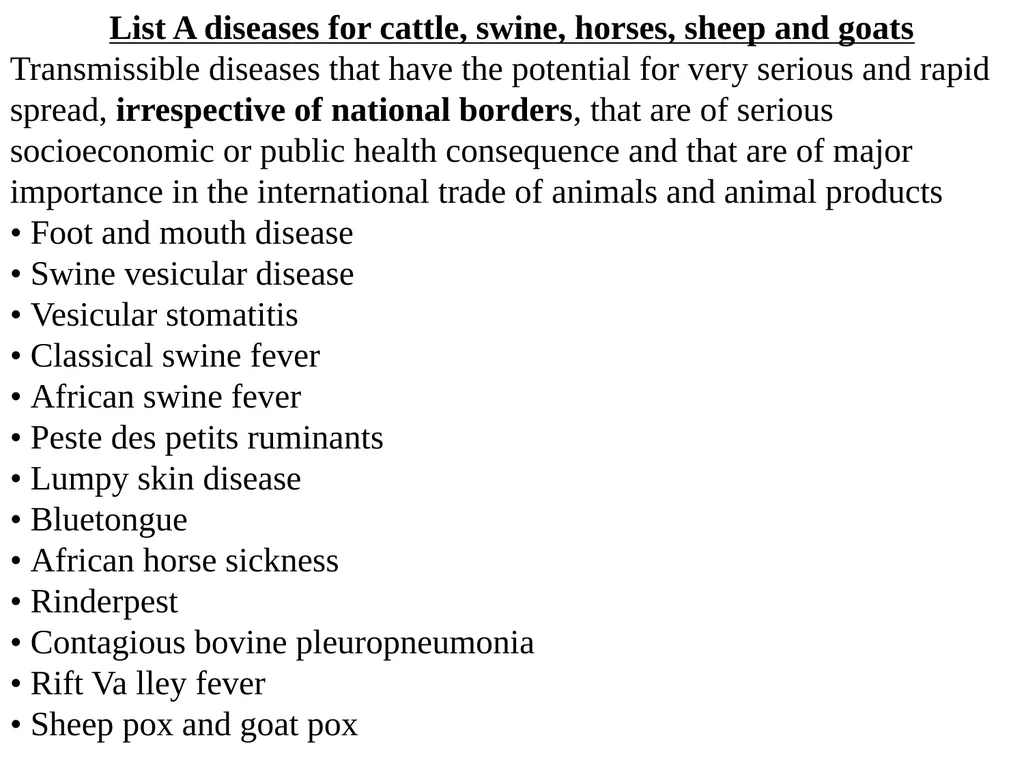
List A diseases for cattle, swine, horses, sheep and goats
Transmissible diseases that have the potential for very serious and rapid spread, irrespective of national borders, that are of serious socioeconomic or public health consequence and that are of major importance in the international trade of animals and animal products
• Foot and mouth disease
• Swine vesicular disease
• Vesicular stomatitis
• Classical swine fever
• African swine fever
• Peste des petits ruminants
• Lumpy skin disease
• Bluetongue
• African horse sickness
• Rinderpest
• Contagious bovine pleuropneumonia
• Rift Va lley fever
• Sheep pox and goat pox<br>
Transmissible diseases that have the potential for very serious and rapid spread, irrespective of national borders, that are of serious socioeconomic or public health consequence and that are of major importance in the international trade of animals and animal products
• Foot and mouth disease
• Swine vesicular disease
• Vesicular stomatitis
• Classical swine fever
• African swine fever
• Peste des petits ruminants
• Lumpy skin disease
• Bluetongue
• African horse sickness
• Rinderpest
• Contagious bovine pleuropneumonia
• Rift Va lley fever
• Sheep pox and goat pox<br>
08
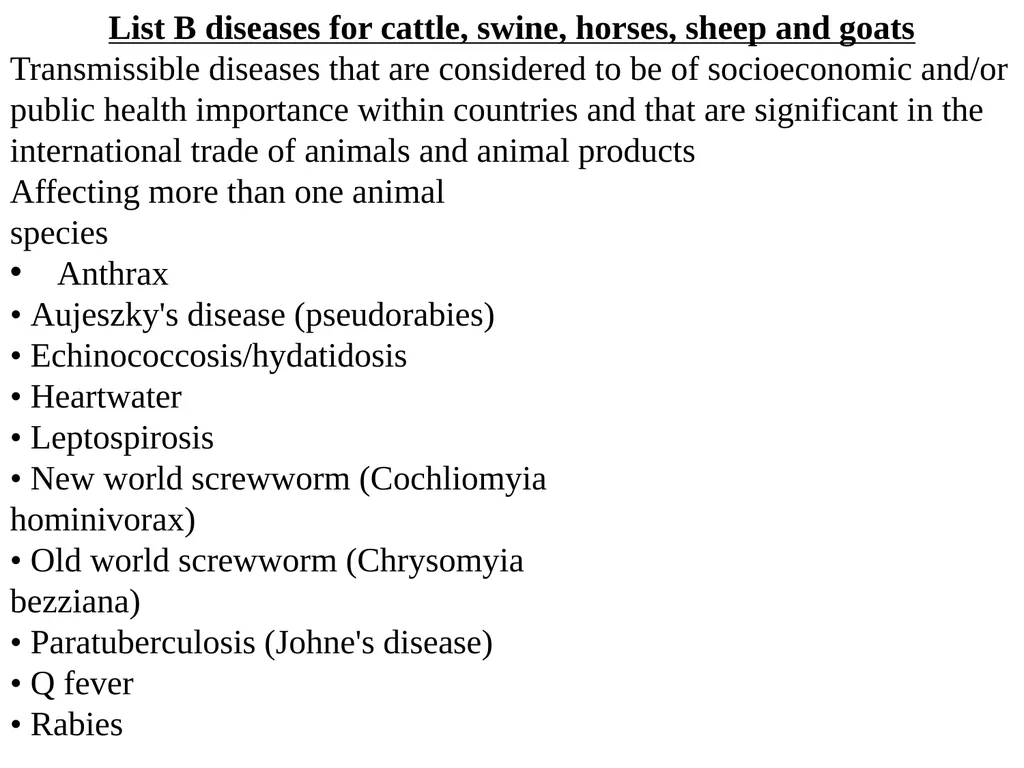
List B diseases for cattle, swine, horses, sheep and goats
Transmissible diseases that are considered to be of socioeconomic and/or public health importance within countries and that are significant in the international trade of animals and animal products
Affecting more than one animal
species
Anthrax
• Aujeszky's disease (pseudorabies)
• Echinococcosis/hydatidosis
• Heartwater
• Leptospirosis
• New world screwworm (Cochliomyia
hominivorax)
• Old world screwworm (Chrysomyia
bezziana)
• Paratuberculosis (Johne's disease)
• Q fever
• Rabies<br>
Transmissible diseases that are considered to be of socioeconomic and/or public health importance within countries and that are significant in the international trade of animals and animal products
Affecting more than one animal
species
Anthrax
• Aujeszky's disease (pseudorabies)
• Echinococcosis/hydatidosis
• Heartwater
• Leptospirosis
• New world screwworm (Cochliomyia
hominivorax)
• Old world screwworm (Chrysomyia
bezziana)
• Paratuberculosis (Johne's disease)
• Q fever
• Rabies<br>
09
DIAGNOSIS OF INFECTIOUS DISEASES
The clinical and laboratory diagnosis of the infectious diseases can be difficult. However, with the appropriate laboratory support and suitable samples, most of them can be diagnosed definitively. For each disease certain samples must be submitted to the laboratory for isolation or demonstration of the specific pathogen. When an infectious disease is suspected, laboratory investigations will aid in diagnosis and differential diagnosis<br>
The clinical and laboratory diagnosis of the infectious diseases can be difficult. However, with the appropriate laboratory support and suitable samples, most of them can be diagnosed definitively. For each disease certain samples must be submitted to the laboratory for isolation or demonstration of the specific pathogen. When an infectious disease is suspected, laboratory investigations will aid in diagnosis and differential diagnosis<br>
10
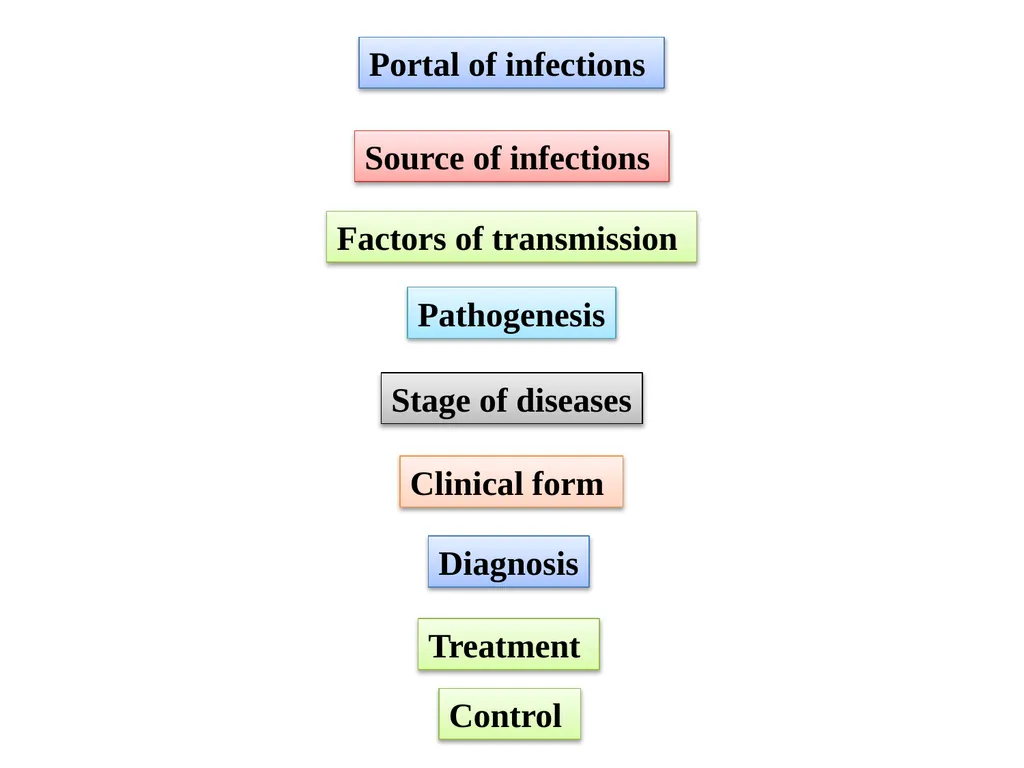
Portal of infections Factors of transmission Pathogenesis Source of infections Stage of diseases Clinical form Diagnosis Treatment Control<br>
11
Epidemiology is the study of diseases in populations which attempt to characterise those individuals in a population with high rates of disease and those with low rates. This allows the factors influencing the rate of disease to be identified. Once identified, measures can be applied to reduce the level of exposure to these factors — reducing the rate of disease in the population. This allows disease to be controlled even if the precise pathogenic mechanism (or the aetiologic agent) is not known.
It is useful to distinguish epidemiological from clinical approaches to disease management.
The clinical approach to disease management is focused on individual animals and is aimed at diagnosing a disease and treating it. It involves physical examination and generation of a list of differential diagnoses. Further examinations, laboratory tests and possibly response to treatment are then used to narrow the list of differential diagnoses to a single diagnosis. In an ideal world this will always be the correct diagnosis.
The success of this approach depends on two conditions:
• That the true diagnosis is on the list of differential diagnoses; and
• Clinical signs arise from a single (disease process in the individual.<br>
It is useful to distinguish epidemiological from clinical approaches to disease management.
The clinical approach to disease management is focused on individual animals and is aimed at diagnosing a disease and treating it. It involves physical examination and generation of a list of differential diagnoses. Further examinations, laboratory tests and possibly response to treatment are then used to narrow the list of differential diagnoses to a single diagnosis. In an ideal world this will always be the correct diagnosis.
The success of this approach depends on two conditions:
• That the true diagnosis is on the list of differential diagnoses; and
• Clinical signs arise from a single (disease process in the individual.<br>
12
The epidemiological approach to disease management is conceptually different in that there is no dependency on being able to precisely define the aetiological agent. It is based on observing differences and similarities between diseased and non-diseased animals in order to try and understand what factors may be increasing or reducing the risk of disease.
Important factors of clinical and epidemiological approach are.
Host, agent, and environment.
Individual, place, and time.
Causation.
Historical examples in the development of epidemiology.<br>
Important factors of clinical and epidemiological approach are.
Host, agent, and environment.
Individual, place, and time.
Causation.
Historical examples in the development of epidemiology.<br>
13
Whether or not disease occurs in an individual depends often on an interplay of three things:
• The host;
• The agent; and
• The environment
The host is the animal (or human) that may contract a disease. Age, genetic makeup,
level of exposure, and state of health all influence a host’s susceptibility to developing
disease. The agent is the factor that causes the disease (bacteria, virus, parasite, fungus,
chemical poison, nutritional deficiency etc) — one or more agents may be involved. The environment includes surroundings and conditions either within the host or external to it, that cause or allow disease transmission to occur. The environment may weaken
the host and increase its susceptibility to disease or provide conditions that favour the
survival of the agent.
The level of disease in a population depends often on an interplay of three factors:
• Individual factors: what types of individuals tend to develop disease and who tends
to be spared?
• Spatial factors: where is the disease especially common or rare, and what is different
about those places?
• Temporal factors: how does disease frequency change over time, and what other
factors are associated with those changes?<br>
• The host;
• The agent; and
• The environment
The host is the animal (or human) that may contract a disease. Age, genetic makeup,
level of exposure, and state of health all influence a host’s susceptibility to developing
disease. The agent is the factor that causes the disease (bacteria, virus, parasite, fungus,
chemical poison, nutritional deficiency etc) — one or more agents may be involved. The environment includes surroundings and conditions either within the host or external to it, that cause or allow disease transmission to occur. The environment may weaken
the host and increase its susceptibility to disease or provide conditions that favour the
survival of the agent.
The level of disease in a population depends often on an interplay of three factors:
• Individual factors: what types of individuals tend to develop disease and who tends
to be spared?
• Spatial factors: where is the disease especially common or rare, and what is different
about those places?
• Temporal factors: how does disease frequency change over time, and what other
factors are associated with those changes?<br>
14
Measurement of health
One of the most fundamental tasks in epidemiological research is to quantify the occurrence of disease. This can be done by counting the number of affected individuals however, to compare levels of disease among groups of individuals, time frames and locations.
A ratio is defines the relative size of two quantities expressed by dividing one (numerator) by the other (denominator). Say we have a herd of 100 cattle and 58 are found to be diseased. The odds of disease in this herd is 58:42 or 1.4 to 1.
A proportion is a fraction in which the numerator is included in the denominator. Say we have a herd of 100 cattle and 58 are found to be diseased. The proportion of diseased animals in this herd is 58 ÷ 100 = 0.58 = 58%.<br>
One of the most fundamental tasks in epidemiological research is to quantify the occurrence of disease. This can be done by counting the number of affected individuals however, to compare levels of disease among groups of individuals, time frames and locations.
A ratio is defines the relative size of two quantities expressed by dividing one (numerator) by the other (denominator). Say we have a herd of 100 cattle and 58 are found to be diseased. The odds of disease in this herd is 58:42 or 1.4 to 1.
A proportion is a fraction in which the numerator is included in the denominator. Say we have a herd of 100 cattle and 58 are found to be diseased. The proportion of diseased animals in this herd is 58 ÷ 100 = 0.58 = 58%.<br>
15
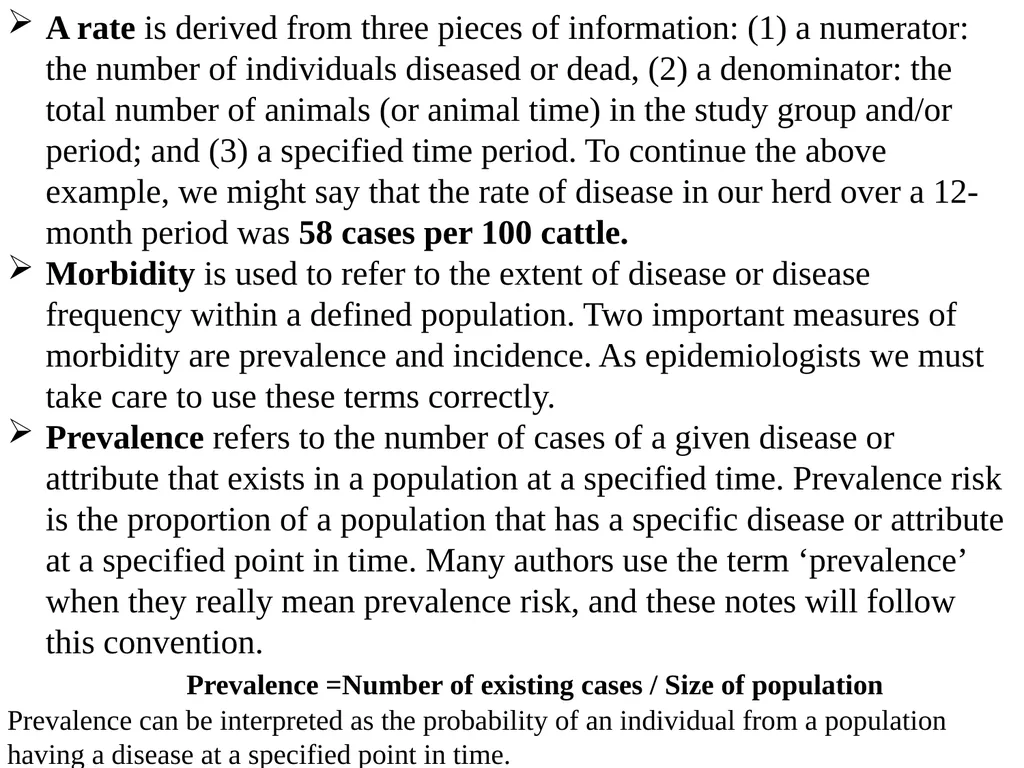
A rate is derived from three pieces of information: (1) a numerator: the number of individuals diseased or dead, (2) a denominator: the total number of animals (or animal time) in the study group and/or period; and (3) a specified time period. To continue the above example, we might say that the rate of disease in our herd over a 12-month period was 58 cases per 100 cattle.
Morbidity is used to refer to the extent of disease or disease frequency within a defined population. Two important measures of morbidity are prevalence and incidence. As epidemiologists we must take care to use these terms correctly.
Prevalence refers to the number of cases of a given disease or attribute that exists in a population at a specified time. Prevalence risk is the proportion of a population that has a specific disease or attribute at a specified point in time. Many authors use the term ‘prevalence’ when they really mean prevalence risk, and these notes will follow this convention.
Prevalence =Number of existing cases / Size of population
Prevalence can be interpreted as the probability of an individual from a population having a disease at a specified point in time.<br>
Morbidity is used to refer to the extent of disease or disease frequency within a defined population. Two important measures of morbidity are prevalence and incidence. As epidemiologists we must take care to use these terms correctly.
Prevalence refers to the number of cases of a given disease or attribute that exists in a population at a specified time. Prevalence risk is the proportion of a population that has a specific disease or attribute at a specified point in time. Many authors use the term ‘prevalence’ when they really mean prevalence risk, and these notes will follow this convention.
Prevalence =Number of existing cases / Size of population
Prevalence can be interpreted as the probability of an individual from a population having a disease at a specified point in time.<br>
16
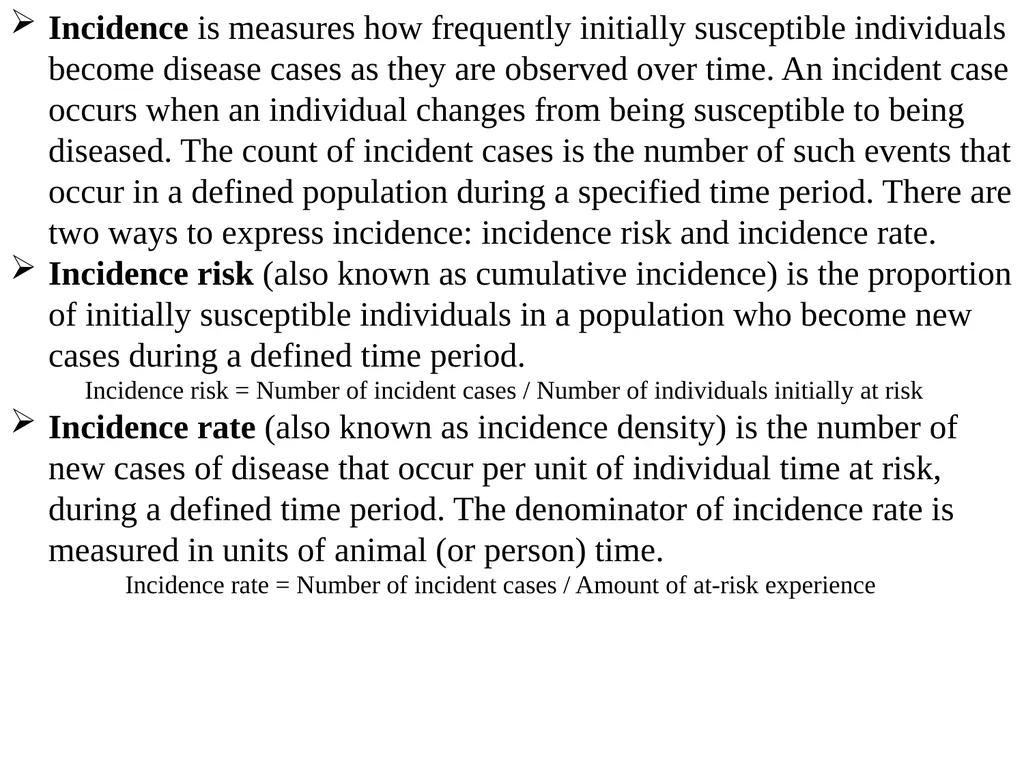
Incidence is measures how frequently initially susceptible individuals become disease cases as they are observed over time. An incident case occurs when an individual changes from being susceptible to being diseased. The count of incident cases is the number of such events that occur in a defined population during a specified time period. There are two ways to express incidence: incidence risk and incidence rate.
Incidence risk (also known as cumulative incidence) is the proportion of initially susceptible individuals in a population who become new cases during a defined time period.
Incidence risk = Number of incident cases / Number of individuals initially at risk
Incidence rate (also known as incidence density) is the number of new cases of disease that occur per unit of individual time at risk, during a defined time period. The denominator of incidence rate is measured in units of animal (or person) time.
Incidence rate = Number of incident cases / Amount of at-risk experience<br>
Incidence risk (also known as cumulative incidence) is the proportion of initially susceptible individuals in a population who become new cases during a defined time period.
Incidence risk = Number of incident cases / Number of individuals initially at risk
Incidence rate (also known as incidence density) is the number of new cases of disease that occur per unit of individual time at risk, during a defined time period. The denominator of incidence rate is measured in units of animal (or person) time.
Incidence rate = Number of incident cases / Amount of at-risk experience<br>
17
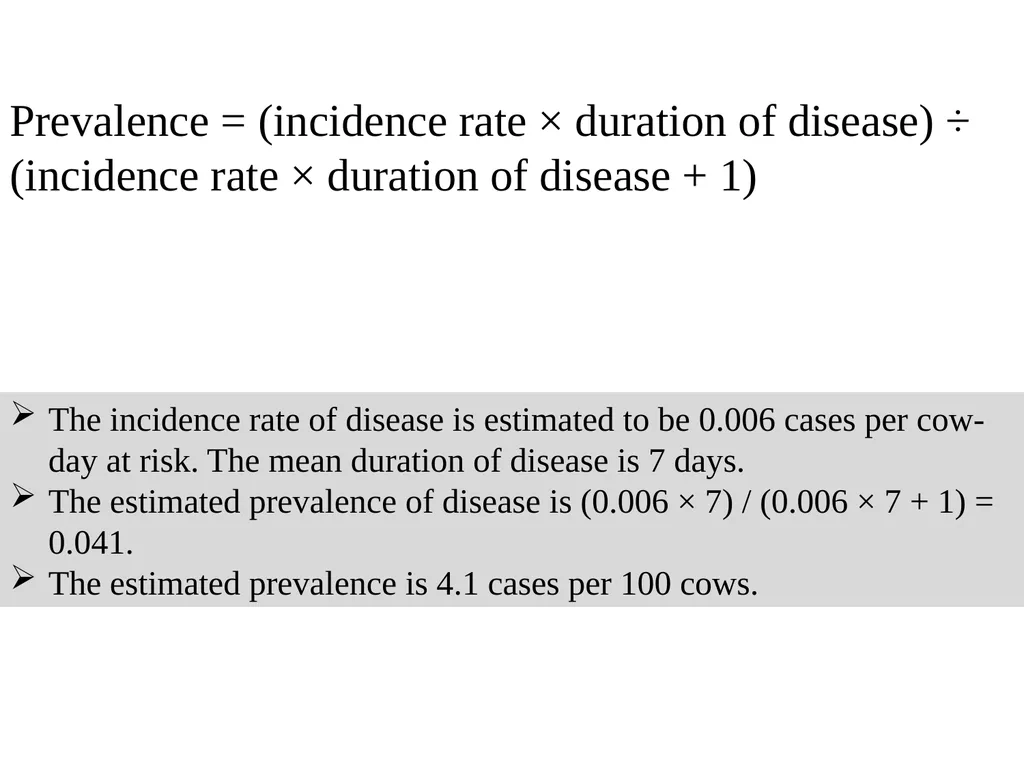
Prevalence = (incidence rate × duration of disease) ÷ (incidence rate × duration of disease + 1) The incidence rate of disease is estimated to be 0.006 cases per cow-day at risk. The mean duration of disease is 7 days.
The estimated prevalence of disease is (0.006 × 7) / (0.006 × 7 + 1) = 0.041.
The estimated prevalence is 4.1 cases per 100 cows.<br>
The estimated prevalence of disease is (0.006 × 7) / (0.006 × 7 + 1) = 0.041.
The estimated prevalence is 4.1 cases per 100 cows.<br>
18
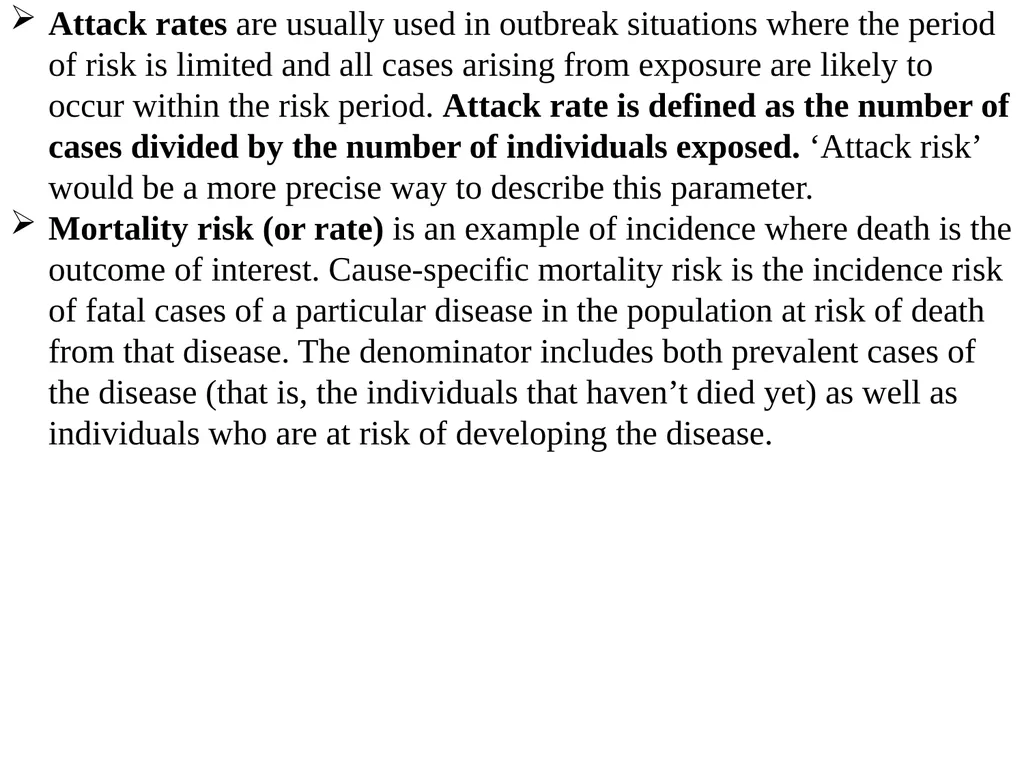
Attack rates are usually used in outbreak situations where the period of risk is limited and all cases arising from exposure are likely to occur within the risk period. Attack rate is defined as the number of cases divided by the number of individuals exposed. ‘Attack risk’ would be a more precise way to describe this parameter.
Mortality risk (or rate) is an example of incidence where death is the outcome of interest. Cause-specific mortality risk is the incidence risk of fatal cases of a particular disease in the population at risk of death from that disease. The denominator includes both prevalent cases of the disease (that is, the individuals that haven’t died yet) as well as individuals who are at risk of developing the disease.<br>
Mortality risk (or rate) is an example of incidence where death is the outcome of interest. Cause-specific mortality risk is the incidence risk of fatal cases of a particular disease in the population at risk of death from that disease. The denominator includes both prevalent cases of the disease (that is, the individuals that haven’t died yet) as well as individuals who are at risk of developing the disease.<br>
19
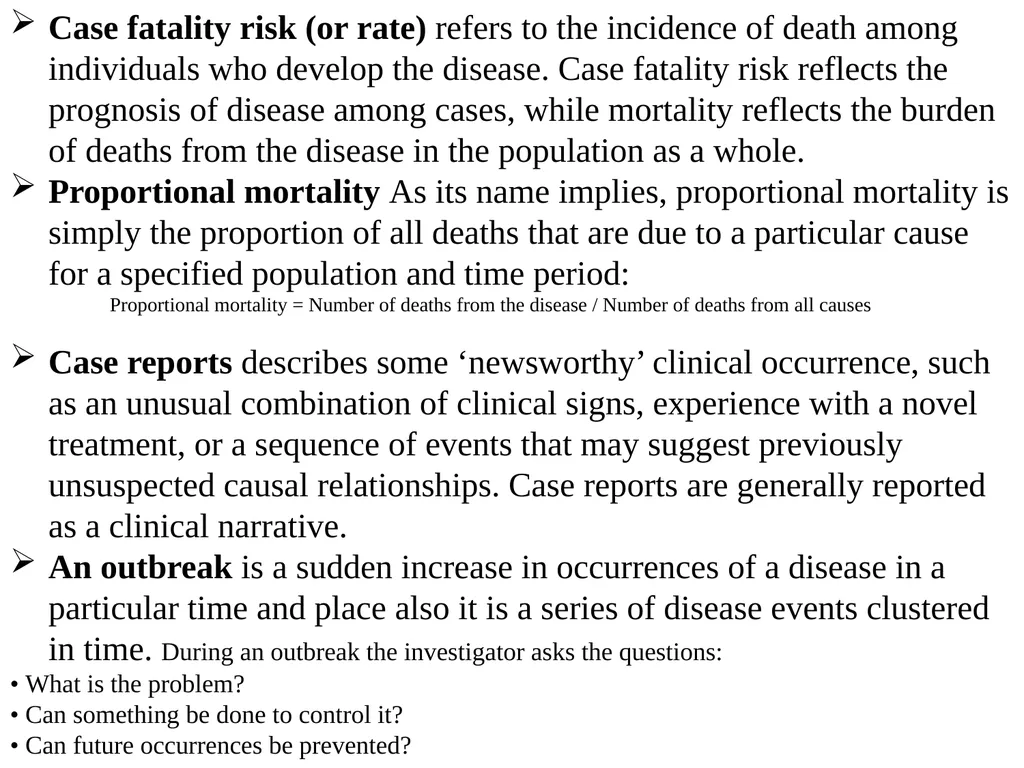
Case fatality risk (or rate) refers to the incidence of death among individuals who develop the disease. Case fatality risk reflects the prognosis of disease among cases, while mortality reflects the burden of deaths from the disease in the population as a whole.
Proportional mortality As its name implies, proportional mortality is simply the proportion of all deaths that are due to a particular cause for a specified population and time period:
Proportional mortality = Number of deaths from the disease / Number of deaths from all causes
Case reports describes some ‘newsworthy’ clinical occurrence, such as an unusual combination of clinical signs, experience with a novel treatment, or a sequence of events that may suggest previously unsuspected causal relationships. Case reports are generally reported as a clinical narrative.
An outbreak is a sudden increase in occurrences of a disease in a particular time and place also it is a series of disease events clustered in time. During an outbreak the investigator asks the questions:
• What is the problem?
• Can something be done to control it?
• Can future occurrences be prevented?<br>
Proportional mortality As its name implies, proportional mortality is simply the proportion of all deaths that are due to a particular cause for a specified population and time period:
Proportional mortality = Number of deaths from the disease / Number of deaths from all causes
Case reports describes some ‘newsworthy’ clinical occurrence, such as an unusual combination of clinical signs, experience with a novel treatment, or a sequence of events that may suggest previously unsuspected causal relationships. Case reports are generally reported as a clinical narrative.
An outbreak is a sudden increase in occurrences of a disease in a particular time and place also it is a series of disease events clustered in time. During an outbreak the investigator asks the questions:
• What is the problem?
• Can something be done to control it?
• Can future occurrences be prevented?<br>
20
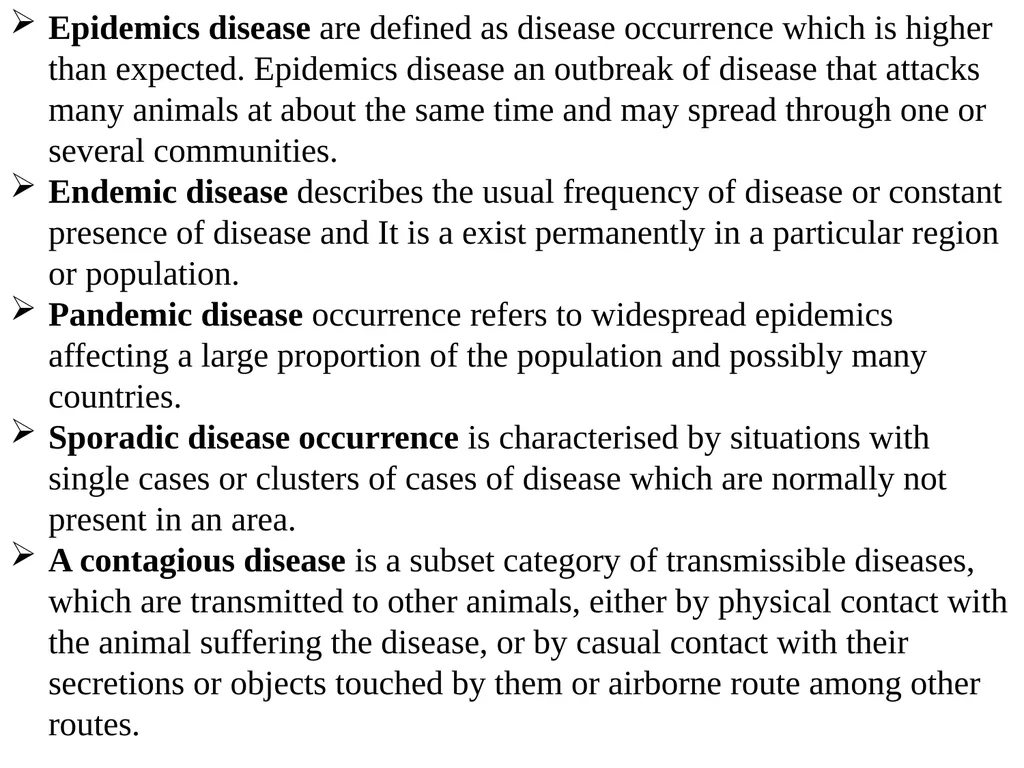
Epidemics disease are defined as disease occurrence which is higher than expected. Epidemics disease an outbreak of disease that attacks many animals at about the same time and may spread through one or several communities.
Endemic disease describes the usual frequency of disease or constant presence of disease and It is a exist permanently in a particular region or population.
Pandemic disease occurrence refers to widespread epidemics affecting a large proportion of the population and possibly many countries.
Sporadic disease occurrence is characterised by situations with single cases or clusters of cases of disease which are normally not present in an area.
A contagious disease is a subset category of transmissible diseases, which are transmitted to other animals, either by physical contact with the animal suffering the disease, or by casual contact with their secretions or objects touched by them or airborne route among other routes.<br>
Endemic disease describes the usual frequency of disease or constant presence of disease and It is a exist permanently in a particular region or population.
Pandemic disease occurrence refers to widespread epidemics affecting a large proportion of the population and possibly many countries.
Sporadic disease occurrence is characterised by situations with single cases or clusters of cases of disease which are normally not present in an area.
A contagious disease is a subset category of transmissible diseases, which are transmitted to other animals, either by physical contact with the animal suffering the disease, or by casual contact with their secretions or objects touched by them or airborne route among other routes.<br>
21
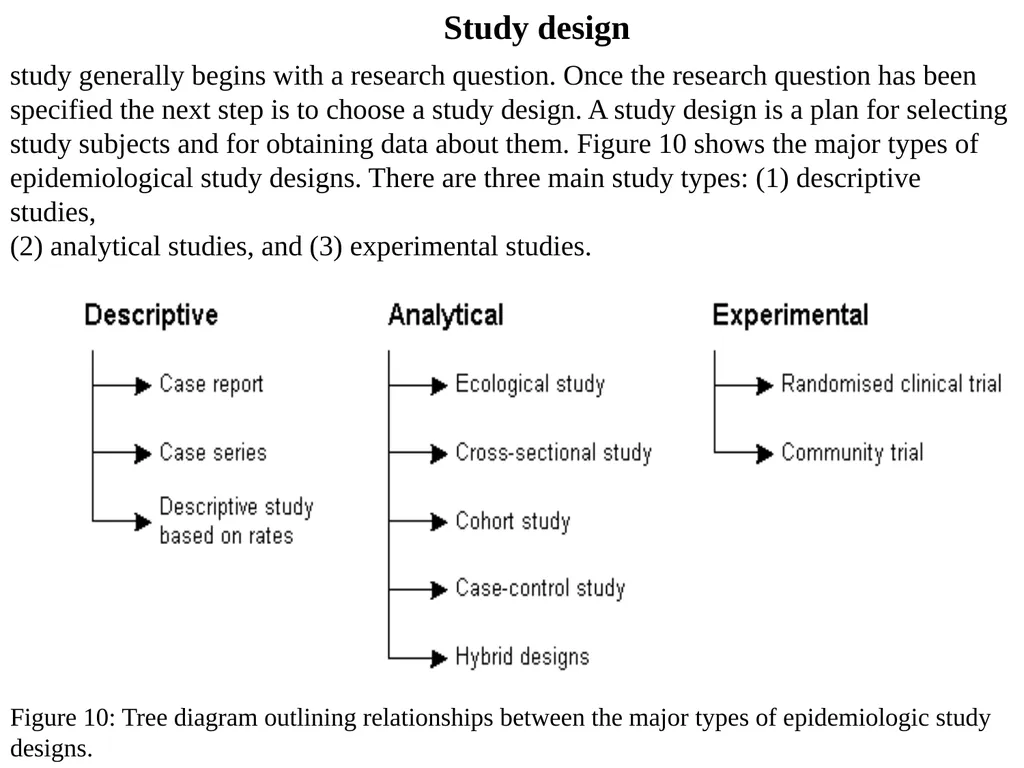
Study design study generally begins with a research question. Once the research question has been
specified the next step is to choose a study design. A study design is a plan for selecting
study subjects and for obtaining data about them. Figure 10 shows the major types of
epidemiological study designs. There are three main study types: (1) descriptive studies,
(2) analytical studies, and (3) experimental studies. Figure 10: Tree diagram outlining relationships between the major types of epidemiologic study designs.<br>
specified the next step is to choose a study design. A study design is a plan for selecting
study subjects and for obtaining data about them. Figure 10 shows the major types of
epidemiological study designs. There are three main study types: (1) descriptive studies,
(2) analytical studies, and (3) experimental studies. Figure 10: Tree diagram outlining relationships between the major types of epidemiologic study designs.<br>
22
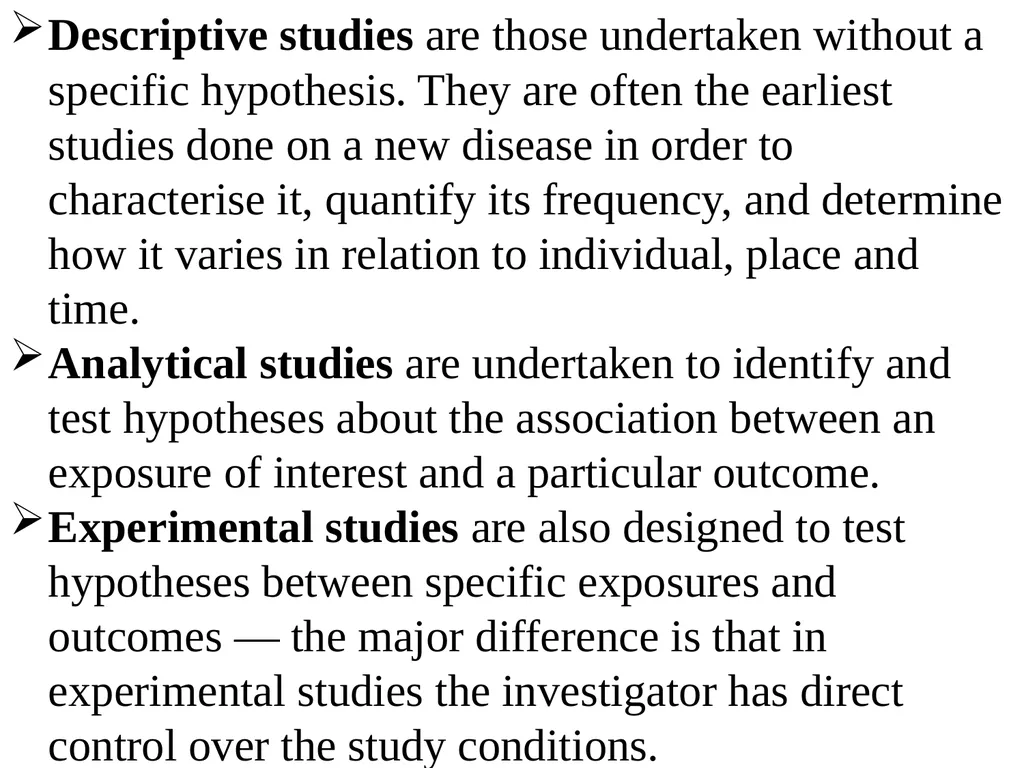
Descriptive studies are those undertaken without a specific hypothesis. They are often the earliest studies done on a new disease in order to characterise it, quantify its frequency, and determine how it varies in relation to individual, place and time.
Analytical studies are undertaken to identify and test hypotheses about the association between an exposure of interest and a particular outcome.
Experimental studies are also designed to test hypotheses between specific exposures and outcomes — the major difference is that in experimental studies the investigator has direct control over the study conditions.<br>
Analytical studies are undertaken to identify and test hypotheses about the association between an exposure of interest and a particular outcome.
Experimental studies are also designed to test hypotheses between specific exposures and outcomes — the major difference is that in experimental studies the investigator has direct control over the study conditions.<br>