
Lecture 12 Cache Memories CS213 – Intro to
EM
Published · 57 slides · 0 views
1 / 1

Description
Lecture 12 Cache Memories CS213 Intro to Computer Systems Branden Ghena Winter 2024 Slides adapted from: St-Amour, Hardavellas, Bustamente (Northwestern), Bryant, OHallaron (CMU), Garcia, Weaver (UC Berkeley) Administrivia Deadline
Related Topics
Share
Embed code
Download this presentation From Below
"Lecture 12 Cache Memories CS213 – Intro to" is the property of its rightful owner. Permission is granted to download and print the materials on this website for personal, non-commercial use only, and to display it on your personal computer provided you do not modify the materials and that you retain all copyright notices contained in the materials. By downloading content from our website, you accept the terms of this agreement.
Presentation Transcript
01
Lecture 12
Cache Memories CS213 – Intro to Computer Systems
Branden Ghena – Winter 2024 Slides adapted from: St-Amour, Hardavellas, Bustamente (Northwestern), Bryant, O’Hallaron (CMU), Garcia, Weaver (UC Berkeley)<br>
Branden Ghena – Winter 2024 Slides adapted from: St-Amour, Hardavellas, Bustamente (Northwestern), Bryant, O’Hallaron (CMU), Garcia, Weaver (UC Berkeley)<br>
02
Administrivia Deadline reminders
Homework 3 tonight
Attack Lab next week Thursday
Next week
Homework 4 & SETI Lab come out 2<br>
Homework 3 tonight
Attack Lab next week Thursday
Next week
Homework 4 & SETI Lab come out 2<br>
03
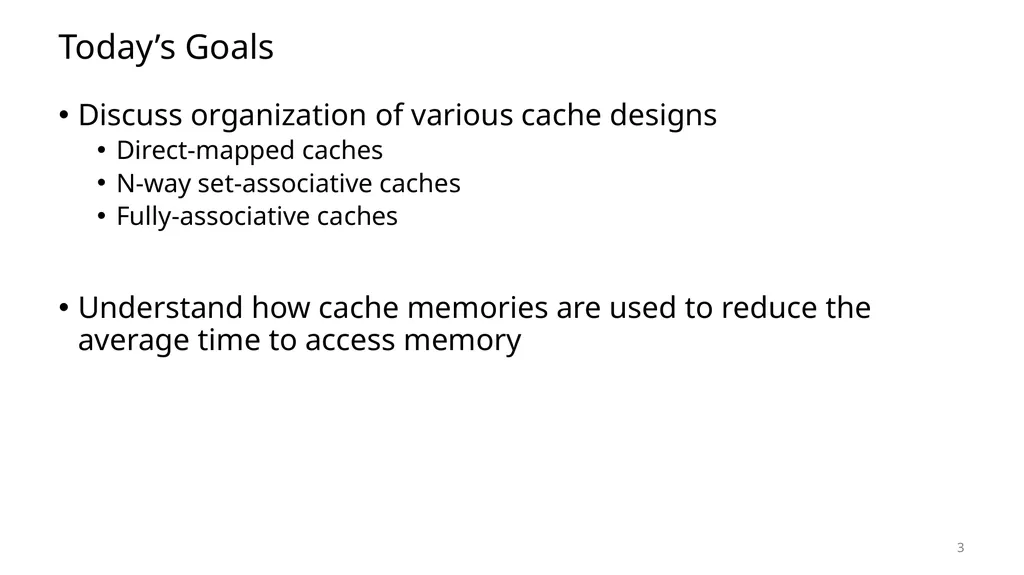
Today’s Goals Discuss organization of various cache designs
Direct-mapped caches
N-way set-associative caches
Fully-associative caches
Understand how cache memories are used to reduce the average time to access memory 3<br>
Direct-mapped caches
N-way set-associative caches
Fully-associative caches
Understand how cache memories are used to reduce the average time to access memory 3<br>
04
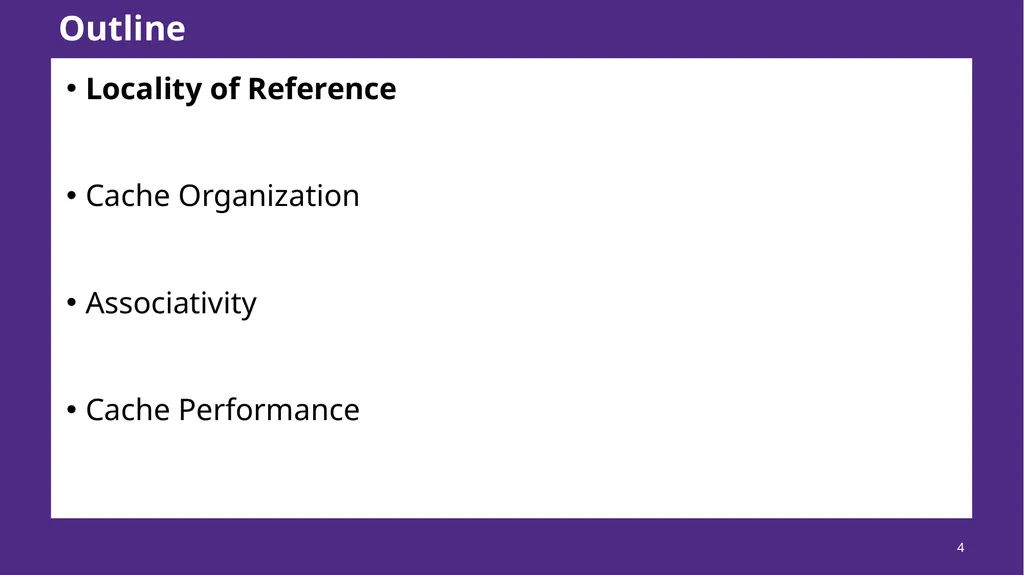
4 Locality of Reference
Cache Organization
Associativity
Cache Performance Outline<br>
Cache Organization
Associativity
Cache Performance Outline<br>
05
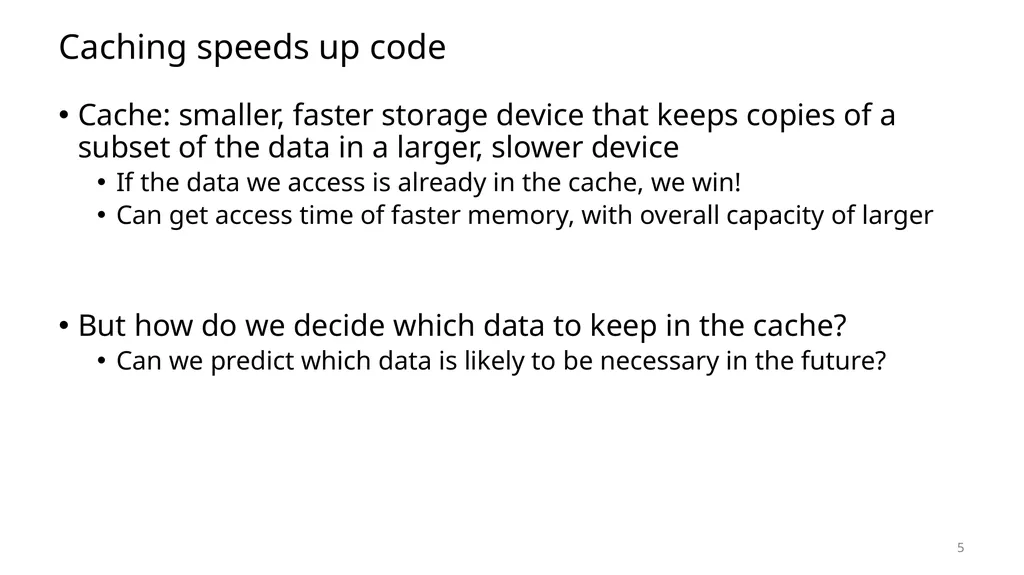
Caching speeds up code Cache: smaller, faster storage device that keeps copies of a subset of the data in a larger, slower device
If the data we access is already in the cache, we win!
Can get access time of faster memory, with overall capacity of larger
But how do we decide which data to keep in the cache?
Can we predict which data is likely to be necessary in the future? 5<br>
If the data we access is already in the cache, we win!
Can get access time of faster memory, with overall capacity of larger
But how do we decide which data to keep in the cache?
Can we predict which data is likely to be necessary in the future? 5<br>
06
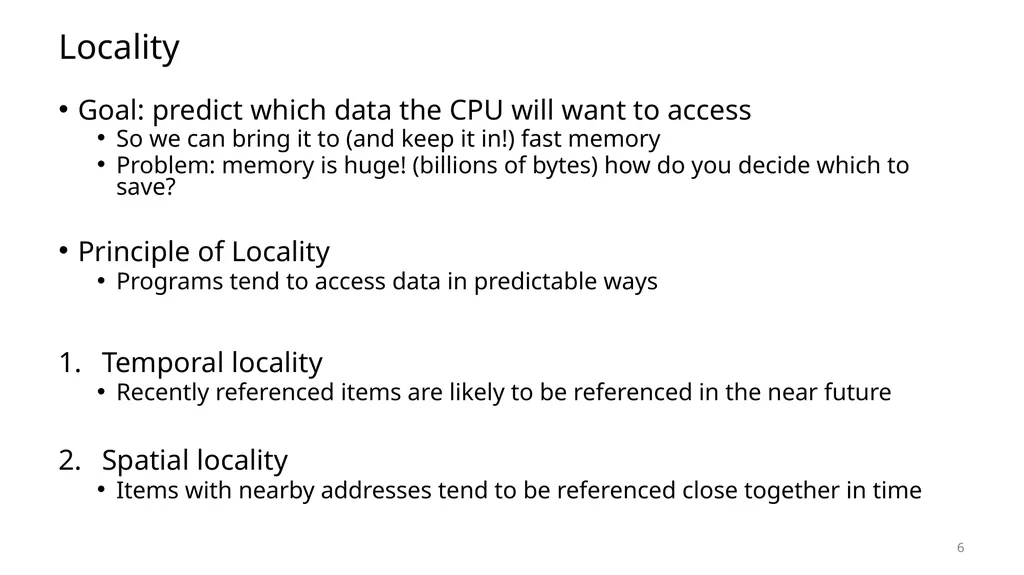
Locality Goal: predict which data the CPU will want to access
So we can bring it to (and keep it in!) fast memory
Problem: memory is huge! (billions of bytes) how do you decide which to save?
Principle of Locality
Programs tend to access data in predictable ways
Temporal locality
Recently referenced items are likely to be referenced in the near future
Spatial locality
Items with nearby addresses tend to be referenced close together in time 6<br>
07
Types of locality practice Temporal locality
Recently referenced items are likely to be referenced in the near future
Spatial locality
Items with nearby addresses tend to be referenced close together in time
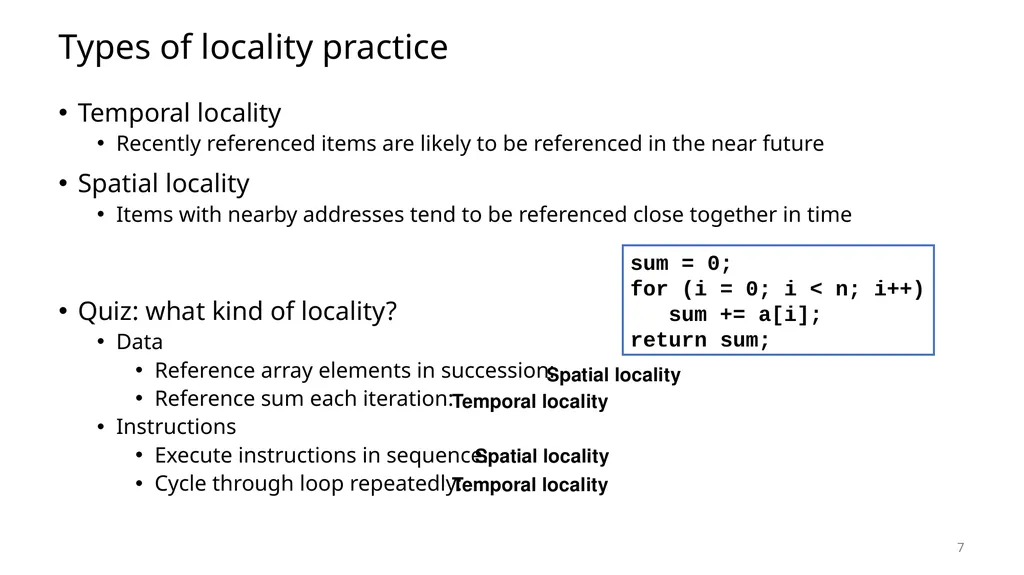
Quiz: what kind of locality?
Data
Reference array elements in succession:
Reference sum each iteration:
Instructions
Execute instructions in sequence:
Cycle through loop repeatedly: 7 sum = 0;
for (i = 0; i < n; i++)
sum += a[i];
return sum; Spatial locality Spatial locality Temporal locality Temporal locality<br>
08
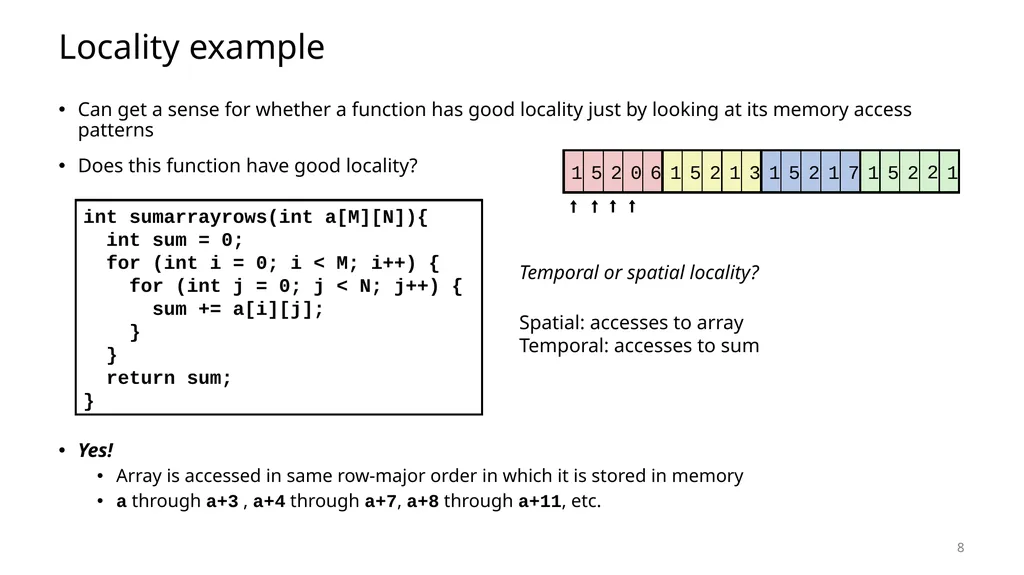
Locality example Can get a sense for whether a function has good locality just by looking at its memory access patterns
Does this function have good locality?
Yes!
Array is accessed in same row-major order in which it is stored in memory
a through a+3 , a+4 through a+7, a+8 through a+11, etc. int sumarrayrows(int a[M][N]){
int sum = 0;
for (int i = 0; i < M; i++) {
for (int j = 0; j < N; j++) {
sum += a[i][j];
}
}
return sum;
} Temporal or spatial locality? 8 Spatial: accesses to array
Temporal: accesses to sum<br>
09
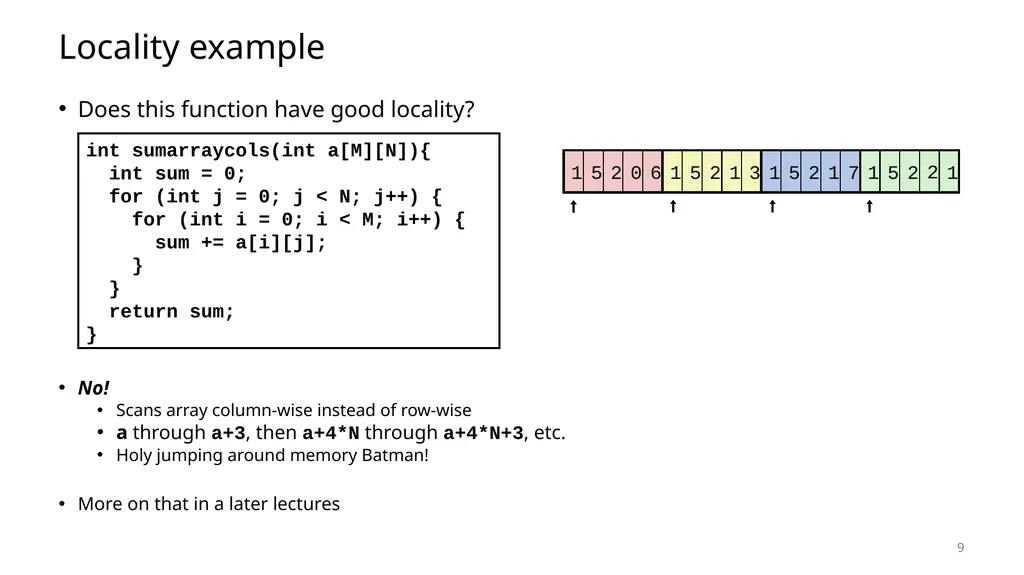
Locality example Does this function have good locality?
No!
Scans array column-wise instead of row-wise
a through a+3, then a+4*N through a+4*N+3, etc.
Holy jumping around memory Batman!
More on that in a later lectures int sumarraycols(int a[M][N]){
int sum = 0;
for (int j = 0; j < N; j++) {
for (int i = 0; i < M; i++) {
sum += a[i][j];
}
}
return sum;
} 9<br>
10
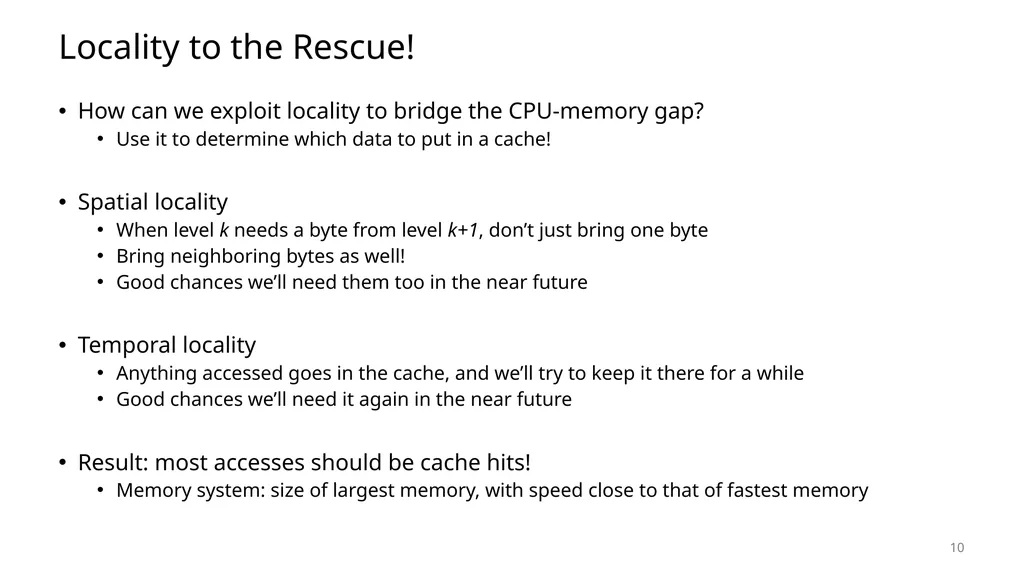
Locality to the Rescue! How can we exploit locality to bridge the CPU-memory gap?
Use it to determine which data to put in a cache!
Spatial locality
When level k needs a byte from level k+1, don’t just bring one byte
Bring neighboring bytes as well!
Good chances we’ll need them too in the near future
Temporal locality
Anything accessed goes in the cache, and we’ll try to keep it there for a while
Good chances we’ll need it again in the near future
Result: most accesses should be cache hits!
Memory system: size of largest memory, with speed close to that of fastest memory 10<br>
11
11 Locality of Reference
Cache Organization
Associativity
Cache Performance Outline<br>
Cache Organization
Associativity
Cache Performance Outline<br>
12
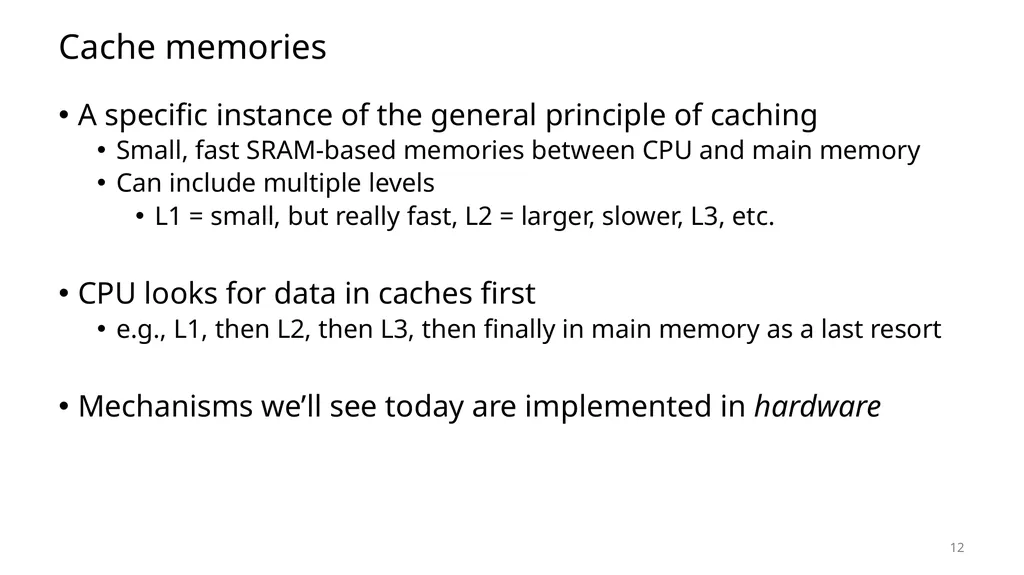
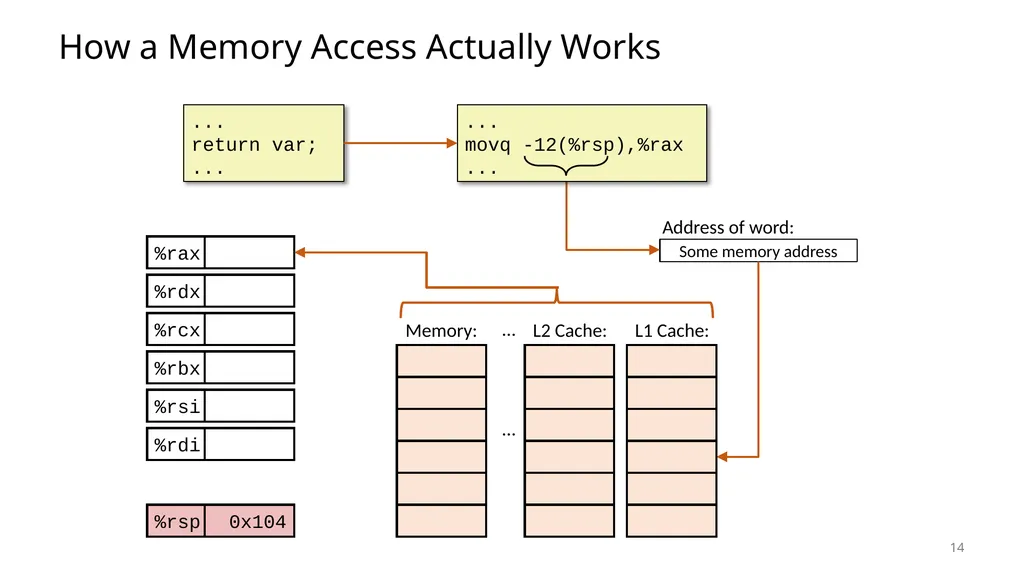
Cache memories A specific instance of the general principle of caching
Small, fast SRAM-based memories between CPU and main memory
Can include multiple levels
L1 = small, but really fast, L2 = larger, slower, L3, etc.
CPU looks for data in caches first
e.g., L1, then L2, then L3, then finally in main memory as a last resort
Mechanisms we’ll see today are implemented in hardware 12<br>
13
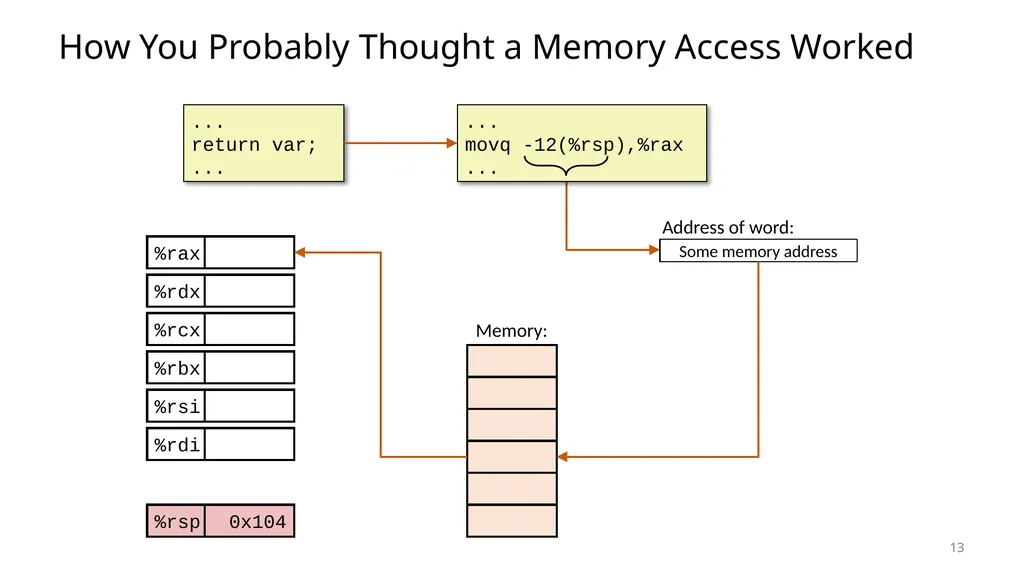
How You Probably Thought a Memory Access Worked Some memory address Address of word: Memory: 13 ...
return var;
... ...
movq -12(%rsp),%rax
...<br>
return var;
... ...
movq -12(%rsp),%rax
...<br>
14
How a Memory Access Actually Works Some memory address Address of word: Memory: L1 Cache: L2 Cache: ... ... 14 ...
return var;
... ...
movq -12(%rsp),%rax
...<br>
return var;
... ...
movq -12(%rsp),%rax
...<br>
15
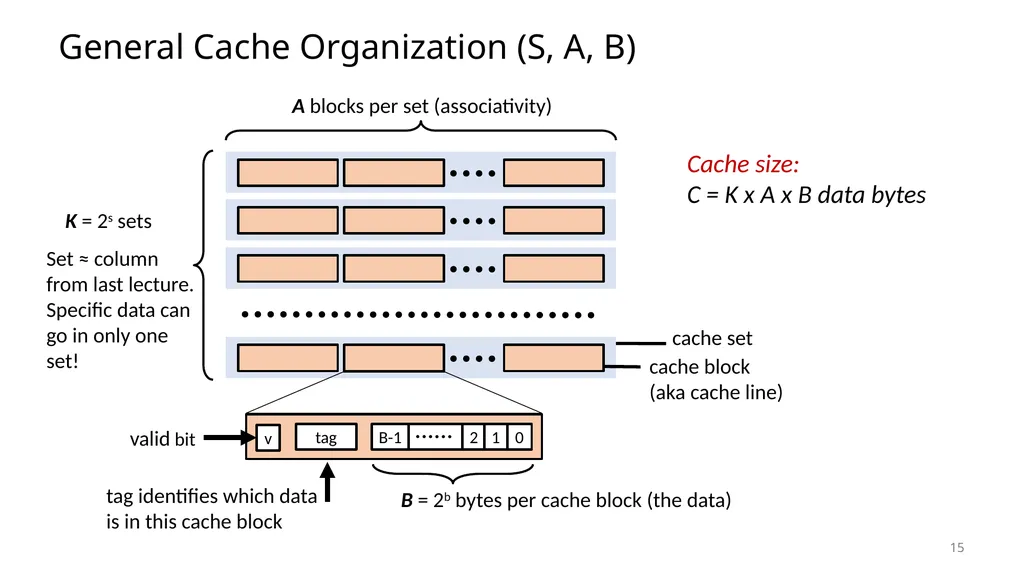
General Cache Organization (S, A, B) A blocks per set (associativity) K = 2s sets cache set B-1 2 1 0 tag v B = 2b bytes per cache block (the data) Cache size:
C = K x A x B data bytes valid bit cache block
(aka cache line) Set ≈ column from last lecture.
Specific data can go in only one set! 15 tag identifies which data is in this cache block<br>
C = K x A x B data bytes valid bit cache block
(aka cache line) Set ≈ column from last lecture.
Specific data can go in only one set! 15 tag identifies which data is in this cache block<br>
16
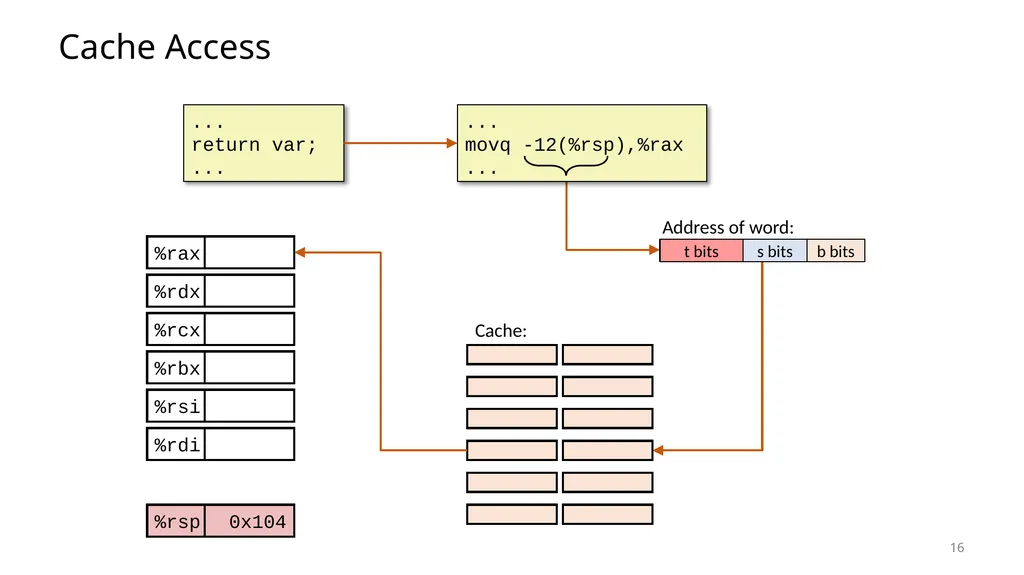
Cache Access Some memory address Address of word: Cache: t bits s bits b bits 16 ...
return var;
... ...
movq -12(%rsp),%rax
...<br>
return var;
... ...
movq -12(%rsp),%rax
...<br>
17
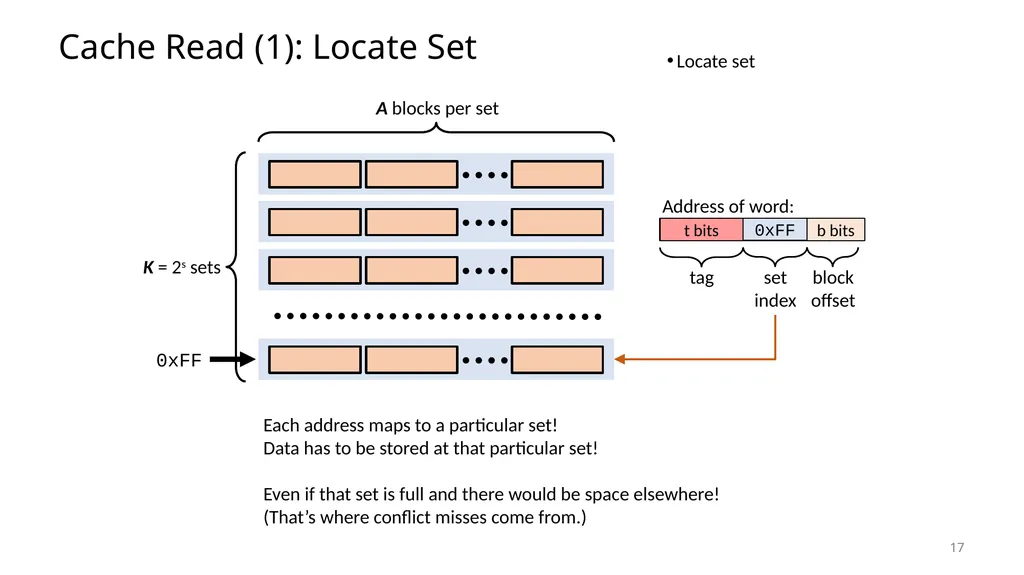
Cache Read (1): Locate Set A blocks per set K = 2s sets t bits s bits b bits Address of word: tag set
index block
offset Locate set 0xFF 0xFF Each address maps to a particular set!
Data has to be stored at that particular set!
Even if that set is full and there would be space elsewhere!
(That’s where conflict misses come from.) 17<br>
index block
offset Locate set 0xFF 0xFF Each address maps to a particular set!
Data has to be stored at that particular set!
Even if that set is full and there would be space elsewhere!
(That’s where conflict misses come from.) 17<br>
18
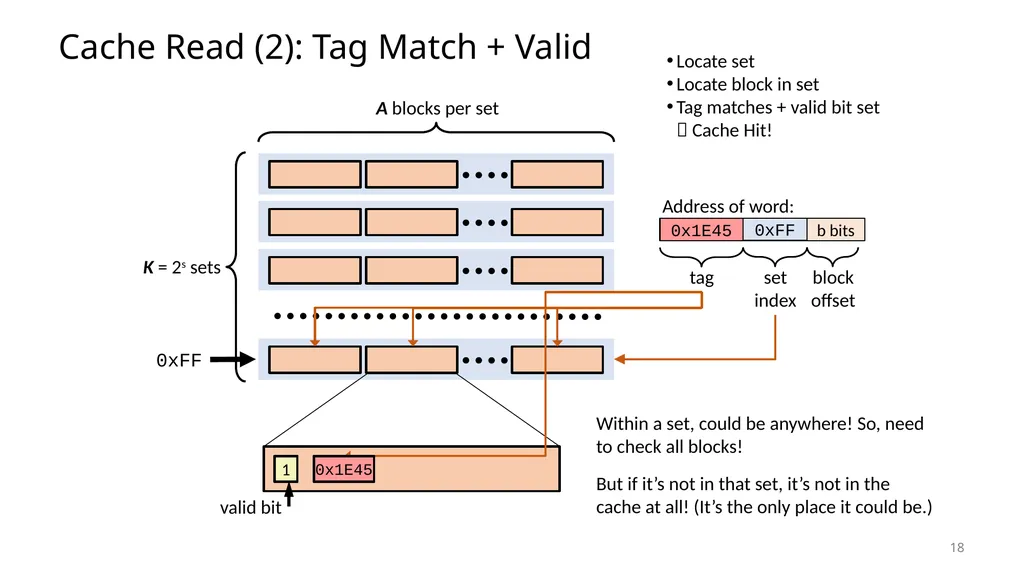
Cache Read (2): Tag Match + Valid A blocks per set K = 2s sets tag v valid bit t bits s bits b bits Address of word: tag set
index block
offset Locate set
Locate block in set
Tag matches + valid bit set Cache Hit! 0xFF 0xFF 0x1E45 0x1E45 1 Within a set, could be anywhere! So, need to check all blocks!
But if it’s not in that set, it’s not in the cache at all! (It’s the only place it could be.) 18<br>
index block
offset Locate set
Locate block in set
Tag matches + valid bit set Cache Hit! 0xFF 0xFF 0x1E45 0x1E45 1 Within a set, could be anywhere! So, need to check all blocks!
But if it’s not in that set, it’s not in the cache at all! (It’s the only place it could be.) 18<br>
19
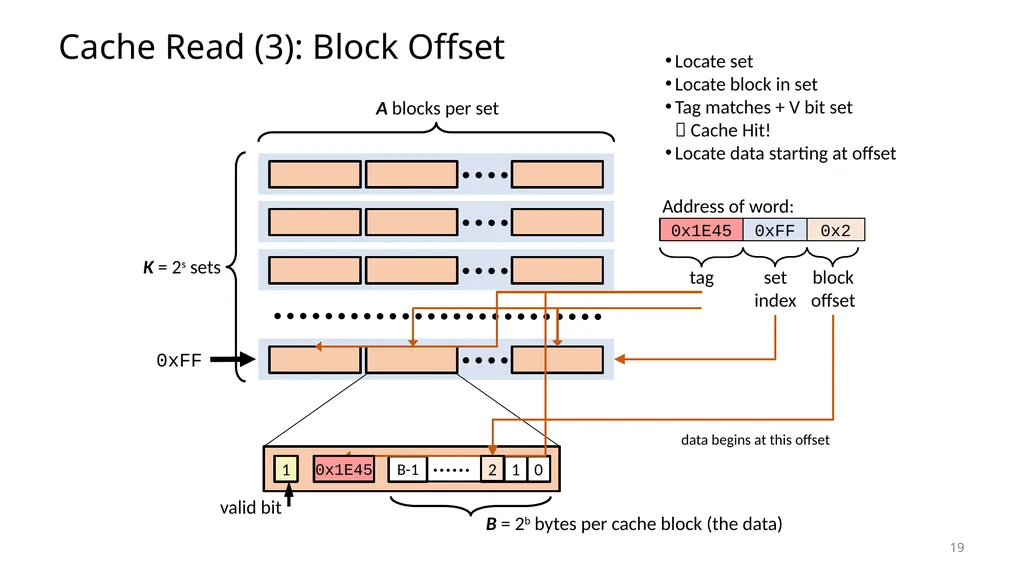
Cache Read (3): Block Offset A blocks per set K = 2s sets 0 1 2 B-1 tag v valid bit B = 2b bytes per cache block (the data) t bits s bits b bits Address of word: tag set
index data begins at this offset Locate set
Locate block in set
Tag matches + V bit set Cache Hit!
Locate data starting at offset block
offset 0xFF 0xFF 0x1E45 0x1E45 1 0x2 2 19<br>
index data begins at this offset Locate set
Locate block in set
Tag matches + V bit set Cache Hit!
Locate data starting at offset block
offset 0xFF 0xFF 0x1E45 0x1E45 1 0x2 2 19<br>
20
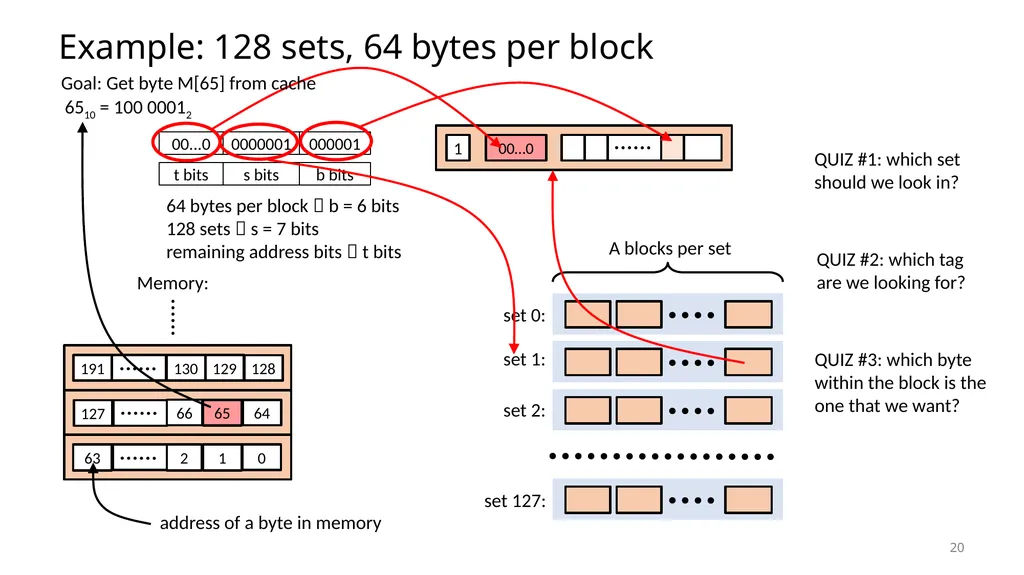
00…0 1 Example: 128 sets, 64 bytes per block 63 2 1 0 127 66 65 64 191 130 129 128 Memory: t bits s bits b bits 6510 = 100 00012 00...0 0000001 000001 64 bytes per block b = 6 bits
128 sets s = 7 bits
remaining address bits t bits address of a byte in memory A blocks per set set 0: set 1: set 2: set 127: Goal: Get byte M[65] from cache QUIZ #1: which set
should we look in? QUIZ #2: which tag
are we looking for? QUIZ #3: which byte
within the block is the
one that we want? 20<br>
21
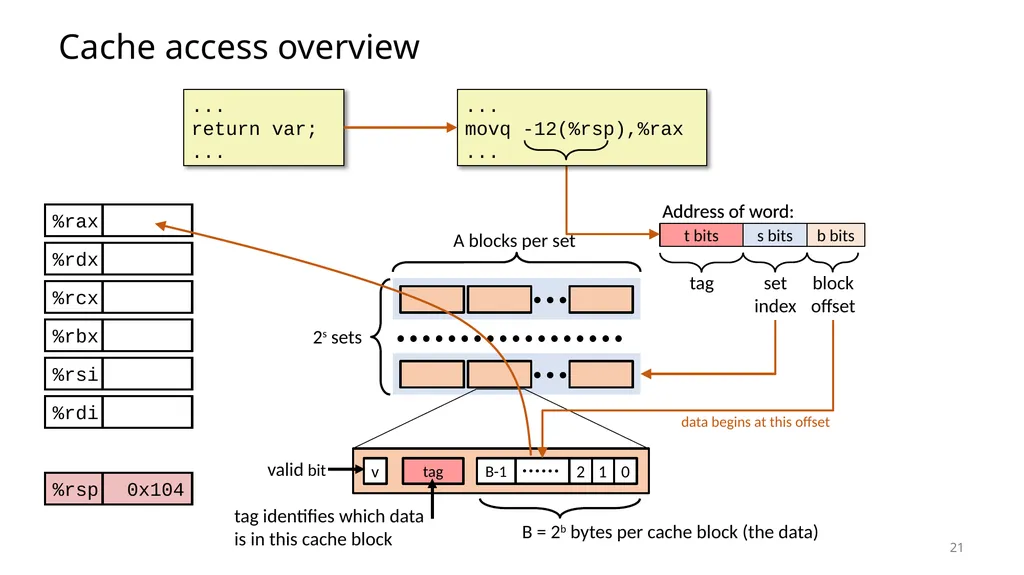
Cache access overview A blocks per set 2s sets 0 1 2 B-1 tag v B = 2b bytes per cache block (the data) t bits s bits b bits Address of word: tag set
index data begins at this offset block
offset Address of word: 21 ...
return var;
... ...
movq -12(%rsp),%rax
... valid bit tag identifies which data is in this cache block<br>
index data begins at this offset block
offset Address of word: 21 ...
return var;
... ...
movq -12(%rsp),%rax
... valid bit tag identifies which data is in this cache block<br>
22
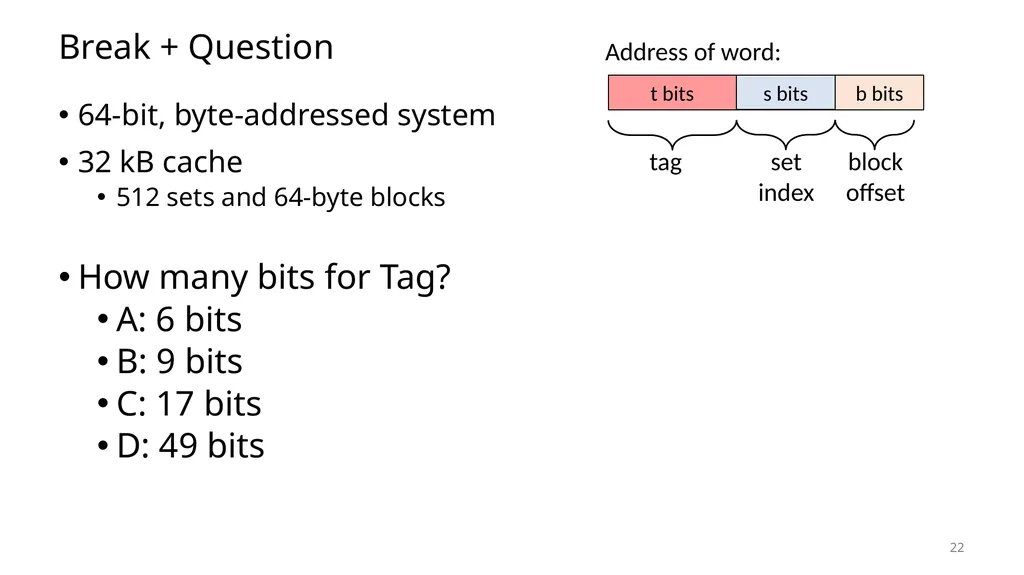
Break + Question 64-bit, byte-addressed system
32 kB cache
512 sets and 64-byte blocks
How many bits for Tag?
A: 6 bits
B: 9 bits
C: 17 bits
D: 49 bits 22<br>
32 kB cache
512 sets and 64-byte blocks
How many bits for Tag?
A: 6 bits
B: 9 bits
C: 17 bits
D: 49 bits 22<br>
23
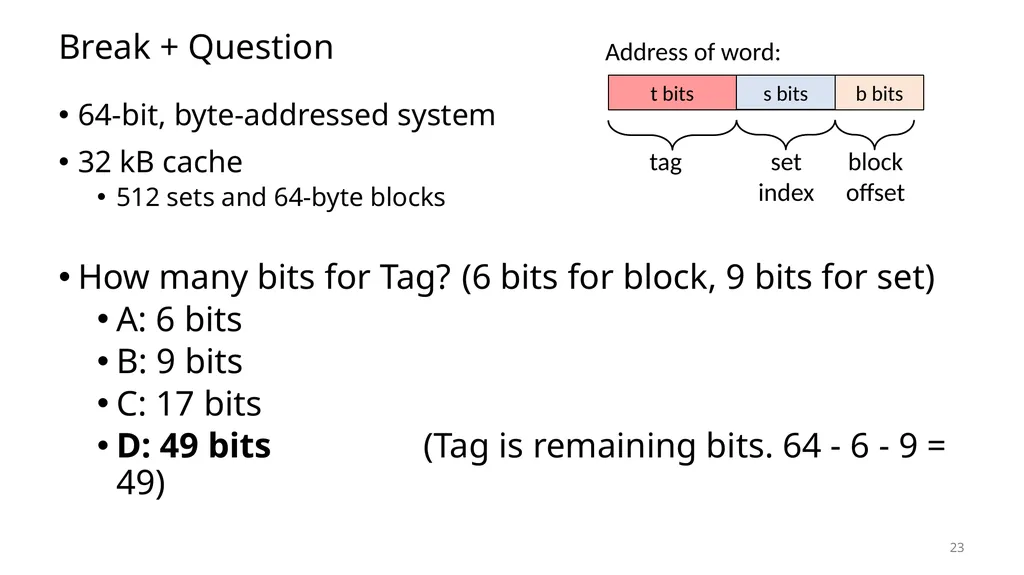
Break + Question 64-bit, byte-addressed system
32 kB cache
512 sets and 64-byte blocks
How many bits for Tag? (6 bits for block, 9 bits for set)
A: 6 bits
B: 9 bits
C: 17 bits
D: 49 bits (Tag is remaining bits. 64 - 6 - 9 = 49) 23<br>
32 kB cache
512 sets and 64-byte blocks
How many bits for Tag? (6 bits for block, 9 bits for set)
A: 6 bits
B: 9 bits
C: 17 bits
D: 49 bits (Tag is remaining bits. 64 - 6 - 9 = 49) 23<br>
24
What about writes? Multiple copies of data exist:
L1, L2, Main Memory, Disk
Don’t want them to get (or at least not to stay) out of sync!
Otherwise, who do you believe?
Multiple configuration options that a cache could have 24<br>
L1, L2, Main Memory, Disk
Don’t want them to get (or at least not to stay) out of sync!
Otherwise, who do you believe?
Multiple configuration options that a cache could have 24<br>
25
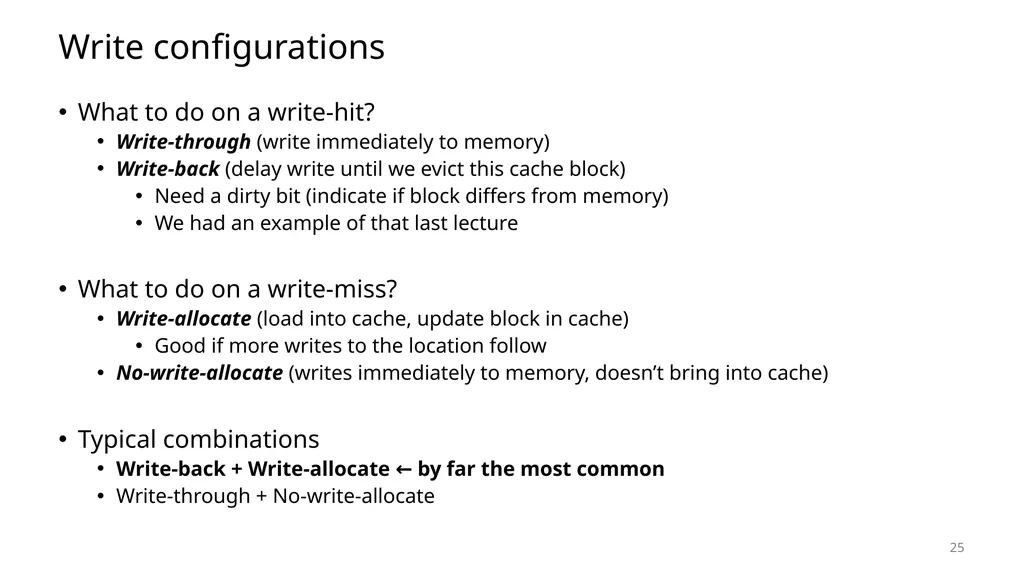
Write configurations What to do on a write-hit?
Write-through (write immediately to memory)
Write-back (delay write until we evict this cache block)
Need a dirty bit (indicate if block differs from memory)
We had an example of that last lecture
What to do on a write-miss?
Write-allocate (load into cache, update block in cache)
Good if more writes to the location follow
No-write-allocate (writes immediately to memory, doesn’t bring into cache)
Typical combinations
Write-back + Write-allocate ← by far the most common
Write-through + No-write-allocate 25<br>
26
26 Locality of Reference
Cache Organization
Associativity
Cache Performance Outline<br>
Cache Organization
Associativity
Cache Performance Outline<br>
27
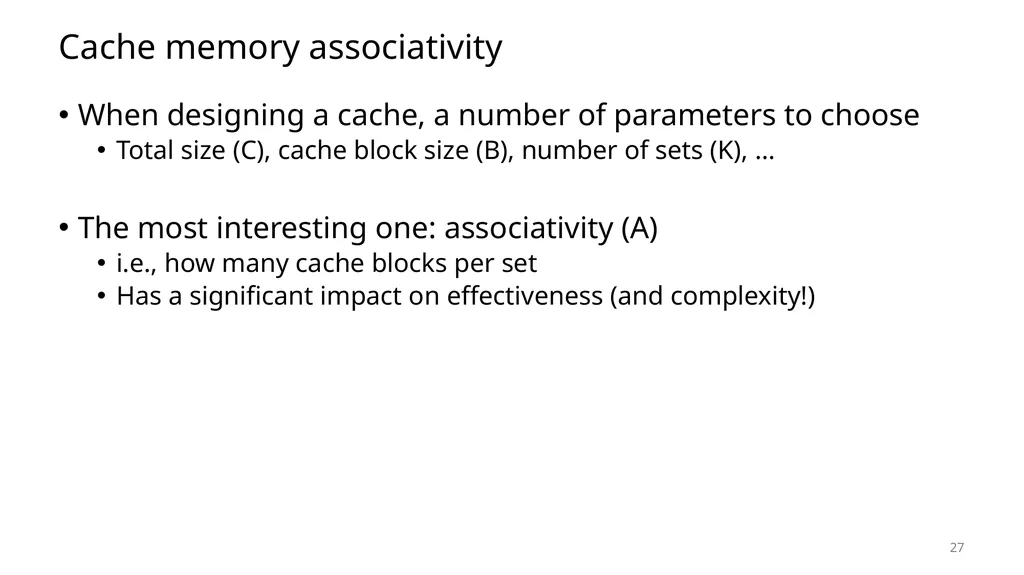
Cache memory associativity When designing a cache, a number of parameters to choose
Total size (C), cache block size (B), number of sets (K), …
The most interesting one: associativity (A)
i.e., how many cache blocks per set
Has a significant impact on effectiveness (and complexity!) 27<br>
Total size (C), cache block size (B), number of sets (K), …
The most interesting one: associativity (A)
i.e., how many cache blocks per set
Has a significant impact on effectiveness (and complexity!) 27<br>
28
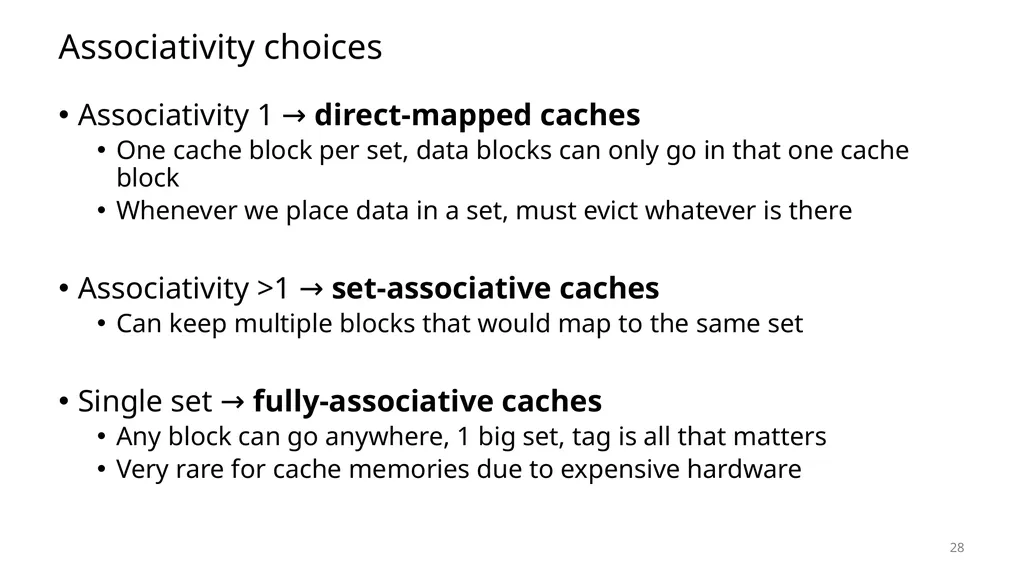
Associativity choices Associativity 1 → direct-mapped caches
One cache block per set, data blocks can only go in that one cache block
Whenever we place data in a set, must evict whatever is there
Associativity >1 → set-associative caches
Can keep multiple blocks that would map to the same set
Single set → fully-associative caches
Any block can go anywhere, 1 big set, tag is all that matters
Very rare for cache memories due to expensive hardware 28<br>
29
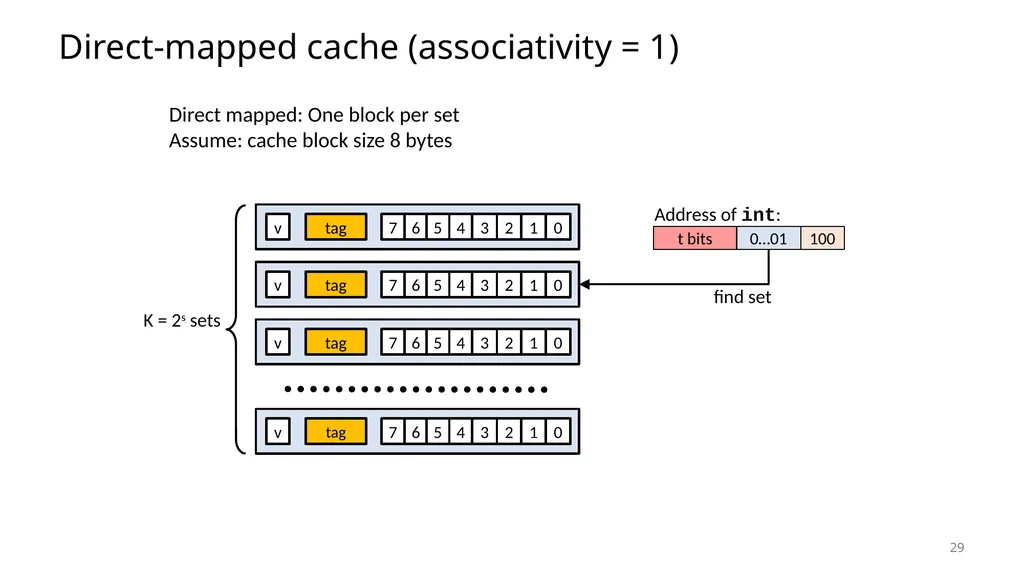
Direct-mapped cache (associativity = 1) K = 2s sets Direct mapped: One block per set
Assume: cache block size 8 bytes t bits 0…01 100 Address of int: 7 6 5 0 tag v 4 1 2 3 7 6 5 0 tag v 4 1 2 3 7 6 5 0 tag v 4 1 2 3 7 6 5 0 tag v 4 1 2 3 find set 29<br>
Assume: cache block size 8 bytes t bits 0…01 100 Address of int: 7 6 5 0 tag v 4 1 2 3 7 6 5 0 tag v 4 1 2 3 7 6 5 0 tag v 4 1 2 3 7 6 5 0 tag v 4 1 2 3 find set 29<br>
30
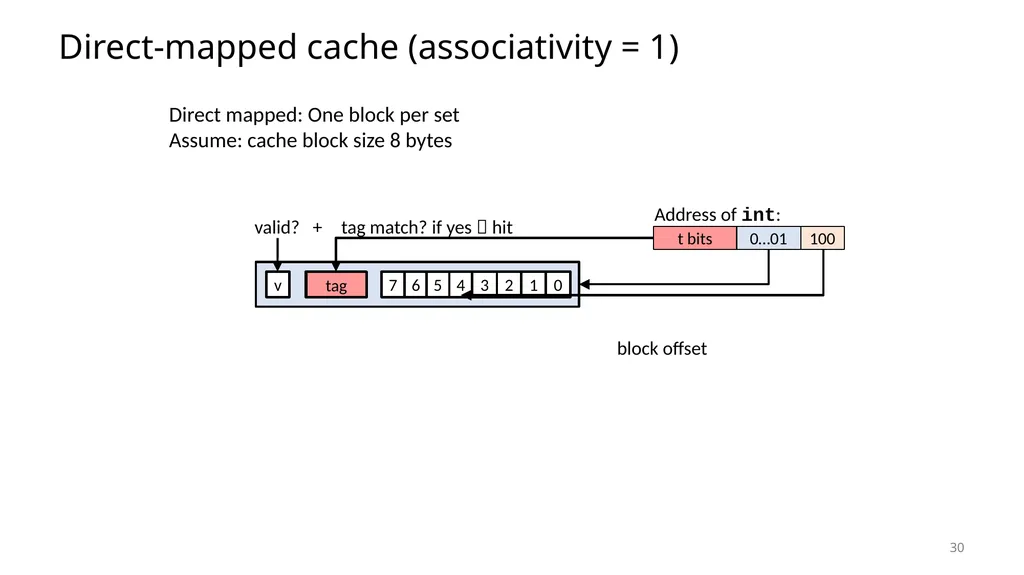
Direct-mapped cache (associativity = 1) Direct mapped: One block per set
Assume: cache block size 8 bytes t bits 0…01 100 7 6 5 0 tag v 4 1 2 3 tag match? if yes hit valid? + block offset tag 30 Address of int:<br>
Assume: cache block size 8 bytes t bits 0…01 100 7 6 5 0 tag v 4 1 2 3 tag match? if yes hit valid? + block offset tag 30 Address of int:<br>
31
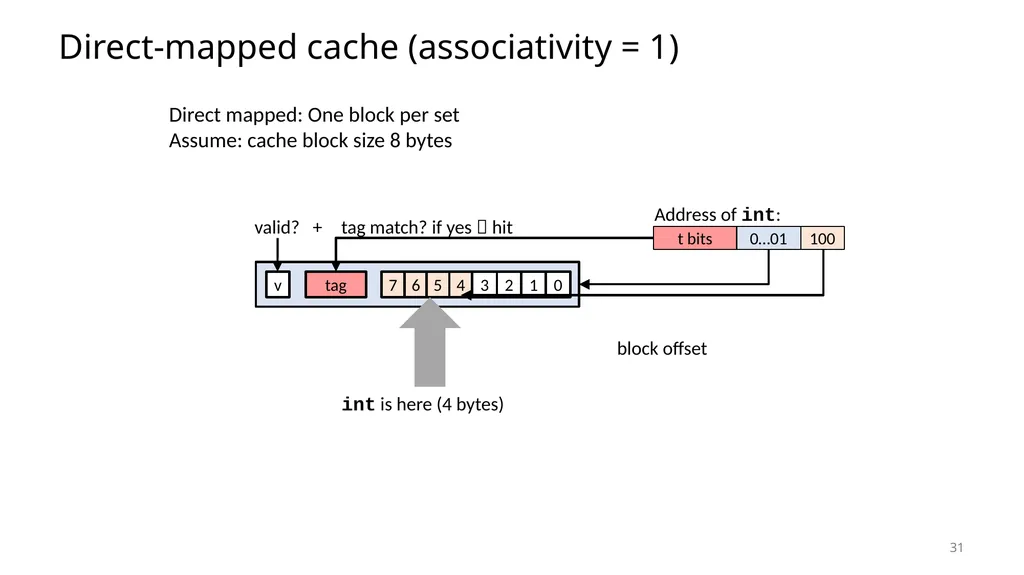
Direct-mapped cache (associativity = 1) Direct mapped: One block per set
Assume: cache block size 8 bytes t bits 0…01 100 7 6 5 0 tag v 4 1 2 3 tag match? if yes hit valid? + int is here (4 bytes) block offset 31 Address of int:<br>
Assume: cache block size 8 bytes t bits 0…01 100 7 6 5 0 tag v 4 1 2 3 tag match? if yes hit valid? + int is here (4 bytes) block offset 31 Address of int:<br>
32
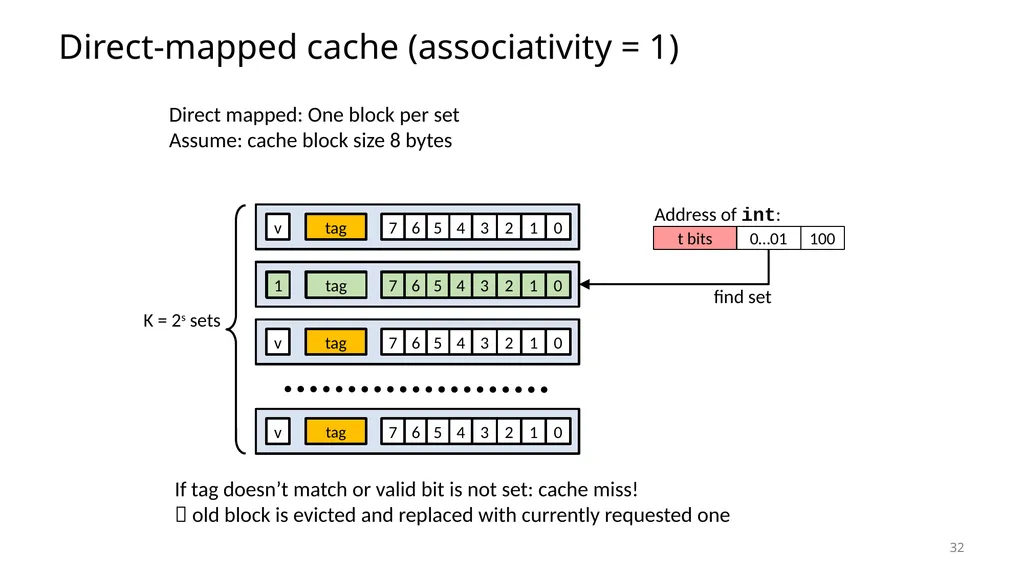
Direct-mapped cache (associativity = 1) K = 2s sets Direct mapped: One block per set
Assume: cache block size 8 bytes t bits 0…01 100 7 6 5 0 tag v 4 1 2 3 7 6 5 0 tag v 4 1 2 3 7 6 5 0 tag v 4 1 2 3 7 6 5 0 tag v 4 1 2 3 find set If tag doesn’t match or valid bit is not set: cache miss!
old block is evicted and replaced with currently requested one X X tag 1 7 6 5 0 4 1 2 3 32 Address of int:<br>
33
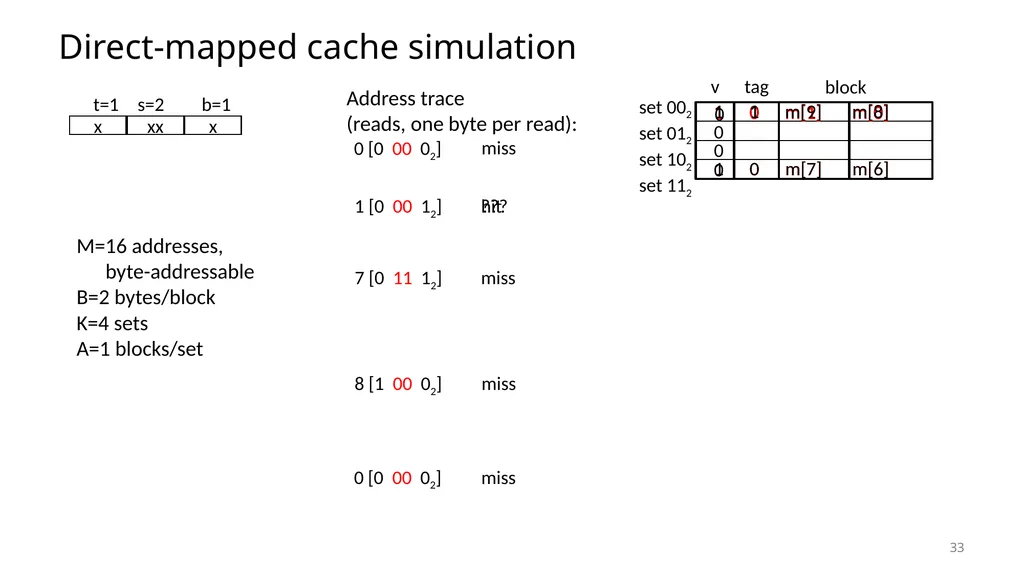
Direct-mapped cache simulation 7 [0 11 12] 8 [1 00 02] 0 [0 00 02] 1 [0 00 12] 0 [0 00 02] 1 0 m[1] m[0] 1 0 m[1] m[0] 1 0 m[7] m[6] 1 1 m[9] m[8] 1 0 m[1] m[0] 1 0 m[7] m[6] miss hit miss miss miss M=16 addresses,
byte-addressable B=2 bytes/block
K=4 sets A=1 blocks/set Address trace (reads, one byte per read): set 002
set 012
set 102
set 112 1 1 m[9] m[8] 0 0 0 0 ??? 33<br>
byte-addressable B=2 bytes/block
K=4 sets A=1 blocks/set Address trace (reads, one byte per read): set 002
set 012
set 102
set 112 1 1 m[9] m[8] 0 0 0 0 ??? 33<br>
34
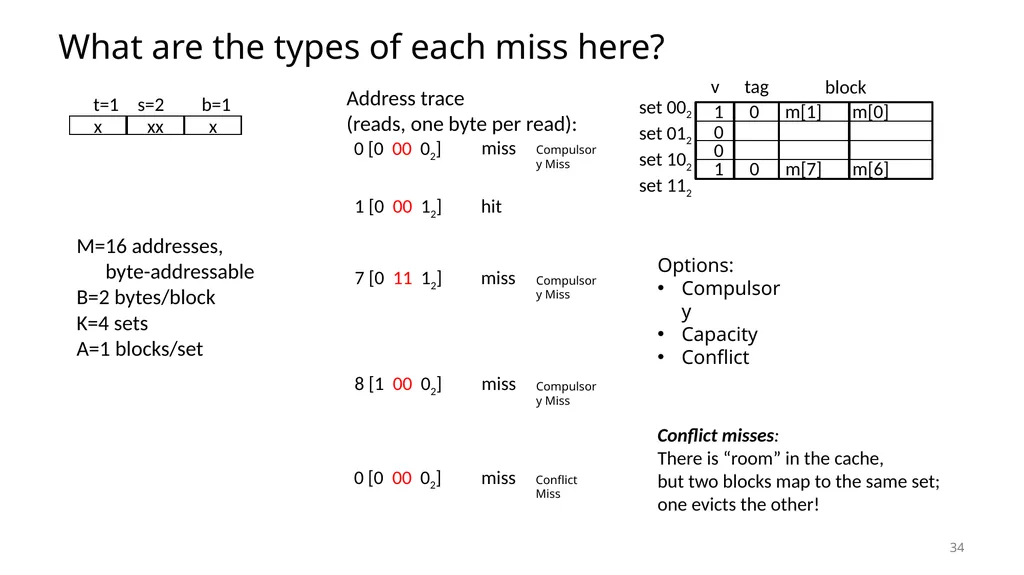
What are the types of each miss here? 7 [0 11 12] 8 [1 00 02] 0 [0 00 02] 1 [0 00 12] Conflict misses:
There is “room” in the cache,
but two blocks map to the same set; one evicts the other! 0 [0 00 02] miss hit miss miss miss M=16 addresses,
byte-addressable B=2 bytes/block
K=4 sets A=1 blocks/set Address trace (reads, one byte per read): set 002
set 012
set 102
set 112 0 0 34 Compulsory Miss Compulsory Miss Compulsory Miss Conflict Miss 1 0 m[7] m[6] Options:
Compulsory
Capacity
Conflict 1 0 m[1] m[0]<br>
byte-addressable B=2 bytes/block
K=4 sets A=1 blocks/set Address trace (reads, one byte per read): set 002
set 012
set 102
set 112 0 0 34 Compulsory Miss Compulsory Miss Compulsory Miss Conflict Miss 1 0 m[7] m[6] Options:
Compulsory
Capacity
Conflict 1 0 m[1] m[0]<br>
35
Pause for questions on direct-mapped caches 35<br>
36
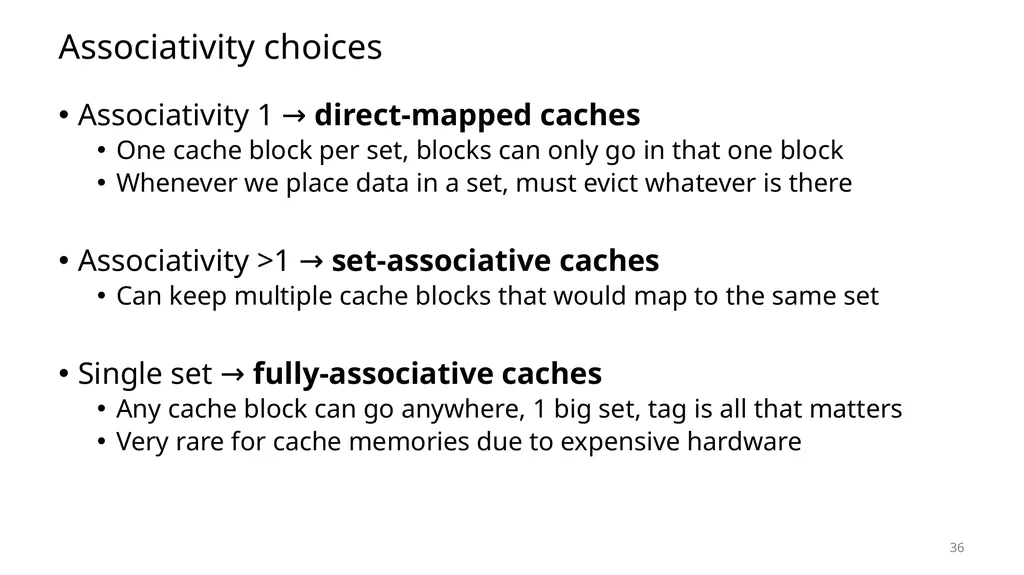
Associativity choices Associativity 1 → direct-mapped caches
One cache block per set, blocks can only go in that one block
Whenever we place data in a set, must evict whatever is there
Associativity >1 → set-associative caches
Can keep multiple cache blocks that would map to the same set
Single set → fully-associative caches
Any cache block can go anywhere, 1 big set, tag is all that matters
Very rare for cache memories due to expensive hardware 36<br>
37
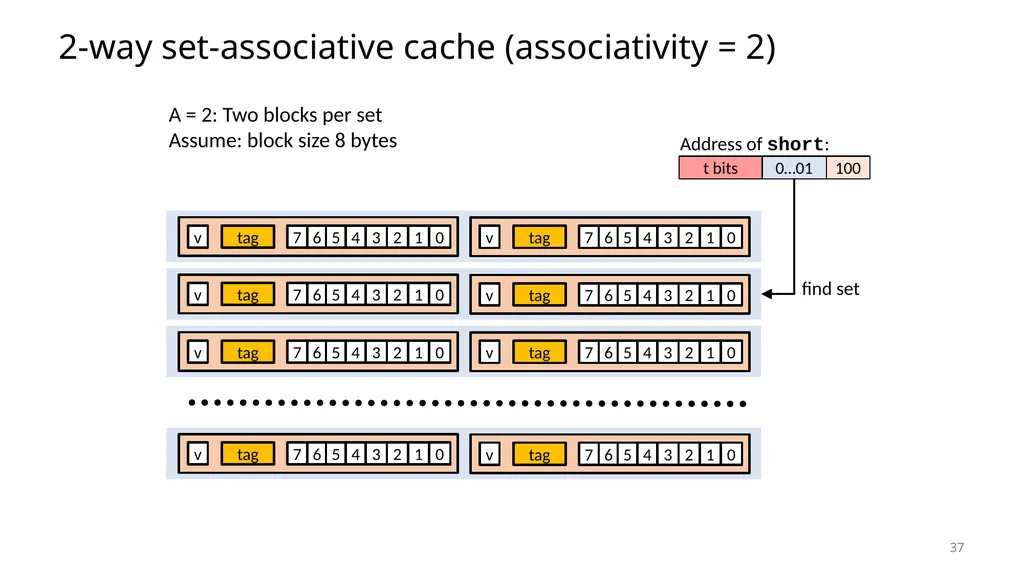
2-way set-associative cache (associativity = 2) A = 2: Two blocks per set
Assume: block size 8 bytes t bits 0…01 100 Address of short: 7 6 5 0 tag v 4 1 2 3 7 6 5 0 tag v 4 1 2 3 7 6 5 0 tag v 4 1 2 3 7 6 5 0 tag v 4 1 2 3 7 6 5 0 tag v 4 1 2 3 7 6 5 0 tag v 4 1 2 3 7 6 5 0 tag v 4 1 2 3 7 6 5 0 tag v 4 1 2 3 find set 37<br>
Assume: block size 8 bytes t bits 0…01 100 Address of short: 7 6 5 0 tag v 4 1 2 3 7 6 5 0 tag v 4 1 2 3 7 6 5 0 tag v 4 1 2 3 7 6 5 0 tag v 4 1 2 3 7 6 5 0 tag v 4 1 2 3 7 6 5 0 tag v 4 1 2 3 7 6 5 0 tag v 4 1 2 3 7 6 5 0 tag v 4 1 2 3 find set 37<br>
38
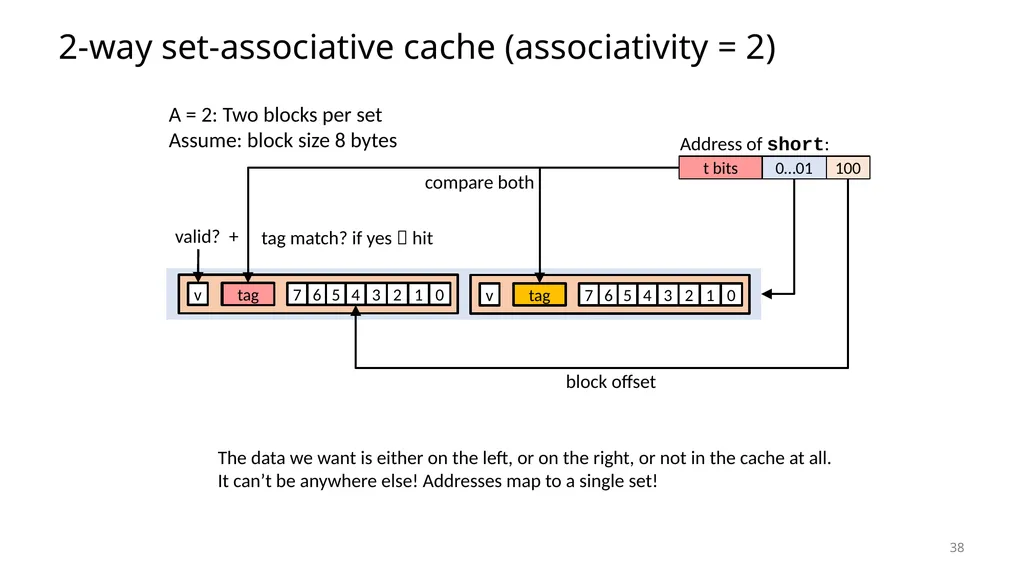
2-way set-associative cache (associativity = 2) A = 2: Two blocks per set
Assume: block size 8 bytes t bits 0…01 100 Address of short: 7 6 5 0 tag v 4 1 2 3 7 6 5 0 tag v 4 1 2 3 compare both valid? + tag match? if yes hit block offset tag The data we want is either on the left, or on the right, or not in the cache at all.
It can’t be anywhere else! Addresses map to a single set! 38<br>
39
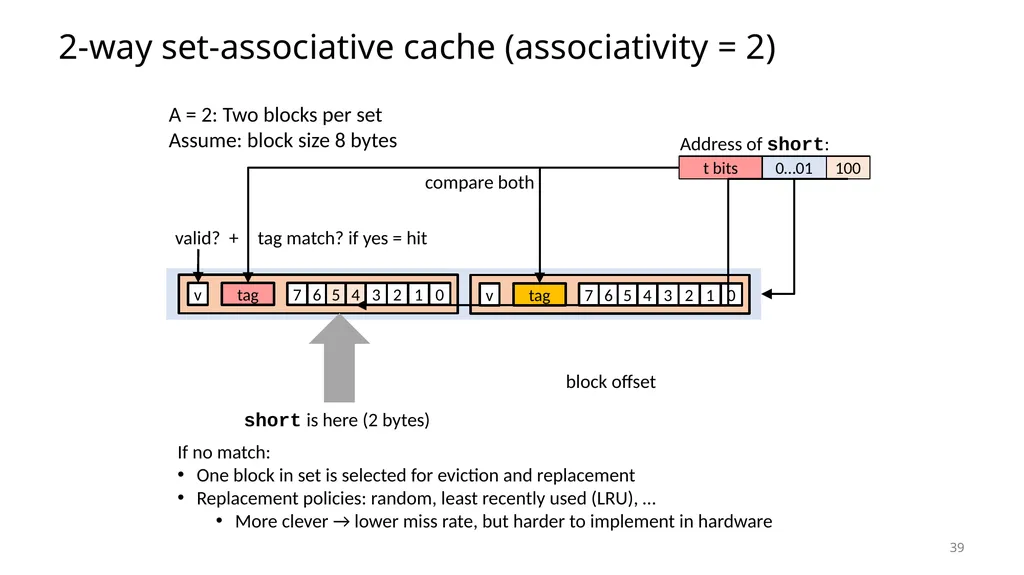
2-way set-associative cache (associativity = 2) A = 2: Two blocks per set
Assume: block size 8 bytes t bits 0…01 100 Address of short: 7 6 5 0 tag v 4 1 2 3 7 6 5 0 tag v 4 1 2 3 compare both valid? + tag match? if yes = hit block offset short is here (2 bytes) If no match:
One block in set is selected for eviction and replacement
Replacement policies: random, least recently used (LRU), …
More clever → lower miss rate, but harder to implement in hardware 39<br>
40
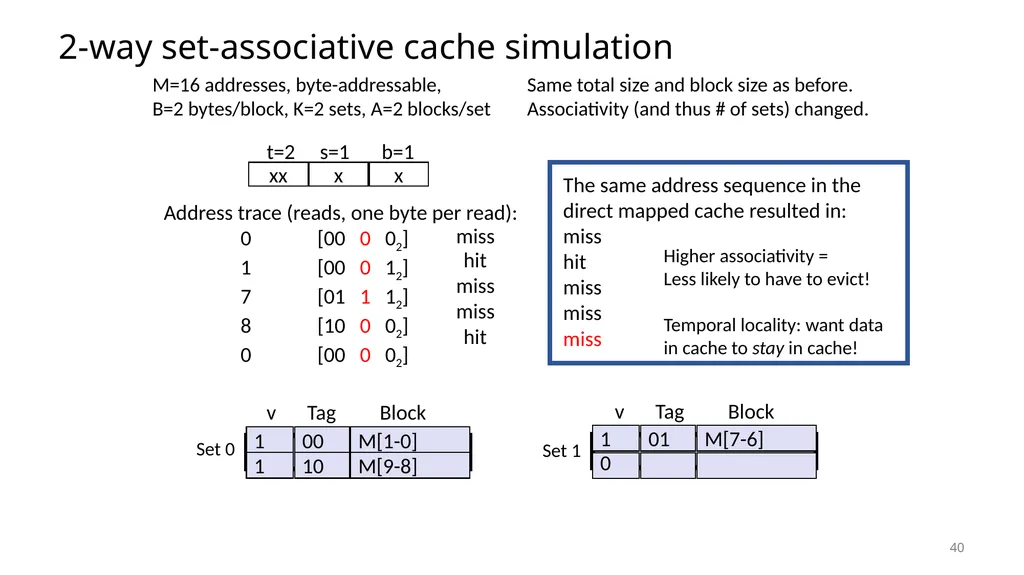
2-way set-associative cache simulation Address trace (reads, one byte per read):
0 [00 0 02]
1 [00 0 12]
7 [01 1 12]
8 [10 0 02]
0 [00 0 02] xx t=2 s=1 b=1 x x v Tag Block 0 0 0 miss hit miss miss hit Set 0 Set 1 The same address sequence in the direct mapped cache resulted in:
miss
hit
miss
miss
miss M=16 addresses, byte-addressable,
B=2 bytes/block, K=2 sets, A=2 blocks/set Higher associativity =
Less likely to have to evict!
Temporal locality: want data in cache to stay in cache! v Tag Block Same total size and block size as before.
Associativity (and thus # of sets) changed. 40<br>
41
Pause for questions on set-associative caches 41<br>
42
Fully-associative caches What changes with fully-associative caches?
Anything can go anywhere
Only one set (s = 0 bits)
Otherwise, same steps as for a set-associative cache
Compare tag against all blocks in the set 42<br>
Anything can go anywhere
Only one set (s = 0 bits)
Otherwise, same steps as for a set-associative cache
Compare tag against all blocks in the set 42<br>
43
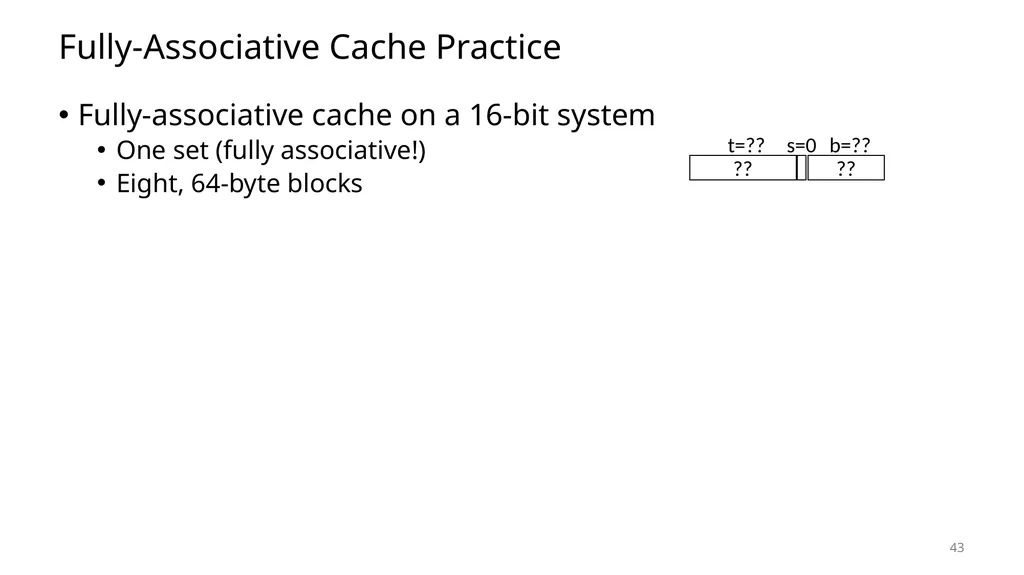
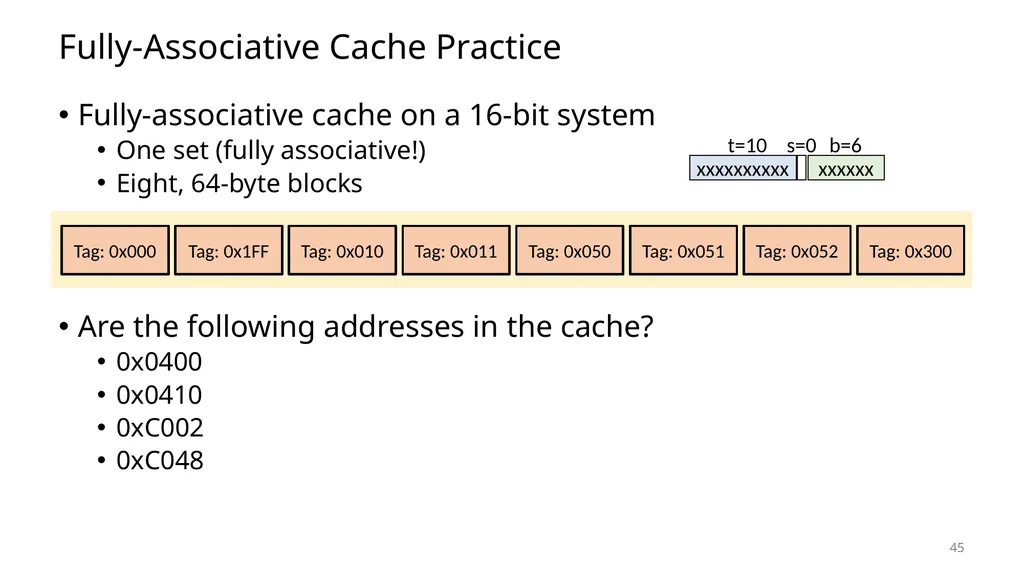
Fully-Associative Cache Practice Fully-associative cache on a 16-bit system
One set (fully associative!)
Eight, 64-byte blocks 43 ?? t=?? s=0 b=?? ??<br>
One set (fully associative!)
Eight, 64-byte blocks 43 ?? t=?? s=0 b=?? ??<br>
44
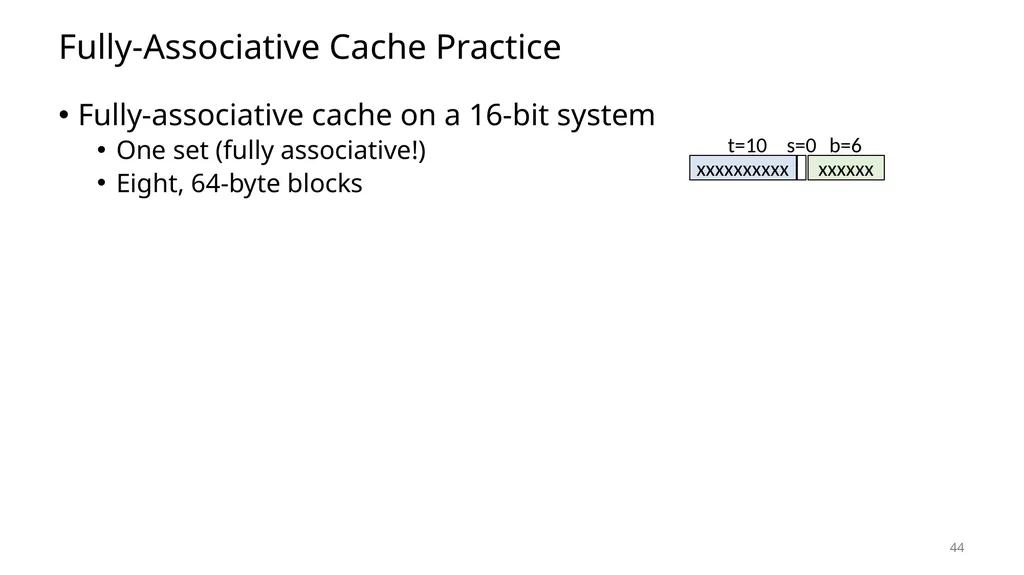
Fully-Associative Cache Practice Fully-associative cache on a 16-bit system
One set (fully associative!)
Eight, 64-byte blocks 44 xxxxxxxxxx t=10 s=0 b=6 xxxxxx<br>
One set (fully associative!)
Eight, 64-byte blocks 44 xxxxxxxxxx t=10 s=0 b=6 xxxxxx<br>
45
Fully-Associative Cache Practice Fully-associative cache on a 16-bit system
One set (fully associative!)
Eight, 64-byte blocks
Are the following addresses in the cache?
0x0400
0x0410
0xC002
0xC048 45 Tag: 0x010 Tag: 0x011 Tag: 0x000 Tag: 0x1FF Tag: 0x052 Tag: 0x300 Tag: 0x050 Tag: 0x051 xxxxxxxxxx t=10 s=0 b=6 xxxxxx<br>
One set (fully associative!)
Eight, 64-byte blocks
Are the following addresses in the cache?
0x0400
0x0410
0xC002
0xC048 45 Tag: 0x010 Tag: 0x011 Tag: 0x000 Tag: 0x1FF Tag: 0x052 Tag: 0x300 Tag: 0x050 Tag: 0x051 xxxxxxxxxx t=10 s=0 b=6 xxxxxx<br>
46
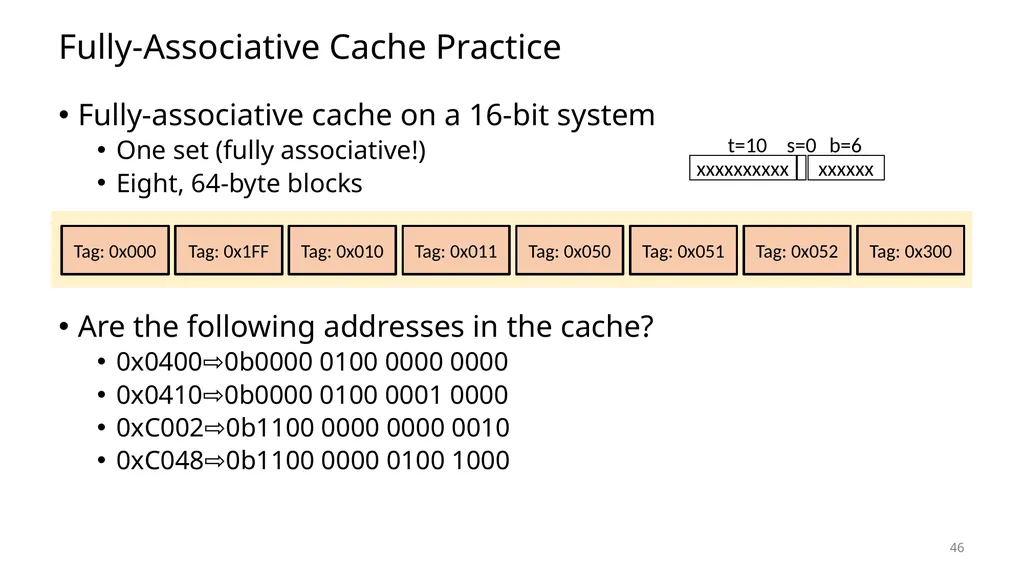
Fully-Associative Cache Practice Fully-associative cache on a 16-bit system
One set (fully associative!)
Eight, 64-byte blocks
Are the following addresses in the cache?
0x0400⇨0b0000 0100 0000 0000
0x0410⇨0b0000 0100 0001 0000
0xC002⇨0b1100 0000 0000 0010
0xC048⇨0b1100 0000 0100 1000 46 Tag: 0x010 Tag: 0x011 Tag: 0x000 Tag: 0x1FF Tag: 0x052 Tag: 0x300 Tag: 0x050 Tag: 0x051 xxxxxxxxxx t=10 s=0 b=6 xxxxxx<br>
47
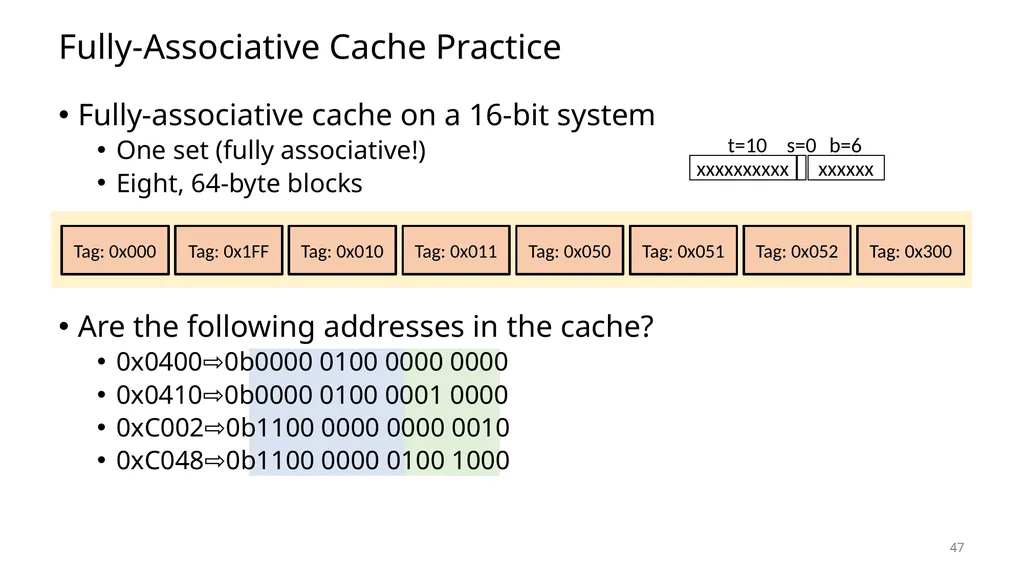
Fully-Associative Cache Practice Fully-associative cache on a 16-bit system
One set (fully associative!)
Eight, 64-byte blocks
Are the following addresses in the cache?
0x0400⇨0b0000 0100 0000 0000
0x0410⇨0b0000 0100 0001 0000
0xC002⇨0b1100 0000 0000 0010
0xC048⇨0b1100 0000 0100 1000 47 Tag: 0x010 Tag: 0x011 Tag: 0x000 Tag: 0x1FF Tag: 0x052 Tag: 0x300 Tag: 0x050 Tag: 0x051 xxxxxxxxxx t=10 s=0 b=6 xxxxxx<br>
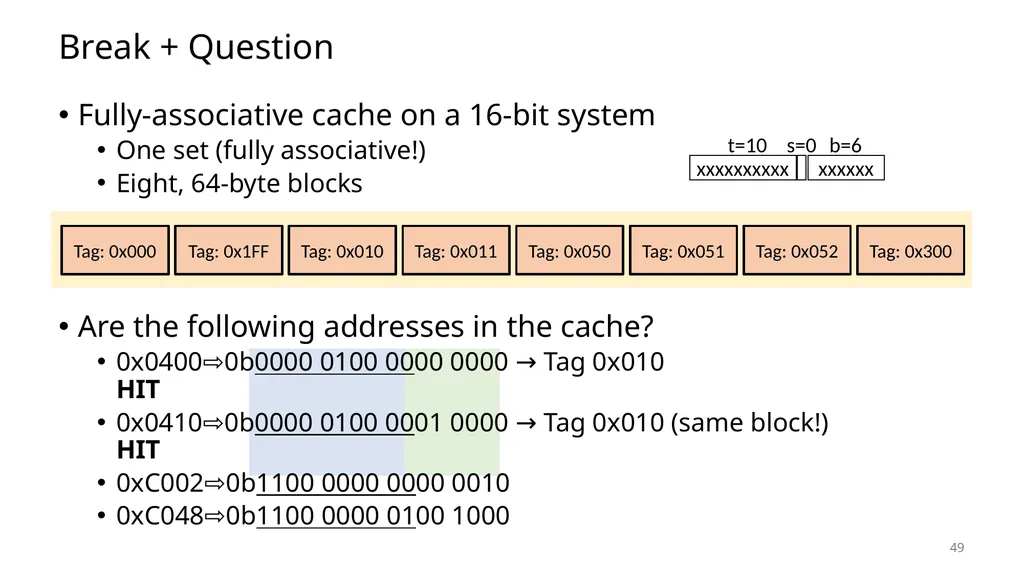
48
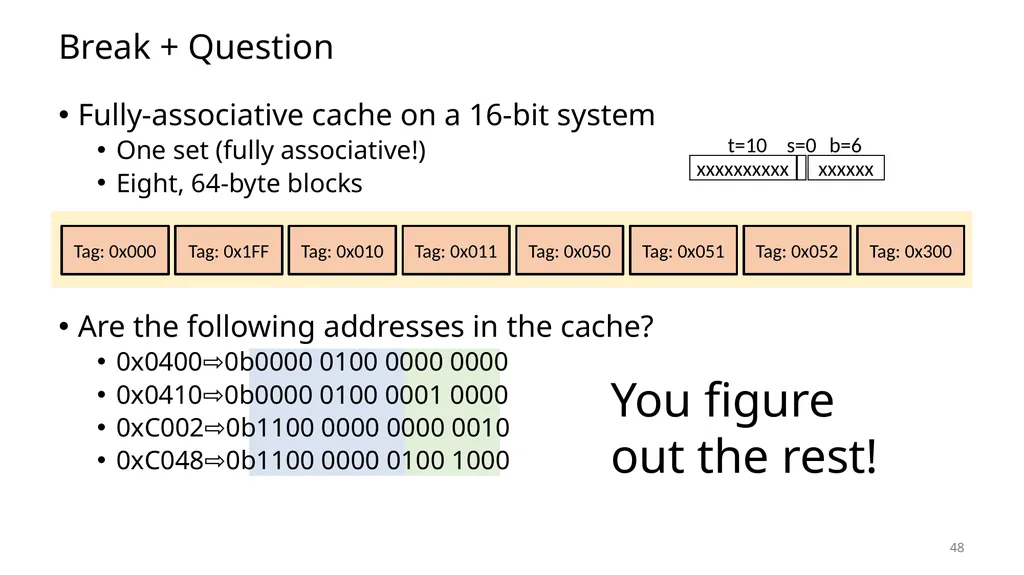
Break + Question Fully-associative cache on a 16-bit system
One set (fully associative!)
Eight, 64-byte blocks
Are the following addresses in the cache?
0x0400⇨0b0000 0100 0000 0000
0x0410⇨0b0000 0100 0001 0000
0xC002⇨0b1100 0000 0000 0010
0xC048⇨0b1100 0000 0100 1000 48 Tag: 0x010 Tag: 0x011 Tag: 0x000 Tag: 0x1FF Tag: 0x052 Tag: 0x300 Tag: 0x050 Tag: 0x051 xxxxxxxxxx t=10 s=0 b=6 xxxxxx You figure out the rest!<br>
49
Break + Question Fully-associative cache on a 16-bit system
One set (fully associative!)
Eight, 64-byte blocks
Are the following addresses in the cache?
0x0400⇨0b0000 0100 0000 0000 → Tag 0x010 HIT
0x0410⇨0b0000 0100 0001 0000 → Tag 0x010 (same block!) HIT
0xC002⇨0b1100 0000 0000 0010
0xC048⇨0b1100 0000 0100 1000 49 Tag: 0x010 Tag: 0x011 Tag: 0x000 Tag: 0x1FF Tag: 0x052 Tag: 0x300 Tag: 0x050 Tag: 0x051 xxxxxxxxxx t=10 s=0 b=6 xxxxxx<br>
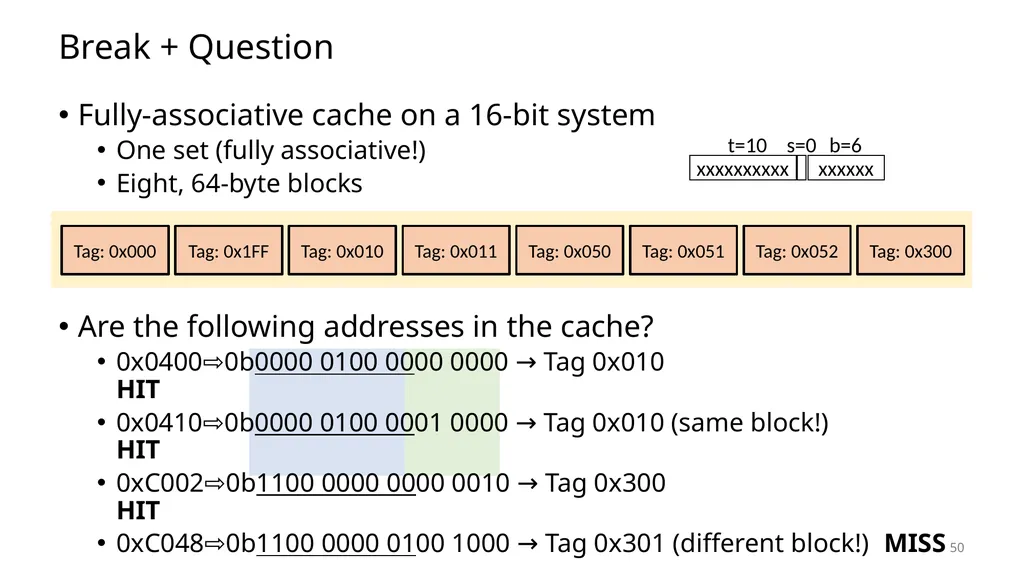
50
Break + Question Fully-associative cache on a 16-bit system
One set (fully associative!)
Eight, 64-byte blocks
Are the following addresses in the cache?
0x0400⇨0b0000 0100 0000 0000 → Tag 0x010 HIT
0x0410⇨0b0000 0100 0001 0000 → Tag 0x010 (same block!) HIT
0xC002⇨0b1100 0000 0000 0010 → Tag 0x300 HIT
0xC048⇨0b1100 0000 0100 1000 → Tag 0x301 (different block!) MISS 50 Tag: 0x010 Tag: 0x011 Tag: 0x000 Tag: 0x1FF Tag: 0x052 Tag: 0x300 Tag: 0x050 Tag: 0x051 xxxxxxxxxx t=10 s=0 b=6 xxxxxx<br>
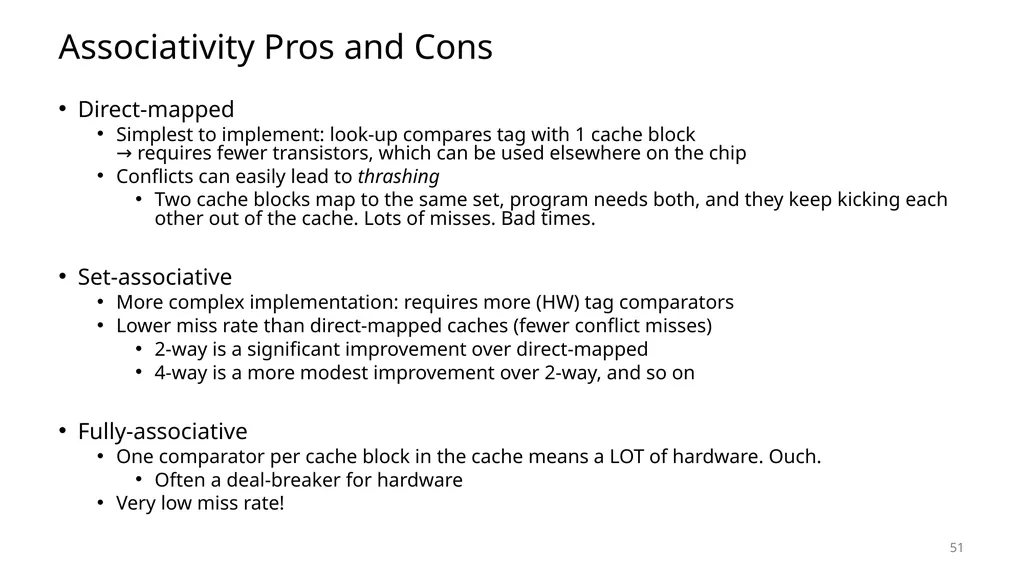
51
Associativity Pros and Cons Direct-mapped
Simplest to implement: look-up compares tag with 1 cache block → requires fewer transistors, which can be used elsewhere on the chip
Conflicts can easily lead to thrashing
Two cache blocks map to the same set, program needs both, and they keep kicking each other out of the cache. Lots of misses. Bad times.
Set-associative
More complex implementation: requires more (HW) tag comparators
Lower miss rate than direct-mapped caches (fewer conflict misses)
2-way is a significant improvement over direct-mapped
4-way is a more modest improvement over 2-way, and so on
Fully-associative
One comparator per cache block in the cache means a LOT of hardware. Ouch.
Often a deal-breaker for hardware
Very low miss rate! 51<br>
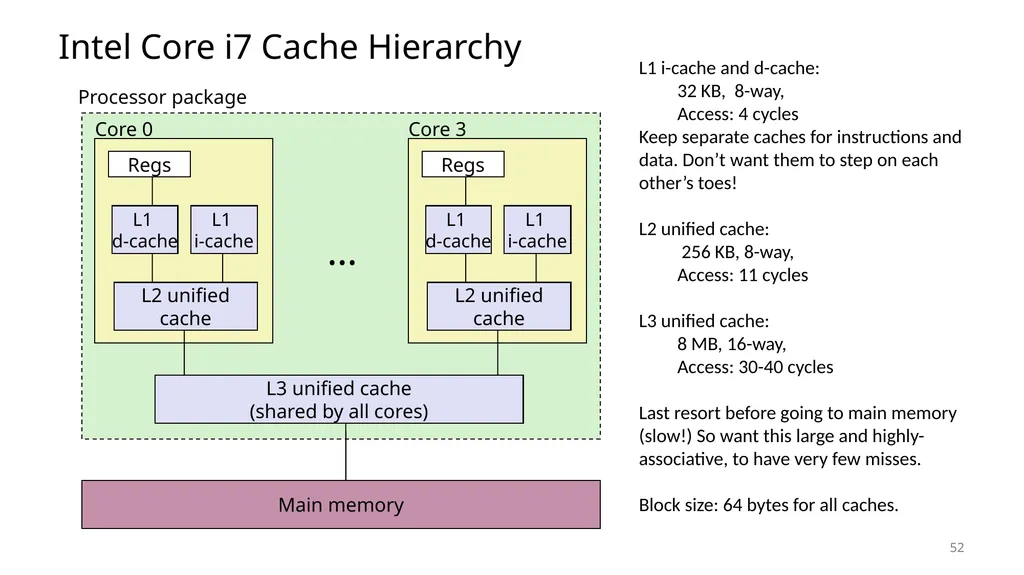
52
Intel Core i7 Cache Hierarchy Regs L1
d-cache L1
i-cache L2 unified cache Core 0 Regs L1
d-cache L1
i-cache L2 unified cache Core 3 … L3 unified cache
(shared by all cores) Main memory Processor package L1 i-cache and d-cache:
32 KB, 8-way,
Access: 4 cycles
Keep separate caches for instructions and data. Don’t want them to step on each other’s toes!
L2 unified cache:
256 KB, 8-way,
Access: 11 cycles
L3 unified cache:
8 MB, 16-way,
Access: 30-40 cycles
Last resort before going to main memory (slow!) So want this large and highly-associative, to have very few misses.
Block size: 64 bytes for all caches. 52<br>
d-cache L1
i-cache L2 unified cache Core 0 Regs L1
d-cache L1
i-cache L2 unified cache Core 3 … L3 unified cache
(shared by all cores) Main memory Processor package L1 i-cache and d-cache:
32 KB, 8-way,
Access: 4 cycles
Keep separate caches for instructions and data. Don’t want them to step on each other’s toes!
L2 unified cache:
256 KB, 8-way,
Access: 11 cycles
L3 unified cache:
8 MB, 16-way,
Access: 30-40 cycles
Last resort before going to main memory (slow!) So want this large and highly-associative, to have very few misses.
Block size: 64 bytes for all caches. 52<br>
53
53 Locality of Reference
Cache Organization
Associativity
Cache Performance Outline<br>
Cache Organization
Associativity
Cache Performance Outline<br>
54
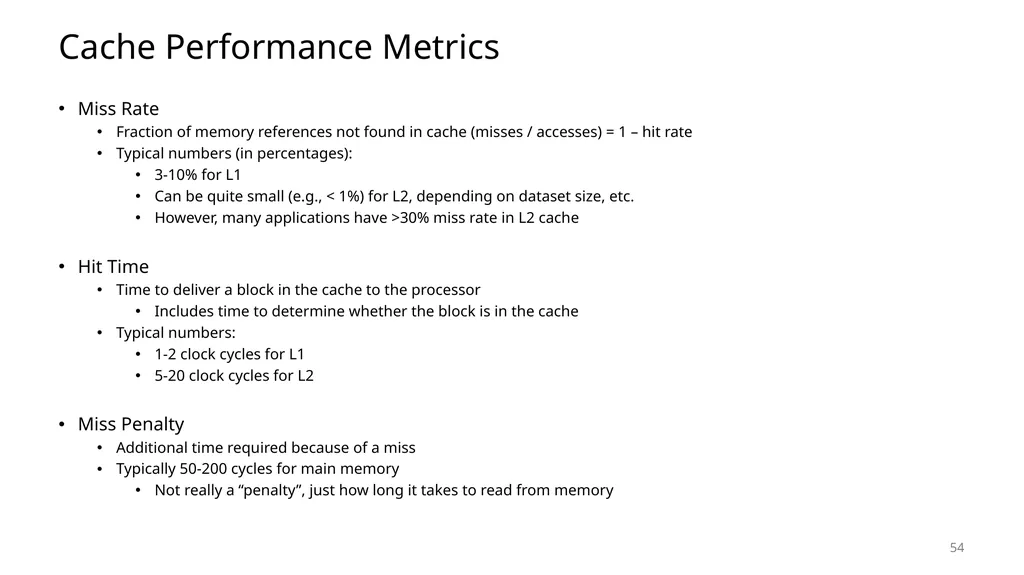
Cache Performance Metrics Miss Rate
Fraction of memory references not found in cache (misses / accesses) = 1 – hit rate
Typical numbers (in percentages):
3-10% for L1
Can be quite small (e.g., < 1%) for L2, depending on dataset size, etc.
However, many applications have >30% miss rate in L2 cache
Hit Time
Time to deliver a block in the cache to the processor
Includes time to determine whether the block is in the cache
Typical numbers:
1-2 clock cycles for L1
5-20 clock cycles for L2
Miss Penalty
Additional time required because of a miss
Typically 50-200 cycles for main memory
Not really a “penalty”, just how long it takes to read from memory 54<br>
55
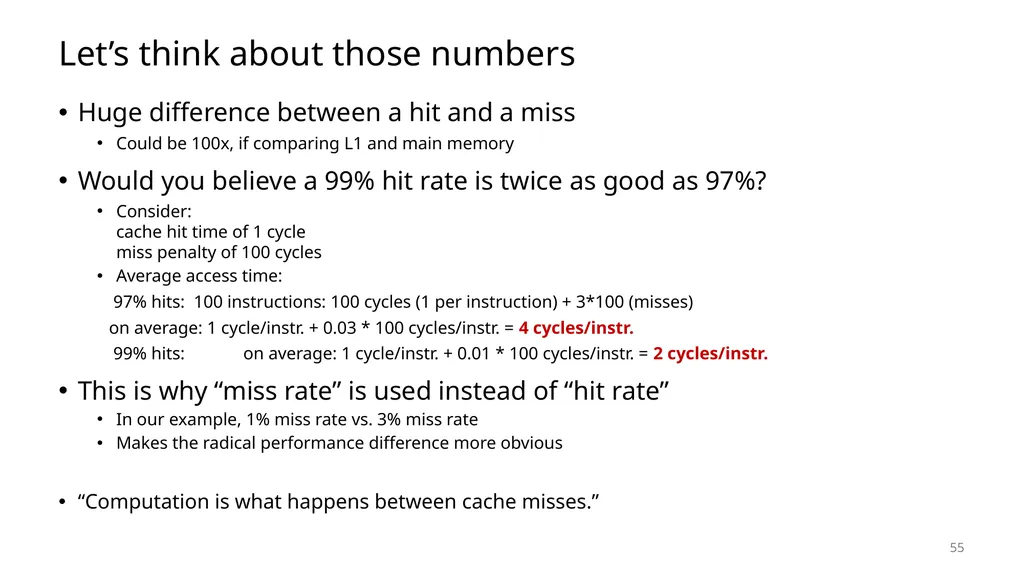
Let’s think about those numbers Huge difference between a hit and a miss
Could be 100x, if comparing L1 and main memory
Would you believe a 99% hit rate is twice as good as 97%?
Consider: cache hit time of 1 cycle miss penalty of 100 cycles
Average access time:
97% hits: 100 instructions: 100 cycles (1 per instruction) + 3*100 (misses)
on average: 1 cycle/instr. + 0.03 * 100 cycles/instr. = 4 cycles/instr.
99% hits: on average: 1 cycle/instr. + 0.01 * 100 cycles/instr. = 2 cycles/instr.
This is why “miss rate” is used instead of “hit rate”
In our example, 1% miss rate vs. 3% miss rate
Makes the radical performance difference more obvious
“Computation is what happens between cache misses.” 55<br>
56
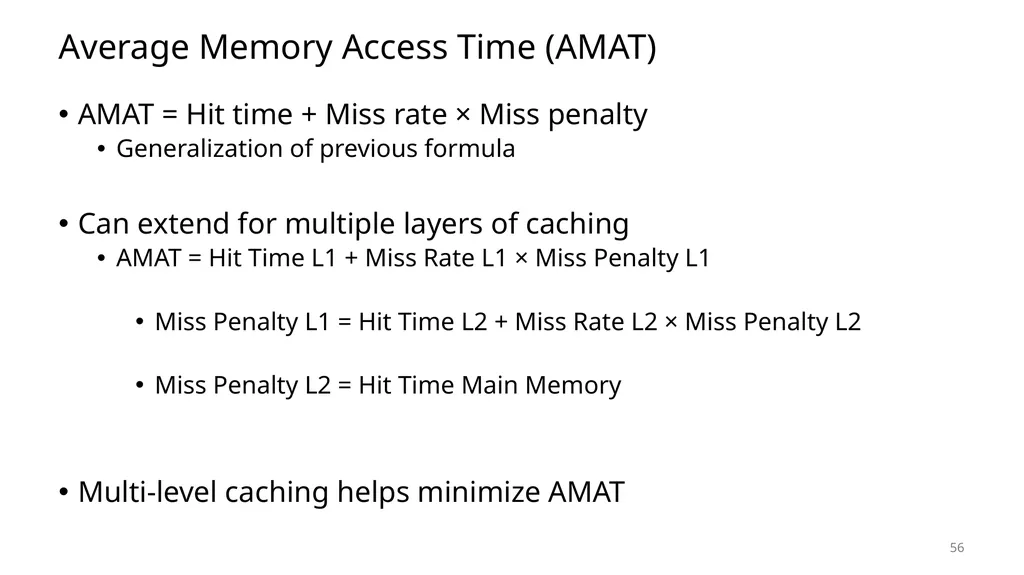
Average Memory Access Time (AMAT) AMAT = Hit time + Miss rate × Miss penalty
Generalization of previous formula
Can extend for multiple layers of caching
AMAT = Hit Time L1 + Miss Rate L1 × Miss Penalty L1
Miss Penalty L1 = Hit Time L2 + Miss Rate L2 × Miss Penalty L2
Miss Penalty L2 = Hit Time Main Memory
Multi-level caching helps minimize AMAT 56<br>
Generalization of previous formula
Can extend for multiple layers of caching
AMAT = Hit Time L1 + Miss Rate L1 × Miss Penalty L1
Miss Penalty L1 = Hit Time L2 + Miss Rate L2 × Miss Penalty L2
Miss Penalty L2 = Hit Time Main Memory
Multi-level caching helps minimize AMAT 56<br>
57
57 Locality of Reference
Cache Organization
Associativity
Cache Performance Outline<br>
Cache Organization
Associativity
Cache Performance Outline<br>