Teams and Team Models in: Early Intervention/Early
Description: Teams and Team Models in: Early InterventionEarly Childhood Special Education (EIECSE) EIECSE Standard 3, Component 3.1 Candidates apply teaming models, skills, and processes, including appropriate uses of technology, when collaborating
Related Topics
Download Presentation
"Teams and Team Models in: Early Intervention/Early" is the property of its rightful owner. Permission is granted to download and print the materials on this website for personal, non-commercial use only, and to display it on your personal computer provided you do not modify the materials and that you retain all copyright notices contained in the materials. By downloading content from our website, you accept the terms of this agreement.
Presentation Transcript
slide1. Teams and Team Models in: Early Intervention/Early Childhood Special Education (EI/ECSE)<br>
slide2. EI/ECSE Standard 3, Component 3.1 Candidates apply teaming models, skills, and processes, including appropriate uses of technology, when collaborating and communicating with families; professionals representing multiple disciplines, skills, expertise, and roles; and community partners and agencies.<br>
slide3. TC1 Practitioners representing multiple disciplines and families work together as a team to plan and implement supports and services to meet the unique needs of each child and family.
TC2 Practitioners and families work together as a team to systematically and regularly exchange expertise, knowledge, and information to build team capacity and jointly solve problems, plan, and implement interventions. DEC Recommended Practices (RPs, 2014)<br>
slide4. TC3 Practitioners use communication and group facilitation strategies to enhance team functioning and interpersonal relationships with and among team members. DEC Recommended Practices (RPs, 2014)<br>
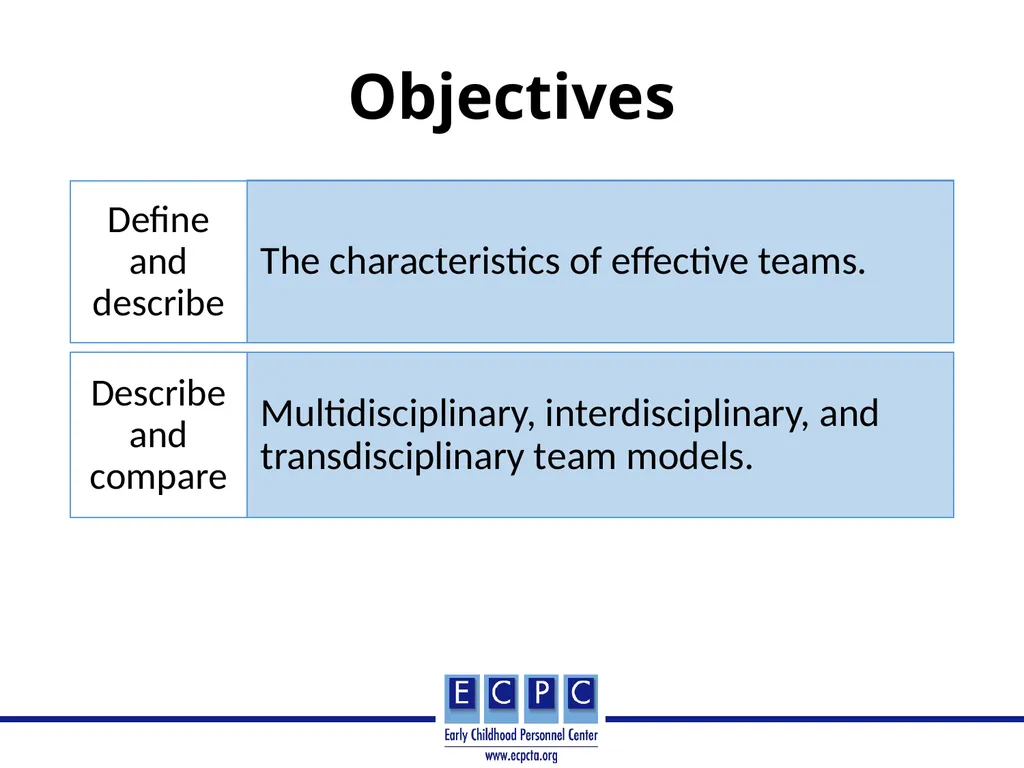
slide5. Objectives<br>
slide6. Teams and Their Characteristics<br>
slide7. “Alone we can do so little; together we can do so much.” - Helen Keller<br>
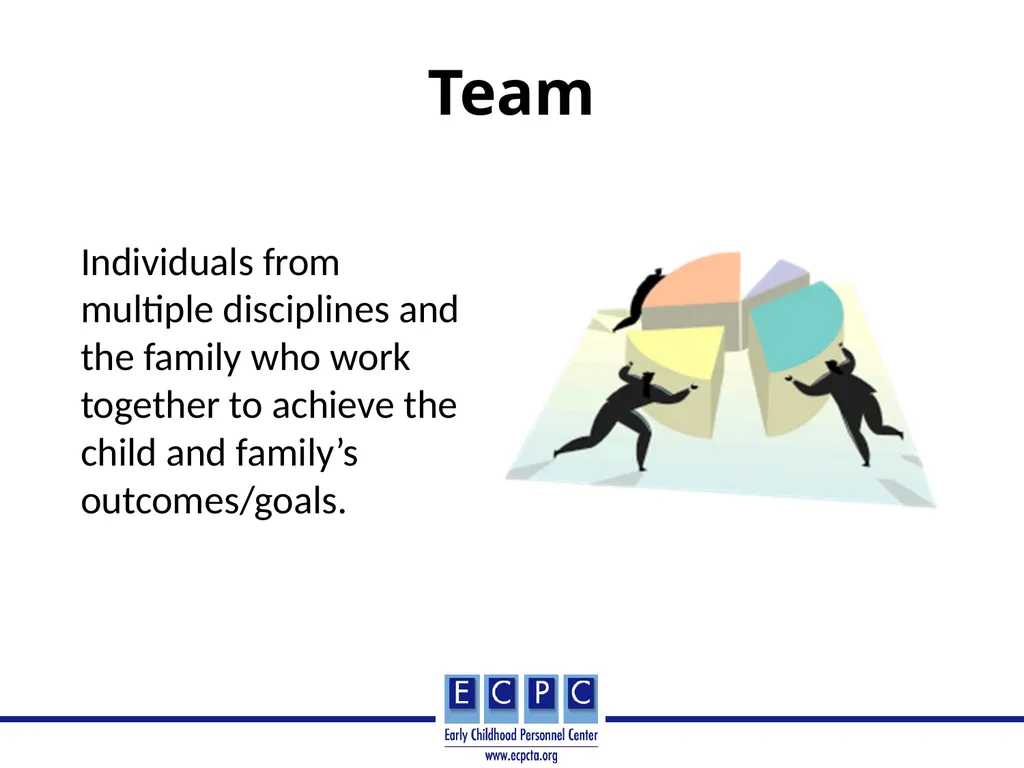
slide8. Team Individuals from multiple disciplines and the family who work together to achieve the child and family’s outcomes/goals.<br>
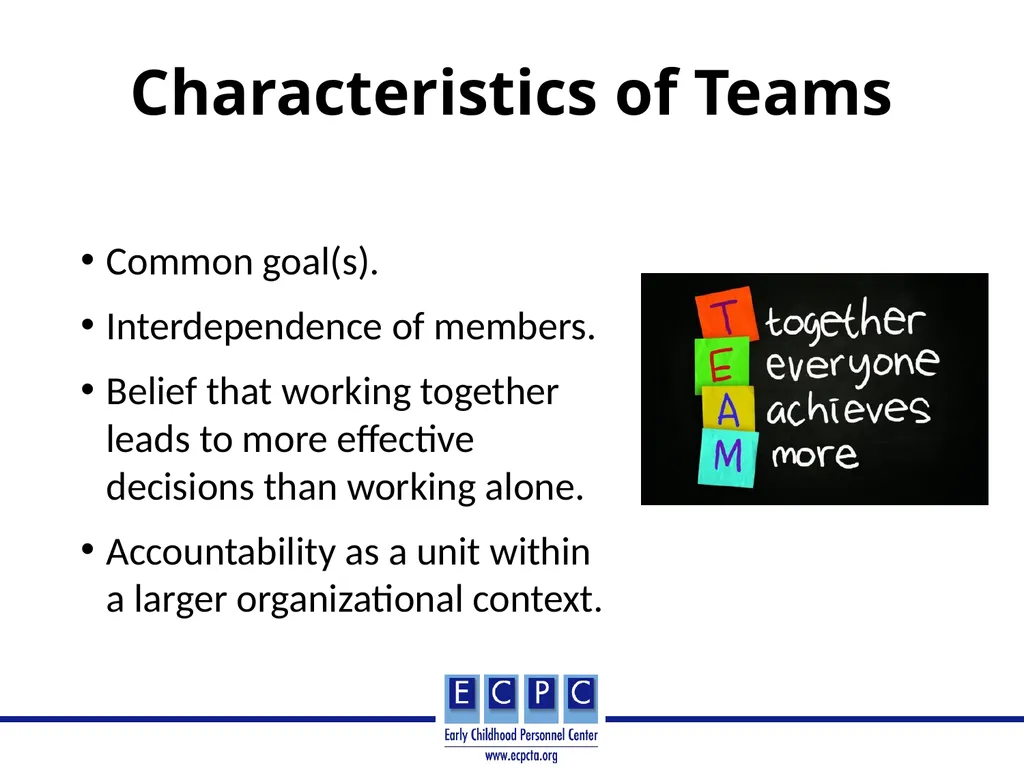
slide9. Characteristics of Teams Common goal(s).
Interdependence of members.
Belief that working together leads to more effective decisions than working alone.
Accountability as a unit within a larger organizational context.<br>
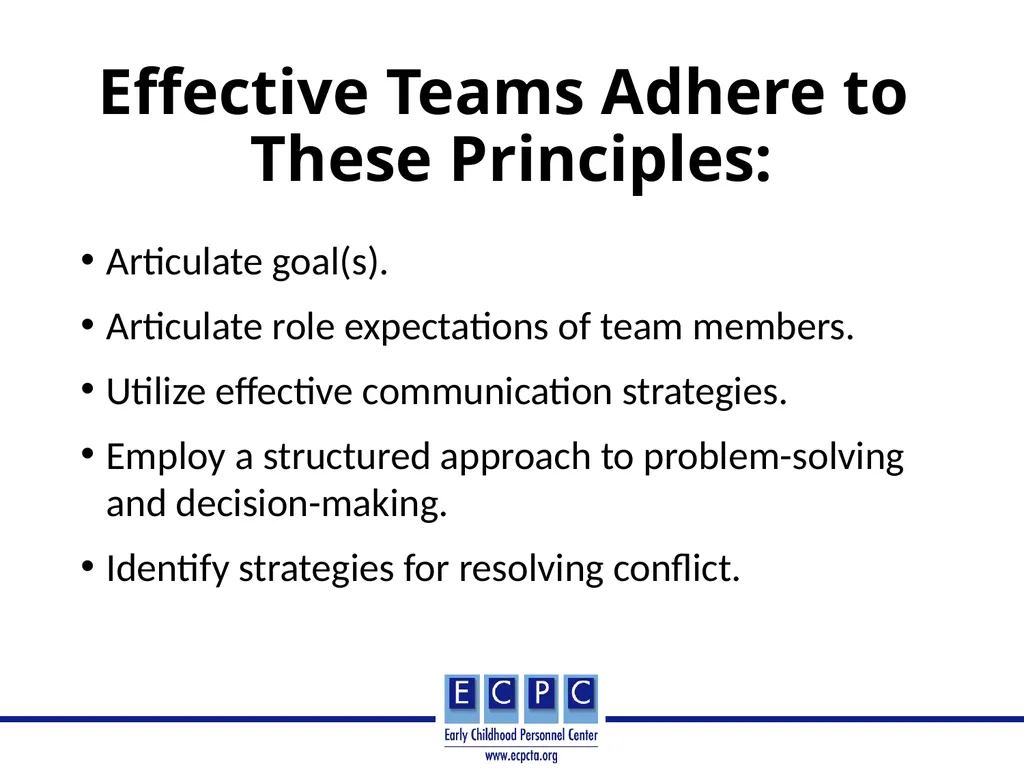
slide10. Effective Teams Adhere to These Principles: Articulate goal(s).
Articulate role expectations of team members.
Utilize effective communication strategies.
Employ a structured approach to problem-solving and decision-making.
Identify strategies for resolving conflict.<br>
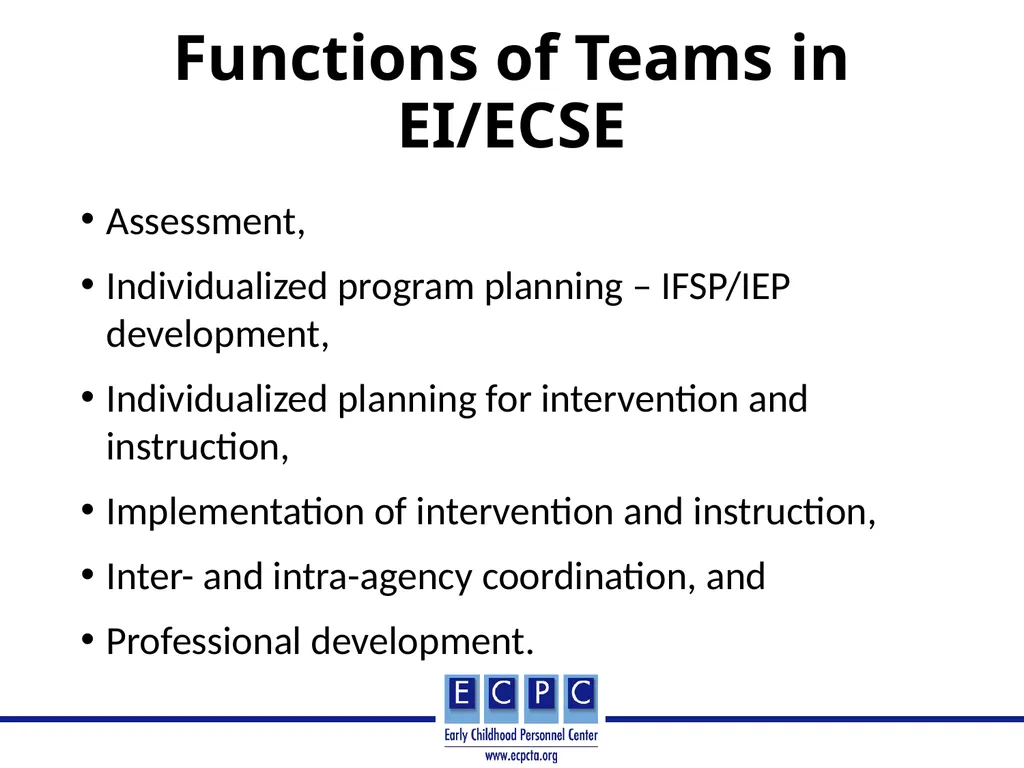
slide11. Functions of Teams in EI/ECSE Assessment,
Individualized program planning – IFSP/IEP development,
Individualized planning for intervention and instruction,
Implementation of intervention and instruction,
Inter- and intra-agency coordination, and
Professional development.<br>
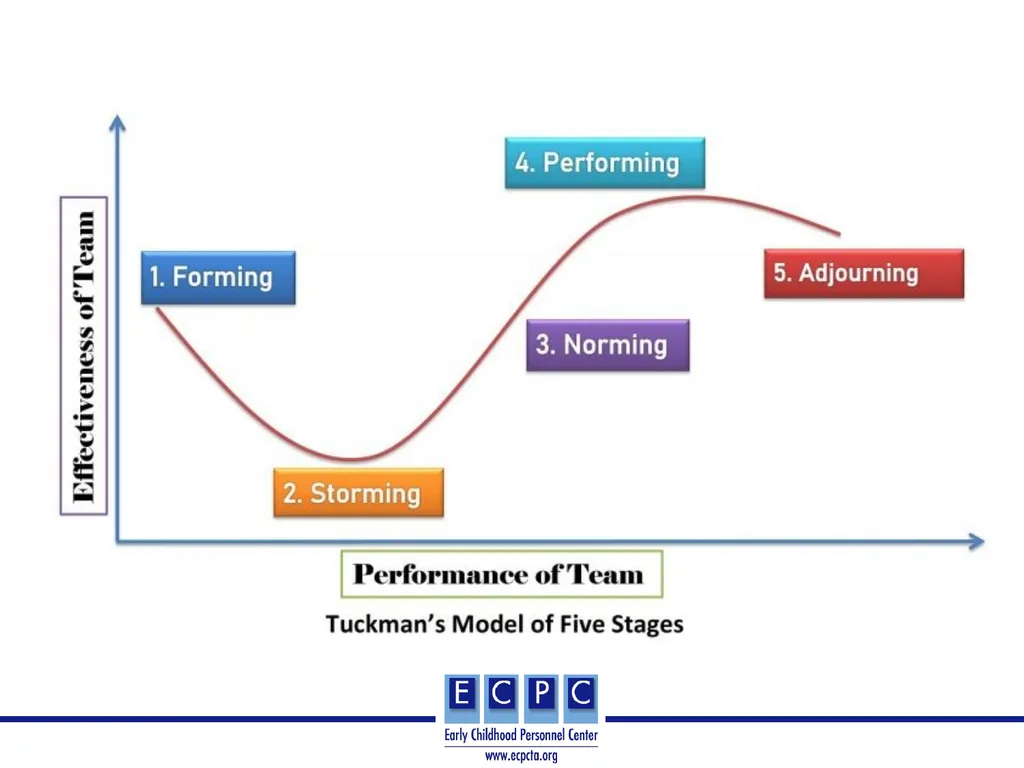
slide12. Tuckman’s Five Stages of Team Development<br>
slide13. Tuckman’s Five Stages of Team Development Tuckman’s Five Stages of Team Development (1:27)
What are Tuckman’s five stages?
What are the main characteristics of each stage?
For a team in which you are currently a member, identify the team’s stage of development.<br>
slide14. Team Members in EI/ECSE<br>
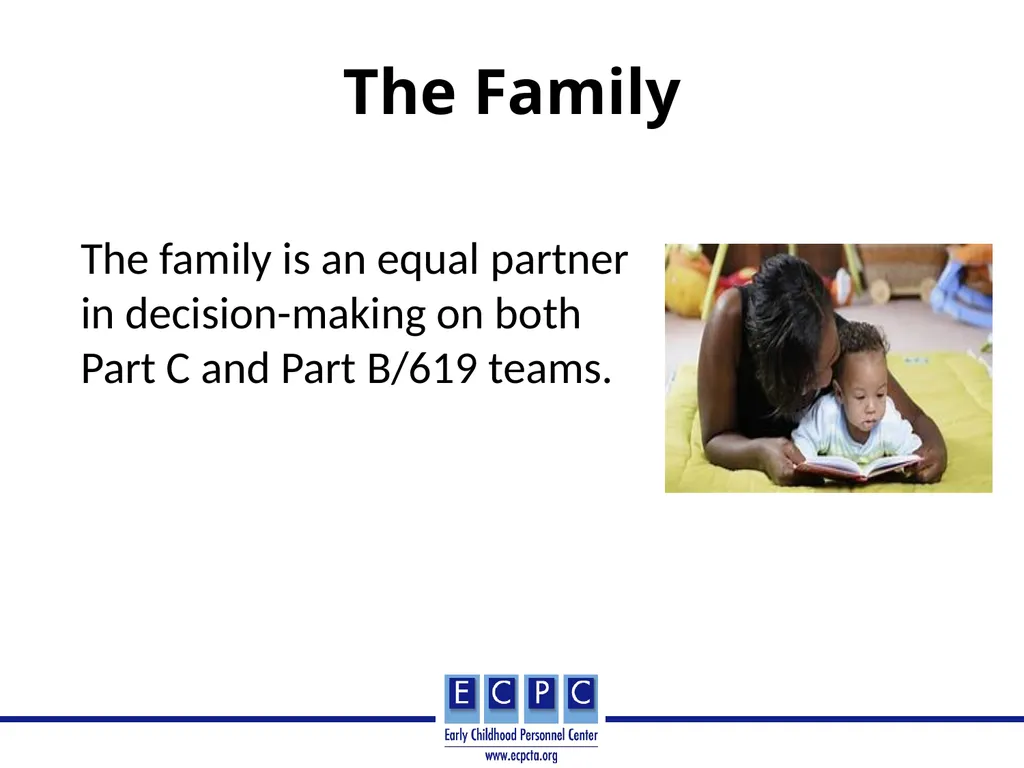
slide15. The Family The family is an equal partner in decision-making on both Part C and Part B/619 teams.<br>
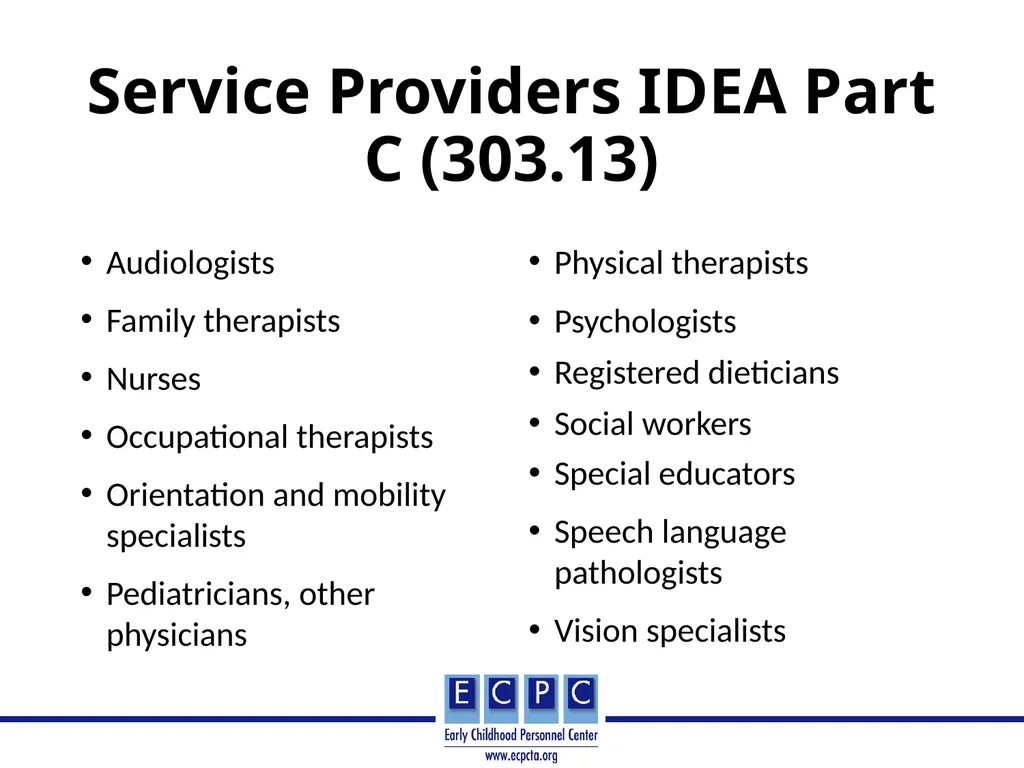
slide16. Service Providers IDEA Part C (303.13) Audiologists
Family therapists
Nurses
Occupational therapists
Orientation and mobility specialists
Pediatricians, other physicians Physical therapists
Psychologists
Registered dieticians
Social workers
Special educators
Speech language pathologists
Vision specialists<br>
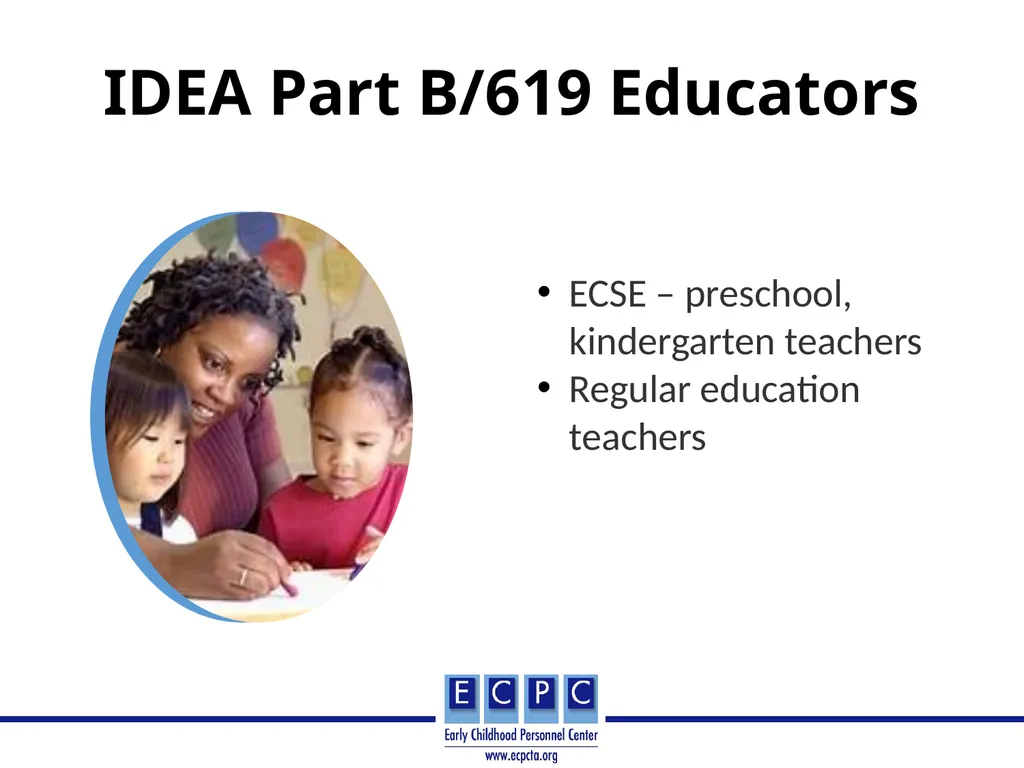
slide17. IDEA Part B/619 Educators ECSE – preschool, kindergarten teachers
Regular education teachers<br>
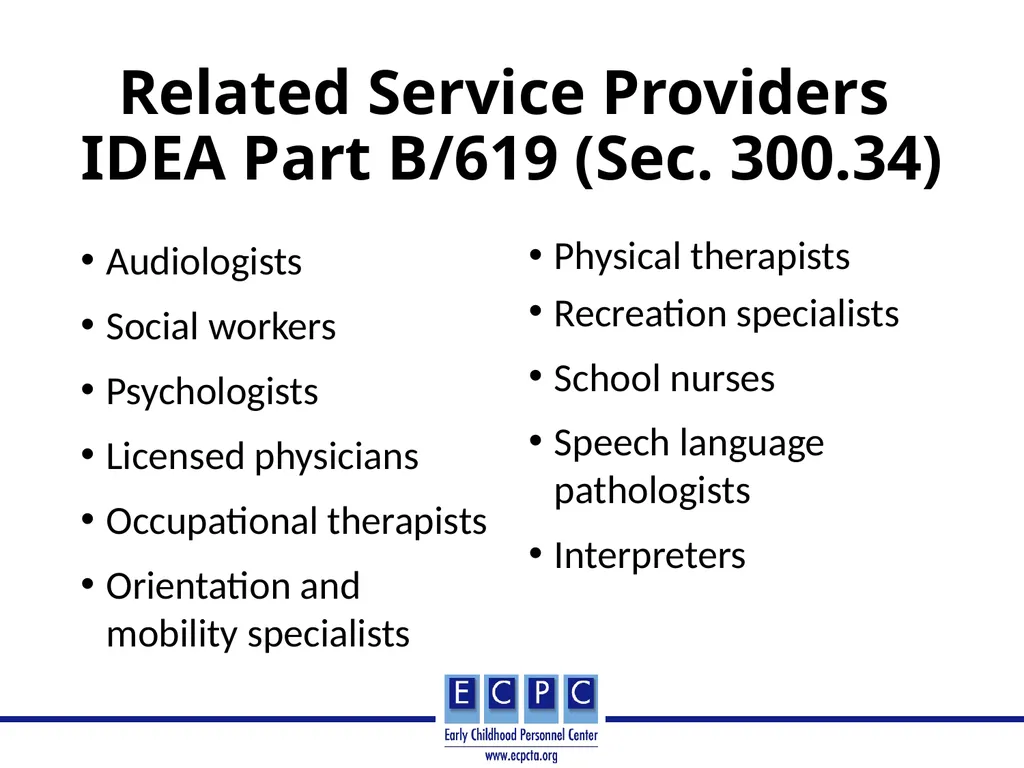
slide18. Related Service Providers IDEA Part B/619 (Sec. 300.34) Audiologists
Social workers
Psychologists
Licensed physicians
Occupational therapists
Orientation and mobility specialists Physical therapists
Recreation specialists
School nurses
Speech language pathologists
Interpreters<br>
slide19. Team Models in EI/ECSE<br>
slide20. Team Models in EI/ECSE Multidisciplinary
Interdisciplinary
Transdisciplinary<br>
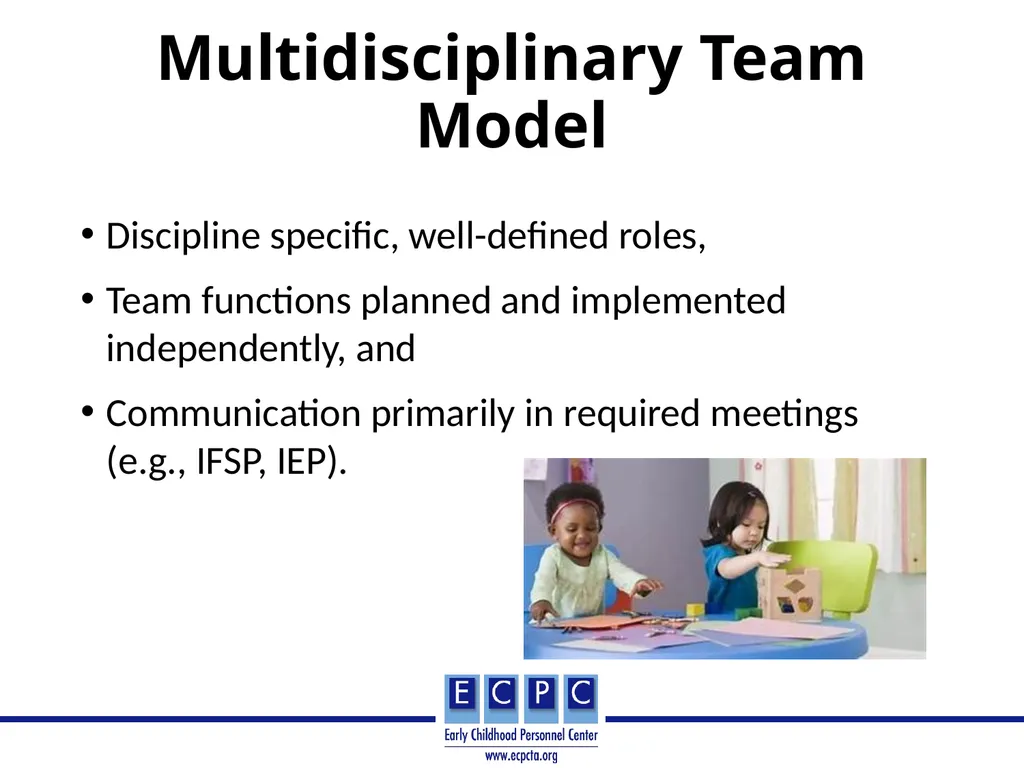
slide21. Multidisciplinary Team Model Discipline specific, well-defined roles,
Team functions planned and implemented independently, and
Communication primarily in required meetings (e.g., IFSP, IEP).<br>
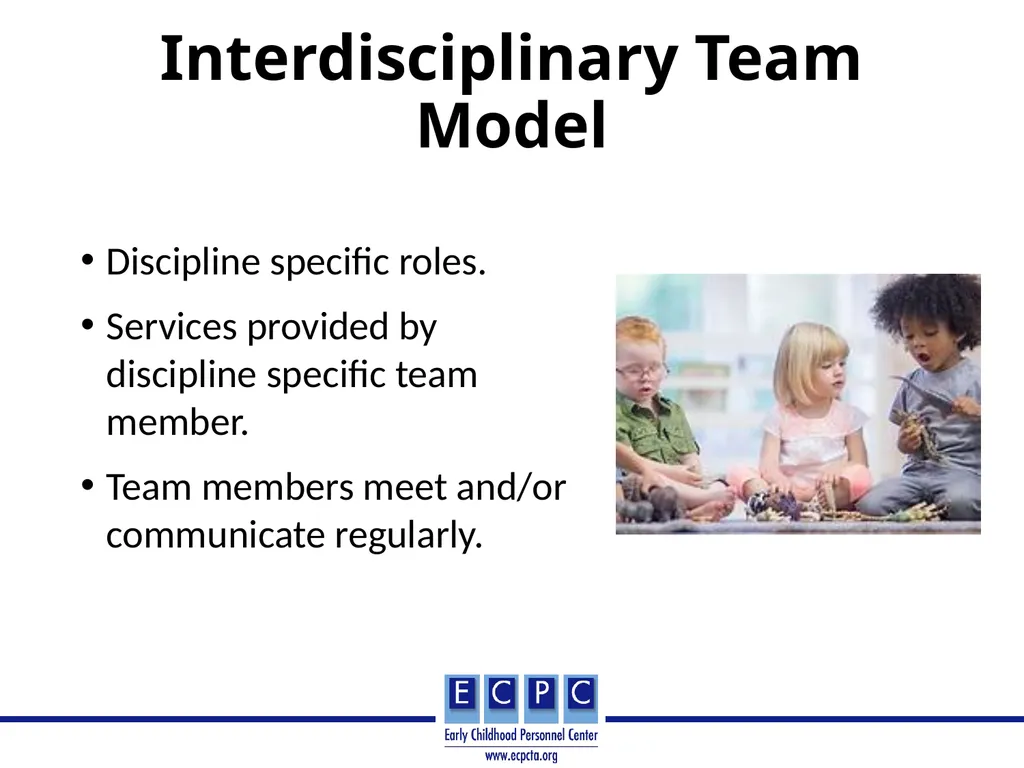
slide22. Interdisciplinary Team Model Discipline specific roles.
Services provided by discipline specific team member.
Team members meet and/or communicate regularly.<br>
slide23. Transdisciplinary Team Model Roles shared across disciplines and with the family.
Shared objectives/outcomes based on IFSP or IEP.
Ongoing communication among team members.
Characterized by the role release process.<br>
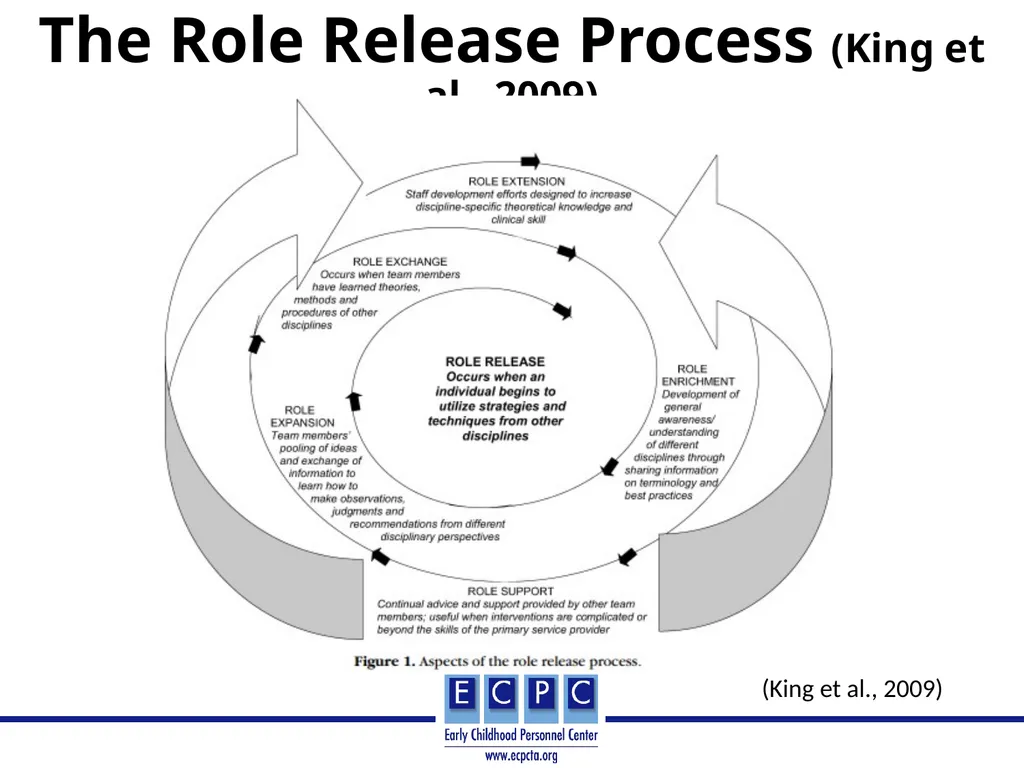
slide24. The Role Release Process (King et al., 2009) (King et al., 2009)<br>
slide25. Role Release Process Role extension – increasing depth of knowledge/skill in each team members’ own discipline
Role enrichment – teaching/learning concepts, information, language across disciplines
Role expansion – increasing knowledge and skills across disciplines
Role exchange – apply new skills while supervised by team member from that discipline
Role release – integrate practices and interventions from other disciplines
Role support – periodic observation and consultation by discipline specific team members<br>
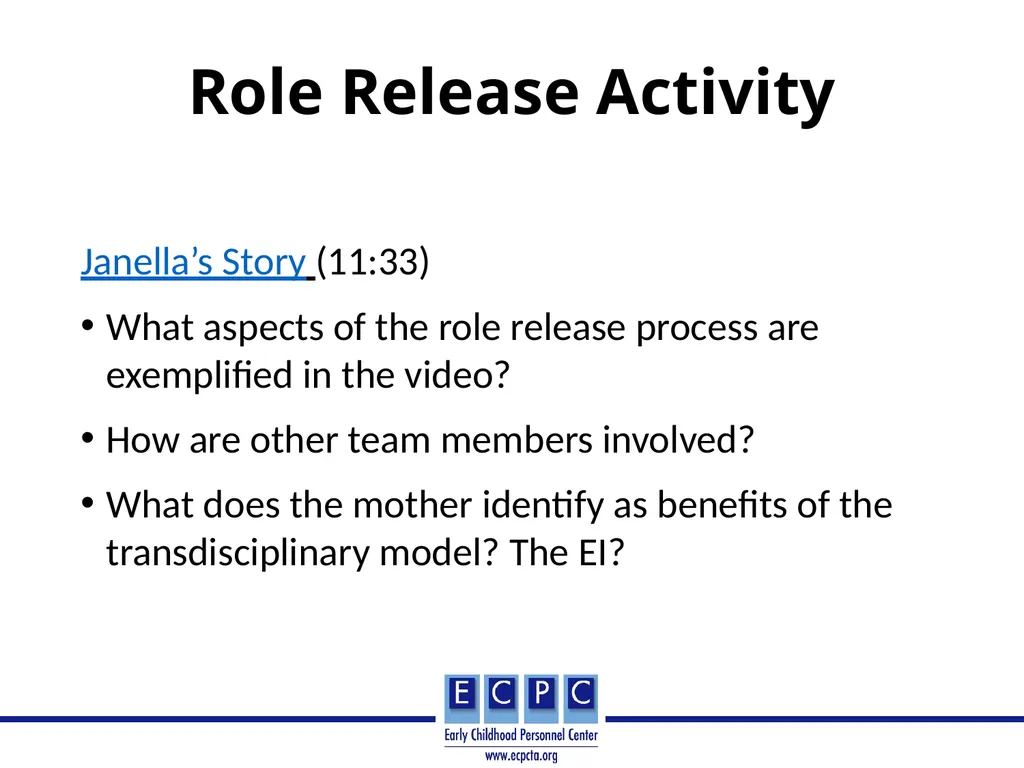
slide26. Role Release Activity Janella’s Story (11:33)
What aspects of the role release process are exemplified in the video?
How are other team members involved?
What does the mother identify as benefits of the transdisciplinary model? The EI?<br>
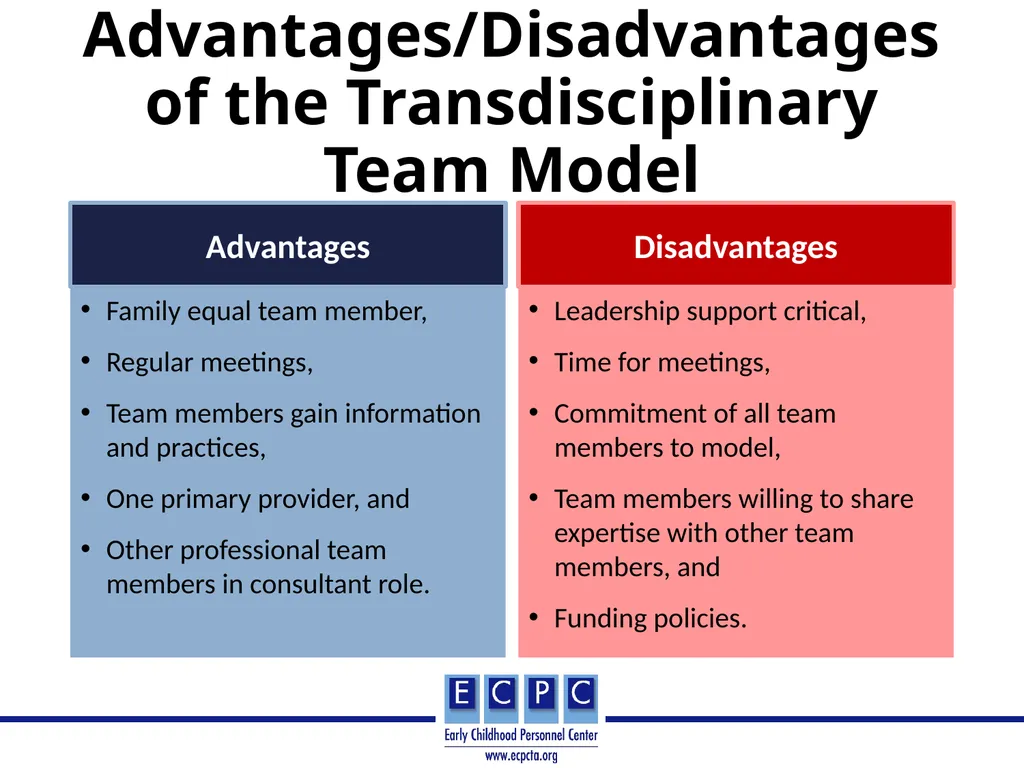
slide27. Advantages/Disadvantages of the Transdisciplinary Team Model Family equal team member,
Regular meetings,
Team members gain information and practices,
One primary provider, and
Other professional team members in consultant role. Advantages Leadership support critical,
Time for meetings,
Commitment of all team members to model,
Team members willing to share expertise with other team members, and
Funding policies. Disadvantages<br>
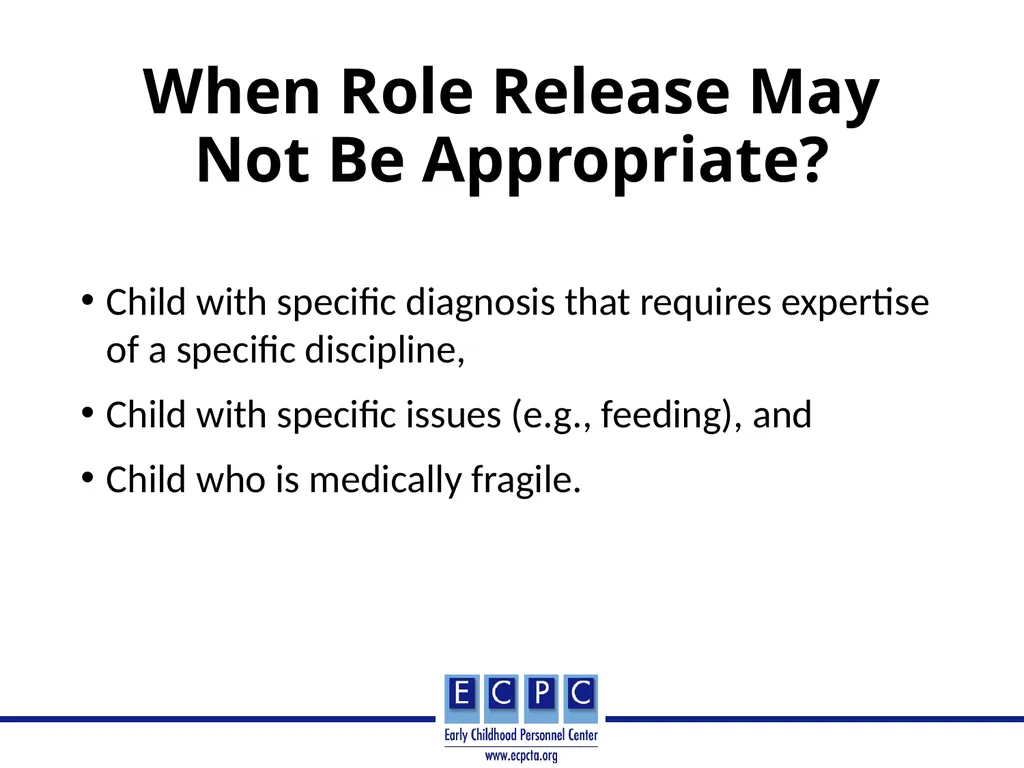
slide28. When Role Release MayNot Be Appropriate? Child with specific diagnosis that requires expertise of a specific discipline,
Child with specific issues (e.g., feeding), and
Child who is medically fragile.<br>
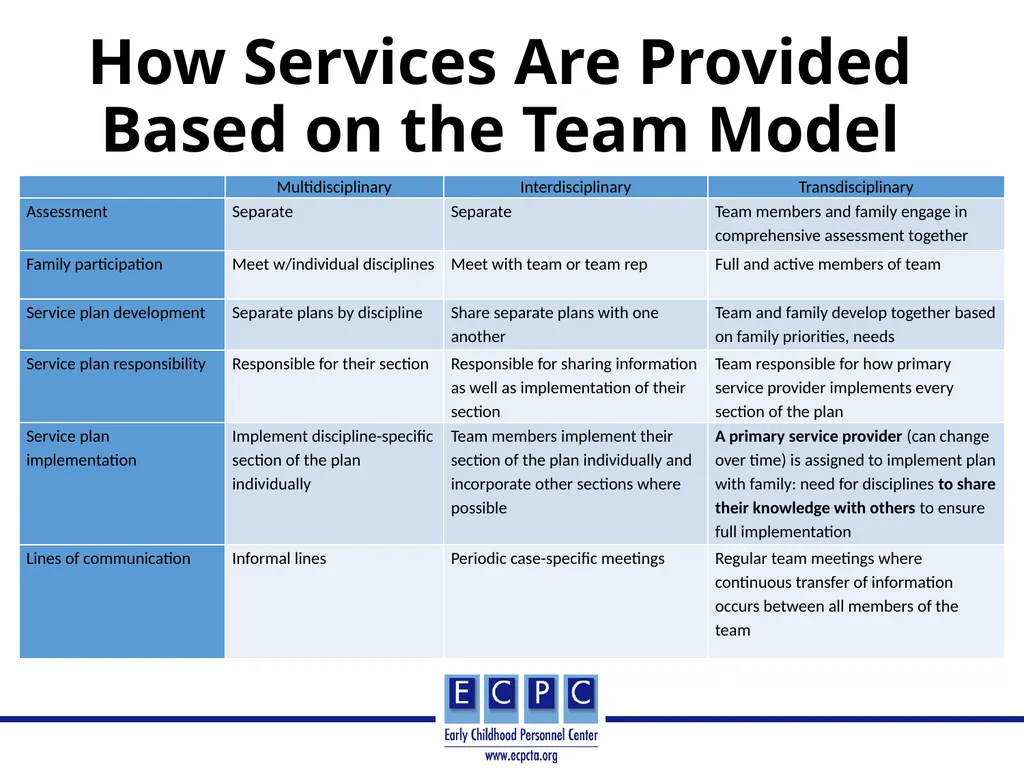
slide29. How Services Are Provided Based on the Team Model<br>
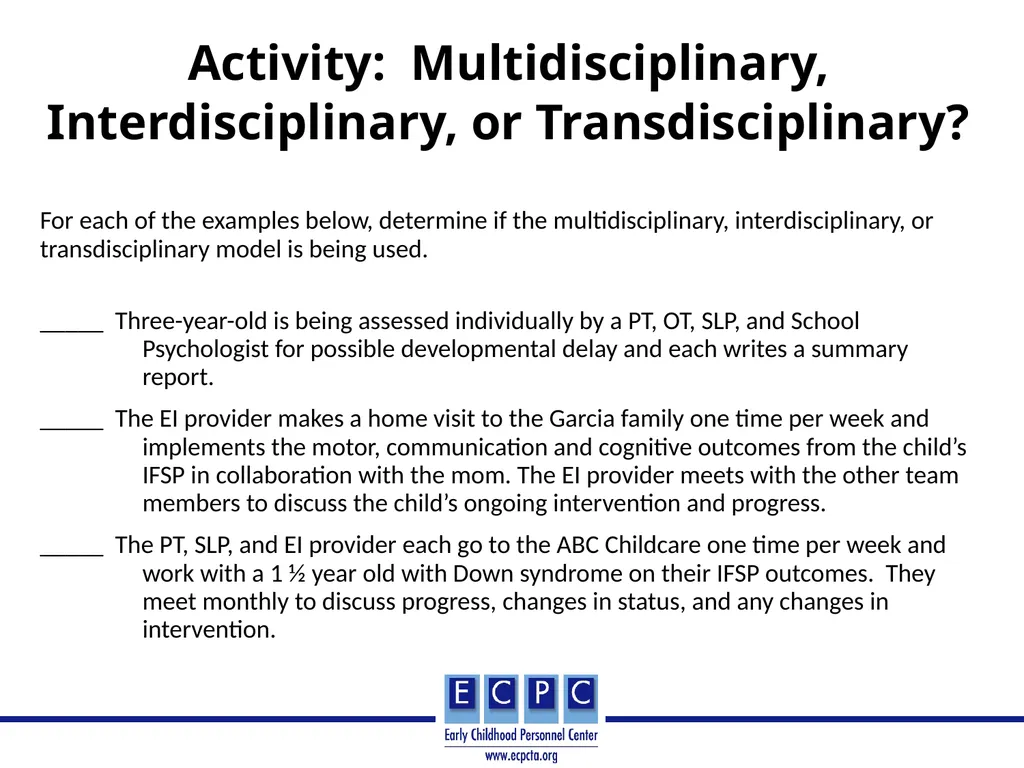
slide30. Activity: Multidisciplinary, Interdisciplinary, or Transdisciplinary? For each of the examples below, determine if the multidisciplinary, interdisciplinary, or transdisciplinary model is being used.
_____ Three-year-old is being assessed individually by a PT, OT, SLP, and School Psychologist for possible developmental delay and each writes a summary report.
_____ The EI provider makes a home visit to the Garcia family one time per week and implements the motor, communication and cognitive outcomes from the child’s IFSP in collaboration with the mom. The EI provider meets with the other team members to discuss the child’s ongoing intervention and progress.
_____ The PT, SLP, and EI provider each go to the ABC Childcare one time per week and work with a 1 ½ year old with Down syndrome on their IFSP outcomes. They meet monthly to discuss progress, changes in status, and any changes in intervention.<br>
slide31. References and Resources Code of Federal Regulations (eCFR). (2021). Part 303 – Early intervention for infants and toddlers with disabilities. National Archives. https://www.ecfr.gov/current/title-34/subtitle-B/chapter-III/part-303#303.13
Division for Early Childhood (DEC). (2014). DEC recommended practices. DEC. https://www.dec-sped.org/dec-recommended-practices
Early Childhood Personnel Center (ECPC). (n.d.). ECPC curriculum modules: Professional Standards, Standard 3: Collaboration and teaming . ECPC. https://ecpcta.org/curriculum-module/standard-3-collaboration-and-teaming/
King, G., Strachan, D., Tucker, M., Duwyn, B., Desserund, S., & Shillington, M. (2009). The application of a transdisciplinary model for early intervention services. Infants and Young Children, 14, 1-13.
Tuckman, B., & Jensen, M. (1977). Stages of small group development. Group and Organizational Studies, (2), 419-427.
U.S. Department of Education. (n.d.). IDEA: Individuals with Disabilities Education Act, Sec.300.34. U.S. Department of Education.
Woodruff, G., & McGonigel, M. J. (1988). Early intervention team approaches: The transdisciplinary model. In J. B. Jordan, J. J. Gallagher, P. L. Hutinger, & M. B. Karnes (Eds.), Early childhood special education: Birth to Three (pp. 163-181). Council for Exceptional Children and Division for Early Childhood.<br>
slide32. Disclaimer This is a product of the Early Childhood Personnel Center (ECPC) awarded to the University of Connecticut Center for Excellence in Developmental Disabilities and was made possible by Cooperative Agreement #H325B170008 which is funded by the U.S. Department of Education, Office of Special Education Programs. However, those contents do not necessarily represent the policy of the Department of Education, and you should not assume endorsement by the Federal Government<br>

slide2. EI/ECSE Standard 3, Component 3.1 Candidates apply teaming models, skills, and processes, including appropriate uses of technology, when collaborating and communicating with families; professionals representing multiple disciplines, skills, expertise, and roles; and community partners and agencies.<br>
slide3. TC1 Practitioners representing multiple disciplines and families work together as a team to plan and implement supports and services to meet the unique needs of each child and family.
TC2 Practitioners and families work together as a team to systematically and regularly exchange expertise, knowledge, and information to build team capacity and jointly solve problems, plan, and implement interventions. DEC Recommended Practices (RPs, 2014)<br>
slide4. TC3 Practitioners use communication and group facilitation strategies to enhance team functioning and interpersonal relationships with and among team members. DEC Recommended Practices (RPs, 2014)<br>
slide5. Objectives<br>
slide6. Teams and Their Characteristics<br>
slide7. “Alone we can do so little; together we can do so much.” - Helen Keller<br>
slide8. Team Individuals from multiple disciplines and the family who work together to achieve the child and family’s outcomes/goals.<br>
slide9. Characteristics of Teams Common goal(s).
Interdependence of members.
Belief that working together leads to more effective decisions than working alone.
Accountability as a unit within a larger organizational context.<br>
slide10. Effective Teams Adhere to These Principles: Articulate goal(s).
Articulate role expectations of team members.
Utilize effective communication strategies.
Employ a structured approach to problem-solving and decision-making.
Identify strategies for resolving conflict.<br>
slide11. Functions of Teams in EI/ECSE Assessment,
Individualized program planning – IFSP/IEP development,
Individualized planning for intervention and instruction,
Implementation of intervention and instruction,
Inter- and intra-agency coordination, and
Professional development.<br>
slide12. Tuckman’s Five Stages of Team Development<br>
slide13. Tuckman’s Five Stages of Team Development Tuckman’s Five Stages of Team Development (1:27)
What are Tuckman’s five stages?
What are the main characteristics of each stage?
For a team in which you are currently a member, identify the team’s stage of development.<br>
slide14. Team Members in EI/ECSE<br>
slide15. The Family The family is an equal partner in decision-making on both Part C and Part B/619 teams.<br>
slide16. Service Providers IDEA Part C (303.13) Audiologists
Family therapists
Nurses
Occupational therapists
Orientation and mobility specialists
Pediatricians, other physicians Physical therapists
Psychologists
Registered dieticians
Social workers
Special educators
Speech language pathologists
Vision specialists<br>
slide17. IDEA Part B/619 Educators ECSE – preschool, kindergarten teachers
Regular education teachers<br>
slide18. Related Service Providers IDEA Part B/619 (Sec. 300.34) Audiologists
Social workers
Psychologists
Licensed physicians
Occupational therapists
Orientation and mobility specialists Physical therapists
Recreation specialists
School nurses
Speech language pathologists
Interpreters<br>
slide19. Team Models in EI/ECSE<br>
slide20. Team Models in EI/ECSE Multidisciplinary
Interdisciplinary
Transdisciplinary<br>
slide21. Multidisciplinary Team Model Discipline specific, well-defined roles,
Team functions planned and implemented independently, and
Communication primarily in required meetings (e.g., IFSP, IEP).<br>
slide22. Interdisciplinary Team Model Discipline specific roles.
Services provided by discipline specific team member.
Team members meet and/or communicate regularly.<br>
slide23. Transdisciplinary Team Model Roles shared across disciplines and with the family.
Shared objectives/outcomes based on IFSP or IEP.
Ongoing communication among team members.
Characterized by the role release process.<br>
slide24. The Role Release Process (King et al., 2009) (King et al., 2009)<br>
slide25. Role Release Process Role extension – increasing depth of knowledge/skill in each team members’ own discipline
Role enrichment – teaching/learning concepts, information, language across disciplines
Role expansion – increasing knowledge and skills across disciplines
Role exchange – apply new skills while supervised by team member from that discipline
Role release – integrate practices and interventions from other disciplines
Role support – periodic observation and consultation by discipline specific team members<br>
slide26. Role Release Activity Janella’s Story (11:33)
What aspects of the role release process are exemplified in the video?
How are other team members involved?
What does the mother identify as benefits of the transdisciplinary model? The EI?<br>
slide27. Advantages/Disadvantages of the Transdisciplinary Team Model Family equal team member,
Regular meetings,
Team members gain information and practices,
One primary provider, and
Other professional team members in consultant role. Advantages Leadership support critical,
Time for meetings,
Commitment of all team members to model,
Team members willing to share expertise with other team members, and
Funding policies. Disadvantages<br>
slide28. When Role Release MayNot Be Appropriate? Child with specific diagnosis that requires expertise of a specific discipline,
Child with specific issues (e.g., feeding), and
Child who is medically fragile.<br>
slide29. How Services Are Provided Based on the Team Model<br>
slide30. Activity: Multidisciplinary, Interdisciplinary, or Transdisciplinary? For each of the examples below, determine if the multidisciplinary, interdisciplinary, or transdisciplinary model is being used.
_____ Three-year-old is being assessed individually by a PT, OT, SLP, and School Psychologist for possible developmental delay and each writes a summary report.
_____ The EI provider makes a home visit to the Garcia family one time per week and implements the motor, communication and cognitive outcomes from the child’s IFSP in collaboration with the mom. The EI provider meets with the other team members to discuss the child’s ongoing intervention and progress.
_____ The PT, SLP, and EI provider each go to the ABC Childcare one time per week and work with a 1 ½ year old with Down syndrome on their IFSP outcomes. They meet monthly to discuss progress, changes in status, and any changes in intervention.<br>
slide31. References and Resources Code of Federal Regulations (eCFR). (2021). Part 303 – Early intervention for infants and toddlers with disabilities. National Archives. https://www.ecfr.gov/current/title-34/subtitle-B/chapter-III/part-303#303.13
Division for Early Childhood (DEC). (2014). DEC recommended practices. DEC. https://www.dec-sped.org/dec-recommended-practices
Early Childhood Personnel Center (ECPC). (n.d.). ECPC curriculum modules: Professional Standards, Standard 3: Collaboration and teaming . ECPC. https://ecpcta.org/curriculum-module/standard-3-collaboration-and-teaming/
King, G., Strachan, D., Tucker, M., Duwyn, B., Desserund, S., & Shillington, M. (2009). The application of a transdisciplinary model for early intervention services. Infants and Young Children, 14, 1-13.
Tuckman, B., & Jensen, M. (1977). Stages of small group development. Group and Organizational Studies, (2), 419-427.
U.S. Department of Education. (n.d.). IDEA: Individuals with Disabilities Education Act, Sec.300.34. U.S. Department of Education.
Woodruff, G., & McGonigel, M. J. (1988). Early intervention team approaches: The transdisciplinary model. In J. B. Jordan, J. J. Gallagher, P. L. Hutinger, & M. B. Karnes (Eds.), Early childhood special education: Birth to Three (pp. 163-181). Council for Exceptional Children and Division for Early Childhood.<br>
slide32. Disclaimer This is a product of the Early Childhood Personnel Center (ECPC) awarded to the University of Connecticut Center for Excellence in Developmental Disabilities and was made possible by Cooperative Agreement #H325B170008 which is funded by the U.S. Department of Education, Office of Special Education Programs. However, those contents do not necessarily represent the policy of the Department of Education, and you should not assume endorsement by the Federal Government<br>