
Unit - I Communication: Meaning and importance of
KL
Published · 196 slides · 0 views

1 / 1













Description
Unit - I Communication: Meaning and importance of communication. Process of communication: Key elements in the communication process - Communication, message, audience; channel of communication. Verbal and nonverbal communication. Basics of
Related Topics
Share
Embed code
Download this presentation From Below
"Unit - I Communication: Meaning and importance of" is the property of its rightful owner. Permission is granted to download and print the materials on this website for personal, non-commercial use only, and to display it on your personal computer provided you do not modify the materials and that you retain all copyright notices contained in the materials. By downloading content from our website, you accept the terms of this agreement.
Presentation Transcript
01
Unit - I Communication: Meaning and importance of communication.
Process of communication: Key elements in the communication process - Communication, message, audience; channel of communication. Verbal and nonverbal communication.
Basics of Communication.
Education and communication for national development.
Interpersonal communication: Interviewing - Objectives, principles of interviewing; listening, qualities of effective communicator.
Seminars, conferences, lectures, group discussion, panel discussion, symposium, workshop, role playing, simulation exercises, written communication, report writing, letter writing, article/essay writing, games, brain storming, street play, field work exposure.<br>
Process of communication: Key elements in the communication process - Communication, message, audience; channel of communication. Verbal and nonverbal communication.
Basics of Communication.
Education and communication for national development.
Interpersonal communication: Interviewing - Objectives, principles of interviewing; listening, qualities of effective communicator.
Seminars, conferences, lectures, group discussion, panel discussion, symposium, workshop, role playing, simulation exercises, written communication, report writing, letter writing, article/essay writing, games, brain storming, street play, field work exposure.<br>
02
Communication: Introduction And Meaning We use ‘communication’ usually to mean speaking or writing or sending a message to another person
Exchange of thoughts, ideas, views between the persons.
Derived from Latin word “communes” means “common”. So communication happens in a common form. .
Communication is complete when the message is understood by the others and people should be present in a communication.
Communication is a learned skill. However, while most people are born with the physical ability to talk, not all can communicate well unless they make special efforts to develop and refine this skill further<br>
Exchange of thoughts, ideas, views between the persons.
Derived from Latin word “communes” means “common”. So communication happens in a common form. .
Communication is complete when the message is understood by the others and people should be present in a communication.
Communication is a learned skill. However, while most people are born with the physical ability to talk, not all can communicate well unless they make special efforts to develop and refine this skill further<br>
03
Definitions “The mechanism through which human relations exist and develop", or "sharing of experience on the basis of commonness“ . Wilbur Schramm.
“Communication is a means of transforming of mental concept from the brain of one individual to the brain of another.”
“Communication is defined as the process of passing information and understanding from one person to other. It is an essential bridge of meaning between people, by using this bridge of meaning a person safely can cross the river of misunderstanding that separates all people”.<br>
“Communication is a means of transforming of mental concept from the brain of one individual to the brain of another.”
“Communication is defined as the process of passing information and understanding from one person to other. It is an essential bridge of meaning between people, by using this bridge of meaning a person safely can cross the river of misunderstanding that separates all people”.<br>
04
Components of Communication/ basics of communication the one who gives information (sender)
and the one who receives it (receiver).
What is being shared? An idea or an information or an attitude (message).
Channel to passing the information.
Communication can happen in 3 levels namely.
Upward
Downward
Cross communication / inter communication<br>
and the one who receives it (receiver).
What is being shared? An idea or an information or an attitude (message).
Channel to passing the information.
Communication can happen in 3 levels namely.
Upward
Downward
Cross communication / inter communication<br>
05
Functions/Importance of Communication Information - Communication provides us enormous information about the environment in which we live.
Instruction : One of the major functions of communication is to instruct, educate, and socialize the members of the society.
Entertainment - Communication provides boundless entertainment to people through pictures, films, music, drama, dance, art, literature, comedy, sports, games etc.
Persuasion : One of the most important functions of communication is to persuade the other party which results in change in attitudes, beliefs, intention, & behavior.<br>
Instruction : One of the major functions of communication is to instruct, educate, and socialize the members of the society.
Entertainment - Communication provides boundless entertainment to people through pictures, films, music, drama, dance, art, literature, comedy, sports, games etc.
Persuasion : One of the most important functions of communication is to persuade the other party which results in change in attitudes, beliefs, intention, & behavior.<br>
06
Functions/Importance of Communication Debate and Discussion : It is through debate and discussion in media that the public can clarify different viewpoints on issues of public interest and arrive at a general agreement on matters that concern all.
Cultural Promotion : Communication provides opportunity for culture to be preserved and promoted.
Integration : Communication is a great integrating tool. Through a fund of knowledge or information, individuals, groups or cultures come to know one another, understand and appreciate other's ways of life and thereby develop tolerance towards one another.<br>
Cultural Promotion : Communication provides opportunity for culture to be preserved and promoted.
Integration : Communication is a great integrating tool. Through a fund of knowledge or information, individuals, groups or cultures come to know one another, understand and appreciate other's ways of life and thereby develop tolerance towards one another.<br>
07
Process of Communication You, as a sender or communicator, formulate (encode) an idea or message as best as you can
and pass on the message to your friend, who to the best of his ability receives or acts on the message (decodes).
He responds by formulating his own message and communicates to you (feedback).
If you think your message is understood or well received by your friend, then you go ahead with the next idea that you have in mind and the conversation goes on and on.<br>
and pass on the message to your friend, who to the best of his ability receives or acts on the message (decodes).
He responds by formulating his own message and communicates to you (feedback).
If you think your message is understood or well received by your friend, then you go ahead with the next idea that you have in mind and the conversation goes on and on.<br>
08
Process of Communication Here the communicator is the encoder,
the message is symbol (verbal or nonverbal),
the channel is one of the transmission medium,
the receiver is the decoder, feedback is the response to the message,
and noise is any interruption that breaks down the communication.
These, in fact, are the essential elements or ingredients which facilitate the communication process. Let us examine what role each element plays in the entire communication process and how all of them are important in making communication effective.<br>
the message is symbol (verbal or nonverbal),
the channel is one of the transmission medium,
the receiver is the decoder, feedback is the response to the message,
and noise is any interruption that breaks down the communication.
These, in fact, are the essential elements or ingredients which facilitate the communication process. Let us examine what role each element plays in the entire communication process and how all of them are important in making communication effective.<br>
09
Process of Communication Communicator (sender or encoder) is the one who initiates the communication process.
He may be an editor, a reporter, a film maker, a teacher, a writer, a speaker, a leader or anybody who takes the initiative to start a dialogue.<br>
He may be an editor, a reporter, a film maker, a teacher, a writer, a speaker, a leader or anybody who takes the initiative to start a dialogue.<br>
10
Process of Communication Encoding is the formulation of messages in the communicator's mind, that is, the communicator not only translates his purpose (ideas, thoughts or information) into a message but also decides on the medium to communicate his planned message.
He must choose the media (speaking, writing, signaling or gesturing) that the receiver can comprehend well.
For instance, an illiterate receiver will fail to understand a written message, but can understand ,it well if told orally.<br>
He must choose the media (speaking, writing, signaling or gesturing) that the receiver can comprehend well.
For instance, an illiterate receiver will fail to understand a written message, but can understand ,it well if told orally.<br>
11
Process of Communication A message is what a communicator actually produces far transmission using spoken or written words, photographs, paintings; films, posters, etc.
The purpose of communication is to influence the receiver and get favourable responses so that appropriate decisions can be taken.
The success of communication, therefore, depends on what we say and how we say it.<br>
The purpose of communication is to influence the receiver and get favourable responses so that appropriate decisions can be taken.
The success of communication, therefore, depends on what we say and how we say it.<br>
12
Process of Communication A channel is the vehicle through which a message is carried from the communicator to the receiver. The channels of communication arc many-written, spoken, verbal, non-verbal, mass media like TV, radio, newspapers, books etc.
The receiver, at the other end of the communication, is the recipient of the message and must possess the same orientation as the communicator. If the receiver does not have the ability to listen, to read, to think, he will not be able to receive and decode the messages in the manner the communicator wants him to.<br>
The receiver, at the other end of the communication, is the recipient of the message and must possess the same orientation as the communicator. If the receiver does not have the ability to listen, to read, to think, he will not be able to receive and decode the messages in the manner the communicator wants him to.<br>
13
Process of Communication Decoding is the interpretation of the message by the receiver. Actually, the receiver looks for the meaning in the message which is common to both the receiver and the communicator.
Feedback is the response or acknowledgement of receiver to the communicator's message. The exchange is possible only if the receiver responds.<br>
Feedback is the response or acknowledgement of receiver to the communicator's message. The exchange is possible only if the receiver responds.<br>
14
Verbal and nonverbal
communication. verbal communication It’s a traditional way of communication which is done with words (written or spoken).
The vocabulary is the main source of communication.
Written communication is of recent origin but verbal communication is existing since from the primitive culture. Therefore verbal communication is not something new.
Verbal communication is also means or consisting of face to face, telephone, radio, television and other media.
Makes immediate impact
Provides opportunity for interaction and feed back
Helps to correct confusions ,It is fastest and less expensive<br>
The vocabulary is the main source of communication.
Written communication is of recent origin but verbal communication is existing since from the primitive culture. Therefore verbal communication is not something new.
Verbal communication is also means or consisting of face to face, telephone, radio, television and other media.
Makes immediate impact
Provides opportunity for interaction and feed back
Helps to correct confusions ,It is fastest and less expensive<br>
15
Nonverbal communication It includes all unwritten and unspoken messages both intentional and unintentional. So it is without words but by body language gestures facial expressions etc.
Forms of non Verbal Communication
Facial expression
Body movement
Gestures
Eye contact
posture
Voice
Touch<br>
Forms of non Verbal Communication
Facial expression
Body movement
Gestures
Eye contact
posture
Voice
Touch<br>
16
Education and communication for national development Communication and education are considered to be the greatest tool that can be used to enhance all developmental activities on the global scene.
Socialization is important factor for national development. Because people cannot live without each other.
Communication approaches are also valuable and so vital because for improved co ordination and teamwork to manage development programmes, and to gain institutional support, finally it leads to development of nation.
Communication has been contributing a lot to different sectors for the nation’s development.<br>
Socialization is important factor for national development. Because people cannot live without each other.
Communication approaches are also valuable and so vital because for improved co ordination and teamwork to manage development programmes, and to gain institutional support, finally it leads to development of nation.
Communication has been contributing a lot to different sectors for the nation’s development.<br>
17
Motivation factor is needed for national development.
Education (proper) to bring changes in the society.
Cultural promotions is necessary for national development
Integration kind of improvement of the individual with the society which will bring national development.
If people are educated the standard of living goes up.
Education can bring employment for unemployed people.
Promote the sense of equal opportunities in political, economic and in social terms.
Assurance of good and impartial administration everywhere.
Equal treatment for every citizen is possible only through decent education and proper communication person.<br>
Education (proper) to bring changes in the society.
Cultural promotions is necessary for national development
Integration kind of improvement of the individual with the society which will bring national development.
If people are educated the standard of living goes up.
Education can bring employment for unemployed people.
Promote the sense of equal opportunities in political, economic and in social terms.
Assurance of good and impartial administration everywhere.
Equal treatment for every citizen is possible only through decent education and proper communication person.<br>
18
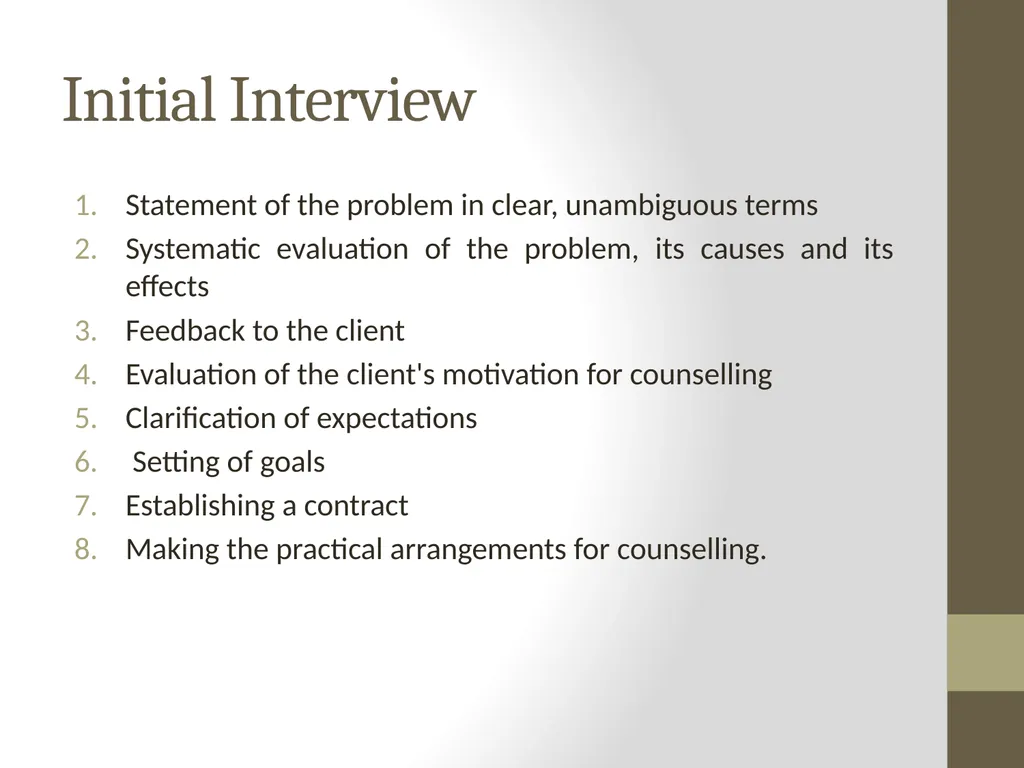
Interviewing An interview is a meaningful exchange of information with a definite purpose.
It is a conversation to specific information eliciting activity.
In an interview, much of the interaction between interviewer and interviewee (client) is carried on by gestures, postures, facial expressions and other communicative behaviour
the verbal information collected from the client.<br>
It is a conversation to specific information eliciting activity.
In an interview, much of the interaction between interviewer and interviewee (client) is carried on by gestures, postures, facial expressions and other communicative behaviour
the verbal information collected from the client.<br>
19
Aim or objective of Interview There can be three main aims of interviews. They are:
to collect information from people
to give information to them
to influence their behaviour in certain ways for example in psychotherapeutic interviewing.<br>
to collect information from people
to give information to them
to influence their behaviour in certain ways for example in psychotherapeutic interviewing.<br>
20
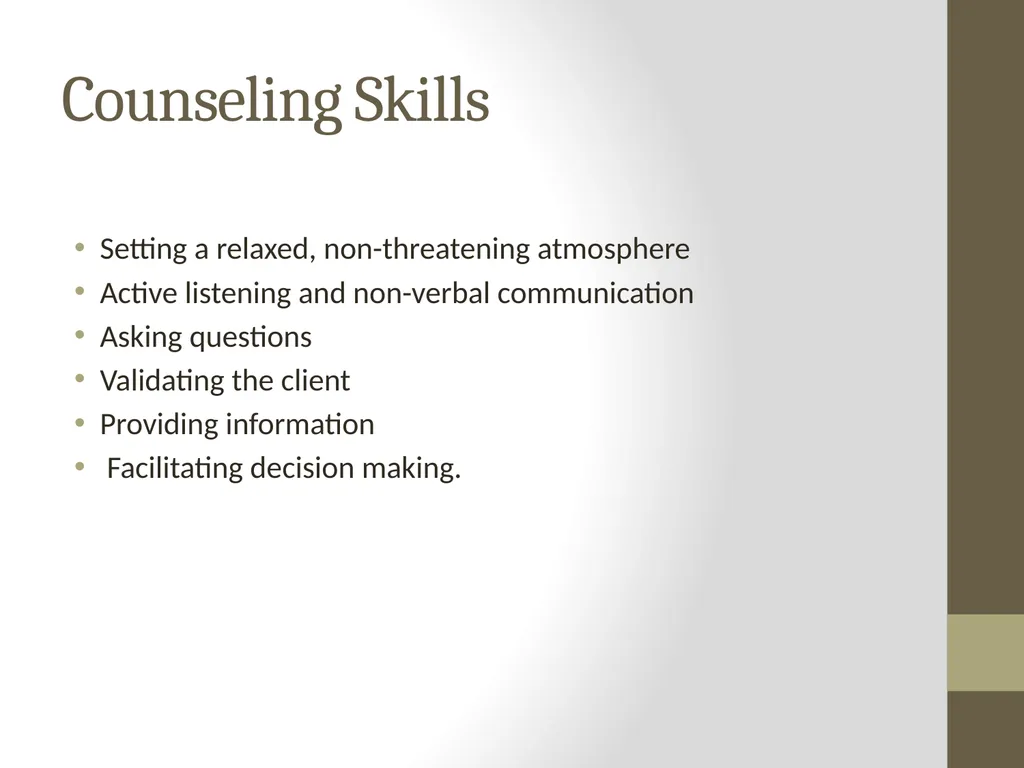
Techniques or principles of Interviewing Commonly used techniques are questioning, observing, listening, restating, validating, reflecting, providing information, clarifying, paraphrasing, pinpointing, linking, structuring, focusing, sharing and summarizing.<br>
21
Observing
Observing is reading non-verbal clues, which speak more than words. Interviewer observes the facial expression, posture, hand movement, perspiration, nail biting, tone of voice, restless movement, frequently changing posture etc.
These clues give an idea about clients present state of mood, reaction to the topic being discussed, anxiety level etc.<br>
Observing is reading non-verbal clues, which speak more than words. Interviewer observes the facial expression, posture, hand movement, perspiration, nail biting, tone of voice, restless movement, frequently changing posture etc.
These clues give an idea about clients present state of mood, reaction to the topic being discussed, anxiety level etc.<br>
22
Listening
Listening is one of the important technique of interviewing. It is very important to listen attentively.
Willingness to listen and being well understood by the listener encourages the speaker to speak freely and express unhesitatingly.
Looking towards the client, nodding in between and making ‘hmmm’ sound gives a positive signal to client and encourages him to speak.<br>
Listening is one of the important technique of interviewing. It is very important to listen attentively.
Willingness to listen and being well understood by the listener encourages the speaker to speak freely and express unhesitatingly.
Looking towards the client, nodding in between and making ‘hmmm’ sound gives a positive signal to client and encourages him to speak.<br>
23
Validating
Validating is to confirm the accuracy of information given by the patient.
This is usually done by asking further questions on the same issue and evaluating the answers in terms of their consistency and appropriateness.
For example:
Client: I feel scared to go out at night.
Interviewer: I understand that you feel scared to go out at night. Can you give example and explain how?<br>
Validating is to confirm the accuracy of information given by the patient.
This is usually done by asking further questions on the same issue and evaluating the answers in terms of their consistency and appropriateness.
For example:
Client: I feel scared to go out at night.
Interviewer: I understand that you feel scared to go out at night. Can you give example and explain how?<br>
24
Preparing for the Interview Set your Objectives: Decide what is to be accomplished. It is better to initially write down your objectives.
Know the Interviewee: If possible learn as much as you can about the person to be interviewed. Consult school records, list profiles, cumulative records, service report, friends, relatives and employers.
Provide for Privacy: Make sure that there is enough privacy to enable the interviewee feel comfortable and relaxed to open up with you.
Be Empathetic: Put yourself in interviewee’s position
Know Yourself: It is important to know one’s own personality. Everyone has certain advance opinions, convictions and attitudes and preconceptions. Many a time these interfere with successful interviewing some sort of study is essential to bring those to surface.<br>
Know the Interviewee: If possible learn as much as you can about the person to be interviewed. Consult school records, list profiles, cumulative records, service report, friends, relatives and employers.
Provide for Privacy: Make sure that there is enough privacy to enable the interviewee feel comfortable and relaxed to open up with you.
Be Empathetic: Put yourself in interviewee’s position
Know Yourself: It is important to know one’s own personality. Everyone has certain advance opinions, convictions and attitudes and preconceptions. Many a time these interfere with successful interviewing some sort of study is essential to bring those to surface.<br>
25
Qualities of an effective communicator Keen Observer
Active Listening
Relationship Building
Eye for detail - Recording<br>
Active Listening
Relationship Building
Eye for detail - Recording<br>
26
Other modes Seminars,
conferences,
lectures,
group discussion,
panel discussion,
symposium,
workshop,
role playing,
simulation exercises,
written communication,
report writing,
letter writing,
article/essay writing,
games,
brain storming,
street play/field work exposure.<br>
conferences,
lectures,
group discussion,
panel discussion,
symposium,
workshop,
role playing,
simulation exercises,
written communication,
report writing,
letter writing,
article/essay writing,
games,
brain storming,
street play/field work exposure.<br>
27
Seminars The word seminar is derived from the Latin word seminarium, meaning "seed plot".
A seminar is a form of academic instruction, either at an academic institution or offered by a commercial or professional organization.
The main purpose of seminar is to elicit shades of opinion on various aspect of the subject
Seminars are forums in which issues are raised and explored, but not necessarily resolved.<br>
A seminar is a form of academic instruction, either at an academic institution or offered by a commercial or professional organization.
The main purpose of seminar is to elicit shades of opinion on various aspect of the subject
Seminars are forums in which issues are raised and explored, but not necessarily resolved.<br>
28
Functions of a Seminar bringing together peoples to discuss ideas
focusing on some particular subject to explore topics in more depth
facilitate active participation and provides an opportunity to learn from other people's experiences and background knowledge
Before the seminar meats, the subject for discussion is mentioned in a preliminary working paper.
The paper should be circulated among the members, to attend the seminar with a view to provide opportunity for preparation.
Appoint a directior or coordinator who is chosen for his extensive knowledge in the field on his ability to give his knowledge to others.<br>
focusing on some particular subject to explore topics in more depth
facilitate active participation and provides an opportunity to learn from other people's experiences and background knowledge
Before the seminar meats, the subject for discussion is mentioned in a preliminary working paper.
The paper should be circulated among the members, to attend the seminar with a view to provide opportunity for preparation.
Appoint a directior or coordinator who is chosen for his extensive knowledge in the field on his ability to give his knowledge to others.<br>
29
Stages Inauguration: Seminar is usually opened by a distinguished person invited by the organisers of the seminar.
Conducting a Seminar: A seminar may continue for two or three days, and be divided into a number of different sessions. Each session covers a broad aspect of the topic, and related papers are presented at the same session. Each session is presided over by someone distinguished in the field. He invites the participants to present their papers. After each paper he invites questions and thus a discussion follows. He also moderates the discussion and prevents it from becoming a mere verbal or heated argument.
Concluding the talk: The conclusion brings all the different sections of the talk together and the main points are brought into proper relationship.
Discussion: The discussion on a seminar talk might bring up a disagreement in views or take the form of a question seeking clarification.
Valediction: A seminar ends with the valediction ceremony<br>
Conducting a Seminar: A seminar may continue for two or three days, and be divided into a number of different sessions. Each session covers a broad aspect of the topic, and related papers are presented at the same session. Each session is presided over by someone distinguished in the field. He invites the participants to present their papers. After each paper he invites questions and thus a discussion follows. He also moderates the discussion and prevents it from becoming a mere verbal or heated argument.
Concluding the talk: The conclusion brings all the different sections of the talk together and the main points are brought into proper relationship.
Discussion: The discussion on a seminar talk might bring up a disagreement in views or take the form of a question seeking clarification.
Valediction: A seminar ends with the valediction ceremony<br>
30
Conference A conference is a meeting of people who "confer" about a topic.
It is a formal meeting for consultation or discussion.
An exchange of views.<br>
It is a formal meeting for consultation or discussion.
An exchange of views.<br>
31
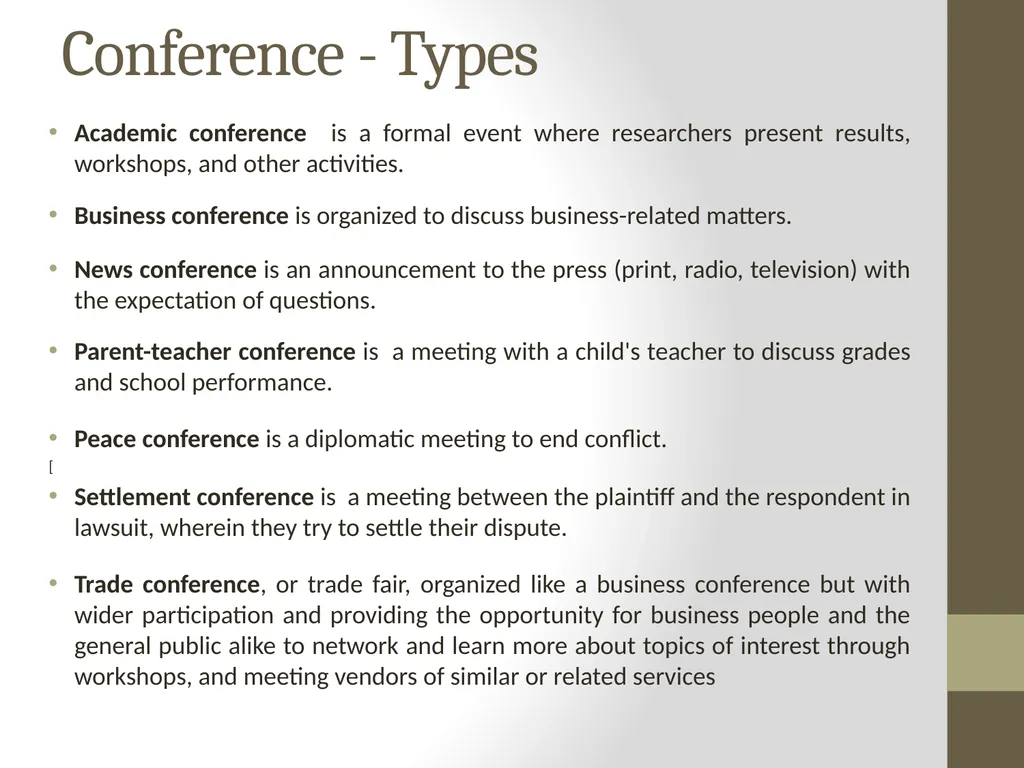
Conference - Types Academic conference is a formal event where researchers present results, workshops, and other activities.
Business conference is organized to discuss business-related matters.
News conference is an announcement to the press (print, radio, television) with the expectation of questions.
Parent-teacher conference is a meeting with a child's teacher to discuss grades and school performance.
Peace conference is a diplomatic meeting to end conflict.
[
Settlement conference is a meeting between the plaintiff and the respondent in lawsuit, wherein they try to settle their dispute.
Trade conference, or trade fair, organized like a business conference but with wider participation and providing the opportunity for business people and the general public alike to network and learn more about topics of interest through workshops, and meeting vendors of similar or related services<br>
Business conference is organized to discuss business-related matters.
News conference is an announcement to the press (print, radio, television) with the expectation of questions.
Parent-teacher conference is a meeting with a child's teacher to discuss grades and school performance.
Peace conference is a diplomatic meeting to end conflict.
[
Settlement conference is a meeting between the plaintiff and the respondent in lawsuit, wherein they try to settle their dispute.
Trade conference, or trade fair, organized like a business conference but with wider participation and providing the opportunity for business people and the general public alike to network and learn more about topics of interest through workshops, and meeting vendors of similar or related services<br>
32
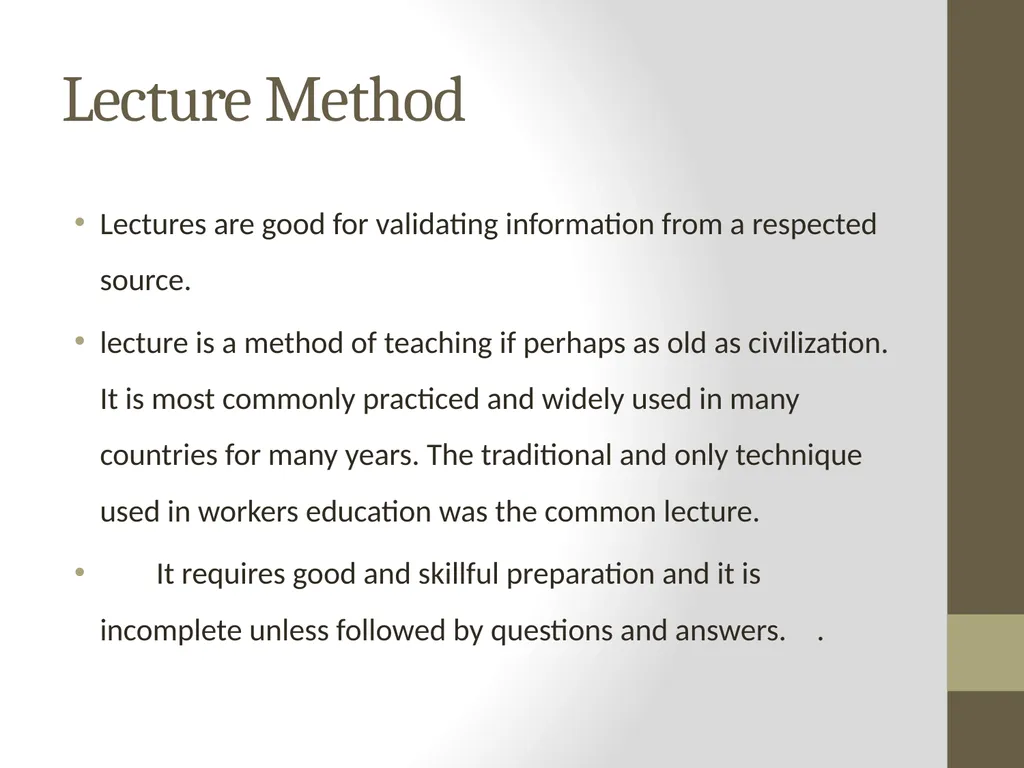
Lecture Method Lectures are good for validating information from a respected source.
lecture is a method of teaching if perhaps as old as civilization. It is most commonly practiced and widely used in many countries for many years. The traditional and only technique used in workers education was the common lecture.
It requires good and skillful preparation and it is incomplete unless followed by questions and answers. .<br>
lecture is a method of teaching if perhaps as old as civilization. It is most commonly practiced and widely used in many countries for many years. The traditional and only technique used in workers education was the common lecture.
It requires good and skillful preparation and it is incomplete unless followed by questions and answers. .<br>
33
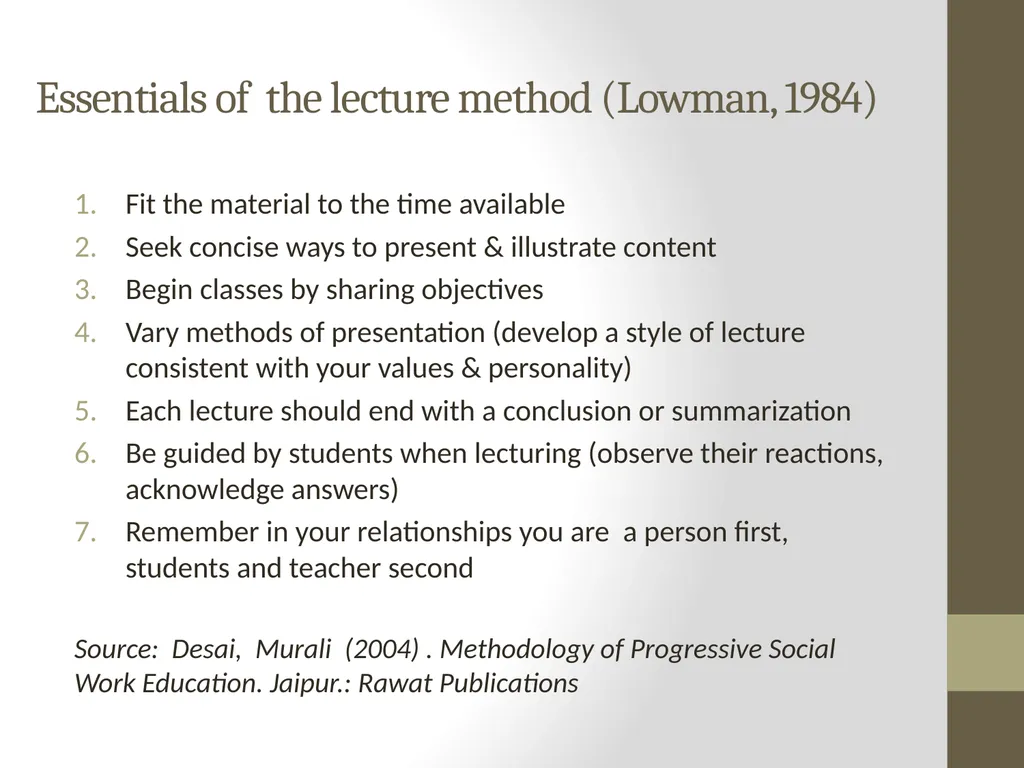
Essentials of the lecture method (Lowman, 1984) Fit the material to the time available
Seek concise ways to present & illustrate content
Begin classes by sharing objectives
Vary methods of presentation (develop a style of lecture consistent with your values & personality)
Each lecture should end with a conclusion or summarization
Be guided by students when lecturing (observe their reactions, acknowledge answers)
Remember in your relationships you are a person first, students and teacher second
Source: Desai, Murali (2004) . Methodology of Progressive Social Work Education. Jaipur.: Rawat Publications<br>
Seek concise ways to present & illustrate content
Begin classes by sharing objectives
Vary methods of presentation (develop a style of lecture consistent with your values & personality)
Each lecture should end with a conclusion or summarization
Be guided by students when lecturing (observe their reactions, acknowledge answers)
Remember in your relationships you are a person first, students and teacher second
Source: Desai, Murali (2004) . Methodology of Progressive Social Work Education. Jaipur.: Rawat Publications<br>
34
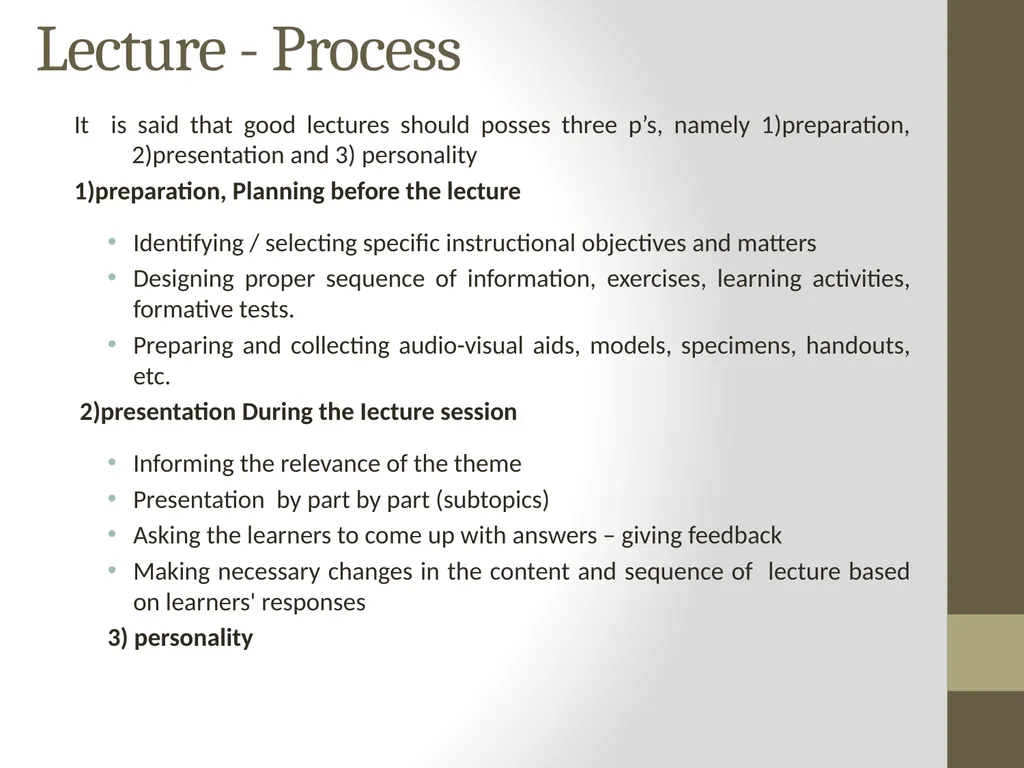
Lecture - Process It is said that good lectures should posses three p’s, namely 1)preparation, 2)presentation and 3) personality
1)preparation, Planning before the lecture
Identifying / selecting specific instructional objectives and matters
Designing proper sequence of information, exercises, learning activities, formative tests.
Preparing and collecting audio-visual aids, models, specimens, handouts, etc.
2)presentation During the Iecture session
Informing the relevance of the theme
Presentation by part by part (subtopics)
Asking the learners to come up with answers – giving feedback
Making necessary changes in the content and sequence of lecture based on learners' responses
3) personality<br>
1)preparation, Planning before the lecture
Identifying / selecting specific instructional objectives and matters
Designing proper sequence of information, exercises, learning activities, formative tests.
Preparing and collecting audio-visual aids, models, specimens, handouts, etc.
2)presentation During the Iecture session
Informing the relevance of the theme
Presentation by part by part (subtopics)
Asking the learners to come up with answers – giving feedback
Making necessary changes in the content and sequence of lecture based on learners' responses
3) personality<br>
35
Group Discussion Group Discussion, as the name itself indicates, is a group activity carried out by participating individuals. It is an exchange of ideas among the individuals of a group on a specific topic.
It is used as reliable, testing device - mainly as a tool to assess all the candidates in a group at one go -in order to select the best in comparative perspective.
Group Discussion is an informal discussion in which participants of the same educational standard discuss a topic of current interest.
It is also known as leaderless discussion. It means its aim is to find out the natural leadership level of the candidates.<br>
It is used as reliable, testing device - mainly as a tool to assess all the candidates in a group at one go -in order to select the best in comparative perspective.
Group Discussion is an informal discussion in which participants of the same educational standard discuss a topic of current interest.
It is also known as leaderless discussion. It means its aim is to find out the natural leadership level of the candidates.<br>
36
Areas of GD Content: Content is a combination of knowledge and the ability to create coherent, logical arguments on the basis of that knowledge. Merely memorising facts is pointless. An in-depth understanding of various issues as well as the ability to analyse the topic and build arguments.
Communication skills
Communication is a two-way process, and the role of the listener is critical. The listener has his own interpretation of what you say. Besides listening, you also need the ability to:
Express your ideas in a clear and concise manner.
Build on others' points.
Sum up the discussion made by the entire group.<br>
Communication skills
Communication is a two-way process, and the role of the listener is critical. The listener has his own interpretation of what you say. Besides listening, you also need the ability to:
Express your ideas in a clear and concise manner.
Build on others' points.
Sum up the discussion made by the entire group.<br>
37
Areas of GD Group dynamics – GD tests the participants behavior aswell as their influence on the group.
Leadership - A good leader is one who allows others to express their views and channels the discussion to a probable decision or conclusion on the given topic.<br>
Leadership - A good leader is one who allows others to express their views and channels the discussion to a probable decision or conclusion on the given topic.<br>
38
Types of GD Topic-based – Knowledge based, non – knowledge based, abstract
Case studies - A structured discussion of a specific situation is given as a case
Group tasks - Specific objectives are to be achieved as a group<br>
Case studies - A structured discussion of a specific situation is given as a case
Group tasks - Specific objectives are to be achieved as a group<br>
39
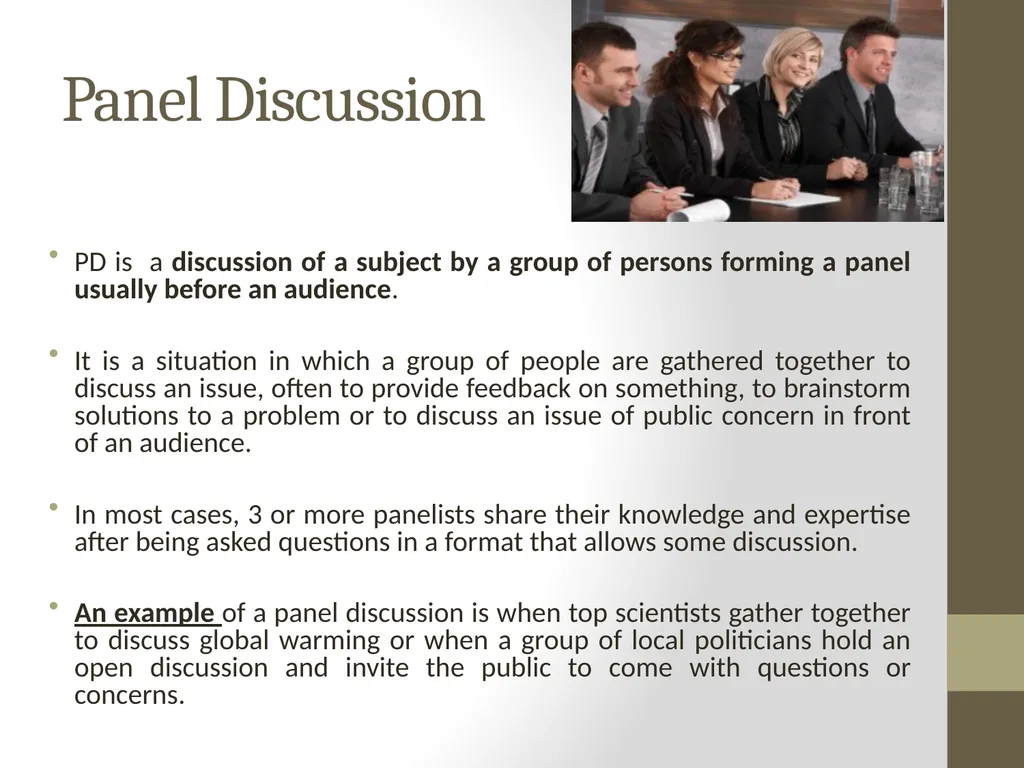
Panel Discussion PD is a discussion of a subject by a group of persons forming a panel usually before an audience.
It is a situation in which a group of people are gathered together to discuss an issue, often to provide feedback on something, to brainstorm solutions to a problem or to discuss an issue of public concern in front of an audience.
In most cases, 3 or more panelists share their knowledge and expertise after being asked questions in a format that allows some discussion.
An example of a panel discussion is when top scientists gather together to discuss global warming or when a group of local politicians hold an open discussion and invite the public to come with questions or concerns.<br>
It is a situation in which a group of people are gathered together to discuss an issue, often to provide feedback on something, to brainstorm solutions to a problem or to discuss an issue of public concern in front of an audience.
In most cases, 3 or more panelists share their knowledge and expertise after being asked questions in a format that allows some discussion.
An example of a panel discussion is when top scientists gather together to discuss global warming or when a group of local politicians hold an open discussion and invite the public to come with questions or concerns.<br>
40
Panel Discussion Process Identify the goal and purpose of your panel discussion.
Invite experts to become panelists
Select and invite a moderator
Determine the rules for the panel discussion.
Write questions for the panelists.
Arrange for the panel discussion to be recorded.
Present and introduce the panelists at the beginning of the panel discussion.
Conduct the discussion as planned, following the established rules.
Conclude the panel discussion with a summary and closing remarks.
Send thank you notes to the panelists and moderator for their participation.<br>
Invite experts to become panelists
Select and invite a moderator
Determine the rules for the panel discussion.
Write questions for the panelists.
Arrange for the panel discussion to be recorded.
Present and introduce the panelists at the beginning of the panel discussion.
Conduct the discussion as planned, following the established rules.
Conclude the panel discussion with a summary and closing remarks.
Send thank you notes to the panelists and moderator for their participation.<br>
41
Symposium Symposium originally referred to a drinking party (the Greek verb sympotein means "to drink together") but has since come to refer to any academic conference or a style of university class characterized by an openly discursive format, rather than a lecture and question-answer format.
A series of speeches is given by as many and different speakers.
a collection of opinions expressed by several persons on a given subject or topic from the same platform.
The convenient number of speakers in two to five.
the audience participation is comparatively less. It is essentially one way method of communication.
the whole activity is topic centered rather than audience centered.
Enables students to realize that every individual has his way of thinking and approach to the problem.<br>
A series of speeches is given by as many and different speakers.
a collection of opinions expressed by several persons on a given subject or topic from the same platform.
The convenient number of speakers in two to five.
the audience participation is comparatively less. It is essentially one way method of communication.
the whole activity is topic centered rather than audience centered.
Enables students to realize that every individual has his way of thinking and approach to the problem.<br>
42
Workshop An educational seminar or series of meetings emphasizing interaction, exchange of information & practice of learning among a usually small number of participants.
Example : a creative writing workshop.
This format often involves students practicing their new skills during the event under the supervision of the instructor.<br>
Example : a creative writing workshop.
This format often involves students practicing their new skills during the event under the supervision of the instructor.<br>
43
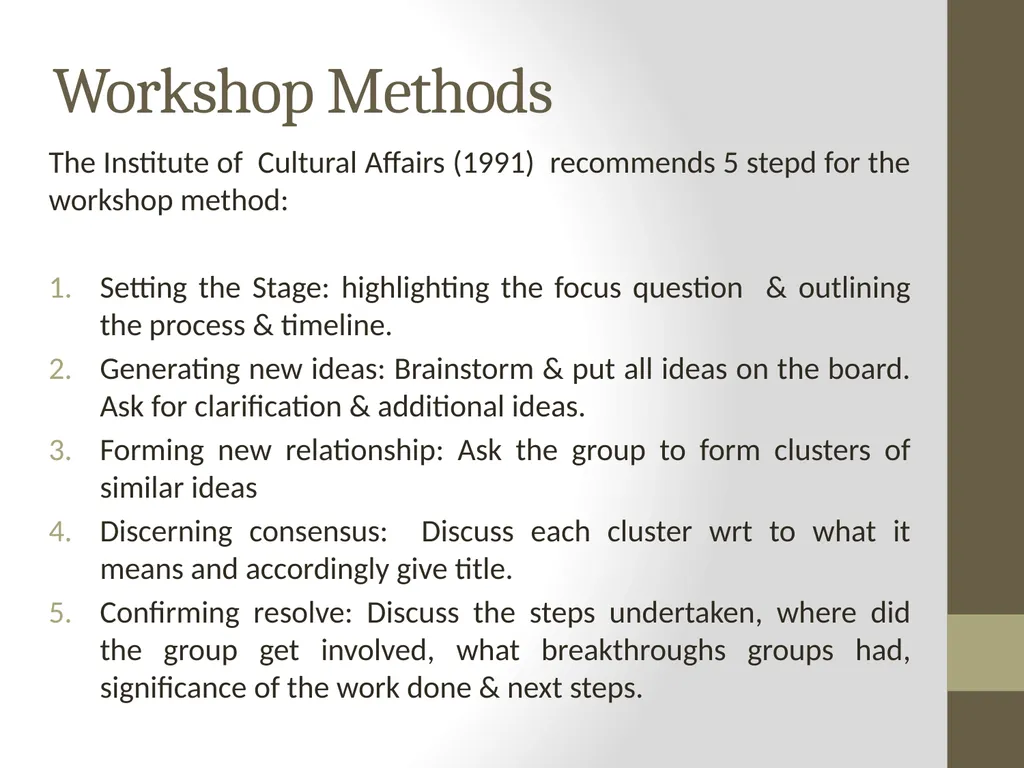
Workshop Methods The Institute of Cultural Affairs (1991) recommends 5 stepd for the workshop method:
Setting the Stage: highlighting the focus question & outlining the process & timeline.
Generating new ideas: Brainstorm & put all ideas on the board. Ask for clarification & additional ideas.
Forming new relationship: Ask the group to form clusters of similar ideas
Discerning consensus: Discuss each cluster wrt to what it means and accordingly give title.
Confirming resolve: Discuss the steps undertaken, where did the group get involved, what breakthroughs groups had, significance of the work done & next steps.<br>
Setting the Stage: highlighting the focus question & outlining the process & timeline.
Generating new ideas: Brainstorm & put all ideas on the board. Ask for clarification & additional ideas.
Forming new relationship: Ask the group to form clusters of similar ideas
Discerning consensus: Discuss each cluster wrt to what it means and accordingly give title.
Confirming resolve: Discuss the steps undertaken, where did the group get involved, what breakthroughs groups had, significance of the work done & next steps.<br>
44
Role Play Role play is used to stimulate discussions on complex issues. A brief enactment can be done by trainers and students to stimulate group discussions on similar issues and experiences.
The scripting can be done completely or partly by the organizers or can be left to the students.
Role plays can also be used for reenactment of past expericences<br>
The scripting can be done completely or partly by the organizers or can be left to the students.
Role plays can also be used for reenactment of past expericences<br>
45
Role Play Method Identify the situation/ problem
Add details
Assign roles
Act out the scenario
Discuss the learnings<br>
Add details
Assign roles
Act out the scenario
Discuss the learnings<br>
46
Simulation exercise: Simulation is the presenting of a problem or an event or a situation or an object in simulation situation.
Simulation or simulation games can be very important means for communicating knowledge experiences and ideas.
They are games that reflect real life situation while providing relaxation and a welcome relief from hectic schedule
Simulation is a contrived (formulation) experience to give the effect of real experience for mini working model of an aero plane used in training pilots to learn and practice.<br>
Simulation or simulation games can be very important means for communicating knowledge experiences and ideas.
They are games that reflect real life situation while providing relaxation and a welcome relief from hectic schedule
Simulation is a contrived (formulation) experience to give the effect of real experience for mini working model of an aero plane used in training pilots to learn and practice.<br>
47
The term 'Simulation Exercise' is any task that you are asked to do as part of applying for a job that simulates the types of tasks you will be doing. They allow you to demonstrate aptitude related to the requirements of the job and they have been shown to be more predictive of future job performance than an interview alone.
An in-tray (also called 'in-basket') exercise asks you to assume a particular role as an employee of a fictitious company and work through an in-tray of items such as letters, memos, reports, requests, emails and problems. You then decide on priorities and actions. They will usually consist of a range of issues of varying degrees of importance / urgency, some of which may well be related. This exercise is designed to measure your ability to organize and prioritize work.<br>
An in-tray (also called 'in-basket') exercise asks you to assume a particular role as an employee of a fictitious company and work through an in-tray of items such as letters, memos, reports, requests, emails and problems. You then decide on priorities and actions. They will usually consist of a range of issues of varying degrees of importance / urgency, some of which may well be related. This exercise is designed to measure your ability to organize and prioritize work.<br>
48
Written communication: every message is in black and white.
It is the best method when communication and the recipient are beyond oral communication media.
Conveying information by writing typing printing or other mechanical means.
exchange of facts, ideas, opinions through a written instrument by which the individual or organization come in touch with each other.
It has been primarily been used as a medium to pass information upwards, downwards communicating with people outside.
Written communication covers all kinds of subjects matter like memos, (legal document) resoutions, opinion of meeting. statement of grievance innocent affidavits complaints, reports, financial statements, appointments, promotions, cast sheet etc.
Formal communication must always be in writing such as rules, orders, manuals, policy matter, and resolution.<br>
It is the best method when communication and the recipient are beyond oral communication media.
Conveying information by writing typing printing or other mechanical means.
exchange of facts, ideas, opinions through a written instrument by which the individual or organization come in touch with each other.
It has been primarily been used as a medium to pass information upwards, downwards communicating with people outside.
Written communication covers all kinds of subjects matter like memos, (legal document) resoutions, opinion of meeting. statement of grievance innocent affidavits complaints, reports, financial statements, appointments, promotions, cast sheet etc.
Formal communication must always be in writing such as rules, orders, manuals, policy matter, and resolution.<br>
49
Objectives of written communication Future reference: written message can be preserved as records and reference source.
Record of evidence: written message have capacity of being stored as record.
Measurement of progress: the records provide relevant and basic information from this. It is possible to know the progress of the organization. (it helps to compare with previous year’s record).
Avoiding mistakes: maintaining written minimize the chances for errors and prevents the mistakes.
Effective decision making: decision making process becomes easy if old records may serve as a guide to the decision making process.
Legal requirements: these are certain documents which are required to be presented compulsorily under the provision of different legislation. Under the Indian companies act 1956 and banking regulation act 1949 etc.<br>
Record of evidence: written message have capacity of being stored as record.
Measurement of progress: the records provide relevant and basic information from this. It is possible to know the progress of the organization. (it helps to compare with previous year’s record).
Avoiding mistakes: maintaining written minimize the chances for errors and prevents the mistakes.
Effective decision making: decision making process becomes easy if old records may serve as a guide to the decision making process.
Legal requirements: these are certain documents which are required to be presented compulsorily under the provision of different legislation. Under the Indian companies act 1956 and banking regulation act 1949 etc.<br>
50
Report writing Report means a statement or description of what has been said, seen, done etc.
A good report is the evidence of the written vocabulary (arranged alphabetically with definitions) grammar it shows whether the written can gather facts, evidence, and analyze them and then reason logically.
C.A Brown defines a report as communication from same one, who has to use that information.
It describes the events or individuals to someone who require it.<br>
A good report is the evidence of the written vocabulary (arranged alphabetically with definitions) grammar it shows whether the written can gather facts, evidence, and analyze them and then reason logically.
C.A Brown defines a report as communication from same one, who has to use that information.
It describes the events or individuals to someone who require it.<br>
51
Types of report: reports may be classified broadly under the following categories.
1) According to use
External reports.
Internal reports
2) According to period
Routine reports
Special reports.
3) Reports according to levels at management:
Reports to top management
Reports to functional management
Reports to junior level management
Functional report<br>
1) According to use
External reports.
Internal reports
2) According to period
Routine reports
Special reports.
3) Reports according to levels at management:
Reports to top management
Reports to functional management
Reports to junior level management
Functional report<br>
52
Letter writing: Letters are most ancient and the most important of all mass communication media. A selling medium on which the entire modern business structure depends.
In the restless world of business letters are used for both internal and external communication,
letters enables one person to reach another and thus ensures two way communication.
Writing a letter is an art, it represents a written message sent by post, sometimes including an envelope, a post card an inland letter.
It is easy to write a letter which is nothing but to put ideas in black and white
to write an impressive and quality letter is difficult.
Though the principles of writing a letters are uniform, there is a lot of difference between business, personal and official correspondence<br>
In the restless world of business letters are used for both internal and external communication,
letters enables one person to reach another and thus ensures two way communication.
Writing a letter is an art, it represents a written message sent by post, sometimes including an envelope, a post card an inland letter.
It is easy to write a letter which is nothing but to put ideas in black and white
to write an impressive and quality letter is difficult.
Though the principles of writing a letters are uniform, there is a lot of difference between business, personal and official correspondence<br>
53
Types of letters Descriptive
narrative,
technical,
legal,
public,
private,
foreign,
confidential,
demi official (semi) personal official letters.<br>
narrative,
technical,
legal,
public,
private,
foreign,
confidential,
demi official (semi) personal official letters.<br>
54
A good letter must have at least 7 parts Letter head: letter head are printed headings such as name, address, telephone number of the sender.
Inside address:
Salutation: eg – sir, dear sir, my dear, madam.
Complimentary: close polite way of concluding eg – yours faithfully, yours sincerely truly yours etc.
Signature: signing his own name indicates responsibility for all the contents in a letter.
Body of the letter: introducing paragraph, main part, closing paragraph.
Signature identification: the signature should be followed by the name of signatory in block letters.<br>
Inside address:
Salutation: eg – sir, dear sir, my dear, madam.
Complimentary: close polite way of concluding eg – yours faithfully, yours sincerely truly yours etc.
Signature: signing his own name indicates responsibility for all the contents in a letter.
Body of the letter: introducing paragraph, main part, closing paragraph.
Signature identification: the signature should be followed by the name of signatory in block letters.<br>
55
Brain Storming: Encouraging the individual to share their ideas, feelings, and opinion.
It’s mostly positive. It is well known that ideas originated in the human mind, and speech is the vehicle of thought yet it is also recognize that many individual of a high degree of original thinking don’t speak out because of shyness the same individuals are helped to remove their inhibitions.
Then the result is they enhance the quality of life.
Brain storming is a small group technique design to stimulate creative thinking, expression and interaction leading to the production of large quantity of ideas related to specific problem or creative task .
It is a relatively simple technique.<br>
It’s mostly positive. It is well known that ideas originated in the human mind, and speech is the vehicle of thought yet it is also recognize that many individual of a high degree of original thinking don’t speak out because of shyness the same individuals are helped to remove their inhibitions.
Then the result is they enhance the quality of life.
Brain storming is a small group technique design to stimulate creative thinking, expression and interaction leading to the production of large quantity of ideas related to specific problem or creative task .
It is a relatively simple technique.<br>
56
Over the past 25 years that techniques of brain storming has been used by different groups including those in business, government, religion, education, health, mental and professionals.
It has been used for a wide variety of purposes such as new product development improvement
and adoption proposing to solution for social problem, labour management relation, managing administrative changes the provision of improved services, communication, marketing.
Brain storming also may contribute to group productivity through individual involvement and in the long run to personality development by encouraging individual creativity in brain storming session.<br>
It has been used for a wide variety of purposes such as new product development improvement
and adoption proposing to solution for social problem, labour management relation, managing administrative changes the provision of improved services, communication, marketing.
Brain storming also may contribute to group productivity through individual involvement and in the long run to personality development by encouraging individual creativity in brain storming session.<br>
57
Street play street play is a form of communication it is deeply rooted in the Indian tradition. It is a medium where social and political messages are propagated through the essential tool called human body.
The ability to through once voice so that 400 people can be reached without the help of mike.
Street plays are used to create awareness among the masses, regarding social, critical issues.
] Street plays breaks the formal barriers and approaches the people directly.
Street plays as the name itself suggests, You could meet them in the most unexpected places, behind the vegetables complex in your market places, during your evening walk, at the bus stop acting out a short skit or play, for anyone who might wish to stop and watch street theatre is a situation where the audience has not come prepared to watch a play and people may not have much time on hard these limitations determined the parameters of the play.<br>
The ability to through once voice so that 400 people can be reached without the help of mike.
Street plays are used to create awareness among the masses, regarding social, critical issues.
] Street plays breaks the formal barriers and approaches the people directly.
Street plays as the name itself suggests, You could meet them in the most unexpected places, behind the vegetables complex in your market places, during your evening walk, at the bus stop acting out a short skit or play, for anyone who might wish to stop and watch street theatre is a situation where the audience has not come prepared to watch a play and people may not have much time on hard these limitations determined the parameters of the play.<br>
58
The script and direction is always significant , in order to draw the attention of crowds from all walks of life they play a humerous songs based on the popular catchy tunes.
To attract all the people to its appeal. The play must as inexpensive and mobile as possible. Since no stage is used.
Street play actors are mainly teachers and students committed to bring about social change.
The preparation of play is joint effort each member has to agree completely on the theme for a production go through the script is usually written jointly as the play progress of course, different groups have varying.<br>
To attract all the people to its appeal. The play must as inexpensive and mobile as possible. Since no stage is used.
Street play actors are mainly teachers and students committed to bring about social change.
The preparation of play is joint effort each member has to agree completely on the theme for a production go through the script is usually written jointly as the play progress of course, different groups have varying.<br>
59
A choral song is used to attract people and once a large enough croud has gathered the play being usually in a circular with the audience all around.
the script sometimes one person narrates while the actor acts. There are no separate costumes for the actors but that depends on the theme.
Street plays as a channel of communication is deeply rooted in the Indian society. The modern form is different only in the theme enacted. The street play groups analysis the society as a exist, visualize its future and then attempts to put a vision across.<br>
the script sometimes one person narrates while the actor acts. There are no separate costumes for the actors but that depends on the theme.
Street plays as a channel of communication is deeply rooted in the Indian society. The modern form is different only in the theme enacted. The street play groups analysis the society as a exist, visualize its future and then attempts to put a vision across.<br>
60
Games Games make teaching easier ,more enjoyable and more focused on issues under discussion.
They can be more effective if used just at the right time.
What is to be learnt from games has to be properly brought out in the discussion.
Each game has to be self contained with clear explanations of objectives and procedures.<br>
They can be more effective if used just at the right time.
What is to be learnt from games has to be properly brought out in the discussion.
Each game has to be self contained with clear explanations of objectives and procedures.<br>
61
Guidelines for using games The game which a teacher chooses should precisely and clearly support the arguments or points he plans to make in a teaching session.
A teacher has to follow the given rules or procedure while conducting a games.
A teacher requires proper guidelines for handling a game.
A teacher may learn much by observing other experienced teacher handle a game.
Participants may find games interesting and educative. The teacher can also relax and enjoy.<br>
A teacher has to follow the given rules or procedure while conducting a games.
A teacher requires proper guidelines for handling a game.
A teacher may learn much by observing other experienced teacher handle a game.
Participants may find games interesting and educative. The teacher can also relax and enjoy.<br>
62
Essays and articles The essay is not highly thought of as it was once few important creatve writers today are primarily essayists.
a short literary composition on a particular theme or subject, usually in prose and generally analytic, speculative, or interpretative
According to websters new international dictionary “a library composition analytical or interpretative in nature, dealing with its subject from a more or less limited or personal stand point and permitting a considerable freedom of style and method. Commonly essays are brief suitable for reading at one sitting.
An article which is often mainly factual and informative, it is an expression of personality of the writer.<br>
a short literary composition on a particular theme or subject, usually in prose and generally analytic, speculative, or interpretative
According to websters new international dictionary “a library composition analytical or interpretative in nature, dealing with its subject from a more or less limited or personal stand point and permitting a considerable freedom of style and method. Commonly essays are brief suitable for reading at one sitting.
An article which is often mainly factual and informative, it is an expression of personality of the writer.<br>
63
a written composition in prose, usually nonfiction, on a specific topic, forming an independent part of a book or other publication, as a newspaper or magazine.
essay is personal the article is not so but the principles of good writing are the same at all stage of composition.
In an essay write what you yourself think and feel about a subject, not what you think the other people will want you to write about it.
You will then be making a personal contribution however small, to the total of human knowledge, what you write will have interest for everybody because it is what you think and what no one else in the world but you should have written. If you express it with simplicity and economy it is the more likely to be clear and thus to be effective.<br>
essay is personal the article is not so but the principles of good writing are the same at all stage of composition.
In an essay write what you yourself think and feel about a subject, not what you think the other people will want you to write about it.
You will then be making a personal contribution however small, to the total of human knowledge, what you write will have interest for everybody because it is what you think and what no one else in the world but you should have written. If you express it with simplicity and economy it is the more likely to be clear and thus to be effective.<br>
64
Street play street play is a form of communication ,it is deeply rooted in the Indian tradition.
It is a medium where social and political messages are propagated ,through the essential tool called human body.
Street plays are used to create awareness among the masses, regarding social, critical issues. Street plays breaks the formal barriers and approaches the people directly.
Street plays as the name itself suggests, You could meet them in the most unexpected places, behind the vegetables complex in your market places, during your evening walk, at the bus stop acting out a short skit or play, for anyone who might wish to stop and watch street theatre is a situation where the audience has not come prepared to watch a play and people may not have much time on hard these limitations determined the parameters of the play<br>
It is a medium where social and political messages are propagated ,through the essential tool called human body.
Street plays are used to create awareness among the masses, regarding social, critical issues. Street plays breaks the formal barriers and approaches the people directly.
Street plays as the name itself suggests, You could meet them in the most unexpected places, behind the vegetables complex in your market places, during your evening walk, at the bus stop acting out a short skit or play, for anyone who might wish to stop and watch street theatre is a situation where the audience has not come prepared to watch a play and people may not have much time on hard these limitations determined the parameters of the play<br>
65
The script and direction is always significant , in order to draw the attention of crowds from all walks of life they play a humerous songs based on the popular catchy tunes. To attract all the people to its appeal. The play must as inexpensive and mobile as possible. Since no stage is used.
Street play actors are mainly teachers and students committed to bring about social change. The preparation of play is joint effort each member has to agree completely on the theme for a production go through the script is usually written jointly as the play progress of course, different groups have varying.
A choral song is used to attract people and once a large enough croud has gathered the play being usually in a circular with the audience all around. The sings or speaks out of the script sometimes one person narrates while the actor acts. Then the face is painted white eyes an exaggerated expression. There are no separate costimate for the actor they might all way a black rope but that depends on the theme. The movement has been to be very exacurated.
Street plays as a channel of communication is deeply rooted in the Indian society. The modern form is different only in the theme enacted. The street play groups analysis the society as a exist, visualize its future and then attempts to put a vision across.<br>
Street play actors are mainly teachers and students committed to bring about social change. The preparation of play is joint effort each member has to agree completely on the theme for a production go through the script is usually written jointly as the play progress of course, different groups have varying.
A choral song is used to attract people and once a large enough croud has gathered the play being usually in a circular with the audience all around. The sings or speaks out of the script sometimes one person narrates while the actor acts. Then the face is painted white eyes an exaggerated expression. There are no separate costimate for the actor they might all way a black rope but that depends on the theme. The movement has been to be very exacurated.
Street plays as a channel of communication is deeply rooted in the Indian society. The modern form is different only in the theme enacted. The street play groups analysis the society as a exist, visualize its future and then attempts to put a vision across.<br>
66
Field work exposure fieldwork exposure is the collection of information outside of a laboratory, library or workplace setting or an investigation carried out in the field rather than in a laboratory or headquarters
The approaches and methods used in field research vary across disciplines. For example, biologists who conduct field research may simply observe animals interacting with their environments,
whereas social scientists conducting field research may interview or observe people in their natural environments to learn their languages, folklore, and social structures.
Field research involves a range of well-defined, although variable, methods: informal interviews, direct observation, participation in the life of the group, collective discussions, analyses of personal documents produced within the group, self-analysis, results from activities undertaken off- or on-line, and life-histories<br>
The approaches and methods used in field research vary across disciplines. For example, biologists who conduct field research may simply observe animals interacting with their environments,
whereas social scientists conducting field research may interview or observe people in their natural environments to learn their languages, folklore, and social structures.
Field research involves a range of well-defined, although variable, methods: informal interviews, direct observation, participation in the life of the group, collective discussions, analyses of personal documents produced within the group, self-analysis, results from activities undertaken off- or on-line, and life-histories<br>
67
Poster Making A poster is any piece of printed paper designed to be attached to a wall or vertical surface. Typically posters include both textual and graphic elements, although a poster may be either wholly graphical or wholly text.
A poster is an excellent way to get your point across quickly.
Posters are designed to be both eye-catching and informative. Posters may be used for many purposes. They are a frequent tool of advertisers (particularly of events, musicians and films),
Posters are also used for reproductions of artwork, particularly famous works, and are generally low-cost compared to original artwork.<br>
A poster is an excellent way to get your point across quickly.
Posters are designed to be both eye-catching and informative. Posters may be used for many purposes. They are a frequent tool of advertisers (particularly of events, musicians and films),
Posters are also used for reproductions of artwork, particularly famous works, and are generally low-cost compared to original artwork.<br>
68
According to the French historian Max Gallo"for over two hundred years, posters have been displayed in public places all over the world. Visually striking, they have been designed to attract the attention of passers-by, making us aware of a political viewpoint, enticing us to attend specific events, or encouraging us to purchase a particular product or service
Posters, in the form of placards and posted bills, have been used since earliest times, primarily for advertising and announcements<br>
Posters, in the form of placards and posted bills, have been used since earliest times, primarily for advertising and announcements<br>
69
Exhibition Exhibitions are expensive but they can give really great returns if you do them properly.
The concept of exhibition is not so new
In the most general sense, is an organized presentation and display of a selection of items. In practice, exhibitions usually occur within museums, galleries and exhibition hall .
The word "exhibition" is usually, but not always, the word used for a collection of items. Sometimes "exhibit" is synonymous with "exhibition", but "exhibit" generally refers to a single item being exhibited within an exhibition.
Exhibitions may be permanent displays or temporary, but in common usage, "exhibitions" are considered temporary and usually scheduled to open and close on specific dates. While many exhibitions are shown in just one venue, some exhibitions are shown in multiple locations and are called travelling exhibitions, and some are online exhibition.<br>
The concept of exhibition is not so new
In the most general sense, is an organized presentation and display of a selection of items. In practice, exhibitions usually occur within museums, galleries and exhibition hall .
The word "exhibition" is usually, but not always, the word used for a collection of items. Sometimes "exhibit" is synonymous with "exhibition", but "exhibit" generally refers to a single item being exhibited within an exhibition.
Exhibitions may be permanent displays or temporary, but in common usage, "exhibitions" are considered temporary and usually scheduled to open and close on specific dates. While many exhibitions are shown in just one venue, some exhibitions are shown in multiple locations and are called travelling exhibitions, and some are online exhibition.<br>
70
Magazines Many people don’t understand just how valuable magazines and periodicals are in our lives. While we might have an idea as to the information they provide, how they can be used is a completely different idea to consider.
This will help to educate the public about politics, the economy and social issues as well. And Magazines And Periodicals - A Part Of Our Everyday Lives”
They are publications, usually periodical publications, that are printed or published electronically. (The online versions are called online magazines.)
They are generally published on a regular schedule and contain a variety of content.
They are generally financed by advertising, by a purchase price, by prepaid subscriptions or a combination of the three. At its root, the word "magazine" refers to a collection or storage location. In the case of written publication, it is a collection of written articles.<br>
This will help to educate the public about politics, the economy and social issues as well. And Magazines And Periodicals - A Part Of Our Everyday Lives”
They are publications, usually periodical publications, that are printed or published electronically. (The online versions are called online magazines.)
They are generally published on a regular schedule and contain a variety of content.
They are generally financed by advertising, by a purchase price, by prepaid subscriptions or a combination of the three. At its root, the word "magazine" refers to a collection or storage location. In the case of written publication, it is a collection of written articles.<br>
71
Advertisement Advertising is the best way to communicate to the customers. Advertising helps informs the customers about the brands available in the market and the variety of products useful to them. Advertising is for everybody including kids, young and old. It is done using various media types, with different techniques and methods most suited
It is used to encourage, persuade, or manipulate an audience (viewers, readers or listeners; sometimes a specific group) to take or continue to take some action.
This type of advertising work belongs to a category called creative or effective labour
In Latin, ad vertere means "to turn toward". Advertising messages are usually paid by sponsors and viewed via mass media such as newspaper, magazines, television advertisement, radio advertisement, outdoor advertising or direct mail; or new media such as blogs, websites or text messages<br>
It is used to encourage, persuade, or manipulate an audience (viewers, readers or listeners; sometimes a specific group) to take or continue to take some action.
This type of advertising work belongs to a category called creative or effective labour
In Latin, ad vertere means "to turn toward". Advertising messages are usually paid by sponsors and viewed via mass media such as newspaper, magazines, television advertisement, radio advertisement, outdoor advertising or direct mail; or new media such as blogs, websites or text messages<br>
72
VCD/DVD Before the advent of DVD, the Video CD (abbreviated as VCD, and also known as View CD, Compact Disc digital video) became the first format for distributing films on standard 120 mm (4.7 in) optical discs.
The format is a standard digital format for storing video on a compact disc.
There are few advantages the VCD format can offer you:
VCDs can be played on more hardware than any other media
VCDs are easy and inexpensive to produce
VCDs are inexpensive to distribute
VCDs are a standard format, so you'll still be able to play them in 20 years
What’s the difference between Video CD and DVD?
DVD, which is stands for Digital Versatile Disc, is a new technology in March 1997. It's not just for movies: it's essentially a successor to the CD. It has the same physical appearance, but it provides several times as much up to 4.7 gigabytes on one disc. That's enough for more than two hours of video movies. Compared to VCDs, movies on DVD provide much higher quality; DVD movies use MPEG-2 compression, rather than the MPEG-1 compression used by Video CDs.<br>
The format is a standard digital format for storing video on a compact disc.
There are few advantages the VCD format can offer you:
VCDs can be played on more hardware than any other media
VCDs are easy and inexpensive to produce
VCDs are inexpensive to distribute
VCDs are a standard format, so you'll still be able to play them in 20 years
What’s the difference between Video CD and DVD?
DVD, which is stands for Digital Versatile Disc, is a new technology in March 1997. It's not just for movies: it's essentially a successor to the CD. It has the same physical appearance, but it provides several times as much up to 4.7 gigabytes on one disc. That's enough for more than two hours of video movies. Compared to VCDs, movies on DVD provide much higher quality; DVD movies use MPEG-2 compression, rather than the MPEG-1 compression used by Video CDs.<br>
73
Planning and executing a communication campaign on an issue using various methods of communication The first step in establishing communication activities for programme is to draft a thorough communication plan and strategy.
The communication plan sets out a clear framework for your communication activities and allocates roles, tasks and goals to individual members of the team. It will serve you as a guiding document throughout the programme’s lifecycle including information on objectives, audiences, messages, tools and budget available.
Before drafting your communication plan, start with a brief analysis of what you hope to achieve. Begin with an overview of your programme’s communications environment, objectives and goals. Include a short situation analysis where you look at your project’s communications strengths, weaknesses, opportunities and threats (SWOT-analysis).<br>
The communication plan sets out a clear framework for your communication activities and allocates roles, tasks and goals to individual members of the team. It will serve you as a guiding document throughout the programme’s lifecycle including information on objectives, audiences, messages, tools and budget available.
Before drafting your communication plan, start with a brief analysis of what you hope to achieve. Begin with an overview of your programme’s communications environment, objectives and goals. Include a short situation analysis where you look at your project’s communications strengths, weaknesses, opportunities and threats (SWOT-analysis).<br>
74
Target groups
Whom do you want to inform about your programme or projects? The question is crucial for at least two reasons. Messages need to be tailored to be appropriate and interesting for different audiences. In addition, different audiences are reached by different tactics and different communication tools. The target audience is the primary group of people that your communication activities are aimed at. A target audience can be people of a certain age group, profession, gender, marital status, educational background, geographic area and so forth. Without knowing your target group, your communication activities will remain diffuse and with little effect<br>
Whom do you want to inform about your programme or projects? The question is crucial for at least two reasons. Messages need to be tailored to be appropriate and interesting for different audiences. In addition, different audiences are reached by different tactics and different communication tools. The target audience is the primary group of people that your communication activities are aimed at. A target audience can be people of a certain age group, profession, gender, marital status, educational background, geographic area and so forth. Without knowing your target group, your communication activities will remain diffuse and with little effect<br>
75
Messages
What are your main messages? A message is not the same as an advertising slogan or a marketing line; a message is a simple and clear idea that summarises the essence of your programme or projects. It should function as a guiding principle for all kinds of communications, from the contents of leaflets, brochures and websites, but also for media interviews. The main point is that messages must be clear and consistent across all kinds of communications. The best rule is to apply the KISS-rule: Keep it short and simple! Without clear messages, a communication agenda lacks clarity and focus. Try to avoid too general issues and focus on a specific achievement/challenge/opportunity or issue.<br>
What are your main messages? A message is not the same as an advertising slogan or a marketing line; a message is a simple and clear idea that summarises the essence of your programme or projects. It should function as a guiding principle for all kinds of communications, from the contents of leaflets, brochures and websites, but also for media interviews. The main point is that messages must be clear and consistent across all kinds of communications. The best rule is to apply the KISS-rule: Keep it short and simple! Without clear messages, a communication agenda lacks clarity and focus. Try to avoid too general issues and focus on a specific achievement/challenge/opportunity or issue.<br>
76
Tools
Which tools would you like to use, which activities have you foreseen in your communication plan? Once you have identified your main target groups and messages, you should think about the appropriate tools to get your messages across. These may vary depending on the target group, for example a more general public will probably be reached with a general programme brochure, whereas a magazine article may be directed at an expert audience, giving more background information on your programme and your projects. It is also important to consider a timeline for the publication and dissemination of your tools in order not to miss deadlines or opportunities on the way.<br>
Which tools would you like to use, which activities have you foreseen in your communication plan? Once you have identified your main target groups and messages, you should think about the appropriate tools to get your messages across. These may vary depending on the target group, for example a more general public will probably be reached with a general programme brochure, whereas a magazine article may be directed at an expert audience, giving more background information on your programme and your projects. It is also important to consider a timeline for the publication and dissemination of your tools in order not to miss deadlines or opportunities on the way.<br>
77
The communication plan should be assessed and revised if necessary on a regular basis (cf. evaluation of communication).
Check list for communication campaign :
description of your programme, including the strengths and weaknesses (results of your SWOT analysis)
definition of communication objectives
main messages you would like to get across
description of target groups
a selection of communication tools
decide on responsibilities
a timeline when to do what
a budget for your communication activities
an indication of how the communication plan will be evaluated<br>
Check list for communication campaign :
description of your programme, including the strengths and weaknesses (results of your SWOT analysis)
definition of communication objectives
main messages you would like to get across
description of target groups
a selection of communication tools
decide on responsibilities
a timeline when to do what
a budget for your communication activities
an indication of how the communication plan will be evaluated<br>
78
Impact of mass communication on society family marriage and child development The media has a huge impact on society in shaping the public opinion of the masses. They can form or modify the public opinion in different ways .
Indeed In last five to six decades or so, the media and its influence on the societies, has grown tremendously with the advance of technology.
There are positive and negative influences of mass media, which we must understand as a responsible person of a society<br>
Indeed In last five to six decades or so, the media and its influence on the societies, has grown tremendously with the advance of technology.
There are positive and negative influences of mass media, which we must understand as a responsible person of a society<br>
79
Positive impact of mass communication news/information,
Entertainment
education.
news/information :The first and foremost function of the media in a society is to provide news and information to the masses, that is why the present era is some time termed as the information age as well. People need news/information for various reasons, on one hand it can be used to socialize and on the other to make decisions and formulate opinions.
Entertainment: would be the other function of the mass media where it is mostly used by the masses to amuse them in present day hectic environment.
Education : it educates the masses about their rights, moral, social and religious obligations is another important function of mass media, which needs no emphasis<br>
Entertainment
education.
news/information :The first and foremost function of the media in a society is to provide news and information to the masses, that is why the present era is some time termed as the information age as well. People need news/information for various reasons, on one hand it can be used to socialize and on the other to make decisions and formulate opinions.
Entertainment: would be the other function of the mass media where it is mostly used by the masses to amuse them in present day hectic environment.
Education : it educates the masses about their rights, moral, social and religious obligations is another important function of mass media, which needs no emphasis<br>
80
The role of newspapers, periodicals, and television in influencing political opinion is fairly well established in the voting behaviour of the so-called undecided voters.
The impact of mass media on the societies is to binding the society together (unity), providing leadership to the public, acting as the conscience of society, satisfying needs for information, helping the public to establish public sphere and to providing society with a mirror of itself<br>
The impact of mass media on the societies is to binding the society together (unity), providing leadership to the public, acting as the conscience of society, satisfying needs for information, helping the public to establish public sphere and to providing society with a mirror of itself<br>
81
A common urban person usually wakes up in the morning checks the TV news or newspaper, goes to work, makes a few phone calls, eats with their family or peers when possible and makes his decisions based on the information that he has either from their co workers, TV news, friends, family, financial reports, etc.
we need to be conscious of the reality that most of our decisions, beliefs and values are based on what we know for a fact, our assumptions and our own experience.
After seeing thousands of advertisings we make our buying decisions based on what we saw on Tv, newspapers or magazines.<br>
we need to be conscious of the reality that most of our decisions, beliefs and values are based on what we know for a fact, our assumptions and our own experience.
After seeing thousands of advertisings we make our buying decisions based on what we saw on Tv, newspapers or magazines.<br>
82
negative influence or impact However a negative influence in teenagers is the use of guns and ammunition by celebrity movie stars, the constant exposure of which would seduce the teen to replicate the same behavior in the real life.
When we watch TV or a action movie we usually see many images of violence and people hurting others.
The problem with this is that it can become traumatic especially in our children as they see it more and more. Our kids that are starting to grow and are shaping their personality values and beliefs can become aggressive or they can lose a sense of distinction between reality and fiction
There are millions of adolescents fighting obesity, but at the same time they are exposed to thousands of advertisements of junk food<br>
When we watch TV or a action movie we usually see many images of violence and people hurting others.
The problem with this is that it can become traumatic especially in our children as they see it more and more. Our kids that are starting to grow and are shaping their personality values and beliefs can become aggressive or they can lose a sense of distinction between reality and fiction
There are millions of adolescents fighting obesity, but at the same time they are exposed to thousands of advertisements of junk food<br>
83
We can add television to the list of things that are destroying marriages across the world. Watching television can be a significant cause of marital strife,<br>
84
COMMUNICATION AND COUNSELLING<br>
85
UNIT - III Counselling: Definition, nature and goals, areas of Counselling; Historical background and origins of counselling , ethical nature of counselling , qualities of an effective counsellor.
Counselling Situations: Developmental, preventive, facilitative, and crisis.
Counselling and Psychotherapy - Skills in Counselling - Establishing the relationship. Process of Counselling.
Approaches to Counselling: Approaches; Theoretical base, thrust, goals, key concepts, techniques - Approaches like person-centered, rational-emotive, behavioural approaches, gestalt, existential approaches, Egans three stage model, eclectic model.
Indigenous Approach: Indigenous approaches of help and self-help like yoga, reflection. Act of Prayashchit.<br>
Counselling Situations: Developmental, preventive, facilitative, and crisis.
Counselling and Psychotherapy - Skills in Counselling - Establishing the relationship. Process of Counselling.
Approaches to Counselling: Approaches; Theoretical base, thrust, goals, key concepts, techniques - Approaches like person-centered, rational-emotive, behavioural approaches, gestalt, existential approaches, Egans three stage model, eclectic model.
Indigenous Approach: Indigenous approaches of help and self-help like yoga, reflection. Act of Prayashchit.<br>
86
Counselling Counselling is an interpersonal process through which guidance and support is provided to persons, with psychological problems. These problems may be personal or interpersonal in nature.<br>
87
Counselling - Definition According to Halm and Mcheall (1955):
"Counselling is a one to one relationship between an individual troubled by problems with which he cannot cope alone and a professional worker whose training and experience have qualified him to help others reach solutions to various types of personal difficulties".
Pepisky and Pepisky (1954) have defined:
"Counselling as that interaction which occurs between two individuals called counsellor and client, takes place in a professional setting and is initiated and maintained to facilitate changes in the behaviour of a client".<br>
"Counselling is a one to one relationship between an individual troubled by problems with which he cannot cope alone and a professional worker whose training and experience have qualified him to help others reach solutions to various types of personal difficulties".
Pepisky and Pepisky (1954) have defined:
"Counselling as that interaction which occurs between two individuals called counsellor and client, takes place in a professional setting and is initiated and maintained to facilitate changes in the behaviour of a client".<br>
88
Definition (contd.) In 2010, 29 American Counselling associations accepted a consensus definition of Counselling as:
“Counselling is a professional relationship that empowers diverse individuals, families, and groups to accomplish mental health, wellness, education, and career goals”
Source: www.Counselling.org/20-20/index.aspx<br>
“Counselling is a professional relationship that empowers diverse individuals, families, and groups to accomplish mental health, wellness, education, and career goals”
Source: www.Counselling.org/20-20/index.aspx<br>
89
Characteristics Affectiveness
Intensity
Growth and Change
Privacy
Support
Honesty<br>
Intensity
Growth and Change
Privacy
Support
Honesty<br>
90
Goals of Counselling Achievement of Positive Mental Health
Problem Resolution
Counselling for Decision Making
Improving Personal Effectiveness
Change and Behavior Modification<br>
Problem Resolution
Counselling for Decision Making
Improving Personal Effectiveness
Change and Behavior Modification<br>
91
Areas of counceling Abuse it can be Emotional, Mental, Physical, Sexual
Addictions Alcohol, Drugs, Exercise, Gambling, Shopping, Smoking, Sex, Work
Anger management
Bereavement and loss
Depression Living with depression can be a very painful and distressing place to be. Depression can take over and leave people feeling both physically and emotionally drained.
Eating Disorders
Low self esteem and confidence
Relationships it can be Couple’s counselling, divorce counselling, issues around sex/intimacy, infidelity
Stress Stress plays a massive role in a lot of people’s lives. Sometimes work, relationships, money and/or health concerns can cause people to feel under a lot of pressure.
Trauma Experiencing/witnessing accidents, attacks, abuse, violence, wars, natural disasters
etc……<br>
Addictions Alcohol, Drugs, Exercise, Gambling, Shopping, Smoking, Sex, Work
Anger management
Bereavement and loss
Depression Living with depression can be a very painful and distressing place to be. Depression can take over and leave people feeling both physically and emotionally drained.
Eating Disorders
Low self esteem and confidence
Relationships it can be Couple’s counselling, divorce counselling, issues around sex/intimacy, infidelity
Stress Stress plays a massive role in a lot of people’s lives. Sometimes work, relationships, money and/or health concerns can cause people to feel under a lot of pressure.
Trauma Experiencing/witnessing accidents, attacks, abuse, violence, wars, natural disasters
etc……<br>
92
Origin of the term counseling: The term counseling is derived from the Latin word counsilium which means advice. Literally it means to give professional help and advice to someone with psychological and personal problem.
The term counseling was originally used by “frank parson” in 1908. Frank parson a volunteer worker in civic services in Boston has been regarded as “the father vocational guidance and counseling in USA”<br>
The term counseling was originally used by “frank parson” in 1908. Frank parson a volunteer worker in civic services in Boston has been regarded as “the father vocational guidance and counseling in USA”<br>
93
Ethical nature of counselling the term ethic indicate that how an activity is conducted. According to American counseling association (1952) some of the important professional ethics in the process of counseling are as follows.
Counseling is the means by which one person helps another through professional conversation.
It includes professional help towards psychological and personal problems.
Counseling involves a series of problem solving interviews.
Counseling is a process in which two individual meet to explore personal problems and to identify solution.
Counseling is a method of identifying practical solution to life or work related problem.
The client can be trusted to find their own solutions.
Personal growth of the client usually achieved in the process of counseling.
Resolution of problems is an expectation in counseling process.<br>
Counseling is the means by which one person helps another through professional conversation.
It includes professional help towards psychological and personal problems.
Counseling involves a series of problem solving interviews.
Counseling is a process in which two individual meet to explore personal problems and to identify solution.
Counseling is a method of identifying practical solution to life or work related problem.
The client can be trusted to find their own solutions.
Personal growth of the client usually achieved in the process of counseling.
Resolution of problems is an expectation in counseling process.<br>
94
Historical Background Counselling is a relatively new profession (Aubrey, 1977, 1982).
It developed in the late 1890s and early 1900s, and was interdisciplinary from its inception.
Developed out of concern for problems caused by Industrial Revolution of the mid- to late 1800s.
Pioneers in Counselling identified themselves as teachers and social reformers/ advocates. They focused on teaching children and young adults about themselves, others, and the world of work.<br>
It developed in the late 1890s and early 1900s, and was interdisciplinary from its inception.
Developed out of concern for problems caused by Industrial Revolution of the mid- to late 1800s.
Pioneers in Counselling identified themselves as teachers and social reformers/ advocates. They focused on teaching children and young adults about themselves, others, and the world of work.<br>
95
Historical Background<br>
96
Historical Background (contd.)<br>
97
Qualities of an effective counsellor the counselor must have certain essential qualities. He could bring about happiness among people only on the bases of his knowledge and experience. Besides, during the process of counseling the counselor has to assess the individuals psychological needs and available resources to fulfill it. Therefore, the essential which a counselor must possess are as follows.
Is sensitive to cultural differences.
Encourages free expressions of feelings by the client.
Rewards and facilities communication by the client.
Enables the client to think of alternative ways of solving problems.
Recognizes own limitations and makes when required.
Respects the confidentiality of all that is disclosed by the client.
listening involves attending the clients verbal and non verbal message<br>
Is sensitive to cultural differences.
Encourages free expressions of feelings by the client.
Rewards and facilities communication by the client.
Enables the client to think of alternative ways of solving problems.
Recognizes own limitations and makes when required.
Respects the confidentiality of all that is disclosed by the client.
listening involves attending the clients verbal and non verbal message<br>
98
An effective counselor
3 components of effective counselling according to Carl Rogers
1) Unconditional positive regard
2) Empathy
3) Congruence<br>
3 components of effective counselling according to Carl Rogers
1) Unconditional positive regard
2) Empathy
3) Congruence<br>
99
Counselling Situations Developmental - Continuous
Preventive – Specific time span
Facilitative - varies
and crisis -immediate<br>
Preventive – Specific time span
Facilitative - varies
and crisis -immediate<br>
100
Developmental Counseling Counseling focuses on motivating employees to obtain desired performance
Value clarification
Personal development
Reviewing decision making at work
4 steps: Identify the need for counseling, prepare for counseling, conduct counseling, Follow up<br>
Value clarification
Personal development
Reviewing decision making at work
4 steps: Identify the need for counseling, prepare for counseling, conduct counseling, Follow up<br>
101
Preventive counseling To prevent anxiety, drug awareness, sex education etc.
Preventive counseling has as its main focus the anticipation and avoidance of conflicts or problems for those facing stress in the future. Preventive counseling can aid in reducing such things as “text anxiety”<br>
Preventive counseling has as its main focus the anticipation and avoidance of conflicts or problems for those facing stress in the future. Preventive counseling can aid in reducing such things as “text anxiety”<br>
102
Facilitative Counseling Rogers said that 3 conditions 1) Unconditional positive regard, 2) Empathy, 3) Congruence are necessary and sufficient for positive outcomes in the counseling process.
Reflection of feeling<br>
Reflection of feeling<br>
103
Crisis councelling Crisis counseling is intended to be quite brief, generally lasting for a period of no longer than a few weeks. It is important to note that crisis counseling is not psychotherapy. Crisis intervention is focused on minimizing the stress of the event, providing emotional support and improving the individual’s coping strategies in the here and now<br>
104
Counseling Skills Setting a relaxed, non-threatening atmosphere
Active listening and non-verbal communication
Asking questions
Validating the client
Providing information
Facilitating decision making.<br>
Active listening and non-verbal communication
Asking questions
Validating the client
Providing information
Facilitating decision making.<br>
105
Counseling Process Phase One: The Initial Interview
Phase Two: The Assessment
Phase Three: The Middle Phase
Phase Four: The Termination<br>
Phase Two: The Assessment
Phase Three: The Middle Phase
Phase Four: The Termination<br>
106
Initial Interview Statement of the problem in clear, unambiguous terms
Systematic evaluation of the problem, its causes and its effects
Feedback to the client
Evaluation of the client's motivation for counselling
Clarification of expectations
Setting of goals
Establishing a contract
Making the practical arrangements for counselling.<br>
Systematic evaluation of the problem, its causes and its effects
Feedback to the client
Evaluation of the client's motivation for counselling
Clarification of expectations
Setting of goals
Establishing a contract
Making the practical arrangements for counselling.<br>
107
Assessment Information should be obtained about the client's personality and life. Areas of enquiry include the following:
The client's adjustment at. home, at work, with his friends, with members of the opposite sex, and with society in general;
The client's strengths and weaknesses, good and bad habits, likes and dislikes; and,
How the client spends his time or runs his life.<br>
The client's adjustment at. home, at work, with his friends, with members of the opposite sex, and with society in general;
The client's strengths and weaknesses, good and bad habits, likes and dislikes; and,
How the client spends his time or runs his life.<br>
108
Assessment Information should be obtained about the client's environment. Areas of enquiry include the following:
The family
Friends, including members of the opposite sex;
The workplace; and
Other social, occupational and leisure areas.
The information obtained should include not just<br>
The family
Friends, including members of the opposite sex;
The workplace; and
Other social, occupational and leisure areas.
The information obtained should include not just<br>
109
Middle Phase What are the emotional factors that have to be corrected to resolve the dysfunctional behaviour?
What are the faulty ways of thinking that the client manifests that need to be corrected for a resolution of the dysfunctional behaviour?
What are the social and environmental factors that have to be addressed to resolve the dysfunctional behaviour?<br>
What are the faulty ways of thinking that the client manifests that need to be corrected for a resolution of the dysfunctional behaviour?
What are the social and environmental factors that have to be addressed to resolve the dysfunctional behaviour?<br>
110
Middle Phase 1) Resolution of the emotional crisis;
2) Resolution of the problem behaviours;
3) Improved self-confidence and self-esteem;
4) Improved self-control and frustration tolerance;
5) Improved reality orientation and appraisal of threats;
6) Improved communication and problem-solving skills; and
7) Improved overall adjustment, judgment, and emotional stability.<br>
2) Resolution of the problem behaviours;
3) Improved self-confidence and self-esteem;
4) Improved self-control and frustration tolerance;
5) Improved reality orientation and appraisal of threats;
6) Improved communication and problem-solving skills; and
7) Improved overall adjustment, judgment, and emotional stability.<br>
111
Termination Stage The stages of termination are as follows:
1) Evaluate readiness for termination;
2) Discuss readiness for termination;
4) Review the course of therapy;
5) Emphasise the client's role in effecting change;
6) Warn against 'flight into health';
7) Give instructions for maintenance of adaptive functioning;
8) Discuss follow-up sessions; and
9) Stress 'open doors'.<br>
1) Evaluate readiness for termination;
2) Discuss readiness for termination;
4) Review the course of therapy;
5) Emphasise the client's role in effecting change;
6) Warn against 'flight into health';
7) Give instructions for maintenance of adaptive functioning;
8) Discuss follow-up sessions; and
9) Stress 'open doors'.<br>
112
Counselor counselee Relationship: The process of counseling includes a scientific assistance that is given by a professionally trained expert to a needy individual.
The counselor assist the individual in understanding himself in relation to his social environment.
He helps him in taking decision on the bases of his self knowledge and the counselor helps the counselee to become more independent in problem solving.
Every type of social retreatment requires the use of human relationship.
From the practical point of view it is based on the art and knowledge of human relation.<br>
The counselor assist the individual in understanding himself in relation to his social environment.
He helps him in taking decision on the bases of his self knowledge and the counselor helps the counselee to become more independent in problem solving.
Every type of social retreatment requires the use of human relationship.
From the practical point of view it is based on the art and knowledge of human relation.<br>
113
In the field of professional counseling, the counselor has to establish purposeful relationship with his counselee. These are as follows.
1) Professional relationship : Professional Relationship: counseling consists of professional relationship oriented towards the welfare of other people.
2) Treatment relationship. in the process of counseling, the counselor and counselee relationship is often called as treatment relationship. In this process treatment begins as soon as relationship between the counselee and the counselor is established<br>
1) Professional relationship : Professional Relationship: counseling consists of professional relationship oriented towards the welfare of other people.
2) Treatment relationship. in the process of counseling, the counselor and counselee relationship is often called as treatment relationship. In this process treatment begins as soon as relationship between the counselee and the counselor is established<br>
114
Approaches to counseling Person centered approach
Rational Emotive Therapy
Behavioral Approach
Gestalt Approach
Existential Approach
Egans three stage model
Eclectic Counselling<br>
Rational Emotive Therapy
Behavioral Approach
Gestalt Approach
Existential Approach
Egans three stage model
Eclectic Counselling<br>
115
Person centered approach PCA was founded by Carl Rogers in the 1940’s
PCA is based on the belief that people have the capacity and the right to move toward self-actualization.
This approach views the client as their own best authority Carl Rogers<br>
PCA is based on the belief that people have the capacity and the right to move toward self-actualization.
This approach views the client as their own best authority Carl Rogers<br>
116
PCA – Views of human nature People are essentially good.
We have innate ability to reach our full potential
Because of early experiences, we may lose our connection to it.
In this theory there is no such thing as mental illness. It is just a matter of being disconnected from our self-potential.<br>
We have innate ability to reach our full potential
Because of early experiences, we may lose our connection to it.
In this theory there is no such thing as mental illness. It is just a matter of being disconnected from our self-potential.<br>
117
PCA - Role of a Counselor Counselor promotes a climate in which the client is free and is encouraged to explore all aspects of self.
Encourage the client to develop independence.
Clients are willing to pursue growth
Helping the client appreciate s/he is and what s/he is capable of accomplishing<br>
Encourage the client to develop independence.
Clients are willing to pursue growth
Helping the client appreciate s/he is and what s/he is capable of accomplishing<br>
118
PCA – Goals & Techniques Goals The aim is to make the client
more confident,
more self directed,
more positively valued by themselves
and less likely to be upset by stress.
They should be
healthier,
integrated,
and well functioning persons in their personality structure. Techniques Unconditional positive regard
Empathy
Congruence<br>
more confident,
more self directed,
more positively valued by themselves
and less likely to be upset by stress.
They should be
healthier,
integrated,
and well functioning persons in their personality structure. Techniques Unconditional positive regard
Empathy
Congruence<br>
119
Rational Emotive Therapy Albert Ellis was an American psychologist who in 1955 developed Rational Emotive Behavior Therapy (REBT)
Also known as Cognitive Behaviour Therapy
Cognitions, emotions, and behaviours interact and have a reciprocal cause and effect relationship.
REBT is an educational process in which clients learn to identify and replace ineffective ways of thinking with effective and rational cognitions. Albert Ellis<br>
Also known as Cognitive Behaviour Therapy
Cognitions, emotions, and behaviours interact and have a reciprocal cause and effect relationship.
REBT is an educational process in which clients learn to identify and replace ineffective ways of thinking with effective and rational cognitions. Albert Ellis<br>
120
REBT -View of Human Nature Human beings have potential for both rational and irrational thinking.
We develop emotional and behavioural problems when we mistake simple preferences (love, approval, success) for dialy needs.
Humans have the capacity to change their cognitive, emotive, and behavioural processes.<br>
We develop emotional and behavioural problems when we mistake simple preferences (love, approval, success) for dialy needs.
Humans have the capacity to change their cognitive, emotive, and behavioural processes.<br>
121
REBT – Role of a Counselor Counsellors are direct in this approach. They act as instructors who teach and correct client’s cognitions.
Ellis identifies several characteristics for counselors:
bright,
knowledgeable,
empathetic,
persistent, and
scientific.<br>
Ellis identifies several characteristics for counselors:
bright,
knowledgeable,
empathetic,
persistent, and
scientific.<br>
122
Behavioral Approach Applies learning principles to the elimination of unwanted behaviours.
The behavioural approach says that people behave in the way that their environment has taught them to behave.
Four Aspects of Behaviour Therapy:
Classical Conditioning
Operant Conditioning
Social Learning Approach
Cognitive Behavior Therapy<br>
The behavioural approach says that people behave in the way that their environment has taught them to behave.
Four Aspects of Behaviour Therapy:
Classical Conditioning
Operant Conditioning
Social Learning Approach
Cognitive Behavior Therapy<br>
123
Behavioral Approach Classical Conditioning: knee jerk reactions such as salivation
Operant conditioning: operate on the environment to produce consequences; if the environment changes reinforce behavior then the behavior is likely to occur again and if environment change does not produce reinforcement then behavior will not reoccur.
Social learning takes place in a social context through modeling (live, verbal instruction & symbolic) and observation.
Cognitive Behavior Therapy: cognitive processes are used to bring behavior change<br>
Operant conditioning: operate on the environment to produce consequences; if the environment changes reinforce behavior then the behavior is likely to occur again and if environment change does not produce reinforcement then behavior will not reoccur.
Social learning takes place in a social context through modeling (live, verbal instruction & symbolic) and observation.
Cognitive Behavior Therapy: cognitive processes are used to bring behavior change<br>
124
Role of a Counselor The behaviour counsellor tries to help the individual to learn new and more adaptable behaviours and to unlearn old non adaptable behaviours.
He tries to restructure the environment so that more adaptable patterns of behaviour can be learned and non adaptable patterns of behaviour can be unlearned.<br>
He tries to restructure the environment so that more adaptable patterns of behaviour can be learned and non adaptable patterns of behaviour can be unlearned.<br>
125
Gestalt Approach This term was first used as the title of a book, written by Fritz Perls (1951)
Gestalt is a German word meaning whole.
It is a therapy which keeps the person in what is known as the here and now.
In this approach, feelings, thoughts, body sensations and actions are all used as a guide to understanding what is central for the client in each moment. Fritz Perls<br>
Gestalt is a German word meaning whole.
It is a therapy which keeps the person in what is known as the here and now.
In this approach, feelings, thoughts, body sensations and actions are all used as a guide to understanding what is central for the client in each moment. Fritz Perls<br>
126
Views of Human Nature Individuals have the capacity to self regulate in their environment.
Gestalt counsellors believe that human beings work for wholeness and completeness in life.
Self actualising tendency emerges through interaction in environment. Each person tries to integrate self into healthy, unified whole.
Overdependence on a particular experience and inability to resolve unfinished business causes problems, such as the client may lose contact with environment, or become over involved, may encounter unfinished business, or become fragmented.<br>
Gestalt counsellors believe that human beings work for wholeness and completeness in life.
Self actualising tendency emerges through interaction in environment. Each person tries to integrate self into healthy, unified whole.
Overdependence on a particular experience and inability to resolve unfinished business causes problems, such as the client may lose contact with environment, or become over involved, may encounter unfinished business, or become fragmented.<br>
127
Role of a Counselor Gestalt counsellor can help their client to both work through and move beyond their painful emotional blocks.
The counsellor must pay attention to clients’ awareness, to clients’ body language, nonverbal language, and inconsistence between verbal and nonverbal message (e.g., anger and smile).
The counselors must create atmosphere that promotes growth.
The counselor is exciting, energetic, fully human and personally involved.<br>
The counsellor must pay attention to clients’ awareness, to clients’ body language, nonverbal language, and inconsistence between verbal and nonverbal message (e.g., anger and smile).
The counselors must create atmosphere that promotes growth.
The counselor is exciting, energetic, fully human and personally involved.<br>
128
Existential Approach Existential approach can be described as a philosophical approach that is not designed to cure people but instead search for value and meaning in life.
Existentialism understands that humans have to be challenged by view that life has no inherent meaning and that the meaning had to be constructed.
Viktor Frank, a famous existentialist, believed that the prime motive of human behaviour is the “will to find meaning to life”<br>
Existentialism understands that humans have to be challenged by view that life has no inherent meaning and that the meaning had to be constructed.
Viktor Frank, a famous existentialist, believed that the prime motive of human behaviour is the “will to find meaning to life”<br>
129
View of Human Nature We have no existence apart from the world. Being in the world is man’s existence.
The basic issue in life is that life inevitably ends in death.
According to Frank (1962), the meaning of life always changes but it never ceases to be. We can discover life’s meaning in three ways:
- By doing a deed. That is, by achieving or accomplishing something.
-By experiencing a value. As for instance experience the value of work of nature, culture or love.
-By Suffering. That is, finding a proper attitude towards unalterable fate.<br>
The basic issue in life is that life inevitably ends in death.
According to Frank (1962), the meaning of life always changes but it never ceases to be. We can discover life’s meaning in three ways:
- By doing a deed. That is, by achieving or accomplishing something.
-By experiencing a value. As for instance experience the value of work of nature, culture or love.
-By Suffering. That is, finding a proper attitude towards unalterable fate.<br>
130
Role of a Counselor Existential counsellors are focused on helping the client achieve and expand their self awareness.
The role of the counsellor is to facilitate the client’s own encounter with himself or herself, to work alongside him in exploring and understanding better his values, assumptions and ideals.
The counsellor is concerned about what matters most to the client and to avoid imposing his own judgments, and to help the client to elaborate on his own perspective.<br>
The role of the counsellor is to facilitate the client’s own encounter with himself or herself, to work alongside him in exploring and understanding better his values, assumptions and ideals.
The counsellor is concerned about what matters most to the client and to avoid imposing his own judgments, and to help the client to elaborate on his own perspective.<br>
131
Egans three stage model Gerard Egan (1986) wrote a book named 'The Skilled Helper ‘ in which he proposed a three stage model
Exploring the client's Existing Situation
Helping the Client Establish Aims and Goals
Help the Client to Develop Strategies<br>
Exploring the client's Existing Situation
Helping the Client Establish Aims and Goals
Help the Client to Develop Strategies<br>
132
Egans three stage model – Stage 1
Exploring the client's Existing Situation Open-ended questions
Silence
Focusing
Empathy
Paraphrasing & Reflecting Meaning
Paraphrasing & Reflecting Feeling
Structuring
Summarising<br>
Silence
Focusing
Empathy
Paraphrasing & Reflecting Meaning
Paraphrasing & Reflecting Feeling
Structuring
Summarising<br>
133
Egans three stage model – Stage 2and 3 This stage is enacted as the Skilled Helper assists the client in exploring options and possible goals.
The Skilled Helper establishes what the client’s really wants and needs and the client is encouraged to consider new possibilities and perspectives, choosing ones that are realistic, consistent with their values.
The Skilled Helper facilitates the client in developing rational decision-making.
In this state brain-storming, divergent thinking and force-field analysis may be used with the client in order to facilitate choices between different ways of dealing with situations and achieving goals.<br>
The Skilled Helper establishes what the client’s really wants and needs and the client is encouraged to consider new possibilities and perspectives, choosing ones that are realistic, consistent with their values.
The Skilled Helper facilitates the client in developing rational decision-making.
In this state brain-storming, divergent thinking and force-field analysis may be used with the client in order to facilitate choices between different ways of dealing with situations and achieving goals.<br>
134
View of Human Nature People are are influenced by others
People acquire skills through learning and development
People have expectations<br>
People acquire skills through learning and development
People have expectations<br>
135
Role of the counselor Effective listening is key to being a Skilled Helper. It consists of various skills, which Egan covers with the acronym SOLER
S - Sitting squarely,
O - Open posture,
L - Leaning forward when necessary,
E - Eye contact
R - Relaxed body language<br>
S - Sitting squarely,
O - Open posture,
L - Leaning forward when necessary,
E - Eye contact
R - Relaxed body language<br>
136
Eclectic Counselling Eclectic counseling is defined as the synthesis and combination of directive and non-directive counseling.
Represents a middle path.
The chief advocate of this type of counseling is Thorne.
Counselor starts with directive technique, then switches on to the non-directive technique.<br>
Represents a middle path.
The chief advocate of this type of counseling is Thorne.
Counselor starts with directive technique, then switches on to the non-directive technique.<br>
137
Role of a Counselor In eclectic counseling, the needs of a person and his personality are studied by the counselor.
After this the counselor selects those techniques, which will be useful for the person.
The main techniques used are reassurance giving information, case history, testing etc.
In eclectic counseling the counselor first takes into consideration the personality and need of the counselee.
He selects the directive or non-directive technique that seems to serve the purpose best.
The counselor may start with the directive technique. When the situation demands, he may switch over to the non-directive counseling and vice-versa.
An attempt is made to adjust the technique to the requirements of the situation and the individual.<br>
After this the counselor selects those techniques, which will be useful for the person.
The main techniques used are reassurance giving information, case history, testing etc.
In eclectic counseling the counselor first takes into consideration the personality and need of the counselee.
He selects the directive or non-directive technique that seems to serve the purpose best.
The counselor may start with the directive technique. When the situation demands, he may switch over to the non-directive counseling and vice-versa.
An attempt is made to adjust the technique to the requirements of the situation and the individual.<br>
138
Prayaschit Means Penance which is a Voluntary self-punishment inflicted as an outward expression of repentance for having done wrong.
In Christian belief a member of the Church confesses sins to a priest and is given absolution.
Catharsis : A process of releasing thereby providing relief from strong emotions..<br>
In Christian belief a member of the Church confesses sins to a priest and is given absolution.
Catharsis : A process of releasing thereby providing relief from strong emotions..<br>
139
Unit IV Couple and Family Counseling: Issues in such counseling, its process and stages. Crisis Counseling
Group Counseling: Counseling for groups - Process, advantages and disadvantages of group counseling.
Practice of counseling in :
family counseling centres
family courts,
Counseling bureau - Premarital and marital counseling,
vocational counseling centres,
mental health centres,
child guidance clinics,
correctional institutions, deaddiction and rehabilitation centres,
Educational institutions.<br>
Group Counseling: Counseling for groups - Process, advantages and disadvantages of group counseling.
Practice of counseling in :
family counseling centres
family courts,
Counseling bureau - Premarital and marital counseling,
vocational counseling centres,
mental health centres,
child guidance clinics,
correctional institutions, deaddiction and rehabilitation centres,
Educational institutions.<br>
140
A. Couple Counseling Where a couple present a problem which they regard as common, or where one partner presents a problem which he or she wishes to work on as couple problem the situation requires couple counseling.<br>
141
Issues in Couple Counseling Issues
Aspects of individual behaviour
Partners often perpetuate individual problems Even if the symptom is clearly affecting one partner more than the other, exploration may help mobilise both partners’ helping capacity<br>
Aspects of individual behaviour
Partners often perpetuate individual problems Even if the symptom is clearly affecting one partner more than the other, exploration may help mobilise both partners’ helping capacity<br>
142
Stages/ Process in Couple Counseling ‘Intake procedure. - basic information needs to be taken and a brief summary of the problem should be obtained.
Assessment of the severity of the problem is made and where needed a referral is made.
Where there are no indications of any other problem or disturbance, counselling begins.
Presenting problem is discussed .
Three stage model is used:
Stage 1: Exploration
Stage 2: Understanding
Stage 3: Action<br>
Assessment of the severity of the problem is made and where needed a referral is made.
Where there are no indications of any other problem or disturbance, counselling begins.
Presenting problem is discussed .
Three stage model is used:
Stage 1: Exploration
Stage 2: Understanding
Stage 3: Action<br>
143
Stage 1: Exploration Steps Intake and assessment
Usually general
Detailed where necessary
Initial exploration
Formation of therapeutic alliance
Ongoing examination of presenting problem Details Specifying the help that clients wants.
Duration of the problem
Factors that perpetuate the problem
Current Major Life Issues
How the partners Interact together
Each Partner’s physical and mental health, both now and in the past
Each partner’s family experience
Legal proceedings in Hand
Significant people<br>
Usually general
Detailed where necessary
Initial exploration
Formation of therapeutic alliance
Ongoing examination of presenting problem Details Specifying the help that clients wants.
Duration of the problem
Factors that perpetuate the problem
Current Major Life Issues
How the partners Interact together
Each Partner’s physical and mental health, both now and in the past
Each partner’s family experience
Legal proceedings in Hand
Significant people<br>
144
Stage 2: Understanding Looking back to earlier relationships and identifying patterns.
Memories of this type from the unconscious emerge through Transference.
Helping the client to break atterns and the therapist or the counselor explains how thoughts and feelings that are not conscious can influence our new relationships.<br>
Memories of this type from the unconscious emerge through Transference.
Helping the client to break atterns and the therapist or the counselor explains how thoughts and feelings that are not conscious can influence our new relationships.<br>
145
Stage 3: Action 3rd stage of counselling is concerned with the action that will be taken as a result of the understanding gained by the counsellor and the clients in the previous stage.
Actions are for the clients to use in order to begin to develop a new way of looking at themselves and their relationships.
Some of the techniques used in this regard includes (i) communication (ii) genogram and (iii) sculpting and also TA.<br>
Actions are for the clients to use in order to begin to develop a new way of looking at themselves and their relationships.
Some of the techniques used in this regard includes (i) communication (ii) genogram and (iii) sculpting and also TA.<br>
146
Important Steps in Action Summarising
Introducing Unacknowledged Feelings
Pointing out the Discrepancies
Challenging Clients for Action<br>
Introducing Unacknowledged Feelings
Pointing out the Discrepancies
Challenging Clients for Action<br>
147
B. Family Counseling What is a Family?
Family is a group of people related by heredity, such as parents, children, and siblings.
The term is sometimes broadened to include related by marriage or those living in the same household, who are emotionally attached, interact regularly, and share concerns for the growth and development of the group and its individual members.<br>
Family is a group of people related by heredity, such as parents, children, and siblings.
The term is sometimes broadened to include related by marriage or those living in the same household, who are emotionally attached, interact regularly, and share concerns for the growth and development of the group and its individual members.<br>
148
What is Family Counseling? Family counselling is a process in which a family counsellor helps:
one or more persons to deal with personal and interpersonal issues in relation to marriage; or
one or more persons (including children) who are affected, or likely to be affected, by separation or divorce to deal with either or both of the following:
i) Personal and interpersonal issues;
ii) Issues relating to the care of children.
Some concepts of family counseling are: Identified Client, Homeostasis, Differentiation and Triangulation<br>
one or more persons to deal with personal and interpersonal issues in relation to marriage; or
one or more persons (including children) who are affected, or likely to be affected, by separation or divorce to deal with either or both of the following:
i) Personal and interpersonal issues;
ii) Issues relating to the care of children.
Some concepts of family counseling are: Identified Client, Homeostasis, Differentiation and Triangulation<br>
149
Concepts in Family Counseling Some concepts of family counseling are:
Identified Client,
Homeostasis,
Differentiation
and Triangulation<br>
Identified Client,
Homeostasis,
Differentiation
and Triangulation<br>
150
Family Counseling Issues Counselors are required to be sensitive to the current stage of development of a family life cycle.
Dysfunctional ways of relating within a family:
the double bind,
marital schism,
marital skew,
and pseudo mutuality.<br>
Dysfunctional ways of relating within a family:
the double bind,
marital schism,
marital skew,
and pseudo mutuality.<br>
151
Family Counseling Types Conjoint family counseling: In conjoint family counseling, the entire family is seen at the same time by one counselor.
Concurrent family counseling: In concurrent family counseling, one counselor sees all family members but in individual sessions.
Collaborative family counseling: In collaborative family counseling, each family member sees a different counselor. The counselors then get together to discuss their respective clients and the family as a whole.<br>
Concurrent family counseling: In concurrent family counseling, one counselor sees all family members but in individual sessions.
Collaborative family counseling: In collaborative family counseling, each family member sees a different counselor. The counselors then get together to discuss their respective clients and the family as a whole.<br>
152
Family Counseling Process Family counselors have the following goals for family counseling:
Improved communication,
Improved autonomy for each member,
Improved agreement about roles,
Reduced conflict, and
Reduced distress in the index client<br>
Improved communication,
Improved autonomy for each member,
Improved agreement about roles,
Reduced conflict, and
Reduced distress in the index client<br>
153
Family Counseling Process Stage 1 Assessment
Structure and History of Family
Role Functioning
Value system, Socialization & Recreation Pattern Stage 2 Intervention
Exploration
Altering and rectifying dysfunctional behaviour
Follow – up
Terminations<br>
Structure and History of Family
Role Functioning
Value system, Socialization & Recreation Pattern Stage 2 Intervention
Exploration
Altering and rectifying dysfunctional behaviour
Follow – up
Terminations<br>
154
Crisis counseling What is Crisis?
Experiencing n event or situation which is of intolerable difficulty that it exceeds the persons current resources or coping mechanisms .
What is Crisis Counseling?
Using action oriented approaches that will help individuals to find resources within themselves or deal externally with crisis<br>
Experiencing n event or situation which is of intolerable difficulty that it exceeds the persons current resources or coping mechanisms .
What is Crisis Counseling?
Using action oriented approaches that will help individuals to find resources within themselves or deal externally with crisis<br>
155
Types of Crisis Developmental, which takes place in all humans as a result of growth. Eg: Retirement, Child Birth.
Situational, events which cannot be controlled. Eg: Automobile accident, Kidnapping.
Existential, issues related to ones life's purpose and meaning. Eg. At the age of 50 realising you have wasted your life.
Ecosystemtic, grief by some natural or human caused disaster. Eg: Tsunami, Hurricane<br>
Situational, events which cannot be controlled. Eg: Automobile accident, Kidnapping.
Existential, issues related to ones life's purpose and meaning. Eg. At the age of 50 realising you have wasted your life.
Ecosystemtic, grief by some natural or human caused disaster. Eg: Tsunami, Hurricane<br>
156
Goal of Crisis Counseling Getting immediate help in variety of forms – psychological, financial, and legal.<br>
157
Role of a Counselor Counselors have to be matured individuals with variety of life experiences with which they have successfully dealt.
Basic helping skills, high energy and quick mental reflexes.
Counselors have to be calm, creative and flexible.
Direct and active<br>
Basic helping skills, high energy and quick mental reflexes.
Counselors have to be calm, creative and flexible.
Direct and active<br>
158
Crisis Counseling Process Stage 1 : Assessing
Evaluating the client; his ability to make judgment regarding the action to be taken.<br>
Evaluating the client; his ability to make judgment regarding the action to be taken.<br>
159
Crisis Counseling Process Stage 2: Listening
Defining the problem: Explore & define the problem from the clients point of view.
Ensuring client safety: ensuring that there is minimum danger to the client or others.
Providing Support : Communicating to the client genuine and unconditional care.<br>
Defining the problem: Explore & define the problem from the clients point of view.
Ensuring client safety: ensuring that there is minimum danger to the client or others.
Providing Support : Communicating to the client genuine and unconditional care.<br>
160
Crisis Counseling Process Stage 3: Acting Strategies
Examining Alternatives
Making plans, so that the client feels in control
Making action plans<br>
Examining Alternatives
Making plans, so that the client feels in control
Making action plans<br>
161
Group Counseling What is a Group?
2 or more individuals interacting together for their mutual benefit.
What is Group Counseling?
Group Counseling is a form of therapy, which helps people through shared experiences.<br>
2 or more individuals interacting together for their mutual benefit.
What is Group Counseling?
Group Counseling is a form of therapy, which helps people through shared experiences.<br>
162
Group Counseling Group Size
Ideal size of counseling group is seven or eight members with an acceptable range of five to ten members.
In small group (three or four members), member interaction diminishes.
On the other hand in large groups the intimacy and comfort diminishes and groups become less personal and more mechanical in their process.<br>
Ideal size of counseling group is seven or eight members with an acceptable range of five to ten members.
In small group (three or four members), member interaction diminishes.
On the other hand in large groups the intimacy and comfort diminishes and groups become less personal and more mechanical in their process.<br>
163
Group Counseling Process 1. The Establishment of the Group
Orient new group members with the format and processes of the group (frequency of meetings, duration of group, and length of group meeting time).
Initial sessions clarify doubts of group members, clarify group purposes & encourage rapport building.<br>
Orient new group members with the format and processes of the group (frequency of meetings, duration of group, and length of group meeting time).
Initial sessions clarify doubts of group members, clarify group purposes & encourage rapport building.<br>
164
Group Counseling Process 2. Identification: Group Role and Goal
The identification of individual roles and group and individual goals are established jointly by the counselor and group members.
Yalom (2005) labels this second phase “the conflict, dominance, rebellion stage.”
In this stage, the counselor needs to keep the discussions relevant and prevent them group members from making personal attacks on individuals’ values and integrity.
The counselor should also remain alert to the possibility that silence of certain group member may be a signal of resistance rather than group compliance.<br>
The identification of individual roles and group and individual goals are established jointly by the counselor and group members.
Yalom (2005) labels this second phase “the conflict, dominance, rebellion stage.”
In this stage, the counselor needs to keep the discussions relevant and prevent them group members from making personal attacks on individuals’ values and integrity.
The counselor should also remain alert to the possibility that silence of certain group member may be a signal of resistance rather than group compliance.<br>
165
Group Counseling Process 3. Productivity
Degree of stability in its pattern of behaving, and the members become more deeply committed to the group.
Group members employ the chosen solution to achieve the desired outcomes<br>
Degree of stability in its pattern of behaving, and the members become more deeply committed to the group.
Group members employ the chosen solution to achieve the desired outcomes<br>
166
Group Counseling Process 4. Realisation
Group members begin to try out the selected solutions or new behaviours, making progress toward realising their individual goals.
The counselor at this point encourages the sharing of individual experiences and goal achievement both inside and outside the group.<br>
Group members begin to try out the selected solutions or new behaviours, making progress toward realising their individual goals.
The counselor at this point encourages the sharing of individual experiences and goal achievement both inside and outside the group.<br>
167
Group Counseling Process Termination
Termination may be determined by the counselor or by the group members and the counselor together.
It occurs when the group goals and the goals of the individual members have been achieved and new behaviours or leanings have been put into practice in everyday life outside the group.
The point of termination is a time for review and summary by both counselor and clients.<br>
Termination may be determined by the counselor or by the group members and the counselor together.
It occurs when the group goals and the goals of the individual members have been achieved and new behaviours or leanings have been put into practice in everyday life outside the group.
The point of termination is a time for review and summary by both counselor and clients.<br>
168
Group counseling Advantages Client may feel good that he is not the only one with problems.
Catharsis
Interpersonal learning
Development of socializing techniques Disadvantages Counselor’s task is somewhat more complex in group counseling.
Some clients problems & personality is not suited for GC.
Individual problem cannot be dealt deeply
Groups may lapse into group think mentality<br>
Catharsis
Interpersonal learning
Development of socializing techniques Disadvantages Counselor’s task is somewhat more complex in group counseling.
Some clients problems & personality is not suited for GC.
Individual problem cannot be dealt deeply
Groups may lapse into group think mentality<br>
169
Practice of Counseling in Family counseling centers Family counseling centre is a cell to settle up the family disputes by way of mutual understanding.
Central Social Welfare Board (CSWB) has entrusted NGO’s for women with the task of setting up Family Counseling Centres.
To be eligible to receive assistance from CSWB for the scheme of Family Counselling Centres the VOs/NGOs should have completed 3 years after registration is required.<br>
Central Social Welfare Board (CSWB) has entrusted NGO’s for women with the task of setting up Family Counseling Centres.
To be eligible to receive assistance from CSWB for the scheme of Family Counselling Centres the VOs/NGOs should have completed 3 years after registration is required.<br>
170
Family Counseling Center (FCC) Scheme Under the FCC scheme, counselling, referral and rehabilitative services to women victims who are in moral danger within the family or society at large including those affected by disputes, marital discord or maladjustment is provided free of charge.
The Family Counselling Centre shall work in close collaboration with local authorities (e.g.,police and institutions like Short Stay Homes ) and is expected to intervene in ‘crisis’ cases and in cases of atrocities against women.
The Institution should appoint two counsellors, holding Masters Degree in Social Work or Psychology. At least one counsellor should be a woman.<br>
The Family Counselling Centre shall work in close collaboration with local authorities (e.g.,police and institutions like Short Stay Homes ) and is expected to intervene in ‘crisis’ cases and in cases of atrocities against women.
The Institution should appoint two counsellors, holding Masters Degree in Social Work or Psychology. At least one counsellor should be a woman.<br>
171
Practice of Counseling in FCCs The FCCs work in coordination with local bodies viz. Administration, Police, Panchayat Raj, Social workers, Psychologists etc.
When people with marital or family problems these FCCs , counselors priority is to help the family overcome their differences and to promote cordial relationship between the members so that the health of the family is restored
The FCC is conducts an investigation and assessment in case of atrocities against women & also aids in registering a case.
Free legal advise is provided to women<br>
When people with marital or family problems these FCCs , counselors priority is to help the family overcome their differences and to promote cordial relationship between the members so that the health of the family is restored
The FCC is conducts an investigation and assessment in case of atrocities against women & also aids in registering a case.
Free legal advise is provided to women<br>
172
Practice of Counseling in Family Courts The Family Courts Act, 1984 provides for establishment of Family Courts by the State Governments in consultation with the High Courts with a view to promote conciliation and secure speedy settlement of disputes relating to marriage and family affairs and related matters.
It is mandatory for the State Governments to set up a Family Court for every area in the State comprising a city or a town whose population exceeds one million.<br>
It is mandatory for the State Governments to set up a Family Court for every area in the State comprising a city or a town whose population exceeds one million.<br>
173
Practice of Counseling in Family Courts Following are the matters which can be filed in the Family Courts-
Decree for nullity of marriage
Restitution of Conjugal rights
Judicial Separation
Divorce
Declaration of marital status of any person
Matrimonial property matters
Claim of maintenance
Guardianship
Custody of children
Access of children
Application for injunction in matrimonial matters.<br>
Decree for nullity of marriage
Restitution of Conjugal rights
Judicial Separation
Divorce
Declaration of marital status of any person
Matrimonial property matters
Claim of maintenance
Guardianship
Custody of children
Access of children
Application for injunction in matrimonial matters.<br>
174
Practice of Counseling in Family Courts The Family Court arranges free and confidential counselling for couples
The Family Court strongly recommends counselling as a way to help sort out disputes.
Graduates, having Master's Degree in Social Work, are appointed as Marriage Counsellors in Family Courts.<br>
The Family Court strongly recommends counselling as a way to help sort out disputes.
Graduates, having Master's Degree in Social Work, are appointed as Marriage Counsellors in Family Courts.<br>
175
Practice of Counseling in Family Courts After a petition is filed in the family court , on the first date of hearing, when the parties come to Court, the matter is referred to the Marriage Counsellor.
The Marriage Counsellor hears the grievances of the parties.
First each of the party is called and heard separately.
Then the Marriage Counsellor hears both the parties together. The Marriage Counsellor, after hearing both the parties, gives suggestions to them to remove their differences and tries for reconciliation between them.<br>
The Marriage Counsellor hears the grievances of the parties.
First each of the party is called and heard separately.
Then the Marriage Counsellor hears both the parties together. The Marriage Counsellor, after hearing both the parties, gives suggestions to them to remove their differences and tries for reconciliation between them.<br>
176
Practice of Counseling in Family Courts Even after persuasion if reconciliation is not possible between the parties then the Marriage Counsellor tries to find out whether matters such as maintenance, residence, custody of the child/children, returning back of ornaments, articles, clothes, etc. can be amicably settled between the parties and whether the parties are agreeable to take divorce by mutual consent.
if this is possible, then terms are prepared accordingly and the parties are directed to file consent terms to take divorce by mutual consent<br>
if this is possible, then terms are prepared accordingly and the parties are directed to file consent terms to take divorce by mutual consent<br>
177
Practice of Counseling in Family Courts A Marriage Counsellor also performs the role of solving the matters regarding access of parents to children. At times where the dispute is very bitter and the parties are not agreeable to give custody of the minor children, even for few hours, then the access to the child is given in the Court's premises itself. For that purpose a special children's complex has been created on the third floor of the Family Court Building.
The Marriage Counsellor also interviews the child to find out the wishes of the child many times. This may be in the presence of the parents or without them.<br>
The Marriage Counsellor also interviews the child to find out the wishes of the child many times. This may be in the presence of the parents or without them.<br>
178
Practice of Counseling in Family Courts In cases where allegations of impotency is made, the Marriage Counsellor refers the matter to a Sexologist for having the party examined in that behalf.
When the allegations are made regarding mental disorder, the Marriage Counsellor refers such parties to psychiatrists, neurologists and other physicians.
At times, the Marriage Counsellor gives a surprise visit to party's residence to find out the exact position as to how the parties live, how one party treats the other party, their surrounding circumstances, behaviour of the family members, etc.
The Marriage Counsellor also performs the task of a Commissioner and visits the residence of the parties or goes to the Bank's locker and makes an inventory of the articles and tries to ascertain from the physical appearance as to, to whom the said property belongs.
In short a Marriage Counsellor performs all those tasks which in earlier days were being performed by a mediator and family friend.<br>
When the allegations are made regarding mental disorder, the Marriage Counsellor refers such parties to psychiatrists, neurologists and other physicians.
At times, the Marriage Counsellor gives a surprise visit to party's residence to find out the exact position as to how the parties live, how one party treats the other party, their surrounding circumstances, behaviour of the family members, etc.
The Marriage Counsellor also performs the task of a Commissioner and visits the residence of the parties or goes to the Bank's locker and makes an inventory of the articles and tries to ascertain from the physical appearance as to, to whom the said property belongs.
In short a Marriage Counsellor performs all those tasks which in earlier days were being performed by a mediator and family friend.<br>
179
Counseling Bureau – Premarital Counseling A pre-marital counseling session helps partners accept each other better and avoid future complications or conflict.
Role of a Counselor:
The counselor in a counseling bureau might put the couple through following exercises:
Descriptive writing: Write a few lines about each other.
The big six: Talking about religion, lifestyle, sex, children, behavior & recreation.
Deciding on Priorities: The couple are asked to rate priorities like Family, career, self, friends, health (physical and emotional), purpose of life and money. Prioritising these heads in front of each other helps the partners know the challenges the other is facing at the time. It helps them acknowledge their weakness and helps the other step up and be more accepting and supportive.
A more spiritual guidance is provided by Pastors & Christian leaders to engaged couples to have a good & godly marriage<br>
Role of a Counselor:
The counselor in a counseling bureau might put the couple through following exercises:
Descriptive writing: Write a few lines about each other.
The big six: Talking about religion, lifestyle, sex, children, behavior & recreation.
Deciding on Priorities: The couple are asked to rate priorities like Family, career, self, friends, health (physical and emotional), purpose of life and money. Prioritising these heads in front of each other helps the partners know the challenges the other is facing at the time. It helps them acknowledge their weakness and helps the other step up and be more accepting and supportive.
A more spiritual guidance is provided by Pastors & Christian leaders to engaged couples to have a good & godly marriage<br>
180
Marital Counseling Refer A. Couple Counseling
Couple seek marriage counseling if their marriage is having problems.
Marriage Problems
Poor communication b/w the couple
Loss of intimacy (physical & mental)
Traumatic event (e.g. loss of a child)
Reoccurring issues/fights
Finance related
Disagreement on Parenting styles
Steps in marriage counseling same as Stages/ Process in Couple Counseling<br>
Couple seek marriage counseling if their marriage is having problems.
Marriage Problems
Poor communication b/w the couple
Loss of intimacy (physical & mental)
Traumatic event (e.g. loss of a child)
Reoccurring issues/fights
Finance related
Disagreement on Parenting styles
Steps in marriage counseling same as Stages/ Process in Couple Counseling<br>
181
Practice of counseling in Vocational centers. Vocational counseling is provided in vocational centers.
Vocational guidance and counseling is a process of assisting the individual to choose an occupation, prepare for it enter in it and progress in it.
Vocational counseling facilitates career decision by providing appropriate counseling to the individual.
The counselor makes the individual aware about his abilities, aptitude, attitude and interests; and helps him in a proper placement suitable to his abilities and from which he derives job satisfaction.<br>
Vocational guidance and counseling is a process of assisting the individual to choose an occupation, prepare for it enter in it and progress in it.
Vocational counseling facilitates career decision by providing appropriate counseling to the individual.
The counselor makes the individual aware about his abilities, aptitude, attitude and interests; and helps him in a proper placement suitable to his abilities and from which he derives job satisfaction.<br>
182
Goals of Vocational Counseling Explore, analyse and develop the factors constituting their self-concept (interests, personal qualities and characteristics, values, skills etc.).
Classify information and alternative education and vocation pathways with respect both to their needs and choices and to labour market requirements.
Create and implement own education and vocation plans.
Ultimately, the individuals will be able to make the correct choices with respect to their future occupation/vocation through educational and vocational counseling.<br>
Classify information and alternative education and vocation pathways with respect both to their needs and choices and to labour market requirements.
Create and implement own education and vocation plans.
Ultimately, the individuals will be able to make the correct choices with respect to their future occupation/vocation through educational and vocational counseling.<br>
183
Practice of counseling in Vocational centers. ROLE OF A VOCATIONAL COUNSELOR
Vocational Counselors also called employment counselors or career counselors, usually provide career counseling outside the school setting.
Their chief focus is helping individuals with career decisions.
Vocational counselors explore and evaluate the client’s education, training, work history, interests, skills, and personality traits.
They may arrange for aptitude and achievement tests to help the client make career decisions.
They also work with individuals to develop their job-search skills and assist clients in locating and applying for jobs.
In addition, career counselors provide support to people experiencing job loss, job stress, or other career transition issues.<br>
Vocational Counselors also called employment counselors or career counselors, usually provide career counseling outside the school setting.
Their chief focus is helping individuals with career decisions.
Vocational counselors explore and evaluate the client’s education, training, work history, interests, skills, and personality traits.
They may arrange for aptitude and achievement tests to help the client make career decisions.
They also work with individuals to develop their job-search skills and assist clients in locating and applying for jobs.
In addition, career counselors provide support to people experiencing job loss, job stress, or other career transition issues.<br>
184
Practice of Counseling in Mental Health centers According to the government's statistics, 20% of Indians need counselling at some point of their lives. One per cent of the population suffers from serious mental health disorders, while 5-10% of Indians suffer from moderate disorders. (source: http://articles.timesofindia.indiatimes.com/2012-10-10/india/34362121_1_mental-health-depression-patients-chronic-depression)
In Mental Health Counseling Centers professional counseling is provided to assist individuals, families, and groups with diverse needs through challenges in their life journeys.<br>
In Mental Health Counseling Centers professional counseling is provided to assist individuals, families, and groups with diverse needs through challenges in their life journeys.<br>
185
Definition of Mental Health Counseling “An interdisciplinary, multifaceted, holistic process of: 1) the promotion of healthy lifestyles; 2) identification of individual stressors and personal levels of functioning;
and 3) the preservation or restoration of mental health” (Seiler & Messina, 1979).<br>
and 3) the preservation or restoration of mental health” (Seiler & Messina, 1979).<br>
186
Practice of Counseling in Mental Health centers The role of the Mental Health Counseling Centre is to provide a variety of services that improve the metal health and wellbeing of an individual and groups for many common but serious mental health concerns, like depression and anxiety disorders.
It involves the application of principles of psychotherapy, human development, learning theory, group dynamics, and the etiology of mental illness and dysfunctional behavior to individuals, couples, families and groups, for the purpose of promoting optimal mental health.
It includes the medical diagnosis of the mental illness and referral for treatment of mental health problems<br>
It involves the application of principles of psychotherapy, human development, learning theory, group dynamics, and the etiology of mental illness and dysfunctional behavior to individuals, couples, families and groups, for the purpose of promoting optimal mental health.
It includes the medical diagnosis of the mental illness and referral for treatment of mental health problems<br>
187
Practice of Counseling in Child Guidance Clinics Guidance is provided to help one to adjust to abilities, interests and needs of the society.
Child Guidance
The purpose of guidance at elementary school level is focussed on assisting pupils to integrate such primary groups forces as the home, the school, religion and peer relationships.
Secondary school guidance services have their focus on the assistance given to the students to develop themselves according to their potentialities and opportunities in the areas of educational planning, career choice, interpersonal relationships and interpersonal acceptance.<br>
Child Guidance
The purpose of guidance at elementary school level is focussed on assisting pupils to integrate such primary groups forces as the home, the school, religion and peer relationships.
Secondary school guidance services have their focus on the assistance given to the students to develop themselves according to their potentialities and opportunities in the areas of educational planning, career choice, interpersonal relationships and interpersonal acceptance.<br>
188
Practice of Counseling in Child Guidance Clinics Child Guidance Clinics are set up to provide treatment for maladjustment in Children.
The treatment is not by one person but a team of experts constituting psychiatrists, pediatricians, social workers etc.
Play therapy & other forms of expressive therapies are applied.<br>
The treatment is not by one person but a team of experts constituting psychiatrists, pediatricians, social workers etc.
Play therapy & other forms of expressive therapies are applied.<br>
189
Counseling in correctional institutions Prison officers are provided training in advanced counseling techniques.
In correctional institutions counselors not only helps individuals to solve problems, but also assists them to prevent offending behaviour and enrich daily living.<br>
In correctional institutions counselors not only helps individuals to solve problems, but also assists them to prevent offending behaviour and enrich daily living.<br>
190
Different kinds of correctional institutions Different kinds of correctional institutions are as follows:
Prisons
Schools for Juvenile Delinquents
Remand/Observation Homes
Beggar Homes
Protective Homes
State Homes<br>
Prisons
Schools for Juvenile Delinquents
Remand/Observation Homes
Beggar Homes
Protective Homes
State Homes<br>
191
Counseling in Deaddiction Counseling begins after detoxification i.e. the period during which the patient is medically supervised and managed, through his physical withdrawal from the substance. During this phase, psychological help via counseling to the patient and family, individually, in groups, on couples or in the family is given.
The focus is on changing attitudes, improving lifestyles and restoring the place in society that the addict had lost.<br>
The focus is on changing attitudes, improving lifestyles and restoring the place in society that the addict had lost.<br>
192
Counseling in Deaddiction & Rehabilitation Counseling is provided in :
professionally run places like hospitals, general hospitals, mental hospitals, private hospitals, or units specially meant for de addiction, i.e. moving way from addiction.
institutions (day-care or residential) run by recovering addicts and/or professionals,
by Alcoholics Anonymous/Narcotics Anonymous fellowships of recovering. Addicts that help others and self to stay sober and to help others to achieve and retain sobriety or to remain ‘dry’ i.e. stay away from the addicting substance.<br>
professionally run places like hospitals, general hospitals, mental hospitals, private hospitals, or units specially meant for de addiction, i.e. moving way from addiction.
institutions (day-care or residential) run by recovering addicts and/or professionals,
by Alcoholics Anonymous/Narcotics Anonymous fellowships of recovering. Addicts that help others and self to stay sober and to help others to achieve and retain sobriety or to remain ‘dry’ i.e. stay away from the addicting substance.<br>
193
Counseling in Deaddiction & Rehabilitation REHABILITATION
The entire process of helping addicts to physically, psychologically and socially cope with situations that are likely to be encountered after detoxification to find one’s place in society, so as to take us one’s duties and fulfil one’s rights may be described as the process of rehabilitation.
Vocational placement or integration thus, forms an important aspect of this process, which may be organised via income-generating projects, and job placement services facilitated by the counselor.<br>
The entire process of helping addicts to physically, psychologically and socially cope with situations that are likely to be encountered after detoxification to find one’s place in society, so as to take us one’s duties and fulfil one’s rights may be described as the process of rehabilitation.
Vocational placement or integration thus, forms an important aspect of this process, which may be organised via income-generating projects, and job placement services facilitated by the counselor.<br>
194
Counseling in Educational Institutions Counselling procedure in Educational Institution are normalisation mechanisms, designed to eradicate undesirable behaviours and attitudes from the students (recipient group).
School counselors incorporate leadership, advocacy, counseling, consultation, coordination, collaboration and teaming, and the use of data to ensure students’ success in the domains of academic, career, and personal/social development.<br>
School counselors incorporate leadership, advocacy, counseling, consultation, coordination, collaboration and teaming, and the use of data to ensure students’ success in the domains of academic, career, and personal/social development.<br>
195
The school counselor conducts various activities for the elementary, secondary and higher secondary students. They are: Individual Counselling
Organising and conducting counseling groups
Classroom and other group guidance activities
Standardised test administration and interpretation
Nonstandardised assessment (i.e. case studies, observation, information
gathering interviews questionnaires)
Needs assessment (to determine the priority needs of the target population) Consultation activities
Providing career guidance and information
Providing educational guidance and information(including scholarships, college placement, student scheduling)
Prevention planning and implementation activities
Developmental activities
Administrative activities<br>
Organising and conducting counseling groups
Classroom and other group guidance activities
Standardised test administration and interpretation
Nonstandardised assessment (i.e. case studies, observation, information
gathering interviews questionnaires)
Needs assessment (to determine the priority needs of the target population) Consultation activities
Providing career guidance and information
Providing educational guidance and information(including scholarships, college placement, student scheduling)
Prevention planning and implementation activities
Developmental activities
Administrative activities<br>
196
Counseling process in Schools Phase1 of Intervention: Initial Contact with the School
Phase 2 of Intervention: Group Debriefing with Children
Phase 3 of Intervention: Individual Assessment of Children
Phase 4 of Intervention: Group Intervention with Teachers
Phase 5 of Intervention: Exiting the School System<br>
Phase 2 of Intervention: Group Debriefing with Children
Phase 3 of Intervention: Individual Assessment of Children
Phase 4 of Intervention: Group Intervention with Teachers
Phase 5 of Intervention: Exiting the School System<br>