
1 ES PROFICIENCY COMPETENCE CERTIFICATION

Description: 1 ES PROFICIENCY COMPETENCE CERTIFICATION EXAMINATIONS PREPARATORY SESSION FEDERAL MINISTRY OF ENVIRONMENT Grievance Redress Mechanism 26TH AUGUST 2025 Grievance Mechanism: Definition A grievance mechanism is an accessible and inclusive
Related Topics
Download Presentation
"1 ES PROFICIENCY COMPETENCE CERTIFICATION" is the property of its rightful owner. Permission is granted to download and print the materials on this website for personal, non-commercial use only, and to display it on your personal computer provided you do not modify the materials and that you retain all copyright notices contained in the materials. By downloading content from our website, you accept the terms of this agreement.
Presentation Transcript
slide1. 1 ES PROFICIENCY COMPETENCE CERTIFICATION EXAMINATIONS PREPARATORY SESSION
FEDERAL MINISTRY OF ENVIRONMENT Grievance Redress Mechanism
26TH AUGUST 2025<br>
slide2. Grievance Mechanism: Definition A grievance mechanism is an accessible and inclusive system, process, or procedure that receives and acts upon complaints and suggestions for improvement in a timely fashion and facilitates the resolution of concerns and grievances arising in connection with a project. An effective grievance mechanism provides project-affected parties with redress and helps address issues at an early stage
A grievance mechanism is designed based on an understanding of the issues that are likely to be the subject of concerns and grievances. The appropriate design and scale of the grievance mechanism are project-specific. The design depends upon factors such as the project context, scale, and scope; the number of project beneficiaries; capacity; cultural attitudes toward lodging grievances; available human and financial resources; and technological constraints
To make grievance mechanisms accessible to all stakeholders, it is helpful to make the procedures to submit grievances simple and easy to understand; advertise them publicly and broadly via newspapers, radio broadcasts, or other accessible and appropriate channels; and indicate the expected length of timelines for acknowledgment, response, and resolution. The grievance mechanism is free of charge to stakeholders. Accessibility for disadvantaged or vulnerable groups is important
Ref: ESF Guidance Note – ESS10: Stakeholder Engagement and Information Disclosure<br>
slide3. Advantages of the Grievance Redress Mechanism The main advantages of establishing and maintaining an appropriate GRM linked to a Bank-funded project are:
Helping maintain good development conditions in the field, conducive to harmonious, sustainable development.
Minimizing the risk of violent or otherwise destructive behaviors, and their associated economic and social costs.
Helping to protect the most vulnerable local groups and individuals.
Alleviating the risk of dispute or conflict escalation<br>
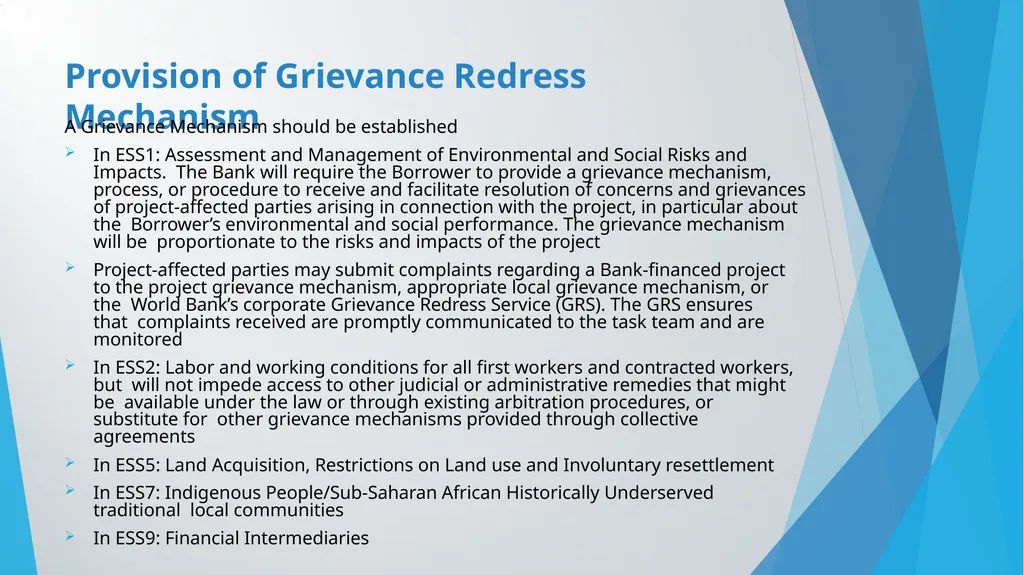
slide4. Provision of Grievance Redress Mechanism A Grievance Mechanism should be established
In ESS1: Assessment and Management of Environmental and Social Risks and Impacts. The Bank will require the Borrower to provide a grievance mechanism, process, or procedure to receive and facilitate resolution of concerns and grievances of project-affected parties arising in connection with the project, in particular about the Borrower’s environmental and social performance. The grievance mechanism will be proportionate to the risks and impacts of the project
Project-affected parties may submit complaints regarding a Bank-financed project to the project grievance mechanism, appropriate local grievance mechanism, or the World Bank’s corporate Grievance Redress Service (GRS). The GRS ensures that complaints received are promptly communicated to the task team and are monitored
In ESS2: Labor and working conditions for all first workers and contracted workers, but will not impede access to other judicial or administrative remedies that might be available under the law or through existing arbitration procedures, or substitute for other grievance mechanisms provided through collective agreements
In ESS5: Land Acquisition, Restrictions on Land use and Involuntary resettlement
In ESS7: Indigenous People/Sub-Saharan African Historically Underserved traditional local communities
In ESS9: Financial Intermediaries<br>
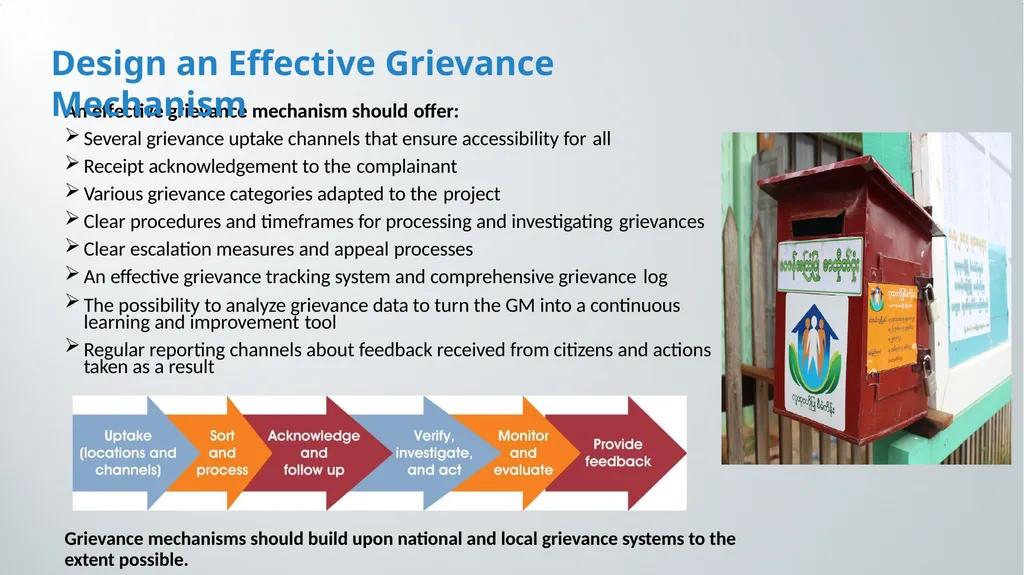
slide5. An effective grievance mechanism should offer:
Several grievance uptake channels that ensure accessibility for all
Receipt acknowledgement to the complainant
Various grievance categories adapted to the project
Clear procedures and timeframes for processing and investigating grievances
Clear escalation measures and appeal processes
An effective grievance tracking system and comprehensive grievance log
The possibility to analyze grievance data to turn the GM into a continuous learning and improvement tool
Regular reporting channels about feedback received from citizens and actions taken as a result Design an Effective Grievance Mechanism Grievance mechanisms should build upon national and local grievance systems to the extent possible.<br>
slide6. Scope and Scale of Grievance Mechanism The Grievance Mechanism may include the following:
Different ways in which users can submit their grievances, which may include submissions in person, by phone, text message, mail, e-mail, or via a website;
A log where grievances are registered in writing and maintained as a database;
Publicly advertised procedures, setting out the length of time users can expect to wait for acknowledgement, response, and resolution of their grievances;
Transparency about the grievance procedure, governing structure, and decision makers; and
An appeal process (including the national judiciary) to which unsatisfied grievances may be referred when the resolution of the grievance has not been achieved<br>
slide7. Scope and Scale of Grievance Mechanism (ctd..) The grievance mechanism is expected to address concerns promptly and effectively, in a transparent manner that is culturally appropriate and readily accessible to all project-affected parties, at no cost and without retribution. The mechanism, process, or procedure will not prevent access to judicial or administrative remedies.
Inform the project-affected parties about the grievance process in the course of its community engagement activities, and will make publicly available a record documenting the responses to all grievances received; and
Handling of grievances will be done in a culturally appropriate manner and be discreet, objective, sensitive and responsive to the needs and concerns of the project-affected parties, balanced and be confidential The mechanism will also allow for anonymous complaints to be raised and addressed.<br>
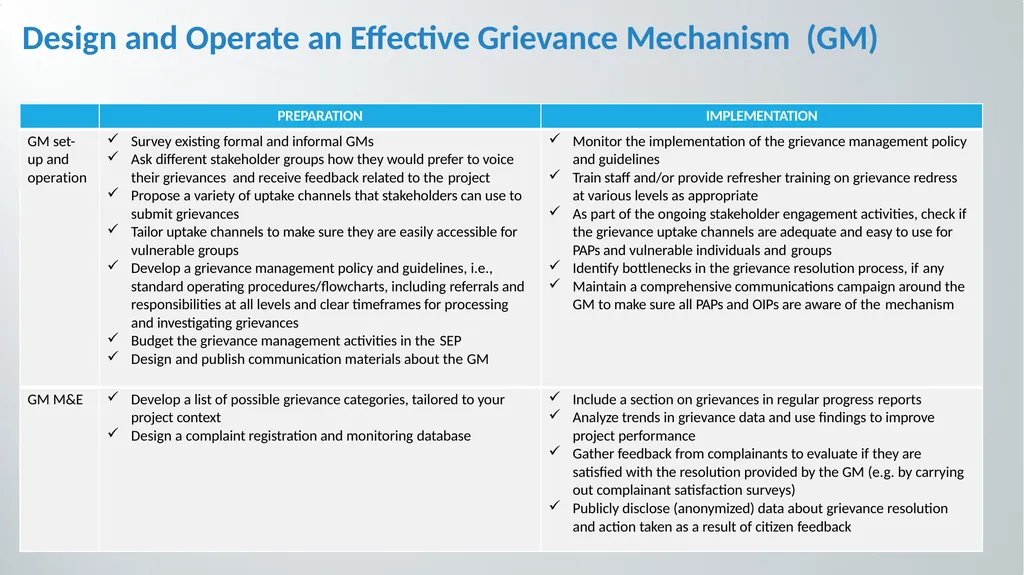
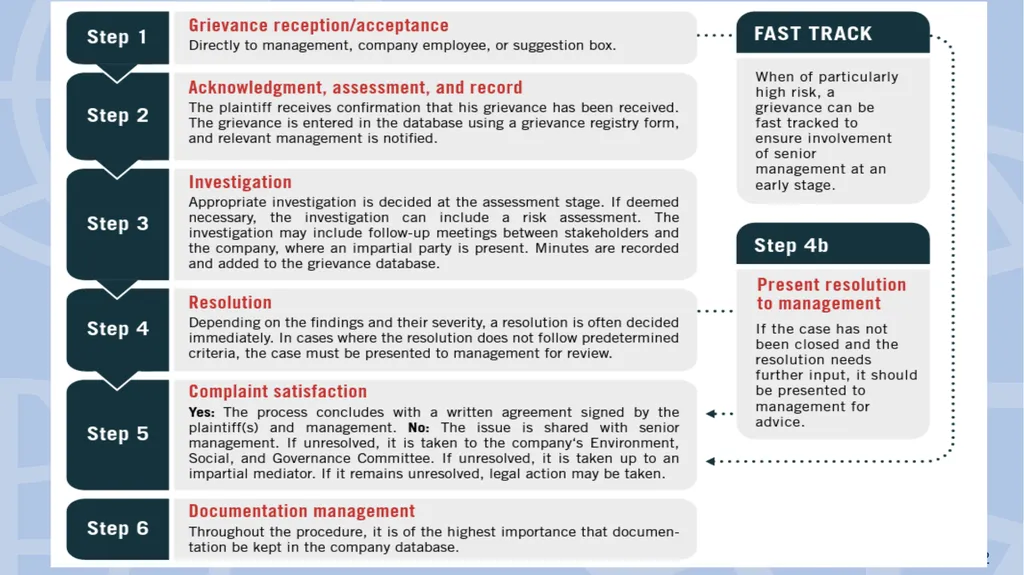
slide8. Design and Operate an Effective Grievance Mechanism (GM)<br>
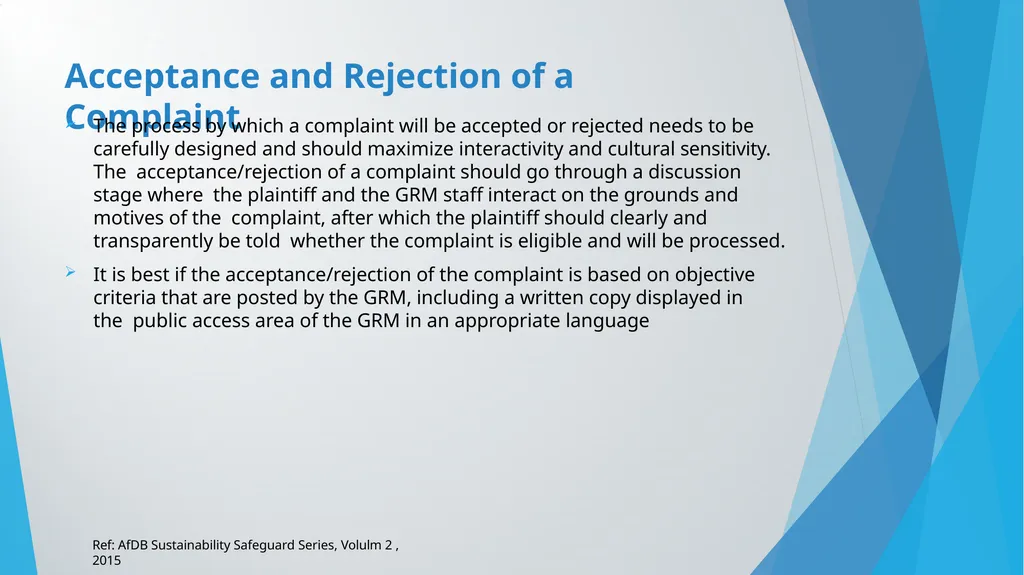
slide9. Acceptance and Rejection of a Complaint The process by which a complaint will be accepted or rejected needs to be carefully designed and should maximize interactivity and cultural sensitivity. The acceptance/rejection of a complaint should go through a discussion stage where the plaintiff and the GRM staff interact on the grounds and motives of the complaint, after which the plaintiff should clearly and transparently be told whether the complaint is eligible and will be processed.
It is best if the acceptance/rejection of the complaint is based on objective criteria that are posted by the GRM, including a written copy displayed in the public access area of the GRM in an appropriate language Ref: AfDB Sustainability Safeguard Series, Volulm 2 , 2015<br>
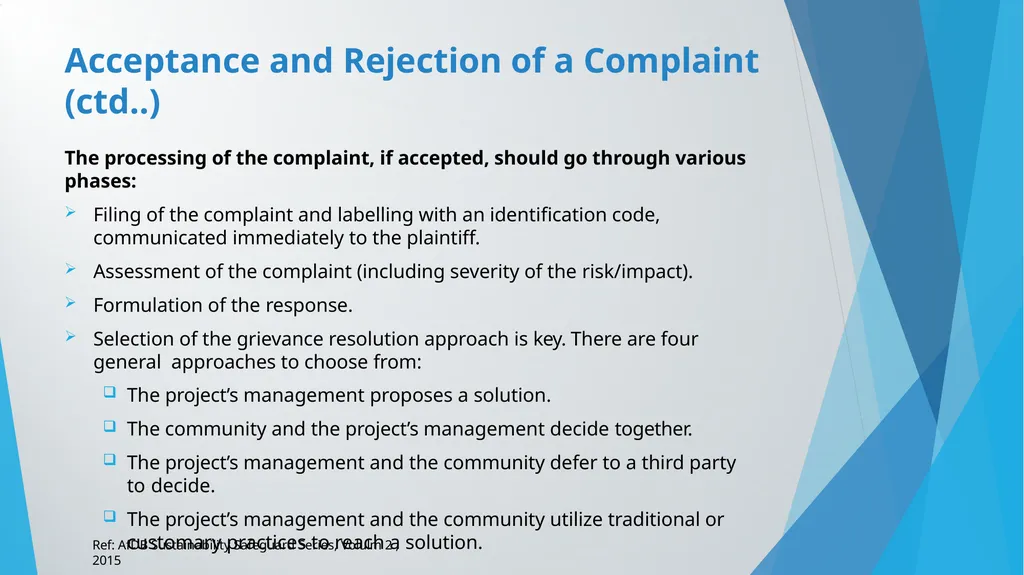
slide10. Acceptance and Rejection of a Complaint (ctd..) The processing of the complaint, if accepted, should go through various phases:
Filing of the complaint and labelling with an identification code, communicated immediately to the plaintiff.
Assessment of the complaint (including severity of the risk/impact).
Formulation of the response.
Selection of the grievance resolution approach is key. There are four general approaches to choose from:
The project’s management proposes a solution.
The community and the project’s management decide together.
The project’s management and the community defer to a third party to decide.
The project’s management and the community utilize traditional or customary practices to reach a solution. Ref: AfDB Sustainability Safeguard Series, Volulm 2 , 2015<br>
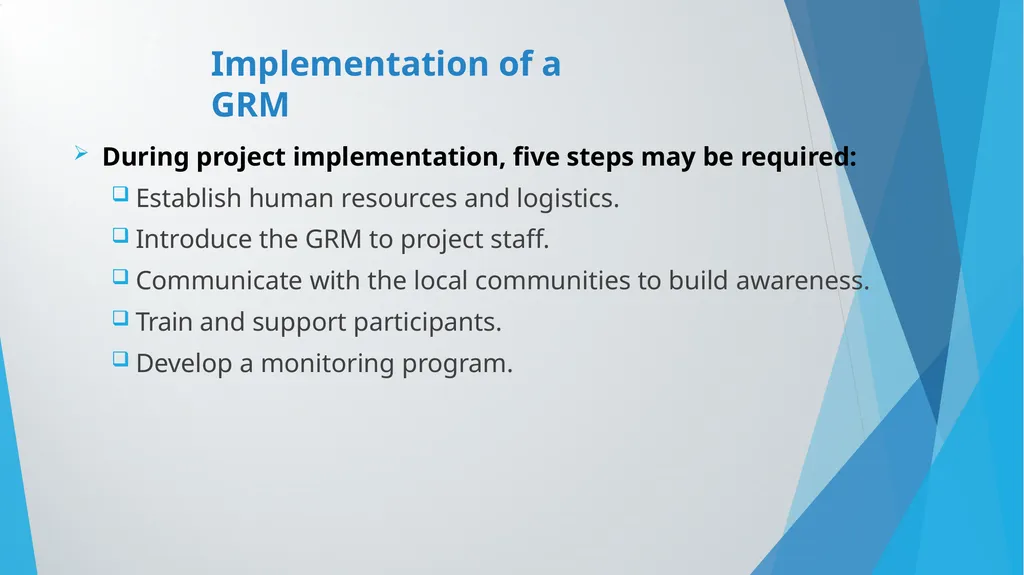
slide11. Implementation of a GRM During project implementation, five steps may be required:
Establish human resources and logistics.
Introduce the GRM to project staff.
Communicate with the local communities to build awareness.
Train and support participants.
Develop a monitoring program.<br>
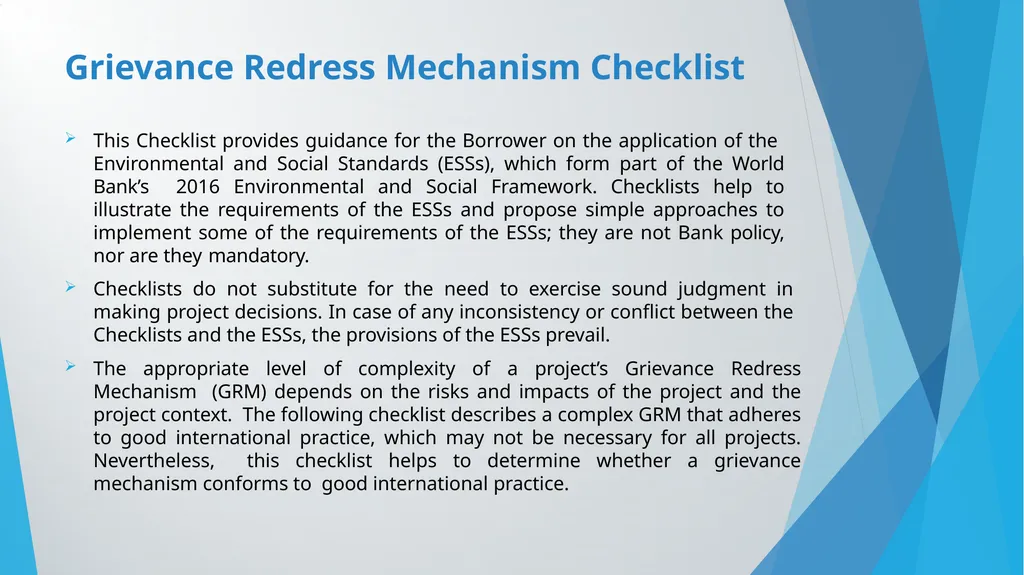
slide13. Grievance Redress Mechanism Checklist This Checklist provides guidance for the Borrower on the application of the Environmental and Social Standards (ESSs), which form part of the World Bank’s 2016 Environmental and Social Framework. Checklists help to illustrate the requirements of the ESSs and propose simple approaches to implement some of the requirements of the ESSs; they are not Bank policy, nor are they mandatory.
Checklists do not substitute for the need to exercise sound judgment in making project decisions. In case of any inconsistency or conflict between the Checklists and the ESSs, the provisions of the ESSs prevail.
The appropriate level of complexity of a project’s Grievance Redress Mechanism (GRM) depends on the risks and impacts of the project and the project context. The following checklist describes a complex GRM that adheres to good international practice, which may not be necessary for all projects. Nevertheless, this checklist helps to determine whether a grievance mechanism conforms to good international practice.<br>
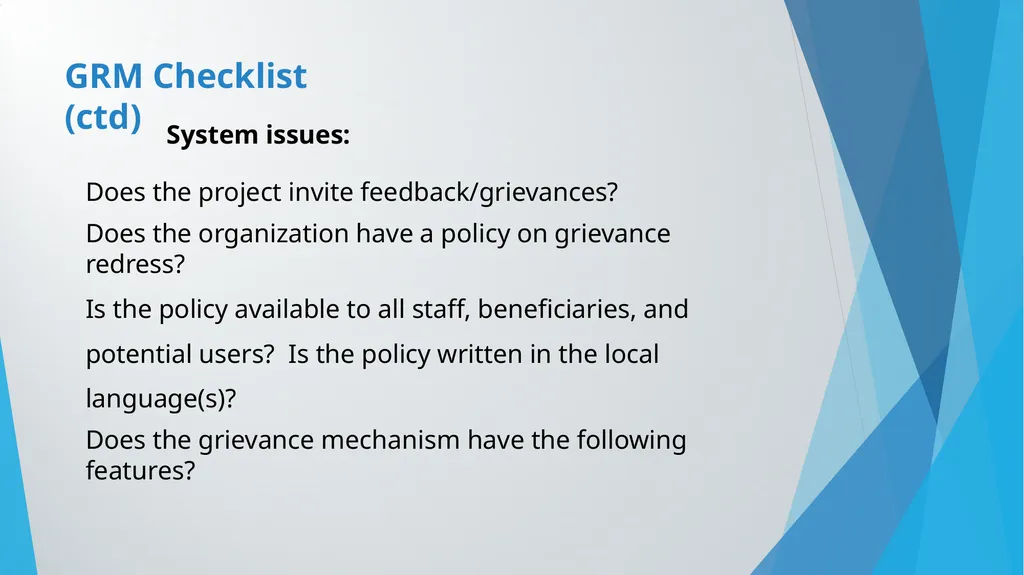
slide14. GRM Checklist (ctd) Does the project invite feedback/grievances?
Does the organization have a policy on grievance redress?
Is the policy available to all staff, beneficiaries, and potential users? Is the policy written in the local language(s)?
Does the grievance mechanism have the following features? System issues:<br>
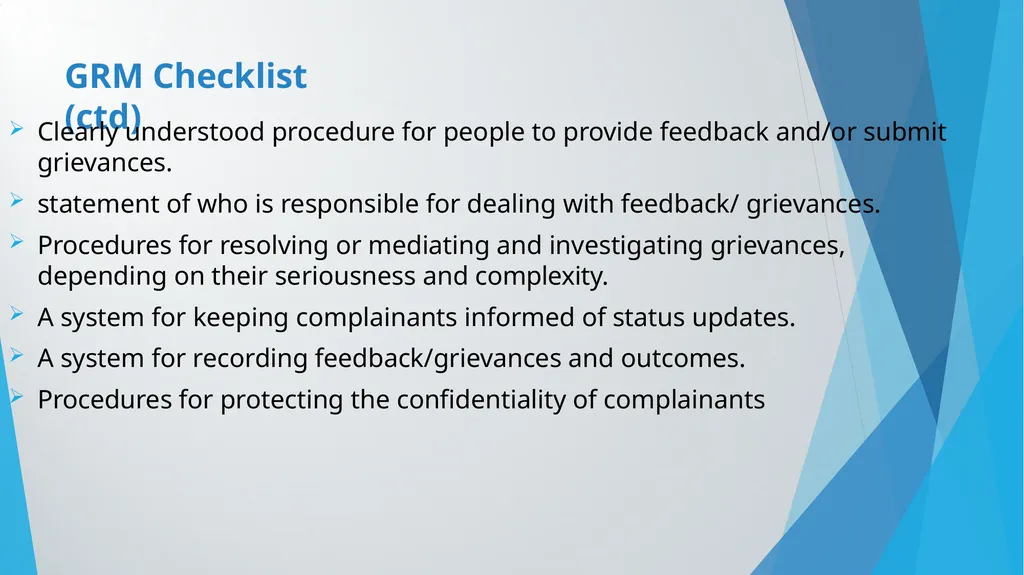
slide15. GRM Checklist (ctd) Clearly understood procedure for people to provide feedback and/or submit grievances.
statement of who is responsible for dealing with feedback/ grievances.
Procedures for resolving or mediating and investigating grievances, depending on their seriousness and complexity.
A system for keeping complainants informed of status updates.
A system for recording feedback/grievances and outcomes.
Procedures for protecting the confidentiality of complainants<br>
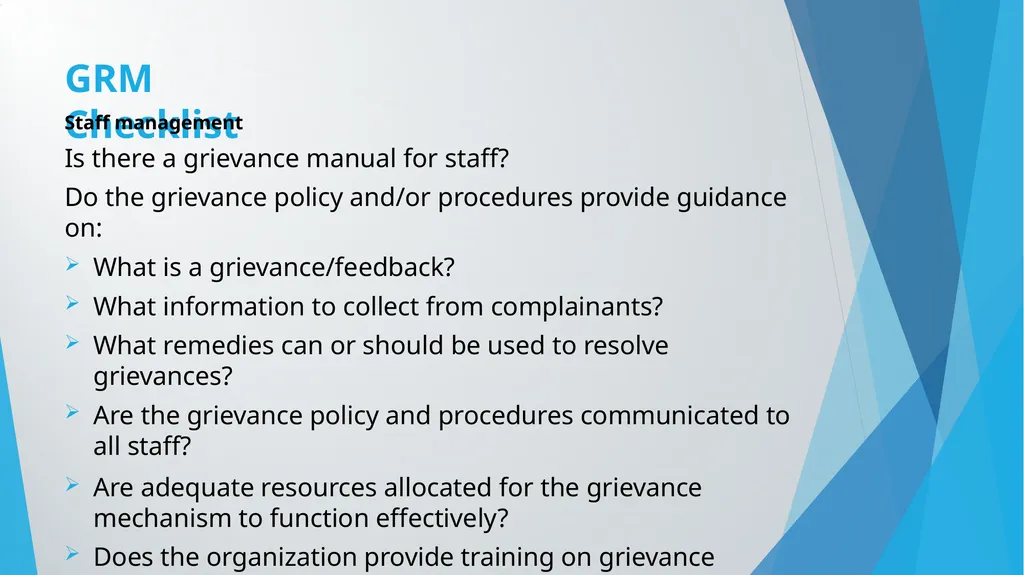
slide16. GRM Checklist Staff management
Is there a grievance manual for staff?
Do the grievance policy and/or procedures provide guidance on:
What is a grievance/feedback?
What information to collect from complainants?
What remedies can or should be used to resolve grievances?
Are the grievance policy and procedures communicated to all staff?
Are adequate resources allocated for the grievance mechanism to function effectively?
Does the organization provide training on grievance management to staff?<br>
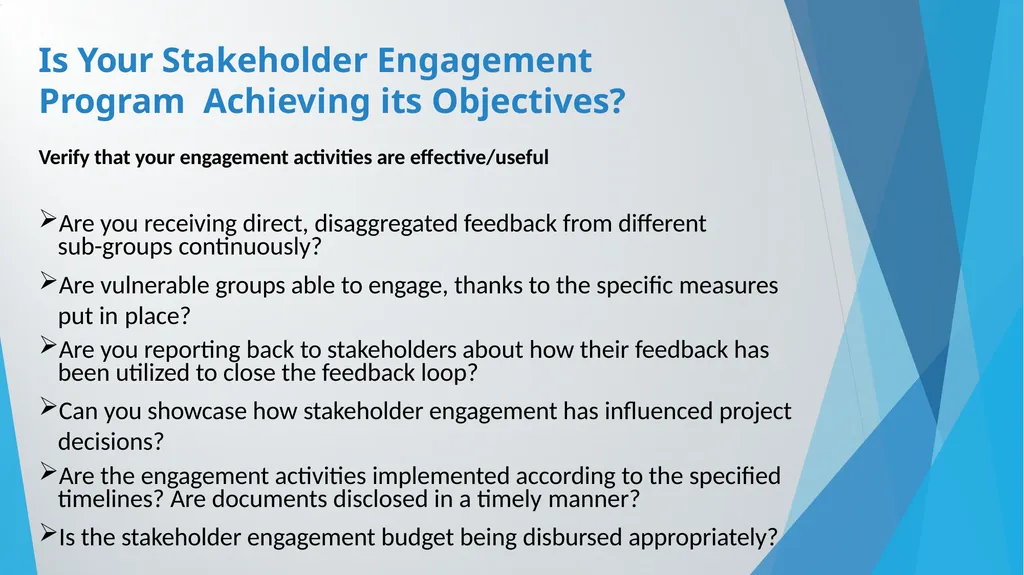
slide17. Verify that your engagement activities are effective/useful
Are you receiving direct, disaggregated feedback from different sub-groups continuously?
Are vulnerable groups able to engage, thanks to the specific measures put in place?
Are you reporting back to stakeholders about how their feedback has been utilized to close the feedback loop?
Can you showcase how stakeholder engagement has influenced project decisions?
Are the engagement activities implemented according to the specified timelines? Are documents disclosed in a timely manner?
Is the stakeholder engagement budget being disbursed appropriately? Is Your Stakeholder Engagement Program Achieving its Objectives?<br>
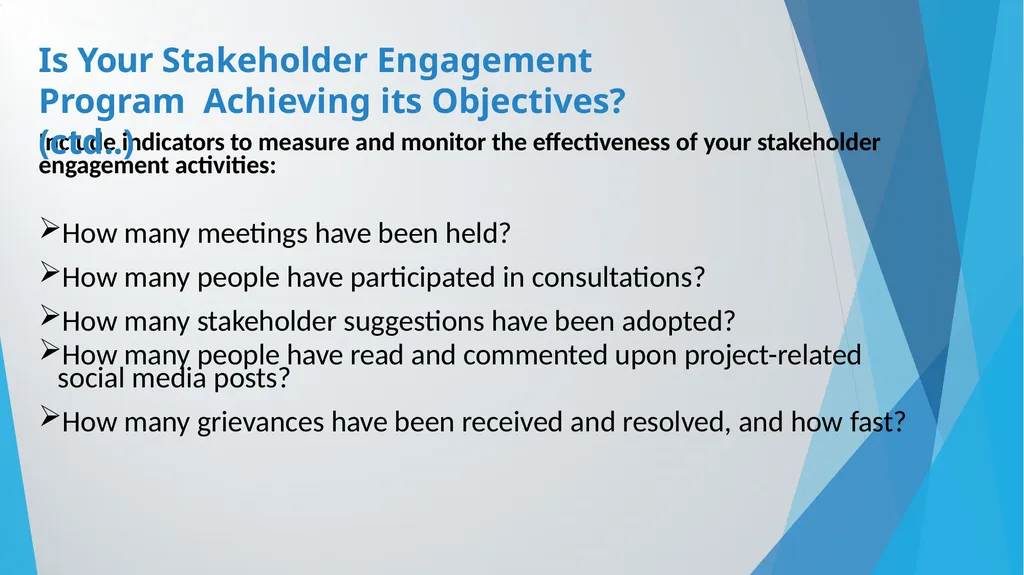
slide18. Include indicators to measure and monitor the effectiveness of your stakeholder engagement activities:
How many meetings have been held?
How many people have participated in consultations?
How many stakeholder suggestions have been adopted?
How many people have read and commented upon project-related social media posts?
How many grievances have been received and resolved, and how fast? Is Your Stakeholder Engagement Program Achieving its Objectives? (ctd..)<br>
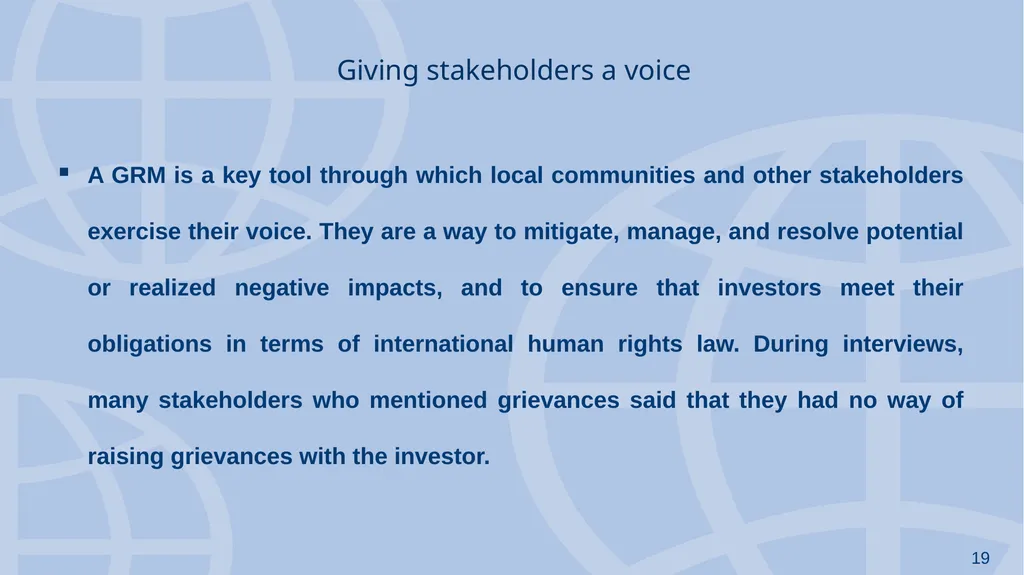
slide19. Giving stakeholders a voice A GRM is a key tool through which local communities and other stakeholders exercise their voice. They are a way to mitigate, manage, and resolve potential or realized negative impacts, and to ensure that investors meet their obligations in terms of international human rights law. During interviews, many stakeholders who mentioned grievances said that they had no way of raising grievances with the investor.<br>
slide20. Addressing grievances early is best Evidence from the field shows that seemingly minor complaints can quickly become major grievances if left unmanaged. A GRM is an important tool that enables investors to learn about and resolve concerns before they escalate. GRMs should permit a peaceful and timely resolution of problems, assuring stakeholders that their concerns have been heard and that the institutionalized mechanism will yield a fair and impartial outcome.<br>
slide21. Zero Grievances No reported grievances does not mean that no grievances exist. In some cases, management thought there were no grievances as none had been received, although they maintained that their door was always open. Community representatives sometimes do have grievances, but are ignorant of how to raise them, often relying on the traditional tribal system and trusting that local leaders would raise them on their behalf.
A better approach is to design the GRM in consultation with communities. Communities should be educated on how to channel their grievances directly.<br>
slide22. Documentation The GRM needs to have a suitable system for ensuring the maintenance of written documentation of all relevant stages in the process. The system should include a complaint form, minutes of any meetings held by the GRM committee or other body, and a signed agreement to any resolution to a grievance.
Good-quality documentation minimizes the risks of grievances being raised again and of subsequent complaints about the resolution. Tracking of the physical location of the source of the grievance (possibly using GPS coordinates) is important so that grievance patterns can be analyzed spatially, to help identify particular problems and solutions.<br>
slide23. Provisions for confidentiality and anonymity The GRM should provide aggrieved parties with the option to keep complaints confidential and/or anonymous. Illiterate people raising a grievance will need assistance so it can be transcribed through a trusted confidant. This could be a family member, friend, or a designated official.<br>
slide24. Transparency The process and outcome of individual grievances should be transparent to the aggrieved party. In publicizing more widely the outcome of grievances, a balance needs to be struck between accountability and transparency, and the desires of aggrieved parties to keep complaints confidential. Investors should consider aggregated public reporting of the operation of the grievance procedures, such as quarterly reports on the number of grievances, their nature, and statistics on how they have been resolved.
In cases where the publication of specific grievances or outcomes may be in the interests of the community or community relations, permission should first be sought from the aggrieved individual.<br>
slide25. Internal evaluation The GRM should be evaluated against key performance indicators such as the percentage of grievances resolved internally before they reach the media or courts; targets for closure of grievances within a specified time frame; target of closure within the first two internal rounds of discussions, avoiding the need for external mediatory bodies; number of complaints expressed as a monthly value for critical, major, and minor grievances; and percentage change year by year of the number and degree of grievances.
The successful application of a GRM is an evolutionary process, and the investor should monitor and look for ways to improve the application of the GRM itself.<br>
slide26. Multi-channelled To avoid conflicts of interest, there should be multiple ways for a grievance to be raised. For example, raising the issue with a supervisor is one channel for an employee, but for a grievance of a personal nature with that supervisor, there need to be other ways to elevate the issue.<br>
slide27. Broad representation A GRM should allow for broad representation on any consultative body, including youth, women, and marginalized and vulnerable groups. It is important that its design does not entrench existing power structures, for example by involving only senior men in the community.<br>
slide28. Set fair and consistent standards early on After its launch, a GRM tends to receive a wave of grievances, complaints, disputes, suggestions, and requests. As the company demonstrates fair and strict management of these grievances, employees and community members learn which issues can be raised and the process stabilizes. Investors need to be vigilant in not overcommitting or creating the impression that all issues can be automatically resolved.<br>
slide29. Any question?<br>
26TH AUGUST 2025<br>
slide2. Grievance Mechanism: Definition A grievance mechanism is an accessible and inclusive system, process, or procedure that receives and acts upon complaints and suggestions for improvement in a timely fashion and facilitates the resolution of concerns and grievances arising in connection with a project. An effective grievance mechanism provides project-affected parties with redress and helps address issues at an early stage
A grievance mechanism is designed based on an understanding of the issues that are likely to be the subject of concerns and grievances. The appropriate design and scale of the grievance mechanism are project-specific. The design depends upon factors such as the project context, scale, and scope; the number of project beneficiaries; capacity; cultural attitudes toward lodging grievances; available human and financial resources; and technological constraints
To make grievance mechanisms accessible to all stakeholders, it is helpful to make the procedures to submit grievances simple and easy to understand; advertise them publicly and broadly via newspapers, radio broadcasts, or other accessible and appropriate channels; and indicate the expected length of timelines for acknowledgment, response, and resolution. The grievance mechanism is free of charge to stakeholders. Accessibility for disadvantaged or vulnerable groups is important
Ref: ESF Guidance Note – ESS10: Stakeholder Engagement and Information Disclosure<br>
slide3. Advantages of the Grievance Redress Mechanism The main advantages of establishing and maintaining an appropriate GRM linked to a Bank-funded project are:
Helping maintain good development conditions in the field, conducive to harmonious, sustainable development.
Minimizing the risk of violent or otherwise destructive behaviors, and their associated economic and social costs.
Helping to protect the most vulnerable local groups and individuals.
Alleviating the risk of dispute or conflict escalation<br>
slide4. Provision of Grievance Redress Mechanism A Grievance Mechanism should be established
In ESS1: Assessment and Management of Environmental and Social Risks and Impacts. The Bank will require the Borrower to provide a grievance mechanism, process, or procedure to receive and facilitate resolution of concerns and grievances of project-affected parties arising in connection with the project, in particular about the Borrower’s environmental and social performance. The grievance mechanism will be proportionate to the risks and impacts of the project
Project-affected parties may submit complaints regarding a Bank-financed project to the project grievance mechanism, appropriate local grievance mechanism, or the World Bank’s corporate Grievance Redress Service (GRS). The GRS ensures that complaints received are promptly communicated to the task team and are monitored
In ESS2: Labor and working conditions for all first workers and contracted workers, but will not impede access to other judicial or administrative remedies that might be available under the law or through existing arbitration procedures, or substitute for other grievance mechanisms provided through collective agreements
In ESS5: Land Acquisition, Restrictions on Land use and Involuntary resettlement
In ESS7: Indigenous People/Sub-Saharan African Historically Underserved traditional local communities
In ESS9: Financial Intermediaries<br>
slide5. An effective grievance mechanism should offer:
Several grievance uptake channels that ensure accessibility for all
Receipt acknowledgement to the complainant
Various grievance categories adapted to the project
Clear procedures and timeframes for processing and investigating grievances
Clear escalation measures and appeal processes
An effective grievance tracking system and comprehensive grievance log
The possibility to analyze grievance data to turn the GM into a continuous learning and improvement tool
Regular reporting channels about feedback received from citizens and actions taken as a result Design an Effective Grievance Mechanism Grievance mechanisms should build upon national and local grievance systems to the extent possible.<br>
slide6. Scope and Scale of Grievance Mechanism The Grievance Mechanism may include the following:
Different ways in which users can submit their grievances, which may include submissions in person, by phone, text message, mail, e-mail, or via a website;
A log where grievances are registered in writing and maintained as a database;
Publicly advertised procedures, setting out the length of time users can expect to wait for acknowledgement, response, and resolution of their grievances;
Transparency about the grievance procedure, governing structure, and decision makers; and
An appeal process (including the national judiciary) to which unsatisfied grievances may be referred when the resolution of the grievance has not been achieved<br>
slide7. Scope and Scale of Grievance Mechanism (ctd..) The grievance mechanism is expected to address concerns promptly and effectively, in a transparent manner that is culturally appropriate and readily accessible to all project-affected parties, at no cost and without retribution. The mechanism, process, or procedure will not prevent access to judicial or administrative remedies.
Inform the project-affected parties about the grievance process in the course of its community engagement activities, and will make publicly available a record documenting the responses to all grievances received; and
Handling of grievances will be done in a culturally appropriate manner and be discreet, objective, sensitive and responsive to the needs and concerns of the project-affected parties, balanced and be confidential The mechanism will also allow for anonymous complaints to be raised and addressed.<br>
slide8. Design and Operate an Effective Grievance Mechanism (GM)<br>
slide9. Acceptance and Rejection of a Complaint The process by which a complaint will be accepted or rejected needs to be carefully designed and should maximize interactivity and cultural sensitivity. The acceptance/rejection of a complaint should go through a discussion stage where the plaintiff and the GRM staff interact on the grounds and motives of the complaint, after which the plaintiff should clearly and transparently be told whether the complaint is eligible and will be processed.
It is best if the acceptance/rejection of the complaint is based on objective criteria that are posted by the GRM, including a written copy displayed in the public access area of the GRM in an appropriate language Ref: AfDB Sustainability Safeguard Series, Volulm 2 , 2015<br>
slide10. Acceptance and Rejection of a Complaint (ctd..) The processing of the complaint, if accepted, should go through various phases:
Filing of the complaint and labelling with an identification code, communicated immediately to the plaintiff.
Assessment of the complaint (including severity of the risk/impact).
Formulation of the response.
Selection of the grievance resolution approach is key. There are four general approaches to choose from:
The project’s management proposes a solution.
The community and the project’s management decide together.
The project’s management and the community defer to a third party to decide.
The project’s management and the community utilize traditional or customary practices to reach a solution. Ref: AfDB Sustainability Safeguard Series, Volulm 2 , 2015<br>
slide11. Implementation of a GRM During project implementation, five steps may be required:
Establish human resources and logistics.
Introduce the GRM to project staff.
Communicate with the local communities to build awareness.
Train and support participants.
Develop a monitoring program.<br>
slide13. Grievance Redress Mechanism Checklist This Checklist provides guidance for the Borrower on the application of the Environmental and Social Standards (ESSs), which form part of the World Bank’s 2016 Environmental and Social Framework. Checklists help to illustrate the requirements of the ESSs and propose simple approaches to implement some of the requirements of the ESSs; they are not Bank policy, nor are they mandatory.
Checklists do not substitute for the need to exercise sound judgment in making project decisions. In case of any inconsistency or conflict between the Checklists and the ESSs, the provisions of the ESSs prevail.
The appropriate level of complexity of a project’s Grievance Redress Mechanism (GRM) depends on the risks and impacts of the project and the project context. The following checklist describes a complex GRM that adheres to good international practice, which may not be necessary for all projects. Nevertheless, this checklist helps to determine whether a grievance mechanism conforms to good international practice.<br>
slide14. GRM Checklist (ctd) Does the project invite feedback/grievances?
Does the organization have a policy on grievance redress?
Is the policy available to all staff, beneficiaries, and potential users? Is the policy written in the local language(s)?
Does the grievance mechanism have the following features? System issues:<br>
slide15. GRM Checklist (ctd) Clearly understood procedure for people to provide feedback and/or submit grievances.
statement of who is responsible for dealing with feedback/ grievances.
Procedures for resolving or mediating and investigating grievances, depending on their seriousness and complexity.
A system for keeping complainants informed of status updates.
A system for recording feedback/grievances and outcomes.
Procedures for protecting the confidentiality of complainants<br>
slide16. GRM Checklist Staff management
Is there a grievance manual for staff?
Do the grievance policy and/or procedures provide guidance on:
What is a grievance/feedback?
What information to collect from complainants?
What remedies can or should be used to resolve grievances?
Are the grievance policy and procedures communicated to all staff?
Are adequate resources allocated for the grievance mechanism to function effectively?
Does the organization provide training on grievance management to staff?<br>
slide17. Verify that your engagement activities are effective/useful
Are you receiving direct, disaggregated feedback from different sub-groups continuously?
Are vulnerable groups able to engage, thanks to the specific measures put in place?
Are you reporting back to stakeholders about how their feedback has been utilized to close the feedback loop?
Can you showcase how stakeholder engagement has influenced project decisions?
Are the engagement activities implemented according to the specified timelines? Are documents disclosed in a timely manner?
Is the stakeholder engagement budget being disbursed appropriately? Is Your Stakeholder Engagement Program Achieving its Objectives?<br>
slide18. Include indicators to measure and monitor the effectiveness of your stakeholder engagement activities:
How many meetings have been held?
How many people have participated in consultations?
How many stakeholder suggestions have been adopted?
How many people have read and commented upon project-related social media posts?
How many grievances have been received and resolved, and how fast? Is Your Stakeholder Engagement Program Achieving its Objectives? (ctd..)<br>
slide19. Giving stakeholders a voice A GRM is a key tool through which local communities and other stakeholders exercise their voice. They are a way to mitigate, manage, and resolve potential or realized negative impacts, and to ensure that investors meet their obligations in terms of international human rights law. During interviews, many stakeholders who mentioned grievances said that they had no way of raising grievances with the investor.<br>
slide20. Addressing grievances early is best Evidence from the field shows that seemingly minor complaints can quickly become major grievances if left unmanaged. A GRM is an important tool that enables investors to learn about and resolve concerns before they escalate. GRMs should permit a peaceful and timely resolution of problems, assuring stakeholders that their concerns have been heard and that the institutionalized mechanism will yield a fair and impartial outcome.<br>
slide21. Zero Grievances No reported grievances does not mean that no grievances exist. In some cases, management thought there were no grievances as none had been received, although they maintained that their door was always open. Community representatives sometimes do have grievances, but are ignorant of how to raise them, often relying on the traditional tribal system and trusting that local leaders would raise them on their behalf.
A better approach is to design the GRM in consultation with communities. Communities should be educated on how to channel their grievances directly.<br>
slide22. Documentation The GRM needs to have a suitable system for ensuring the maintenance of written documentation of all relevant stages in the process. The system should include a complaint form, minutes of any meetings held by the GRM committee or other body, and a signed agreement to any resolution to a grievance.
Good-quality documentation minimizes the risks of grievances being raised again and of subsequent complaints about the resolution. Tracking of the physical location of the source of the grievance (possibly using GPS coordinates) is important so that grievance patterns can be analyzed spatially, to help identify particular problems and solutions.<br>
slide23. Provisions for confidentiality and anonymity The GRM should provide aggrieved parties with the option to keep complaints confidential and/or anonymous. Illiterate people raising a grievance will need assistance so it can be transcribed through a trusted confidant. This could be a family member, friend, or a designated official.<br>
slide24. Transparency The process and outcome of individual grievances should be transparent to the aggrieved party. In publicizing more widely the outcome of grievances, a balance needs to be struck between accountability and transparency, and the desires of aggrieved parties to keep complaints confidential. Investors should consider aggregated public reporting of the operation of the grievance procedures, such as quarterly reports on the number of grievances, their nature, and statistics on how they have been resolved.
In cases where the publication of specific grievances or outcomes may be in the interests of the community or community relations, permission should first be sought from the aggrieved individual.<br>
slide25. Internal evaluation The GRM should be evaluated against key performance indicators such as the percentage of grievances resolved internally before they reach the media or courts; targets for closure of grievances within a specified time frame; target of closure within the first two internal rounds of discussions, avoiding the need for external mediatory bodies; number of complaints expressed as a monthly value for critical, major, and minor grievances; and percentage change year by year of the number and degree of grievances.
The successful application of a GRM is an evolutionary process, and the investor should monitor and look for ways to improve the application of the GRM itself.<br>
slide26. Multi-channelled To avoid conflicts of interest, there should be multiple ways for a grievance to be raised. For example, raising the issue with a supervisor is one channel for an employee, but for a grievance of a personal nature with that supervisor, there need to be other ways to elevate the issue.<br>
slide27. Broad representation A GRM should allow for broad representation on any consultative body, including youth, women, and marginalized and vulnerable groups. It is important that its design does not entrench existing power structures, for example by involving only senior men in the community.<br>
slide28. Set fair and consistent standards early on After its launch, a GRM tends to receive a wave of grievances, complaints, disputes, suggestions, and requests. As the company demonstrates fair and strict management of these grievances, employees and community members learn which issues can be raised and the process stabilizes. Investors need to be vigilant in not overcommitting or creating the impression that all issues can be automatically resolved.<br>
slide29. Any question?<br>