Assessment for formative and summative purposes Wynne Harlen What do you mean by assessment? Is there assessment when: A teacher asks pupils questions to find out what ideas they have about a topic before starting it? A teacher observes
"Assessment for formative and summative purposes" is the property of its rightful owner. Permission is granted to
download and print the materials on this website for personal, non-commercial use only, and to display it
on your personal computer provided you do not modify the materials and that you retain all copyright
notices contained in the materials. By downloading content from our website, you accept the terms of this
agreement.
Presentation Transcript
01
Assessment for formative and summative purposes Wynne Harlen<br>
02
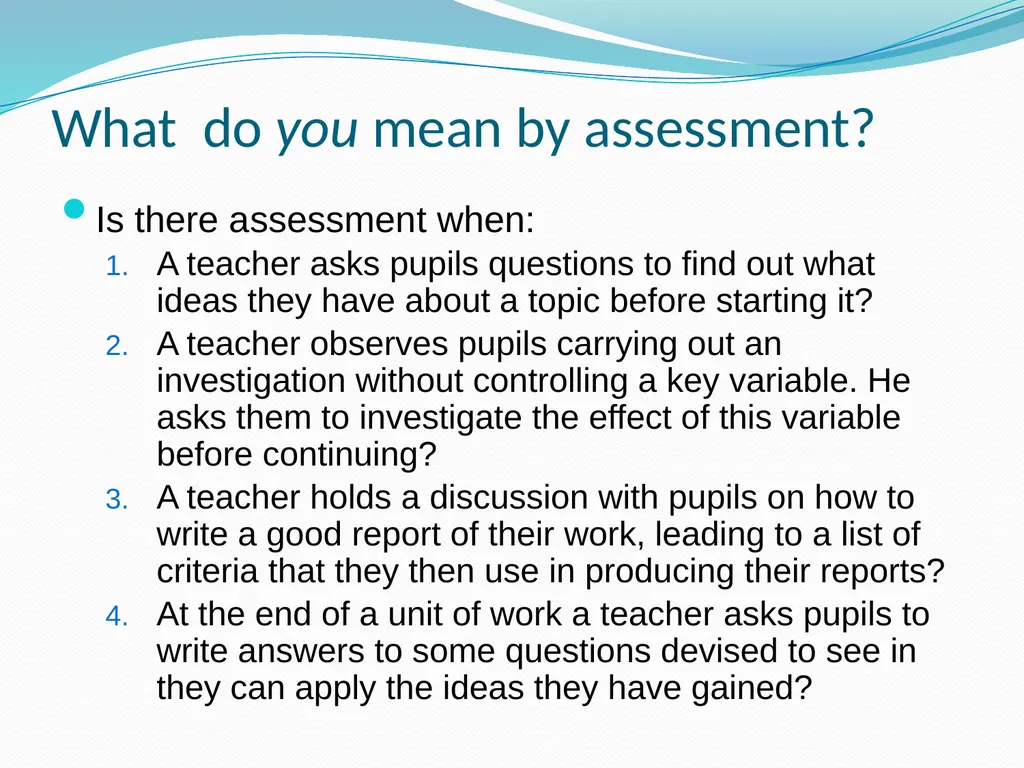
What do you mean by assessment? Is there assessment when:
A teacher asks pupils questions to find out what ideas they have about a topic before starting it?
A teacher observes pupils carrying out an investigation without controlling a key variable. He asks them to investigate the effect of this variable before continuing?
A teacher holds a discussion with pupils on how to write a good report of their work, leading to a list of criteria that they then use in producing their reports?
At the end of a unit of work a teacher asks pupils to write answers to some questions devised to see in they can apply the ideas they have gained?<br>
03
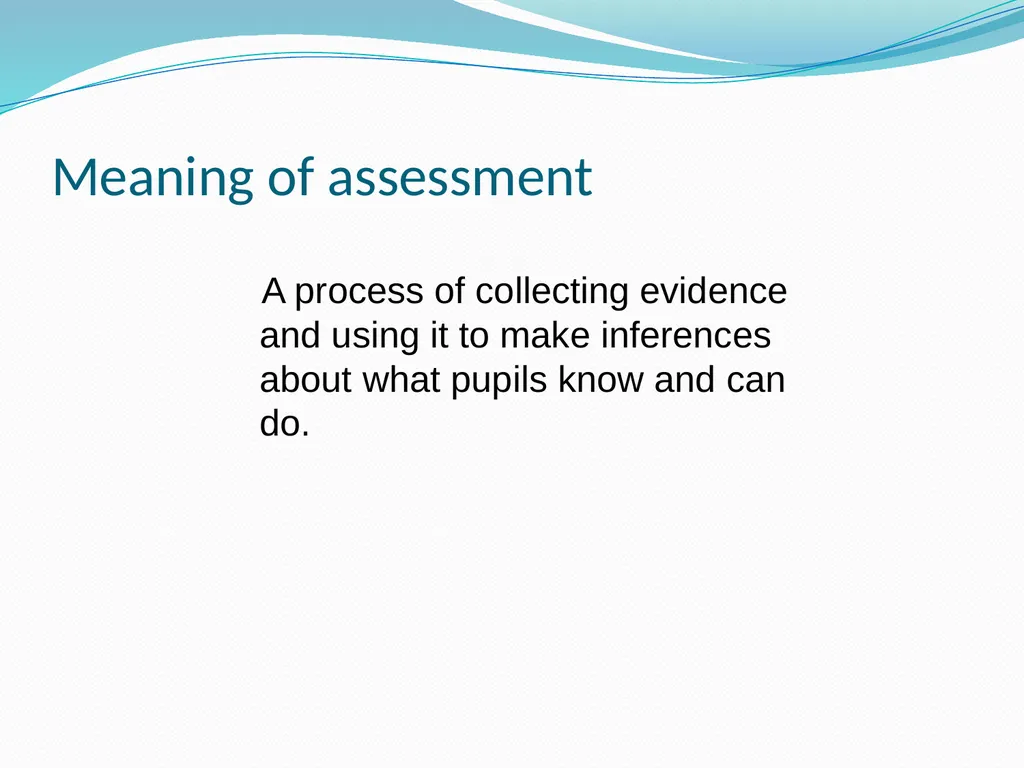
Meaning of assessment A process of collecting evidence and using it to make inferences about what pupils know and can do.<br>
04
Purposes of assessment Formative – to help learning and foster deeper engagement with it
Summative for ‘internal’ school uses - for keeping records and giving reports on progress to other teachers, parents and children
Summative for ‘external’ uses - including certification, selection and meeting statutory requirements, eg for national tests or assessment<br>
05
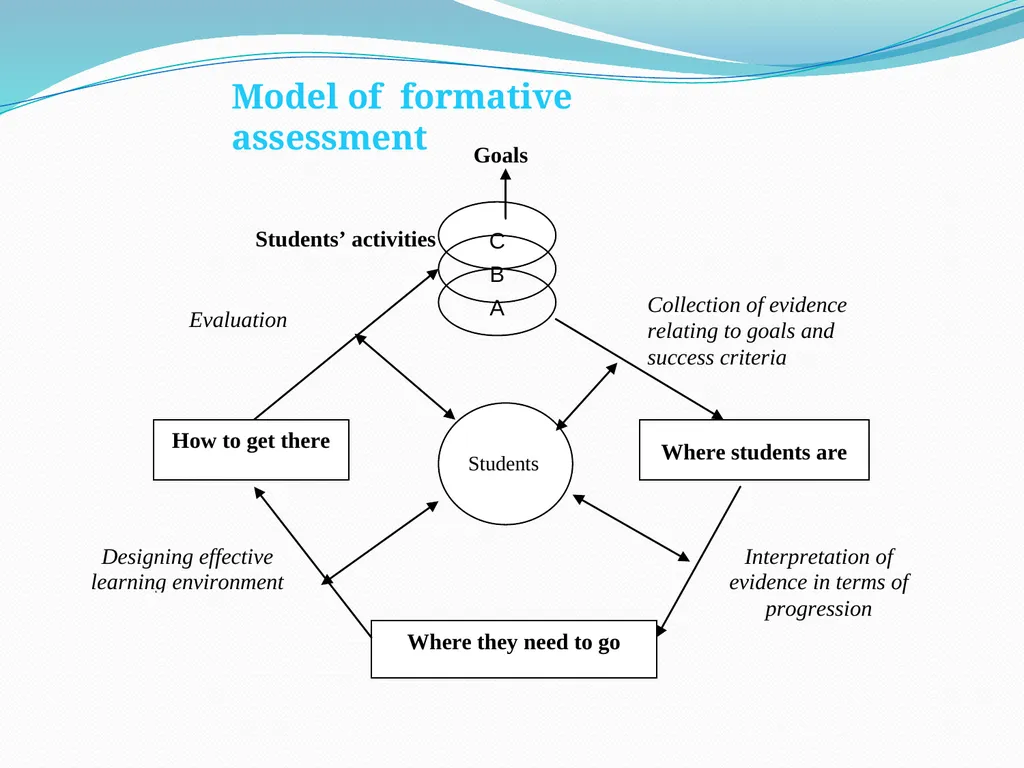
Processes and procedures Formative assessment - also called ‘assessment for learning’ (AfL) - involves processes of “seeking and interpreting evidence for use by learners and their teachers to decide where the learners are in their learning and where they need to go and how best to get there” (ARG 2002).
Summative assessment – also called ‘assessment of learning’ (AoL) - involves processes of summing up by reviewing learning over a period of time, or checking-up by testing learning at a particular time.<br>
06
Uses The difference between formative and summative assessment is in the uses of the evidence
There is no method of assessment that is inherently ‘formative’ or ‘summative’.
Formative has one use – to help learning of individuals and groups directly. It if doesn’t help then it isn’t formative.
Summative has several uses, some relating to individuals, groups or populations and for making different decisions (selection, ranking, accountability, etc)<br>
07
Formative assessment A continuing cyclic process in which information about pupils’ ideas and skills informs on-going teaching and helps learners’ active engagement in learning.
Involves the collection of evidence about learning as it takes place, the interpretation of that evidence in terms of progress towards the goals of the work, the identification of appropriate next steps and decisions about how to take them.
Helps to ensure progression in learning
Regulates the teaching and learning processes to ensure learning with understanding, by providing feedback to both teacher and student.<br>
08
Model of formative assessment<br>
09
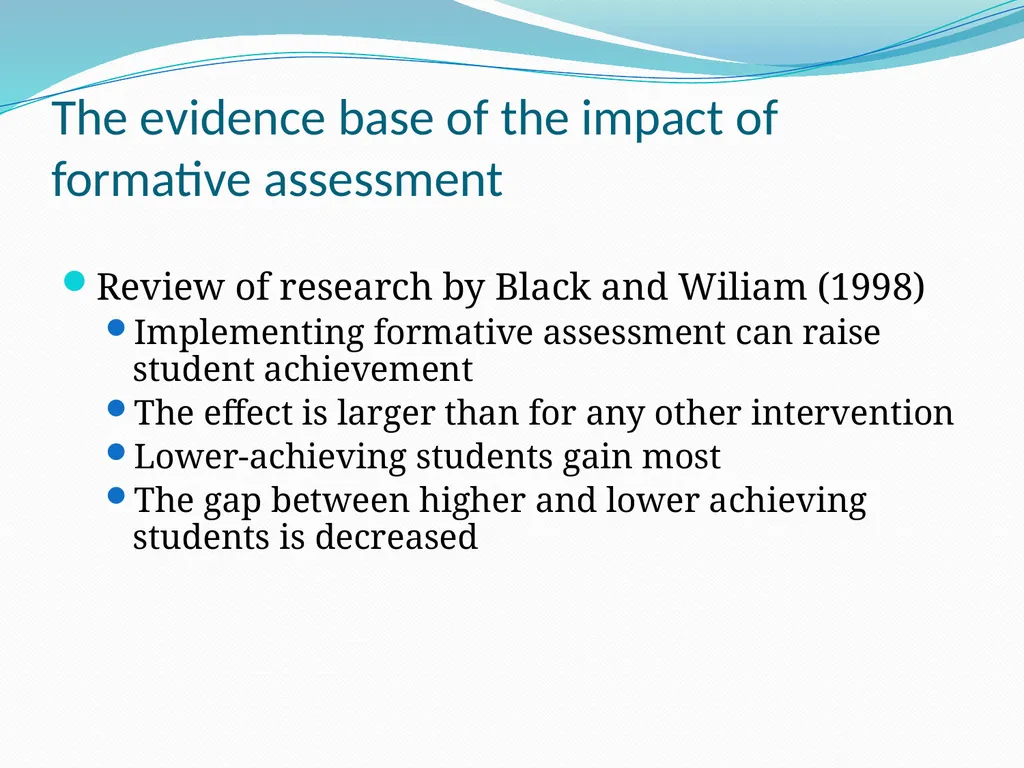
The evidence base of the impact of formative assessment Review of research by Black and Wiliam (1998)
Implementing formative assessment can raise student achievement
The effect is larger than for any other intervention
Lower-achieving students gain most
The gap between higher and lower achieving students is decreased<br>
10
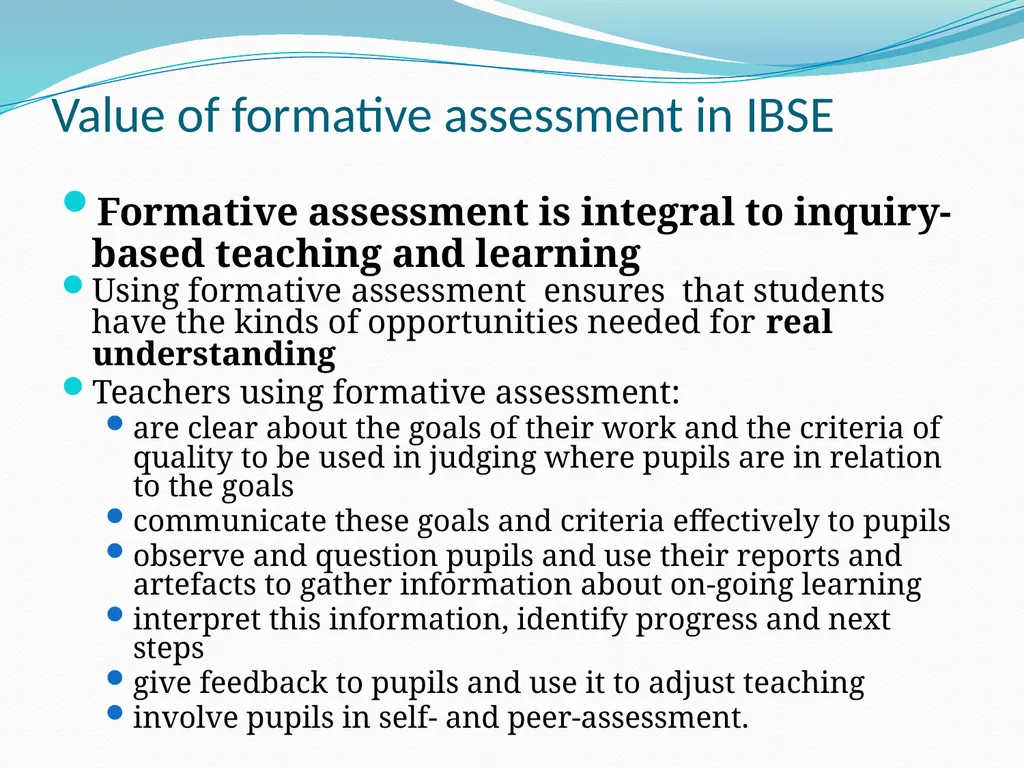
Value of formative assessment in IBSE Formative assessment is integral to inquiry-based teaching and learning
Using formative assessment ensures that students have the kinds of opportunities needed for real understanding
Teachers using formative assessment:
are clear about the goals of their work and the criteria of quality to be used in judging where pupils are in relation to the goals
communicate these goals and criteria effectively to pupils
observe and question pupils and use their reports and artefacts to gather information about on-going learning
interpret this information, identify progress and next steps
give feedback to pupils and use it to adjust teaching
involve pupils in self- and peer-assessment.<br>
11
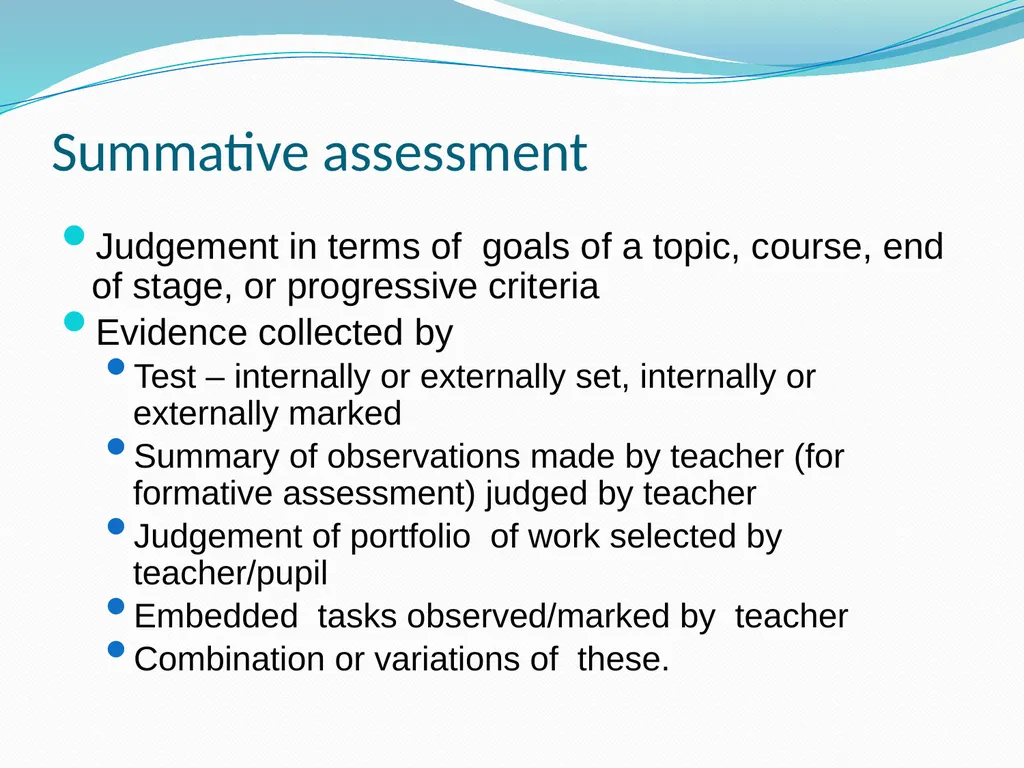
Summative assessment Judgement in terms of goals of a topic, course, end of stage, or progressive criteria
Evidence collected by
Test – internally or externally set, internally or externally marked
Summary of observations made by teacher (for formative assessment) judged by teacher
Judgement of portfolio of work selected by teacher/pupil
Embedded tasks observed/marked by teacher
Combination or variations of these.<br>
12
Problems with tests Limited number of items – leading to sampling errors
many students given incorrect grades (Wiliam 2001)
Preference for reliably marked items reduces validity –trade-off between validity and reliability
Context effect in assessment of skills
Individual skills rather than whole investigations
Difficulty of ensuring application rather than recall
communicating an unfamiliar context makes demands on reading, interpretation of representations
Other features of context (beyond familiarity) may affect engagement
High stakes uses of results leads to ‘teaching to the test.’<br>
13
The impact of using test results for school evaluation and accountability (As reported in the Cambridge Primary Review, Alexander (Eds) 2010)
put children and teachers under intolerable pressure
are highly stressful
constrain the curriculum
subvert the goals of learning
undermine children’s self-esteem
run counter to schools’ commitment to a full and rounded education
turn the final year of primary school into a year of cramming and testing (p316)<br>
14
What is needed to assess inquiry skills? Situations in which students are
Observing, raising questions, planning investigations
Collecting, analysing and interpreting data
Drawing conclusions, communicating and applying
Real contexts which engage their thinking
Content which enables development of their understanding of big ideas
All these are situations which inquiry-based classroom science activities should provide and are opportunities for teachers to collect data for assessment.<br>
15
Some advantages of assessment by teachers Potential for the full range of goals to be included as teachers collect evidence as part of their normal work with students
Can relieve the pressure, on pupils and teachers, of terminal tests and examinations
Teachers can use information about students formatively as well as summatively
Can release resources (time and other costs) for alternative use.<br>
16
Some disadvantages Teachers’ judgements often perceived as being unreliable
Increase in work load for teachers
Can lead to the same distortion of teaching as testing if the results are used for high stakes accountability.<br>
17
Increasing the reliability of assessment by teachers Moderation procedures
Provision of detailed progressive criteria
Exemplification – ‘worked examples’
Group discussions of assessed work
Standardised tasks or short tests used to check judgements<br>
18
Importance of assessment for IBSE What is assessed and reported influences what is valued and given priority in teaching
So summative assessment must reflect the full range of goals of inquiry-based science education
How the assessment information is collected (by tests, by teachers, etc) influences what is assessed and reported
Process of summative assessment has an impact on the use of formative assessment.<br>