Explaining Neurodiversity with the Neurotrait Wheel www.neurotrait.org Neurodiversity: Natural variation in how brains work Neurodiversity is how we describe the natural variations of how human brains work. Neurodiverse conditions like
"Explaining Neurodiversity with the Neurotrait" is the property of its rightful owner. Permission is granted to
download and print the materials on this website for personal, non-commercial use only, and to display it
on your personal computer provided you do not modify the materials and that you retain all copyright
notices contained in the materials. By downloading content from our website, you accept the terms of this
agreement.
Presentation Transcript
01
Explaining Neurodiversity with the Neurotrait Wheel www.neurotrait.org<br>
02
Neurodiversity: Natural variation in how brains work Neurodiversity is how we describe the natural variations of how human brains work.
Neurodiverse conditions like autism, ADHD, dyslexia and others are not deficits or problems to be fixed. Just like biodiversity helps ecosystems thrive, neurodiversity brings strength to communities and teams through different perspectives and skills. www.neurotrait.org<br>
03
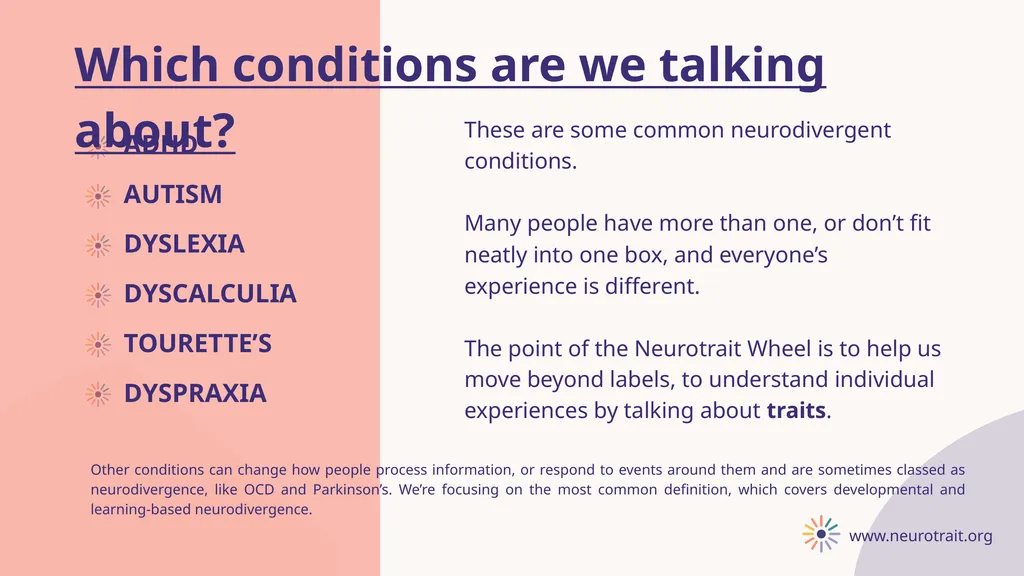
Which conditions are we talking about? ADHD AUTISM DYSLEXIA DYSPRAXIA DYSCALCULIA TOURETTE’S These are some common neurodivergent conditions.
Many people have more than one, or don’t fit neatly into one box, and everyone’s experience is different.
The point of the Neurotrait Wheel is to help us move beyond labels, to understand individual experiences by talking about traits. Other conditions can change how people process information, or respond to events around them and are sometimes classed as neurodivergence, like OCD and Parkinson’s. We’re focusing on the most common definition, which covers developmental and learning-based neurodivergence. www.neurotrait.org<br>
04
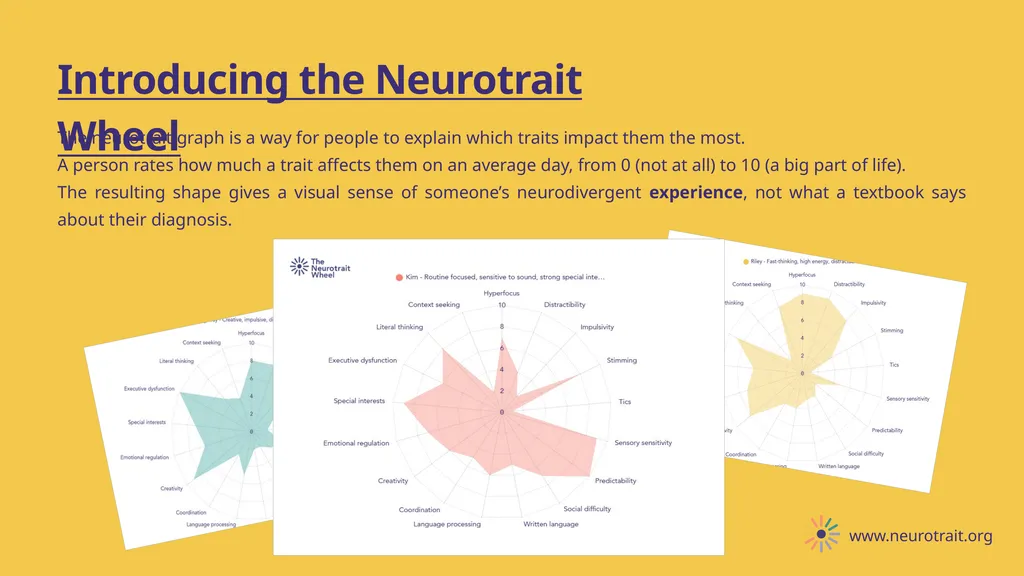
Introducing the Neurotrait Wheel The neurotrait graph is a way for people to explain which traits impact them the most.
A person rates how much a trait affects them on an average day, from 0 (not at all) to 10 (a big part of life).
The resulting shape gives a visual sense of someone’s neurodivergent experience, not what a textbook says about their diagnosis. www.neurotrait.org<br>
05
About the Traits These traits are some of the most common things that neurodivergent people experience. Some can be positive, some negative, and most depend on how much they show up in different circumstances. Hyperfocus
Distractibility
Impulsivity
Stimming
Tics
Sensory sensitivity
Need for predictability
Social difficulty
Written language difficulties There are lots of things that aren’t included on this list, but most neurodivergent people will experience many of these traits to some extent. Language processing
Coordination
Creativity
Emotional regulation
Special interests
Executive dysfunction
Literal thinking
Context seeking<br>
06
Why Traits? We talk about traits, not just symptoms, or strengths.
“Traits” is a neutral word. It includes things that might be seen as symptoms, strengths, challenges, or quirks, and reflects how people actually experience these conditions.
Someone might find that their traits affect them more or less in different circumstances, in different jobs, and so on.
Everyone has traits - what matters is how much impact they have on someone’s everyday life. www.neurotrait.org<br>
07
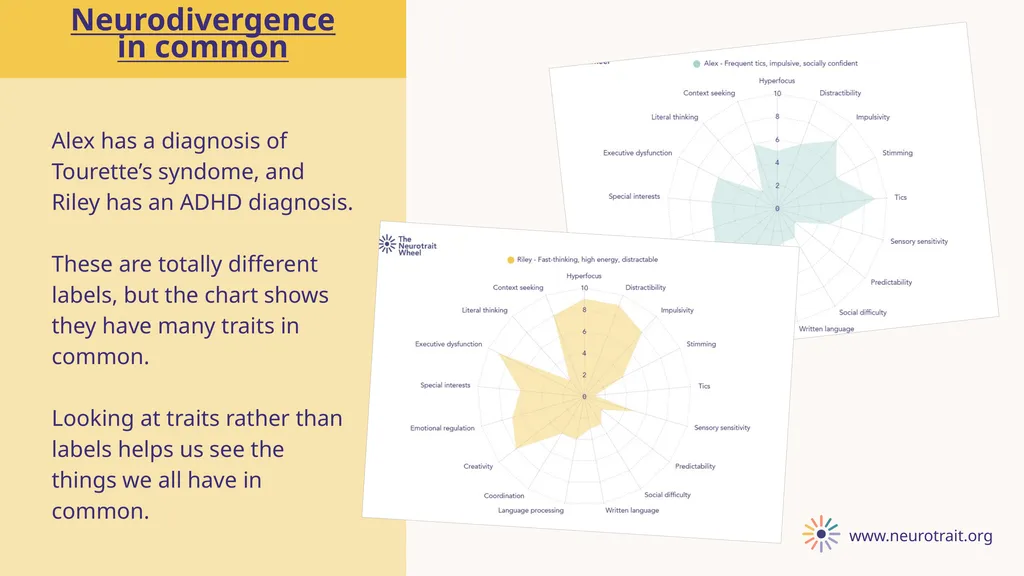
Neurodivergence in common Alex has a diagnosis of Tourette’s syndome, and Riley has an ADHD diagnosis.
These are totally different labels, but the chart shows they have many traits in common.
Looking at traits rather than labels helps us see the things we all have in common. www.neurotrait.org<br>
08
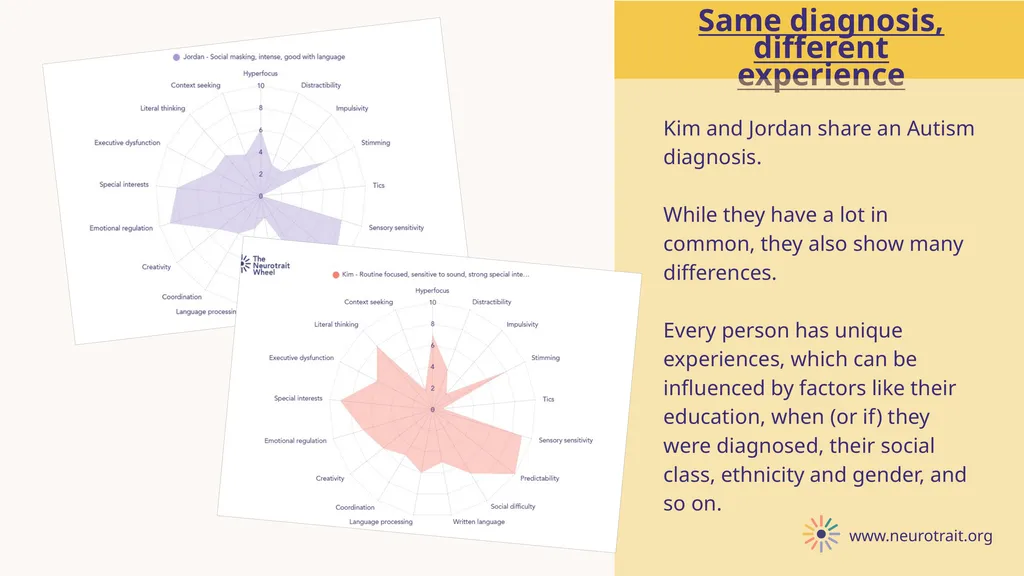
Same diagnosis, different experience Kim and Jordan share an Autism diagnosis.
While they have a lot in common, they also show many differences.
Every person has unique experiences, which can be influenced by factors like their education, when (or if) they were diagnosed, their social class, ethnicity and gender, and so on. www.neurotrait.org<br>
09
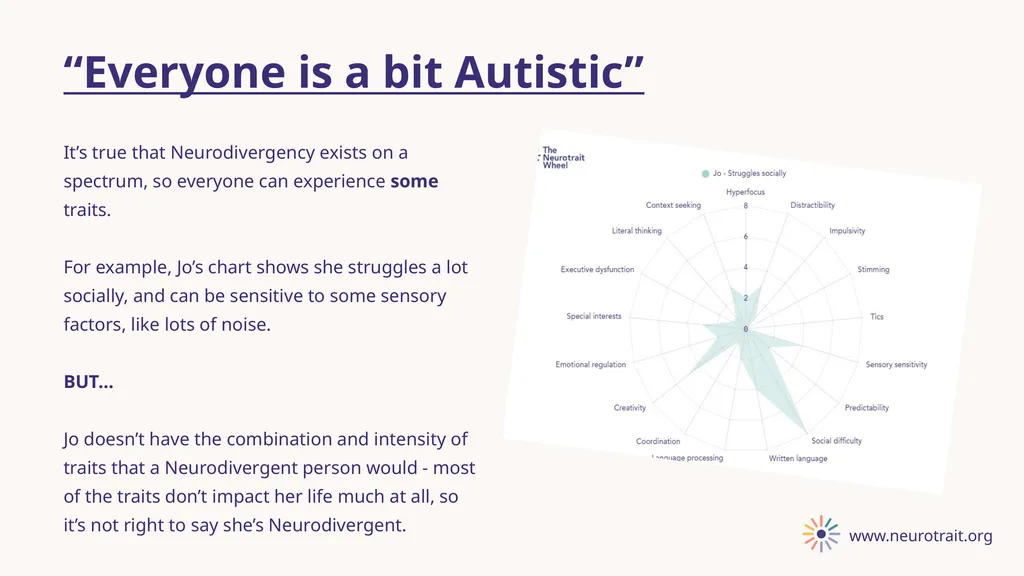
It’s true that Neurodivergency exists on a spectrum, so everyone can experience some traits.
For example, Jo’s chart shows she struggles a lot socially, and can be sensitive to some sensory factors, like lots of noise.
BUT...
Jo doesn’t have the combination and intensity of traits that a Neurodivergent person would - most of the traits don’t impact her life much at all, so it’s not right to say she’s Neurodivergent. “Everyone is a bit Autistic” www.neurotrait.org<br>
10
Tools like the Neurotrait Wheel can help spark useful conversations, but they’re just the beginning.
The most important thing you can do is be open, listen without judgement, and focus on what helps each individual thrive.
Remember: not everyone gets a diagnosis, and not all people with the same diagnosis have the same needs. That’s why this trait-based model helps. It gives us a way to talk about what someone actually experiences day-to-day. Supporting Neurodivergent people at work www.neurotrait.org Look for people’s strengths, and make use of them
Ask about needs, not labels
Understand that traits may vary daily
Don’t assume - listen to the individual
Think flexibly - one size doesn’t fit all
Use tools like this to guide conversations What you can do<br>