
Function of ingredients Properties and functions
CB
Published · 7 slides · 0 views
1 / 1
Description
Function of ingredients Properties and functions of ingredients Primary ingredients: Raw foods that have received little or no processing i.e. fresh fruit or vegetables Secondary ingredients: Foods that have received more complex
Related Topics
Share
Embed code
Download this presentation From Below
"Function of ingredients Properties and functions" is the property of its rightful owner. Permission is granted to download and print the materials on this website for personal, non-commercial use only, and to display it on your personal computer provided you do not modify the materials and that you retain all copyright notices contained in the materials. By downloading content from our website, you accept the terms of this agreement.
Presentation Transcript
01
Function of ingredients<br>
02
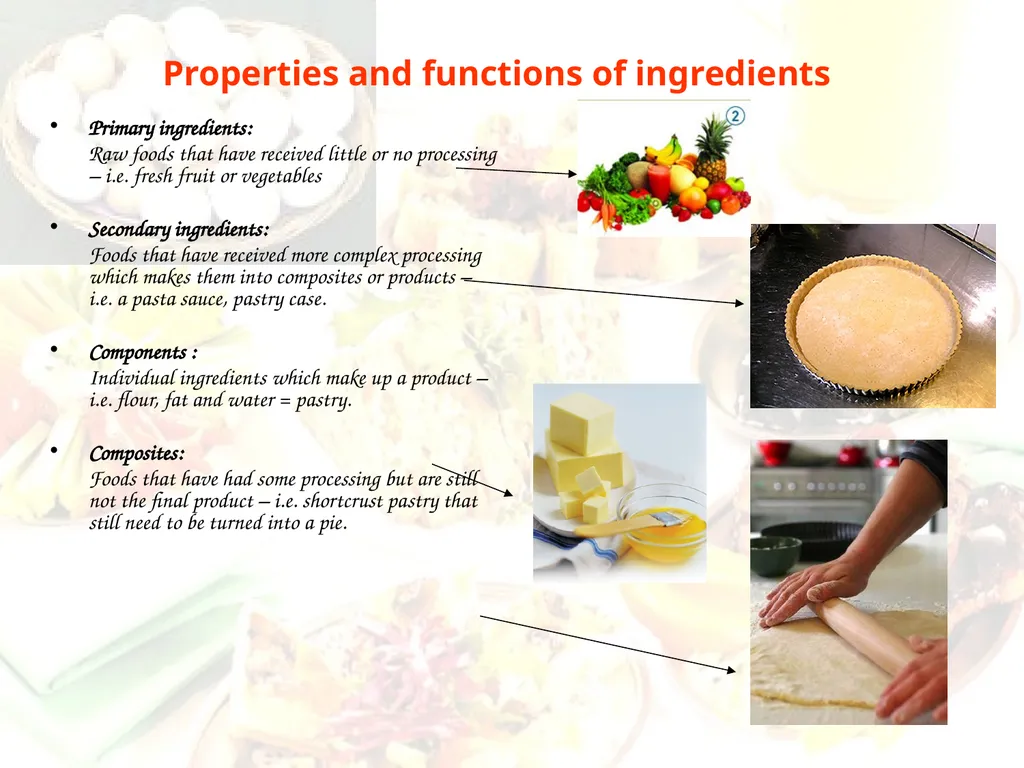
Properties and functions of ingredients Primary ingredients:
Raw foods that have received little or no processing – i.e. fresh fruit or vegetables
Secondary ingredients:
Foods that have received more complex processing which makes them into composites or products – i.e. a pasta sauce, pastry case.
Components :
Individual ingredients which make up a product – i.e. flour, fat and water = pastry.
Composites:
Foods that have had some processing but are still not the final product – i.e. shortcrust pastry that still need to be turned into a pie.<br>
Raw foods that have received little or no processing – i.e. fresh fruit or vegetables
Secondary ingredients:
Foods that have received more complex processing which makes them into composites or products – i.e. a pasta sauce, pastry case.
Components :
Individual ingredients which make up a product – i.e. flour, fat and water = pastry.
Composites:
Foods that have had some processing but are still not the final product – i.e. shortcrust pastry that still need to be turned into a pie.<br>
03
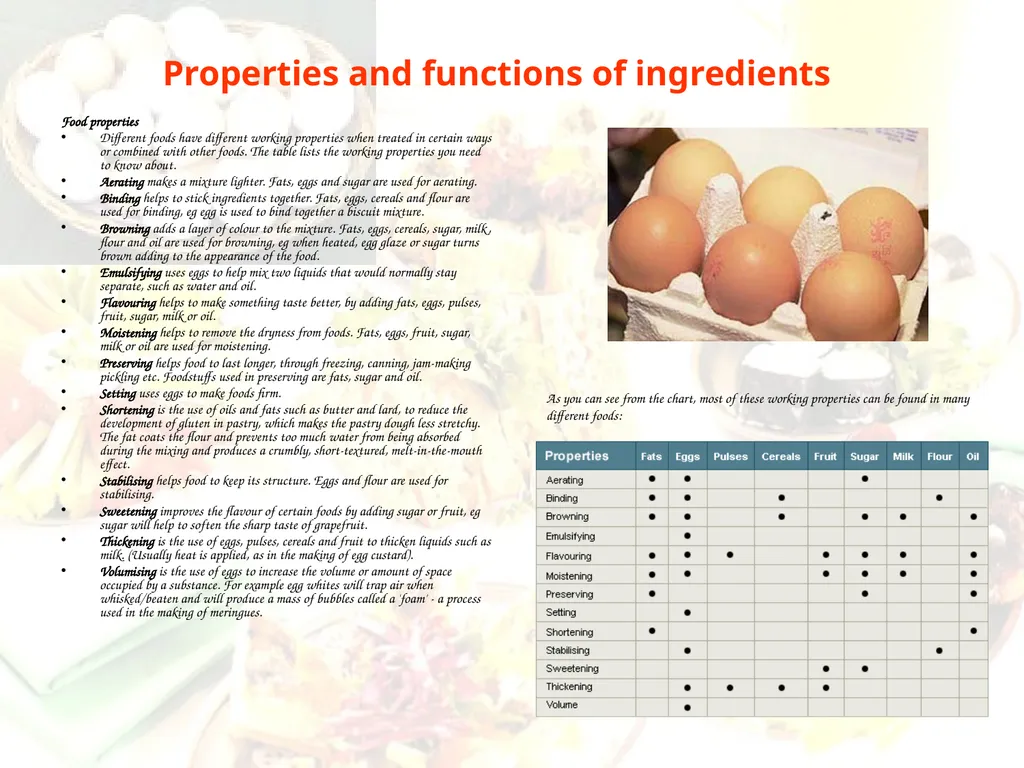
As you can see from the chart, most of these working properties can be found in many different foods: Properties and functions of ingredients Food properties
Different foods have different working properties when treated in certain ways or combined with other foods. The table lists the working properties you need to know about.
Aerating makes a mixture lighter. Fats, eggs and sugar are used for aerating.
Binding helps to stick ingredients together. Fats, eggs, cereals and flour are used for binding, eg egg is used to bind together a biscuit mixture.
Browning adds a layer of colour to the mixture. Fats, eggs, cereals, sugar, milk, flour and oil are used for browning, eg when heated, egg glaze or sugar turns brown adding to the appearance of the food.
Emulsifying uses eggs to help mix two liquids that would normally stay separate, such as water and oil.
Flavouring helps to make something taste better, by adding fats, eggs, pulses, fruit, sugar, milk or oil.
Moistening helps to remove the dryness from foods. Fats, eggs, fruit, sugar, milk or oil are used for moistening.
Preserving helps food to last longer, through freezing, canning, jam-making pickling etc. Foodstuffs used in preserving are fats, sugar and oil.
Setting uses eggs to make foods firm.
Shortening is the use of oils and fats such as butter and lard, to reduce the development of gluten in pastry, which makes the pastry dough less stretchy. The fat coats the flour and prevents too much water from being absorbed during the mixing and produces a crumbly, short-textured, melt-in-the-mouth effect.
Stabilising helps food to keep its structure. Eggs and flour are used for stabilising.
Sweetening improves the flavour of certain foods by adding sugar or fruit, eg sugar will help to soften the sharp taste of grapefruit.
Thickening is the use of eggs, pulses, cereals and fruit to thicken liquids such as milk. (Usually heat is applied, as in the making of egg custard).
Volumising is the use of eggs to increase the volume or amount of space occupied by a substance. For example egg whites will trap air when whisked/beaten and will produce a mass of bubbles called a 'foam' - a process used in the making of meringues.<br>
Different foods have different working properties when treated in certain ways or combined with other foods. The table lists the working properties you need to know about.
Aerating makes a mixture lighter. Fats, eggs and sugar are used for aerating.
Binding helps to stick ingredients together. Fats, eggs, cereals and flour are used for binding, eg egg is used to bind together a biscuit mixture.
Browning adds a layer of colour to the mixture. Fats, eggs, cereals, sugar, milk, flour and oil are used for browning, eg when heated, egg glaze or sugar turns brown adding to the appearance of the food.
Emulsifying uses eggs to help mix two liquids that would normally stay separate, such as water and oil.
Flavouring helps to make something taste better, by adding fats, eggs, pulses, fruit, sugar, milk or oil.
Moistening helps to remove the dryness from foods. Fats, eggs, fruit, sugar, milk or oil are used for moistening.
Preserving helps food to last longer, through freezing, canning, jam-making pickling etc. Foodstuffs used in preserving are fats, sugar and oil.
Setting uses eggs to make foods firm.
Shortening is the use of oils and fats such as butter and lard, to reduce the development of gluten in pastry, which makes the pastry dough less stretchy. The fat coats the flour and prevents too much water from being absorbed during the mixing and produces a crumbly, short-textured, melt-in-the-mouth effect.
Stabilising helps food to keep its structure. Eggs and flour are used for stabilising.
Sweetening improves the flavour of certain foods by adding sugar or fruit, eg sugar will help to soften the sharp taste of grapefruit.
Thickening is the use of eggs, pulses, cereals and fruit to thicken liquids such as milk. (Usually heat is applied, as in the making of egg custard).
Volumising is the use of eggs to increase the volume or amount of space occupied by a substance. For example egg whites will trap air when whisked/beaten and will produce a mass of bubbles called a 'foam' - a process used in the making of meringues.<br>
04
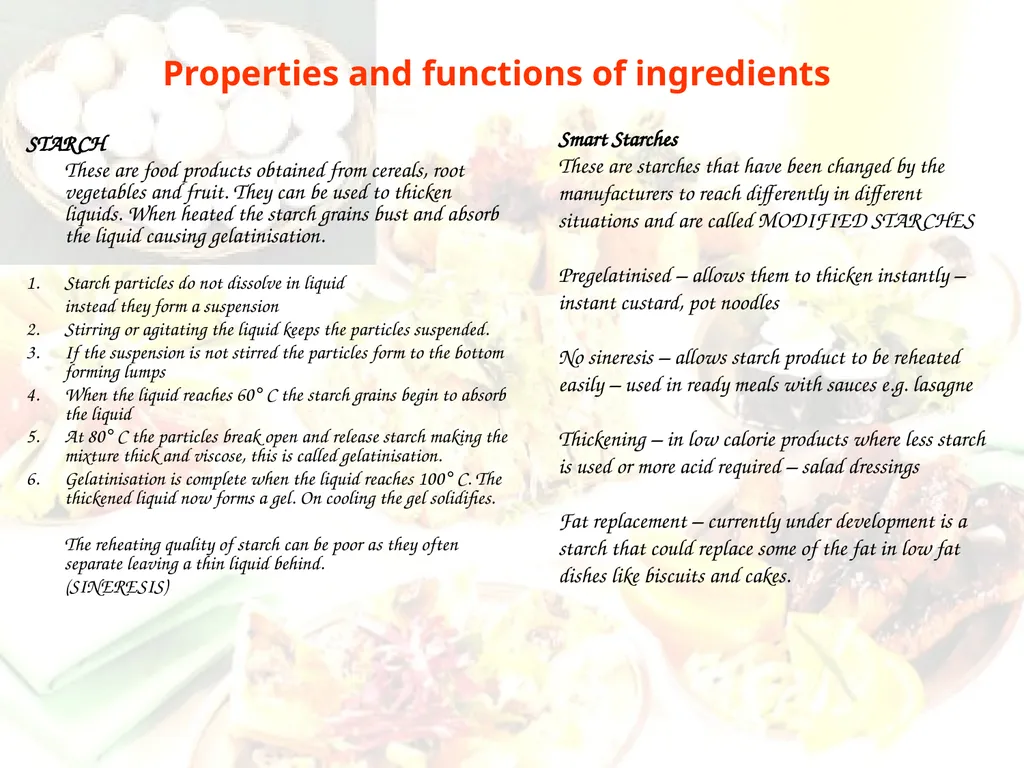
STARCH
These are food products obtained from cereals, root vegetables and fruit. They can be used to thicken liquids. When heated the starch grains bust and absorb the liquid causing gelatinisation.
Starch particles do not dissolve in liquid
instead they form a suspension
Stirring or agitating the liquid keeps the particles suspended.
If the suspension is not stirred the particles form to the bottom forming lumps
When the liquid reaches 60°C the starch grains begin to absorb the liquid
At 80°C the particles break open and release starch making the mixture thick and viscose, this is called gelatinisation.
Gelatinisation is complete when the liquid reaches 100°C. The thickened liquid now forms a gel. On cooling the gel solidifies.
The reheating quality of starch can be poor as they often separate leaving a thin liquid behind.
(SINERESIS) Smart Starches
These are starches that have been changed by the manufacturers to reach differently in different situations and are called MODIFIED STARCHES
Pregelatinised – allows them to thicken instantly – instant custard, pot noodles
No sineresis – allows starch product to be reheated easily – used in ready meals with sauces e.g. lasagne
Thickening – in low calorie products where less starch is used or more acid required – salad dressings
Fat replacement – currently under development is a starch that could replace some of the fat in low fat dishes like biscuits and cakes. Properties and functions of ingredients<br>
These are food products obtained from cereals, root vegetables and fruit. They can be used to thicken liquids. When heated the starch grains bust and absorb the liquid causing gelatinisation.
Starch particles do not dissolve in liquid
instead they form a suspension
Stirring or agitating the liquid keeps the particles suspended.
If the suspension is not stirred the particles form to the bottom forming lumps
When the liquid reaches 60°C the starch grains begin to absorb the liquid
At 80°C the particles break open and release starch making the mixture thick and viscose, this is called gelatinisation.
Gelatinisation is complete when the liquid reaches 100°C. The thickened liquid now forms a gel. On cooling the gel solidifies.
The reheating quality of starch can be poor as they often separate leaving a thin liquid behind.
(SINERESIS) Smart Starches
These are starches that have been changed by the manufacturers to reach differently in different situations and are called MODIFIED STARCHES
Pregelatinised – allows them to thicken instantly – instant custard, pot noodles
No sineresis – allows starch product to be reheated easily – used in ready meals with sauces e.g. lasagne
Thickening – in low calorie products where less starch is used or more acid required – salad dressings
Fat replacement – currently under development is a starch that could replace some of the fat in low fat dishes like biscuits and cakes. Properties and functions of ingredients<br>
05
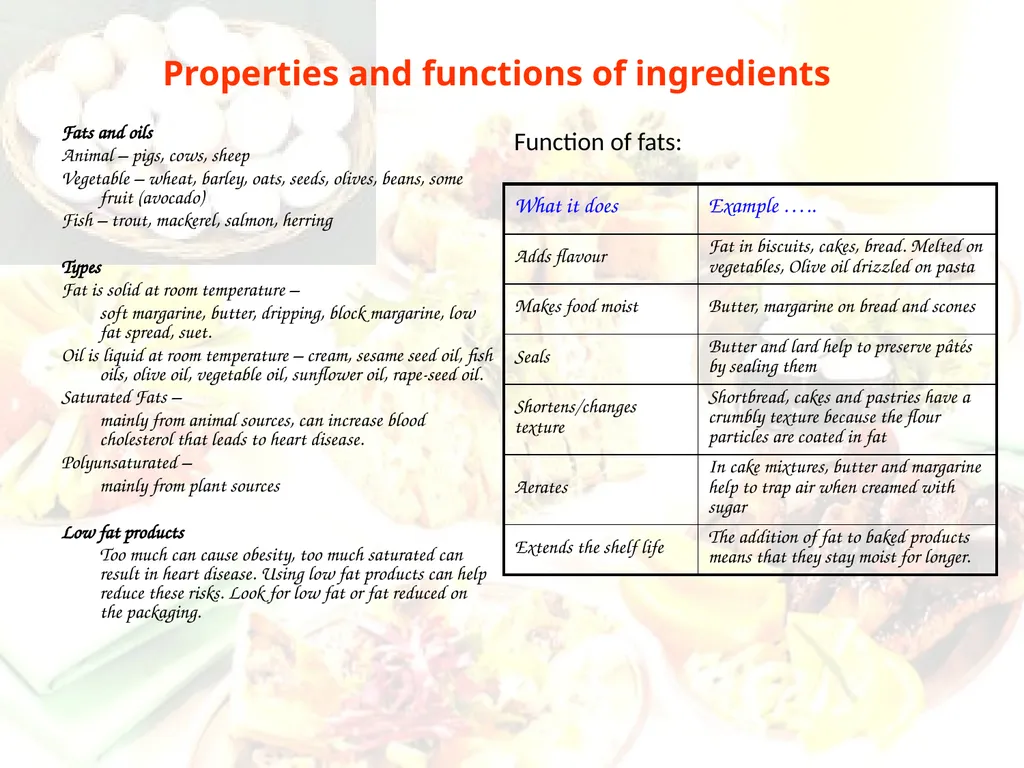
Fats and oils
Animal – pigs, cows, sheep
Vegetable – wheat, barley, oats, seeds, olives, beans, some fruit (avocado)
Fish – trout, mackerel, salmon, herring
Types
Fat is solid at room temperature –
soft margarine, butter, dripping, block margarine, low fat spread, suet.
Oil is liquid at room temperature – cream, sesame seed oil, fish oils, olive oil, vegetable oil, sunflower oil, rape-seed oil.
Saturated Fats –
mainly from animal sources, can increase blood cholesterol that leads to heart disease.
Polyunsaturated –
mainly from plant sources
Low fat products
Too much can cause obesity, too much saturated can result in heart disease. Using low fat products can help reduce these risks. Look for low fat or fat reduced on the packaging. Properties and functions of ingredients Function of fats:<br>
Animal – pigs, cows, sheep
Vegetable – wheat, barley, oats, seeds, olives, beans, some fruit (avocado)
Fish – trout, mackerel, salmon, herring
Types
Fat is solid at room temperature –
soft margarine, butter, dripping, block margarine, low fat spread, suet.
Oil is liquid at room temperature – cream, sesame seed oil, fish oils, olive oil, vegetable oil, sunflower oil, rape-seed oil.
Saturated Fats –
mainly from animal sources, can increase blood cholesterol that leads to heart disease.
Polyunsaturated –
mainly from plant sources
Low fat products
Too much can cause obesity, too much saturated can result in heart disease. Using low fat products can help reduce these risks. Look for low fat or fat reduced on the packaging. Properties and functions of ingredients Function of fats:<br>
06
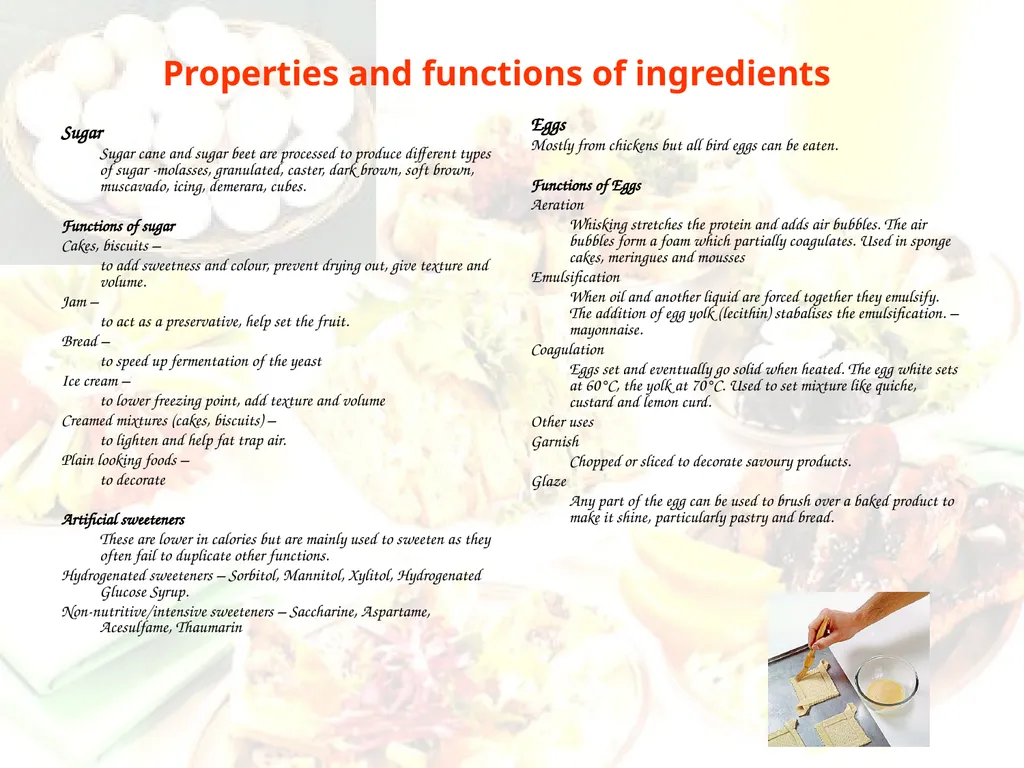
Properties and functions of ingredients Sugar
Sugar cane and sugar beet are processed to produce different types of sugar -molasses, granulated, caster, dark brown, soft brown, muscavado, icing, demerara, cubes.
Functions of sugar
Cakes, biscuits –
to add sweetness and colour, prevent drying out, give texture and volume.
Jam –
to act as a preservative, help set the fruit.
Bread –
to speed up fermentation of the yeast
Ice cream –
to lower freezing point, add texture and volume
Creamed mixtures (cakes, biscuits) –
to lighten and help fat trap air.
Plain looking foods –
to decorate
Artificial sweeteners
These are lower in calories but are mainly used to sweeten as they often fail to duplicate other functions.
Hydrogenated sweeteners – Sorbitol, Mannitol, Xylitol, Hydrogenated Glucose Syrup.
Non-nutritive/intensive sweeteners – Saccharine, Aspartame, Acesulfame, Thaumarin Eggs
Mostly from chickens but all bird eggs can be eaten.
Functions of Eggs
Aeration
Whisking stretches the protein and adds air bubbles. The air bubbles form a foam which partially coagulates. Used in sponge cakes, meringues and mousses
Emulsification
When oil and another liquid are forced together they emulsify. The addition of egg yolk (lecithin) stabalises the emulsification. – mayonnaise.
Coagulation
Eggs set and eventually go solid when heated. The egg white sets at 60°C, the yolk at 70°C. Used to set mixture like quiche, custard and lemon curd.
Other uses
Garnish
Chopped or sliced to decorate savoury products.
Glaze
Any part of the egg can be used to brush over a baked product to make it shine, particularly pastry and bread.<br>
Sugar cane and sugar beet are processed to produce different types of sugar -molasses, granulated, caster, dark brown, soft brown, muscavado, icing, demerara, cubes.
Functions of sugar
Cakes, biscuits –
to add sweetness and colour, prevent drying out, give texture and volume.
Jam –
to act as a preservative, help set the fruit.
Bread –
to speed up fermentation of the yeast
Ice cream –
to lower freezing point, add texture and volume
Creamed mixtures (cakes, biscuits) –
to lighten and help fat trap air.
Plain looking foods –
to decorate
Artificial sweeteners
These are lower in calories but are mainly used to sweeten as they often fail to duplicate other functions.
Hydrogenated sweeteners – Sorbitol, Mannitol, Xylitol, Hydrogenated Glucose Syrup.
Non-nutritive/intensive sweeteners – Saccharine, Aspartame, Acesulfame, Thaumarin Eggs
Mostly from chickens but all bird eggs can be eaten.
Functions of Eggs
Aeration
Whisking stretches the protein and adds air bubbles. The air bubbles form a foam which partially coagulates. Used in sponge cakes, meringues and mousses
Emulsification
When oil and another liquid are forced together they emulsify. The addition of egg yolk (lecithin) stabalises the emulsification. – mayonnaise.
Coagulation
Eggs set and eventually go solid when heated. The egg white sets at 60°C, the yolk at 70°C. Used to set mixture like quiche, custard and lemon curd.
Other uses
Garnish
Chopped or sliced to decorate savoury products.
Glaze
Any part of the egg can be used to brush over a baked product to make it shine, particularly pastry and bread.<br>
07
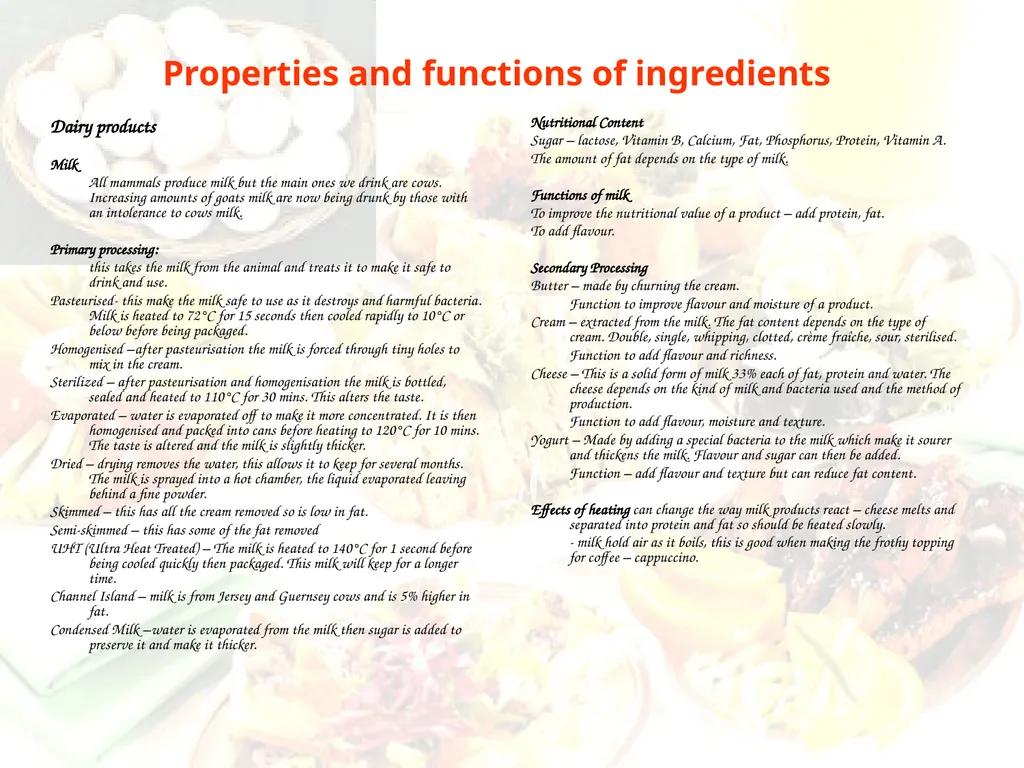
Properties and functions of ingredients Dairy products
Milk
All mammals produce milk but the main ones we drink are cows. Increasing amounts of goats milk are now being drunk by those with an intolerance to cows milk.
Primary processing:
this takes the milk from the animal and treats it to make it safe to drink and use.
Pasteurised- this make the milk safe to use as it destroys and harmful bacteria. Milk is heated to 72°C for 15 seconds then cooled rapidly to 10°C or below before being packaged.
Homogenised –after pasteurisation the milk is forced through tiny holes to mix in the cream.
Sterilized – after pasteurisation and homogenisation the milk is bottled, sealed and heated to 110°C for 30 mins. This alters the taste.
Evaporated – water is evaporated off to make it more concentrated. It is then homogenised and packed into cans before heating to 120°C for 10 mins. The taste is altered and the milk is slightly thicker.
Dried – drying removes the water, this allows it to keep for several months. The milk is sprayed into a hot chamber, the liquid evaporated leaving behind a fine powder.
Skimmed – this has all the cream removed so is low in fat.
Semi-skimmed – this has some of the fat removed
UHT (Ultra Heat Treated) – The milk is heated to 140°C for 1 second before being cooled quickly then packaged. This milk will keep for a longer time.
Channel Island – milk is from Jersey and Guernsey cows and is 5% higher in fat.
Condensed Milk –water is evaporated from the milk then sugar is added to preserve it and make it thicker. Nutritional Content
Sugar – lactose, Vitamin B, Calcium, Fat, Phosphorus, Protein, Vitamin A.
The amount of fat depends on the type of milk.
Functions of milk
To improve the nutritional value of a product – add protein, fat.
To add flavour.
Secondary Processing
Butter – made by churning the cream.
Function to improve flavour and moisture of a product.
Cream – extracted from the milk. The fat content depends on the type of cream. Double, single, whipping, clotted, crème fraîche, sour, sterilised.
Function to add flavour and richness.
Cheese – This is a solid form of milk 33% each of fat, protein and water. The cheese depends on the kind of milk and bacteria used and the method of production.
Function to add flavour, moisture and texture.
Yogurt – Made by adding a special bacteria to the milk which make it sourer and thickens the milk. Flavour and sugar can then be added.
Function – add flavour and texture but can reduce fat content.
Effects of heating can change the way milk products react – cheese melts and separated into protein and fat so should be heated slowly.
- milk hold air as it boils, this is good when making the frothy topping for coffee – cappuccino.<br>
Milk
All mammals produce milk but the main ones we drink are cows. Increasing amounts of goats milk are now being drunk by those with an intolerance to cows milk.
Primary processing:
this takes the milk from the animal and treats it to make it safe to drink and use.
Pasteurised- this make the milk safe to use as it destroys and harmful bacteria. Milk is heated to 72°C for 15 seconds then cooled rapidly to 10°C or below before being packaged.
Homogenised –after pasteurisation the milk is forced through tiny holes to mix in the cream.
Sterilized – after pasteurisation and homogenisation the milk is bottled, sealed and heated to 110°C for 30 mins. This alters the taste.
Evaporated – water is evaporated off to make it more concentrated. It is then homogenised and packed into cans before heating to 120°C for 10 mins. The taste is altered and the milk is slightly thicker.
Dried – drying removes the water, this allows it to keep for several months. The milk is sprayed into a hot chamber, the liquid evaporated leaving behind a fine powder.
Skimmed – this has all the cream removed so is low in fat.
Semi-skimmed – this has some of the fat removed
UHT (Ultra Heat Treated) – The milk is heated to 140°C for 1 second before being cooled quickly then packaged. This milk will keep for a longer time.
Channel Island – milk is from Jersey and Guernsey cows and is 5% higher in fat.
Condensed Milk –water is evaporated from the milk then sugar is added to preserve it and make it thicker. Nutritional Content
Sugar – lactose, Vitamin B, Calcium, Fat, Phosphorus, Protein, Vitamin A.
The amount of fat depends on the type of milk.
Functions of milk
To improve the nutritional value of a product – add protein, fat.
To add flavour.
Secondary Processing
Butter – made by churning the cream.
Function to improve flavour and moisture of a product.
Cream – extracted from the milk. The fat content depends on the type of cream. Double, single, whipping, clotted, crème fraîche, sour, sterilised.
Function to add flavour and richness.
Cheese – This is a solid form of milk 33% each of fat, protein and water. The cheese depends on the kind of milk and bacteria used and the method of production.
Function to add flavour, moisture and texture.
Yogurt – Made by adding a special bacteria to the milk which make it sourer and thickens the milk. Flavour and sugar can then be added.
Function – add flavour and texture but can reduce fat content.
Effects of heating can change the way milk products react – cheese melts and separated into protein and fat so should be heated slowly.
- milk hold air as it boils, this is good when making the frothy topping for coffee – cappuccino.<br>