
Improving NAND Flash Memory Lifetime with
LO
Published · 35 slides · 0 views
1 / 1

Description
Improving NAND Flash Memory Lifetime with Write-hotness Aware Retention Management Yixin Luo, Yu Cai, Saugata Ghose, Jongmoo Choi, Onur Mutlu Carnegie Mellon University, Dankook University WARM 1 Executive Summary Flash memory can achieve
Related Topics
Share
Embed code
Download this presentation From Below
"Improving NAND Flash Memory Lifetime with" is the property of its rightful owner. Permission is granted to download and print the materials on this website for personal, non-commercial use only, and to display it on your personal computer provided you do not modify the materials and that you retain all copyright notices contained in the materials. By downloading content from our website, you accept the terms of this agreement.
Presentation Transcript
01
Improving NAND Flash Memory Lifetime with
Write-hotness Aware Retention Management Yixin Luo, Yu Cai, Saugata Ghose, Jongmoo Choi*, Onur Mutlu
Carnegie Mellon University, *Dankook University WARM 1<br>
Carnegie Mellon University, *Dankook University WARM 1<br>
02
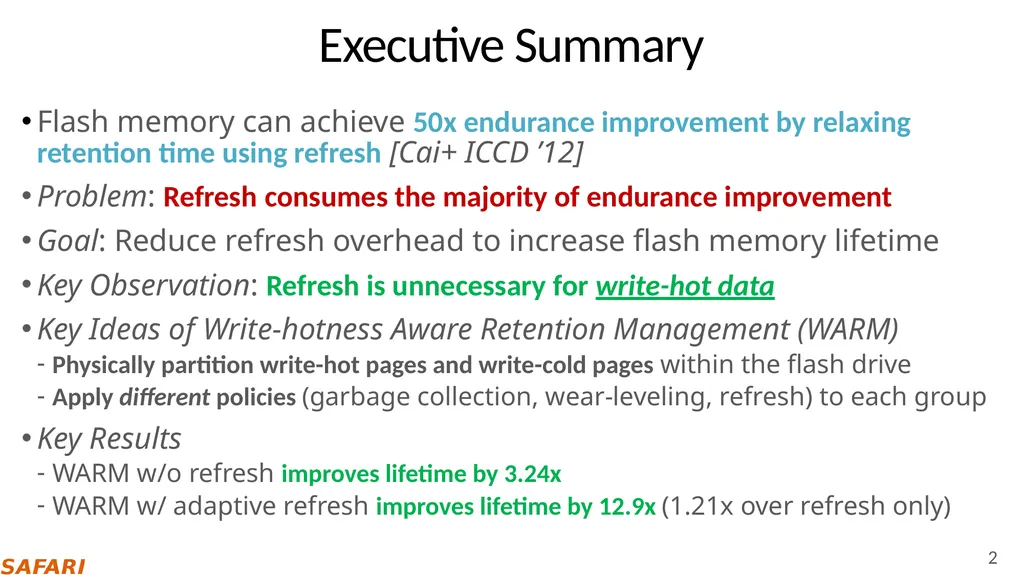
Executive Summary Flash memory can achieve 50x endurance improvement by relaxing retention time using refresh [Cai+ ICCD ’12]
Problem: Refresh consumes the majority of endurance improvement
Goal: Reduce refresh overhead to increase flash memory lifetime
Key Observation: Refresh is unnecessary for write-hot data
Key Ideas of Write-hotness Aware Retention Management (WARM)
Physically partition write-hot pages and write-cold pages within the flash drive
Apply different policies (garbage collection, wear-leveling, refresh) to each group
Key Results
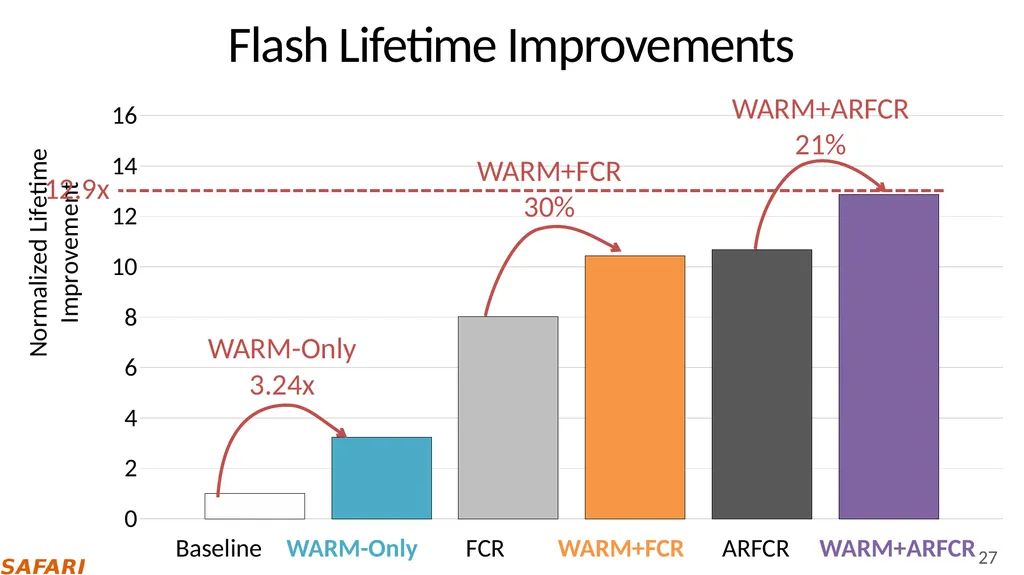
WARM w/o refresh improves lifetime by 3.24x
WARM w/ adaptive refresh improves lifetime by 12.9x (1.21x over refresh only) 2<br>
Problem: Refresh consumes the majority of endurance improvement
Goal: Reduce refresh overhead to increase flash memory lifetime
Key Observation: Refresh is unnecessary for write-hot data
Key Ideas of Write-hotness Aware Retention Management (WARM)
Physically partition write-hot pages and write-cold pages within the flash drive
Apply different policies (garbage collection, wear-leveling, refresh) to each group
Key Results
WARM w/o refresh improves lifetime by 3.24x
WARM w/ adaptive refresh improves lifetime by 12.9x (1.21x over refresh only) 2<br>
03
Outline Problem and Goal
Key Observations
WARM: Write-hotness Aware Retention Management
Results
Conclusion 3<br>
Key Observations
WARM: Write-hotness Aware Retention Management
Results
Conclusion 3<br>
04
Outline Problem and Goal
Key Observations
WARM: Write-hotness Aware Retention Management
Results
Conclusion 4<br>
Key Observations
WARM: Write-hotness Aware Retention Management
Results
Conclusion 4<br>
05
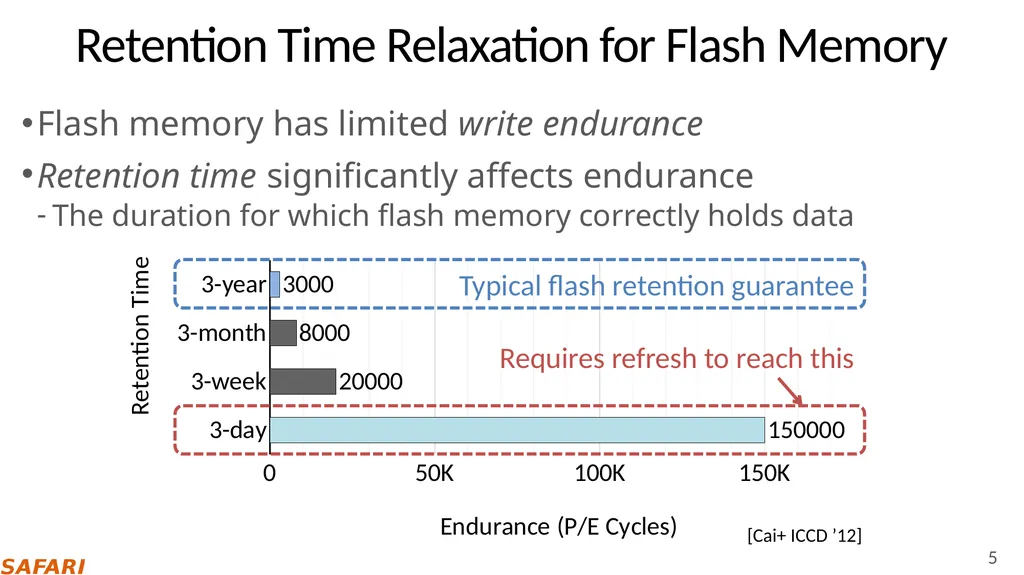
Retention Time Relaxation for Flash Memory Flash memory has limited write endurance
Retention time significantly affects endurance
The duration for which flash memory correctly holds data Typical flash retention guarantee Requires refresh to reach this 5 [Cai+ ICCD ’12]<br>
Retention time significantly affects endurance
The duration for which flash memory correctly holds data Typical flash retention guarantee Requires refresh to reach this 5 [Cai+ ICCD ’12]<br>
06
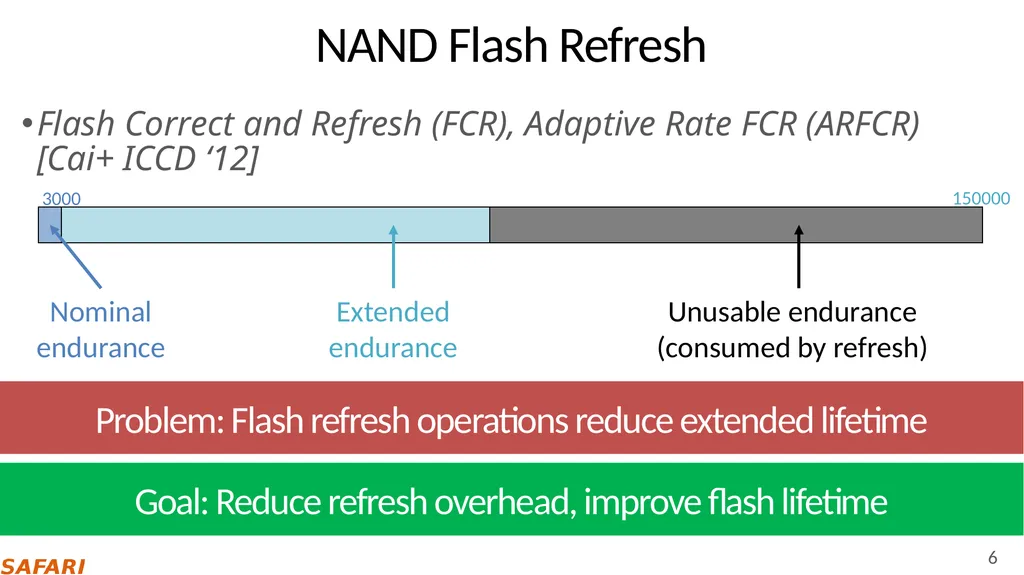
NAND Flash Refresh Flash Correct and Refresh (FCR), Adaptive Rate FCR (ARFCR)
[Cai+ ICCD ‘12] 6 Problem: Flash refresh operations reduce extended lifetime Goal: Reduce refresh overhead, improve flash lifetime Nominal endurance Extended endurance Unusable endurance (consumed by refresh) 3000 150000<br>
07
Outline Problem and Goal
Key Observations
WARM: Write-hotness Aware Retention Management
Results
Conclusion 7<br>
Key Observations
WARM: Write-hotness Aware Retention Management
Results
Conclusion 7<br>
08
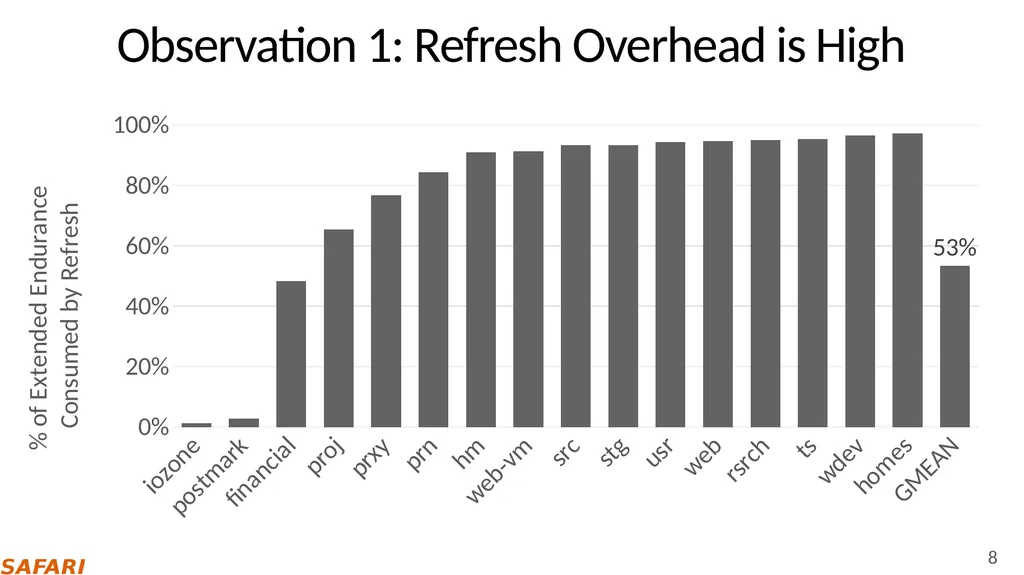
Observation 1: Refresh Overhead is High 8<br>
09
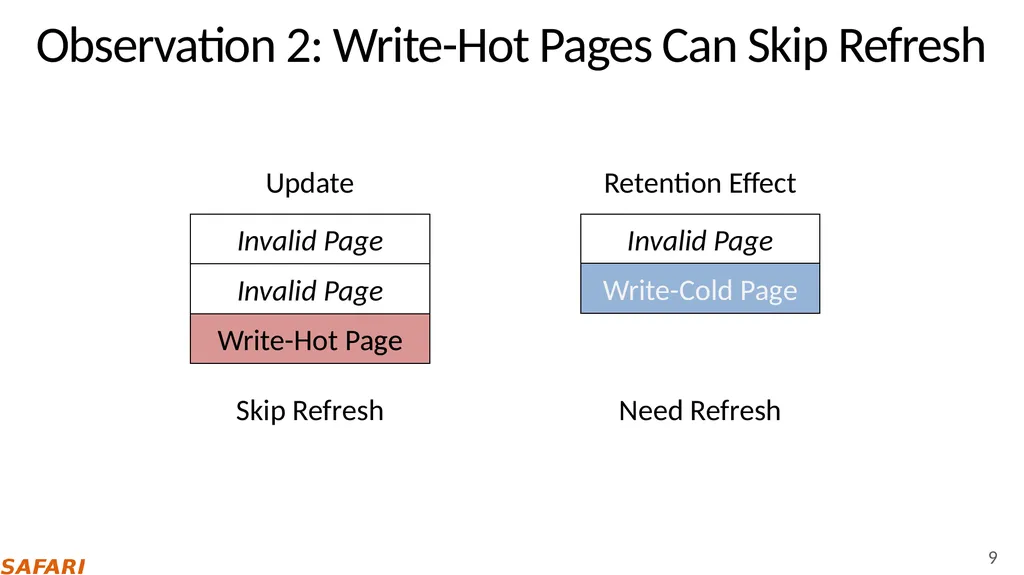
Observation 2: Write-Hot Pages Can Skip Refresh 9 Write-Hot Page Write-Cold Page Write-Hot Page Invalid Page Invalid Page Write-Hot Page Retention Effect Update Invalid Page Write-Cold Page Need Refresh Skip Refresh<br>
10
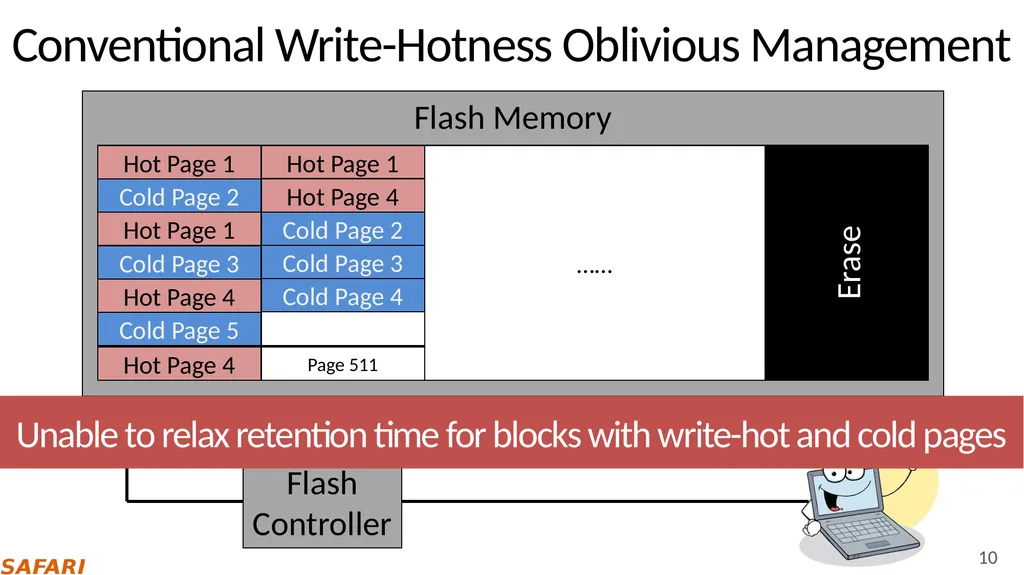
Flash Memory Conventional Write-Hotness Oblivious Management 10 Flash Controller Hot Page 1 Cold Page 2 Hot Page 1 Cold Page 3 Hot Page 4 Cold Page 5 Hot Page 4 Hot Page 1 Hot Page 4 Cold Page 2 Cold Page 3 Cold Page 4 Read Write Erase Unable to relax retention time for blocks with write-hot and cold pages<br>
11
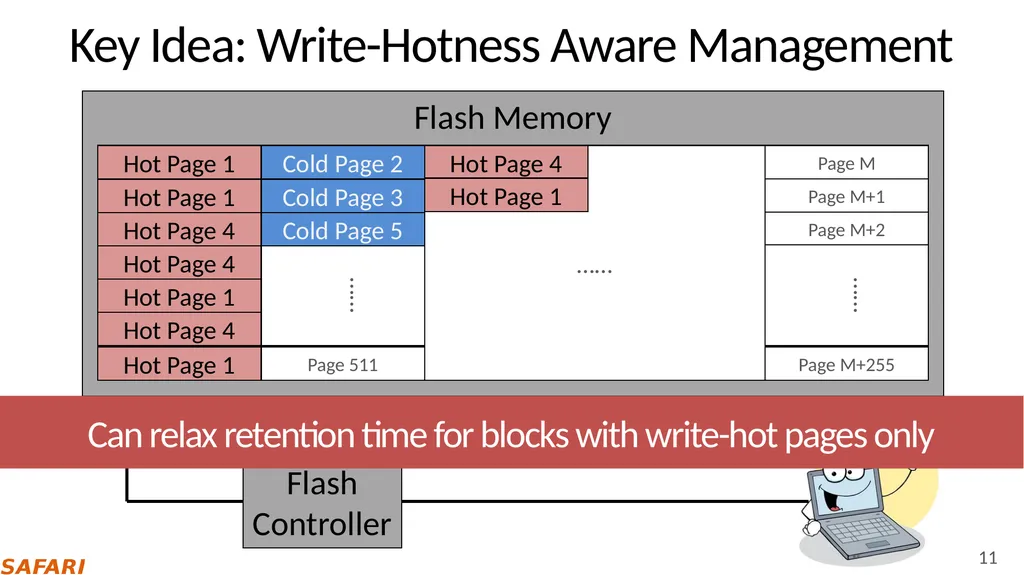
Flash Memory Key Idea: Write-Hotness Aware Management 11 Flash Controller Hot Page 1 Cold Page 2 Hot Page 1 Cold Page 3 Hot Page 4 Cold Page 5 Hot Page 4 Hot Page 1 Hot Page 4 Hot Page 1 Hot Page 4 Hot Page 1 Can relax retention time for blocks with write-hot pages only<br>
12
Outline Problem and Goal
Key Observations
WARM: Write-hotness Aware Retention Management
Results
Conclusion 12<br>
Key Observations
WARM: Write-hotness Aware Retention Management
Results
Conclusion 12<br>
13
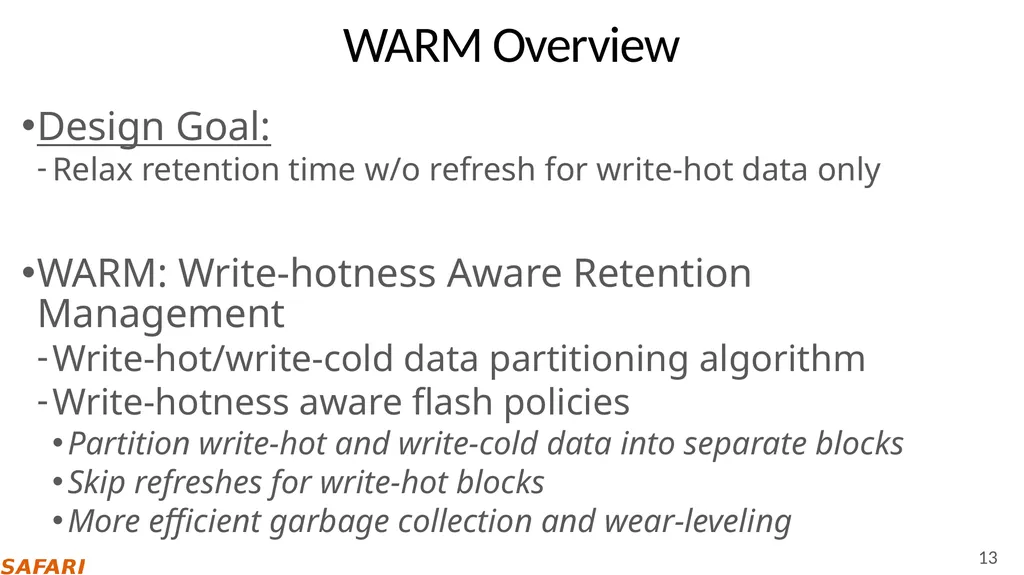
WARM Overview Design Goal:
Relax retention time w/o refresh for write-hot data only
WARM: Write-hotness Aware Retention Management
Write-hot/write-cold data partitioning algorithm
Write-hotness aware flash policies
Partition write-hot and write-cold data into separate blocks
Skip refreshes for write-hot blocks
More efficient garbage collection and wear-leveling 13<br>
Relax retention time w/o refresh for write-hot data only
WARM: Write-hotness Aware Retention Management
Write-hot/write-cold data partitioning algorithm
Write-hotness aware flash policies
Partition write-hot and write-cold data into separate blocks
Skip refreshes for write-hot blocks
More efficient garbage collection and wear-leveling 13<br>
14
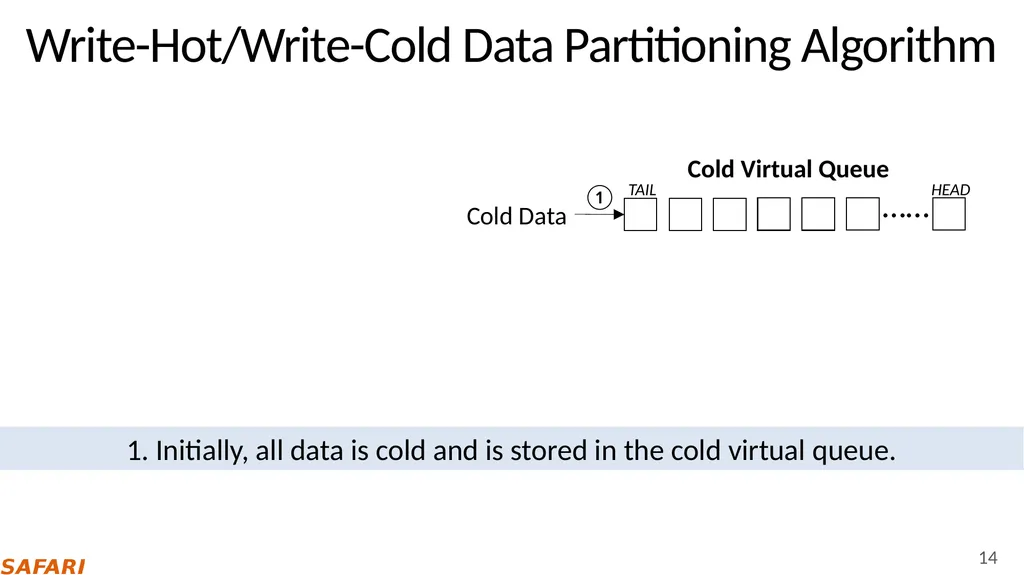
Write-Hot/Write-Cold Data Partitioning Algorithm Cold Virtual Queue Cold Data …… ① TAIL HEAD 1. Initially, all data is cold and is stored in the cold virtual queue. 14<br>
15
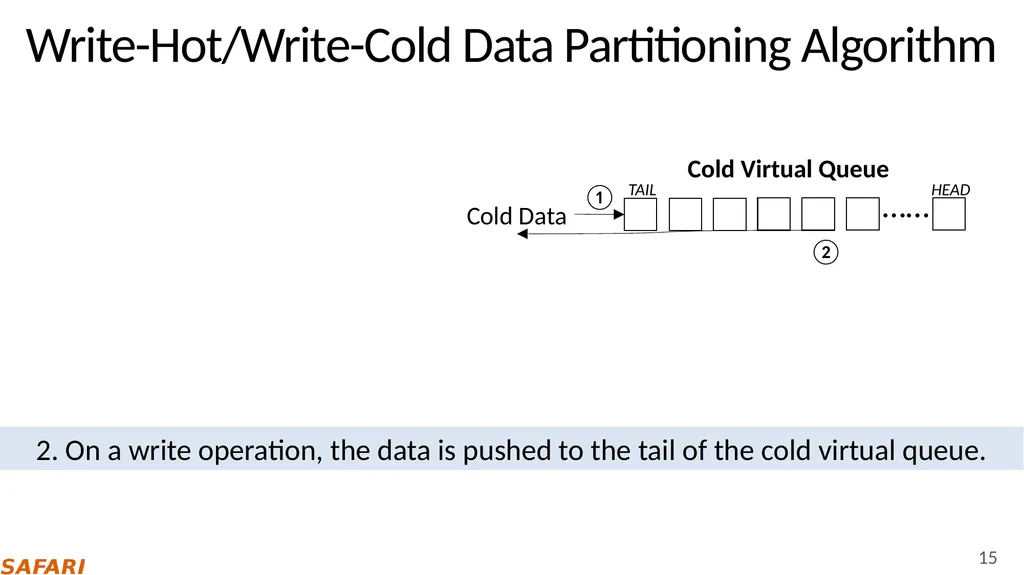
Write-Hot/Write-Cold Data Partitioning Algorithm Cold Virtual Queue Cold Data …… ① TAIL HEAD 2. On a write operation, the data is pushed to the tail of the cold virtual queue. ② 15<br>
16
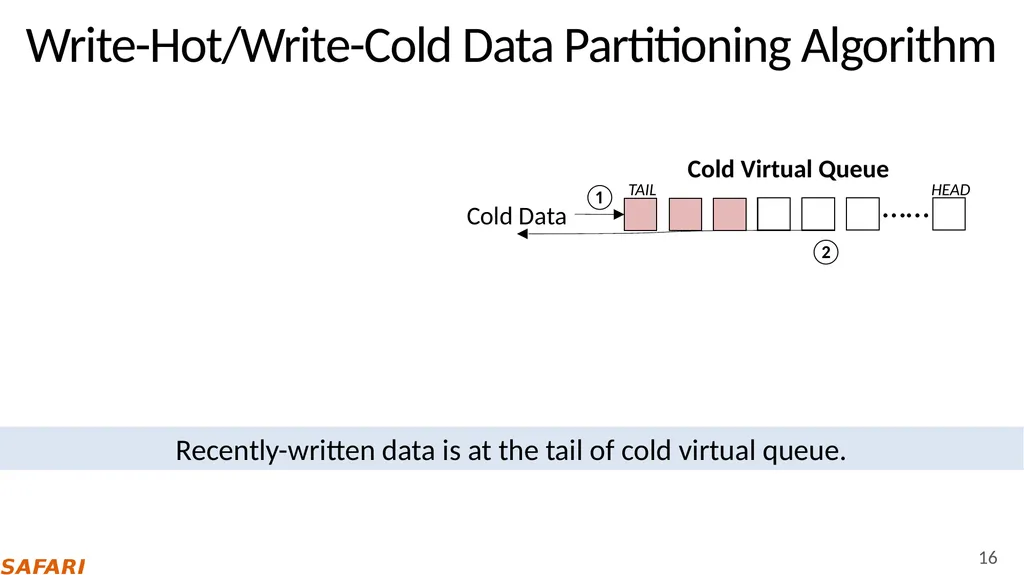
Write-Hot/Write-Cold Data Partitioning Algorithm Cold Virtual Queue Cold Data …… ① TAIL HEAD Recently-written data is at the tail of cold virtual queue. ② 16<br>
17
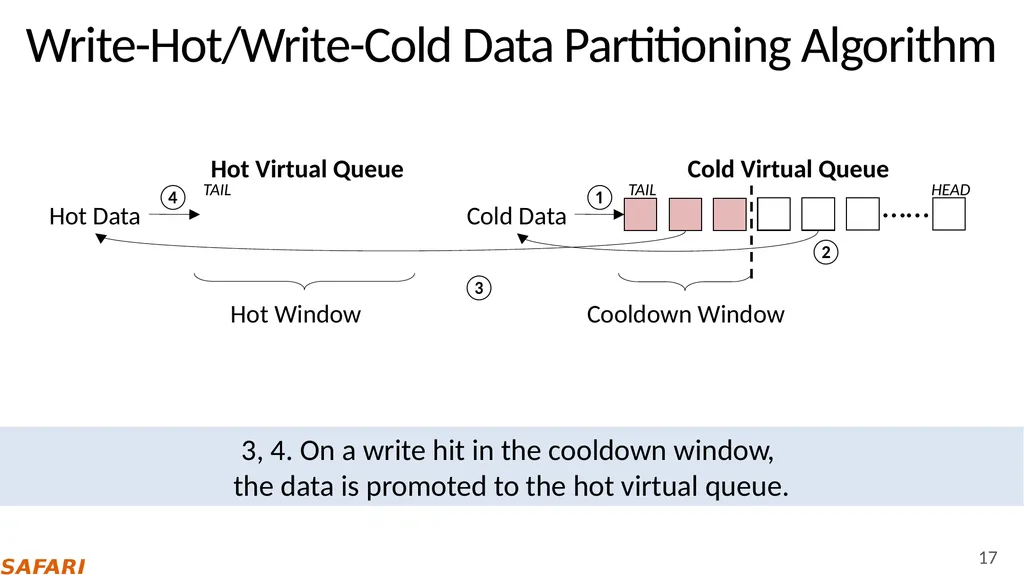
Write-Hot/Write-Cold Data Partitioning Algorithm Hot Virtual Queue Hot Window Hot Data Cold Virtual Queue Cooldown Window Cold Data …… ④ ② ① ③ TAIL TAIL HEAD 3, 4. On a write hit in the cooldown window,
the data is promoted to the hot virtual queue. 17<br>
18
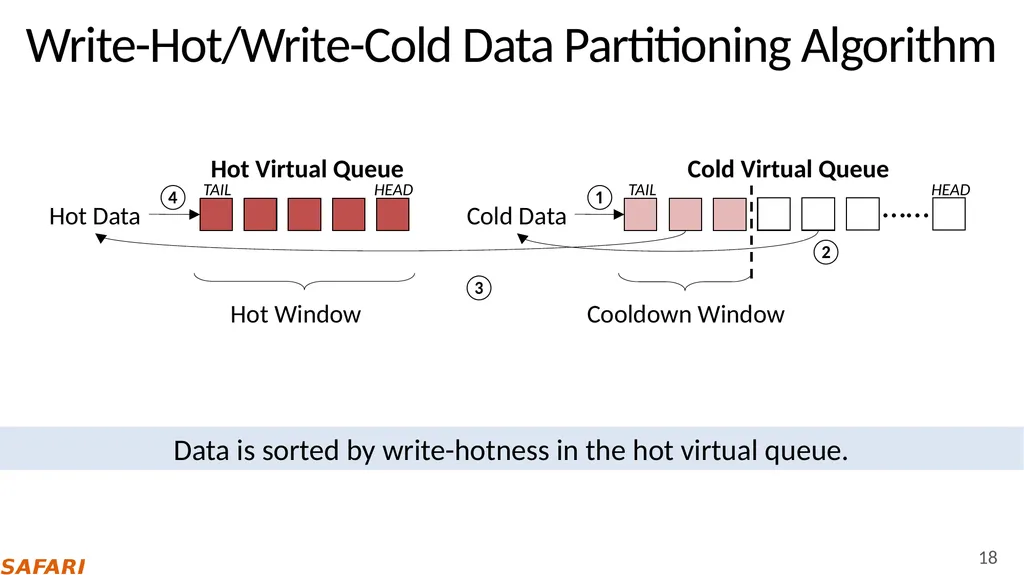
Write-Hot/Write-Cold Data Partitioning Algorithm Hot Virtual Queue Hot Window Hot Data Cold Virtual Queue Cooldown Window Cold Data …… ④ ② ① ③ TAIL HEAD TAIL HEAD Data is sorted by write-hotness in the hot virtual queue. 18<br>
19
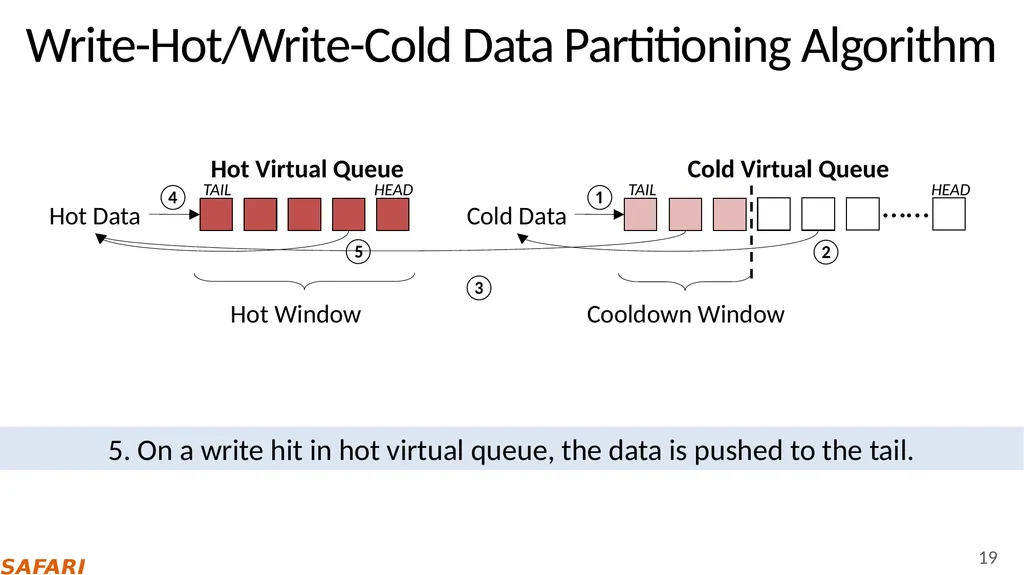
Write-Hot/Write-Cold Data Partitioning Algorithm Hot Virtual Queue Hot Window Hot Data Cold Virtual Queue Cooldown Window Cold Data …… ④ ⑤ ② ① ③ TAIL HEAD TAIL HEAD 5. On a write hit in hot virtual queue, the data is pushed to the tail. 19<br>
20
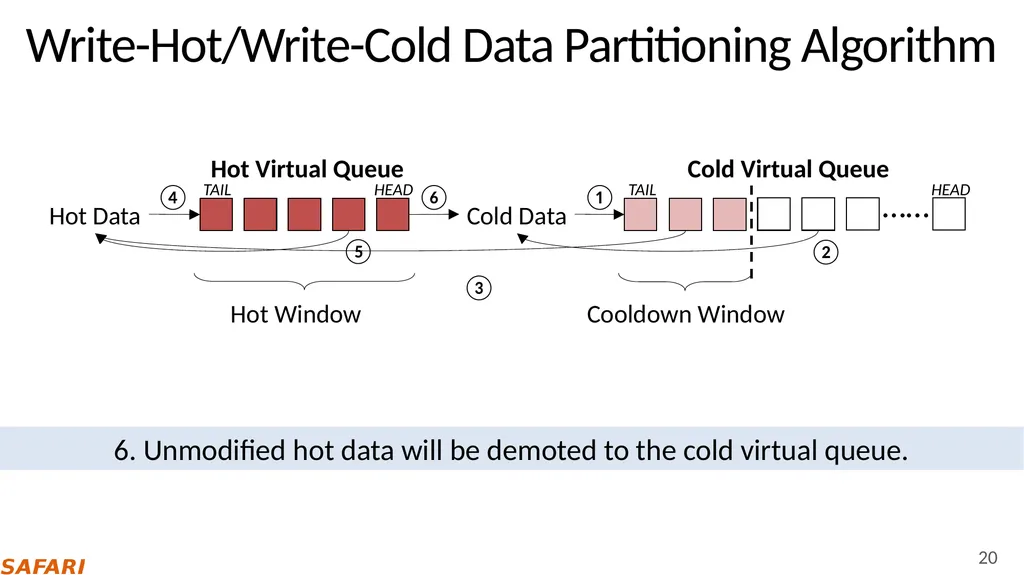
Write-Hot/Write-Cold Data Partitioning Algorithm Hot Virtual Queue Hot Window Hot Data Cold Virtual Queue Cooldown Window Cold Data …… ④ ⑥ ⑤ ② ① ③ TAIL HEAD TAIL HEAD 6. Unmodified hot data will be demoted to the cold virtual queue. 20<br>
21
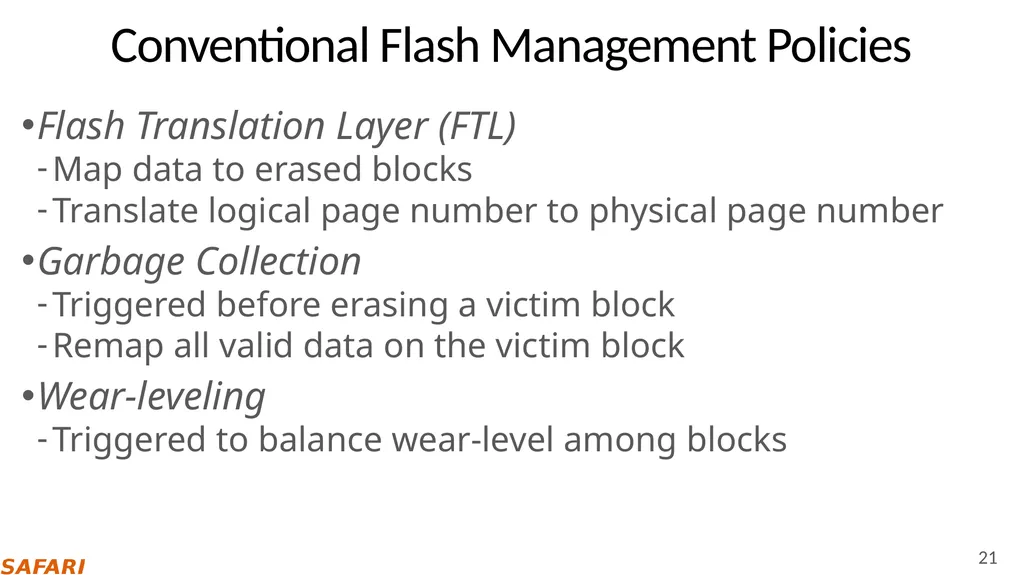
Conventional Flash Management Policies Flash Translation Layer (FTL)
Map data to erased blocks
Translate logical page number to physical page number
Garbage Collection
Triggered before erasing a victim block
Remap all valid data on the victim block
Wear-leveling
Triggered to balance wear-level among blocks 21<br>
Map data to erased blocks
Translate logical page number to physical page number
Garbage Collection
Triggered before erasing a victim block
Remap all valid data on the victim block
Wear-leveling
Triggered to balance wear-level among blocks 21<br>
22
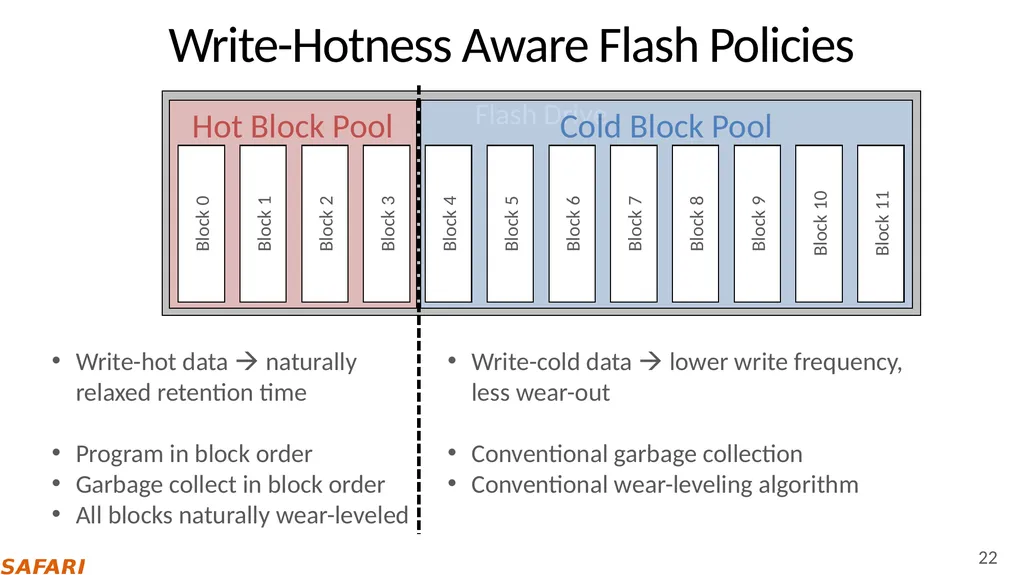
Write-Hotness Aware Flash Policies Flash Drive Block 0 Block 1 Block 2 Block 3 Block 4 Block 5 Block 6 Block 7 Block 8 Block 9 Block 10 Block 11 Hot Block Pool Cold Block Pool Block 0 Block 1 Block 2 Block 3 Block 4 Block 5 Block 6 Block 7 Block 8 Block 9 Block 10 Block 11 Write-hot data naturally relaxed retention time
Program in block order
Garbage collect in block order
All blocks naturally wear-leveled Write-cold data lower write frequency, less wear-out
Conventional garbage collection
Conventional wear-leveling algorithm 22<br>
Program in block order
Garbage collect in block order
All blocks naturally wear-leveled Write-cold data lower write frequency, less wear-out
Conventional garbage collection
Conventional wear-leveling algorithm 22<br>
23
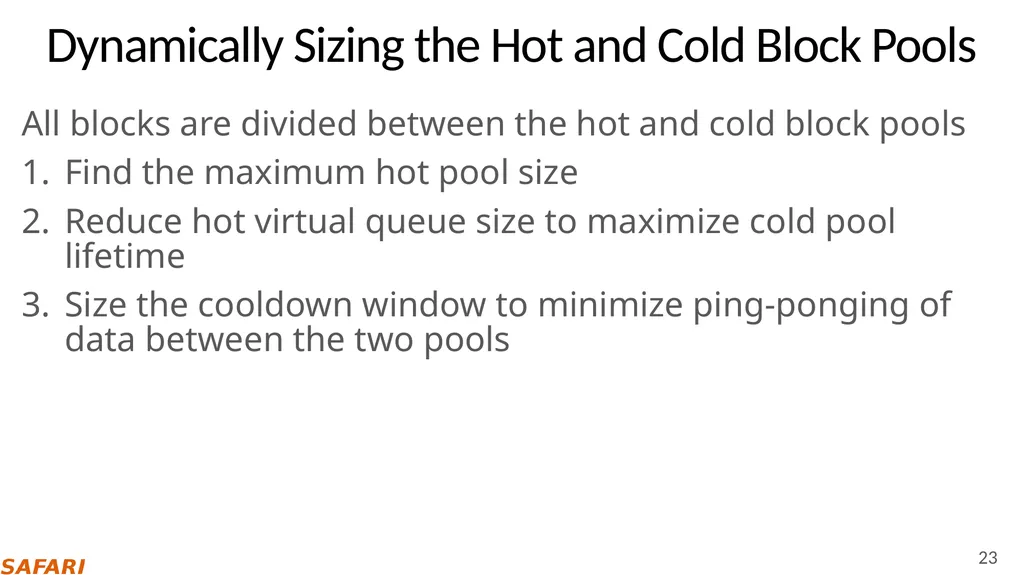
Dynamically Sizing the Hot and Cold Block Pools All blocks are divided between the hot and cold block pools
Find the maximum hot pool size
Reduce hot virtual queue size to maximize cold pool lifetime
Size the cooldown window to minimize ping-ponging of data between the two pools 23<br>
Find the maximum hot pool size
Reduce hot virtual queue size to maximize cold pool lifetime
Size the cooldown window to minimize ping-ponging of data between the two pools 23<br>
24
Outline Problem and Goal
Key Observations
WARM: Write-hotness Aware Retention Management
Results
Conclusion 24<br>
Key Observations
WARM: Write-hotness Aware Retention Management
Results
Conclusion 24<br>
25
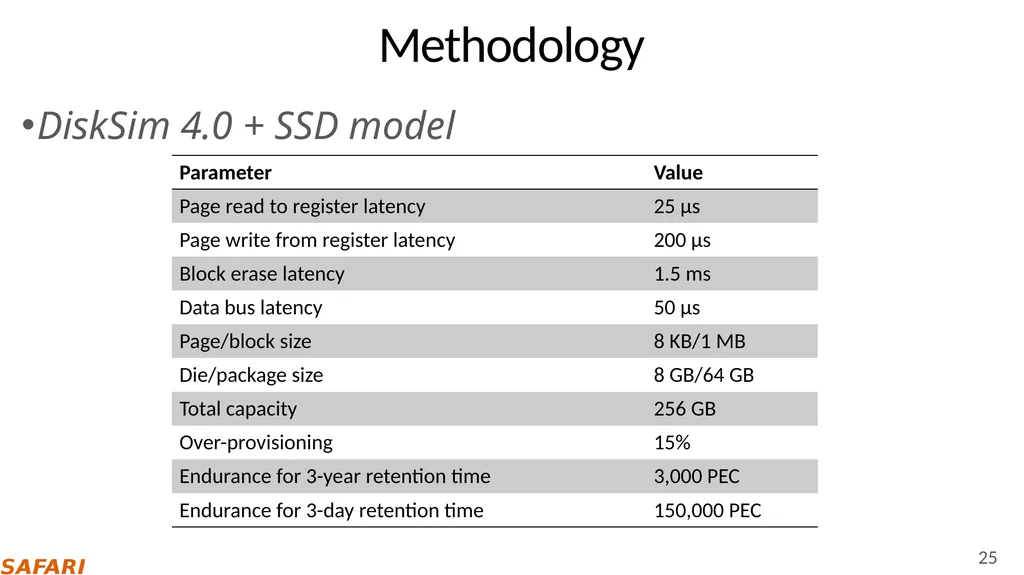
Methodology DiskSim 4.0 + SSD model 25<br>
26
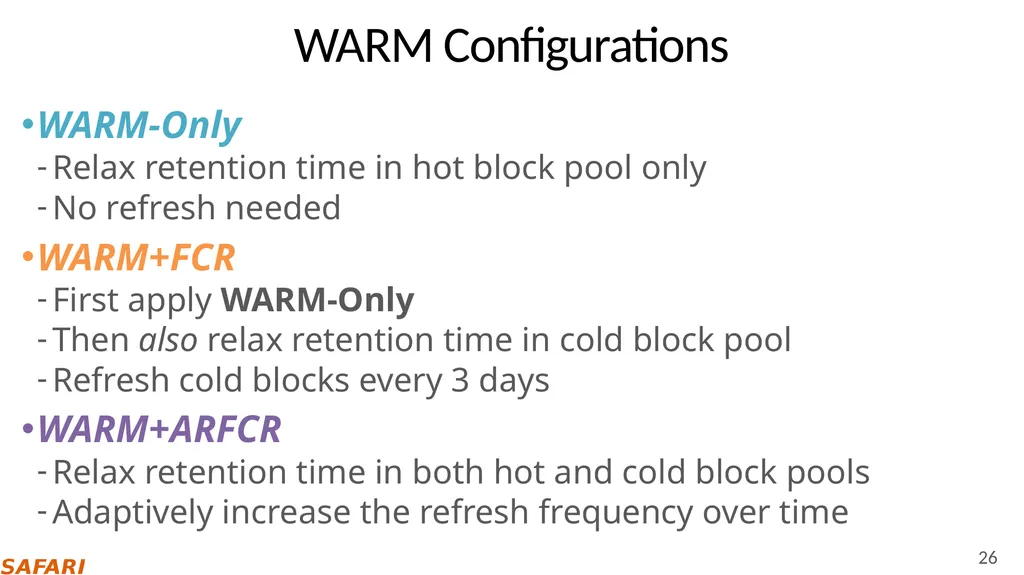
WARM Configurations WARM-Only
Relax retention time in hot block pool only
No refresh needed
WARM+FCR
First apply WARM-Only
Then also relax retention time in cold block pool
Refresh cold blocks every 3 days
WARM+ARFCR
Relax retention time in both hot and cold block pools
Adaptively increase the refresh frequency over time 26<br>
Relax retention time in hot block pool only
No refresh needed
WARM+FCR
First apply WARM-Only
Then also relax retention time in cold block pool
Refresh cold blocks every 3 days
WARM+ARFCR
Relax retention time in both hot and cold block pools
Adaptively increase the refresh frequency over time 26<br>
27
Flash Lifetime Improvements Baseline WARM-Only FCR WARM+FCR ARFCR WARM+ARFCR 27<br>
28
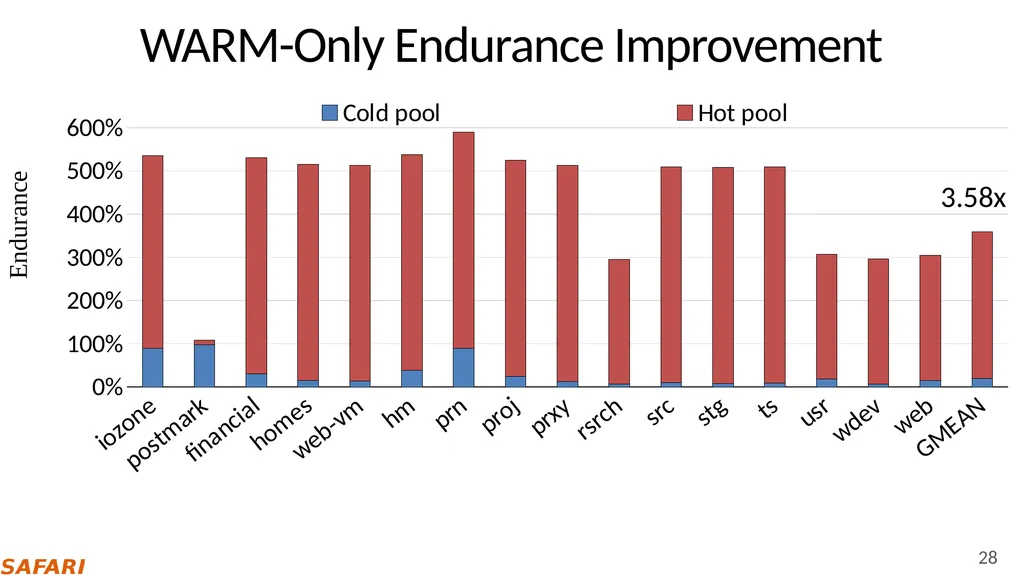
WARM-Only Endurance Improvement 3.58x 28<br>
29
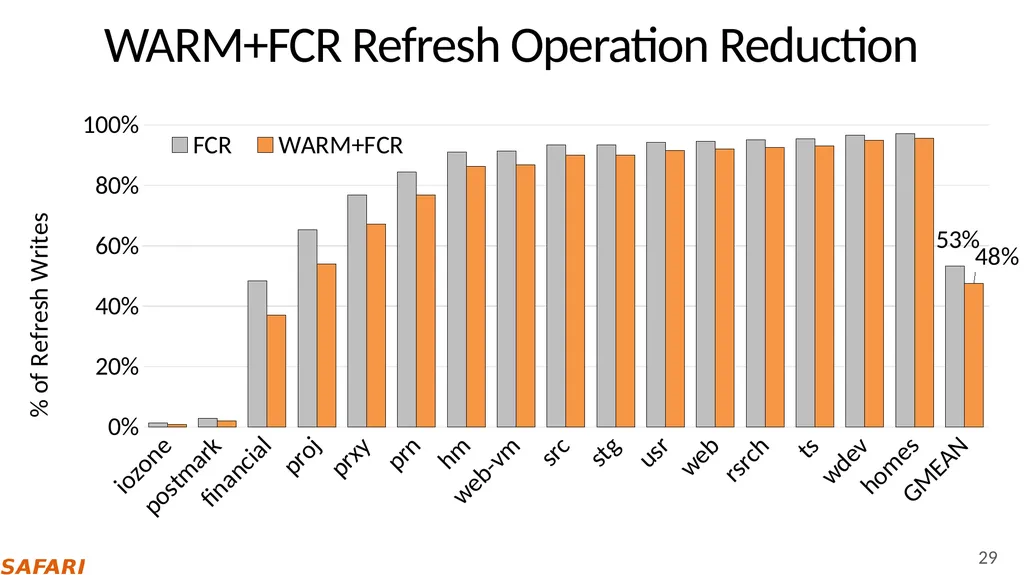
WARM+FCR Refresh Operation Reduction 29<br>
30
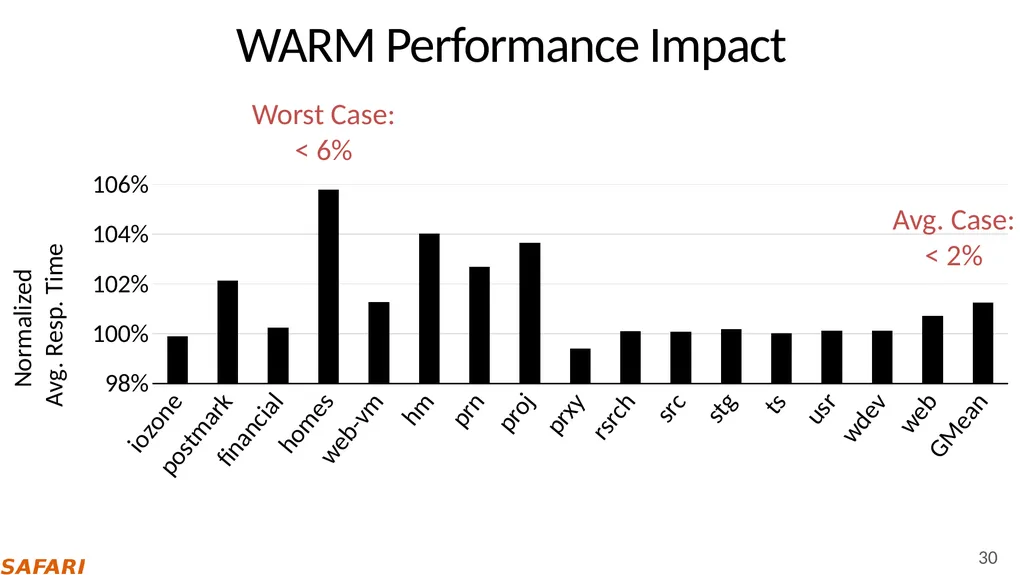
WARM Performance Impact 30 Worst Case:
< 6% Avg. Case:
< 2%<br>
31
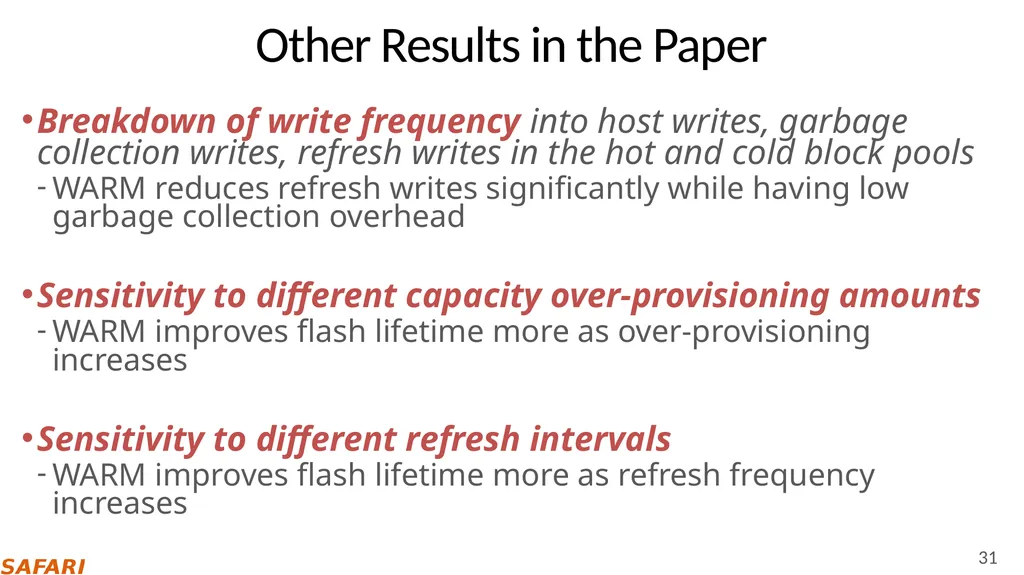
Other Results in the Paper Breakdown of write frequency into host writes, garbage collection writes, refresh writes in the hot and cold block pools
WARM reduces refresh writes significantly while having low garbage collection overhead
Sensitivity to different capacity over-provisioning amounts
WARM improves flash lifetime more as over-provisioning increases
Sensitivity to different refresh intervals
WARM improves flash lifetime more as refresh frequency increases 31<br>
WARM reduces refresh writes significantly while having low garbage collection overhead
Sensitivity to different capacity over-provisioning amounts
WARM improves flash lifetime more as over-provisioning increases
Sensitivity to different refresh intervals
WARM improves flash lifetime more as refresh frequency increases 31<br>
32
Outline Problem and Goal
Key Observations
WARM: Write-hotness Aware Retention Management
Results
Conclusion 32<br>
Key Observations
WARM: Write-hotness Aware Retention Management
Results
Conclusion 32<br>
33
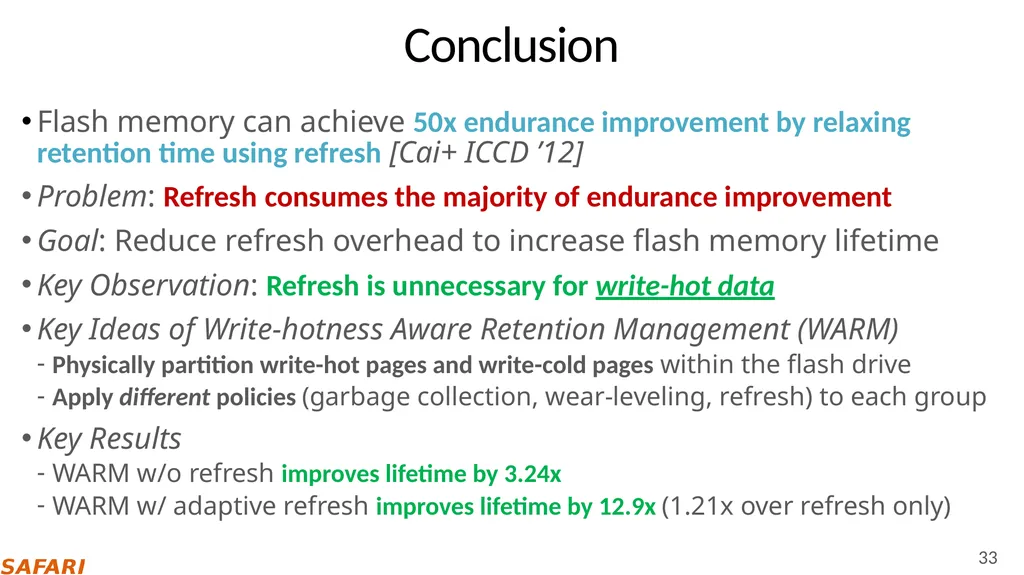
Conclusion Flash memory can achieve 50x endurance improvement by relaxing retention time using refresh [Cai+ ICCD ’12]
Problem: Refresh consumes the majority of endurance improvement
Goal: Reduce refresh overhead to increase flash memory lifetime
Key Observation: Refresh is unnecessary for write-hot data
Key Ideas of Write-hotness Aware Retention Management (WARM)
Physically partition write-hot pages and write-cold pages within the flash drive
Apply different policies (garbage collection, wear-leveling, refresh) to each group
Key Results
WARM w/o refresh improves lifetime by 3.24x
WARM w/ adaptive refresh improves lifetime by 12.9x (1.21x over refresh only) 33<br>
Problem: Refresh consumes the majority of endurance improvement
Goal: Reduce refresh overhead to increase flash memory lifetime
Key Observation: Refresh is unnecessary for write-hot data
Key Ideas of Write-hotness Aware Retention Management (WARM)
Physically partition write-hot pages and write-cold pages within the flash drive
Apply different policies (garbage collection, wear-leveling, refresh) to each group
Key Results
WARM w/o refresh improves lifetime by 3.24x
WARM w/ adaptive refresh improves lifetime by 12.9x (1.21x over refresh only) 33<br>
34
Other Work by SAFARI on Flash Memory J. Meza, Q. Wu, S. Kumar, and O. Mutlu. A Large-Scale Study of Flash Memory Errors in the Field, SIGMETRICS 2015.
Y. Cai, Y. Luo, S. Ghose, E. F. Haratsch, K. Mai, O. Mutlu. Read Disturb Errors in MLC NAND Flash Memory: Characterization and Mitigation, DSN 2015.
Y. Cai, Y. Luo, E. F. Haratsch, K. Mai, O. Mutlu. Data Retention in MLC NAND Flash Memory: Characterization, Optimization and Recovery, HPCA 2015.
Y. Cai, G. Yalcin, O. Mutlu, E. F. Haratsch, O. Unsal, A. Cristal, K. Mai. Neighbor-Cell Assisted Error Correction for MLC NAND Flash Memories, SIGMETRICS 2014.
Y. Cai, O. Mutlu, E. F. Haratsch, K. Mai. Program Interference in MLC NAND Flash Memory: Characterization, Modeling, and Mitigation, ICCD 2013.
Y. Cai, G. Yalcin, O. Mutlu, E. F. Haratsch, A. Cristal, O. Unsal, K. Mai. Error Analysis and Retention-Aware Error Management for NAND Flash Memory, Intel Technology Jrnl. (ITJ), Vol. 17, No. 1, May 2013.
Y. Cai, E. F. Haratsch, O. Mutlu, K. Mai. Threshold Voltage Distribution in MLC NAND Flash Memory: Characterization, Analysis and Modeling, DATE 2013.
Y. Cai, G. Yalcin, O. Mutlu, E. F. Haratsch, A. Cristal, O. Unsal, K. Mai. Flash Correct-and-Refresh: Retention-Aware Error Management for Increased Flash Memory Lifetime, ICCD 2012.
Y. Cai, E. F. Haratsch, O. Mutlu, K. Mai. Error Patterns in MLC NAND Flash Memory: Measurement, Characterization, and Analysis, DATE 2012. 34<br>
Y. Cai, Y. Luo, S. Ghose, E. F. Haratsch, K. Mai, O. Mutlu. Read Disturb Errors in MLC NAND Flash Memory: Characterization and Mitigation, DSN 2015.
Y. Cai, Y. Luo, E. F. Haratsch, K. Mai, O. Mutlu. Data Retention in MLC NAND Flash Memory: Characterization, Optimization and Recovery, HPCA 2015.
Y. Cai, G. Yalcin, O. Mutlu, E. F. Haratsch, O. Unsal, A. Cristal, K. Mai. Neighbor-Cell Assisted Error Correction for MLC NAND Flash Memories, SIGMETRICS 2014.
Y. Cai, O. Mutlu, E. F. Haratsch, K. Mai. Program Interference in MLC NAND Flash Memory: Characterization, Modeling, and Mitigation, ICCD 2013.
Y. Cai, G. Yalcin, O. Mutlu, E. F. Haratsch, A. Cristal, O. Unsal, K. Mai. Error Analysis and Retention-Aware Error Management for NAND Flash Memory, Intel Technology Jrnl. (ITJ), Vol. 17, No. 1, May 2013.
Y. Cai, E. F. Haratsch, O. Mutlu, K. Mai. Threshold Voltage Distribution in MLC NAND Flash Memory: Characterization, Analysis and Modeling, DATE 2013.
Y. Cai, G. Yalcin, O. Mutlu, E. F. Haratsch, A. Cristal, O. Unsal, K. Mai. Flash Correct-and-Refresh: Retention-Aware Error Management for Increased Flash Memory Lifetime, ICCD 2012.
Y. Cai, E. F. Haratsch, O. Mutlu, K. Mai. Error Patterns in MLC NAND Flash Memory: Measurement, Characterization, and Analysis, DATE 2012. 34<br>
35
Improving NAND Flash Memory Lifetime with
Write-hotness Aware Retention Management Yixin Luo, Yu Cai, Saugata Ghose, Jongmoo Choi*, Onur Mutlu
Carnegie Mellon University, *Dankook University WARM 35<br>
Carnegie Mellon University, *Dankook University WARM 35<br>