
Organizational Behaviour: Understanding and
PC
Published · 102 slides · 0 views

1 / 1

Description
Organizational Behaviour: Understanding and Managing Life at Work Eleventh Edition Chapter 2 Personality and Learning Copyright 2020 Pearson Canada Inc. Learning Objectives (1 of 3) LO2.1 Define personality and describe the dispositional,
Related Topics
Share
Embed code
Download this presentation From Below
"Organizational Behaviour: Understanding and" is the property of its rightful owner. Permission is granted to download and print the materials on this website for personal, non-commercial use only, and to display it on your personal computer provided you do not modify the materials and that you retain all copyright notices contained in the materials. By downloading content from our website, you accept the terms of this agreement.
Presentation Transcript
01
Organizational Behaviour:
Understanding and Managing Life at Work Eleventh Edition Chapter 2 Personality and Learning Copyright © 2020 Pearson Canada Inc.<br>
02
Learning Objectives (1 of 3) LO2.1 Define personality and describe the dispositional, situational, and interactionist approaches to organizational behaviour.
LO2.2 Discuss the Five-Factor Model of personality, locus of control, self-monitoring, and self-esteem.
LO2.3 Discuss positive and negative affectivity, proactive personality, general self-efficacy, and core self-evaluations and their consequences.<br>
LO2.2 Discuss the Five-Factor Model of personality, locus of control, self-monitoring, and self-esteem.
LO2.3 Discuss positive and negative affectivity, proactive personality, general self-efficacy, and core self-evaluations and their consequences.<br>
03
Learning Objectives (2 of 3) LO2.4 Define learning, and describe what is learned in organizations.
LO2.5 Explain operant learning theory, and differentiate between positive and negative reinforcements, and extinction and punishment, and explain how to use punishment effectively.
LO2.6 Explain when to use immediate versus delayed reinforcement and when to use continuous versus partial reinforcement.<br>
LO2.5 Explain operant learning theory, and differentiate between positive and negative reinforcements, and extinction and punishment, and explain how to use punishment effectively.
LO2.6 Explain when to use immediate versus delayed reinforcement and when to use continuous versus partial reinforcement.<br>
04
Learning Objectives (3 of 3) LO2.7 Explain social cognitive theory and discuss observational learning, self-efficacy beliefs, and self-regulation.
LO2.8 Describe the following organizational learning practices: organizational behaviour modification, employee recognition programs, and training and development programs.<br>
LO2.8 Describe the following organizational learning practices: organizational behaviour modification, employee recognition programs, and training and development programs.<br>
05
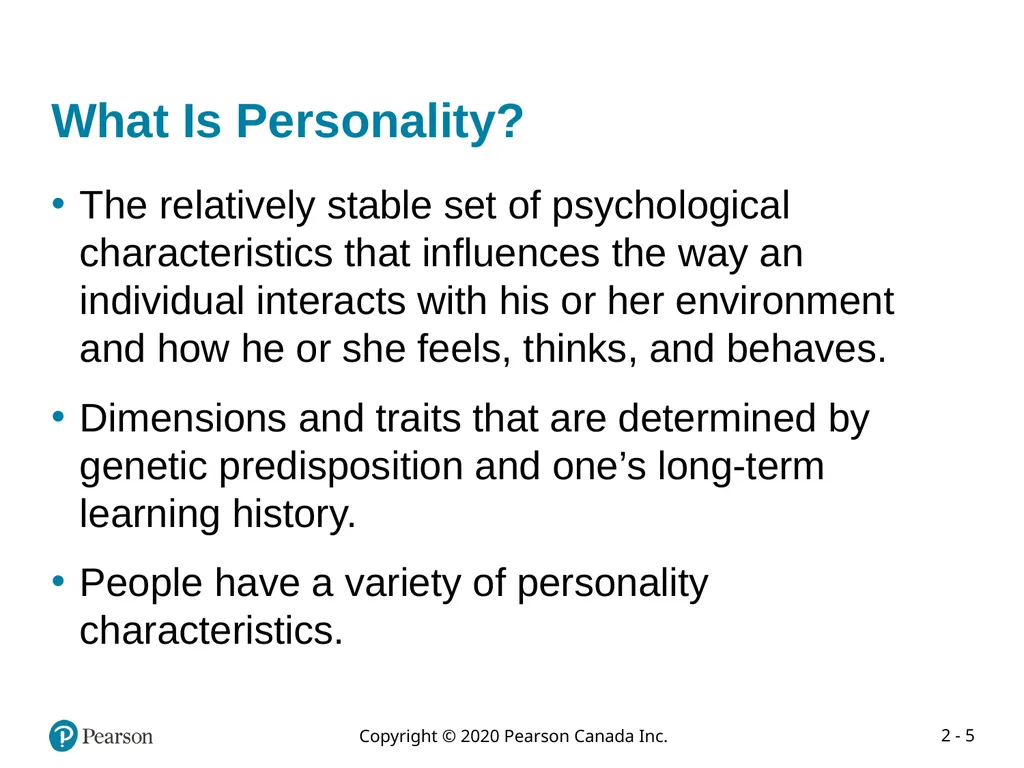
What Is Personality? The relatively stable set of psychological characteristics that influences the way an individual interacts with his or her environment and how he or she feels, thinks, and behaves.
Dimensions and traits that are determined by genetic predisposition and one’s long-term learning history.
People have a variety of personality characteristics.<br>
Dimensions and traits that are determined by genetic predisposition and one’s long-term learning history.
People have a variety of personality characteristics.<br>
06
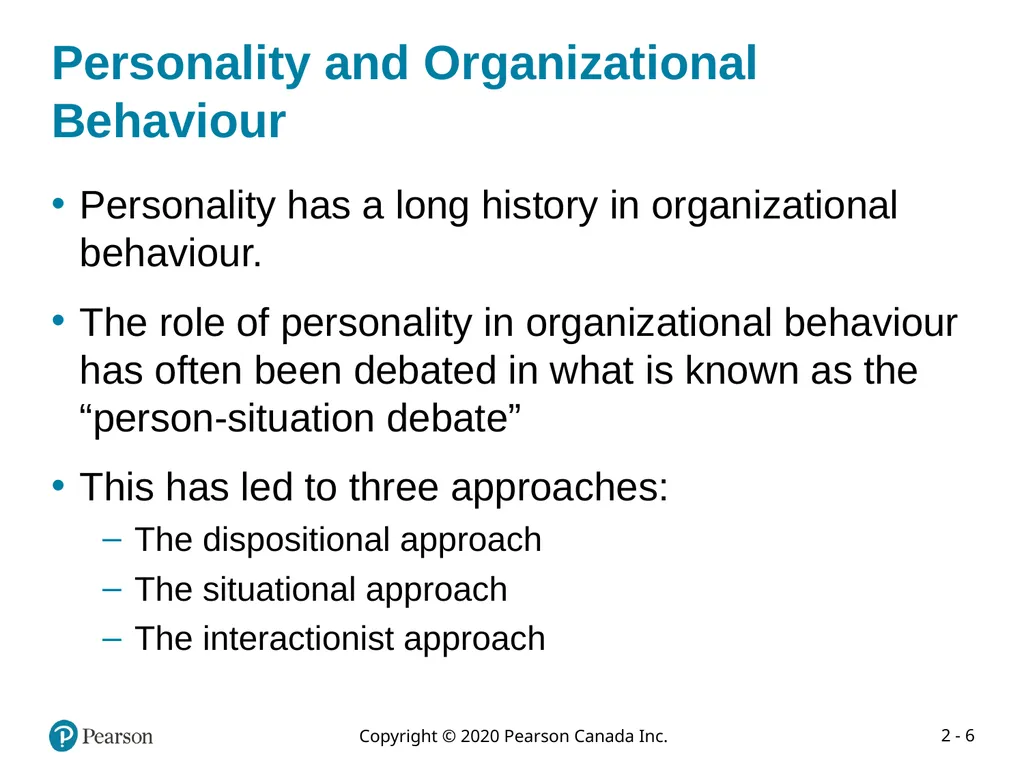
Personality and Organizational Behaviour Personality has a long history in organizational behaviour.
The role of personality in organizational behaviour has often been debated in what is known as the “person-situation debate”
This has led to three approaches:
The dispositional approach
The situational approach
The interactionist approach<br>
The role of personality in organizational behaviour has often been debated in what is known as the “person-situation debate”
This has led to three approaches:
The dispositional approach
The situational approach
The interactionist approach<br>
07
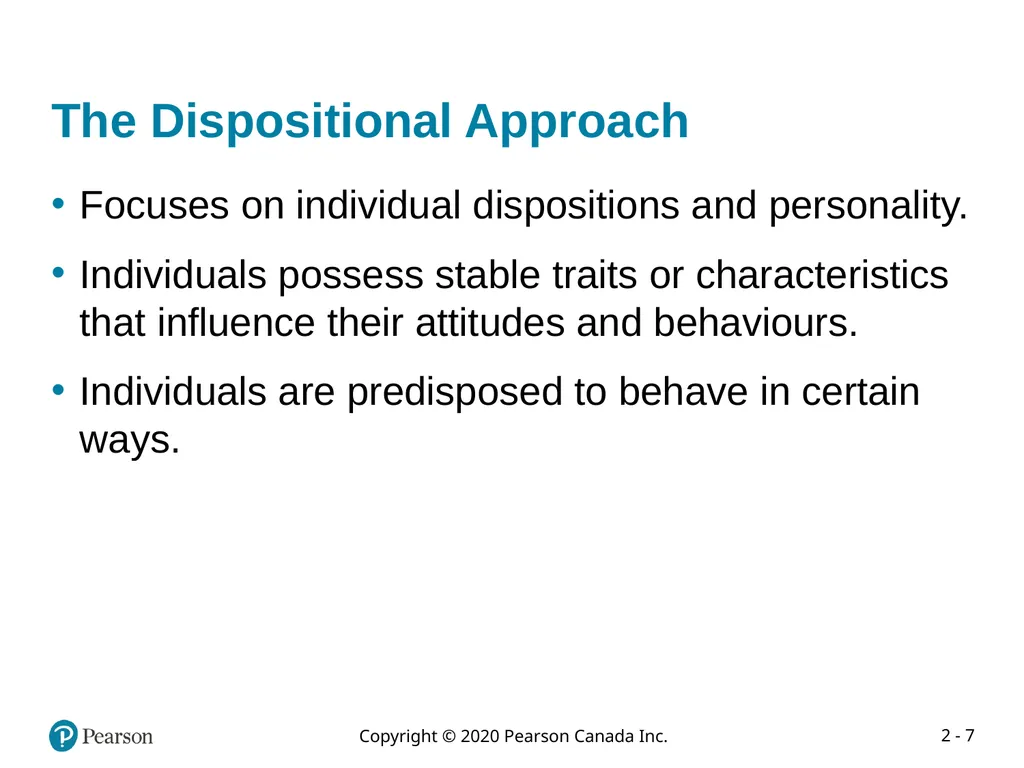
The Dispositional Approach Focuses on individual dispositions and personality.
Individuals possess stable traits or characteristics that influence their attitudes and behaviours.
Individuals are predisposed to behave in certain ways.<br>
Individuals possess stable traits or characteristics that influence their attitudes and behaviours.
Individuals are predisposed to behave in certain ways.<br>
08
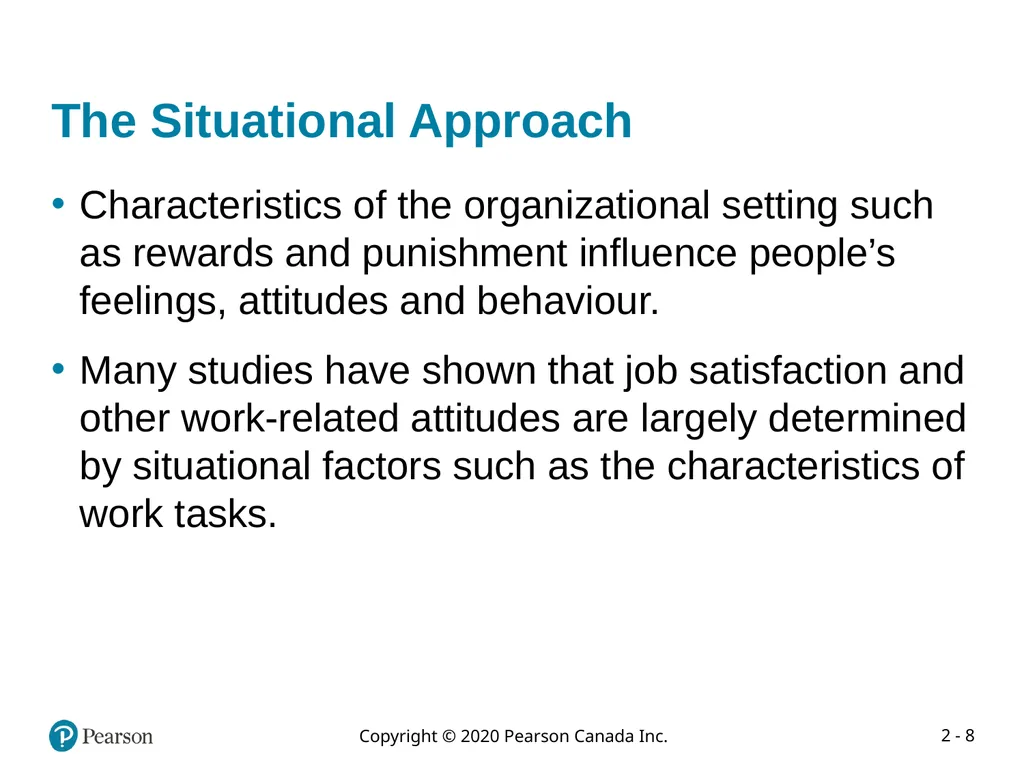
The Situational Approach Characteristics of the organizational setting such as rewards and punishment influence people’s feelings, attitudes and behaviour.
Many studies have shown that job satisfaction and other work-related attitudes are largely determined by situational factors such as the characteristics of work tasks.<br>
Many studies have shown that job satisfaction and other work-related attitudes are largely determined by situational factors such as the characteristics of work tasks.<br>
09
The Interactionist Approach Organizational behaviour (individuals’ attitudes and behaviour) is a function of both dispositions and the situation.
To predict and understand organizational behaviour, we need to know something about an individual’s personality and the work setting.
The interactionist approach is the most widely accepted perspective within organizational behaviour.<br>
To predict and understand organizational behaviour, we need to know something about an individual’s personality and the work setting.
The interactionist approach is the most widely accepted perspective within organizational behaviour.<br>
10
Personality and the Situation (1 of 2) Situations can be described as being either “weak” or “strong”.
In weak situations, roles are loosely defined, there are few rules and weak reinforcement and punishment contingencies.
Personality has the strongest effect in weak situations.<br>
In weak situations, roles are loosely defined, there are few rules and weak reinforcement and punishment contingencies.
Personality has the strongest effect in weak situations.<br>
11
Personality and the Situation (2 of 2) In strong situations, the roles, rules, and contingencies are more defined.
Personality has less of an impact in strong situations.
The extent to which personality influences people’s attitudes and behaviour depends on the situation.<br>
Personality has less of an impact in strong situations.
The extent to which personality influences people’s attitudes and behaviour depends on the situation.<br>
12
Trait Activation Theory Personality traits lead to certain behaviours only when the situation makes the need for the trait salient.
Personality influences people’s behaviour when the situation calls for a particular personality characteristic.<br>
Personality influences people’s behaviour when the situation calls for a particular personality characteristic.<br>
13
Implications of the Interactionist Approach Some personality characteristics are useful in certain organizational situations.
There is no one best personality.
Managers need to appreciate the advantages of employee diversity.
The importance of fit - putting the right person in the right job, group, or organization.<br>
There is no one best personality.
Managers need to appreciate the advantages of employee diversity.
The importance of fit - putting the right person in the right job, group, or organization.<br>
14
The Five-Factor Model of Personality
(1 of 2) Five basic but general dimensions that describe personality:
Extraversion
Emotional stability/neuroticism
Agreeableness
Conscientiousness
Openness to experience<br>
Extraversion
Emotional stability/neuroticism
Agreeableness
Conscientiousness
Openness to experience<br>
15
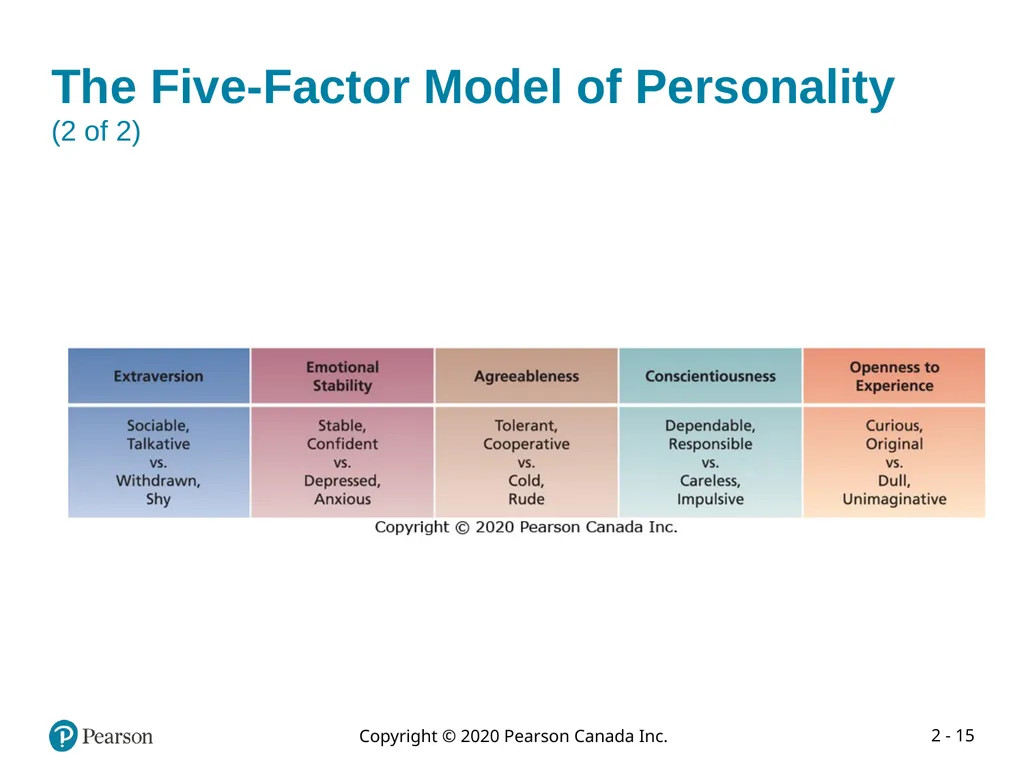
The Five-Factor Model of Personality
(2 of 2)<br>
16
Extraversion and OB Important for jobs that require interpersonal interaction and where being sociable, assertive, energetic, and ambitious is important for success.<br>
17
Emotional Stability/Neuroticism and OB Persons high on emotional stability will have more effective interactions with co-workers and customers as they tend to be more calm and secure.<br>
18
Agreeableness and OB Contributes to job performance in jobs that require interaction and involve helping, cooperating, and nurturing others as well as in jobs that involve teamwork and cooperation.<br>
19
Conscientiousness and OB Important for job performance on most jobs given the tendency towards hard work and achievement.<br>
20
Openness to Experience and OB Important for jobs that involve learning and creativity given the tendency to be intellectual, curious, and imaginative and have broad interests.<br>
21
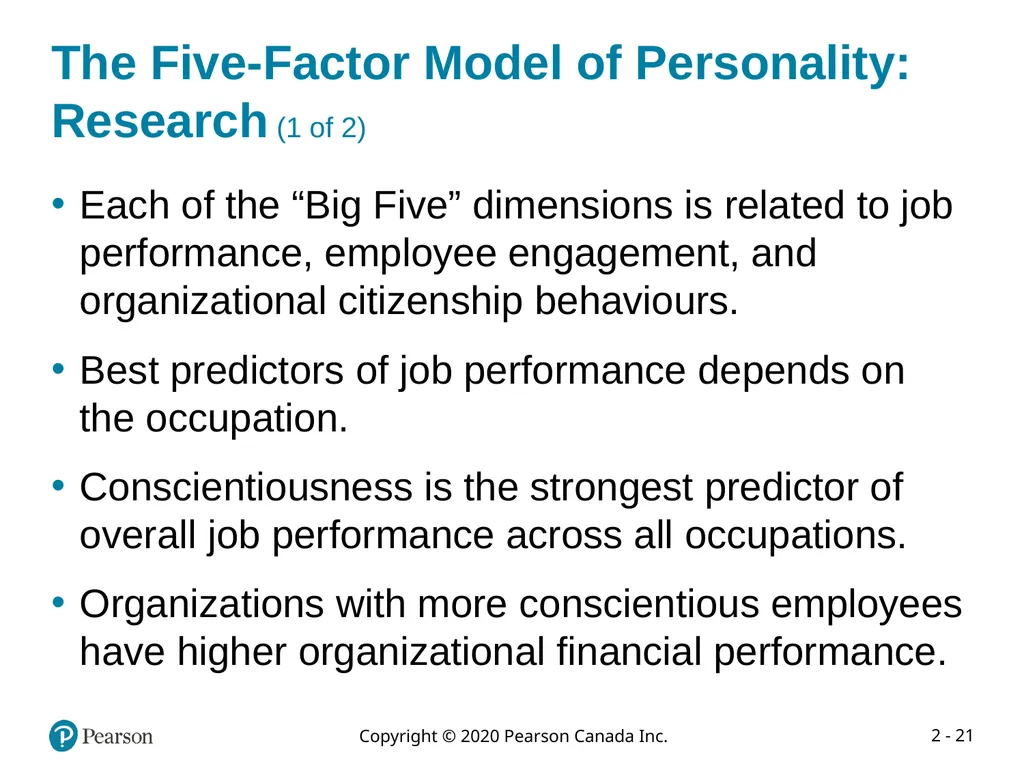
The Five-Factor Model of Personality: Research (1 of 2) Each of the “Big Five” dimensions is related to job performance, employee engagement, and organizational citizenship behaviours.
Best predictors of job performance depends on the occupation.
Conscientiousness is the strongest predictor of overall job performance across all occupations.
Organizations with more conscientious employees have higher organizational financial performance.<br>
Best predictors of job performance depends on the occupation.
Conscientiousness is the strongest predictor of overall job performance across all occupations.
Organizations with more conscientious employees have higher organizational financial performance.<br>
22
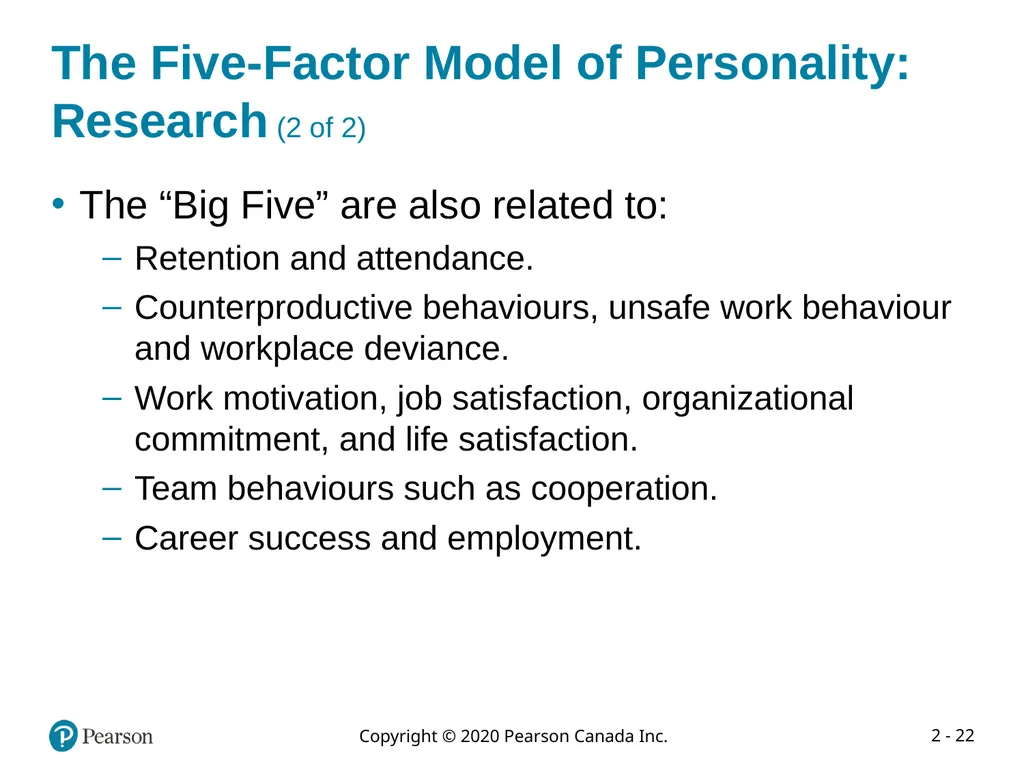
The Five-Factor Model of Personality: Research (2 of 2) The “Big Five” are also related to:
Retention and attendance.
Counterproductive behaviours, unsafe work behaviour and workplace deviance.
Work motivation, job satisfaction, organizational commitment, and life satisfaction.
Team behaviours such as cooperation.
Career success and employment.<br>
Retention and attendance.
Counterproductive behaviours, unsafe work behaviour and workplace deviance.
Work motivation, job satisfaction, organizational commitment, and life satisfaction.
Team behaviours such as cooperation.
Career success and employment.<br>
23
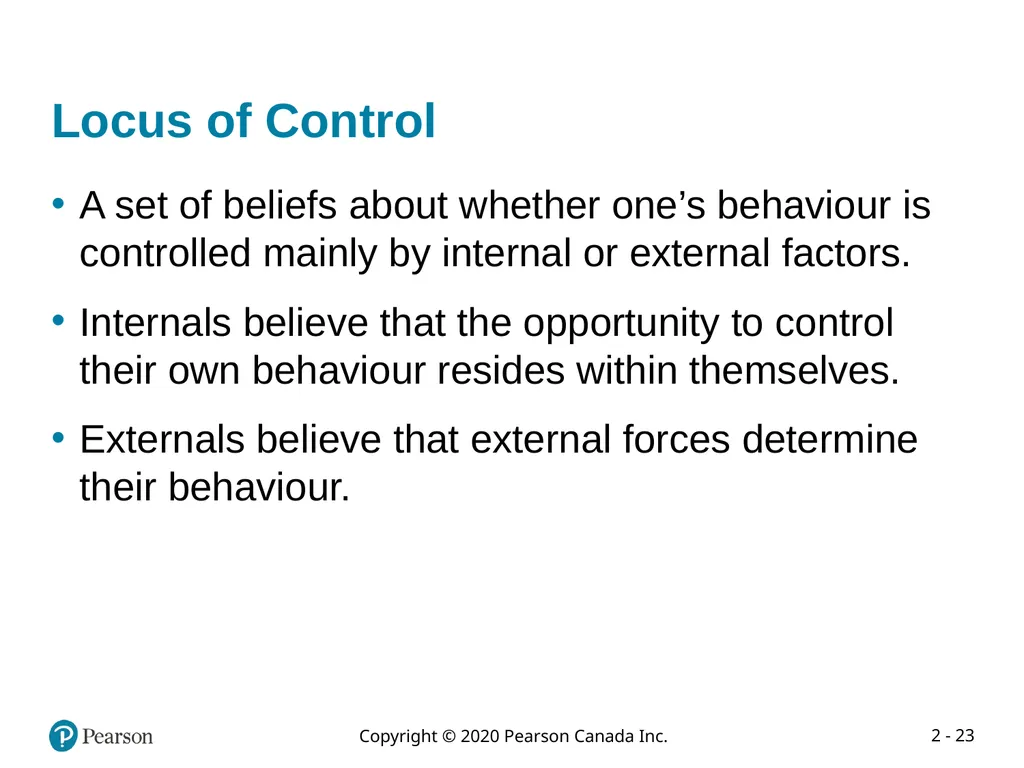
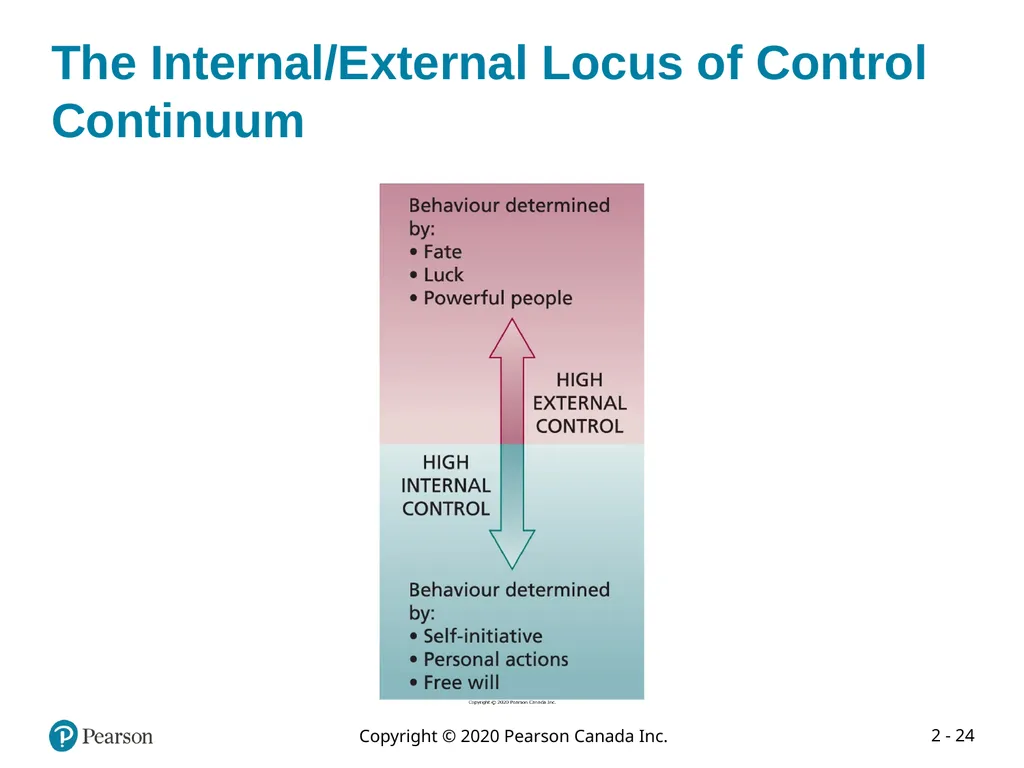
Locus of Control A set of beliefs about whether one’s behaviour is controlled mainly by internal or external factors.
Internals believe that the opportunity to control their own behaviour resides within themselves.
Externals believe that external forces determine their behaviour.<br>
Internals believe that the opportunity to control their own behaviour resides within themselves.
Externals believe that external forces determine their behaviour.<br>
24
The Internal/External Locus of Control Continuum<br>
25
Locus of Control: Research Internals are more satisfied with their jobs, more committed to their organization, earn more money, and achieve higher organizational positions.
Internals perceive less stress, cope with stress better and experience less burnout, and engage in more careful career planning.
Internals are less likely to be absent from work and are more satisfied with their lives.<br>
Internals perceive less stress, cope with stress better and experience less burnout, and engage in more careful career planning.
Internals are less likely to be absent from work and are more satisfied with their lives.<br>
26
Self-Monitoring (1 of 2) The extent to which people observe and regulate how they appear and behave in social settings and relationships.
High self-monitors take great care to observe and control the images that they project.<br>
High self-monitors take great care to observe and control the images that they project.<br>
27
Self-Monitoring (2 of 2) High self-monitors show concern for socially appropriate emotions and behaviours, and tune into social and interpersonal cues; they regulate their behaviour and self-presentation according to these cues.<br>
28
Self-Monitoring: Research (1 of 2) High self-monitors gravitate to jobs that require role-playing and the use of their self-presentation skills.
High self-monitors are more involved in their jobs, perform better, and are more likely to emerge as leaders.
High self-monitors experience more role stress and show less commitment to their organization.<br>
High self-monitors are more involved in their jobs, perform better, and are more likely to emerge as leaders.
High self-monitors experience more role stress and show less commitment to their organization.<br>
29
Self-Monitoring: Research (2 of 2) High self-monitors are not comfortable in ambiguous social settings in which it is hard to determine what behaviours are socially appropriate.
Dealing with unfamiliar cultures might provoke stress.<br>
Dealing with unfamiliar cultures might provoke stress.<br>
30
Self-Esteem The degree to which a person has a positive
self-evaluation.
People with high self-esteem have favourable self-images.
People with low self-esteem have unfavourable self-images.<br>
People with high self-esteem have favourable self-images.
People with low self-esteem have unfavourable self-images.<br>
31
Self-Esteem and Behavioural Plasticity Theory People with low self-esteem tend to be more susceptible to external and social influences than those who have high self-esteem.
Events and people in organizations have more impact on the beliefs and actions of employees with low self-esteem.<br>
Events and people in organizations have more impact on the beliefs and actions of employees with low self-esteem.<br>
32
Self-Esteem: Research Employees with low self-esteem react badly to negative feedback – it lowers subsequent performance.
People with high self-esteem make more fulfilling career decisions and have higher job satisfaction and job performance.
People with high self-esteem are more resilient to the strains of everyday work-life.
What can organizations do to bolster self-esteem?<br>
People with high self-esteem make more fulfilling career decisions and have higher job satisfaction and job performance.
People with high self-esteem are more resilient to the strains of everyday work-life.
What can organizations do to bolster self-esteem?<br>
33
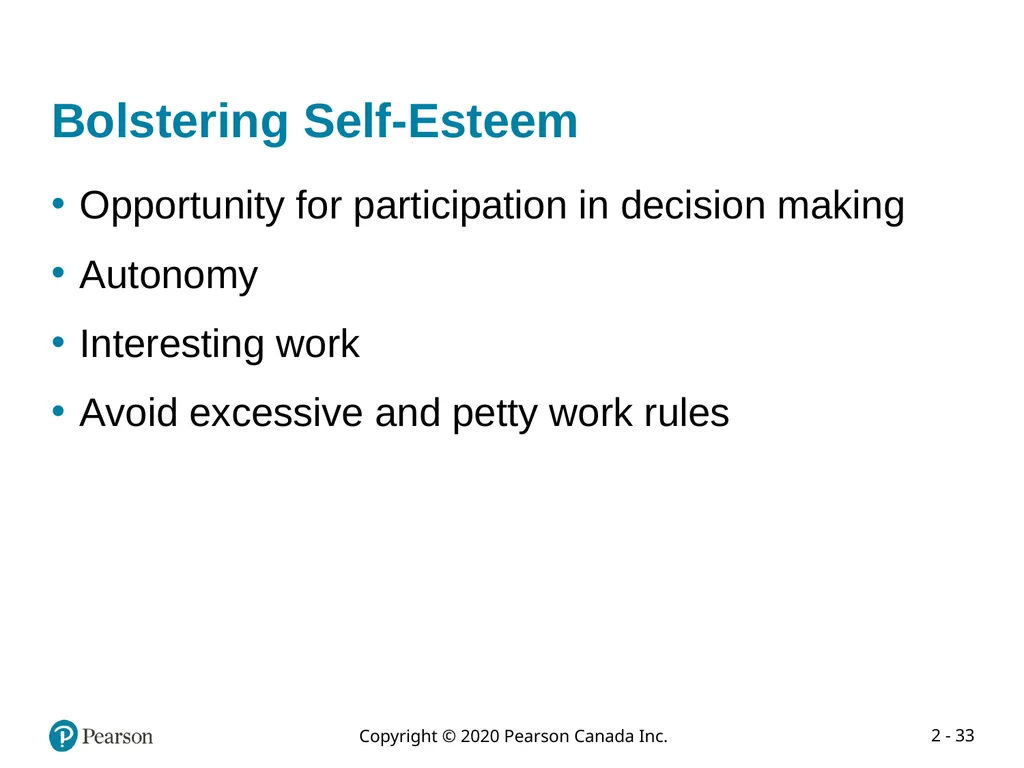
Bolstering Self-Esteem Opportunity for participation in decision making
Autonomy
Interesting work
Avoid excessive and petty work rules<br>
Autonomy
Interesting work
Avoid excessive and petty work rules<br>
34
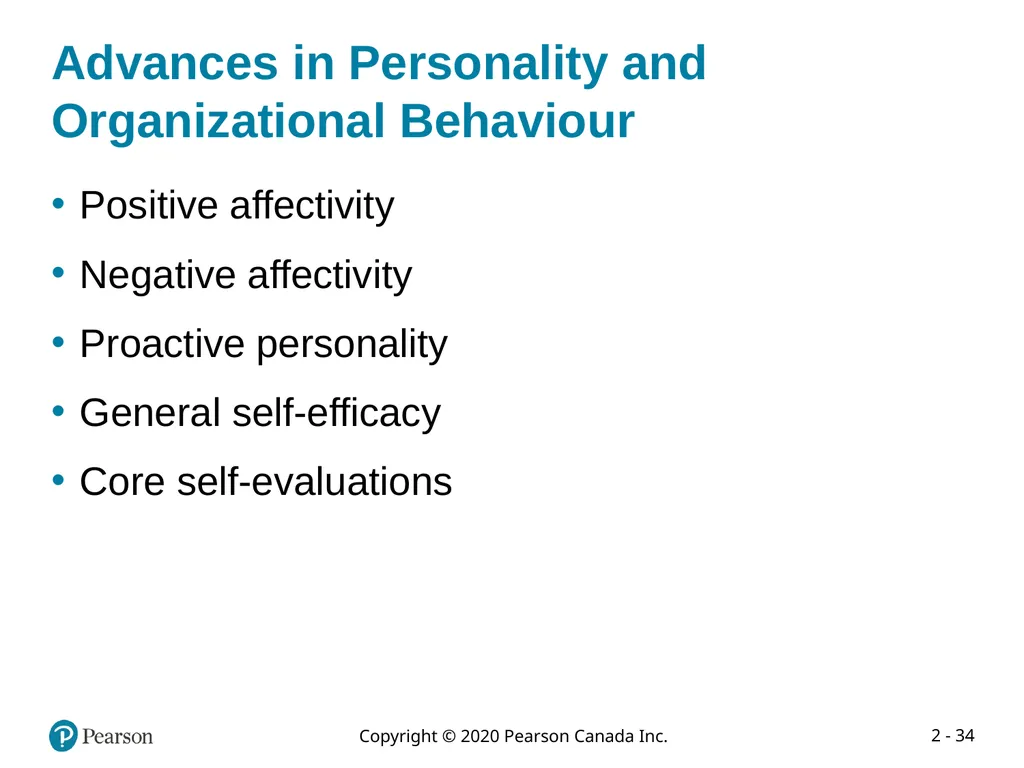
Advances in Personality and Organizational Behaviour Positive affectivity
Negative affectivity
Proactive personality
General self-efficacy
Core self-evaluations<br>
Negative affectivity
Proactive personality
General self-efficacy
Core self-evaluations<br>
35
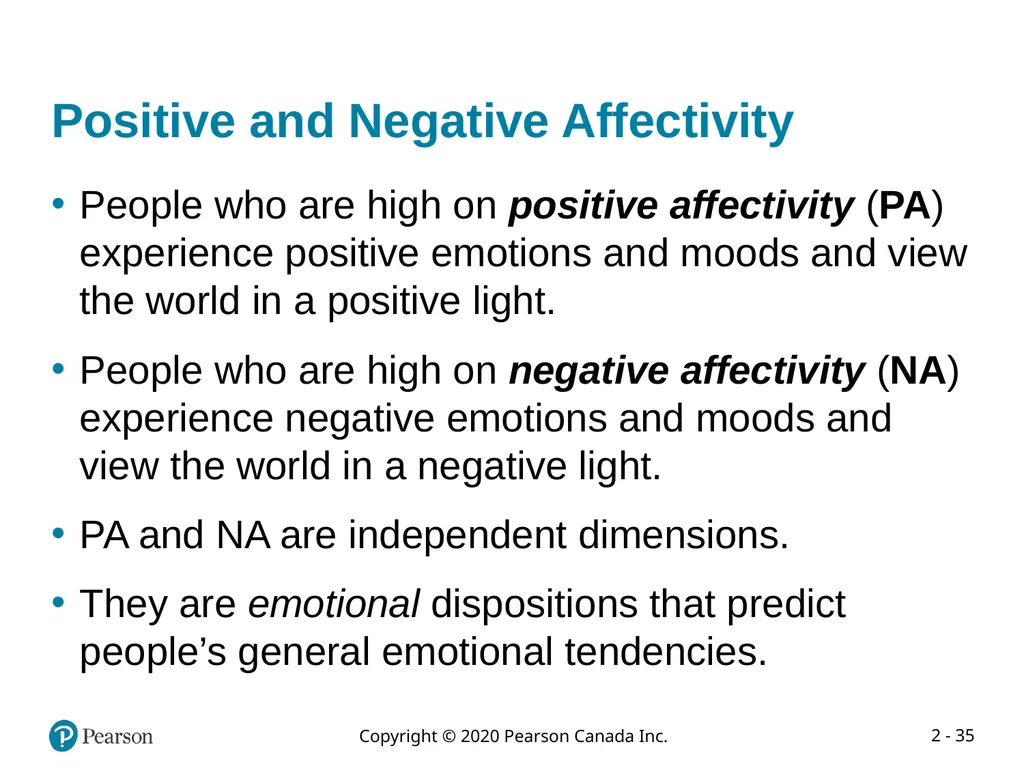
Positive and Negative Affectivity People who are high on positive affectivity (PA) experience positive emotions and moods and view the world in a positive light.
People who are high on negative affectivity (NA) experience negative emotions and moods and view the world in a negative light.
PA and NA are independent dimensions.
They are emotional dispositions that predict people’s general emotional tendencies.<br>
People who are high on negative affectivity (NA) experience negative emotions and moods and view the world in a negative light.
PA and NA are independent dimensions.
They are emotional dispositions that predict people’s general emotional tendencies.<br>
36
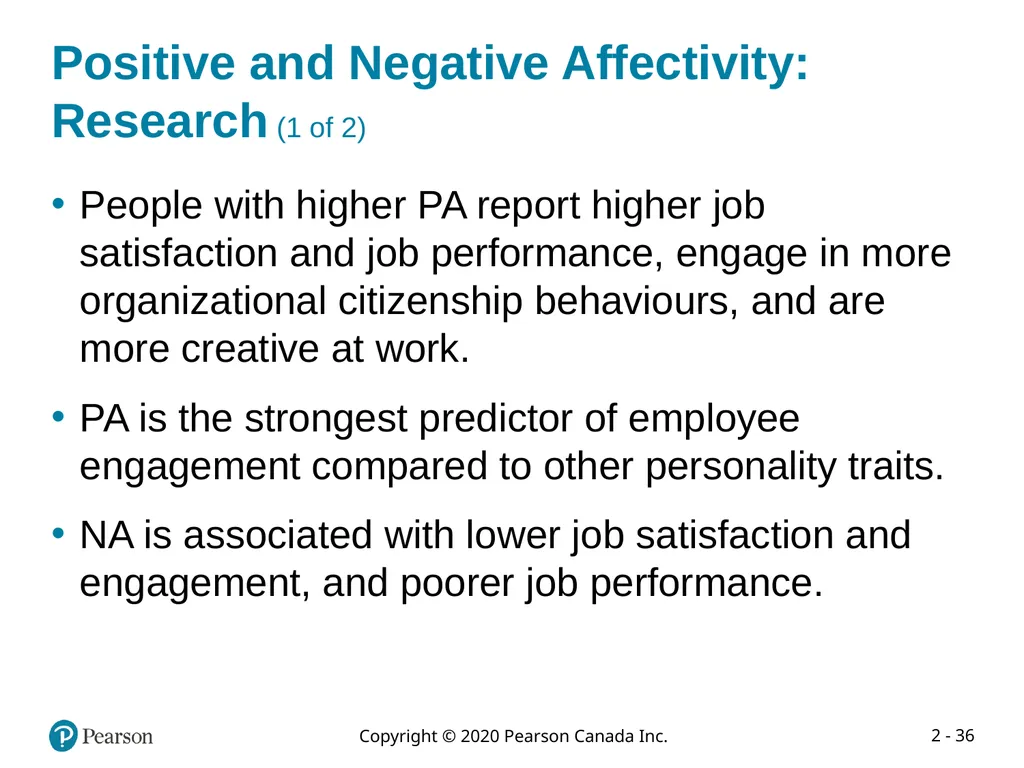
Positive and Negative Affectivity: Research (1 of 2) People with higher PA report higher job satisfaction and job performance, engage in more organizational citizenship behaviours, and are more creative at work.
PA is the strongest predictor of employee engagement compared to other personality traits.
NA is associated with lower job satisfaction and engagement, and poorer job performance.<br>
PA is the strongest predictor of employee engagement compared to other personality traits.
NA is associated with lower job satisfaction and engagement, and poorer job performance.<br>
37
Positive and Negative Affectivity: Research (2 of 2) NA has also been found to be related to more counterproductive work behaviours, withdrawal behaviours, and occupational injury.
PA has been found to link happiness to success in life and at work.<br>
PA has been found to link happiness to success in life and at work.<br>
38
Proactive Personality A stable personal disposition that reflects a tendency to take personal initiative across a range of activities and situations and to effect positive change in one’s environment.
Proactive behaviour involves taking initiative to improve current circumstances or creating new ones.
Proactive individuals search for and identify opportunities, show initiative, take action, and persevere until they bring about meaningful change.<br>
Proactive behaviour involves taking initiative to improve current circumstances or creating new ones.
Proactive individuals search for and identify opportunities, show initiative, take action, and persevere until they bring about meaningful change.<br>
39
Proactive Personality: Research Proactive personality is related to a number of work outcomes (such as job satisfaction, employee engagement, job performance, organizational citizenship behaviours).
Persons with a proactive personality are more successful in searching for employment and career success.<br>
Persons with a proactive personality are more successful in searching for employment and career success.<br>
40
General Self-Efficacy A general trait that refers to an individual’s belief in his or her ability to perform successfully in a variety of challenging situations.
General self-efficacy (GSE) is a motivational trait rather than an affective trait.<br>
General self-efficacy (GSE) is a motivational trait rather than an affective trait.<br>
41
General Self-Efficacy: Research Individuals with higher GSE are better able to adapt to novel, uncertain, and adverse situations.
Employees with higher GSE have higher job satisfaction and job performance.<br>
Employees with higher GSE have higher job satisfaction and job performance.<br>
42
Core Self-Evaluations A multidimensional trait and broad personality concept that consists of several more specific traits that reflect the evaluations people hold about themselves and their self-worth, competence, and capability.<br>
43
Four Traits of Core Self-Evaluations Self-esteem
General self-efficacy
Locus of control
Neuroticism (emotional stability)<br>
General self-efficacy
Locus of control
Neuroticism (emotional stability)<br>
44
Core Self-Evaluations: Research (1 of 2) People with more positive CSEs have higher job satisfaction, life satisfaction, and career satisfaction.
CSE is related to job satisfaction over time.
CSE is related to higher organizational commitment, job performance, and learning outcomes.
Individuals with higher CSE perceive fewer stressors and experience less stress and conflict at work.<br>
CSE is related to job satisfaction over time.
CSE is related to higher organizational commitment, job performance, and learning outcomes.
Individuals with higher CSE perceive fewer stressors and experience less stress and conflict at work.<br>
45
Core Self-Evaluations: Research (2 of 2) Individuals with higher CSE are more likely to perceive and pay attention to the positive aspects of their environments.
They also experience their job as more intrinsically satisfying and have higher perceptions of fairness and support.<br>
They also experience their job as more intrinsically satisfying and have higher perceptions of fairness and support.<br>
46
What Is Learning? Learning occurs when practice or experience leads to a relatively permanent change in behaviour potential.
The practice or experience that prompts learning stems from an environment that provides feedback concerning the consequences of behaviour.<br>
The practice or experience that prompts learning stems from an environment that provides feedback concerning the consequences of behaviour.<br>
47
What Do Employees Learn in Organizations? Practical skills
Intrapersonal skills
Interpersonal skills
Cultural awareness<br>
Intrapersonal skills
Interpersonal skills
Cultural awareness<br>
48
Practical Skills Job-specific skills, knowledge, technical competence.<br>
49
Intrapersonal Skills Problem solving, critical thinking, alternative work processes, risk taking.<br>
50
Interpersonal Skills Interactive skills such as communicating, teamwork, conflict resolution.<br>
51
Cultural Awareness The social norms of organizations, company goals, business operations, expectations, and priorities.<br>
52
How Do People Learn? Two theories that describe how people in organizations learn:
Operant learning theory
Social cognitive theory<br>
Operant learning theory
Social cognitive theory<br>
53
Operant Learning Theory (1 of 2) Learning in which the subject learns to operate on the environment to achieve certain consequences.
Operantly learned behaviour is controlled by the consequences that follow it.
It is the connection between the behaviour and the consequence that is learned.<br>
Operantly learned behaviour is controlled by the consequences that follow it.
It is the connection between the behaviour and the consequence that is learned.<br>
54
Operant Learning Theory (2 of 2) Operant learning can be used to increase the probability of desired behaviours and to reduce or eliminate the probability of undesirable behaviours.<br>
55
Increasing the Probability of Behaviour (1 of 2) One of the most important consequences that influences behaviour is reinforcement.
Reinforcement is the process by which stimuli strengthen behaviours.
A reinforcer is a stimulus that follows some behaviour and increases or maintains the probability of that behaviour.<br>
Reinforcement is the process by which stimuli strengthen behaviours.
A reinforcer is a stimulus that follows some behaviour and increases or maintains the probability of that behaviour.<br>
56
Increasing the Probability of Behaviour (2 of 2) Positive reinforcers work by their application to a situation.
Negative reinforcers work by their removal from a situation.<br>
Negative reinforcers work by their removal from a situation.<br>
57
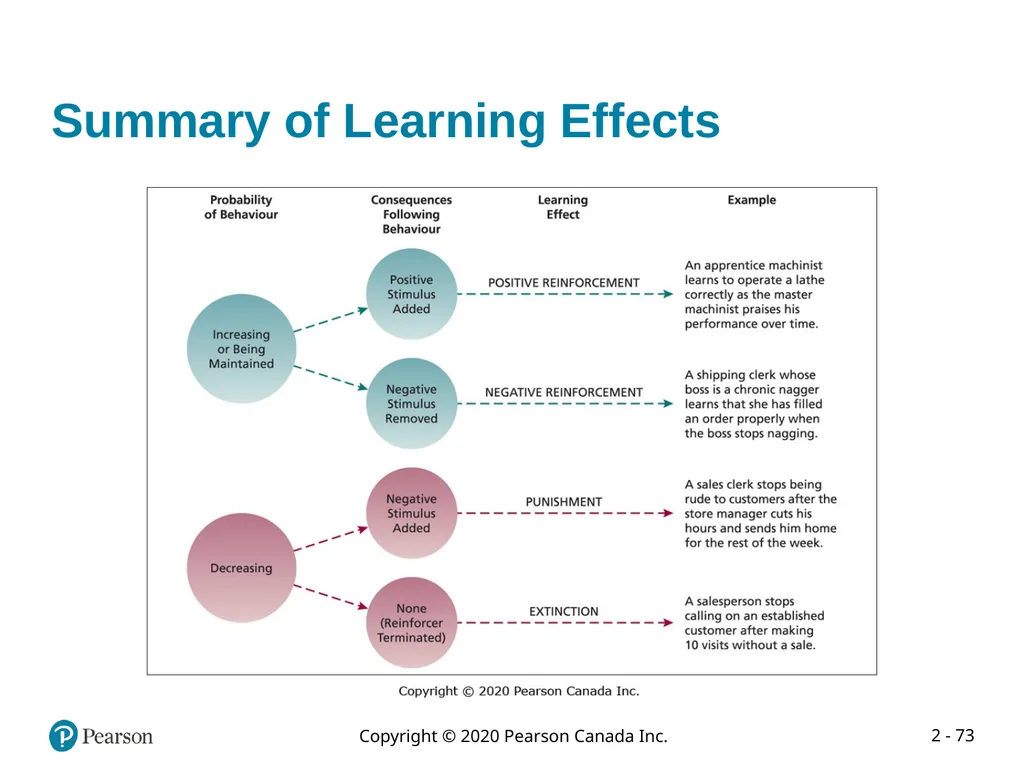
Positive Reinforcement The application or addition of a stimulus that increases or maintains the probability of some behaviour.
The stimulus is the positive reinforcer.
The reinforcer is dependent or contingent on the occurrence of some desired behaviour.
Whether or not something is a positive reinforcer depends on whether it increases or maintains the occurrence of some behaviour by its application.<br>
The stimulus is the positive reinforcer.
The reinforcer is dependent or contingent on the occurrence of some desired behaviour.
Whether or not something is a positive reinforcer depends on whether it increases or maintains the occurrence of some behaviour by its application.<br>
58
Negative Reinforcement The removal of a stimulus from a situation that increases or maintains the probability of some behaviour.
Negative reinforcement occurs when a response prevents some event or stimulus from occurring.
The removed or prevented stimulus is a negative reinforcer.
Negative reinforcers are defined by what they do and how they work, not by their unpleasantness.<br>
Negative reinforcement occurs when a response prevents some event or stimulus from occurring.
The removed or prevented stimulus is a negative reinforcer.
Negative reinforcers are defined by what they do and how they work, not by their unpleasantness.<br>
59
Organizational Errors Involving Reinforcement Managers sometimes make the following errors when trying to use reinforcement:
Confusing rewards with reinforcers
Neglecting diversity in preferences for reinforcers
Neglecting important sources of reinforcement<br>
Confusing rewards with reinforcers
Neglecting diversity in preferences for reinforcers
Neglecting important sources of reinforcement<br>
60
Confusing Rewards with Reinforcers Rewards fail to serve as reinforcers when they are not made contingent on some specific desired behaviours.<br>
61
Neglecting Diversity in Preferences for Reinforcers Organizations often fail to appreciate individual differences in preferences for reinforcers.
Managers should consider the stimuli under their control for their applicability as reinforcers for particular employees.<br>
Managers should consider the stimuli under their control for their applicability as reinforcers for particular employees.<br>
62
Neglecting Important Sources of Reinforcement Managers often neglect important sources of reinforcement such as those administered by
co-workers or intrinsic to the job.
Two important sources of reinforcement that managers often ignore:
Performance feedback
Social recognition<br>
Two important sources of reinforcement that managers often ignore:
Performance feedback
Social recognition<br>
63
Performance Feedback (1 of 2) Performance feedback involves providing quantitative or qualitative information on past performance for the purpose of changing or maintaining performance in specific ways.<br>
64
Performance Feedback (2 of 2) Performance feedback is most effective when it is:
Conveyed in a positive manner
Delivered immediately after observing performance
Represented visually (graph or chart form)
Specific to the behaviour that is being targeted for feedback<br>
Conveyed in a positive manner
Delivered immediately after observing performance
Represented visually (graph or chart form)
Specific to the behaviour that is being targeted for feedback<br>
65
Social Recognition Social recognition involves informal acknowledgement, attention, praise, approval, or genuine appreciation for work well done from one individual or group to another.
It is so important to employees that many would leave their job if their manager failed to provide it.
When social recognition is made contingent on employee behaviour it can be an effective means for performance improvement.<br>
It is so important to employees that many would leave their job if their manager failed to provide it.
When social recognition is made contingent on employee behaviour it can be an effective means for performance improvement.<br>
66
Reinforcement Strategies (1 of 3) Reinforcement can be:
Continuous versus partial
Immediate versus delayed
What is the best way to administer reinforcers?<br>
Continuous versus partial
Immediate versus delayed
What is the best way to administer reinforcers?<br>
67
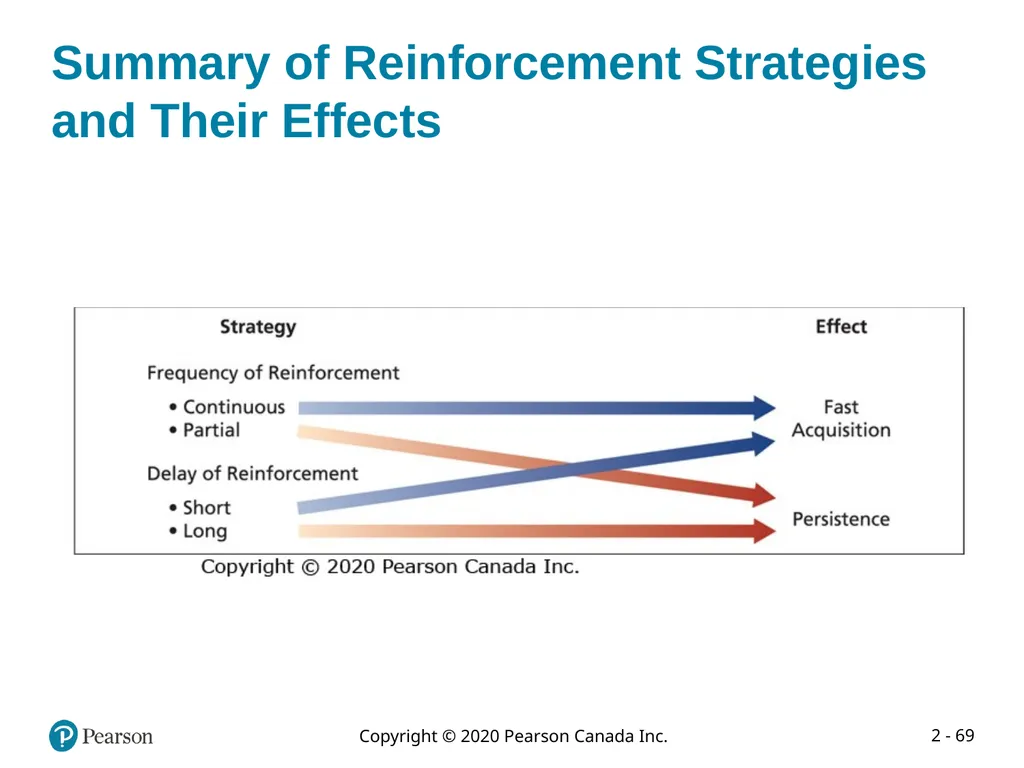
Reinforcement Strategies (2 of 3) For fast acquisition of some response, continuous and immediate reinforcement should be used.
Behaviour tends to be persistent when it is learned under conditions of partial and delayed reinforcement.<br>
Behaviour tends to be persistent when it is learned under conditions of partial and delayed reinforcement.<br>
68
Reinforcement Strategies (3 of 3) Managers have to tailor reinforcement strategies to the needs of the situation and often must alter their strategies over time to achieve effective learning and maintenance of behaviour.<br>
69
Summary of Reinforcement Strategies and Their Effects<br>
70
Reducing the Probability of Behaviour Sometimes learned behaviours are detrimental to the operation of an organization and they need to be reduced or eliminated.
Two strategies that can reduce the probability of learned behaviour:
Extinction
Punishment<br>
Two strategies that can reduce the probability of learned behaviour:
Extinction
Punishment<br>
71
Extinction The gradual dissipation of behaviour following the termination of reinforcement.
If the behaviour is not reinforced, it will gradually dissipate or be extinguished.
Extinction works best when coupled with the reinforcement of some desired substitute behaviour.<br>
If the behaviour is not reinforced, it will gradually dissipate or be extinguished.
Extinction works best when coupled with the reinforcement of some desired substitute behaviour.<br>
72
Punishment The application of an aversive stimulus following unwanted behaviour to decrease the probability of that behaviour.
A nasty stimulus is applied after some undesirable behaviour in order to decrease the probability of that behaviour.<br>
A nasty stimulus is applied after some undesirable behaviour in order to decrease the probability of that behaviour.<br>
73
Summary of Learning Effects<br>
74
Problems Using Punishment (1 of 2) Punishment has some unique characteristics that often limit its effectiveness in eliminating unwanted behaviour.
It does not demonstrate which behaviours should replace the punished response.
Punishment indicates only what is not appropriate.<br>
It does not demonstrate which behaviours should replace the punished response.
Punishment indicates only what is not appropriate.<br>
75
Problems Using Punishment (2 of 2) Punishment only temporarily suppresses the unwanted behaviour.
Punishment can provoke a strong emotional reaction from the punished individual.<br>
Punishment can provoke a strong emotional reaction from the punished individual.<br>
76
Using Punishment Effectively (1 of 2) Provide an acceptable alternative response for the punished response.
Limit the emotions involved in punishment.
Make sure the chosen punishment is truly aversive.<br>
Limit the emotions involved in punishment.
Make sure the chosen punishment is truly aversive.<br>
77
Using Punishment Effectively (2 of 2) Punish immediately or reinstate the circumstances surrounding the problem behaviour at a more appropriate time.
Do not reward unwanted behaviours before or after punishment.
Do not inadvertently punish desirable behaviour.<br>
Do not reward unwanted behaviours before or after punishment.
Do not inadvertently punish desirable behaviour.<br>
78
Social Cognitive Theory (1 of 2) Social cognitive theory emphasizes the role of cognitive processes in regulating people’s behaviour.
People learn by observing the behaviour of others and can regulate their own behaviour by thinking about the consequences of their actions, setting performance goals, monitoring performance, and rewarding themselves for goal accomplishment.<br>
People learn by observing the behaviour of others and can regulate their own behaviour by thinking about the consequences of their actions, setting performance goals, monitoring performance, and rewarding themselves for goal accomplishment.<br>
79
Social Cognitive Theory (2 of 2) Human behaviour can best be explained through a system of triadic reciprocal causation in which personal factors and environmental factors work together and interact to influence people’s behaviour.
People’s behaviour also influences personal factors and the environment.
Social cognitive theory compliments operant learning theory in explaining how people learn and organizational behaviour.<br>
People’s behaviour also influences personal factors and the environment.
Social cognitive theory compliments operant learning theory in explaining how people learn and organizational behaviour.<br>
80
Components of Social Cognitive Theory Observational learning
Self-efficacy beliefs
Self-regulation<br>
Self-efficacy beliefs
Self-regulation<br>
81
Observational Learning (1 of 2) The process of observing and imitating the behaviour of others:
Examining the behaviour of others
Seeing the consequences they experience
Thinking about what might happen if we act the same way
Imitating the behaviour if we expect favourable consequences<br>
Examining the behaviour of others
Seeing the consequences they experience
Thinking about what might happen if we act the same way
Imitating the behaviour if we expect favourable consequences<br>
82
Observational Learning (2 of 2) The reinforcement is self-reinforcement.
Attractive, credible, competent, high-status people are most likely to be imitated.
It is important that the model’s behaviour result in positive consequences that are vivid and memorable.<br>
Attractive, credible, competent, high-status people are most likely to be imitated.
It is important that the model’s behaviour result in positive consequences that are vivid and memorable.<br>
83
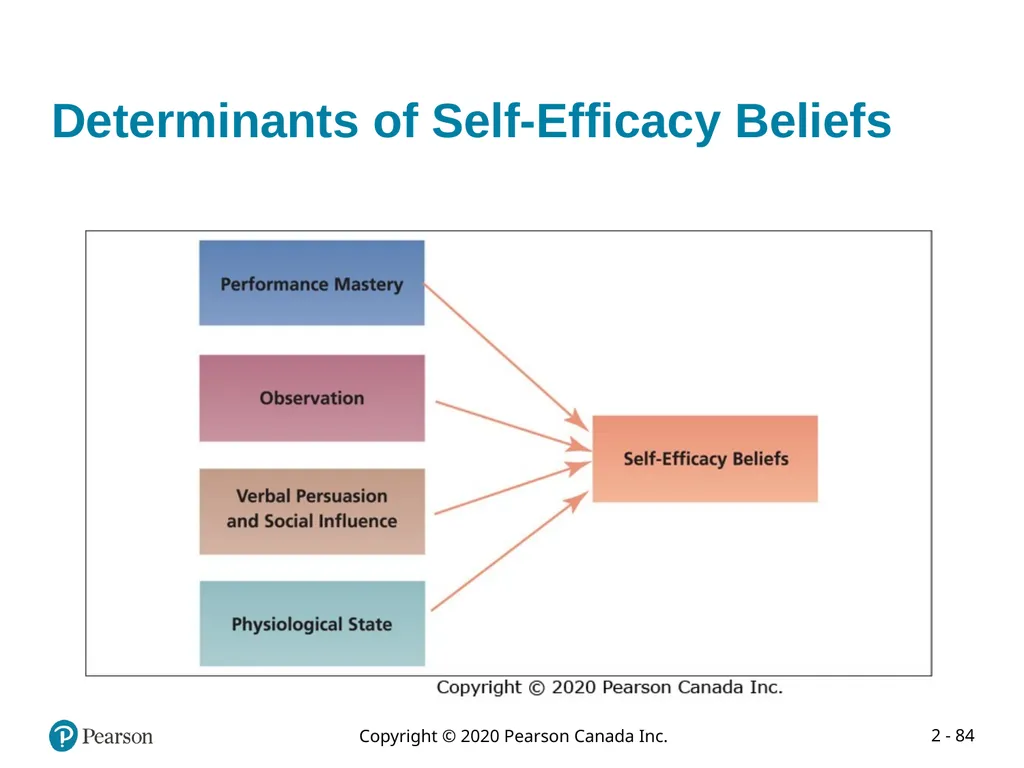
Self-Efficacy Beliefs (1 of 2) Beliefs people have about their ability to successfully perform a specific task.
It is a cognitive belief that can be changed and modified in response to different sources of information.
Self-efficacy is influenced by four sources of information.<br>
It is a cognitive belief that can be changed and modified in response to different sources of information.
Self-efficacy is influenced by four sources of information.<br>
84
Determinants of Self-Efficacy Beliefs<br>
85
Self-Efficacy Beliefs (2 of 2) Self-efficacy beliefs influence the activities people choose to perform, the amount of effort and persistence devoted to a task, affective and stress reactions, and job performance.<br>
86
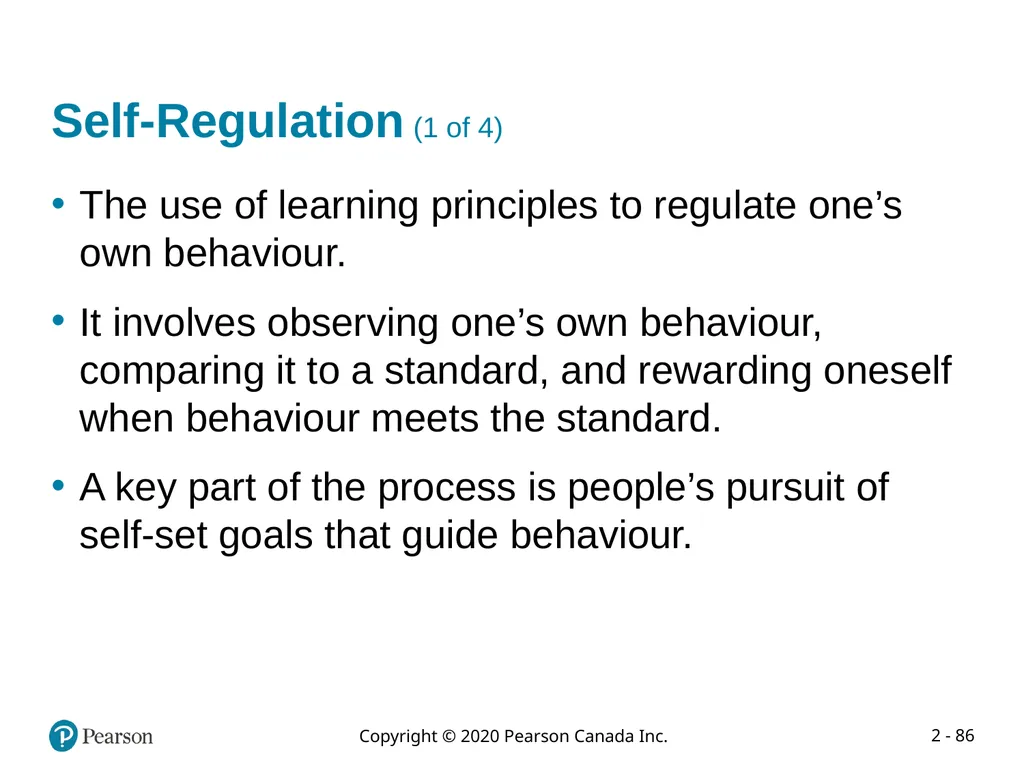
Self-Regulation (1 of 4) The use of learning principles to regulate one’s own behaviour.
It involves observing one’s own behaviour, comparing it to a standard, and rewarding oneself when behaviour meets the standard.
A key part of the process is people’s pursuit of self-set goals that guide behaviour.<br>
It involves observing one’s own behaviour, comparing it to a standard, and rewarding oneself when behaviour meets the standard.
A key part of the process is people’s pursuit of self-set goals that guide behaviour.<br>
87
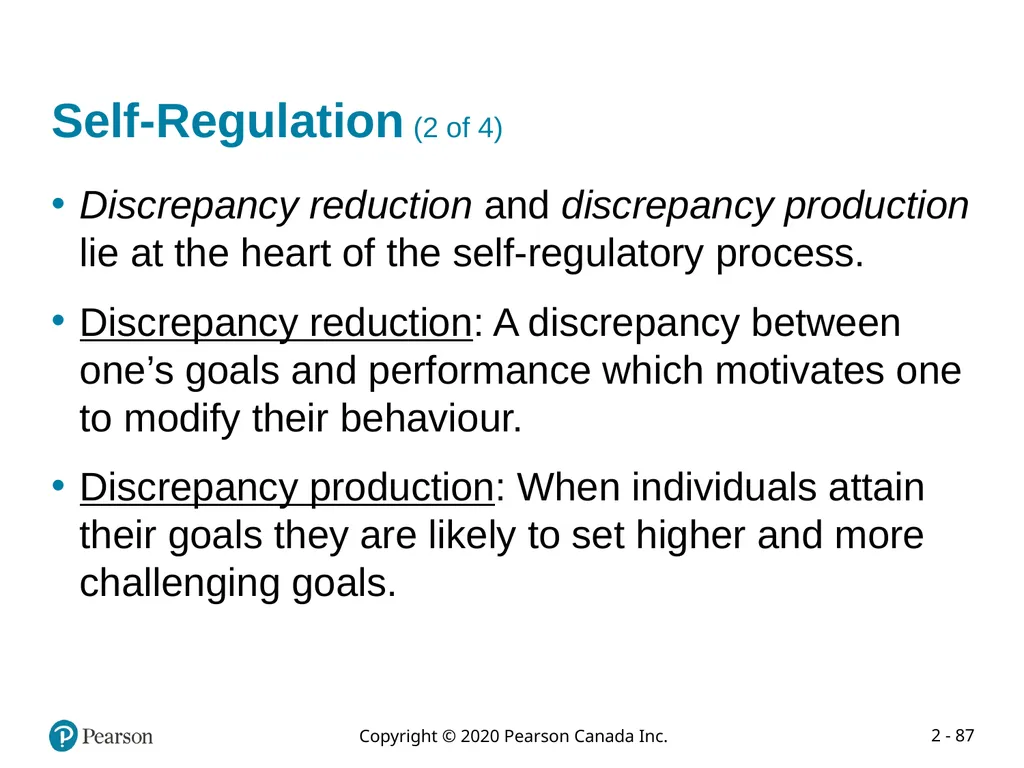
Self-Regulation (2 of 4) Discrepancy reduction and discrepancy production lie at the heart of the self-regulatory process.
Discrepancy reduction: A discrepancy between one’s goals and performance which motivates one to modify their behaviour.
Discrepancy production: When individuals attain their goals they are likely to set higher and more challenging goals.<br>
Discrepancy reduction: A discrepancy between one’s goals and performance which motivates one to modify their behaviour.
Discrepancy production: When individuals attain their goals they are likely to set higher and more challenging goals.<br>
88
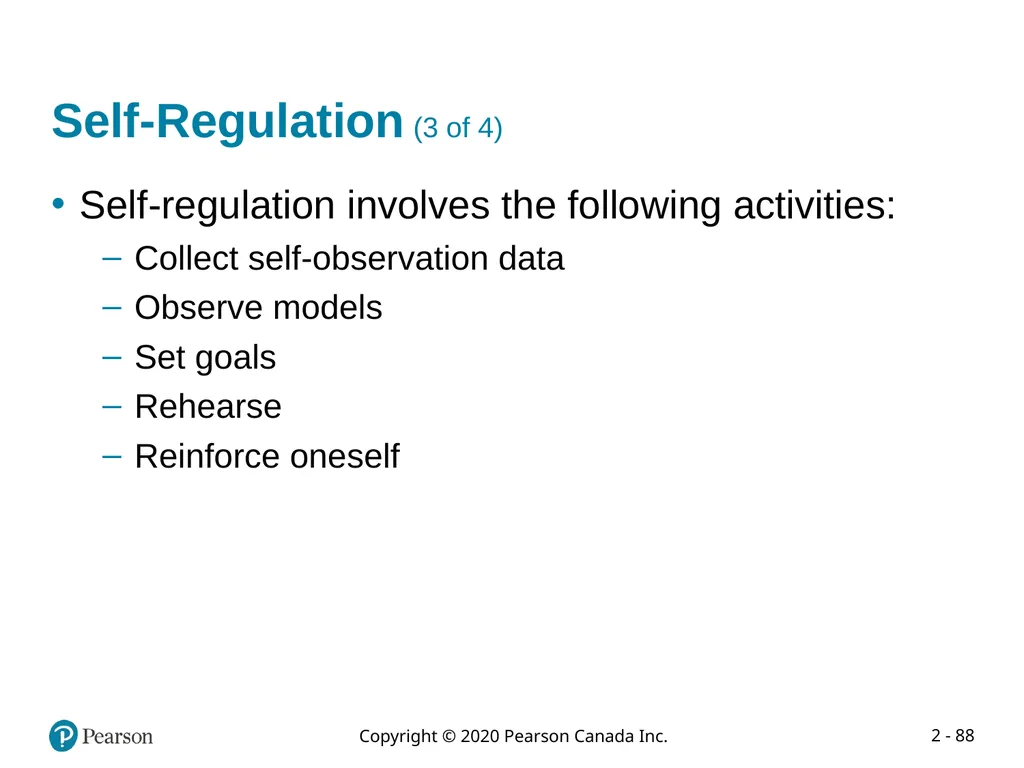
Self-Regulation (3 of 4) Self-regulation involves the following activities:
Collect self-observation data
Observe models
Set goals
Rehearse
Reinforce oneself<br>
Collect self-observation data
Observe models
Set goals
Rehearse
Reinforce oneself<br>
89
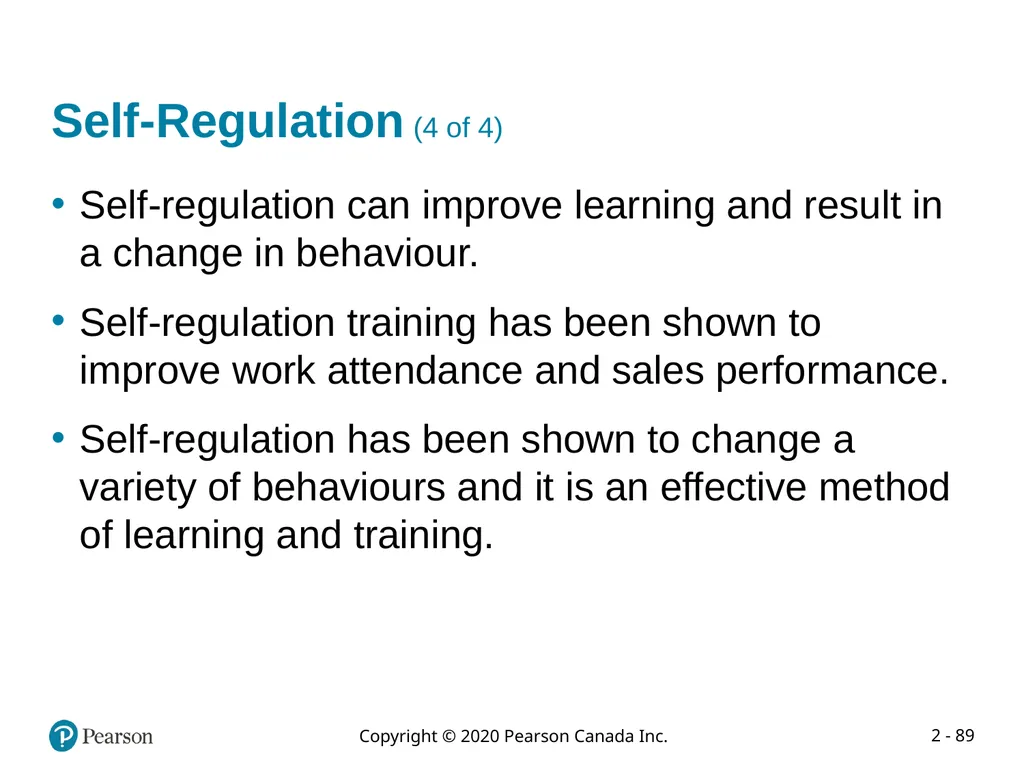
Self-Regulation (4 of 4) Self-regulation can improve learning and result in a change in behaviour.
Self-regulation training has been shown to improve work attendance and sales performance.
Self-regulation has been shown to change a variety of behaviours and it is an effective method of learning and training.<br>
Self-regulation training has been shown to improve work attendance and sales performance.
Self-regulation has been shown to change a variety of behaviours and it is an effective method of learning and training.<br>
90
Organizational Learning Practices Organizational learning practices include:
Organizational behaviour modification
Employee recognition programs
Training and development programs<br>
Organizational behaviour modification
Employee recognition programs
Training and development programs<br>
91
Organizational Behaviour Modification (O.B. Mod.) (1 of 2) The systematic use of learning principles to influence organizational behaviour.
Research supports the effectiveness of O.B. Mod.
O.B. Mod. has been shown to improve safe working behaviour, work attendance, and task performance.<br>
Research supports the effectiveness of O.B. Mod.
O.B. Mod. has been shown to improve safe working behaviour, work attendance, and task performance.<br>
92
Organizational Behaviour Modification (O.B. Mod.) (2 of 2) The effects on task performance are stronger in manufacturing than in service organizations.
Money, feedback, and social recognition have been used as effective forms of positive reinforcement.
Money has stronger effects, however, the use of all three together has the strongest effect on task performance.<br>
Money, feedback, and social recognition have been used as effective forms of positive reinforcement.
Money has stronger effects, however, the use of all three together has the strongest effect on task performance.<br>
93
Employee Recognition Programs (1 of 3) Formal organizational programs that publicly recognize and reward employees for specific behaviours.
Many companies in Canada have some form of employee recognition program.
Many recognition programs are not effective.<br>
Many companies in Canada have some form of employee recognition program.
Many recognition programs are not effective.<br>
94
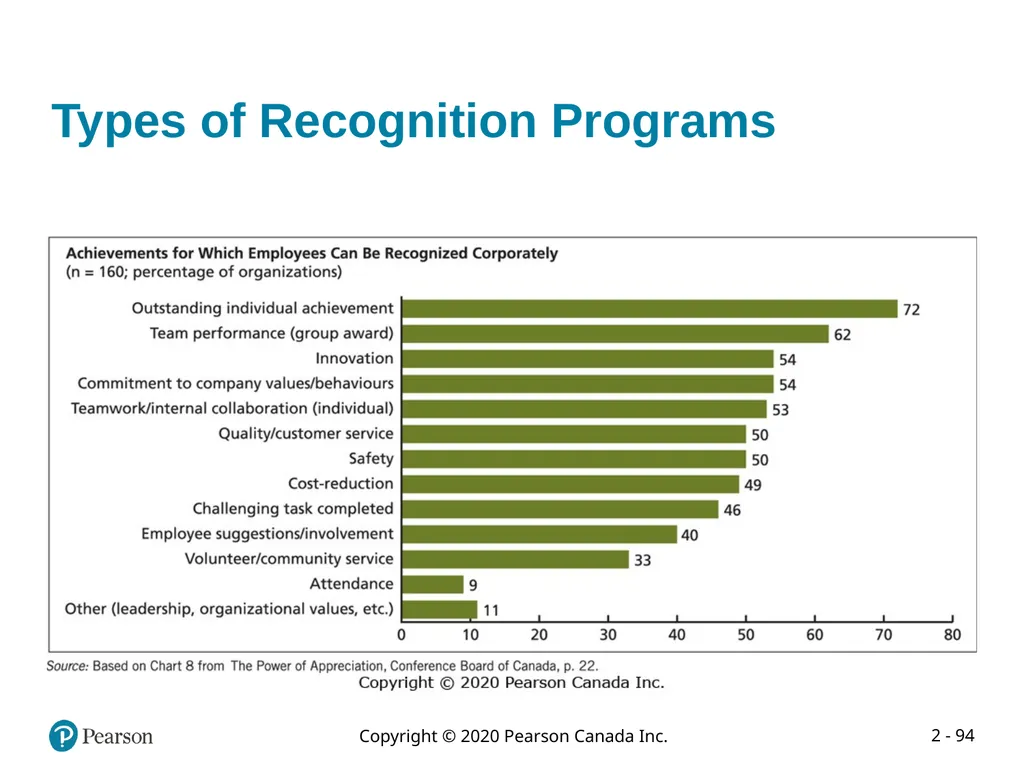
Types of Recognition Programs<br>
95
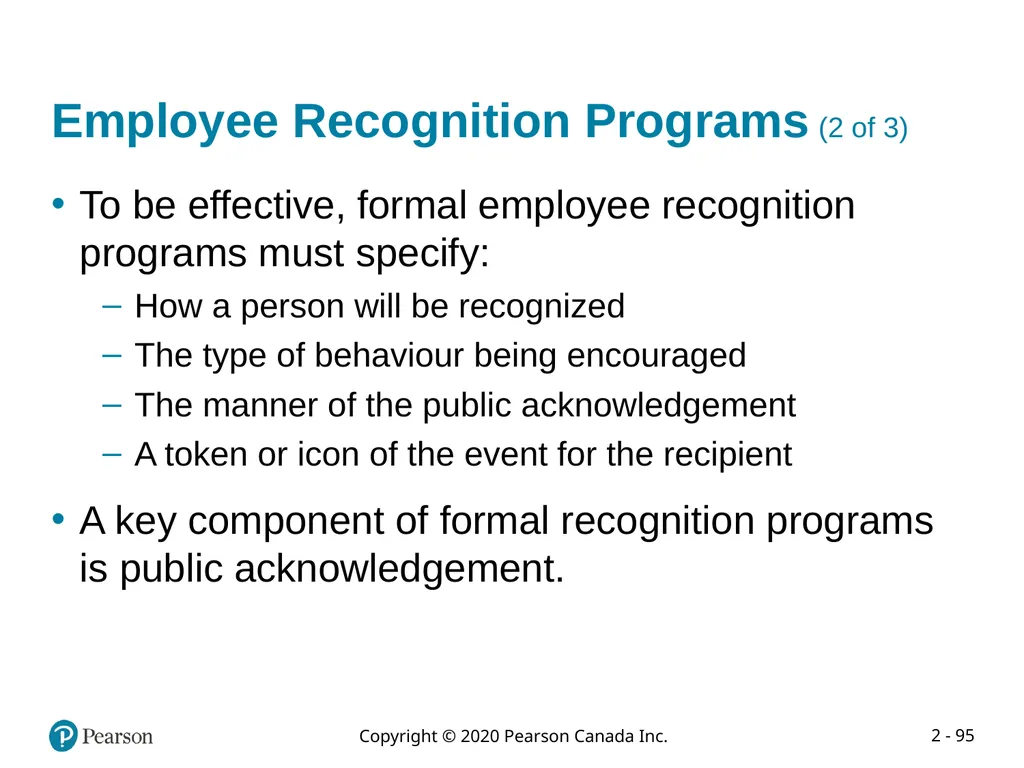
Employee Recognition Programs (2 of 3) To be effective, formal employee recognition programs must specify:
How a person will be recognized
The type of behaviour being encouraged
The manner of the public acknowledgement
A token or icon of the event for the recipient
A key component of formal recognition programs is public acknowledgement.<br>
How a person will be recognized
The type of behaviour being encouraged
The manner of the public acknowledgement
A token or icon of the event for the recipient
A key component of formal recognition programs is public acknowledgement.<br>
96
Peer Recognition Programs Formal programs in which employees publicly acknowledge, recognize, and reward their co-workers for exceptional work and performance.
Many organizations have begun to use social recognition platforms for peer recognition.<br>
Many organizations have begun to use social recognition platforms for peer recognition.<br>
97
Employee Recognition Programs (3 of 3) Employee recognition programs have been found to result in individual and organizational outcomes:
Job satisfaction
Performance and productivity
Lower absenteeism and turnover<br>
Job satisfaction
Performance and productivity
Lower absenteeism and turnover<br>
98
Training and Development Programs
(1 of 2) Training refers to planned organizational activities that are designed to facilitate knowledge and skill acquisition to change behaviour and improve performance on one’s current job.
Development focuses on future job responsibilities.<br>
Development focuses on future job responsibilities.<br>
99
Training and Development Programs
(2 of 2) Effective training and development programs include many principles of learning such as:
Positive reinforcement
Feedback
Observational learning
Self-efficacy beliefs
Self-regulation<br>
Positive reinforcement
Feedback
Observational learning
Self-efficacy beliefs
Self-regulation<br>
100
Behaviour Modelling Training (BMT)
(1 of 2) One of the most widely used and effective methods of training which is based on the observational learning component of social cognitive theory.
Trainees observe a model performing a task followed by opportunities to practice the observed behaviours.
It involves five steps based on observational learning.<br>
Trainees observe a model performing a task followed by opportunities to practice the observed behaviours.
It involves five steps based on observational learning.<br>
101
Describe to trainees a set of well-defined behaviours (skills) to be learned.
Provide a model or models displaying the effective use of those behaviours.
Provide opportunities for trainees to practice using those behaviours.
Provide feedback and social reinforcement to trainees following practice.
Take steps to maximize the transfer of those behaviours to the job. Steps in Behaviour Modelling Training (BMT)<br>
Provide a model or models displaying the effective use of those behaviours.
Provide opportunities for trainees to practice using those behaviours.
Provide feedback and social reinforcement to trainees following practice.
Take steps to maximize the transfer of those behaviours to the job. Steps in Behaviour Modelling Training (BMT)<br>
102
BMT has been used to develop many different types of skills (e.g., interpersonal, sales).
BMT has a positive effect on learning, skills, and job behaviour.
The effects on behaviour are greatest when trainees are instructed to set goals and when rewards and sanctions are used in the trainees’ work environment. Behaviour Modelling Training (BMT) (2 of 2)<br>
BMT has a positive effect on learning, skills, and job behaviour.
The effects on behaviour are greatest when trainees are instructed to set goals and when rewards and sanctions are used in the trainees’ work environment. Behaviour Modelling Training (BMT) (2 of 2)<br>