Reasonable Accommodations New Employee Orientation Briefing Reasonable Accommodation Officer: Jennifer Burke EMAIL: Jennifer.Burkesss.gov Purpose: To provide Selective Service managers and staff with a general understanding of the agencys
"Reasonable Accommodations New Employee Orientation" is the property of its rightful owner. Permission is granted to
download and print the materials on this website for personal, non-commercial use only, and to display it
on your personal computer provided you do not modify the materials and that you retain all copyright
notices contained in the materials. By downloading content from our website, you accept the terms of this
agreement.
Presentation Transcript
01
Reasonable Accommodations New Employee Orientation Briefing Reasonable Accommodation Officer:
Jennifer Burke
EMAIL: Jennifer.Burke@sss.gov<br>
02
Purpose: To provide Selective Service managers and staff with a general understanding of the agency’s reasonable accommodations (RA) procedures and process.<br>
03
Objectives: Define reasonable accommodation (RA)
Identify the agency’s responsibilities relating to RA requests
Identify the employee’s responsibilities relating to RA requests
Highlight the RA request process
Provide additional resources for Selective Service
team members<br>
04
What is a Reasonable Accommodation? Accommodation of a known mental or physical limitation of an individual with a disability who is otherwise qualified to do a job, unless to do so would cause an undue hardship.<br>
05
So what is a disability? An “individual with a disability” is someone who:
Has a physical or mental impairment that “substantially limits” one or more of that individual’s “major life activities”
Has a record of such impairment; or
Is “regarded as” having an impairment<br>
06
How do I know what is considered a “Major Life Activity (MLA)?” As defined by the ADA Amendments Act, an MLA is a basic activity that most people in the general healthy population can perform with little or no difficulty, such as:
Activities like caring for oneself, performing manual tasks, walking, seeing, hearing, speaking, breathing, sitting, standing, lifting, reaching, bending, reading, learning, thinking, interacting with other people, communicating, concentrating, eating, sleeping, walking, or
Major bodily functions, e.g., functions of the immune system, normal cell growth, digestive, bowel, bladder, neurological, brain, respiratory, circulatory, endocrine, and reproductive functions<br>
07
Selective Service is required to: Provide all employees and applicants with a process that allows for a reasonable accommodation request
Adhere to the local, state, and federal laws relating to disabilities and reasonable accommodations
Keep all information relating to reasonable accommodations secure, confidential, and separate from the employee’s personnel file<br>
08
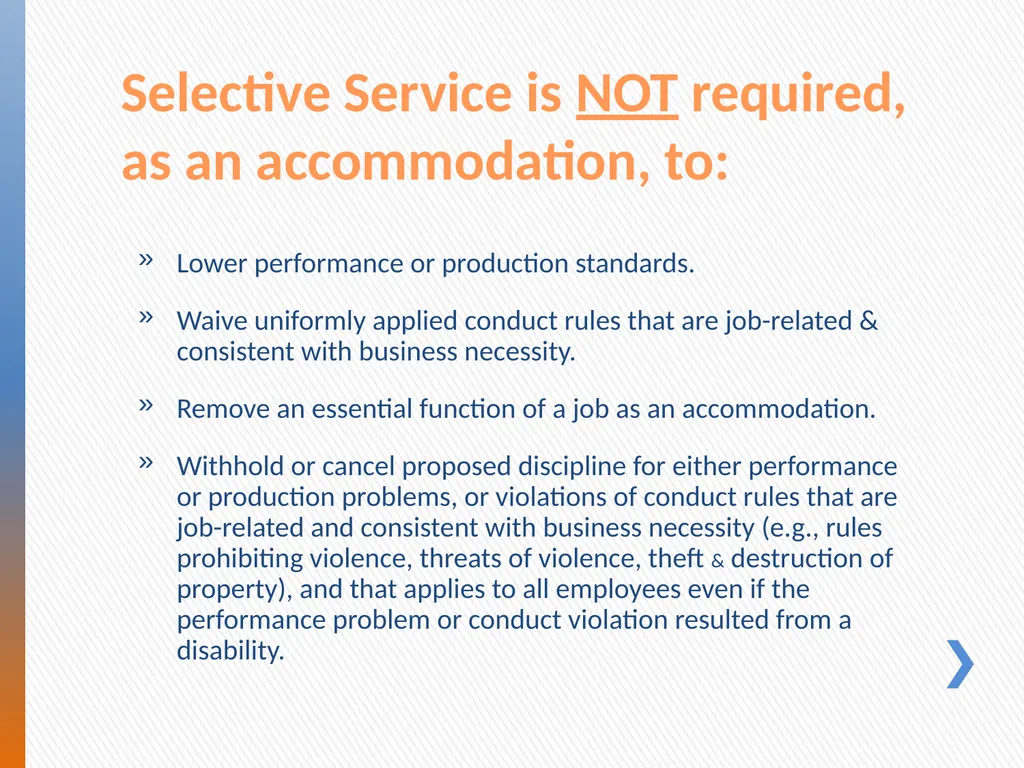
Selective Service is NOT required, as an accommodation, to: Lower performance or production standards.
Waive uniformly applied conduct rules that are job-related & consistent with business necessity.
Remove an essential function of a job as an accommodation.
Withhold or cancel proposed discipline for either performance or production problems, or violations of conduct rules that are job-related and consistent with business necessity (e.g., rules prohibiting violence, threats of violence, theft & destruction of property), and that applies to all employees even if the performance problem or conduct violation resulted from a disability.<br>
09
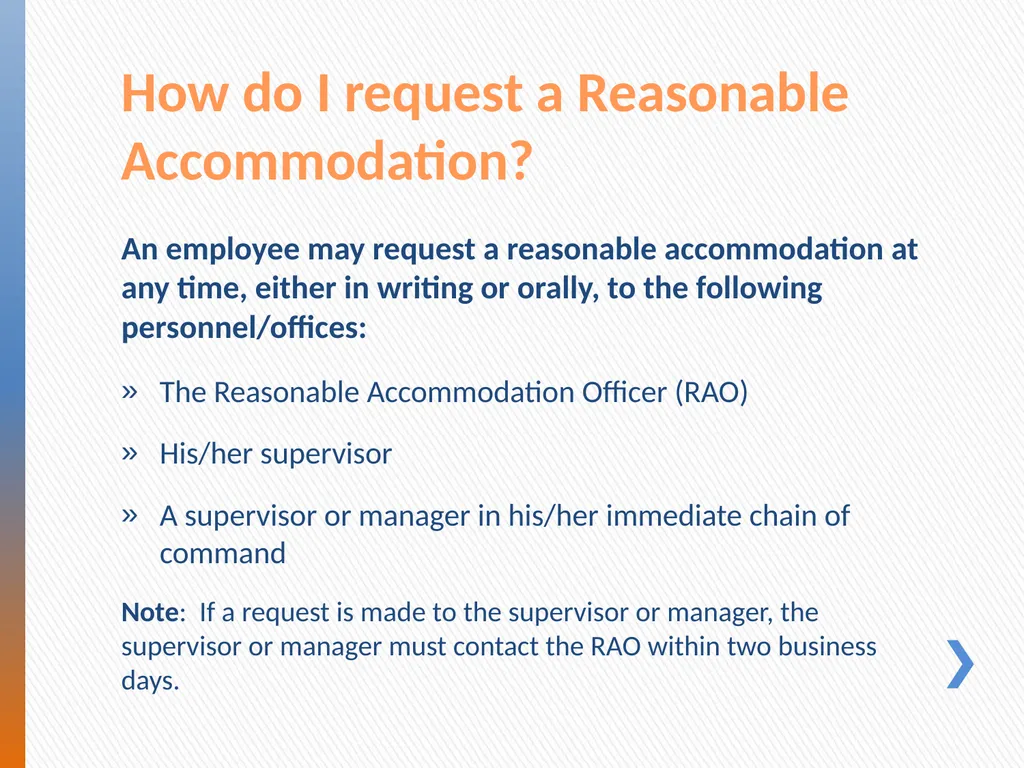
How do I request a Reasonable Accommodation? An employee may request a reasonable accommodation at any time, either in writing or orally, to the following personnel/offices:
The Reasonable Accommodation Officer (RAO)
His/her supervisor
A supervisor or manager in his/her immediate chain of command
Note: If a request is made to the supervisor or manager, the supervisor or manager must contact the RAO within two business days.<br>
10
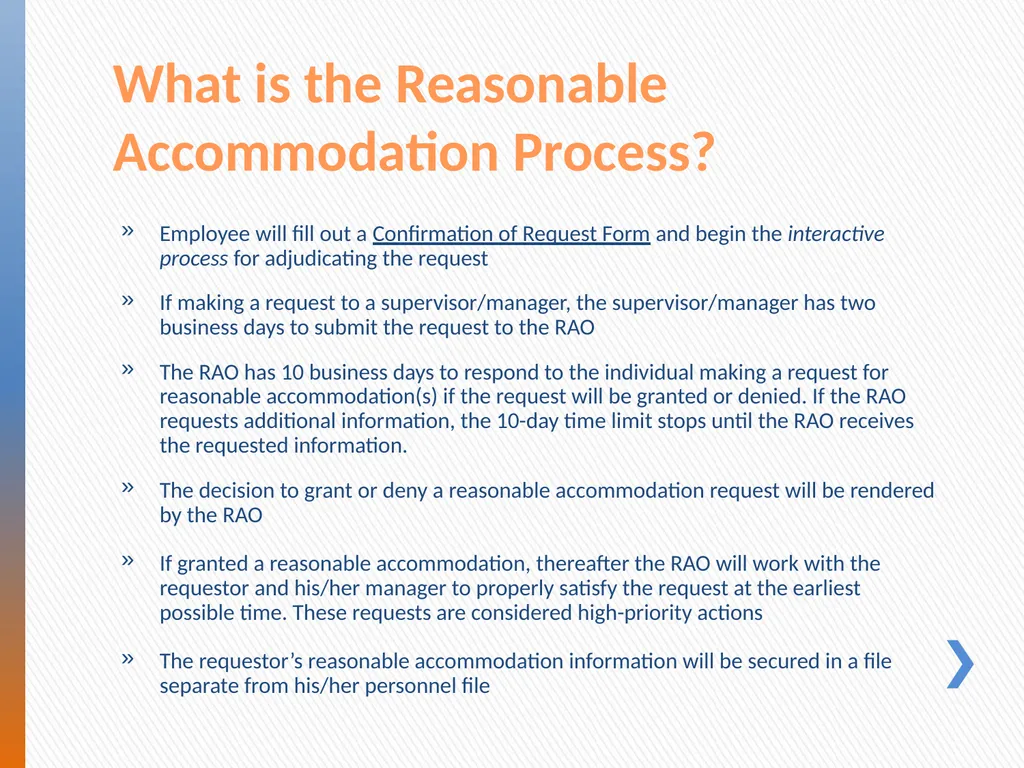
What is the Reasonable Accommodation Process? Employee will fill out a Confirmation of Request Form and begin the interactive process for adjudicating the request
If making a request to a supervisor/manager, the supervisor/manager has two business days to submit the request to the RAO
The RAO has 10 business days to respond to the individual making a request for reasonable accommodation(s) if the request will be granted or denied. If the RAO requests additional information, the 10-day time limit stops until the RAO receives the requested information.
The decision to grant or deny a reasonable accommodation request will be rendered by the RAO
If granted a reasonable accommodation, thereafter the RAO will work with the requestor and his/her manager to properly satisfy the request at the earliest possible time. These requests are considered high-priority actions
The requestor’s reasonable accommodation information will be secured in a file separate from his/her personnel file<br>
11
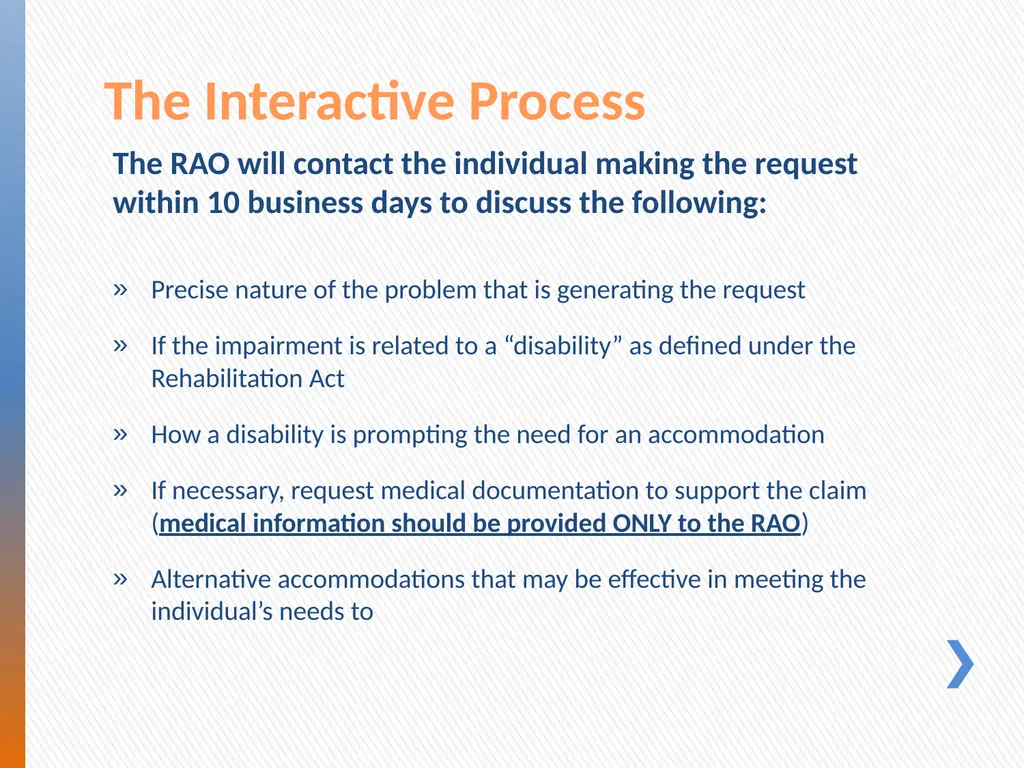
The Interactive Process The RAO will contact the individual making the request within 10 business days to discuss the following:
Precise nature of the problem that is generating the request
If the impairment is related to a “disability” as defined under the Rehabilitation Act
How a disability is prompting the need for an accommodation
If necessary, request medical documentation to support the claim (medical information should be provided ONLY to the RAO)
Alternative accommodations that may be effective in meeting the individual’s needs to<br>
12
Contact Information Jennifer Burke
Reasonable Accommodation Officer
National Headquarters, Selective Service System
Arlington, VA 22209
Jennifer.Burke@sss.gov
Betty Lou Wingo
EEO Counselor / Alternate RA Intake Official
National Headquarters, Selective Service System
Arlington, VA 22209
(703) 605-4005 (Office)
(703) 605-4006 (Fax)
BettyLou.Wingo@sss.gov
Jorene (Irish) Massey
EEO Director
National Headquarters, Selective Service System
Arlington, VA 22209
(703) 605-4079 (Office)
(703) 605-4136 (Fax)
Jorene.Massey@sss.gov<br>