Strength abilites The ability to move, maintain, or inhibit resistance by muscle contraction in a dynamic or static mode of muscle activity. Strenght abilites Statics Dynamics Single Endurance Explosive str. Speed str Endurance str.
"Strength abilites The ability to move, maintain," is the property of its rightful owner. Permission is granted to
download and print the materials on this website for personal, non-commercial use only, and to display it
on your personal computer provided you do not modify the materials and that you retain all copyright
notices contained in the materials. By downloading content from our website, you accept the terms of this
agreement.
Presentation Transcript
01
Strength abilites The ability to move, maintain, or inhibit resistance by muscle contraction in a dynamic or static mode of muscle activity.<br>
02
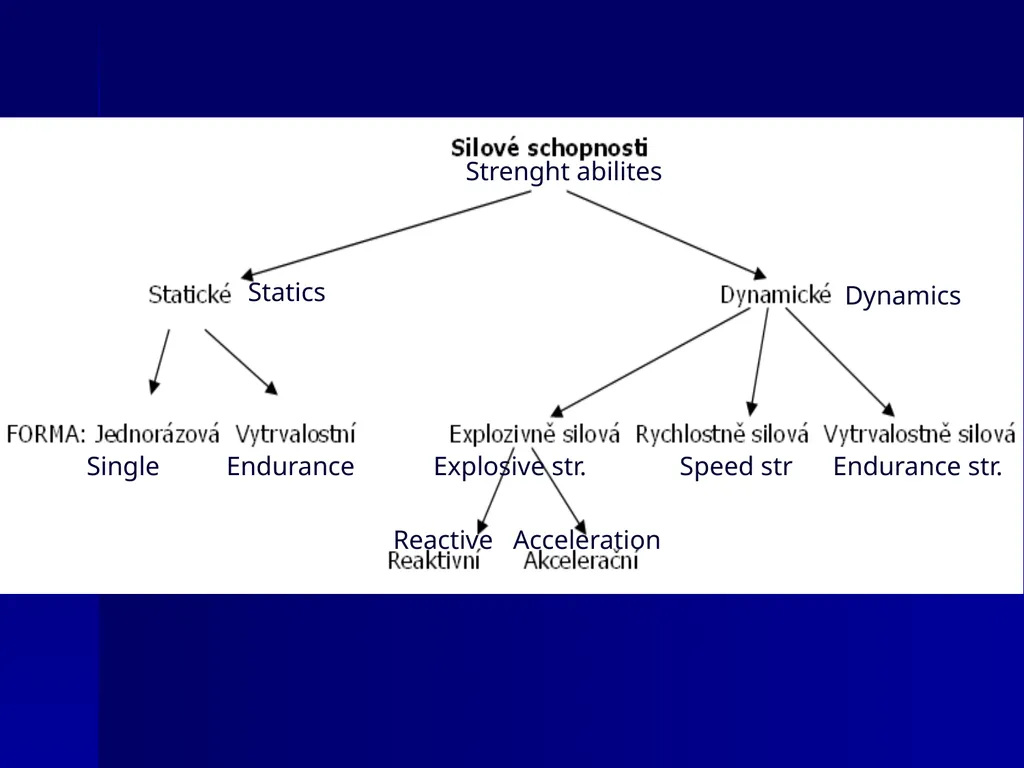
Strenght abilites Statics Dynamics Single Endurance Explosive str. Speed str Endurance str. Reactive Acceleration<br>
03
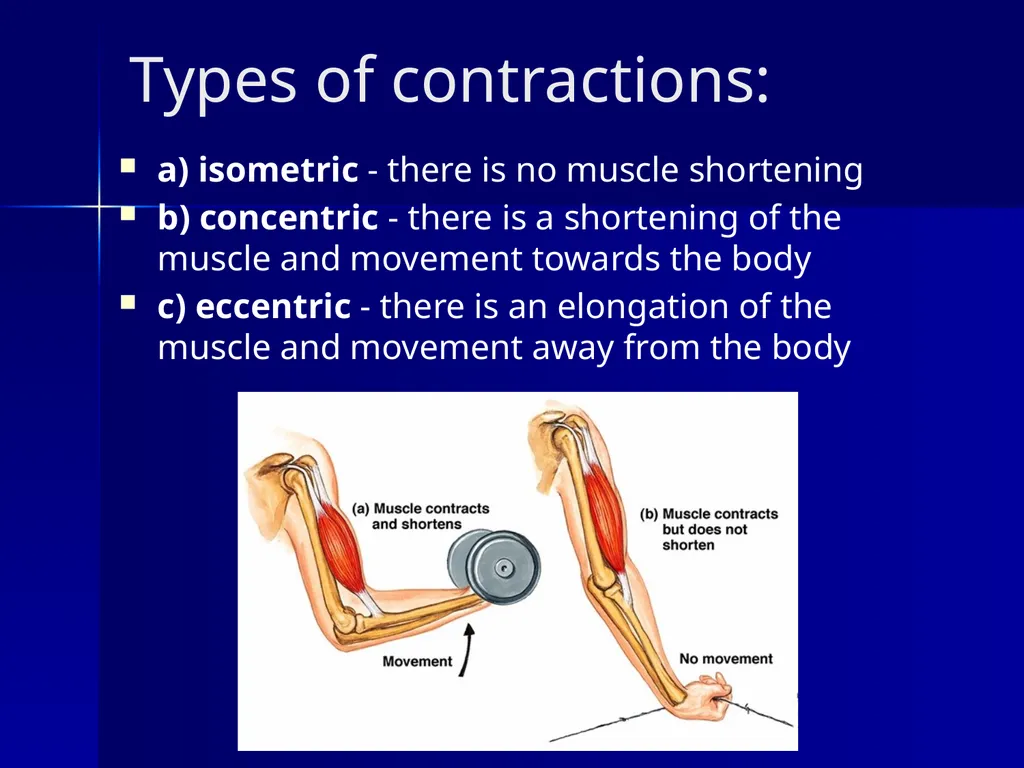
Types of contractions: a) isometric - there is no muscle shortening
b) concentric - there is a shortening of the muscle and movement towards the body
c) eccentric - there is an elongation of the muscle and movement away from the body<br>
04
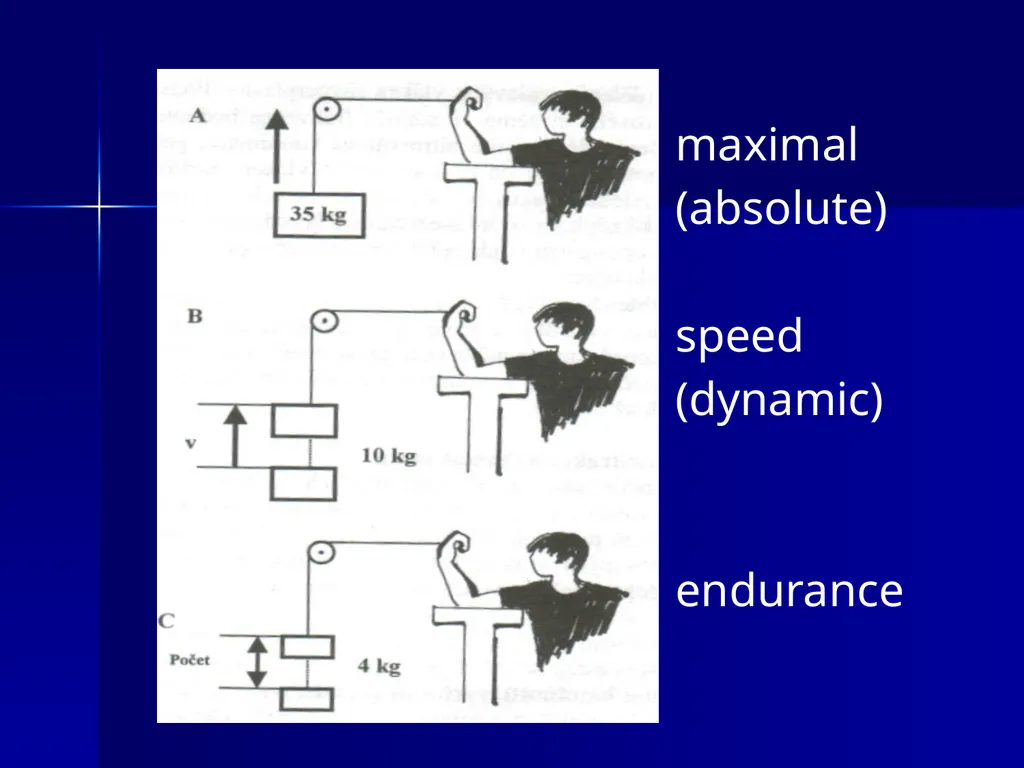
maximal
(absolute)
speed
(dynamic)
endurance<br>
05
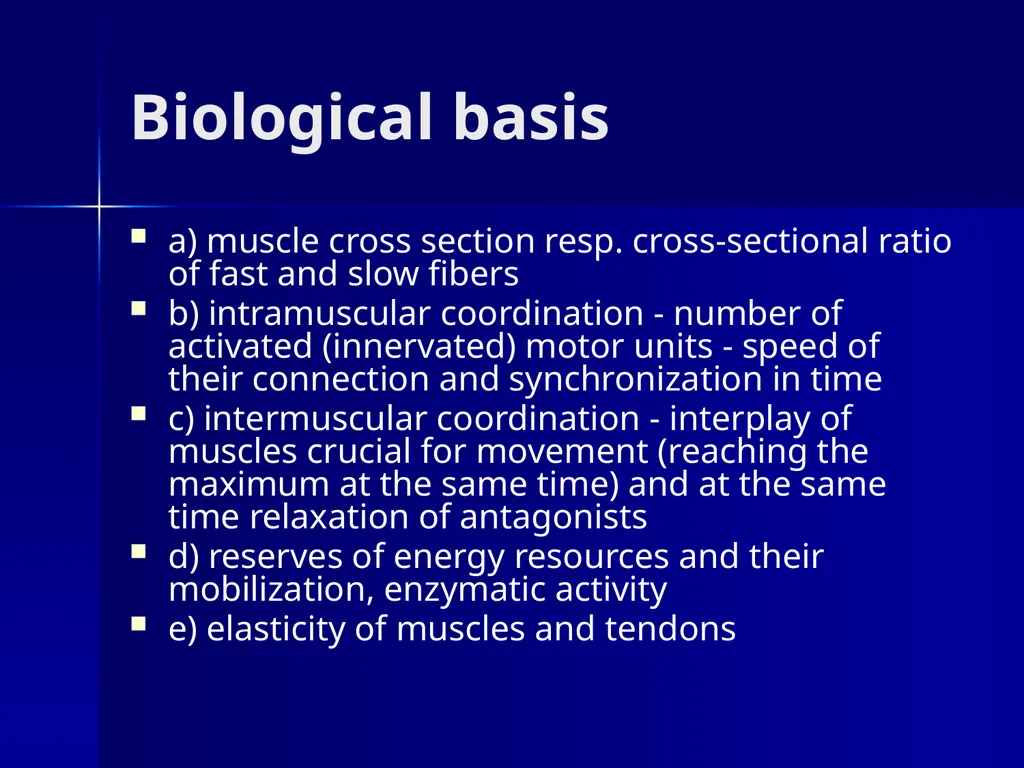
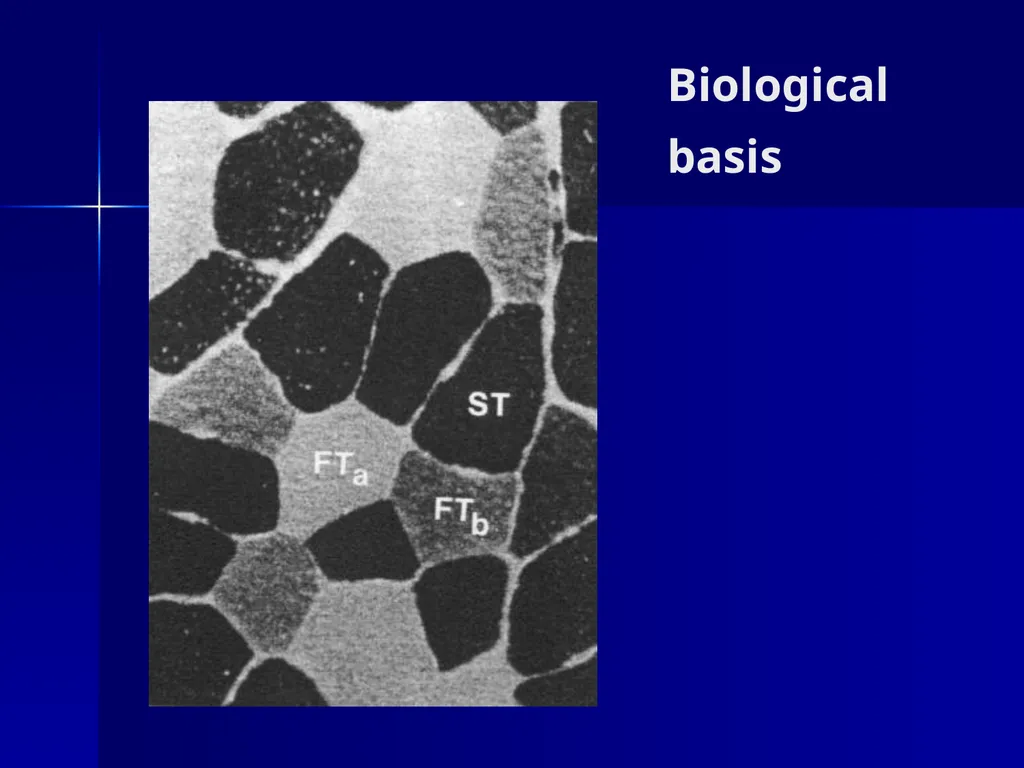
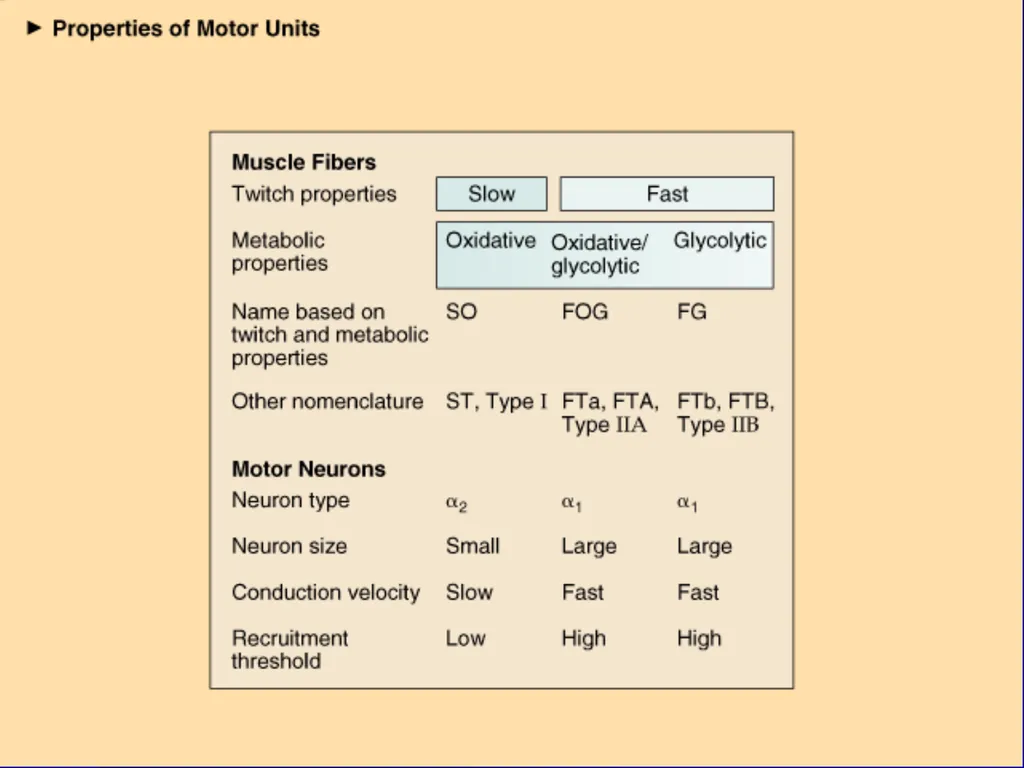
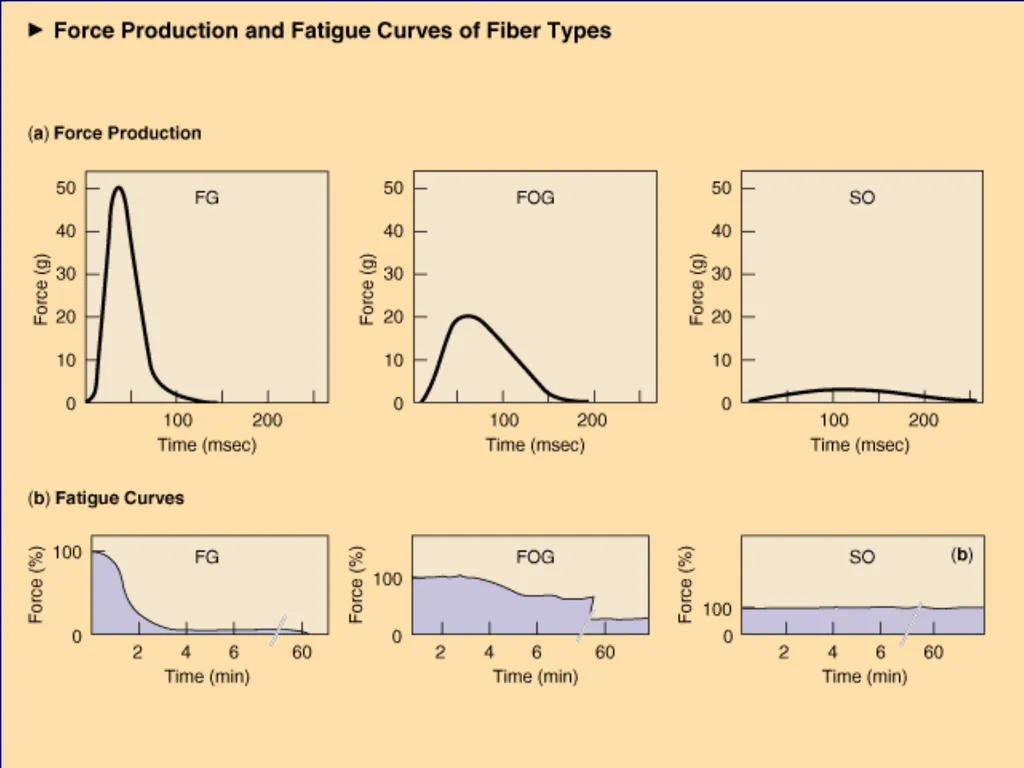
Biological basis a) muscle cross section resp. cross-sectional ratio of fast and slow fibers
b) intramuscular coordination - number of activated (innervated) motor units - speed of their connection and synchronization in time
c) intermuscular coordination - interplay of muscles crucial for movement (reaching the maximum at the same time) and at the same time relaxation of antagonists
d) reserves of energy resources and their mobilization, enzymatic activity
e) elasticity of muscles and tendons<br>
06
Biological basis<br>
07
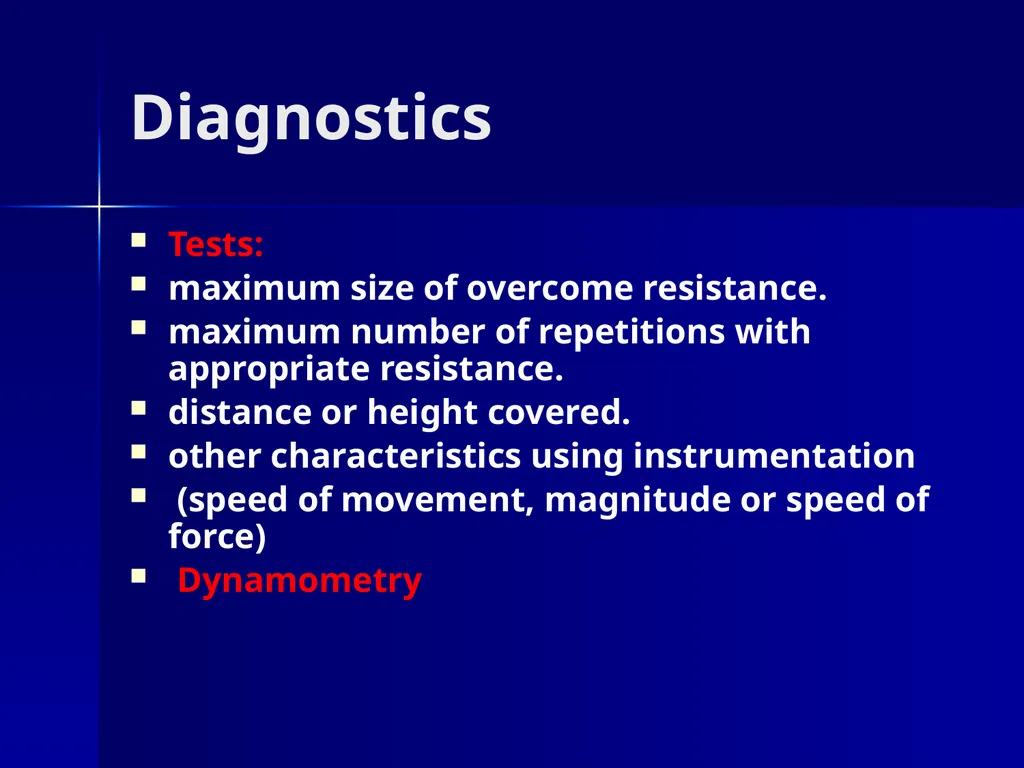
Diagnostics Tests:
maximum size of overcome resistance.
maximum number of repetitions with appropriate resistance.
distance or height covered.
other characteristics using instrumentation
(speed of movement, magnitude or speed of force)
Dynamometry<br>
08
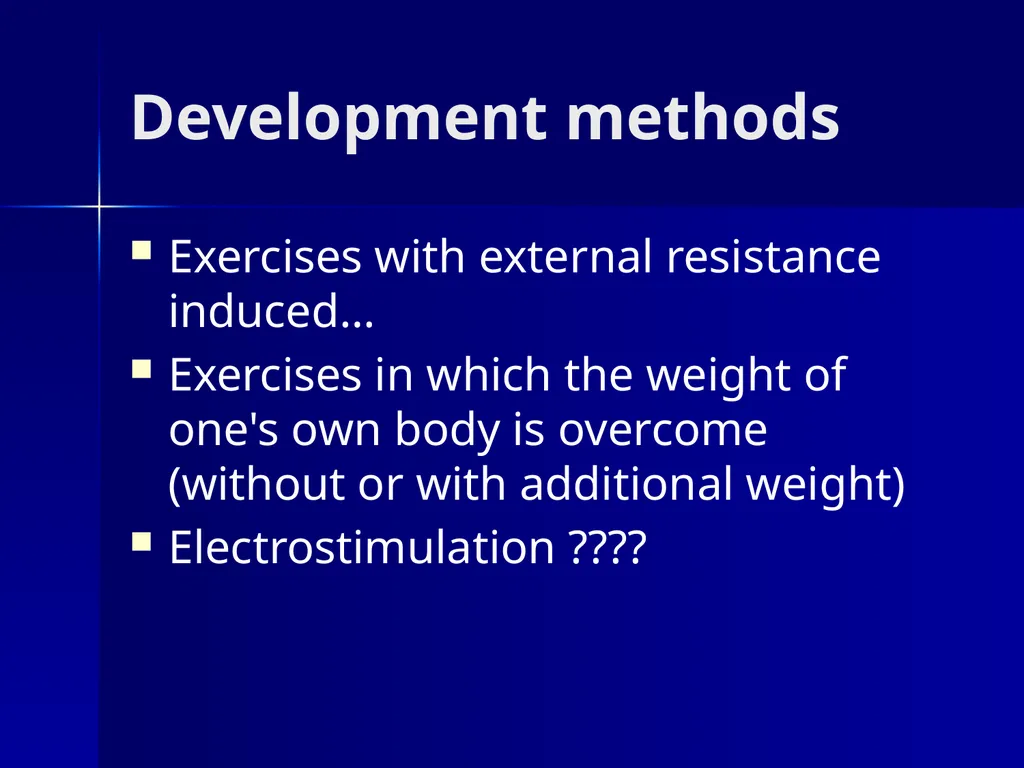
Development methods Exercises with external resistance induced…
Exercises in which the weight of one's own body is overcome (without or with additional weight)
Electrostimulation ????<br>
09
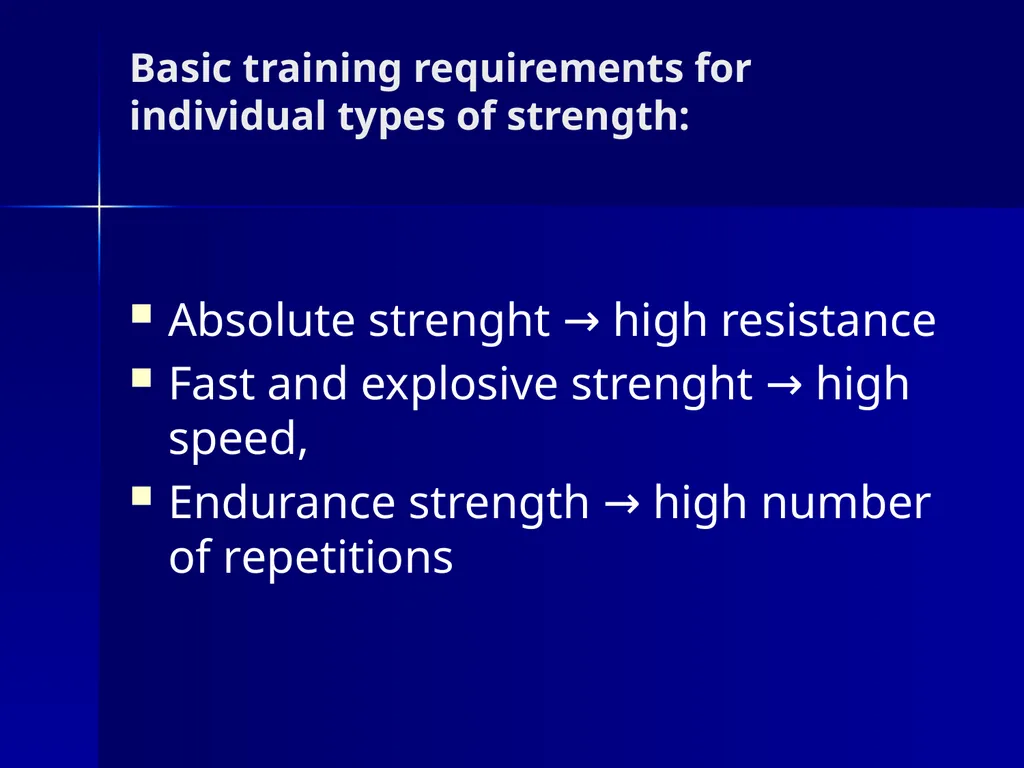
Basic training requirements for individual types of strength: Absolute strenght → high resistance
Fast and explosive strenght → high speed,
Endurance strength → high number of repetitions<br>
10
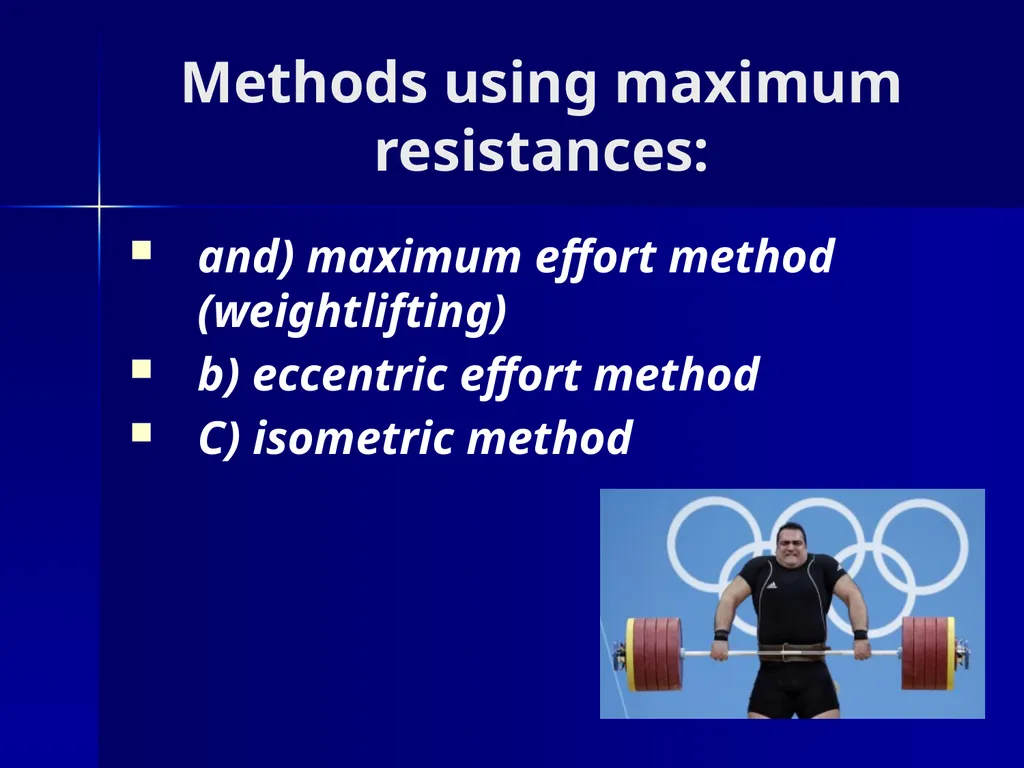
Methods using maximum resistances: and) maximum effort method (weightlifting)
b) eccentric effort method
C) isometric method<br>
11
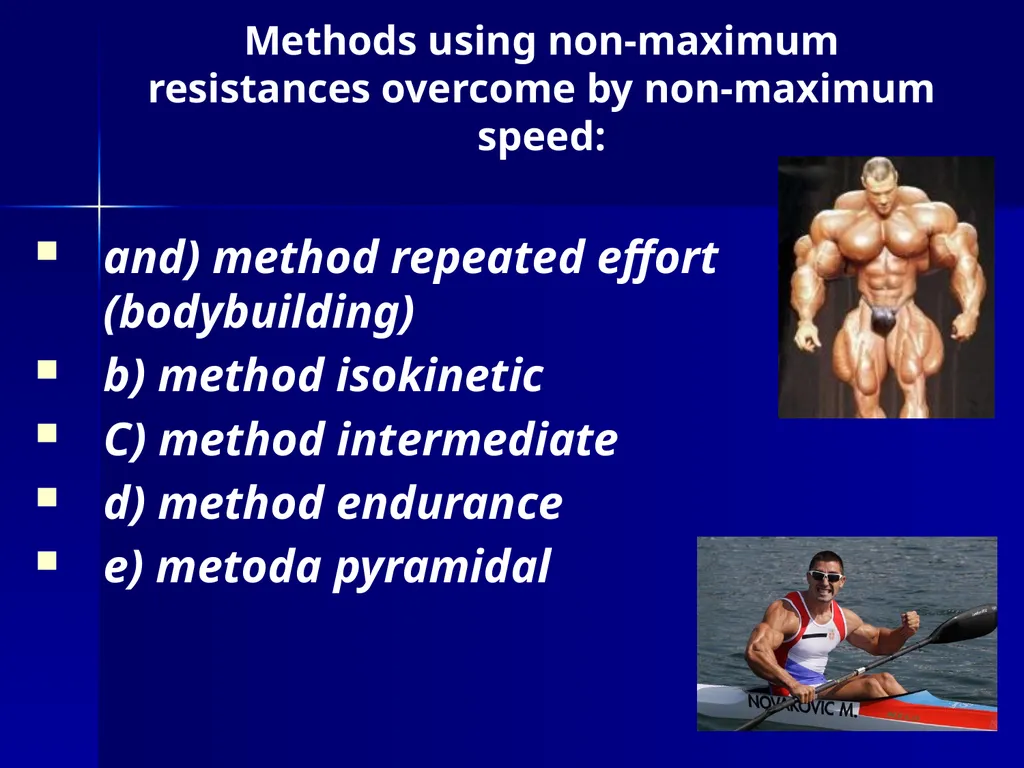
Methods using non-maximum resistances overcome by non-maximum speed: and) method repeated effort (bodybuilding)
b) method isokinetic
C) method intermediate
d) method endurance
e) metoda pyramidal<br>
12
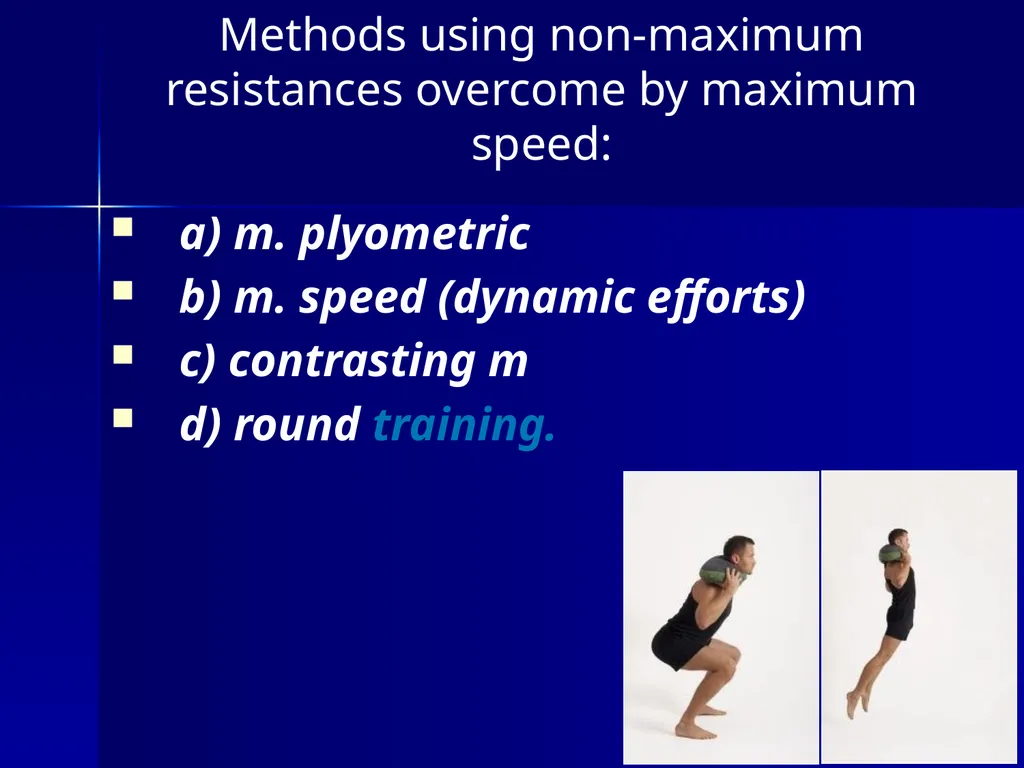
Methods using non-maximum resistances overcome by maximum speed: a) m. plyometric
b) m. speed (dynamic efforts)
c) contrasting m
d) round training.<br>
13
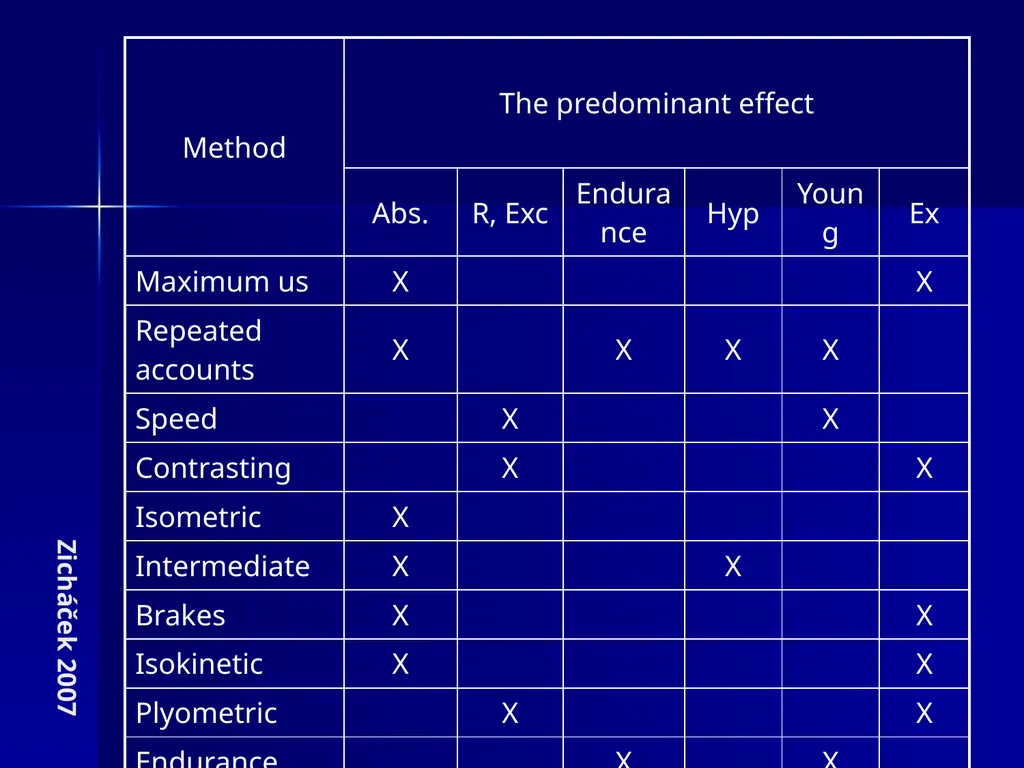
Zicháček 2007<br>
14
Sensitive period Absolute power B 13-14, 16-17, G 10-12, 16-17
Static power B 14-17, G 9-12
Speed power forms B 7-9, G 7-11, 13-14
Boys/Girls
Muscle strength weakens slowly, disappears after 6-10 weeks.
(Guželovskij 1977)<br>
15
Methodological factors Activity intensity (eg maximum)
Load duration (eg up to 10 - 15 s)
Number of repetitions in one series (eg 10 - 15)
Length of recovery intervals in series (eg 30-120 s)
Number of series (eg 3)
Duration of recovery intervals between series (eg 1-3 min, slightly extended after each series)
Nature of activity in recovery intervals (eg passive)<br>
16
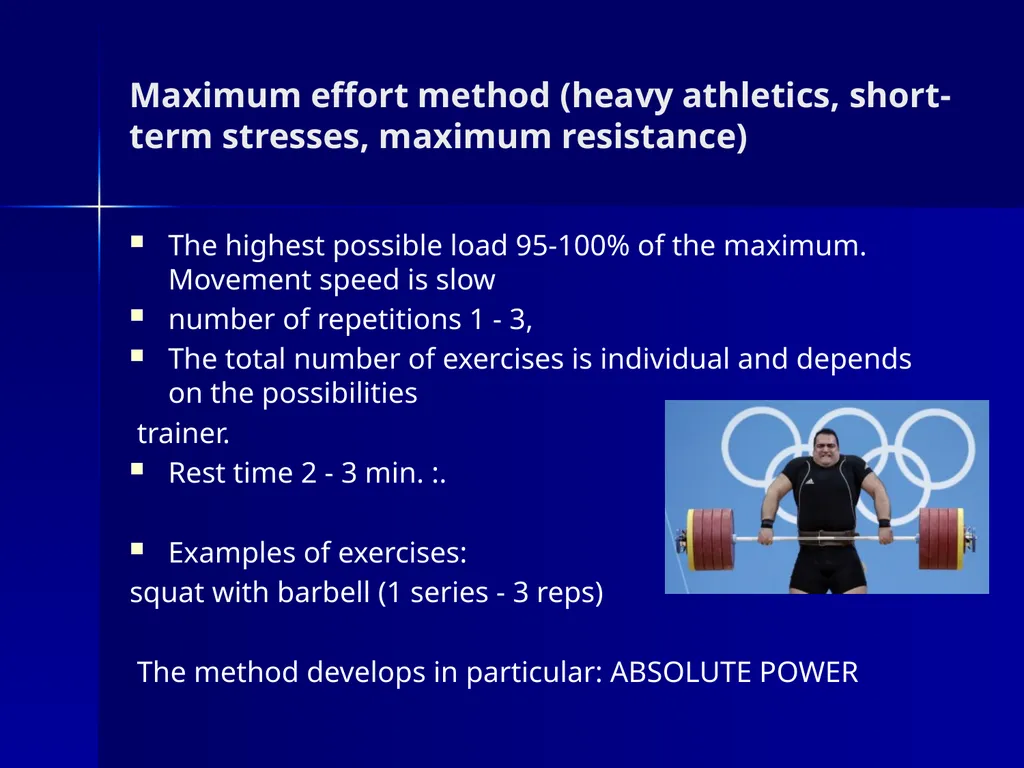
Maximum effort method (heavy athletics, short-term stresses, maximum resistance) The highest possible load 95-100% of the maximum. Movement speed is slow
number of repetitions 1 - 3,
The total number of exercises is individual and depends on the possibilities
trainer.
Rest time 2 - 3 min. :.
Examples of exercises:
squat with barbell (1 series - 3 reps)
The method develops in particular: ABSOLUTE POWER<br>
17
Braking method (eccentric): The load is lowered or braked, the applied force acts with a slow pressure or pull against the resistance.
Overmaximum resistances - 120 - 150% of absolute muscle strength for a given movement.
The number of repetitions is 3-5 times.
Example:
Lowering the discs on the exercise machine „leg press“Out of stretch legs bent. Assistance is provided by a pulley orfellow practitioners. Resistance 120% maximum, 4 series, 3 repetitions.
The method develops above all ABSOLUTE FORCE
.<br>
18
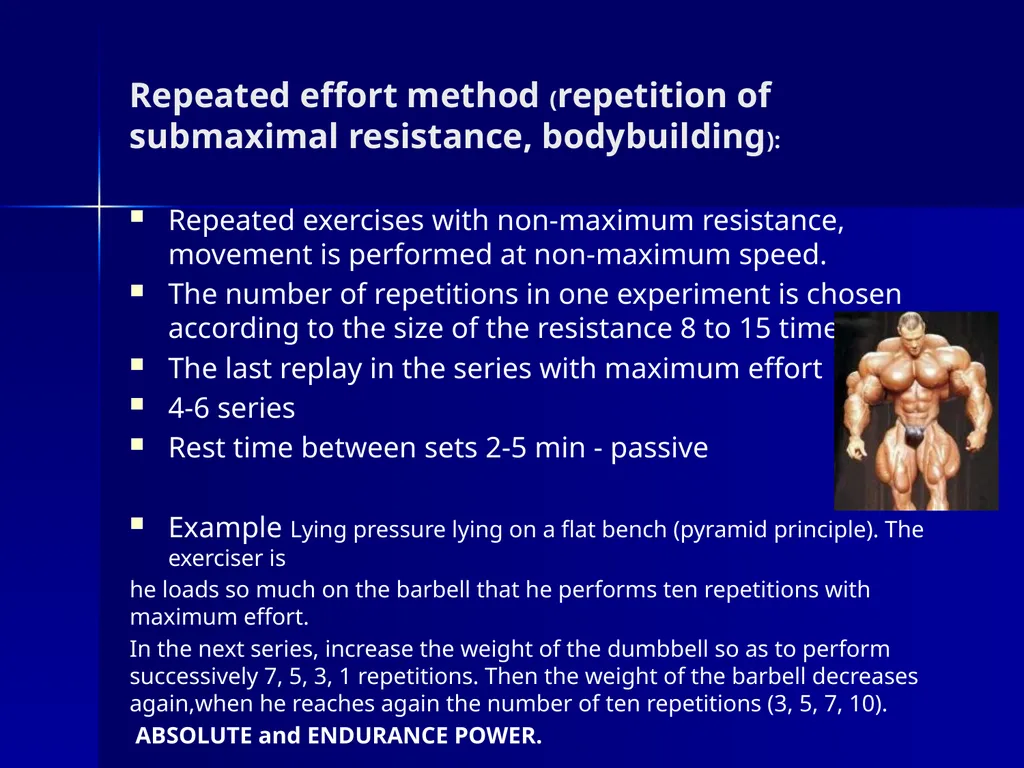
Repeated effort method (repetition of submaximal resistance, bodybuilding): Repeated exercises with non-maximum resistance, movement is performed at non-maximum speed.
The number of repetitions in one experiment is chosen according to the size of the resistance 8 to 15 times
The last replay in the series with maximum effort
4-6 series
Rest time between sets 2-5 min - passive
Example Lying pressure lying on a flat bench (pyramid principle). The exerciser is
he loads so much on the barbell that he performs ten repetitions with maximum effort.
In the next series, increase the weight of the dumbbell so as to perform successively 7, 5, 3, 1 repetitions. Then the weight of the barbell decreases again,when he reaches again the number of ten repetitions (3, 5, 7, 10).
ABSOLUTE and ENDURANCE POWER.<br>
19
Method plyometric (reactive, shock): The principle is toning = "prestressing" the muscle, preceding the active one
movement. This can be achieved by dropping the body from a certain height. In the depreciation phase, braking contraction is applied,
Under this condition, subsequent active work (isokinetic contraction) can proceed much faster than under other conditions where preliminary toning is lacking.
The magnitude of the resistance is determined by the weight of the load and the height of the fall, the ratio must be tested. The height of fall is preferred to the higher weight of loads. The depreciation path during exercise should be as short as possible.
Dosage: 2-4 series, repetition 5-10.
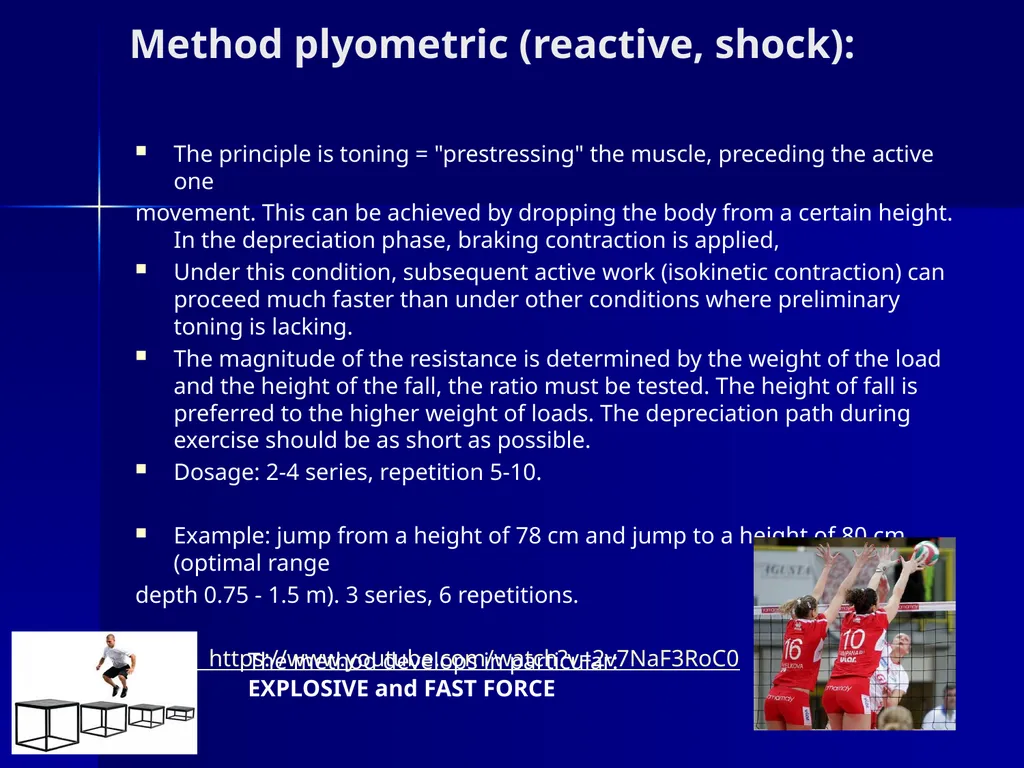
Example: jump from a height of 78 cm and jump to a height of 80 cm (optimal range
depth 0.75 - 1.5 m). 3 series, 6 repetitions.
https://www.youtube.com/watch?v=2v7NaF3RoC0 The method develops in particular:
EXPLOSIVE and FAST FORCE<br>
20
Force endurance method: High number of repetitions (20-50 or more), dosing until "rejection" is usual
The magnitude of the resistance is lower (30 - 40% of the maximum), the speed of movement is medium to slow.