
Training module Teaching mental wellbeing Part of:
PC
Published · 62 slides · 0 views
1 / 1


Description
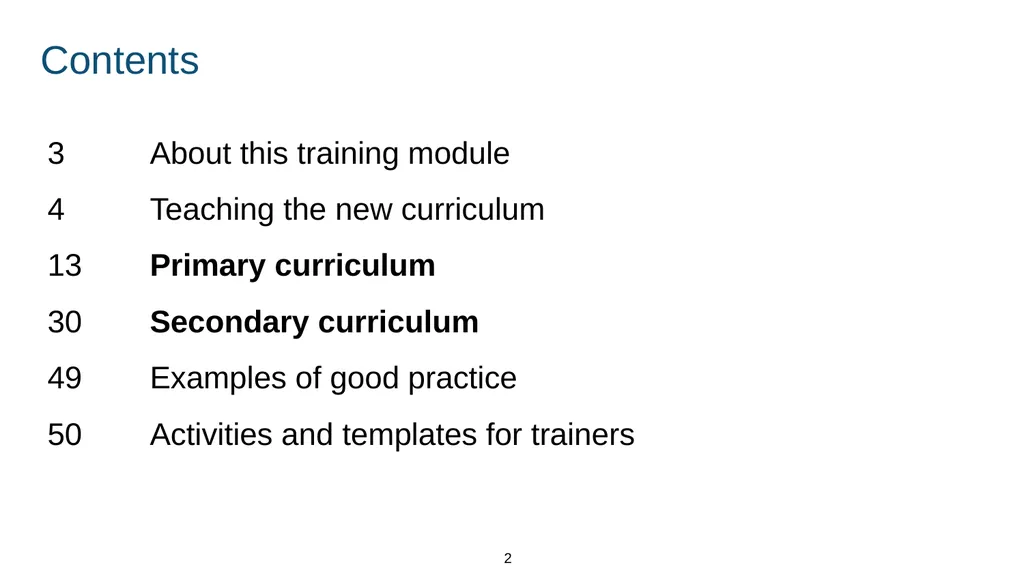
Training module Teaching mental wellbeing Part of: Health education Primary Secondary June 2020 Contents 2 3 About this training module 4 Teaching the new curriculum 13 Primary curriculum 30 Secondary curriculum 49 Examples of good practice
Related Topics
Share
Embed code
Download this presentation From Below
"Training module Teaching mental wellbeing Part of:" is the property of its rightful owner. Permission is granted to download and print the materials on this website for personal, non-commercial use only, and to display it on your personal computer provided you do not modify the materials and that you retain all copyright notices contained in the materials. By downloading content from our website, you accept the terms of this agreement.
Presentation Transcript
01
Training module Teaching mental wellbeing Part of: Health education Primary Secondary June 2020<br>
02
Contents 2 3 About this training module
4 Teaching the new curriculum
13 Primary curriculum
30 Secondary curriculum
49 Examples of good practice
50 Activities and templates for trainers<br>
4 Teaching the new curriculum
13 Primary curriculum
30 Secondary curriculum
49 Examples of good practice
50 Activities and templates for trainers<br>
03
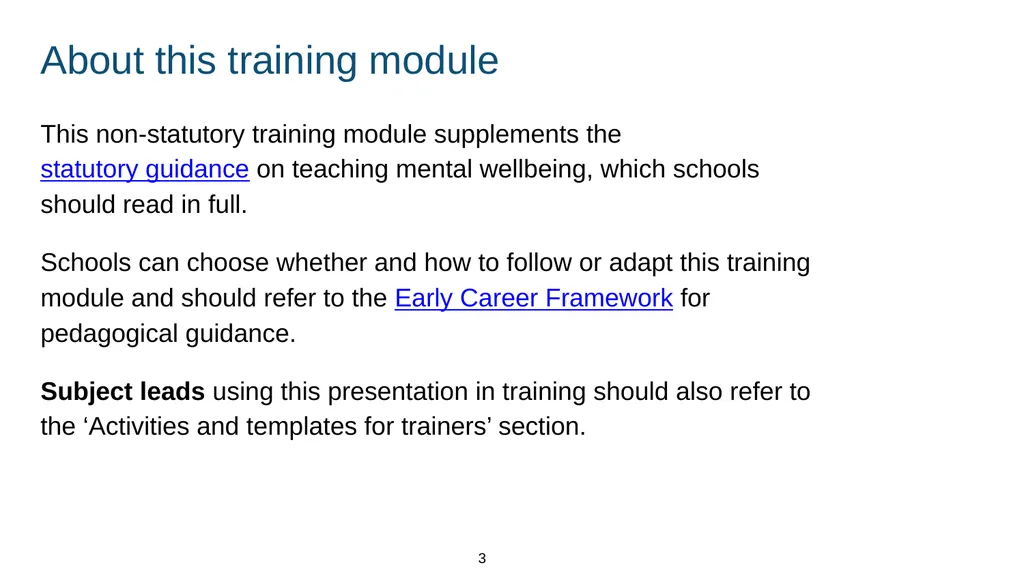
About this training module This non-statutory training module supplements the statutory guidance on teaching mental wellbeing, which schools should read in full.
Schools can choose whether and how to follow or adapt this training module and should refer to the Early Career Framework for pedagogical guidance.
Subject leads using this presentation in training should also refer to the ‘Activities and templates for trainers’ section. 3<br>
Schools can choose whether and how to follow or adapt this training module and should refer to the Early Career Framework for pedagogical guidance.
Subject leads using this presentation in training should also refer to the ‘Activities and templates for trainers’ section. 3<br>
04
Teaching the new curriculum 4<br>
05
Knowledge and capability From September 2020 there are new requirements for teaching mental wellbeing as part of health education. Statutory guidance explains how this knowledge will benefit pupils. STATUTORY GUIDANCE
… young people are increasingly experiencing challenges … The new subject content will give them the knowledge and capability to take care of themselves and receive support if problems arise. (p4) 5<br>
06
Primary and secondary teaching Some slides in this training have a Primary or Secondary label to indicate that the material is usually first introduced in that phase.
Schools have flexibility to design and plan age-appropriate subject content (statutory guidance).
Using your knowledge of your pupils and school community you can:
introduce secondary material in primary with pupils who are ready
teach the primary material in early secondary lessons to pupils who need to build knowledge before secondary requirements are taught 6<br>
Schools have flexibility to design and plan age-appropriate subject content (statutory guidance).
Using your knowledge of your pupils and school community you can:
introduce secondary material in primary with pupils who are ready
teach the primary material in early secondary lessons to pupils who need to build knowledge before secondary requirements are taught 6<br>
07
Start with wellbeing The majority of children and young people have good mental wellbeing most of the time. The starting point should therefore be teaching pupils the factors that contribute to and help us maintain wellbeing.
Once understanding of wellbeing is established you will be able to teach pupils to understand and identify:
when someone may be experiencing poor mental health
contributing factors to poor mental health
positive strategies to improve wellbeing
when people need help from others 7<br>
Once understanding of wellbeing is established you will be able to teach pupils to understand and identify:
when someone may be experiencing poor mental health
contributing factors to poor mental health
positive strategies to improve wellbeing
when people need help from others 7<br>
08
Closely related topics Mental wellbeing is closely related to several other topics such as:
Relationships, bullying, and internet safety and harms
Physical health, healthy eating, and drugs, alcohol and tobacco
Intimate and sexual relationships (secondary)
Therefore you should:
consider thematic links when planning and delivering lessons
find ways to link knowledge and vocabulary across topics
design lessons that enable pupils to make connections between mental wellbeing and other topics 8<br>
Relationships, bullying, and internet safety and harms
Physical health, healthy eating, and drugs, alcohol and tobacco
Intimate and sexual relationships (secondary)
Therefore you should:
consider thematic links when planning and delivering lessons
find ways to link knowledge and vocabulary across topics
design lessons that enable pupils to make connections between mental wellbeing and other topics 8<br>
09
Pupils with SEND Pupils with special educational needs and disabilities are statistically more likely to have wellbeing needs. Your special educational needs coordinator (SENCO) can help you develop support strategies (this may have happened during curriculum planning).
You will need to adapt lessons to allow all children to access and apply the knowledge in this module, using your expertise as you normally would.
You might want to link lesson outcomes with statutory ‘preparing for adulthood’ outcomes for those with an education, health and care (EHC) plan. (See SEND code of practice, section 8.) 9<br>
You will need to adapt lessons to allow all children to access and apply the knowledge in this module, using your expertise as you normally would.
You might want to link lesson outcomes with statutory ‘preparing for adulthood’ outcomes for those with an education, health and care (EHC) plan. (See SEND code of practice, section 8.) 9<br>
10
Safeguarding Pupils may be affected by issues discussed in lessons. Let your child protection/pastoral/safeguarding lead know what you are teaching so they can speak to pupils, including those with adverse childhood experiences.
Also make sure you follow safeguarding procedures, including:
setting ground rules for lessons, where needed, particularly around not sharing personal information
stopping discussions if personal information is shared in lessons and following up with pupils later where needed
not promising confidentiality if a pupil confides something concerning
telling pupils they can ask for help and they will be taken seriously 10<br>
Also make sure you follow safeguarding procedures, including:
setting ground rules for lessons, where needed, particularly around not sharing personal information
stopping discussions if personal information is shared in lessons and following up with pupils later where needed
not promising confidentiality if a pupil confides something concerning
telling pupils they can ask for help and they will be taken seriously 10<br>
11
Create class ground rules Clear class ground rules can help when teaching about sensitive topics. They also support confidentiality and safeguarding of pupils.
Good practice is for ground rules to be:
discussed and understood by all
clear and practical
modelled by the teacher
followed consistently and enforced
updated when needed
visible in lessons (for example, posters) 11<br>
Good practice is for ground rules to be:
discussed and understood by all
clear and practical
modelled by the teacher
followed consistently and enforced
updated when needed
visible in lessons (for example, posters) 11<br>
12
Example ground rules Respect privacy. We can discuss examples but don’t use names or descriptions that identify anyone, including ourselves. We never put anyone ‘on the spot’.
Listen to others. It’s okay to challenge a view or disagree, but we listen properly before making assumptions or deciding how to respond. Everyone has the right to feel listened to.
No judgement. We can explore beliefs and misunderstandings about a topic without fear of being judged.
Right to pass. Every pupil has the right to choose not to answer a question or join the discussion if a topic makes them uncomfortable. 12<br>
Listen to others. It’s okay to challenge a view or disagree, but we listen properly before making assumptions or deciding how to respond. Everyone has the right to feel listened to.
No judgement. We can explore beliefs and misunderstandings about a topic without fear of being judged.
Right to pass. Every pupil has the right to choose not to answer a question or join the discussion if a topic makes them uncomfortable. 12<br>
13
Primary curriculum 13<br>
14
Primary You may also want to refer to the statutory guidance for physical health and mental wellbeing. 14<br>
15
Introducing mental wellbeing Primary Teach pupils that, like physical health, mental wellbeing is an important part of daily life that is influenced by different factors, including exercise.
Explain to younger pupils that things they value, enjoy or are good at can all support mental wellbeing. Positive relationships, and eating and sleeping well can also help.
Prompt older pupils to reflect on ways they can contribute to others’ mental wellbeing, and establish which activities help them maintain their own wellbeing.
Reference: NHS: 5 steps to mental wellbeing STATUTORY GUIDANCE Know mental wellbeing is a normal part of daily life, in the same way as physical health. 15<br>
Explain to younger pupils that things they value, enjoy or are good at can all support mental wellbeing. Positive relationships, and eating and sleeping well can also help.
Prompt older pupils to reflect on ways they can contribute to others’ mental wellbeing, and establish which activities help them maintain their own wellbeing.
Reference: NHS: 5 steps to mental wellbeing STATUTORY GUIDANCE Know mental wellbeing is a normal part of daily life, in the same way as physical health. 15<br>
16
Range of childhood emotions Primary Teach pupils to identify and name the range and degrees of emotions in daily life. Pitch lessons to match developmental stage.
Stage 1: Recognising fear, joy, disgust, surprise, sadness, anger, happiness.
Stage 2: Recognising pride, shame, dismay, jealousy, embarrassment, empathy.
Stage 3: Recognising multiple emotions (feeling good, bad or indifferent at the same time), false emotions (pretending to like a present). STATUTORY GUIDANCE Know there is a normal range of emotions (e.g. happiness, sadness, anger, fear, surprise, nervousness) and scale of emotions that all humans experience in relation to different experiences and situations. 16<br>
Stage 1: Recognising fear, joy, disgust, surprise, sadness, anger, happiness.
Stage 2: Recognising pride, shame, dismay, jealousy, embarrassment, empathy.
Stage 3: Recognising multiple emotions (feeling good, bad or indifferent at the same time), false emotions (pretending to like a present). STATUTORY GUIDANCE Know there is a normal range of emotions (e.g. happiness, sadness, anger, fear, surprise, nervousness) and scale of emotions that all humans experience in relation to different experiences and situations. 16<br>
17
Scale of childhood emotions Primary Teach younger pupils to recognise:
emotional triggers (losing a toy, routine change)
that the behaviour of others can affect their wellbeing
their own behaviour and emotions can affect others
Build older pupils’ awareness of:
the impact of life events (parents separating, arrival of a new sibling)
the many factors that can affect mood such as responsibilities, personal preferences, exercise
how events can affect the intensity of our emotions STATUTORY GUIDANCE Know there is a normal range of emotions (e.g. happiness, sadness, anger, fear, surprise, nervousness) and scale of emotions that all humans experience in relation to different experiences and situations. 17<br>
emotional triggers (losing a toy, routine change)
that the behaviour of others can affect their wellbeing
their own behaviour and emotions can affect others
Build older pupils’ awareness of:
the impact of life events (parents separating, arrival of a new sibling)
the many factors that can affect mood such as responsibilities, personal preferences, exercise
how events can affect the intensity of our emotions STATUTORY GUIDANCE Know there is a normal range of emotions (e.g. happiness, sadness, anger, fear, surprise, nervousness) and scale of emotions that all humans experience in relation to different experiences and situations. 17<br>
18
Talking about emotions Primary Establish and build younger pupils’ vocabulary for:
things that make them feel happy or sad
things that could make someone else feel happy
Challenge older pupils to talk in more complex and nuanced ways about:
how events and people can make them feel happy, sad, anxious or upset
others’ emotions and how to recognise them
how someone might feel in an abstract scenario STATUTORY GUIDANCE Know how to recognise and talk about emotions, including having a varied vocabulary of words to use when talking about their own and others’ feelings. 18<br>
things that make them feel happy or sad
things that could make someone else feel happy
Challenge older pupils to talk in more complex and nuanced ways about:
how events and people can make them feel happy, sad, anxious or upset
others’ emotions and how to recognise them
how someone might feel in an abstract scenario STATUTORY GUIDANCE Know how to recognise and talk about emotions, including having a varied vocabulary of words to use when talking about their own and others’ feelings. 18<br>
19
Appropriate emotions / behaviour Primary For younger pupils model appropriate:
responses to events/situations
ways to express emotions
Also provide opportunities for pupils to practise recognising appropriate emotions and behaviour.
Give older pupils opportunities to select appropriate emotions and behaviours in response to (positive or negative) scenario-based triggers. Teach that there is usually a range of potential responses / expected behaviours. STATUTORY GUIDANCE Know how to judge whether what they are feeling and how they are behaving is appropriate and proportionate. 19<br>
responses to events/situations
ways to express emotions
Also provide opportunities for pupils to practise recognising appropriate emotions and behaviour.
Give older pupils opportunities to select appropriate emotions and behaviours in response to (positive or negative) scenario-based triggers. Teach that there is usually a range of potential responses / expected behaviours. STATUTORY GUIDANCE Know how to judge whether what they are feeling and how they are behaving is appropriate and proportionate. 19<br>
20
Physical activity and wellbeing Primary Teach pupils that physical activity (activity that gets heart pumping) has been proven to be good for mental wellbeing. Pupils should be physically active every day for at least 60 minutes. Ensure pupils know and experience the benefit of activity, such as:
PE at school
walking or cycling to school
physically demanding activity out of or inside school (e.g. daily mile-long walk, jogging, sports)
Explain that this is the minimum and that the more exercise they do the better their wellbeing is likely to be. STATUTORY GUIDANCE Know the benefits of physical exercise, time outdoors, community participation, voluntary and service-based activity on mental wellbeing and happiness. 20<br>
PE at school
walking or cycling to school
physically demanding activity out of or inside school (e.g. daily mile-long walk, jogging, sports)
Explain that this is the minimum and that the more exercise they do the better their wellbeing is likely to be. STATUTORY GUIDANCE Know the benefits of physical exercise, time outdoors, community participation, voluntary and service-based activity on mental wellbeing and happiness. 20<br>
21
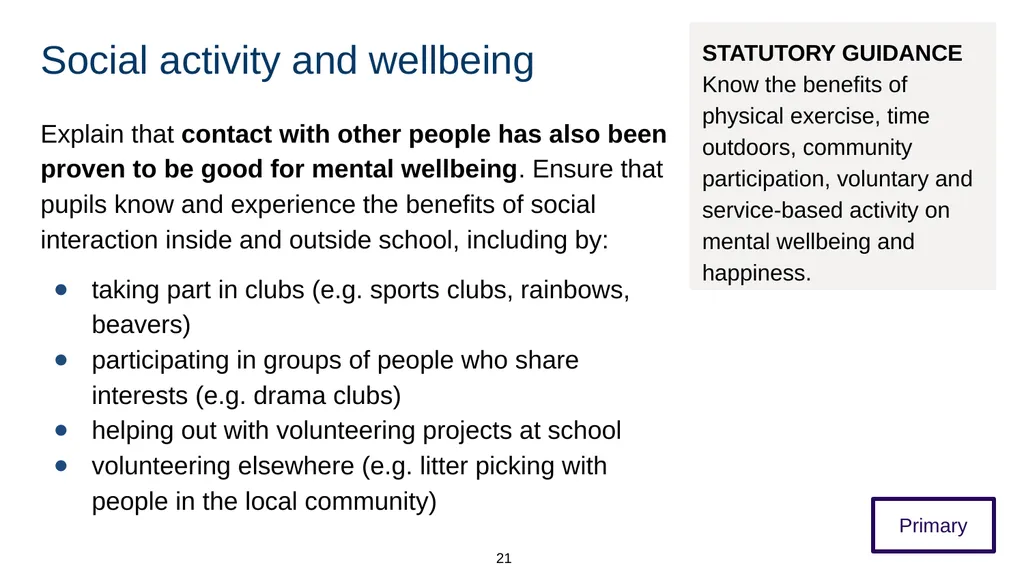
Social activity and wellbeing Primary Explain that contact with other people has also been proven to be good for mental wellbeing. Ensure that pupils know and experience the benefits of social interaction inside and outside school, including by:
taking part in clubs (e.g. sports clubs, rainbows, beavers)
participating in groups of people who share interests (e.g. drama clubs)
helping out with volunteering projects at school
volunteering elsewhere (e.g. litter picking with people in the local community) STATUTORY GUIDANCE Know the benefits of physical exercise, time outdoors, community participation, voluntary and service-based activity on mental wellbeing and happiness. 21<br>
taking part in clubs (e.g. sports clubs, rainbows, beavers)
participating in groups of people who share interests (e.g. drama clubs)
helping out with volunteering projects at school
volunteering elsewhere (e.g. litter picking with people in the local community) STATUTORY GUIDANCE Know the benefits of physical exercise, time outdoors, community participation, voluntary and service-based activity on mental wellbeing and happiness. 21<br>
22
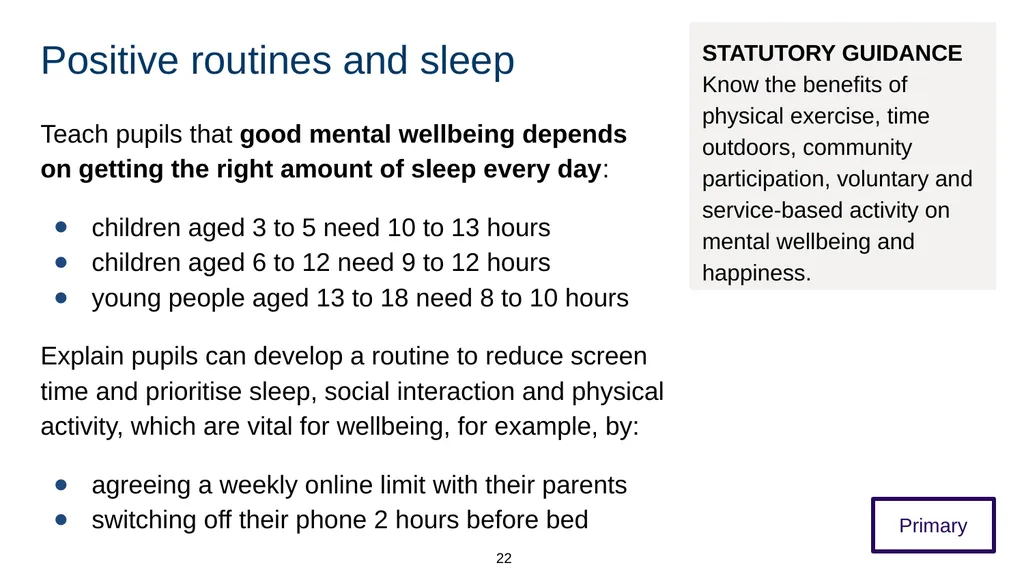
Positive routines and sleep Primary Teach pupils that good mental wellbeing depends
on getting the right amount of sleep every day:
children aged 3 to 5 need 10 to 13 hours
children aged 6 to 12 need 9 to 12 hours
young people aged 13 to 18 need 8 to 10 hours
Explain pupils can develop a routine to reduce screen time and prioritise sleep, social interaction and physical activity, which are vital for wellbeing, for example, by:
agreeing a weekly online limit with their parents
switching off their phone 2 hours before bed STATUTORY GUIDANCE Know the benefits of physical exercise, time outdoors, community participation, voluntary and service-based activity on mental wellbeing and happiness. 22<br>
children aged 3 to 5 need 10 to 13 hours
children aged 6 to 12 need 9 to 12 hours
young people aged 13 to 18 need 8 to 10 hours
Explain pupils can develop a routine to reduce screen time and prioritise sleep, social interaction and physical activity, which are vital for wellbeing, for example, by:
agreeing a weekly online limit with their parents
switching off their phone 2 hours before bed STATUTORY GUIDANCE Know the benefits of physical exercise, time outdoors, community participation, voluntary and service-based activity on mental wellbeing and happiness. 22<br>
23
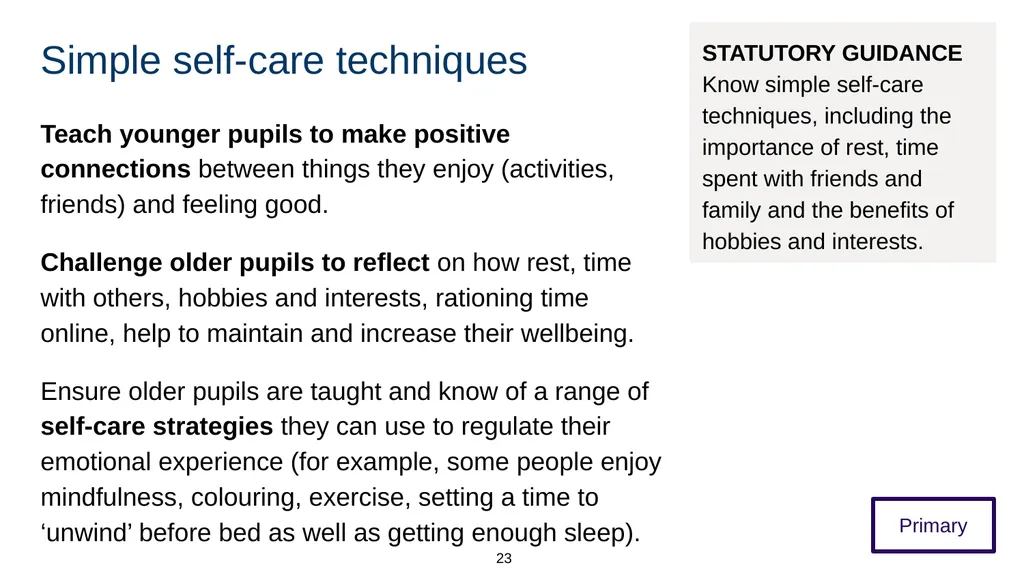
Simple self-care techniques Primary Teach younger pupils to make positive connections between things they enjoy (activities, friends) and feeling good.
Challenge older pupils to reflect on how rest, time with others, hobbies and interests, rationing time online, help to maintain and increase their wellbeing.
Ensure older pupils are taught and know of a range of self-care strategies they can use to regulate their emotional experience (for example, some people enjoy mindfulness, colouring, exercise, setting a time to ‘unwind’ before bed as well as getting enough sleep). STATUTORY GUIDANCE Know simple self-care techniques, including the importance of rest, time spent with friends and family and the benefits of hobbies and interests. 23<br>
Challenge older pupils to reflect on how rest, time with others, hobbies and interests, rationing time online, help to maintain and increase their wellbeing.
Ensure older pupils are taught and know of a range of self-care strategies they can use to regulate their emotional experience (for example, some people enjoy mindfulness, colouring, exercise, setting a time to ‘unwind’ before bed as well as getting enough sleep). STATUTORY GUIDANCE Know simple self-care techniques, including the importance of rest, time spent with friends and family and the benefits of hobbies and interests. 23<br>
24
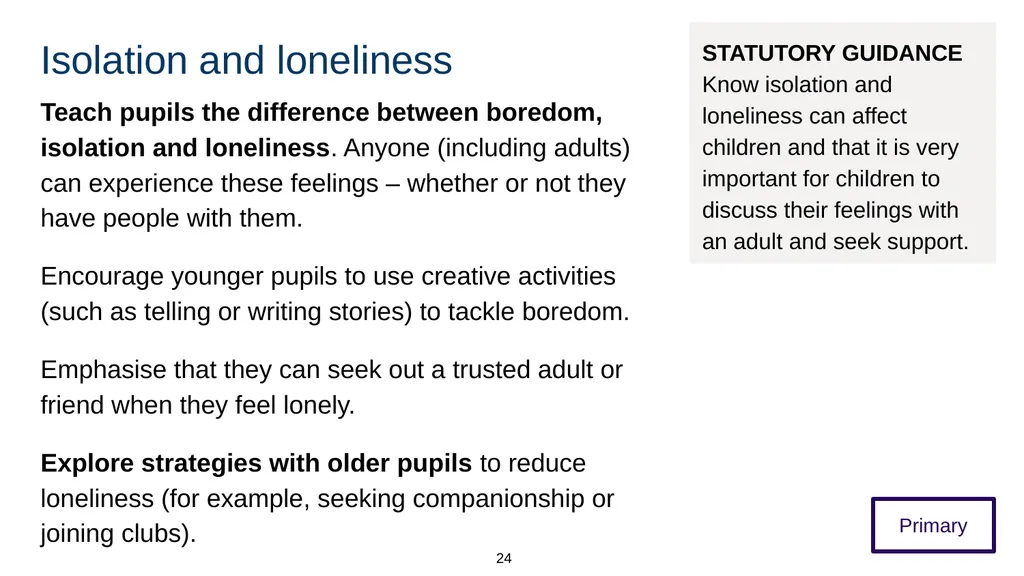
Isolation and loneliness Primary Teach pupils the difference between boredom, isolation and loneliness. Anyone (including adults) can experience these feelings – whether or not they have people with them.
Encourage younger pupils to use creative activities (such as telling or writing stories) to tackle boredom.
Emphasise that they can seek out a trusted adult or friend when they feel lonely.
Explore strategies with older pupils to reduce loneliness (for example, seeking companionship or joining clubs). STATUTORY GUIDANCE Know isolation and loneliness can affect children and that it is very important for children to discuss their feelings with an adult and seek support. 24<br>
Encourage younger pupils to use creative activities (such as telling or writing stories) to tackle boredom.
Emphasise that they can seek out a trusted adult or friend when they feel lonely.
Explore strategies with older pupils to reduce loneliness (for example, seeking companionship or joining clubs). STATUTORY GUIDANCE Know isolation and loneliness can affect children and that it is very important for children to discuss their feelings with an adult and seek support. 24<br>
25
Talking and getting support Primary Remind younger pupils to talk to a trusted adult when:
experiencing friendship problems (e.g. toys being taken from them)
they feel lonely
Check that older pupils:
can describe what loneliness is
know that it can help to talk about feelings
are aware of the adults they can talk to
can suggest actions a character might take if they were lonely (structured scenario) STATUTORY GUIDANCE Know isolation and loneliness can affect children and that it is very important for children to discuss their feelings with an adult and seek support. 25<br>
experiencing friendship problems (e.g. toys being taken from them)
they feel lonely
Check that older pupils:
can describe what loneliness is
know that it can help to talk about feelings
are aware of the adults they can talk to
can suggest actions a character might take if they were lonely (structured scenario) STATUTORY GUIDANCE Know isolation and loneliness can affect children and that it is very important for children to discuss their feelings with an adult and seek support. 25<br>
26
The impact of bullying Primary Teach that:
bullying can make people feel bad and negatively affects mental wellbeing
all types of bullying can hurt people (including ‘cyberbullying’)
you can’t always tell if someone is being hurt by bullying
bullying can affect someone long after an incident has happened (it can affect their whole life)
Emphasise that bullying should not be tolerated and that people should ask for help if they need it. STATUTORY GUIDANCE Know that bullying (including cyberbullying) has a negative and often lasting impact on mental wellbeing. 26<br>
bullying can make people feel bad and negatively affects mental wellbeing
all types of bullying can hurt people (including ‘cyberbullying’)
you can’t always tell if someone is being hurt by bullying
bullying can affect someone long after an incident has happened (it can affect their whole life)
Emphasise that bullying should not be tolerated and that people should ask for help if they need it. STATUTORY GUIDANCE Know that bullying (including cyberbullying) has a negative and often lasting impact on mental wellbeing. 26<br>
27
When to ask for help Primary Tell younger pupils that they should always ask for help when they need it, such as when they or someone else is worried or upset.
Explain and encourage older pupils to recognise scenarios when they should ask for help, such as when they’re concerned about:
their wellbeing / emotional reactions
someone else’s wellbeing / emotional reactions
This could be in response to face-to-face or online behaviour. STATUTORY GUIDANCE Know where and how to seek support (including recognising the triggers for seeking support). 27<br>
Explain and encourage older pupils to recognise scenarios when they should ask for help, such as when they’re concerned about:
their wellbeing / emotional reactions
someone else’s wellbeing / emotional reactions
This could be in response to face-to-face or online behaviour. STATUTORY GUIDANCE Know where and how to seek support (including recognising the triggers for seeking support). 27<br>
28
Who to ask for help Primary Ensure all pupils know their appropriate adults to ask for support when they or somebody else is feeling hurt, upset, worried or angry (including about issues arising online).
Identify their key trusted adults at school and remind pupils they can also talk to any other teacher.
Older pupils should also know who they can speak to outside school (e.g. parent/carer, a friend). STATUTORY GUIDANCE Know … whom in school they should speak to if they are worried about their own or someone else’s mental wellbeing or ability to control their emotions (including issues arising online). 28<br>
Identify their key trusted adults at school and remind pupils they can also talk to any other teacher.
Older pupils should also know who they can speak to outside school (e.g. parent/carer, a friend). STATUTORY GUIDANCE Know … whom in school they should speak to if they are worried about their own or someone else’s mental wellbeing or ability to control their emotions (including issues arising online). 28<br>
29
Children and mental health Primary Teach pupils that feeling emotions such as sadness doesn’t mean we are unwell - feelings often change throughout the day and over longer periods.
Sometimes mental wellbeing can be affected, e.g. by life events or seemingly lower-level stressors and:
people sometimes need help to get better or cope, e.g. help from family, friends, a doctor
wellbeing is a spectrum and addressing issues early can minimise the negative impact
people can seem happy but still need help STATUTORY GUIDANCE Know it is common for people to experience mental ill health. For many people who do, the problems can be resolved if the right support is made available, especially if accessed early enough. 29<br>
Sometimes mental wellbeing can be affected, e.g. by life events or seemingly lower-level stressors and:
people sometimes need help to get better or cope, e.g. help from family, friends, a doctor
wellbeing is a spectrum and addressing issues early can minimise the negative impact
people can seem happy but still need help STATUTORY GUIDANCE Know it is common for people to experience mental ill health. For many people who do, the problems can be resolved if the right support is made available, especially if accessed early enough. 29<br>
30
Secondary curriculum 30 STATUTORY GUIDANCE
Schools should continue to develop knowledge on topics specified for primary as required and in addition cover the following content by the end of secondary.<br>
31
Secondary You may also want to refer to the statutory guidance for physical health and mental wellbeing. 31<br>
32
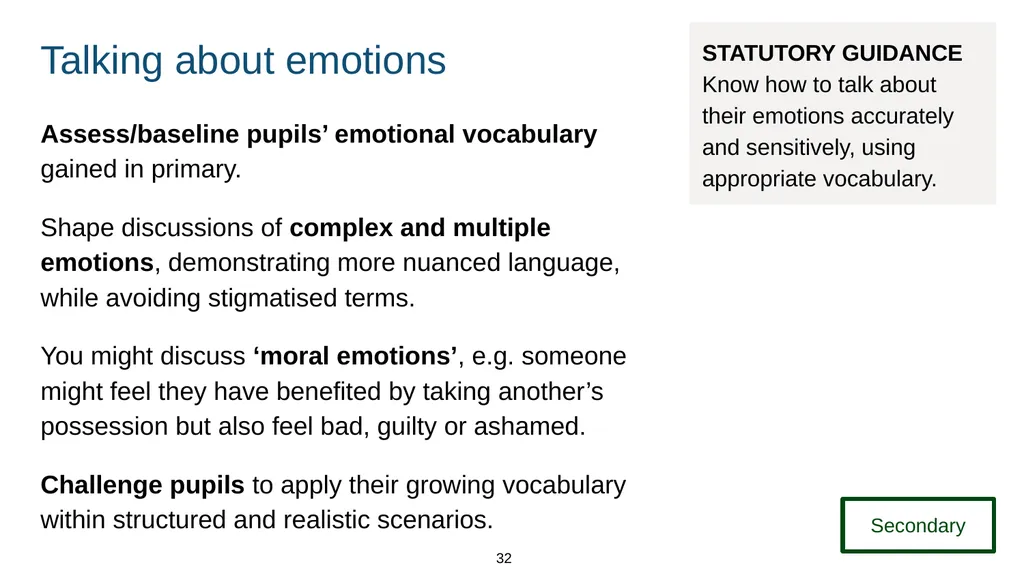
Talking about emotions Secondary Assess/baseline pupils’ emotional vocabulary gained in primary.
Shape discussions of complex and multiple emotions, demonstrating more nuanced language, while avoiding stigmatised terms.
You might discuss ‘moral emotions’, e.g. someone might feel they have benefited by taking another’s possession but also feel bad, guilty or ashamed.
Challenge pupils to apply their growing vocabulary within structured and realistic scenarios. STATUTORY GUIDANCE Know how to talk about their emotions accurately and sensitively, using appropriate vocabulary. 32<br>
Shape discussions of complex and multiple emotions, demonstrating more nuanced language, while avoiding stigmatised terms.
You might discuss ‘moral emotions’, e.g. someone might feel they have benefited by taking another’s possession but also feel bad, guilty or ashamed.
Challenge pupils to apply their growing vocabulary within structured and realistic scenarios. STATUTORY GUIDANCE Know how to talk about their emotions accurately and sensitively, using appropriate vocabulary. 32<br>
33
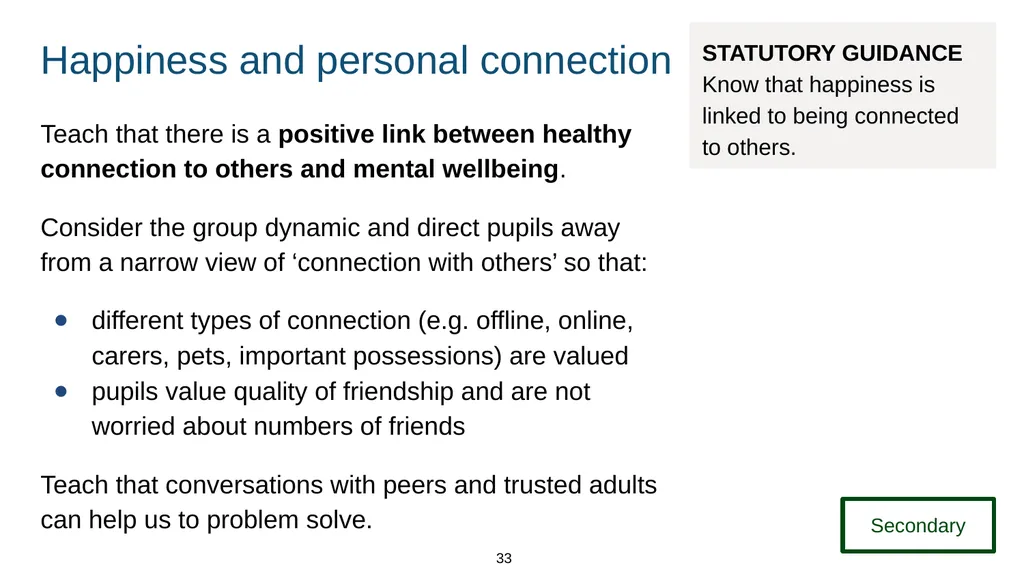
Happiness and personal connection Secondary Teach that there is a positive link between healthy connection to others and mental wellbeing.
Consider the group dynamic and direct pupils away from a narrow view of ‘connection with others’ so that:
different types of connection (e.g. offline, online, carers, pets, important possessions) are valued
pupils value quality of friendship and are not worried about numbers of friends
Teach that conversations with peers and trusted adults can help us to problem solve. STATUTORY GUIDANCE Know that happiness is linked to being connected to others. 33<br>
Consider the group dynamic and direct pupils away from a narrow view of ‘connection with others’ so that:
different types of connection (e.g. offline, online, carers, pets, important possessions) are valued
pupils value quality of friendship and are not worried about numbers of friends
Teach that conversations with peers and trusted adults can help us to problem solve. STATUTORY GUIDANCE Know that happiness is linked to being connected to others. 33<br>
34
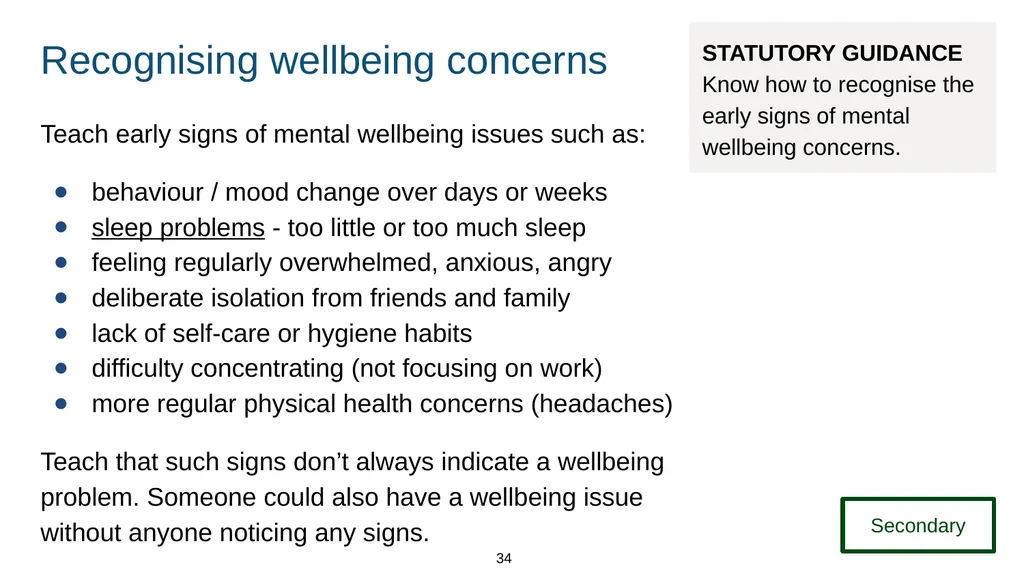
Recognising wellbeing concerns Secondary Teach early signs of mental wellbeing issues such as:
behaviour / mood change over days or weeks
sleep problems - too little or too much sleep
feeling regularly overwhelmed, anxious, angry
deliberate isolation from friends and family
lack of self-care or hygiene habits
difficulty concentrating (not focusing on work)
more regular physical health concerns (headaches)
Teach that such signs don’t always indicate a wellbeing problem. Someone could also have a wellbeing issue without anyone noticing any signs. STATUTORY GUIDANCE Know how to recognise the early signs of mental wellbeing concerns. 34<br>
behaviour / mood change over days or weeks
sleep problems - too little or too much sleep
feeling regularly overwhelmed, anxious, angry
deliberate isolation from friends and family
lack of self-care or hygiene habits
difficulty concentrating (not focusing on work)
more regular physical health concerns (headaches)
Teach that such signs don’t always indicate a wellbeing problem. Someone could also have a wellbeing issue without anyone noticing any signs. STATUTORY GUIDANCE Know how to recognise the early signs of mental wellbeing concerns. 34<br>
35
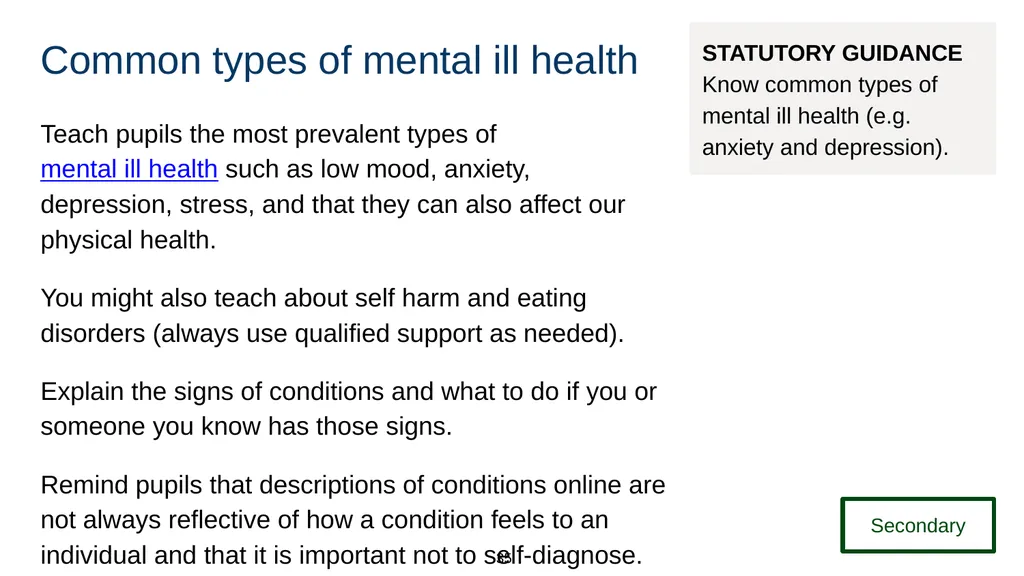
Common types of mental ill health Secondary Teach pupils the most prevalent types of mental ill health such as low mood, anxiety, depression, stress, and that they can also affect our physical health.
You might also teach about self harm and eating disorders (always use qualified support as needed).
Explain the signs of conditions and what to do if you or someone you know has those signs.
Remind pupils that descriptions of conditions online are not always reflective of how a condition feels to an individual and that it is important not to self-diagnose. STATUTORY GUIDANCE Know common types of mental ill health (e.g. anxiety and depression). 35<br>
You might also teach about self harm and eating disorders (always use qualified support as needed).
Explain the signs of conditions and what to do if you or someone you know has those signs.
Remind pupils that descriptions of conditions online are not always reflective of how a condition feels to an individual and that it is important not to self-diagnose. STATUTORY GUIDANCE Know common types of mental ill health (e.g. anxiety and depression). 35<br>
36
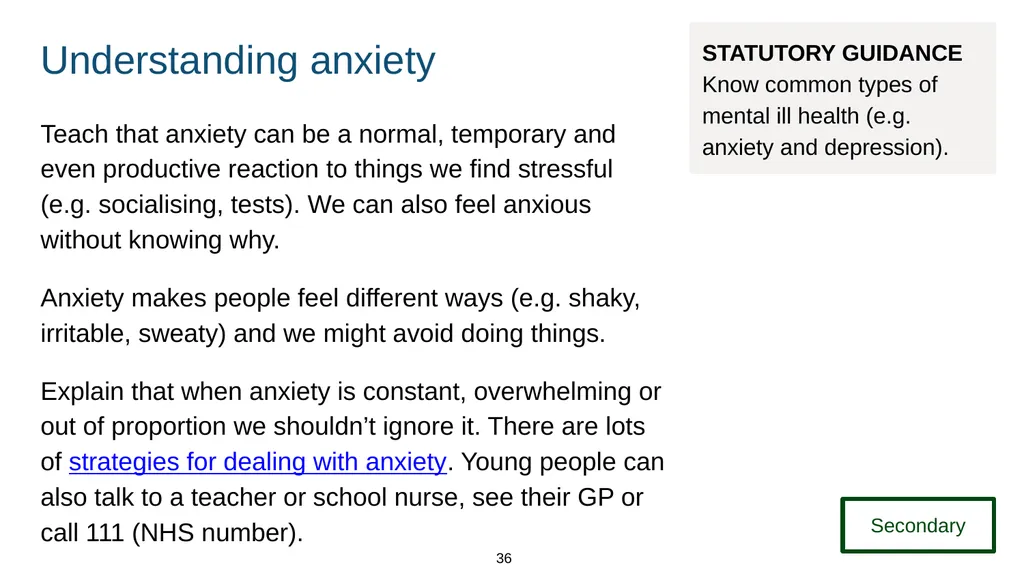
Understanding anxiety Secondary Teach that anxiety can be a normal, temporary and even productive reaction to things we find stressful (e.g. socialising, tests). We can also feel anxious without knowing why.
Anxiety makes people feel different ways (e.g. shaky, irritable, sweaty) and we might avoid doing things.
Explain that when anxiety is constant, overwhelming or out of proportion we shouldn’t ignore it. There are lots of strategies for dealing with anxiety. Young people can also talk to a teacher or school nurse, see their GP or call 111 (NHS number). STATUTORY GUIDANCE Know common types of mental ill health (e.g. anxiety and depression). 36<br>
Anxiety makes people feel different ways (e.g. shaky, irritable, sweaty) and we might avoid doing things.
Explain that when anxiety is constant, overwhelming or out of proportion we shouldn’t ignore it. There are lots of strategies for dealing with anxiety. Young people can also talk to a teacher or school nurse, see their GP or call 111 (NHS number). STATUTORY GUIDANCE Know common types of mental ill health (e.g. anxiety and depression). 36<br>
37
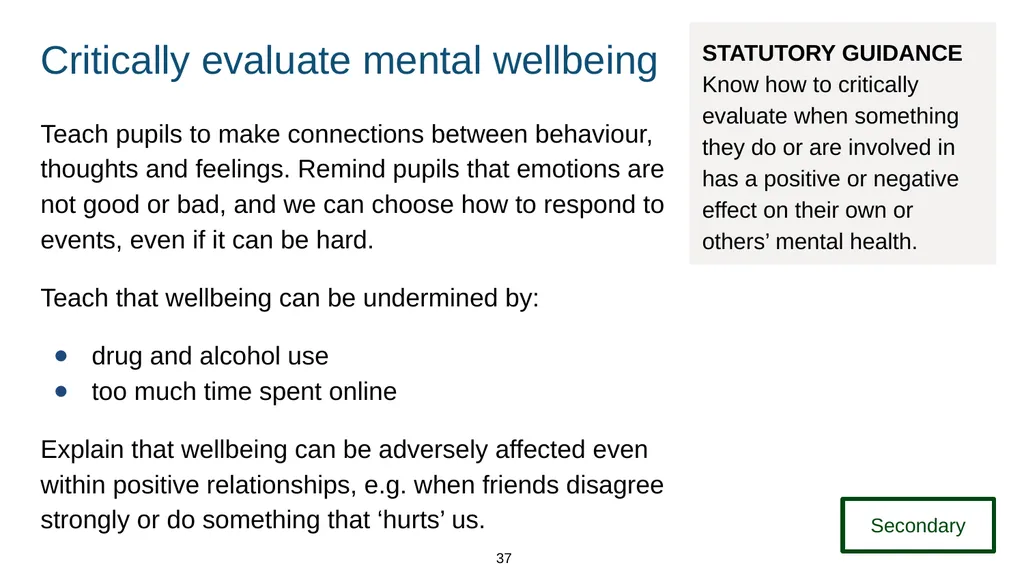
Critically evaluate mental wellbeing Secondary Teach pupils to make connections between behaviour, thoughts and feelings. Remind pupils that emotions are not good or bad, and we can choose how to respond to events, even if it can be hard.
Teach that wellbeing can be undermined by:
drug and alcohol use
too much time spent online
Explain that wellbeing can be adversely affected even within positive relationships, e.g. when friends disagree strongly or do something that ‘hurts’ us. STATUTORY GUIDANCE Know how to critically evaluate when something they do or are involved in has a positive or negative effect on their own or others’ mental health. 37<br>
Teach that wellbeing can be undermined by:
drug and alcohol use
too much time spent online
Explain that wellbeing can be adversely affected even within positive relationships, e.g. when friends disagree strongly or do something that ‘hurts’ us. STATUTORY GUIDANCE Know how to critically evaluate when something they do or are involved in has a positive or negative effect on their own or others’ mental health. 37<br>
38
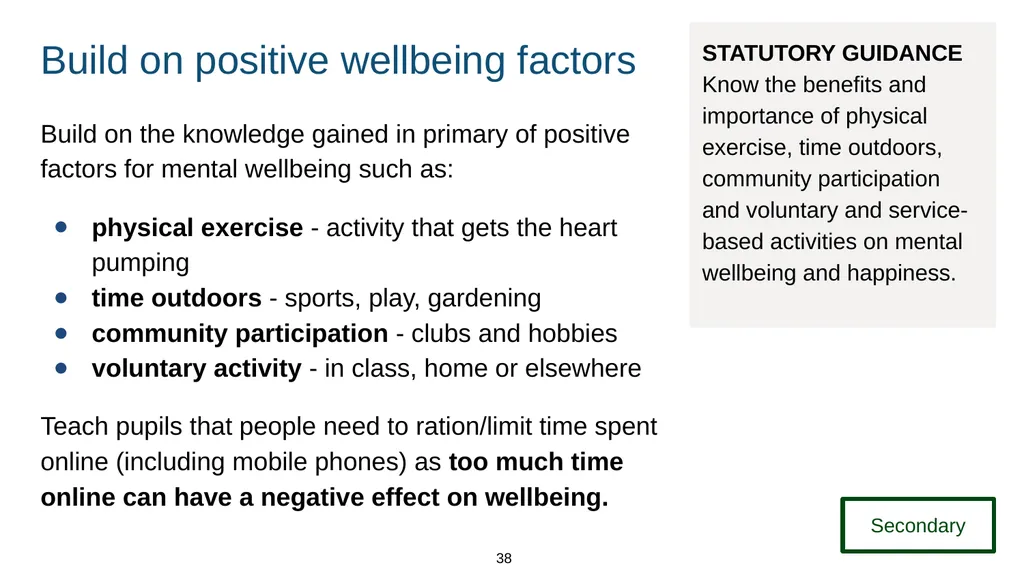
Build on positive wellbeing factors Secondary Build on the knowledge gained in primary of positive factors for mental wellbeing such as:
physical exercise - activity that gets the heart pumping
time outdoors - sports, play, gardening
community participation - clubs and hobbies
voluntary activity - in class, home or elsewhere
Teach pupils that people need to ration/limit time spent online (including mobile phones) as too much time online can have a negative effect on wellbeing. STATUTORY GUIDANCE Know the benefits and importance of physical exercise, time outdoors, community participation and voluntary and service-based activities on mental wellbeing and happiness. 38<br>
physical exercise - activity that gets the heart pumping
time outdoors - sports, play, gardening
community participation - clubs and hobbies
voluntary activity - in class, home or elsewhere
Teach pupils that people need to ration/limit time spent online (including mobile phones) as too much time online can have a negative effect on wellbeing. STATUTORY GUIDANCE Know the benefits and importance of physical exercise, time outdoors, community participation and voluntary and service-based activities on mental wellbeing and happiness. 38<br>
39
Examples of good practice 39<br>
40
Good practice Good practice The following are just some of the approaches you might consider when preparing to teach mental wellbeing.
You will need to adapt these approaches to ensure they are age appropriate and developmentally appropriate for your pupils. 40<br>
You will need to adapt these approaches to ensure they are age appropriate and developmentally appropriate for your pupils. 40<br>
41
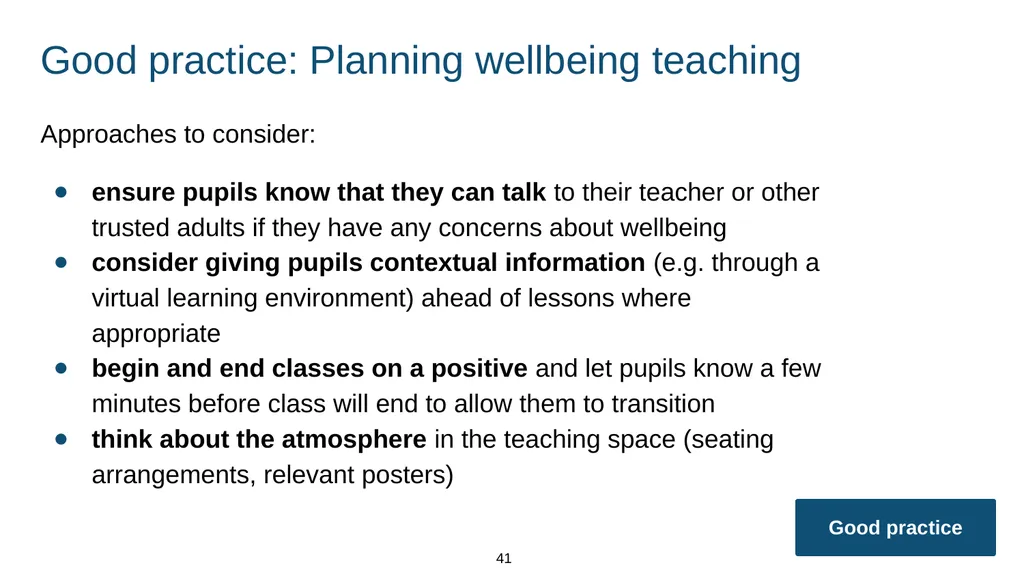
Good practice: Planning wellbeing teaching Good practice Approaches to consider:
ensure pupils know that they can talk to their teacher or other trusted adults if they have any concerns about wellbeing
consider giving pupils contextual information (e.g. through a virtual learning environment) ahead of lessons where appropriate
begin and end classes on a positive and let pupils know a few minutes before class will end to allow them to transition
think about the atmosphere in the teaching space (seating arrangements, relevant posters) 41<br>
ensure pupils know that they can talk to their teacher or other trusted adults if they have any concerns about wellbeing
consider giving pupils contextual information (e.g. through a virtual learning environment) ahead of lessons where appropriate
begin and end classes on a positive and let pupils know a few minutes before class will end to allow them to transition
think about the atmosphere in the teaching space (seating arrangements, relevant posters) 41<br>
42
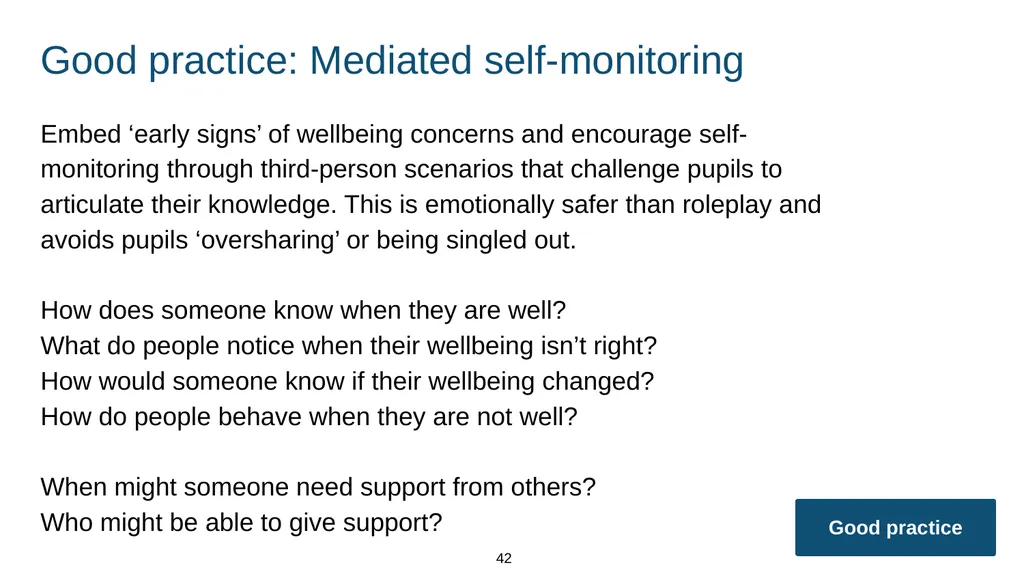
Good practice: Mediated self-monitoring Good practice Embed ‘early signs’ of wellbeing concerns and encourage self-monitoring through third-person scenarios that challenge pupils to articulate their knowledge. This is emotionally safer than roleplay and avoids pupils ‘oversharing’ or being singled out.
How does someone know when they are well? What do people notice when their wellbeing isn’t right?
How would someone know if their wellbeing changed? How do people behave when they are not well? When might someone need support from others? Who might be able to give support? 42<br>
How does someone know when they are well? What do people notice when their wellbeing isn’t right?
How would someone know if their wellbeing changed? How do people behave when they are not well? When might someone need support from others? Who might be able to give support? 42<br>
43
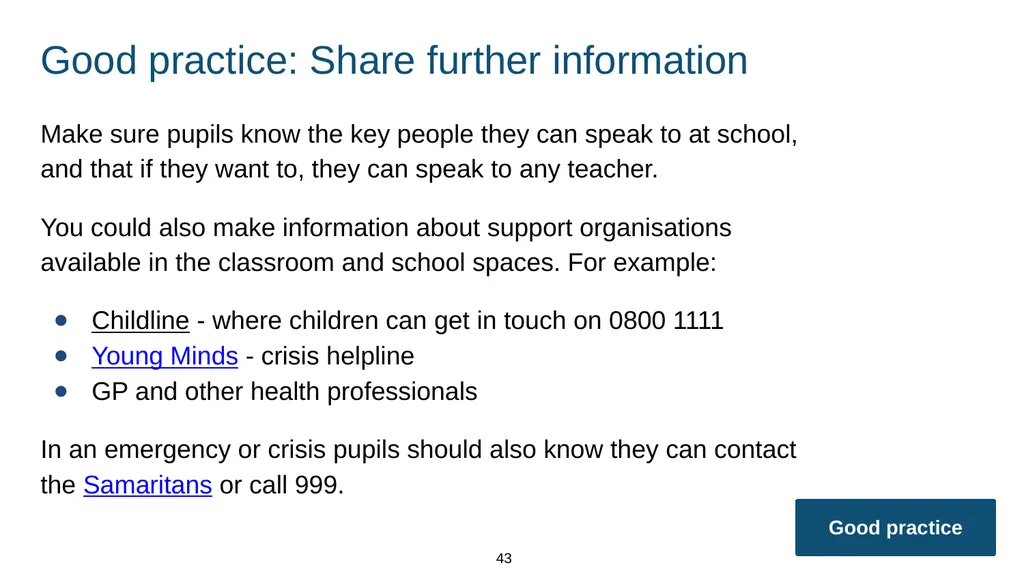
Good practice: Share further information Good practice Make sure pupils know the key people they can speak to at school, and that if they want to, they can speak to any teacher.
You could also make information about support organisations available in the classroom and school spaces. For example:
Childline - where children can get in touch on 0800 1111
Young Minds - crisis helpline
GP and other health professionals
In an emergency or crisis pupils should also know they can contact the Samaritans or call 999. 43<br>
You could also make information about support organisations available in the classroom and school spaces. For example:
Childline - where children can get in touch on 0800 1111
Young Minds - crisis helpline
GP and other health professionals
In an emergency or crisis pupils should also know they can contact the Samaritans or call 999. 43<br>
44
Activities and templates for trainers 44<br>
45
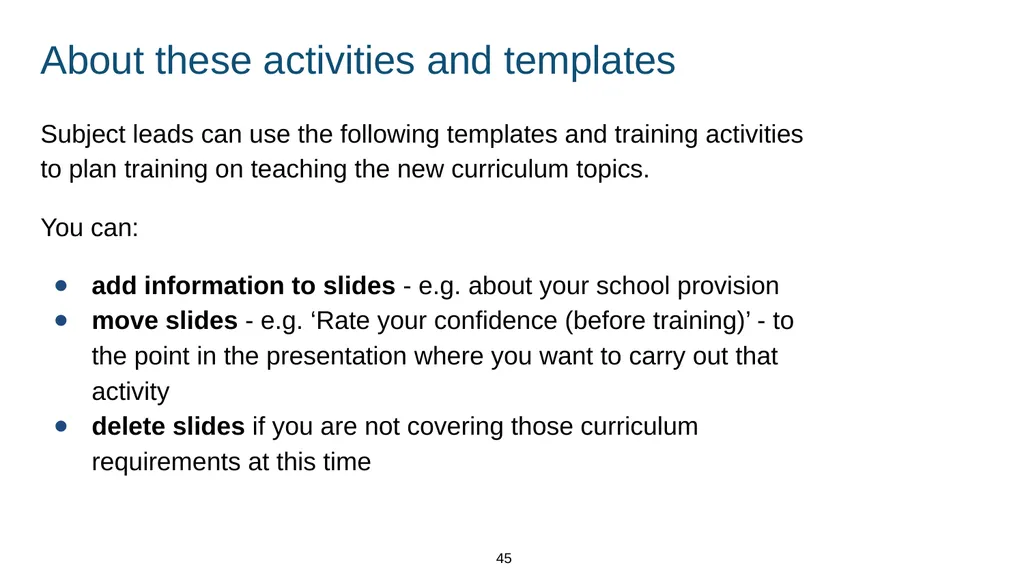
About these activities and templates Subject leads can use the following templates and training activities to plan training on teaching the new curriculum topics.
You can:
add information to slides - e.g. about your school provision
move slides - e.g. ‘Rate your confidence (before training)’ - to the point in the presentation where you want to carry out that activity
delete slides if you are not covering those curriculum requirements at this time 45<br>
You can:
add information to slides - e.g. about your school provision
move slides - e.g. ‘Rate your confidence (before training)’ - to the point in the presentation where you want to carry out that activity
delete slides if you are not covering those curriculum requirements at this time 45<br>
46
Training activity:
Rate your confidence 46<br>
Rate your confidence 46<br>
47
Rate your confidence (trainer notes) Ask your colleagues to rate confidence before and after topic training using the slides in this deck.
Before training Ask teachers to think about where they currently fit on the scale.
After training Ask teachers to rate their confidence again and talk about changes. You might want to repeat this activity at later check ins.
If teachers still rate confidence as low, discuss ways you can develop their subject knowledge, offer peer support etc. 47<br>
Before training Ask teachers to think about where they currently fit on the scale.
After training Ask teachers to rate their confidence again and talk about changes. You might want to repeat this activity at later check ins.
If teachers still rate confidence as low, discuss ways you can develop their subject knowledge, offer peer support etc. 47<br>
48
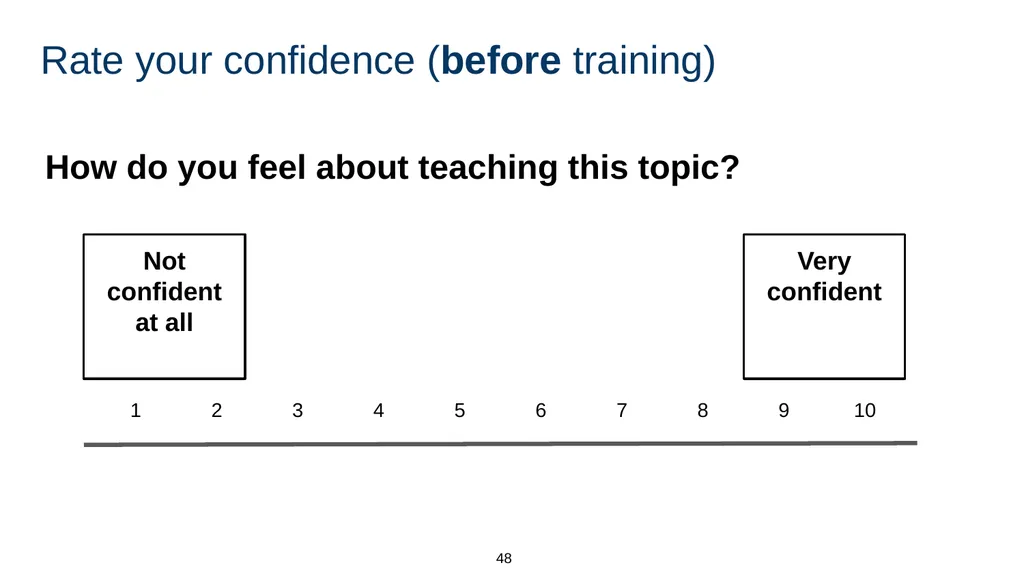
Rate your confidence (before training) How do you feel about teaching this topic? Not confident at all Very confident 48<br>
49
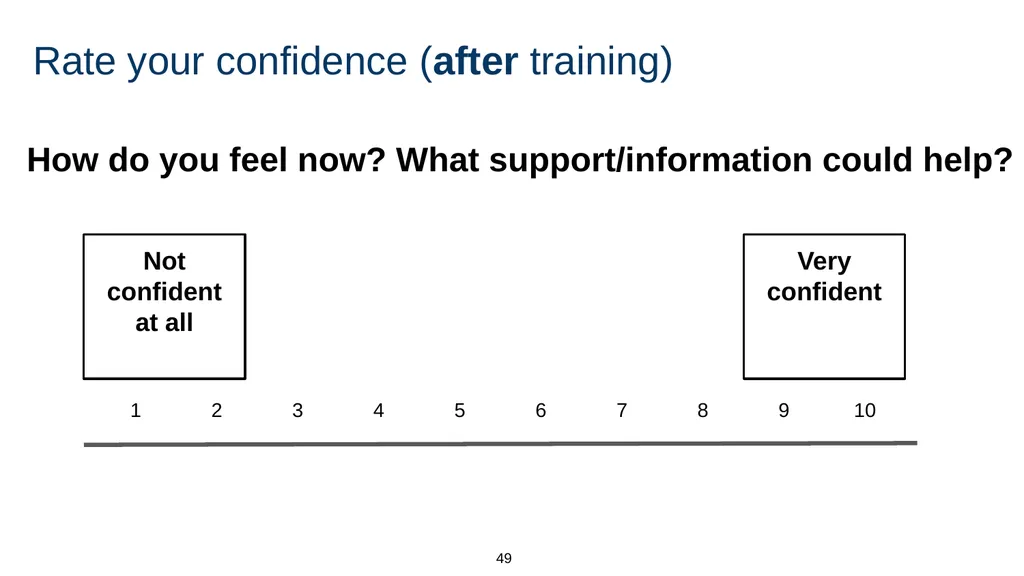
Rate your confidence (after training) How do you feel now? What support/information could help? Not confident at all Very confident 49<br>
50
‘Our school’ templates 50<br>
51
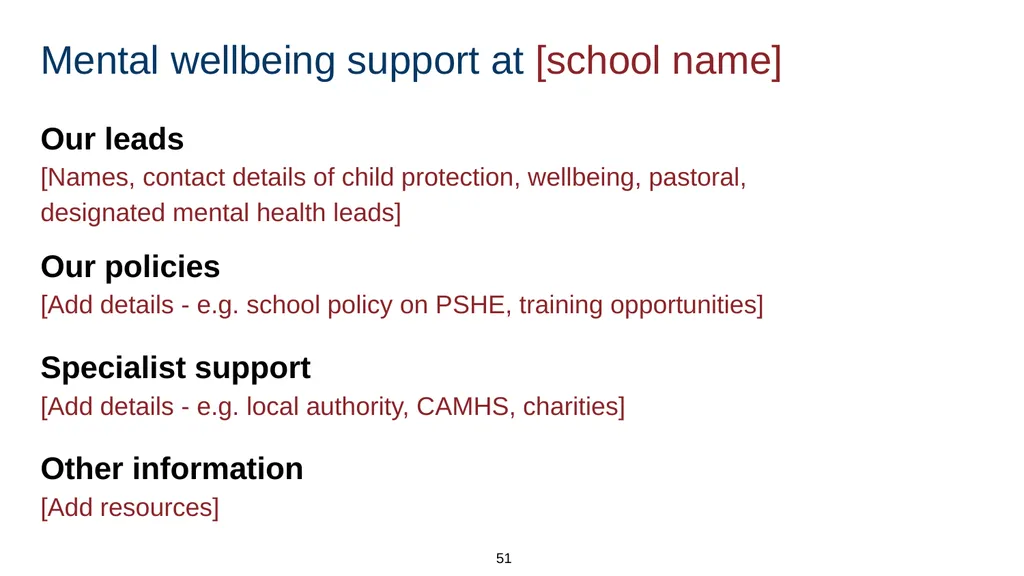
Mental wellbeing support at [school name] Our leads
[Names, contact details of child protection, wellbeing, pastoral, designated mental health leads]
Our policies
[Add details - e.g. school policy on PSHE, training opportunities]
Specialist support [Add details - e.g. local authority, CAMHS, charities]
Other information
[Add resources] 51<br>
[Names, contact details of child protection, wellbeing, pastoral, designated mental health leads]
Our policies
[Add details - e.g. school policy on PSHE, training opportunities]
Specialist support [Add details - e.g. local authority, CAMHS, charities]
Other information
[Add resources] 51<br>
52
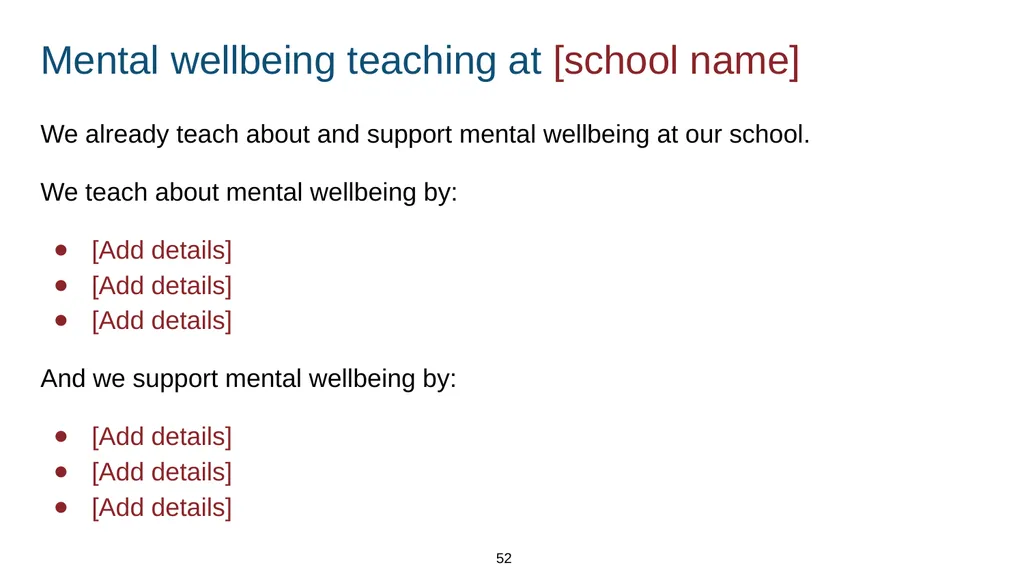
Mental wellbeing teaching at [school name] We already teach about and support mental wellbeing at our school.
We teach about mental wellbeing by:
[Add details]
[Add details]
[Add details]
And we support mental wellbeing by:
[Add details]
[Add details]
[Add details] 52<br>
We teach about mental wellbeing by:
[Add details]
[Add details]
[Add details]
And we support mental wellbeing by:
[Add details]
[Add details]
[Add details] 52<br>
53
Training activity:
Dealing with difficult questions 53<br>
Dealing with difficult questions 53<br>
54
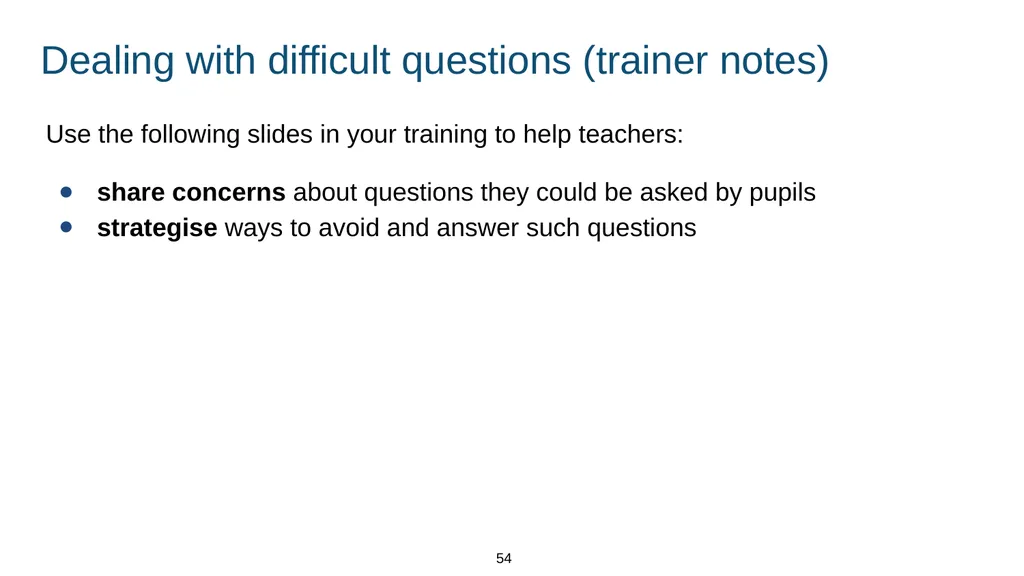
Dealing with difficult questions (trainer notes) Use the following slides in your training to help teachers:
share concerns about questions they could be asked by pupils
strategise ways to avoid and answer such questions 54<br>
share concerns about questions they could be asked by pupils
strategise ways to avoid and answer such questions 54<br>
55
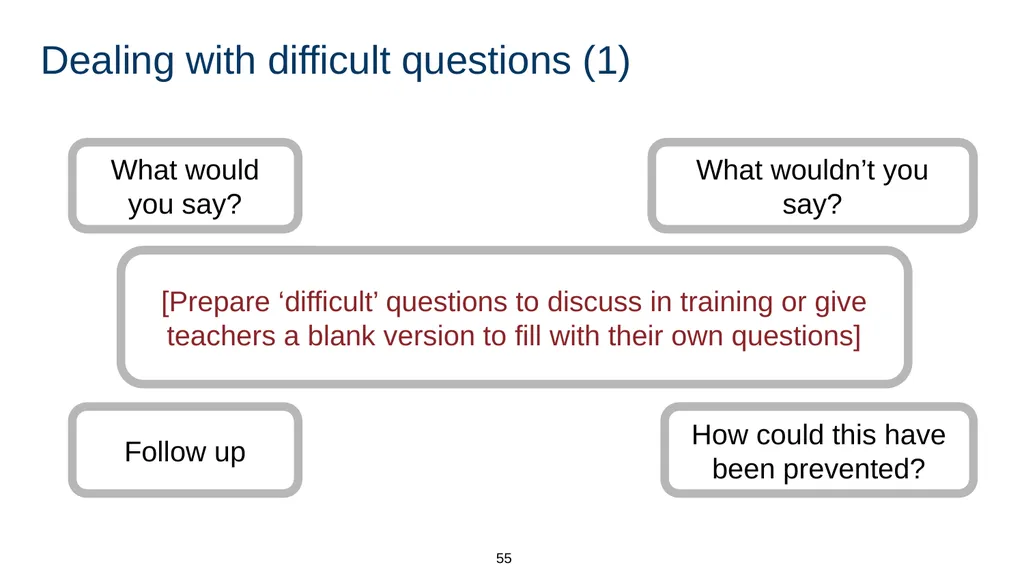
Dealing with difficult questions (1) [Prepare ‘difficult’ questions to discuss in training or give teachers a blank version to fill with their own questions] What would you say? What wouldn’t you say? Follow up How could this have been prevented? 55<br>
56
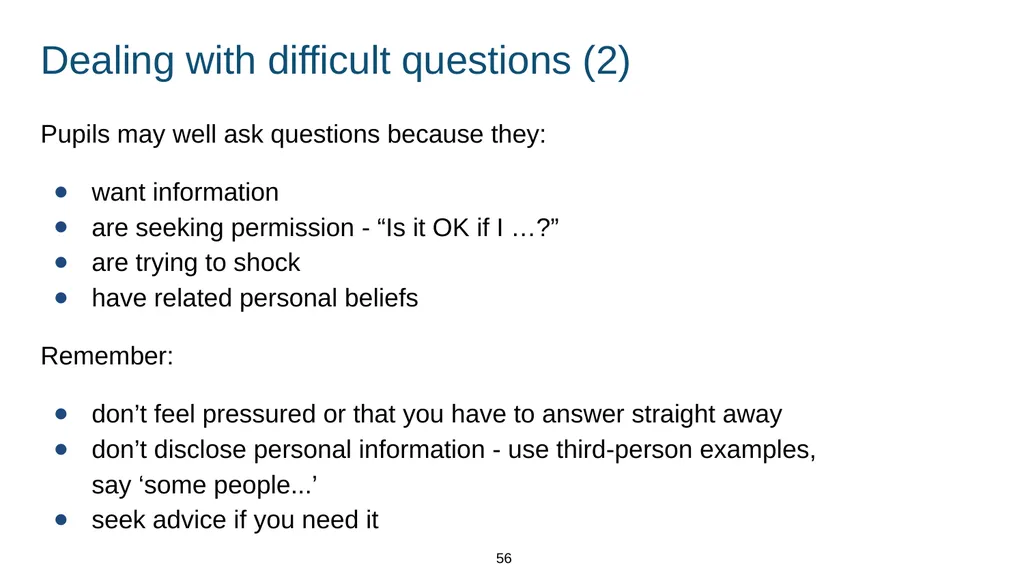
Dealing with difficult questions (2) Pupils may well ask questions because they:
want information
are seeking permission - “Is it OK if I …?”
are trying to shock
have related personal beliefs
Remember:
don’t feel pressured or that you have to answer straight away
don’t disclose personal information - use third-person examples, say ‘some people...’
seek advice if you need it 56<br>
want information
are seeking permission - “Is it OK if I …?”
are trying to shock
have related personal beliefs
Remember:
don’t feel pressured or that you have to answer straight away
don’t disclose personal information - use third-person examples, say ‘some people...’
seek advice if you need it 56<br>
57
Additional slides for structuring training 57<br>
58
Teaching mental wellbeing Part of: Physical health and mental wellbeing ADAPT THIS FOR YOUR OWN PRESENTATION [YOUR NAME, YOUR SCHOOL] Primary Secondary [DATE]<br>
59
What you get out of today By the end of this training you should:
know the statutory guidance
know some of the ways you can teach the required knowledge
have strategies to deal with questions that come up in class
feel more confident teaching about mental wellbeing 59 ADAPT THIS FOR YOUR OWN PRESENTATION<br>
know the statutory guidance
know some of the ways you can teach the required knowledge
have strategies to deal with questions that come up in class
feel more confident teaching about mental wellbeing 59 ADAPT THIS FOR YOUR OWN PRESENTATION<br>
60
Any questions? 60 ADAPT THIS FOR YOUR OWN PRESENTATION Any concerns? What support do you need?<br>
61
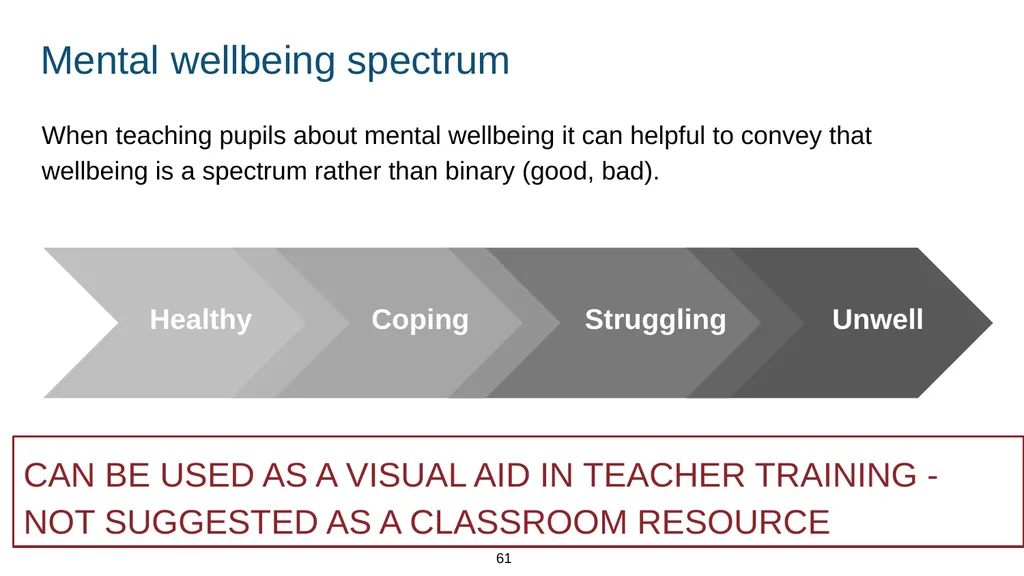
Mental wellbeing spectrum CAN BE USED AS A VISUAL AID IN TEACHER TRAINING - NOT SUGGESTED AS A CLASSROOM RESOURCE When teaching pupils about mental wellbeing it can helpful to convey that wellbeing is a spectrum rather than binary (good, bad). 61 Healthy Struggling Coping Unwell<br>
62
XX% [Use this format to present your own key facts and statistics - e.g. from your local authority or own monitoring. Include the source] 62 ADAPT THIS FOR YOUR OWN PRESENTATION<br>