
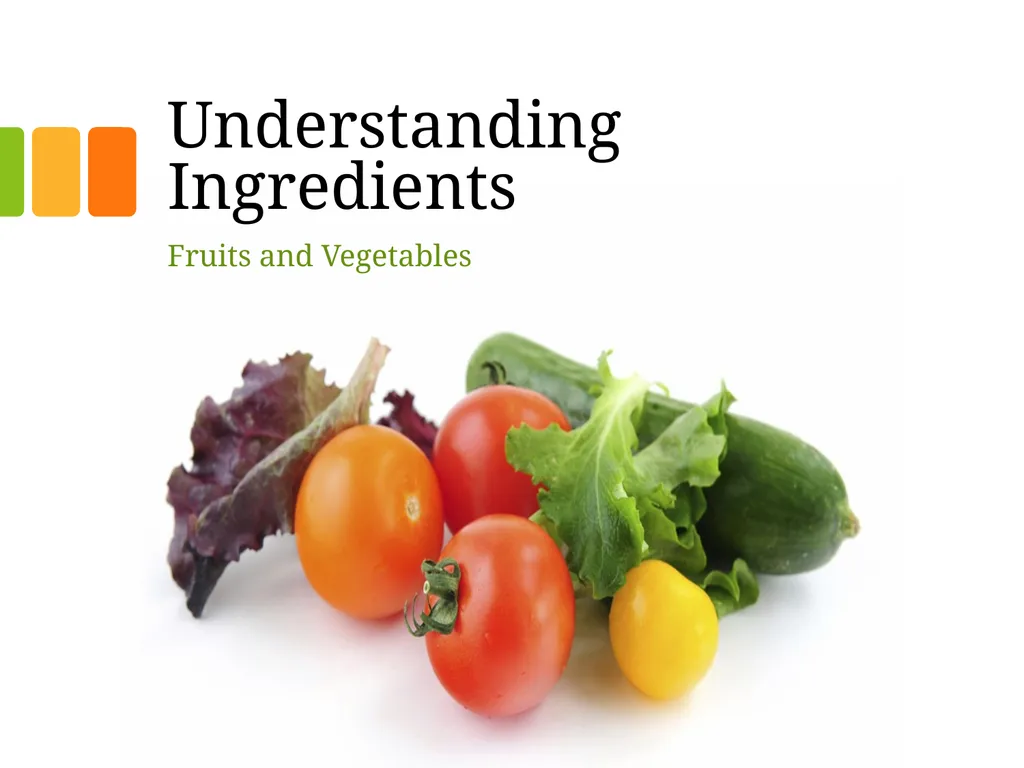
Understanding Ingredients Fruits and Vegetables
YM
Published · 31 slides · 0 views

1 / 1

Description
Understanding Ingredients Fruits and Vegetables Topics Types of Vegetables and Fruits Structures of Vegetables and Fruits Nutritive Value of Vegetables and Fruits Choice and Storage of Vegetables and Fruits Uses of Vegetables and Fruits in
Related Topics
Share
Embed code
Download this presentation From Below
"Understanding Ingredients Fruits and Vegetables" is the property of its rightful owner. Permission is granted to download and print the materials on this website for personal, non-commercial use only, and to display it on your personal computer provided you do not modify the materials and that you retain all copyright notices contained in the materials. By downloading content from our website, you accept the terms of this agreement.
Presentation Transcript
01
Understanding Ingredients Fruits and Vegetables<br>
02
Topics Types of Vegetables and Fruits
Structures of Vegetables and Fruits
Nutritive Value of Vegetables and Fruits
Choice and Storage of Vegetables and Fruits
Uses of Vegetables and Fruits in Cooking / Diet
Food and Nutrition Labelling of Vegetables and Fruits 2<br>
Structures of Vegetables and Fruits
Nutritive Value of Vegetables and Fruits
Choice and Storage of Vegetables and Fruits
Uses of Vegetables and Fruits in Cooking / Diet
Food and Nutrition Labelling of Vegetables and Fruits 2<br>
03
Types of Vegetables and Fruits 3<br>
04
Types of Vegetables and Fruits From food processing point of view, fruits and vegetables can be classified into two types:
Fresh produce
Food additives are not used
Product are of natural qualities at its natural state
They are perish in high rate
Processed product
Treated and often with food additives
Subjected to alternation in terms of quality compared to its natural state
Longer shelf life
Available at any time of the year
Quick and easy to cook
e.g. frozen vegetables, canned fruits, dried vegetables/fruits, preserved vegetables, candied fruits 4<br>
Fresh produce
Food additives are not used
Product are of natural qualities at its natural state
They are perish in high rate
Processed product
Treated and often with food additives
Subjected to alternation in terms of quality compared to its natural state
Longer shelf life
Available at any time of the year
Quick and easy to cook
e.g. frozen vegetables, canned fruits, dried vegetables/fruits, preserved vegetables, candied fruits 4<br>
05
Types of Vegetables Vegetables are the edible portion of plant eaten with (or as) the main course
Vegetables can be classified based on the part of the plant that is eaten
Different types of vegetables have different food values 5<br>
Vegetables can be classified based on the part of the plant that is eaten
Different types of vegetables have different food values 5<br>
06
Classification based on the edible parts of plant Fruit – the mature ovaries with seeds, also include vegetable fruits (in botany), e.g. tomato, cucumber and pepper
Seed and pod – seed are in fruits or pods, e.g. string beans and green peas
Flower – clusters of stem, e.g. broccoli and cauliflower
Leaf – typically thin and flattened part, e.g. spinach and lettuce 6<br>
Seed and pod – seed are in fruits or pods, e.g. string beans and green peas
Flower – clusters of stem, e.g. broccoli and cauliflower
Leaf – typically thin and flattened part, e.g. spinach and lettuce 6<br>
07
Classification based on the edible parts of plant Stem – above ground axis that support the flower, leaf, and fruit, e.g. celery and asparagus
Bulb – a short underground stem with fleshy leaves that store food for adverse condition, e.g. onion and garlic
Tuber – enlarged underground structure used as storage for nutrients, e.g. potato and taro
Root – usually underground, it absorbs water and inorganic nutrients, e.g. carrot and turnip 7<br>
Bulb – a short underground stem with fleshy leaves that store food for adverse condition, e.g. onion and garlic
Tuber – enlarged underground structure used as storage for nutrients, e.g. potato and taro
Root – usually underground, it absorbs water and inorganic nutrients, e.g. carrot and turnip 7<br>
08
Types of Fruit Botanically, fruits are the mature ovaries of plants with their seeds. Therefore, this definition includes all grains, legumes, nuts and seeds, and common “vegetable-fruits” such as cucumbers, olives, peppers, and tomatoes.
When defined and considered in a culinary role, fruit is the fleshy part of a plant, usually eaten alone or served as a dessert.
Fruits are high in organic acids and sugar—higher than vegetables. 8<br>
When defined and considered in a culinary role, fruit is the fleshy part of a plant, usually eaten alone or served as a dessert.
Fruits are high in organic acids and sugar—higher than vegetables. 8<br>
09
Types of Fruit Common classification of fruits:
Berries
Citrus fruits
Grapes
Melons
Pome fruits
Stone fruits
Tropical and exotic fruits 9<br>
Berries
Citrus fruits
Grapes
Melons
Pome fruits
Stone fruits
Tropical and exotic fruits 9<br>
10
Types of Fruit Berries – a small sweet-tart flesh packed into a thin skin, e.g. strawberries, raspberries, blueberries
Citrus fruits – notable for their fragrance and juice content, e.g. orange, lemon, grapefruit, pomelo
Grapes – very versatile, e.g. red grapes, white grapes
Melons – grow on long vines, e.g. water melon, honeydew, cantaloupe 10<br>
Citrus fruits – notable for their fragrance and juice content, e.g. orange, lemon, grapefruit, pomelo
Grapes – very versatile, e.g. red grapes, white grapes
Melons – grow on long vines, e.g. water melon, honeydew, cantaloupe 10<br>
11
Types of Fruit Pome fruits – grows on a tree, e.g. pear, apple
Stone fruits – contains a pit in the center, e.g. plum, cherry, prune
Tropical and exotic fruits – native to tropical and subtropical climates, they are called exotic because they are not readily available, e.g. mango, passion fruit, papaya, durian, star fruit 11<br>
Stone fruits – contains a pit in the center, e.g. plum, cherry, prune
Tropical and exotic fruits – native to tropical and subtropical climates, they are called exotic because they are not readily available, e.g. mango, passion fruit, papaya, durian, star fruit 11<br>
12
Structures of Vegetables and Fruits 12<br>
13
Structures of Vegetables and Fruits Plant cells are primarily made of soft and succulent cells that are bounded by cell wall.
In younger plants, cell wall is made of cellulose, hemicellulose, and pectic substances including pectin.
Older, more mature plants have a secondary cell wall composed of lignin which is thick, tough, and fibrous.
When the wall is firm, the original shape and texture of the cell are maintained.
However, when the wall is destroyed (by cutting, dehydration or cooking), it breaks and spills its contents into the surrounding environment. Thus, water, sugars, or water-soluble vitamins of a cell may be lost. 13<br>
In younger plants, cell wall is made of cellulose, hemicellulose, and pectic substances including pectin.
Older, more mature plants have a secondary cell wall composed of lignin which is thick, tough, and fibrous.
When the wall is firm, the original shape and texture of the cell are maintained.
However, when the wall is destroyed (by cutting, dehydration or cooking), it breaks and spills its contents into the surrounding environment. Thus, water, sugars, or water-soluble vitamins of a cell may be lost. 13<br>
14
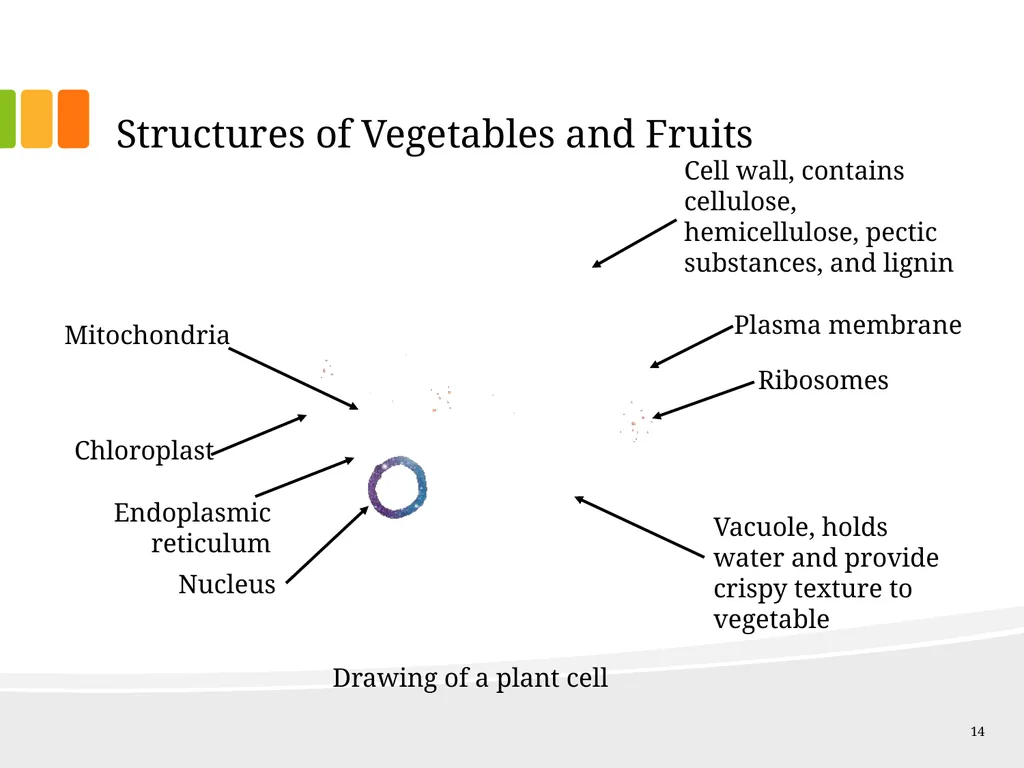
Structures of Vegetables and Fruits 14 Drawing of a plant cell Cell wall, contains cellulose, hemicellulose, pectic substances, and lignin Plasma membrane Ribosomes Vacuole, holds water and provide crispy texture to vegetable Mitochondria Chloroplast Nucleus Endoplasmic reticulum<br>
15
Nutritive Value of Vegetables and Fruits 15<br>
16
Nutritive Value of Vegetables and Fruits All vegetables and fruits provide dietary fibre and water
Green vegetables are the main source of vitamin C
Green, orange, yellow and red vegetables provide vitamin A
Dark green vegetables provide calcium and iron
Root and tuber vegetables contain starch
Bulb vegetables contain sugar
Fruits are good source of vitamins and minerals
Fat is low in the majority of fruits and vegetables 16<br>
Green vegetables are the main source of vitamin C
Green, orange, yellow and red vegetables provide vitamin A
Dark green vegetables provide calcium and iron
Root and tuber vegetables contain starch
Bulb vegetables contain sugar
Fruits are good source of vitamins and minerals
Fat is low in the majority of fruits and vegetables 16<br>
17
Nutritive Value of Vegetables and Fruits Apart from nutrients, there are continual researches showing that non-nutrient substances can bring beneficial effects to health by their:
antioxidant properties (beta-carotene, vitamin C, and vitamin E)
anticarcinogenic properties
The Department of Health launched a territory-wide healthy diet campaign, titled "2 plus 3 A Day" in June 2005. The campaign promotes the consumption of at least two servings of fruit and three servings of vegetables every day as part of a balanced diet in order to promote optimal health. 17<br>
antioxidant properties (beta-carotene, vitamin C, and vitamin E)
anticarcinogenic properties
The Department of Health launched a territory-wide healthy diet campaign, titled "2 plus 3 A Day" in June 2005. The campaign promotes the consumption of at least two servings of fruit and three servings of vegetables every day as part of a balanced diet in order to promote optimal health. 17<br>
18
Choice and Storage of Vegetables and Fruits 18<br>
19
Choice and Storage of Vegetables When buying fresh vegetables, check these characteristics:
Ripeness
- If the vegetables are not ripe when they are purchased, they will have poor texture and flavour
Colour and texture
Vegetables should have a bright, characteristic colour and a crisp texture
Colour is the key to nutrition, especially for vitamin A content
Shape
- Misshapen vegetables may be poor in texture and flavour
Size
Extra-large vegetables may be overripe, coarse, and have poor flavour
Extremely small ones tend to be immature and have poor flavour, too
Vegetables should feel heavy in relation to their size 19<br>
Ripeness
- If the vegetables are not ripe when they are purchased, they will have poor texture and flavour
Colour and texture
Vegetables should have a bright, characteristic colour and a crisp texture
Colour is the key to nutrition, especially for vitamin A content
Shape
- Misshapen vegetables may be poor in texture and flavour
Size
Extra-large vegetables may be overripe, coarse, and have poor flavour
Extremely small ones tend to be immature and have poor flavour, too
Vegetables should feel heavy in relation to their size 19<br>
20
Choice and Storage of Vegetables Keep green and salad vegetables crisp and fresh at the bottom vegetable drawer of a refrigerator
Keep root and bulb vegetables in dry, ventilated, and dark place
In some plants, e.g. potatoes sugars increase and starch decreases when stored in refrigerator, leading to flavour and texture quality loss 20<br>
Keep root and bulb vegetables in dry, ventilated, and dark place
In some plants, e.g. potatoes sugars increase and starch decreases when stored in refrigerator, leading to flavour and texture quality loss 20<br>
21
Choice and Storage of Fruits When buying fresh fruits, check these characteristics:
The quality of fresh fruit depends on its maturity and ripeness
Maturity means fruit has reached its full size
Ripeness refers to how ready it is to eat
Choose fruit which has a good colour, is firm and is not damaged
Keep fruit cool and crisp in the refrigerator
Most fruits are climate-dependent when they are grown
Fruit that are grown in tropical area should be stored at room temperature instead of a refrigerator, otherwise they become soft and gelatinous 21<br>
The quality of fresh fruit depends on its maturity and ripeness
Maturity means fruit has reached its full size
Ripeness refers to how ready it is to eat
Choose fruit which has a good colour, is firm and is not damaged
Keep fruit cool and crisp in the refrigerator
Most fruits are climate-dependent when they are grown
Fruit that are grown in tropical area should be stored at room temperature instead of a refrigerator, otherwise they become soft and gelatinous 21<br>
22
Uses of Vegetables and Fruits in Cooking / Diet 22<br>
23
Uses of Vegetables in Cooking / Diet Vegetables are the edible portion of plant eaten with (or as) the main course
Vegetables may be consumed raw or as appetizer, e.g. salad vegetables and Chinese cucumber salad
They can also be made ready for consumption by methods such as baking, boiling, frying, pressure-cooking, blanching, stir-frying, and so forth, e.g.:
Baked vegetables in Portuguese sauce
Minestrone
Onion rings
Carrots in stewed meat dish
Blanched choi sum
Stir-fried mixed vegetables with garlic 23<br>
Vegetables may be consumed raw or as appetizer, e.g. salad vegetables and Chinese cucumber salad
They can also be made ready for consumption by methods such as baking, boiling, frying, pressure-cooking, blanching, stir-frying, and so forth, e.g.:
Baked vegetables in Portuguese sauce
Minestrone
Onion rings
Carrots in stewed meat dish
Blanched choi sum
Stir-fried mixed vegetables with garlic 23<br>
24
Uses of Vegetables in Cooking / Diet Soup/appetizer – e.g. Cream of Mushroom Soup, Borscht, Green Salad, Sweet Corn and Bean Curd Soup
Main course (in particular for vegetarians) – e.g. Cabbage Roll, Stir-fried Assorted Vegetables (炒雜菜)
Side dish of main course in western cuisine
Snack – e.g. Potato Cakes, Deep Fried Stuffed Eggplant 24<br>
Main course (in particular for vegetarians) – e.g. Cabbage Roll, Stir-fried Assorted Vegetables (炒雜菜)
Side dish of main course in western cuisine
Snack – e.g. Potato Cakes, Deep Fried Stuffed Eggplant 24<br>
25
Uses of Fruits in Cooking / Diet Fruit is usually eaten alone
Fruit can be used to prepare:
Breakfast – e.g. fresh fruits, fruits in yoghurt, stewed fruits
Soup – e.g. Sour Cherry Soup, Papaya Soup
Main course – e.g. Pork Chop with Apple Sauce, Deep Fried Spareribs with Strawberry
Dessert – e.g. Apple Pie, Banana Fritters, Fruits in Jelly, Fruit Salad, Summer Pudding
Bakery products – e.g. cakes, biscuits, pastries and bread (e.g. Cookies with Raisins, Fruit Cake, Pineapple Tart, Danish pastry with Apricot, Banana Bread)
Beverage – e.g. smoothies, milk shakes, fruit juice
Preserve – e.g. jam, chutney, marmalade, lemon curd 25<br>
Fruit can be used to prepare:
Breakfast – e.g. fresh fruits, fruits in yoghurt, stewed fruits
Soup – e.g. Sour Cherry Soup, Papaya Soup
Main course – e.g. Pork Chop with Apple Sauce, Deep Fried Spareribs with Strawberry
Dessert – e.g. Apple Pie, Banana Fritters, Fruits in Jelly, Fruit Salad, Summer Pudding
Bakery products – e.g. cakes, biscuits, pastries and bread (e.g. Cookies with Raisins, Fruit Cake, Pineapple Tart, Danish pastry with Apricot, Banana Bread)
Beverage – e.g. smoothies, milk shakes, fruit juice
Preserve – e.g. jam, chutney, marmalade, lemon curd 25<br>
26
Food and Nutrition Labelling of Vegetables and Fruits 26<br>
27
Food and Nutrition Labelling of Vegetables and Fruits Vegetables and fruits that are not sold as prepackaged products in Hong Kong, is not bound to follow the nutrition labelling regulation in Hong Kong 27<br>
28
Food and Nutrition Labelling of Vegetables and Fruits Organic Vegetables and Fruits
Foods labelled “organic” must be grown without the use of
Chemical pesticides
Herbicides
Fertilisers
There must verifiable records of the system of production
Organic products must be 95% organically produced
Pesticide residue would certainly be lowered or nonexistent 28<br>
Foods labelled “organic” must be grown without the use of
Chemical pesticides
Herbicides
Fertilisers
There must verifiable records of the system of production
Organic products must be 95% organically produced
Pesticide residue would certainly be lowered or nonexistent 28<br>
29
Food and Nutrition Labelling of Vegetables and Fruits Organic Vegetables and Fruits
Bacterial counts of organically grown plant material may be higher than conventionally grown foods
There is no evidence that organically grown foods are higher in nutrient content than conventionally grown foods
In Hong Kong, the Hong Kong Organic Resource Center (HKORC) had launched its independent organic certification service for organic farmers and organic food processors
There is currently no legal requirement for organic foods 29<br>
Bacterial counts of organically grown plant material may be higher than conventionally grown foods
There is no evidence that organically grown foods are higher in nutrient content than conventionally grown foods
In Hong Kong, the Hong Kong Organic Resource Center (HKORC) had launched its independent organic certification service for organic farmers and organic food processors
There is currently no legal requirement for organic foods 29<br>
30
Food and Nutrition Labelling of Vegetables and Fruits Green Foods
Green Food project of China is launched to enhance food quality and safety, to promote consumer's health, and to protect agricultural bio-environment for sustainable development
Green Food Certification Standards is the transition between turning conventional farming to organic farming 30<br>
Green Food project of China is launched to enhance food quality and safety, to promote consumer's health, and to protect agricultural bio-environment for sustainable development
Green Food Certification Standards is the transition between turning conventional farming to organic farming 30<br>
31
References Provost, J., Kelly, B., Bodwin, J., & Wallert, M. (2016). The Science of Cooking. John Wiley & Sons.
Vickie A. Vaclavik, Elizabeth W. Christian. Essentials of food science. New York, NY: Springer, c2008.
Department of Health - Press Release (27 August 2005).
Hong Kong Organic Resource Centre
中国绿色食品发展中心 31<br>
Vickie A. Vaclavik, Elizabeth W. Christian. Essentials of food science. New York, NY: Springer, c2008.
Department of Health - Press Release (27 August 2005).
Hong Kong Organic Resource Centre
中国绿色食品发展中心 31<br>