
Unit 38 & 50: Customer Value Management P1 Explain


Description: Unit 38 50: Customer Value Management P1 Explain and analyse the various components that enable an organization to determine and calculate a customers lifetime value DEFINE; CUSTOMER VALUE? CUSTOMER VALUE Customer value is the
Related Topics
Download Presentation
"Unit 38 & 50: Customer Value Management P1 Explain" is the property of its rightful owner. Permission is granted to download and print the materials on this website for personal, non-commercial use only, and to display it on your personal computer provided you do not modify the materials and that you retain all copyright notices contained in the materials. By downloading content from our website, you accept the terms of this agreement.
Presentation Transcript
slide1. Unit 38 & 50: Customer Value Management P1 Explain and analyse the various components that enable an organization to determine and calculate a customer’s lifetime value<br>
slide2. DEFINE; CUSTOMER VALUE?<br>
slide3. CUSTOMER VALUE “Customer value is the perception of what a product or service is worth to a customer versus the possible alternatives”(Kothari, 2012, sec. 1).
Value has many different meanings, to some value means;
Price (what is the value of this car?)
Benefit (the value I got from this car)
The worth of something. That is why you hear some people saying, “value for money” (meaning they are price sensitive);
and others who prefer “money for value” (meaning they are willing to pay for what they consider as benefits, as from a brand or a better product, or more convenience etc.)<br>
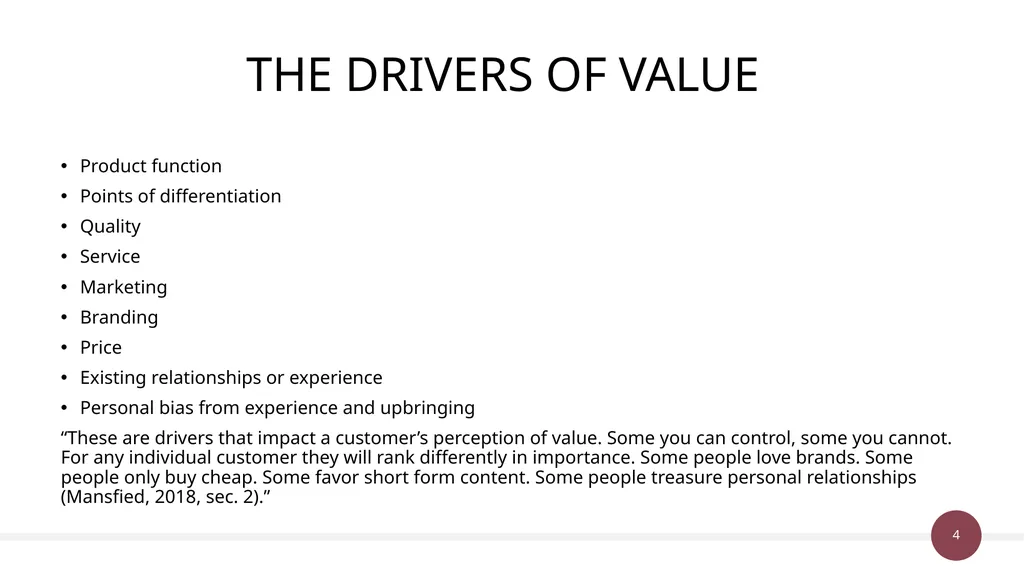
slide4. THE DRIVERS OF VALUE Product function
Points of differentiation
Quality
Service
Marketing
Branding
Price
Existing relationships or experience
Personal bias from experience and upbringing
“These are drivers that impact a customer’s perception of value. Some you can control, some you cannot. For any individual customer they will rank differently in importance. Some people love brands. Some people only buy cheap. Some favor short form content. Some people treasure personal relationships (Mansfied, 2018, sec. 2).”<br>
slide5. DEFINE; CUSTOMER SATISFACTION?<br>
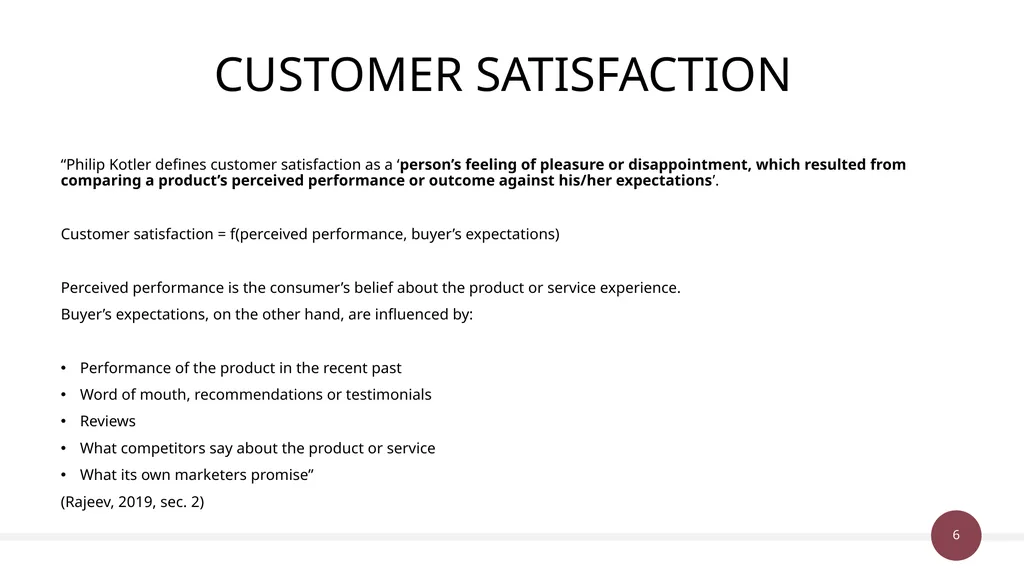
slide6. CUSTOMER SATISFACTION “Philip Kotler defines customer satisfaction as a ‘person’s feeling of pleasure or disappointment, which resulted from comparing a product’s perceived performance or outcome against his/her expectations’.
Customer satisfaction = f(perceived performance, buyer’s expectations)
Perceived performance is the consumer’s belief about the product or service experience.
Buyer’s expectations, on the other hand, are influenced by:
Performance of the product in the recent past
Word of mouth, recommendations or testimonials
Reviews
What competitors say about the product or service
What its own marketers promise”
(Rajeev, 2019, sec. 2)<br>
slide7. DEFINE; CUSTOMER RETENTION?<br>
slide8. CUSTOMER RETENTION Customer retention is the ability of a company to retain its customers over a period of time.
Customer retention is important because it measures not only how successful companies are at acquiring new customers, but also how successful they are at satisfying existing customers.
It's easier and more cost-effective to retain customers than to acquire new ones as returning customers spend more, buy more often and refer friends and family.
(Bernazzani, 2019)<br>
slide9. 3 WAYS TO IMPROVE CUSTOMER RETENTION https://www.copper.com/blog/customer-retention-rate<br>
slide10. WHAT IS CUSTOMER VALUE MANAGEMENT?<br>
slide11. CUSTOMER VALUE MANAGEMENT CVM helps corporations develop tailored products and services to their customers, in order to maximize profits on an individual customer level.
The goal of CVM is to move towards mass customized offers and price discrimination based on:
– Willingness to pay (both consumer and corporate)
– Current customer value and usage profiles
– Churn and migration risks<br>
slide12. CUSTOMER VALUE MANAGEMENT CVM enables companies to manage their firm value in the face of rapidly decreasing prices and potentially slower acquisition growth.
Specifically, CVM generates or preserves value through:
– Usage stimulation through micro-targeted offers
– Rate plan and feature migration management through improved understanding of reprice potential and proactive offer design
– Churn prevention through improved predictive modeling and targeted retention strategy
– Improved acquisition strategies which consider existing base impact<br>
slide13. CUSTOMER VALUE MANAGEMENT The concept of customer value management is simple. It's about:
“asking customers in your target market what they're looking for when they do business with vendors
determining how customers in your target market rate the value you provide relative to the value provided by your competitors
deciding what changes on your part will have the greatest positive impact on customers' perception of the relative value of your offering
aligning people and processes in a common focus to deliver value
providing a consistent flow of data and information to keep them aligned
winning with customers, with employees and with shareholders”
(What is customer value management?, 2016, sec. 1)<br>
slide14. DEFINE; CUSTOMER LIFETIME VALUE?<br>
slide15. CUSTOMER LIFETIME VALUE “In marketing, customer lifetime value (CLV) is a metric that represents the total net profit a company makes from any given customer. CLV is a projection to estimate a customer's monetary worth to a business after factoring in the value of the relationship with a customer over time. CLV is an important metric for determining how much money a company wants to spend on acquiring new customers and how much repeat business a company can expect from certain consumers (Rouse, 2015, par. 1).”<br>
slide16. WHY IS KNOWING THE LIFETIME VALUE OF YOUR CUSTOMERS IMPORTANT?<br>
slide17. IMPORTANCE OF CUSTOMER LIFETIME VALUE Customer lifetime value is important because, the higher the number, the greater the profits. You’ll always have to spend money to acquire new customers and to retain existing ones, but the former costs five times as much.<br>
slide18. 9 Ways to Increase Your Customer Lifetime Value https://www.crazyegg.com/blog/customer-lifetime-value/<br>
slide19. How To Calculate Customer Lifetime Value<br>
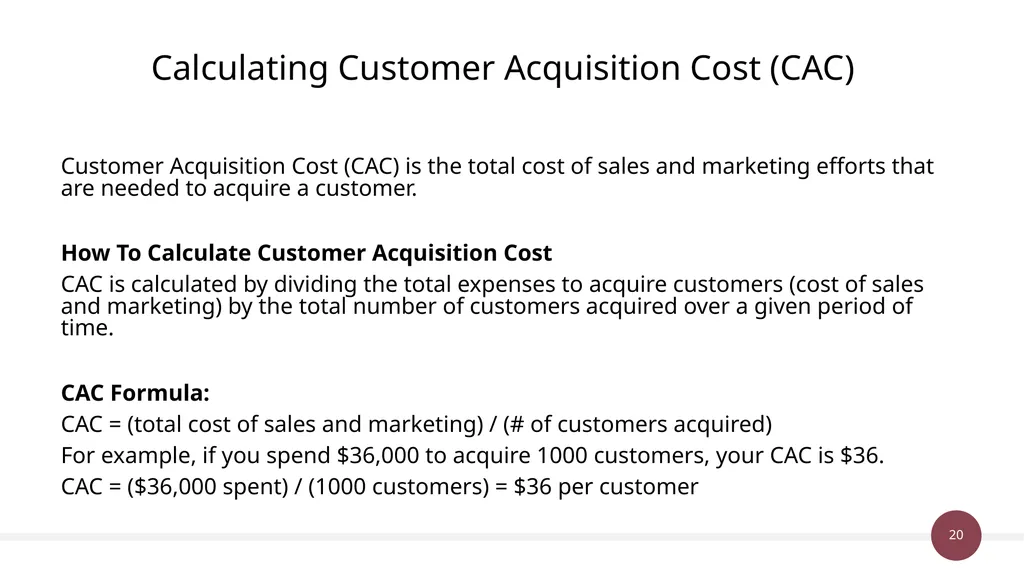
slide20. Calculating Customer Acquisition Cost (CAC) Customer Acquisition Cost (CAC) is the total cost of sales and marketing efforts that are needed to acquire a customer.
How To Calculate Customer Acquisition Cost
CAC is calculated by dividing the total expenses to acquire customers (cost of sales and marketing) by the total number of customers acquired over a given period of time.
CAC Formula:
CAC = (total cost of sales and marketing) / (# of customers acquired)
For example, if you spend $36,000 to acquire 1000 customers, your CAC is $36.
CAC = ($36,000 spent) / (1000 customers) = $36 per customer<br>
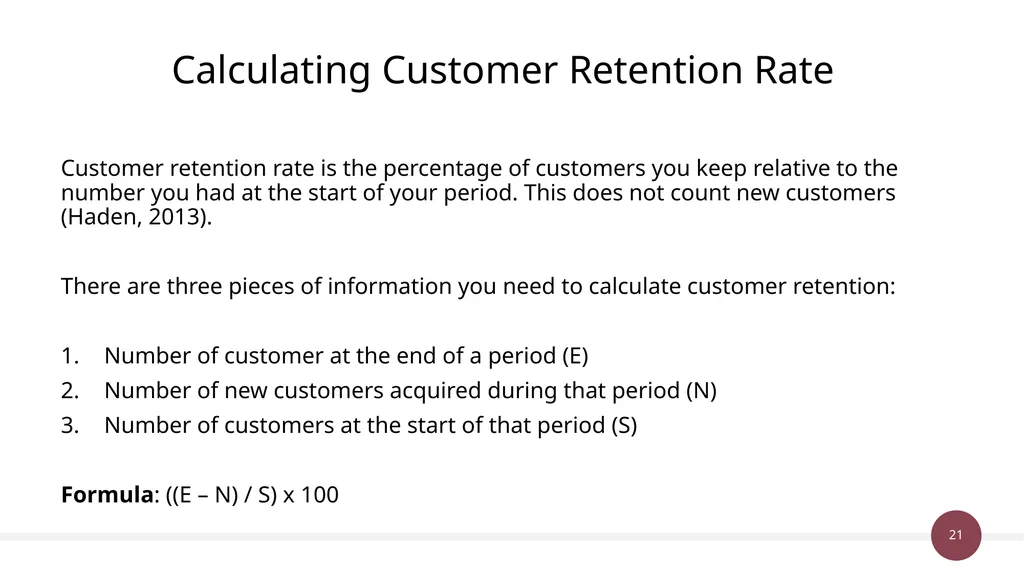
slide21. Calculating Customer Retention Rate Customer retention rate is the percentage of customers you keep relative to the number you had at the start of your period. This does not count new customers (Haden, 2013).
There are three pieces of information you need to calculate customer retention:
Number of customer at the end of a period (E)
Number of new customers acquired during that period (N)
Number of customers at the start of that period (S)
Formula: ((E – N) / S) x 100<br>
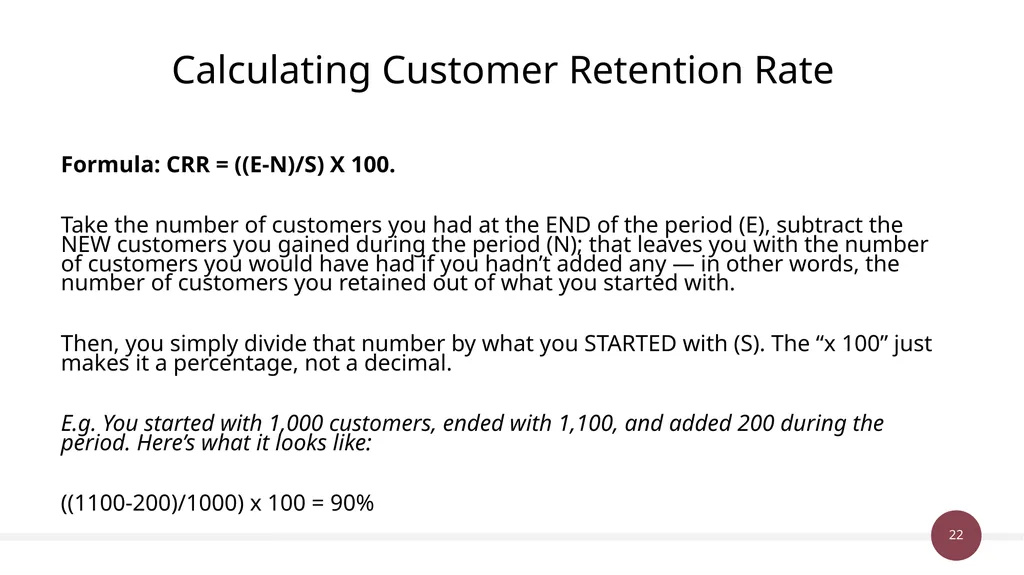
slide22. Calculating Customer Retention Rate Formula: CRR = ((E-N)/S) X 100.
Take the number of customers you had at the END of the period (E), subtract the NEW customers you gained during the period (N); that leaves you with the number of customers you would have had if you hadn’t added any — in other words, the number of customers you retained out of what you started with.
Then, you simply divide that number by what you STARTED with (S). The “x 100” just makes it a percentage, not a decimal.
E.g. You started with 1,000 customers, ended with 1,100, and added 200 during the period. Here’s what it looks like:
((1100-200)/1000) x 100 = 90%<br>
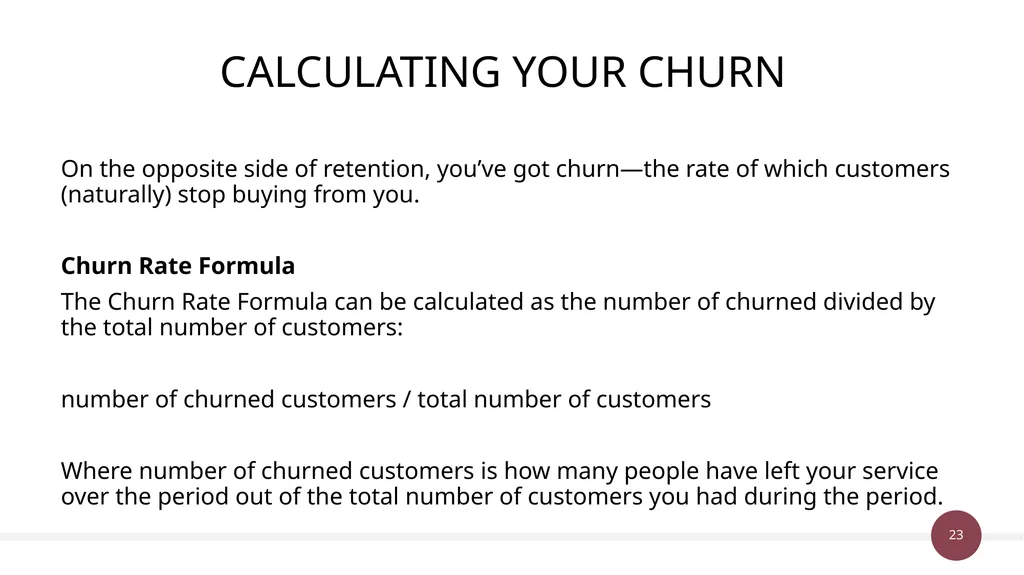
slide23. CALCULATING YOUR CHURN On the opposite side of retention, you’ve got churn—the rate of which customers (naturally) stop buying from you.
Churn Rate Formula
The Churn Rate Formula can be calculated as the number of churned divided by the total number of customers:
number of churned customers / total number of customers
Where number of churned customers is how many people have left your service over the period out of the total number of customers you had during the period.<br>
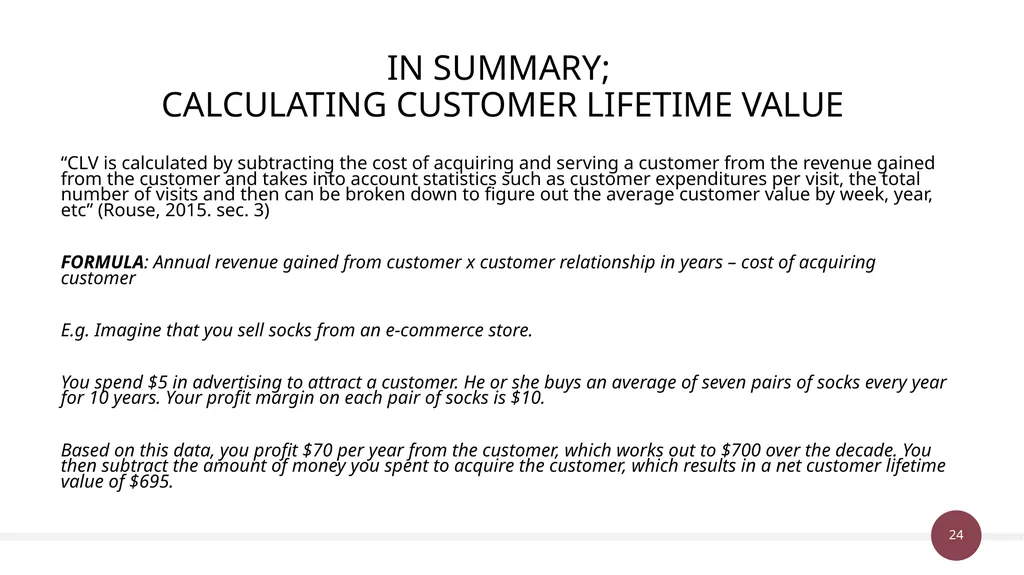
slide24. IN SUMMARY; CALCULATING CUSTOMER LIFETIME VALUE “CLV is calculated by subtracting the cost of acquiring and serving a customer from the revenue gained from the customer and takes into account statistics such as customer expenditures per visit, the total number of visits and then can be broken down to figure out the average customer value by week, year, etc” (Rouse, 2015. sec. 3)
FORMULA: Annual revenue gained from customer x customer relationship in years – cost of acquiring customer
E.g. Imagine that you sell socks from an e-commerce store.
You spend $5 in advertising to attract a customer. He or she buys an average of seven pairs of socks every year for 10 years. Your profit margin on each pair of socks is $10.
Based on this data, you profit $70 per year from the customer, which works out to $700 over the decade. You then subtract the amount of money you spent to acquire the customer, which results in a net customer lifetime value of $695.<br>
slide25. PAIR UP! CLASS ACTIVITY 10 Question Quiz With Prize<br>
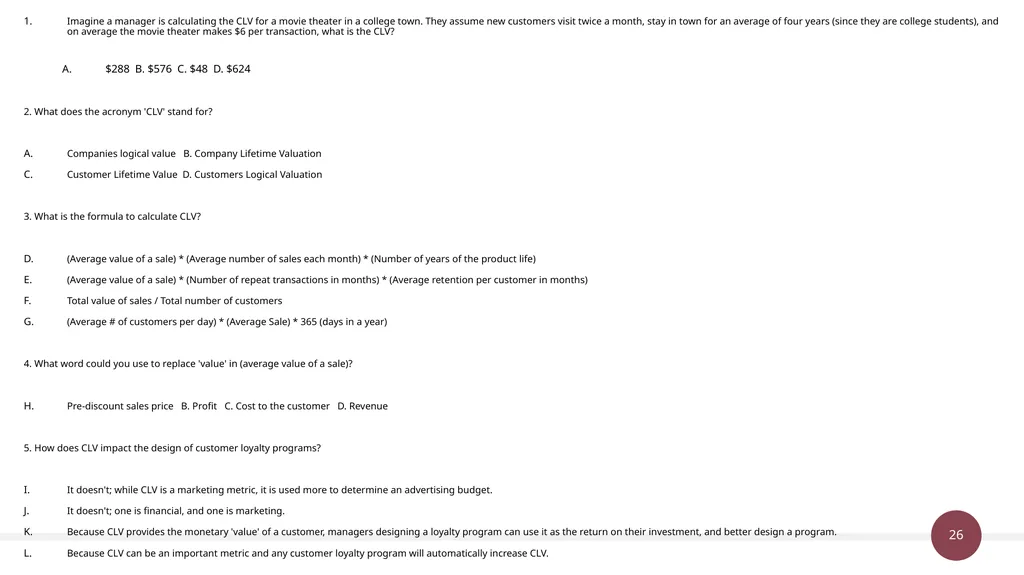
slide26. Imagine a manager is calculating the CLV for a movie theater in a college town. They assume new customers visit twice a month, stay in town for an average of four years (since they are college students), and on average the movie theater makes $6 per transaction, what is the CLV?
$288 B. $576 C. $48 D. $624
2. What does the acronym 'CLV' stand for?
Companies logical value B. Company Lifetime Valuation
Customer Lifetime Value D. Customers Logical Valuation
3. What is the formula to calculate CLV?
(Average value of a sale) * (Average number of sales each month) * (Number of years of the product life)
(Average value of a sale) * (Number of repeat transactions in months) * (Average retention per customer in months)
Total value of sales / Total number of customers
(Average # of customers per day) * (Average Sale) * 365 (days in a year)
4. What word could you use to replace 'value' in (average value of a sale)?
Pre-discount sales price B. Profit C. Cost to the customer D. Revenue
5. How does CLV impact the design of customer loyalty programs?
It doesn't; while CLV is a marketing metric, it is used more to determine an advertising budget.
It doesn't; one is financial, and one is marketing.
Because CLV provides the monetary 'value' of a customer, managers designing a loyalty program can use it as the return on their investment, and better design a program.
Because CLV can be an important metric and any customer loyalty program will automatically increase CLV.<br>
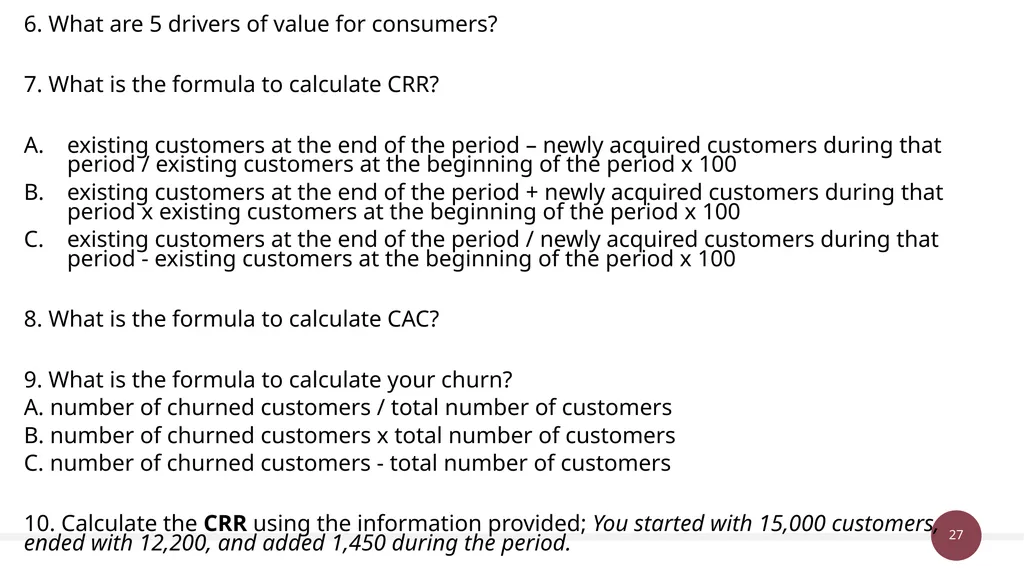
slide27. 6. What are 5 drivers of value for consumers?
7. What is the formula to calculate CRR?
existing customers at the end of the period – newly acquired customers during that period / existing customers at the beginning of the period x 100
existing customers at the end of the period + newly acquired customers during that period x existing customers at the beginning of the period x 100
existing customers at the end of the period / newly acquired customers during that period - existing customers at the beginning of the period x 100
8. What is the formula to calculate CAC?
9. What is the formula to calculate your churn?
A. number of churned customers / total number of customers
B. number of churned customers x total number of customers
C. number of churned customers - total number of customers
10. Calculate the CRR using the information provided; You started with 15,000 customers, ended with 12,200, and added 1,450 during the period.<br>
slide28. REFERENCES Bernazzani, S. (2019). The Ultimate Guide to Customer Retention. [online] Blog.hubspot.com. Available at: https://blog.hubspot.com/service/customer-retention [Accessed 4 Jan. 2020].
cvminc.com. (2015). WHAT IS CUSTOMER VALUE MANAGEMENT?. [online] Available at: http://www.cvminc.com/what-is-cvm.html [Accessed 4 Jan. 2020].
Haden, J. (2013). Best Way to Track Customer Retention. [online] Inc.com. Available at: https://www.inc.com/jeff-haden/best-way-to-calculate-customer-retention-rate.html [Accessed 4 Jan. 2020].
KOTHARI, A. (2017). Customer Value: What it Means and How to Create It [5+ Ideas] - Tallyfy. [online] Tallyfy. Available at: https://tallyfy.com/customer-value/ [Accessed 4 Jan. 2020].
Mansfield, D. (2018). Customer Value: What it Means & Why It's Important - Builtvisible. [online] Builtvisible. Available at: https://builtvisible.com/understanding-customer-value/ [Accessed 4 Jan. 2020].
Rajeev, M. (2019). What is Customer Satisfaction?. [online] Freshcaller Blog. Available at: https://www.freshworks.com/freshcaller-cloud-pbx/call-center-software/customer-satisfaction-definition-blog/ [Accessed 4 Jan. 2020].
Rouse, M. (2015). What is customer lifetime value (CLV)? - Definition from WhatIs.com. [online] SearchCustomerExperience. Available at: https://searchcustomerexperience.techtarget.com/definition/customer-lifetime-value-CLV [Accessed 4 Jan. 2020].<br>
slide2. DEFINE; CUSTOMER VALUE?<br>
slide3. CUSTOMER VALUE “Customer value is the perception of what a product or service is worth to a customer versus the possible alternatives”(Kothari, 2012, sec. 1).
Value has many different meanings, to some value means;
Price (what is the value of this car?)
Benefit (the value I got from this car)
The worth of something. That is why you hear some people saying, “value for money” (meaning they are price sensitive);
and others who prefer “money for value” (meaning they are willing to pay for what they consider as benefits, as from a brand or a better product, or more convenience etc.)<br>
slide4. THE DRIVERS OF VALUE Product function
Points of differentiation
Quality
Service
Marketing
Branding
Price
Existing relationships or experience
Personal bias from experience and upbringing
“These are drivers that impact a customer’s perception of value. Some you can control, some you cannot. For any individual customer they will rank differently in importance. Some people love brands. Some people only buy cheap. Some favor short form content. Some people treasure personal relationships (Mansfied, 2018, sec. 2).”<br>
slide5. DEFINE; CUSTOMER SATISFACTION?<br>
slide6. CUSTOMER SATISFACTION “Philip Kotler defines customer satisfaction as a ‘person’s feeling of pleasure or disappointment, which resulted from comparing a product’s perceived performance or outcome against his/her expectations’.
Customer satisfaction = f(perceived performance, buyer’s expectations)
Perceived performance is the consumer’s belief about the product or service experience.
Buyer’s expectations, on the other hand, are influenced by:
Performance of the product in the recent past
Word of mouth, recommendations or testimonials
Reviews
What competitors say about the product or service
What its own marketers promise”
(Rajeev, 2019, sec. 2)<br>
slide7. DEFINE; CUSTOMER RETENTION?<br>
slide8. CUSTOMER RETENTION Customer retention is the ability of a company to retain its customers over a period of time.
Customer retention is important because it measures not only how successful companies are at acquiring new customers, but also how successful they are at satisfying existing customers.
It's easier and more cost-effective to retain customers than to acquire new ones as returning customers spend more, buy more often and refer friends and family.
(Bernazzani, 2019)<br>
slide9. 3 WAYS TO IMPROVE CUSTOMER RETENTION https://www.copper.com/blog/customer-retention-rate<br>
slide10. WHAT IS CUSTOMER VALUE MANAGEMENT?<br>
slide11. CUSTOMER VALUE MANAGEMENT CVM helps corporations develop tailored products and services to their customers, in order to maximize profits on an individual customer level.
The goal of CVM is to move towards mass customized offers and price discrimination based on:
– Willingness to pay (both consumer and corporate)
– Current customer value and usage profiles
– Churn and migration risks<br>
slide12. CUSTOMER VALUE MANAGEMENT CVM enables companies to manage their firm value in the face of rapidly decreasing prices and potentially slower acquisition growth.
Specifically, CVM generates or preserves value through:
– Usage stimulation through micro-targeted offers
– Rate plan and feature migration management through improved understanding of reprice potential and proactive offer design
– Churn prevention through improved predictive modeling and targeted retention strategy
– Improved acquisition strategies which consider existing base impact<br>
slide13. CUSTOMER VALUE MANAGEMENT The concept of customer value management is simple. It's about:
“asking customers in your target market what they're looking for when they do business with vendors
determining how customers in your target market rate the value you provide relative to the value provided by your competitors
deciding what changes on your part will have the greatest positive impact on customers' perception of the relative value of your offering
aligning people and processes in a common focus to deliver value
providing a consistent flow of data and information to keep them aligned
winning with customers, with employees and with shareholders”
(What is customer value management?, 2016, sec. 1)<br>
slide14. DEFINE; CUSTOMER LIFETIME VALUE?<br>
slide15. CUSTOMER LIFETIME VALUE “In marketing, customer lifetime value (CLV) is a metric that represents the total net profit a company makes from any given customer. CLV is a projection to estimate a customer's monetary worth to a business after factoring in the value of the relationship with a customer over time. CLV is an important metric for determining how much money a company wants to spend on acquiring new customers and how much repeat business a company can expect from certain consumers (Rouse, 2015, par. 1).”<br>
slide16. WHY IS KNOWING THE LIFETIME VALUE OF YOUR CUSTOMERS IMPORTANT?<br>
slide17. IMPORTANCE OF CUSTOMER LIFETIME VALUE Customer lifetime value is important because, the higher the number, the greater the profits. You’ll always have to spend money to acquire new customers and to retain existing ones, but the former costs five times as much.<br>
slide18. 9 Ways to Increase Your Customer Lifetime Value https://www.crazyegg.com/blog/customer-lifetime-value/<br>
slide19. How To Calculate Customer Lifetime Value<br>
slide20. Calculating Customer Acquisition Cost (CAC) Customer Acquisition Cost (CAC) is the total cost of sales and marketing efforts that are needed to acquire a customer.
How To Calculate Customer Acquisition Cost
CAC is calculated by dividing the total expenses to acquire customers (cost of sales and marketing) by the total number of customers acquired over a given period of time.
CAC Formula:
CAC = (total cost of sales and marketing) / (# of customers acquired)
For example, if you spend $36,000 to acquire 1000 customers, your CAC is $36.
CAC = ($36,000 spent) / (1000 customers) = $36 per customer<br>
slide21. Calculating Customer Retention Rate Customer retention rate is the percentage of customers you keep relative to the number you had at the start of your period. This does not count new customers (Haden, 2013).
There are three pieces of information you need to calculate customer retention:
Number of customer at the end of a period (E)
Number of new customers acquired during that period (N)
Number of customers at the start of that period (S)
Formula: ((E – N) / S) x 100<br>
slide22. Calculating Customer Retention Rate Formula: CRR = ((E-N)/S) X 100.
Take the number of customers you had at the END of the period (E), subtract the NEW customers you gained during the period (N); that leaves you with the number of customers you would have had if you hadn’t added any — in other words, the number of customers you retained out of what you started with.
Then, you simply divide that number by what you STARTED with (S). The “x 100” just makes it a percentage, not a decimal.
E.g. You started with 1,000 customers, ended with 1,100, and added 200 during the period. Here’s what it looks like:
((1100-200)/1000) x 100 = 90%<br>
slide23. CALCULATING YOUR CHURN On the opposite side of retention, you’ve got churn—the rate of which customers (naturally) stop buying from you.
Churn Rate Formula
The Churn Rate Formula can be calculated as the number of churned divided by the total number of customers:
number of churned customers / total number of customers
Where number of churned customers is how many people have left your service over the period out of the total number of customers you had during the period.<br>
slide24. IN SUMMARY; CALCULATING CUSTOMER LIFETIME VALUE “CLV is calculated by subtracting the cost of acquiring and serving a customer from the revenue gained from the customer and takes into account statistics such as customer expenditures per visit, the total number of visits and then can be broken down to figure out the average customer value by week, year, etc” (Rouse, 2015. sec. 3)
FORMULA: Annual revenue gained from customer x customer relationship in years – cost of acquiring customer
E.g. Imagine that you sell socks from an e-commerce store.
You spend $5 in advertising to attract a customer. He or she buys an average of seven pairs of socks every year for 10 years. Your profit margin on each pair of socks is $10.
Based on this data, you profit $70 per year from the customer, which works out to $700 over the decade. You then subtract the amount of money you spent to acquire the customer, which results in a net customer lifetime value of $695.<br>
slide25. PAIR UP! CLASS ACTIVITY 10 Question Quiz With Prize<br>
slide26. Imagine a manager is calculating the CLV for a movie theater in a college town. They assume new customers visit twice a month, stay in town for an average of four years (since they are college students), and on average the movie theater makes $6 per transaction, what is the CLV?
$288 B. $576 C. $48 D. $624
2. What does the acronym 'CLV' stand for?
Companies logical value B. Company Lifetime Valuation
Customer Lifetime Value D. Customers Logical Valuation
3. What is the formula to calculate CLV?
(Average value of a sale) * (Average number of sales each month) * (Number of years of the product life)
(Average value of a sale) * (Number of repeat transactions in months) * (Average retention per customer in months)
Total value of sales / Total number of customers
(Average # of customers per day) * (Average Sale) * 365 (days in a year)
4. What word could you use to replace 'value' in (average value of a sale)?
Pre-discount sales price B. Profit C. Cost to the customer D. Revenue
5. How does CLV impact the design of customer loyalty programs?
It doesn't; while CLV is a marketing metric, it is used more to determine an advertising budget.
It doesn't; one is financial, and one is marketing.
Because CLV provides the monetary 'value' of a customer, managers designing a loyalty program can use it as the return on their investment, and better design a program.
Because CLV can be an important metric and any customer loyalty program will automatically increase CLV.<br>
slide27. 6. What are 5 drivers of value for consumers?
7. What is the formula to calculate CRR?
existing customers at the end of the period – newly acquired customers during that period / existing customers at the beginning of the period x 100
existing customers at the end of the period + newly acquired customers during that period x existing customers at the beginning of the period x 100
existing customers at the end of the period / newly acquired customers during that period - existing customers at the beginning of the period x 100
8. What is the formula to calculate CAC?
9. What is the formula to calculate your churn?
A. number of churned customers / total number of customers
B. number of churned customers x total number of customers
C. number of churned customers - total number of customers
10. Calculate the CRR using the information provided; You started with 15,000 customers, ended with 12,200, and added 1,450 during the period.<br>
slide28. REFERENCES Bernazzani, S. (2019). The Ultimate Guide to Customer Retention. [online] Blog.hubspot.com. Available at: https://blog.hubspot.com/service/customer-retention [Accessed 4 Jan. 2020].
cvminc.com. (2015). WHAT IS CUSTOMER VALUE MANAGEMENT?. [online] Available at: http://www.cvminc.com/what-is-cvm.html [Accessed 4 Jan. 2020].
Haden, J. (2013). Best Way to Track Customer Retention. [online] Inc.com. Available at: https://www.inc.com/jeff-haden/best-way-to-calculate-customer-retention-rate.html [Accessed 4 Jan. 2020].
KOTHARI, A. (2017). Customer Value: What it Means and How to Create It [5+ Ideas] - Tallyfy. [online] Tallyfy. Available at: https://tallyfy.com/customer-value/ [Accessed 4 Jan. 2020].
Mansfield, D. (2018). Customer Value: What it Means & Why It's Important - Builtvisible. [online] Builtvisible. Available at: https://builtvisible.com/understanding-customer-value/ [Accessed 4 Jan. 2020].
Rajeev, M. (2019). What is Customer Satisfaction?. [online] Freshcaller Blog. Available at: https://www.freshworks.com/freshcaller-cloud-pbx/call-center-software/customer-satisfaction-definition-blog/ [Accessed 4 Jan. 2020].
Rouse, M. (2015). What is customer lifetime value (CLV)? - Definition from WhatIs.com. [online] SearchCustomerExperience. Available at: https://searchcustomerexperience.techtarget.com/definition/customer-lifetime-value-CLV [Accessed 4 Jan. 2020].<br>