
Workplace Violence ACC Presentation .
BR
Published · 29 slides · 0 views
1 / 1

Description
Workplace Violence ACC Presentation . ogletreedeakins.com Presented by: Sheri Giger 2018, Ogletree, Deakins Nash, Smoak Stewart, P.C. What is workplace violence? The Occupational Safety and Health Administration (OSHA) defines
Related Topics
Share
Embed code
Download this presentation From Below
"Workplace Violence ACC Presentation ." is the property of its rightful owner. Permission is granted to download and print the materials on this website for personal, non-commercial use only, and to display it on your personal computer provided you do not modify the materials and that you retain all copyright notices contained in the materials. By downloading content from our website, you accept the terms of this agreement.
Presentation Transcript
01
Workplace Violence
ACC Presentation . ogletreedeakins.com Presented by:
Sheri Giger © 2018, Ogletree, Deakins Nash, Smoak & Stewart, P.C.<br>
ACC Presentation . ogletreedeakins.com Presented by:
Sheri Giger © 2018, Ogletree, Deakins Nash, Smoak & Stewart, P.C.<br>
02
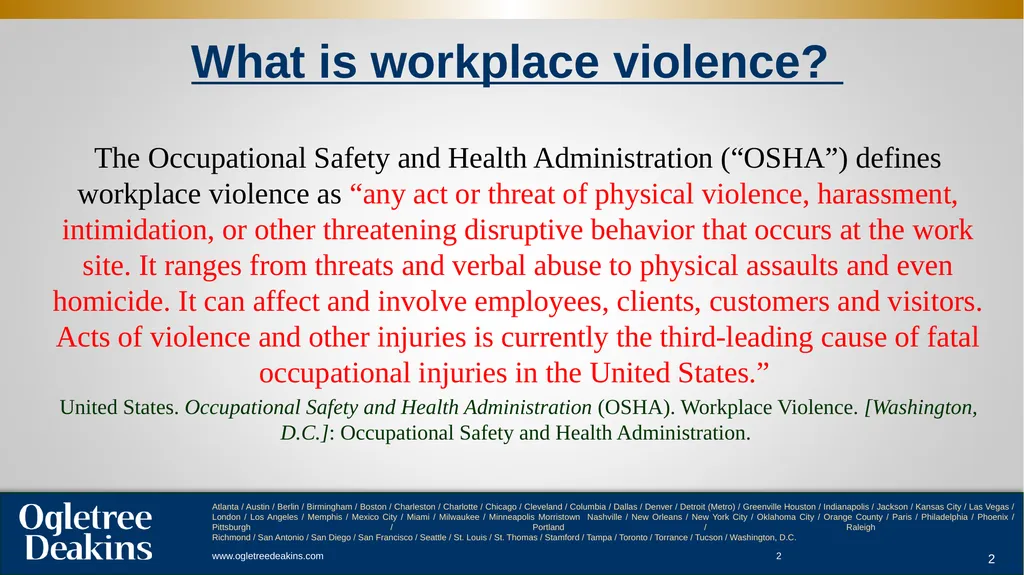
What is workplace violence? The Occupational Safety and Health Administration (“OSHA”) defines workplace violence as “any act or threat of physical violence, harassment, intimidation, or other threatening disruptive behavior that occurs at the work site. It ranges from threats and verbal abuse to physical assaults and even homicide. It can affect and involve employees, clients, customers and visitors. Acts of violence and other injuries is currently the third-leading cause of fatal occupational injuries in the United States.”
United States. Occupational Safety and Health Administration (OSHA). Workplace Violence. [Washington, D.C.]: Occupational Safety and Health Administration. 2<br>
United States. Occupational Safety and Health Administration (OSHA). Workplace Violence. [Washington, D.C.]: Occupational Safety and Health Administration. 2<br>
03
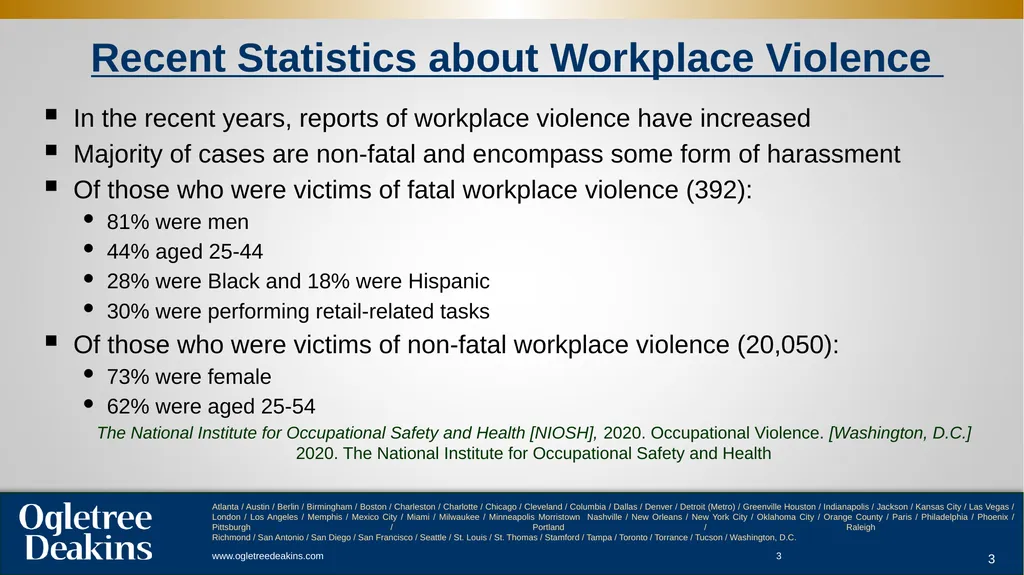
Recent Statistics about Workplace Violence In the recent years, reports of workplace violence have increased
Majority of cases are non-fatal and encompass some form of harassment
Of those who were victims of fatal workplace violence (392):
81% were men
44% aged 25-44
28% were Black and 18% were Hispanic
30% were performing retail-related tasks
Of those who were victims of non-fatal workplace violence (20,050):
73% were female
62% were aged 25-54
The National Institute for Occupational Safety and Health [NIOSH], 2020. Occupational Violence. [Washington, D.C.] 2020. The National Institute for Occupational Safety and Health 3<br>
Majority of cases are non-fatal and encompass some form of harassment
Of those who were victims of fatal workplace violence (392):
81% were men
44% aged 25-44
28% were Black and 18% were Hispanic
30% were performing retail-related tasks
Of those who were victims of non-fatal workplace violence (20,050):
73% were female
62% were aged 25-54
The National Institute for Occupational Safety and Health [NIOSH], 2020. Occupational Violence. [Washington, D.C.] 2020. The National Institute for Occupational Safety and Health 3<br>
04
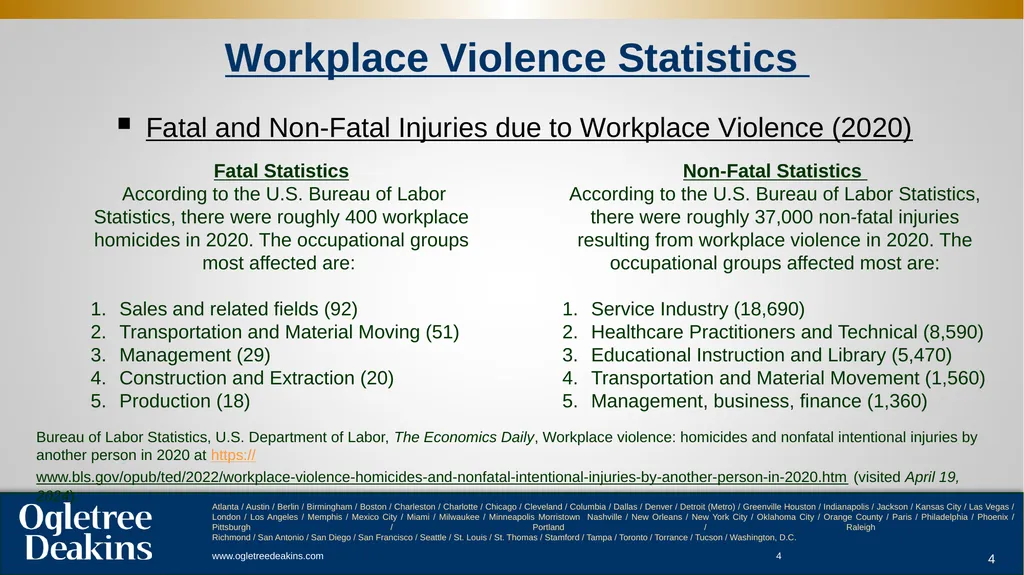
Workplace Violence Statistics Fatal and Non-Fatal Injuries due to Workplace Violence (2020) Fatal Statistics
According to the U.S. Bureau of Labor Statistics, there were roughly 400 workplace homicides in 2020. The occupational groups most affected are:
Sales and related fields (92)
Transportation and Material Moving (51)
Management (29)
Construction and Extraction (20)
Production (18) Non-Fatal Statistics
According to the U.S. Bureau of Labor Statistics, there were roughly 37,000 non-fatal injuries resulting from workplace violence in 2020. The occupational groups affected most are:
Service Industry (18,690)
Healthcare Practitioners and Technical (8,590)
Educational Instruction and Library (5,470)
Transportation and Material Movement (1,560)
Management, business, finance (1,360) 4 Bureau of Labor Statistics, U.S. Department of Labor, The Economics Daily, Workplace violence: homicides and nonfatal intentional injuries by another person in 2020 at https://www.bls.gov/opub/ted/2022/workplace-violence-homicides-and-nonfatal-intentional-injuries-by-another-person-in-2020.htm (visited April 19, 2024).<br>
According to the U.S. Bureau of Labor Statistics, there were roughly 400 workplace homicides in 2020. The occupational groups most affected are:
Sales and related fields (92)
Transportation and Material Moving (51)
Management (29)
Construction and Extraction (20)
Production (18) Non-Fatal Statistics
According to the U.S. Bureau of Labor Statistics, there were roughly 37,000 non-fatal injuries resulting from workplace violence in 2020. The occupational groups affected most are:
Service Industry (18,690)
Healthcare Practitioners and Technical (8,590)
Educational Instruction and Library (5,470)
Transportation and Material Movement (1,560)
Management, business, finance (1,360) 4 Bureau of Labor Statistics, U.S. Department of Labor, The Economics Daily, Workplace violence: homicides and nonfatal intentional injuries by another person in 2020 at https://www.bls.gov/opub/ted/2022/workplace-violence-homicides-and-nonfatal-intentional-injuries-by-another-person-in-2020.htm (visited April 19, 2024).<br>
05
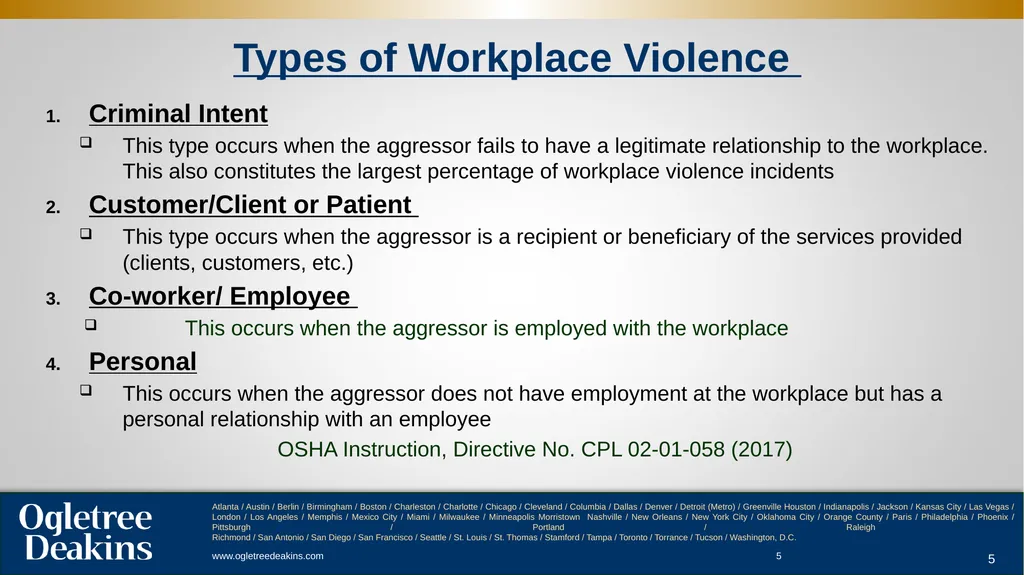
Types of Workplace Violence Criminal Intent
This type occurs when the aggressor fails to have a legitimate relationship to the workplace. This also constitutes the largest percentage of workplace violence incidents
Customer/Client or Patient
This type occurs when the aggressor is a recipient or beneficiary of the services provided (clients, customers, etc.)
Co-worker/ Employee
This occurs when the aggressor is employed with the workplace
Personal
This occurs when the aggressor does not have employment at the workplace but has a personal relationship with an employee
OSHA Instruction, Directive No. CPL 02-01-058 (2017) 5<br>
This type occurs when the aggressor fails to have a legitimate relationship to the workplace. This also constitutes the largest percentage of workplace violence incidents
Customer/Client or Patient
This type occurs when the aggressor is a recipient or beneficiary of the services provided (clients, customers, etc.)
Co-worker/ Employee
This occurs when the aggressor is employed with the workplace
Personal
This occurs when the aggressor does not have employment at the workplace but has a personal relationship with an employee
OSHA Instruction, Directive No. CPL 02-01-058 (2017) 5<br>
06
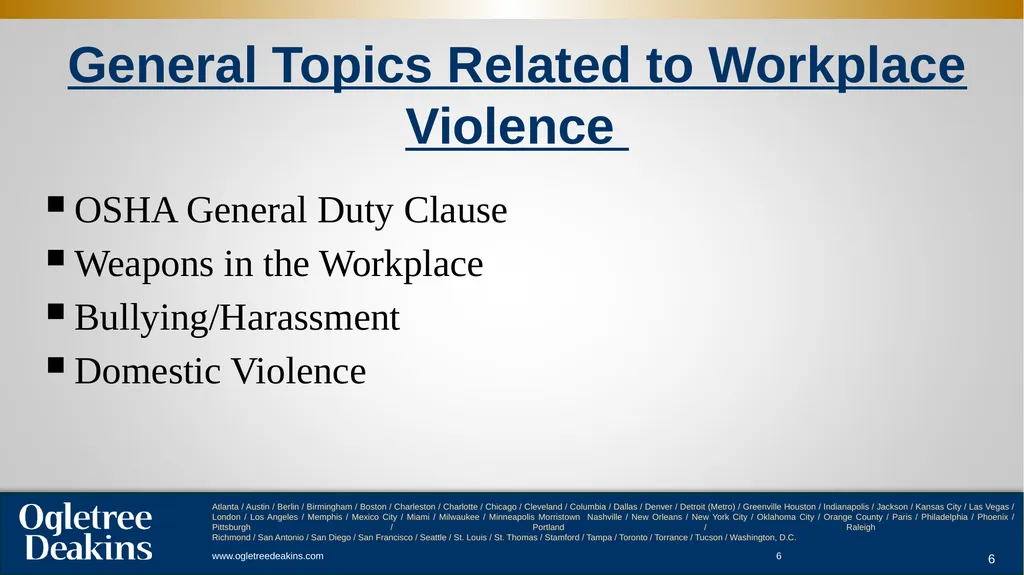
General Topics Related to Workplace Violence OSHA General Duty Clause
Weapons in the Workplace
Bullying/Harassment
Domestic Violence 6<br>
Weapons in the Workplace
Bullying/Harassment
Domestic Violence 6<br>
07
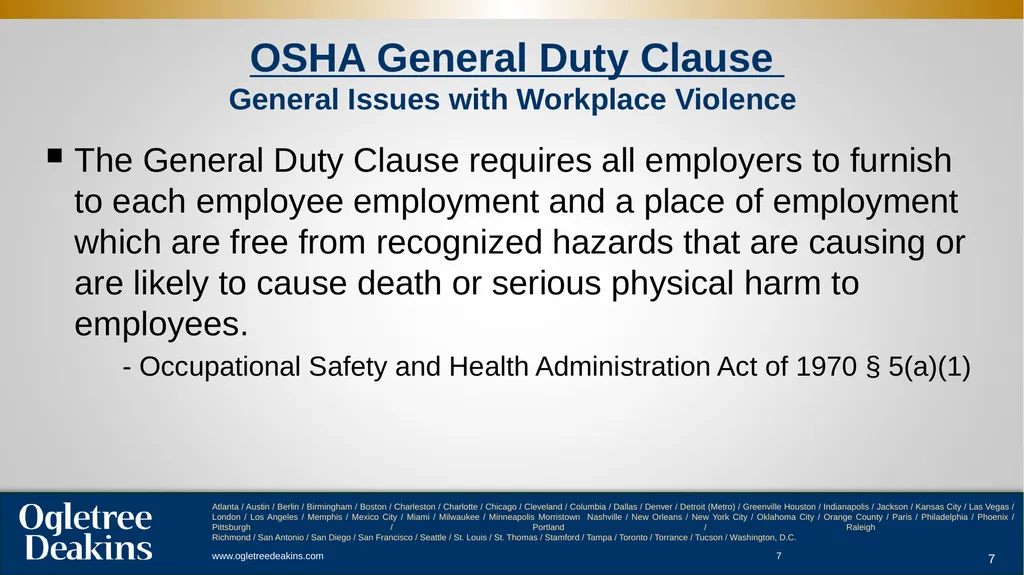
OSHA General Duty Clause
General Issues with Workplace Violence The General Duty Clause requires all employers to furnish to each employee employment and a place of employment which are free from recognized hazards that are causing or are likely to cause death or serious physical harm to employees.
- Occupational Safety and Health Administration Act of 1970 § 5(a)(1) 7<br>
- Occupational Safety and Health Administration Act of 1970 § 5(a)(1) 7<br>
08
OSHA General Duty Clause:
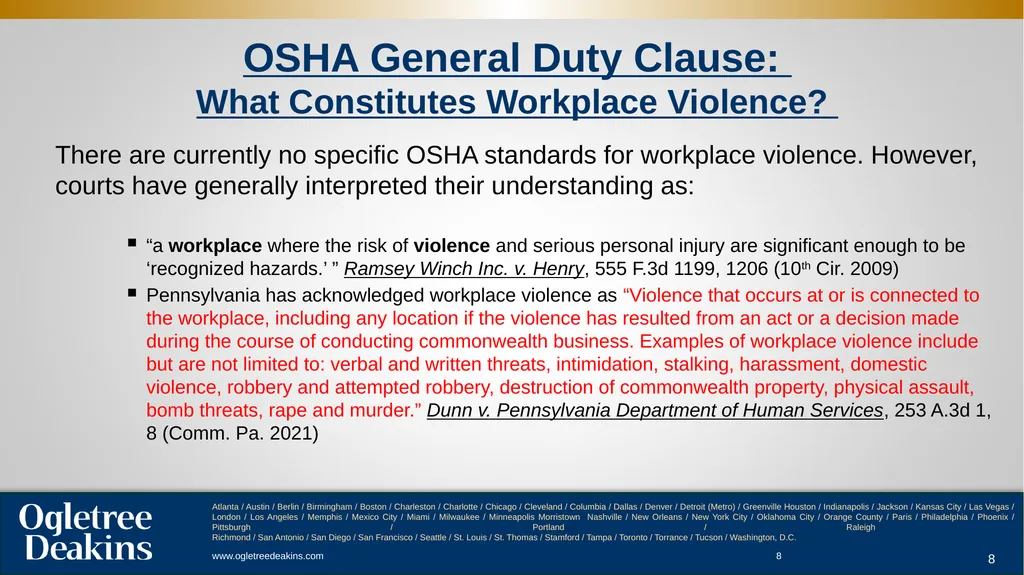
What Constitutes Workplace Violence? There are currently no specific OSHA standards for workplace violence. However, courts have generally interpreted their understanding as:
“a workplace where the risk of violence and serious personal injury are significant enough to be ‘recognized hazards.’ ” Ramsey Winch Inc. v. Henry, 555 F.3d 1199, 1206 (10th Cir. 2009)
Pennsylvania has acknowledged workplace violence as “Violence that occurs at or is connected to the workplace, including any location if the violence has resulted from an act or a decision made during the course of conducting commonwealth business. Examples of workplace violence include but are not limited to: verbal and written threats, intimidation, stalking, harassment, domestic violence, robbery and attempted robbery, destruction of commonwealth property, physical assault, bomb threats, rape and murder.” Dunn v. Pennsylvania Department of Human Services, 253 A.3d 1, 8 (Comm. Pa. 2021) 8<br>
“a workplace where the risk of violence and serious personal injury are significant enough to be ‘recognized hazards.’ ” Ramsey Winch Inc. v. Henry, 555 F.3d 1199, 1206 (10th Cir. 2009)
Pennsylvania has acknowledged workplace violence as “Violence that occurs at or is connected to the workplace, including any location if the violence has resulted from an act or a decision made during the course of conducting commonwealth business. Examples of workplace violence include but are not limited to: verbal and written threats, intimidation, stalking, harassment, domestic violence, robbery and attempted robbery, destruction of commonwealth property, physical assault, bomb threats, rape and murder.” Dunn v. Pennsylvania Department of Human Services, 253 A.3d 1, 8 (Comm. Pa. 2021) 8<br>
09
Remember… Fatalities or incidents that result in the hospitalization of three (3) or more employees are reportable to OSHA under 29 CFR 1904.8, including those resulting from workplace violence 9<br>
10
Weapons in the Workplace (Parking lot)
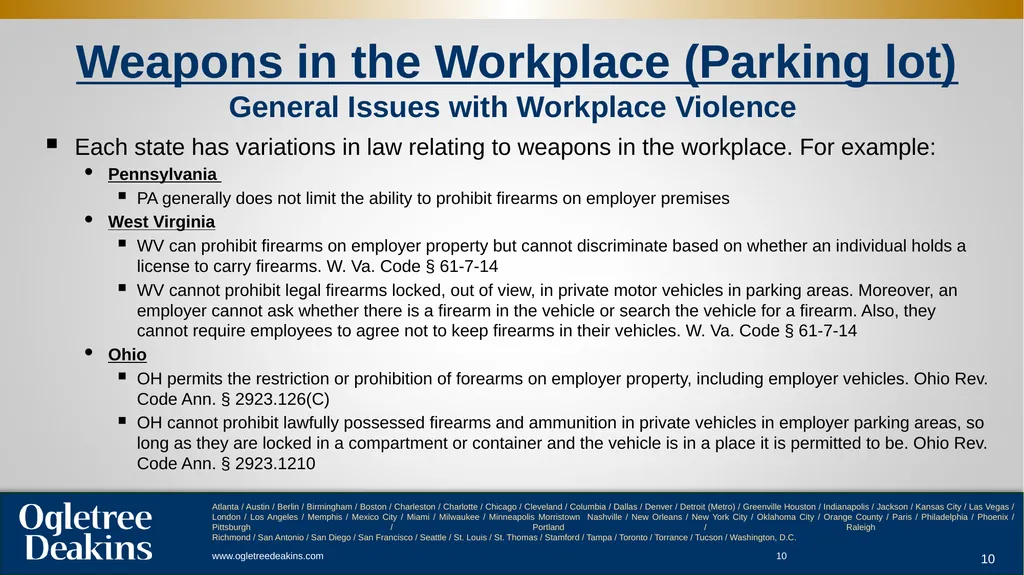
General Issues with Workplace Violence Each state has variations in law relating to weapons in the workplace. For example:
Pennsylvania
PA generally does not limit the ability to prohibit firearms on employer premises
West Virginia
WV can prohibit firearms on employer property but cannot discriminate based on whether an individual holds a license to carry firearms. W. Va. Code § 61-7-14
WV cannot prohibit legal firearms locked, out of view, in private motor vehicles in parking areas. Moreover, an employer cannot ask whether there is a firearm in the vehicle or search the vehicle for a firearm. Also, they cannot require employees to agree not to keep firearms in their vehicles. W. Va. Code § 61-7-14
Ohio
OH permits the restriction or prohibition of forearms on employer property, including employer vehicles. Ohio Rev. Code Ann. § 2923.126(C)
OH cannot prohibit lawfully possessed firearms and ammunition in private vehicles in employer parking areas, so long as they are locked in a compartment or container and the vehicle is in a place it is permitted to be. Ohio Rev. Code Ann. § 2923.1210 10<br>
Pennsylvania
PA generally does not limit the ability to prohibit firearms on employer premises
West Virginia
WV can prohibit firearms on employer property but cannot discriminate based on whether an individual holds a license to carry firearms. W. Va. Code § 61-7-14
WV cannot prohibit legal firearms locked, out of view, in private motor vehicles in parking areas. Moreover, an employer cannot ask whether there is a firearm in the vehicle or search the vehicle for a firearm. Also, they cannot require employees to agree not to keep firearms in their vehicles. W. Va. Code § 61-7-14
Ohio
OH permits the restriction or prohibition of forearms on employer property, including employer vehicles. Ohio Rev. Code Ann. § 2923.126(C)
OH cannot prohibit lawfully possessed firearms and ammunition in private vehicles in employer parking areas, so long as they are locked in a compartment or container and the vehicle is in a place it is permitted to be. Ohio Rev. Code Ann. § 2923.1210 10<br>
11
Bullying/ Harassment
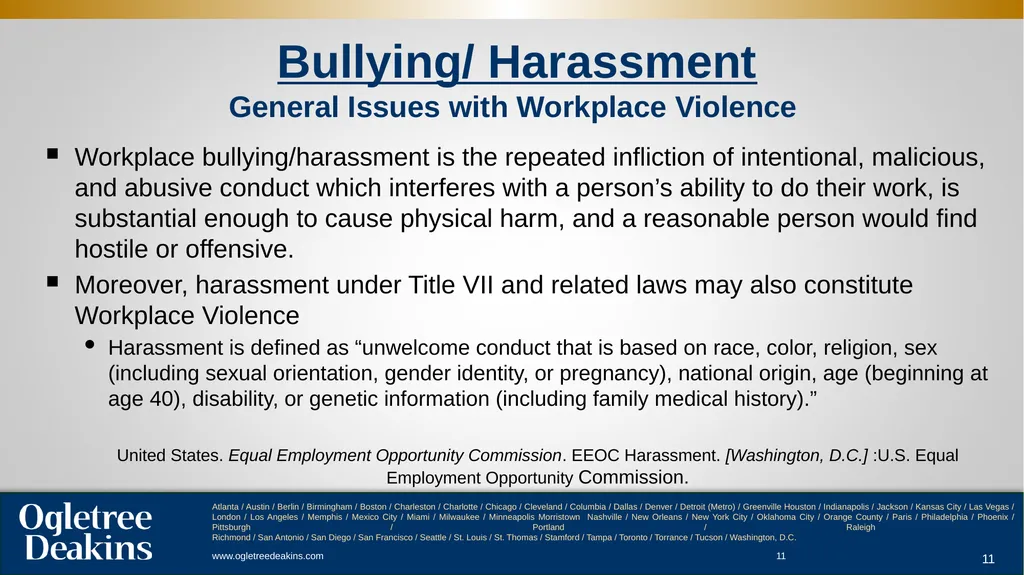
General Issues with Workplace Violence Workplace bullying/harassment is the repeated infliction of intentional, malicious, and abusive conduct which interferes with a person’s ability to do their work, is substantial enough to cause physical harm, and a reasonable person would find hostile or offensive.
Moreover, harassment under Title VII and related laws may also constitute Workplace Violence
Harassment is defined as “unwelcome conduct that is based on race, color, religion, sex (including sexual orientation, gender identity, or pregnancy), national origin, age (beginning at age 40), disability, or genetic information (including family medical history).”
United States. Equal Employment Opportunity Commission. EEOC Harassment. [Washington, D.C.] :U.S. Equal Employment Opportunity Commission. 11<br>
Moreover, harassment under Title VII and related laws may also constitute Workplace Violence
Harassment is defined as “unwelcome conduct that is based on race, color, religion, sex (including sexual orientation, gender identity, or pregnancy), national origin, age (beginning at age 40), disability, or genetic information (including family medical history).”
United States. Equal Employment Opportunity Commission. EEOC Harassment. [Washington, D.C.] :U.S. Equal Employment Opportunity Commission. 11<br>
12
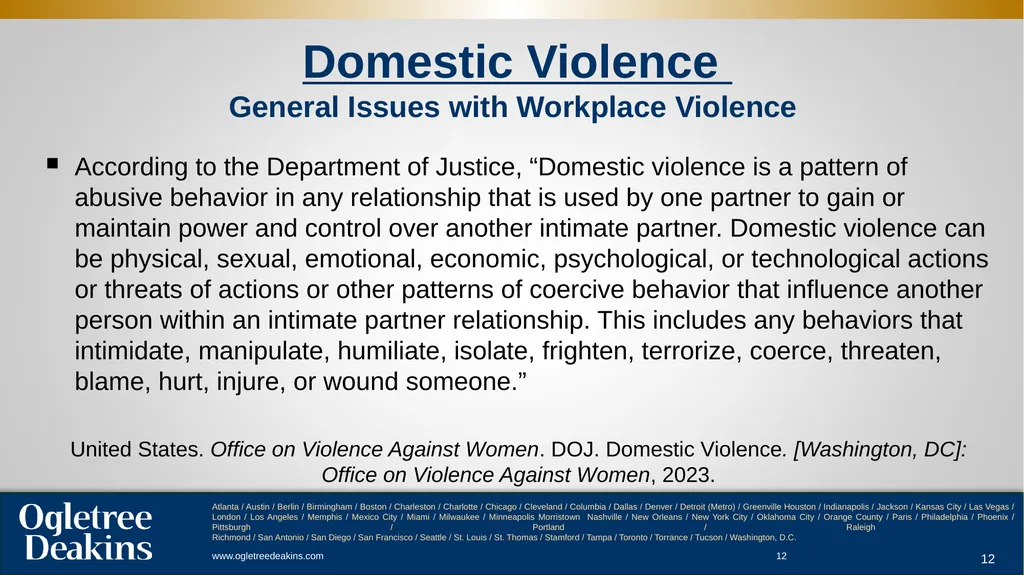
Domestic Violence
General Issues with Workplace Violence According to the Department of Justice, “Domestic violence is a pattern of abusive behavior in any relationship that is used by one partner to gain or maintain power and control over another intimate partner. Domestic violence can be physical, sexual, emotional, economic, psychological, or technological actions or threats of actions or other patterns of coercive behavior that influence another person within an intimate partner relationship. This includes any behaviors that intimidate, manipulate, humiliate, isolate, frighten, terrorize, coerce, threaten, blame, hurt, injure, or wound someone.”
United States. Office on Violence Against Women. DOJ. Domestic Violence. [Washington, DC]: Office on Violence Against Women, 2023. 12<br>
United States. Office on Violence Against Women. DOJ. Domestic Violence. [Washington, DC]: Office on Violence Against Women, 2023. 12<br>
13
Strategies for Identifying and Preventing Workplace Violence 13<br>
14
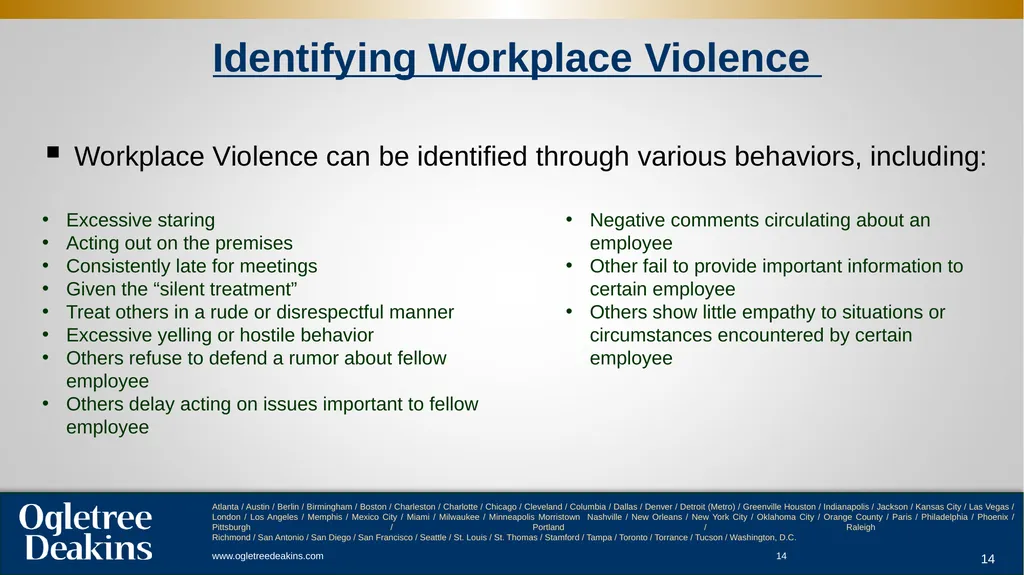
Identifying Workplace Violence Workplace Violence can be identified through various behaviors, including: Excessive staring
Acting out on the premises
Consistently late for meetings
Given the “silent treatment”
Treat others in a rude or disrespectful manner
Excessive yelling or hostile behavior
Others refuse to defend a rumor about fellow employee
Others delay acting on issues important to fellow employee Negative comments circulating about an employee
Other fail to provide important information to certain employee
Others show little empathy to situations or circumstances encountered by certain employee 14<br>
Acting out on the premises
Consistently late for meetings
Given the “silent treatment”
Treat others in a rude or disrespectful manner
Excessive yelling or hostile behavior
Others refuse to defend a rumor about fellow employee
Others delay acting on issues important to fellow employee Negative comments circulating about an employee
Other fail to provide important information to certain employee
Others show little empathy to situations or circumstances encountered by certain employee 14<br>
15
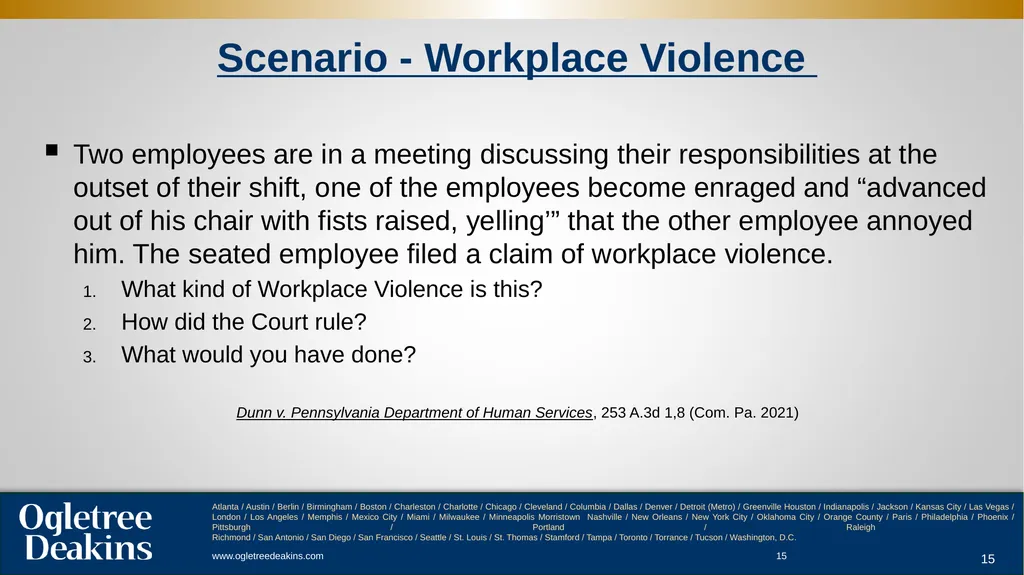
Scenario - Workplace Violence Two employees are in a meeting discussing their responsibilities at the outset of their shift, one of the employees become enraged and “advanced out of his chair with fists raised, yelling’” that the other employee annoyed him. The seated employee filed a claim of workplace violence.
What kind of Workplace Violence is this?
How did the Court rule?
What would you have done?
Dunn v. Pennsylvania Department of Human Services, 253 A.3d 1,8 (Com. Pa. 2021) 15<br>
What kind of Workplace Violence is this?
How did the Court rule?
What would you have done?
Dunn v. Pennsylvania Department of Human Services, 253 A.3d 1,8 (Com. Pa. 2021) 15<br>
16
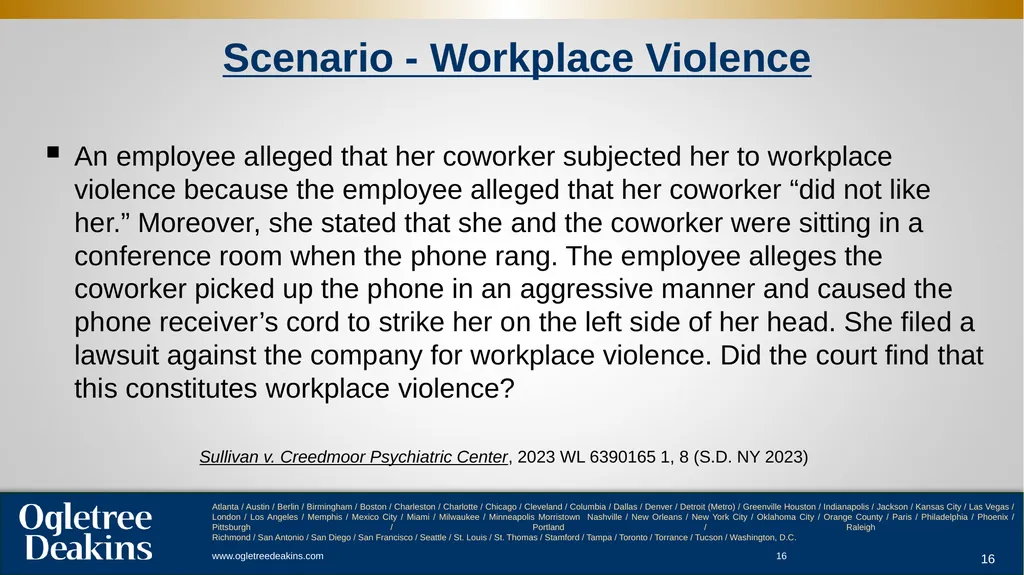
Scenario - Workplace Violence An employee alleged that her coworker subjected her to workplace violence because the employee alleged that her coworker “did not like her.” Moreover, she stated that she and the coworker were sitting in a conference room when the phone rang. The employee alleges the coworker picked up the phone in an aggressive manner and caused the phone receiver’s cord to strike her on the left side of her head. She filed a lawsuit against the company for workplace violence. Did the court find that this constitutes workplace violence?
Sullivan v. Creedmoor Psychiatric Center, 2023 WL 6390165 1, 8 (S.D. NY 2023) 16<br>
Sullivan v. Creedmoor Psychiatric Center, 2023 WL 6390165 1, 8 (S.D. NY 2023) 16<br>
17
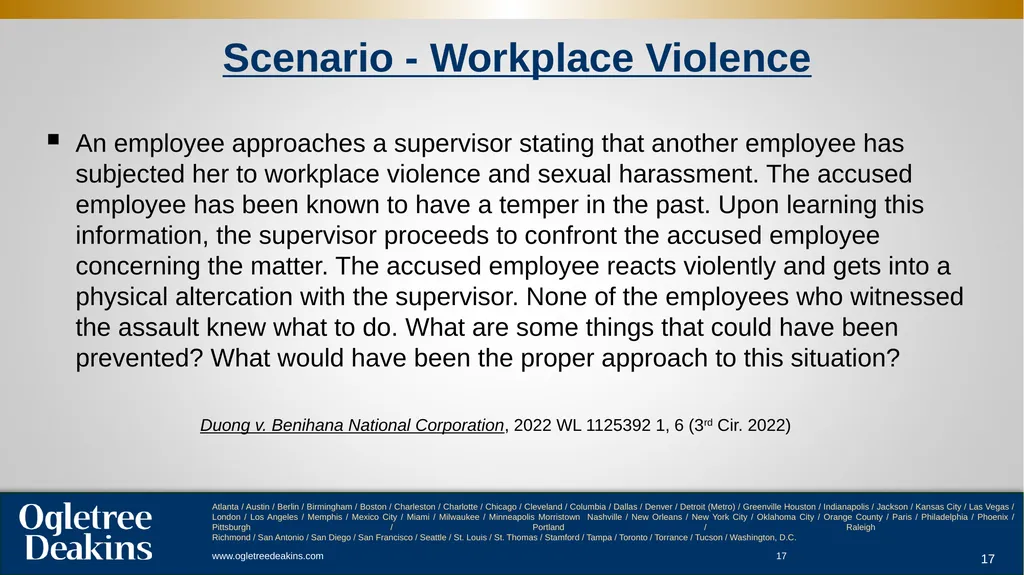
Scenario - Workplace Violence An employee approaches a supervisor stating that another employee has subjected her to workplace violence and sexual harassment. The accused employee has been known to have a temper in the past. Upon learning this information, the supervisor proceeds to confront the accused employee concerning the matter. The accused employee reacts violently and gets into a physical altercation with the supervisor. None of the employees who witnessed the assault knew what to do. What are some things that could have been prevented? What would have been the proper approach to this situation?
Duong v. Benihana National Corporation, 2022 WL 1125392 1, 6 (3rd Cir. 2022) 17<br>
Duong v. Benihana National Corporation, 2022 WL 1125392 1, 6 (3rd Cir. 2022) 17<br>
18
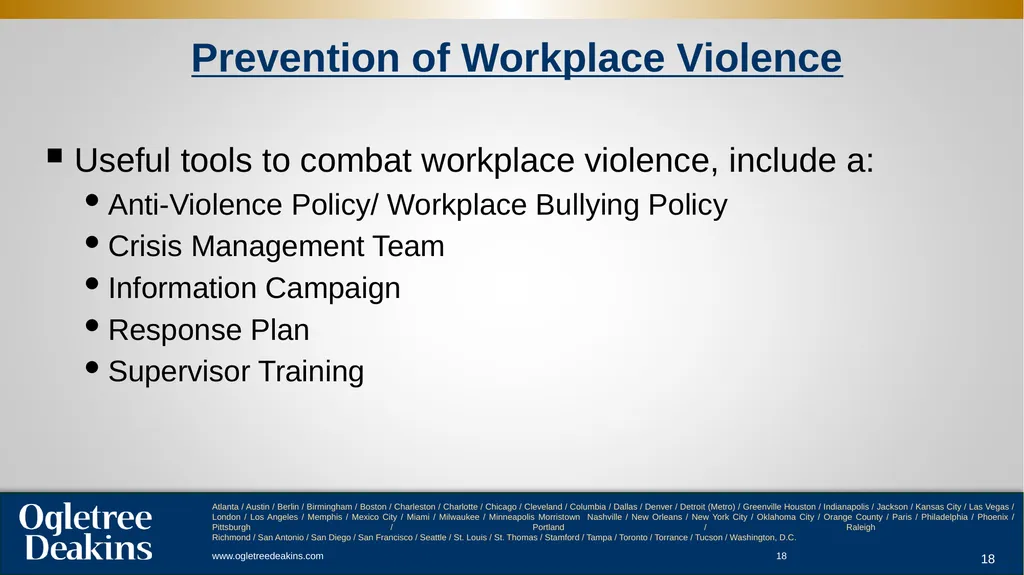
Prevention of Workplace Violence Useful tools to combat workplace violence, include a:
Anti-Violence Policy/ Workplace Bullying Policy
Crisis Management Team
Information Campaign
Response Plan
Supervisor Training 18<br>
Anti-Violence Policy/ Workplace Bullying Policy
Crisis Management Team
Information Campaign
Response Plan
Supervisor Training 18<br>
19
Creating an Effective Policy 19<br>
20
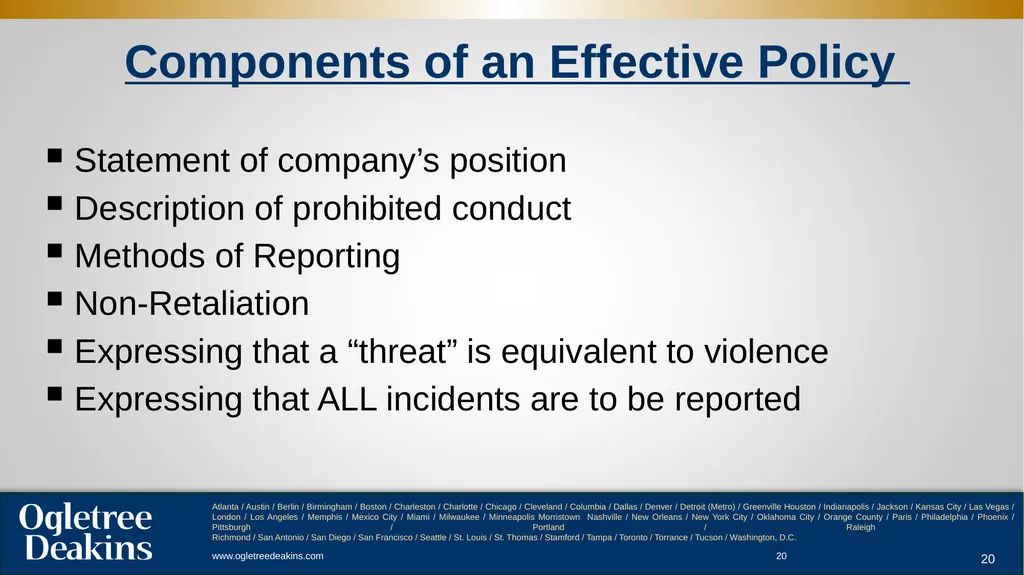
Components of an Effective Policy Statement of company’s position
Description of prohibited conduct
Methods of Reporting
Non-Retaliation
Expressing that a “threat” is equivalent to violence
Expressing that ALL incidents are to be reported 20<br>
Description of prohibited conduct
Methods of Reporting
Non-Retaliation
Expressing that a “threat” is equivalent to violence
Expressing that ALL incidents are to be reported 20<br>
21
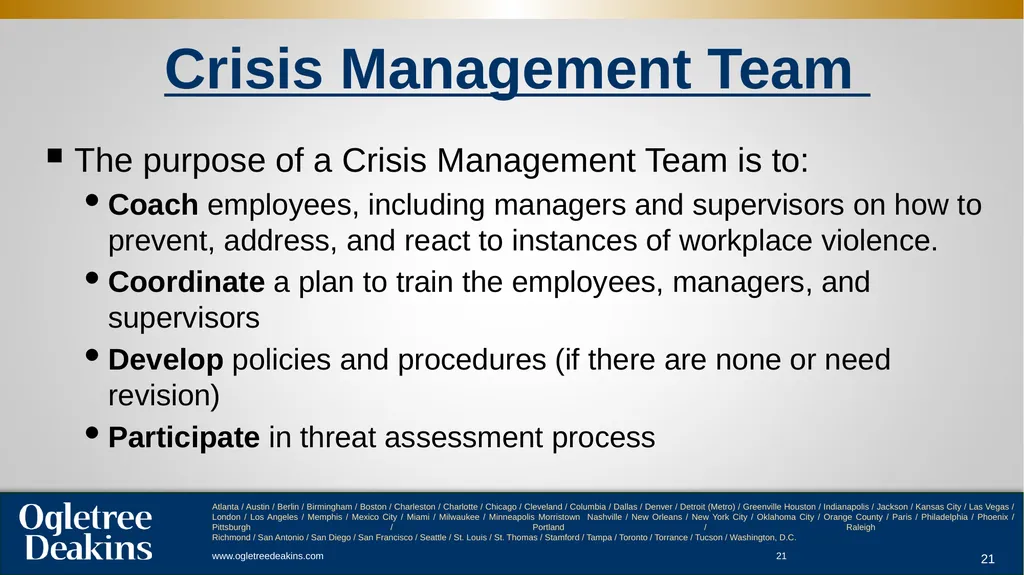
Crisis Management Team The purpose of a Crisis Management Team is to:
Coach employees, including managers and supervisors on how to prevent, address, and react to instances of workplace violence.
Coordinate a plan to train the employees, managers, and supervisors
Develop policies and procedures (if there are none or need revision)
Participate in threat assessment process 21<br>
Coach employees, including managers and supervisors on how to prevent, address, and react to instances of workplace violence.
Coordinate a plan to train the employees, managers, and supervisors
Develop policies and procedures (if there are none or need revision)
Participate in threat assessment process 21<br>
22
Information Campaign Periodically host information campaigns for all employees (including employees, managers, and supervisors) concerning the overall expectation of what constitutes workplace violence and specific nuances relegated to your workplace (if any) 22<br>
23
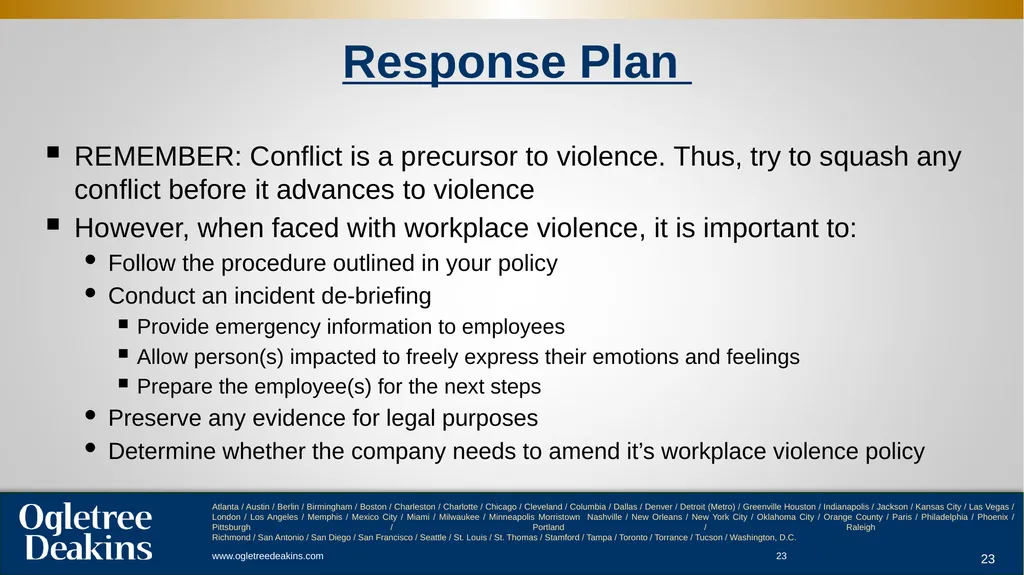
Response Plan REMEMBER: Conflict is a precursor to violence. Thus, try to squash any conflict before it advances to violence
However, when faced with workplace violence, it is important to:
Follow the procedure outlined in your policy
Conduct an incident de-briefing
Provide emergency information to employees
Allow person(s) impacted to freely express their emotions and feelings
Prepare the employee(s) for the next steps
Preserve any evidence for legal purposes
Determine whether the company needs to amend it’s workplace violence policy 23<br>
However, when faced with workplace violence, it is important to:
Follow the procedure outlined in your policy
Conduct an incident de-briefing
Provide emergency information to employees
Allow person(s) impacted to freely express their emotions and feelings
Prepare the employee(s) for the next steps
Preserve any evidence for legal purposes
Determine whether the company needs to amend it’s workplace violence policy 23<br>
24
Supervisor Training One of the key factors in dealing with incidents of pre and post workplace violence, is ensuring that your managers and supervisors are adequately trained on addressing such situations by:
Developing a ‘Needs Assessment’ that outlines workplace hazards, involvement with law enforcement, and a layout of the facility
Moreover, train ALL of your managers and supervisors
Decide what type of training is necessary
Active shooter, domestic violence, harassment 24<br>
Developing a ‘Needs Assessment’ that outlines workplace hazards, involvement with law enforcement, and a layout of the facility
Moreover, train ALL of your managers and supervisors
Decide what type of training is necessary
Active shooter, domestic violence, harassment 24<br>
25
Supervisor Training It is also imperative for supervisors to know that identifying the potential for workplace violence is best observed from:
That person’s past behavior because the greatest predictor of future behavior is that which they have acted on in the past.
This includes:
Performance
Peer relationships
Previous threats of violence 25<br>
That person’s past behavior because the greatest predictor of future behavior is that which they have acted on in the past.
This includes:
Performance
Peer relationships
Previous threats of violence 25<br>
26
Don’t Forget About State Law California:
On September 30, 2023, Governor Gavin Newsom signed into law Senate Bill No. 553, which requires virtually every California employer to implement a comprehensive workplace violence prevention plan with very specific components and procedures.
The new law adds Section 6401.9 to the Labor Code and goes into effect on July 1, 2024.
California’s Division of Occupational Safety and Health (Cal/OSHA) will enforce the new law. 26<br>
On September 30, 2023, Governor Gavin Newsom signed into law Senate Bill No. 553, which requires virtually every California employer to implement a comprehensive workplace violence prevention plan with very specific components and procedures.
The new law adds Section 6401.9 to the Labor Code and goes into effect on July 1, 2024.
California’s Division of Occupational Safety and Health (Cal/OSHA) will enforce the new law. 26<br>
27
California (Cont’d) Requirements include:
A workplace violence prevention plan
Training for managers and employees
Maintenance of a violent incident log, required to be retained for five years
Conducting workplace hazard assessments to address workplace threats and exposure
A workplace violence prevention notice for bulletin boards, intranet systems, or other posting platforms to communicate the plan information 27<br>
A workplace violence prevention plan
Training for managers and employees
Maintenance of a violent incident log, required to be retained for five years
Conducting workplace hazard assessments to address workplace threats and exposure
A workplace violence prevention notice for bulletin boards, intranet systems, or other posting platforms to communicate the plan information 27<br>
28
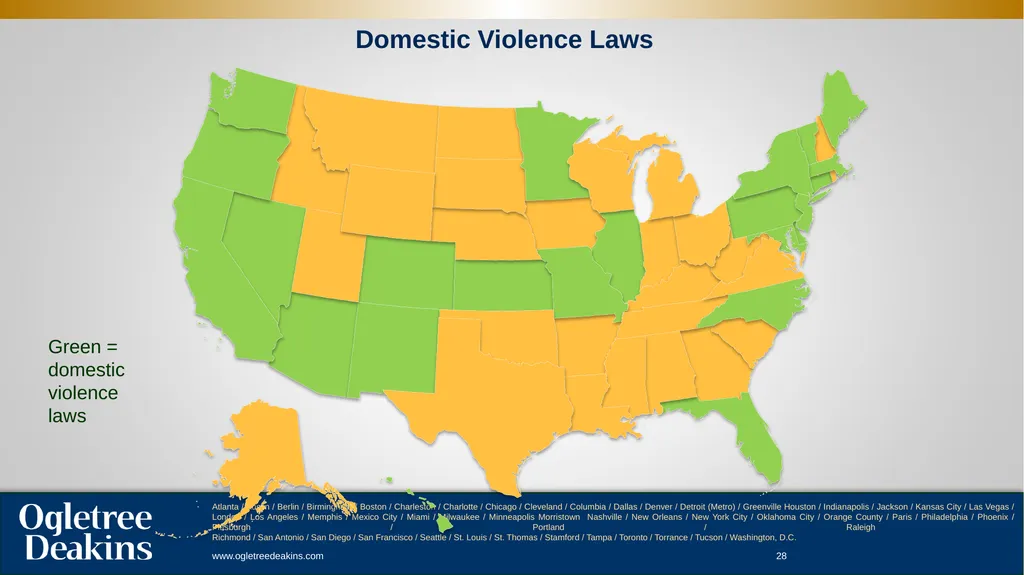
Domestic Violence Laws Green = domestic violence laws<br>
29
Questions?
Thank you!<br>
Thank you!<br>