
Scholarship of Teaching & Learning: Practical
KB
Published · 22 slides · 0 views
1 / 1




Description
Scholarship of Teaching Learning: Practical Teaching Ideas based on Research Jenna Cambria Educational Statistics and Research Methods (RHRC) Motivation (my particular area of focus) Study influences on student outcomes (choices,
Related Topics
Share
Embed code
Download this presentation From Below
"Scholarship of Teaching & Learning: Practical" is the property of its rightful owner. Permission is granted to download and print the materials on this website for personal, non-commercial use only, and to display it on your personal computer provided you do not modify the materials and that you retain all copyright notices contained in the materials. By downloading content from our website, you accept the terms of this agreement.
Presentation Transcript
01
Scholarship of Teaching & Learning: Practical Teaching Ideas based on Research Jenna Cambria
Educational Statistics and Research Methods (RHRC)<br>
Educational Statistics and Research Methods (RHRC)<br>
02
Motivation (my particular area of focus) Study influences on student outcomes (choices, well-being, and achievement)
Examine questions about representation in certain fields
Several multimillion dollar grants
Here is what I have learned! Jenna’s top research based ideas for supporting your students!<br>
Examine questions about representation in certain fields
Several multimillion dollar grants
Here is what I have learned! Jenna’s top research based ideas for supporting your students!<br>
03
1: Consider how the environment suits the stage Stage environment theory was put forth by Jacque Eccles and Carol Midgley (Eccles et al., 1993; Eccles & Roeser, 2009) This theory suggests that when there is good fit between the psychological needs demanded by a psychological stage, there is context that supports well-being
For example, when an adolescent is achieving new abilities in formal operations and abstract thinking, have increased needs for autonomy, feel personal fables
Environments that do not allow for choice or foreclosed thinking are likely to lead to a frustrated adolescent, which might result in behavioral or emotional difficulties.<br>
For example, when an adolescent is achieving new abilities in formal operations and abstract thinking, have increased needs for autonomy, feel personal fables
Environments that do not allow for choice or foreclosed thinking are likely to lead to a frustrated adolescent, which might result in behavioral or emotional difficulties.<br>
04
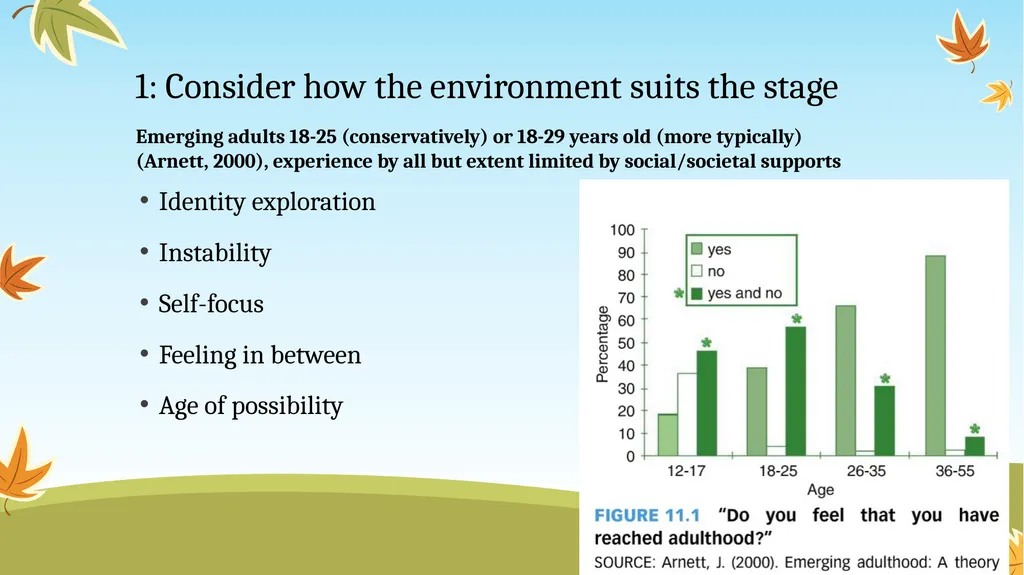
1: Consider how the environment suits the stage Emerging adults 18-25 (conservatively) or 18-29 years old (more typically) (Arnett, 2000), experience by all but extent limited by social/societal supports Identity exploration
Instability
Self-focus
Feeling in between
Age of possibility<br>
Instability
Self-focus
Feeling in between
Age of possibility<br>
05
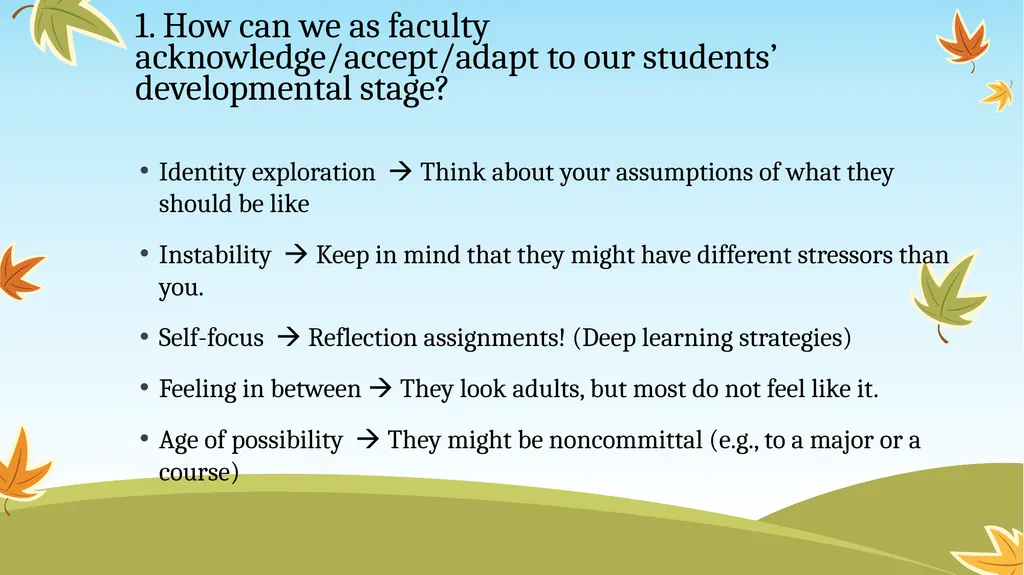
1. How can we as faculty acknowledge/accept/adapt to our students’ developmental stage? Identity exploration Think about your assumptions of what they should be like
Instability Keep in mind that they might have different stressors than you.
Self-focus Reflection assignments! (Deep learning strategies)
Feeling in between They look adults, but most do not feel like it.
Age of possibility They might be noncommittal (e.g., to a major or a course)<br>
Instability Keep in mind that they might have different stressors than you.
Self-focus Reflection assignments! (Deep learning strategies)
Feeling in between They look adults, but most do not feel like it.
Age of possibility They might be noncommittal (e.g., to a major or a course)<br>
06
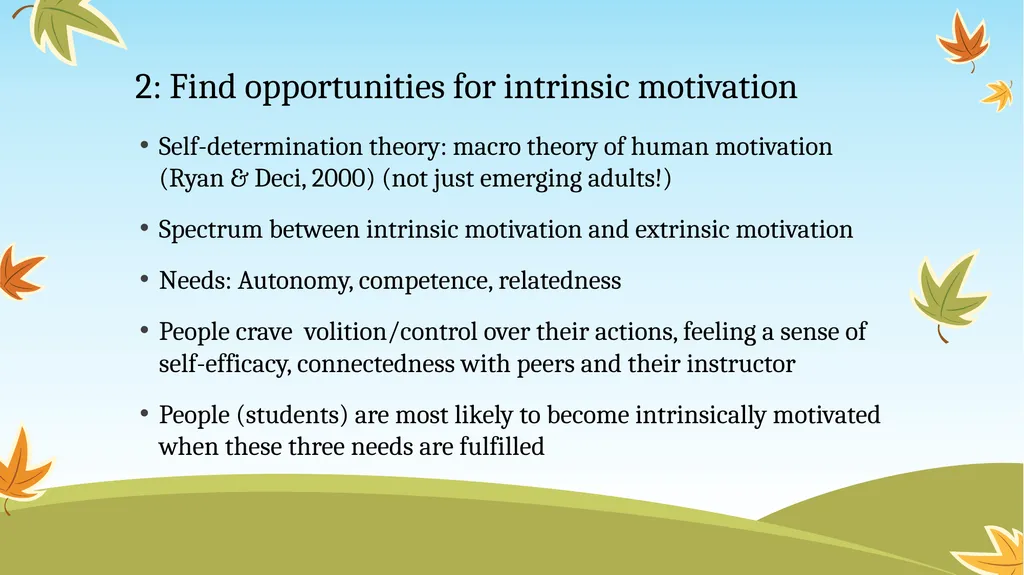
2: Find opportunities for intrinsic motivation Self-determination theory: macro theory of human motivation (Ryan & Deci, 2000) (not just emerging adults!)
Spectrum between intrinsic motivation and extrinsic motivation
Needs: Autonomy, competence, relatedness
People crave volition/control over their actions, feeling a sense of self-efficacy, connectedness with peers and their instructor
People (students) are most likely to become intrinsically motivated when these three needs are fulfilled<br>
Spectrum between intrinsic motivation and extrinsic motivation
Needs: Autonomy, competence, relatedness
People crave volition/control over their actions, feeling a sense of self-efficacy, connectedness with peers and their instructor
People (students) are most likely to become intrinsically motivated when these three needs are fulfilled<br>
07
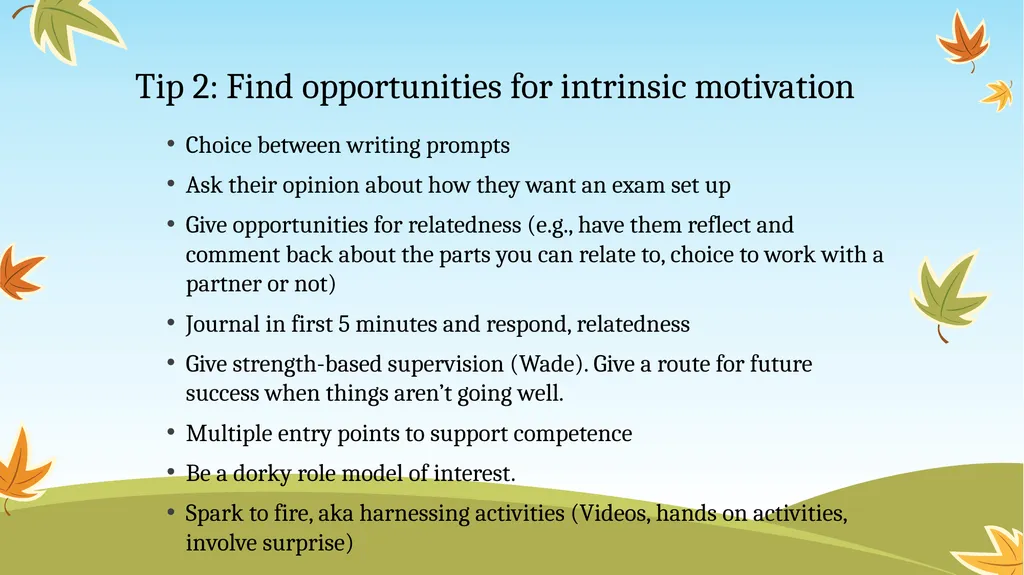
Tip 2: Find opportunities for intrinsic motivation Choice between writing prompts
Ask their opinion about how they want an exam set up
Give opportunities for relatedness (e.g., have them reflect and comment back about the parts you can relate to, choice to work with a partner or not)
Journal in first 5 minutes and respond, relatedness
Give strength-based supervision (Wade). Give a route for future success when things aren’t going well.
Multiple entry points to support competence
Be a dorky role model of interest.
Spark to fire, aka harnessing activities (Videos, hands on activities, involve surprise)<br>
Ask their opinion about how they want an exam set up
Give opportunities for relatedness (e.g., have them reflect and comment back about the parts you can relate to, choice to work with a partner or not)
Journal in first 5 minutes and respond, relatedness
Give strength-based supervision (Wade). Give a route for future success when things aren’t going well.
Multiple entry points to support competence
Be a dorky role model of interest.
Spark to fire, aka harnessing activities (Videos, hands on activities, involve surprise)<br>
08
3: According to research, you can affect task values Based on work on expectancy-value theory. Subjective task values are how a task is related to individual’s sense of usefulness, importance, enjoyment, and cost (Hulleman & Harackewiecz, 2009; Rozek, 2015)
Utility value can be affected in the “long” term pretty easily.
Research on math utility value (remembering and valuing)
Value for taking part in a STEM field
Longitudinal effects
With parents, with peers, and guest speakers<br>
Utility value can be affected in the “long” term pretty easily.
Research on math utility value (remembering and valuing)
Value for taking part in a STEM field
Longitudinal effects
With parents, with peers, and guest speakers<br>
09
3: According to research, you can affect task values What can you do?
Talk specifically and redundantly about why content is useful and why you are making the choices you are making
In my class we do a final reflection on 3 concepts that can be used in their profession (I am playing psychological mind games to help them remember and use content)
Bring in guest speakers, if possible, to talk about utility. In our research, girls were most interested in math when they had a female that was about 10 years older than them talk to them about math. Don’t assume who matters to them, talk to them.
Have them write down “Why does this matter today? Why is this good for me? Why does this matter for their future?”<br>
Talk specifically and redundantly about why content is useful and why you are making the choices you are making
In my class we do a final reflection on 3 concepts that can be used in their profession (I am playing psychological mind games to help them remember and use content)
Bring in guest speakers, if possible, to talk about utility. In our research, girls were most interested in math when they had a female that was about 10 years older than them talk to them about math. Don’t assume who matters to them, talk to them.
Have them write down “Why does this matter today? Why is this good for me? Why does this matter for their future?”<br>
10
4: Build trust and community in your class Create a classroom community where students feel welcome, supported and valued by the teacher and their peers
Incorporating what students value from their own communities into their instruction (culturally relevant instruction). Learn this from talking with them, having them write down.
Consider their families, experiences, and knowledge that might not "fit" into the curriculum, but is invaluable (Byrd, 2016; Moll et al., 2005; Sternberg et al., 2007)
Culturally Responsive Teaching: Theory, Research, and Practice, Geneva Gay<br>
Incorporating what students value from their own communities into their instruction (culturally relevant instruction). Learn this from talking with them, having them write down.
Consider their families, experiences, and knowledge that might not "fit" into the curriculum, but is invaluable (Byrd, 2016; Moll et al., 2005; Sternberg et al., 2007)
Culturally Responsive Teaching: Theory, Research, and Practice, Geneva Gay<br>
11
4: Build trust and community in your class I found that tasks building trust/community in my class made it easier for when we got to the hard conversations or in being able to seek help when its needed
Favorite song
Review visual reflection (Shoulders) as a group and give your own reflection
Talk to them, listen to them, have them journal. Don’t make assumptions.
Model bridge building
Software for big classrooms (Poll everywhere, Kahoot, Word Cloud, there are a ton!)
Preparing them for and executing hard conversations<br>
Favorite song
Review visual reflection (Shoulders) as a group and give your own reflection
Talk to them, listen to them, have them journal. Don’t make assumptions.
Model bridge building
Software for big classrooms (Poll everywhere, Kahoot, Word Cloud, there are a ton!)
Preparing them for and executing hard conversations<br>
12
Now before we get to the next idea…. A hands on activity<br>
13
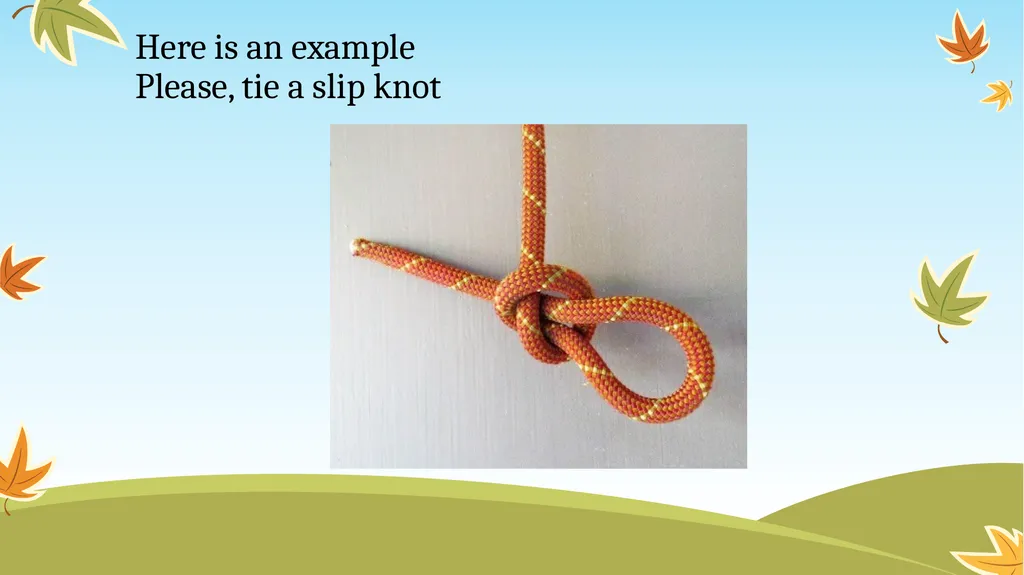
Here is an example
Please, tie a slip knot<br>
14
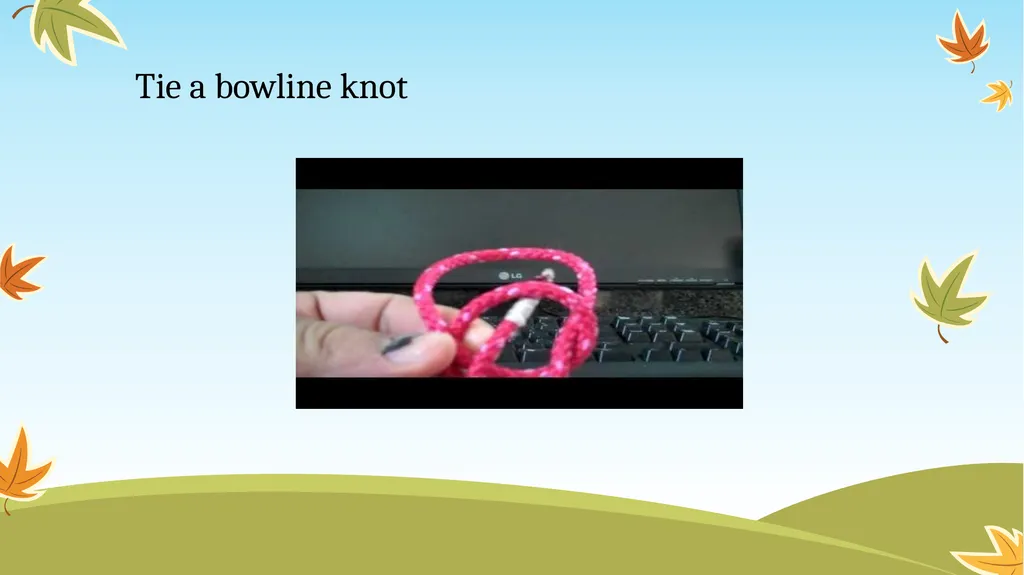
Now, please tie a bowline knot<br>
15
Tie a bowline knot<br>
16
Tip 7: Zone of Proximal Development Be wary of task difficulty, both too easy and too hard tasks are frustrating
Zone of proximal development (Vygotsky), the area where it is not too easy, not too difficult and they can meet the goal with some scaffolding.
Motivation can plummet without proper time, prep, scaffolding, or background knowledge
Look into work on how you can use differentiated instruction in your class/Consider learning preferences (not learning styles).<br>
Zone of proximal development (Vygotsky), the area where it is not too easy, not too difficult and they can meet the goal with some scaffolding.
Motivation can plummet without proper time, prep, scaffolding, or background knowledge
Look into work on how you can use differentiated instruction in your class/Consider learning preferences (not learning styles).<br>
17
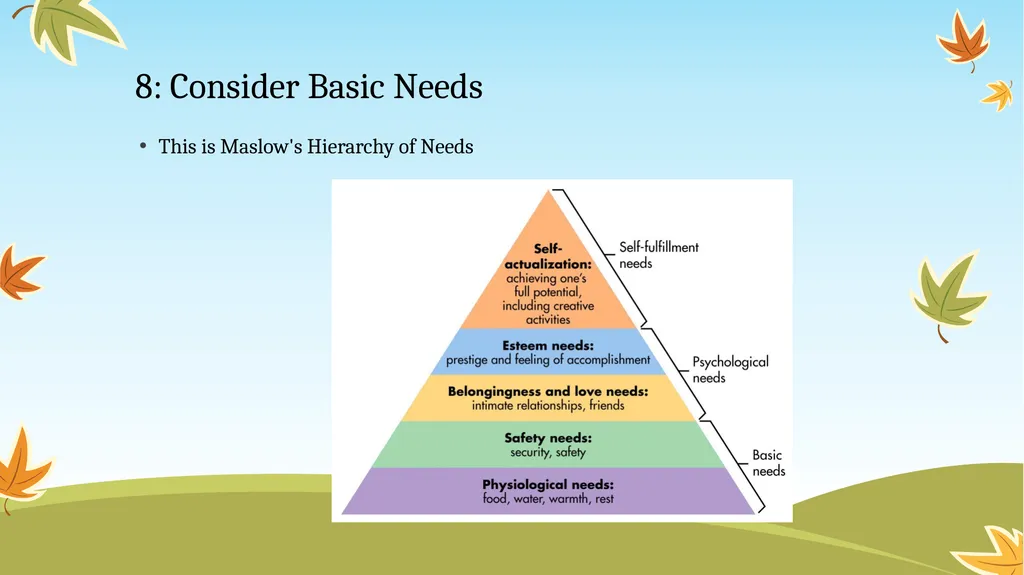
8: Consider Basic Needs This is Maslow's Hierarchy of Needs<br>
18
8: Consider Basic Needs Information on campus food pantry https://service.uark.edu/foodprograms/jane-b-gearhart-full-circle-food-pantry/index.php
Emergency food assistance program that distributes a three day supply of food to all members of a household provided at least one person has a University of Arkansas ID number.
Volunteer, bring food, request food, pantry2@uark.edu
Information about safety concerns https://uofacares.uark.edu/<br>
Emergency food assistance program that distributes a three day supply of food to all members of a household provided at least one person has a University of Arkansas ID number.
Volunteer, bring food, request food, pantry2@uark.edu
Information about safety concerns https://uofacares.uark.edu/<br>
19
In sum (for today) Consider how the environment suits the stage
Find opportunities for intrinsic motivation
Talk about utility explicitly
Build trust and community in your class
Consider time, scaffolding, difficulty, and background knowledge to stay in the zone of proximal development
Remember to look out for students’ basic needs<br>
Find opportunities for intrinsic motivation
Talk about utility explicitly
Build trust and community in your class
Consider time, scaffolding, difficulty, and background knowledge to stay in the zone of proximal development
Remember to look out for students’ basic needs<br>
20
References Arnett, J. J. (2000). Emerging adulthood: A theory of development from the late teens through the twenties. American Psychologist, 55(5), 469–480. http://doi.org/10.1037//0003-066X.55.5.469
Byrd, C. M. (2016). Does Culturally Relevant Teaching Work? An Examination From Student Perspectives. SAGE Open, 6(3), 215824401666074. http://doi.org/10.1177/2158244016660744
Deci, E. L., & Ryan, R. M. (2008). Self-determination theory: A macrotheory of human motivation, development, and health. Canadian Psychology/Psychologie Canadienne, 49(3), 182–185. http://doi.org/10.1037/a0012801
Eccles, J. S., Midgley, C., Wigfield, A., Buchanan, C. M., Reuman, D., Flanagan, C., & Mac Iver, D. (1993). Development during adolescence: The impact of stage-environment fit on young adolescents’ experiences in schools and in families. American Psychologist, 48(2), 90–101. http://doi.org/10.1037/0003-066X.48.2.90
Eccles, J. S., & Roeser, R. W. (2009). Schools, Academic Motivation, and Stage-Environment Fit. In Handbook of Adolescent Psychology. Hoboken, NJ, USA: John Wiley & Sons, Inc. http://doi.org/10.1002/9780470479193.adlpsy001013
Hulleman, C. S., & Harackiewicz, J. M. (2009). Promoting interest and performance in high school science classes. Science (New York, N.Y.), 326(5958), 1410–2. http://doi.org/10.1126/science.1177067
Moll, L., Amanti, C., Neff, D., & González, N. (2005). Funds of Knowledge. Routledge. http://doi.org/10.4324/9781410613462
Rozek, C. S., Hyde, J. S., Svoboda, R. C., Hulleman, C. S., & Harackiewicz, J. M. (2015). Gender differences in the effects of a utility-value intervention to help parents motivate adolescents in mathematics and science. Journal of Educational Psychology, 107(1), 195–206. http://doi.org/10.1037/a0036981
Ryan, R. M., & Deci, E. L. (2000). Self-determination theory and the facilitation of intrinsic motivation, social development, and well-being. American Psychologist , 55(1), 68–78. http://doi.org/10.1037/0003-066X.55.1.68
Sternberg, R. J. (n.d.). Who Are the Bright Children? The Cultural Context of Being and Acting Intelligent. Educational Researcher. American Educational Research Association. http://doi.org/10.2307/4621089<br>
Byrd, C. M. (2016). Does Culturally Relevant Teaching Work? An Examination From Student Perspectives. SAGE Open, 6(3), 215824401666074. http://doi.org/10.1177/2158244016660744
Deci, E. L., & Ryan, R. M. (2008). Self-determination theory: A macrotheory of human motivation, development, and health. Canadian Psychology/Psychologie Canadienne, 49(3), 182–185. http://doi.org/10.1037/a0012801
Eccles, J. S., Midgley, C., Wigfield, A., Buchanan, C. M., Reuman, D., Flanagan, C., & Mac Iver, D. (1993). Development during adolescence: The impact of stage-environment fit on young adolescents’ experiences in schools and in families. American Psychologist, 48(2), 90–101. http://doi.org/10.1037/0003-066X.48.2.90
Eccles, J. S., & Roeser, R. W. (2009). Schools, Academic Motivation, and Stage-Environment Fit. In Handbook of Adolescent Psychology. Hoboken, NJ, USA: John Wiley & Sons, Inc. http://doi.org/10.1002/9780470479193.adlpsy001013
Hulleman, C. S., & Harackiewicz, J. M. (2009). Promoting interest and performance in high school science classes. Science (New York, N.Y.), 326(5958), 1410–2. http://doi.org/10.1126/science.1177067
Moll, L., Amanti, C., Neff, D., & González, N. (2005). Funds of Knowledge. Routledge. http://doi.org/10.4324/9781410613462
Rozek, C. S., Hyde, J. S., Svoboda, R. C., Hulleman, C. S., & Harackiewicz, J. M. (2015). Gender differences in the effects of a utility-value intervention to help parents motivate adolescents in mathematics and science. Journal of Educational Psychology, 107(1), 195–206. http://doi.org/10.1037/a0036981
Ryan, R. M., & Deci, E. L. (2000). Self-determination theory and the facilitation of intrinsic motivation, social development, and well-being. American Psychologist , 55(1), 68–78. http://doi.org/10.1037/0003-066X.55.1.68
Sternberg, R. J. (n.d.). Who Are the Bright Children? The Cultural Context of Being and Acting Intelligent. Educational Researcher. American Educational Research Association. http://doi.org/10.2307/4621089<br>
21
Thank you!<br>
22
Questions?
My contact information: jcambria@uark.edu<br>