
Consumer Motivation and Personality CHAPTER Three
GB
Published · 51 slides · 0 views
1 / 1

Description
Consumer Motivation and Personality CHAPTER Three Learning Objectives To Understand the Dynamics of Motives, Needs, and Goals, and how they shape consumer behavior. To understand motivation theories and their application to consumer
Related Topics
Download this presentation From Below
"Consumer Motivation and Personality CHAPTER Three" is the property of its rightful owner. Permission is granted to download and print the materials on this website for personal, non-commercial use only, and to display it on your personal computer provided you do not modify the materials and that you retain all copyright notices contained in the materials. By downloading content from our website, you accept the terms of this agreement.
Share
Embed code
Presentation Transcript
01
Consumer Motivation and Personality CHAPTER
Three<br>
Three<br>
02
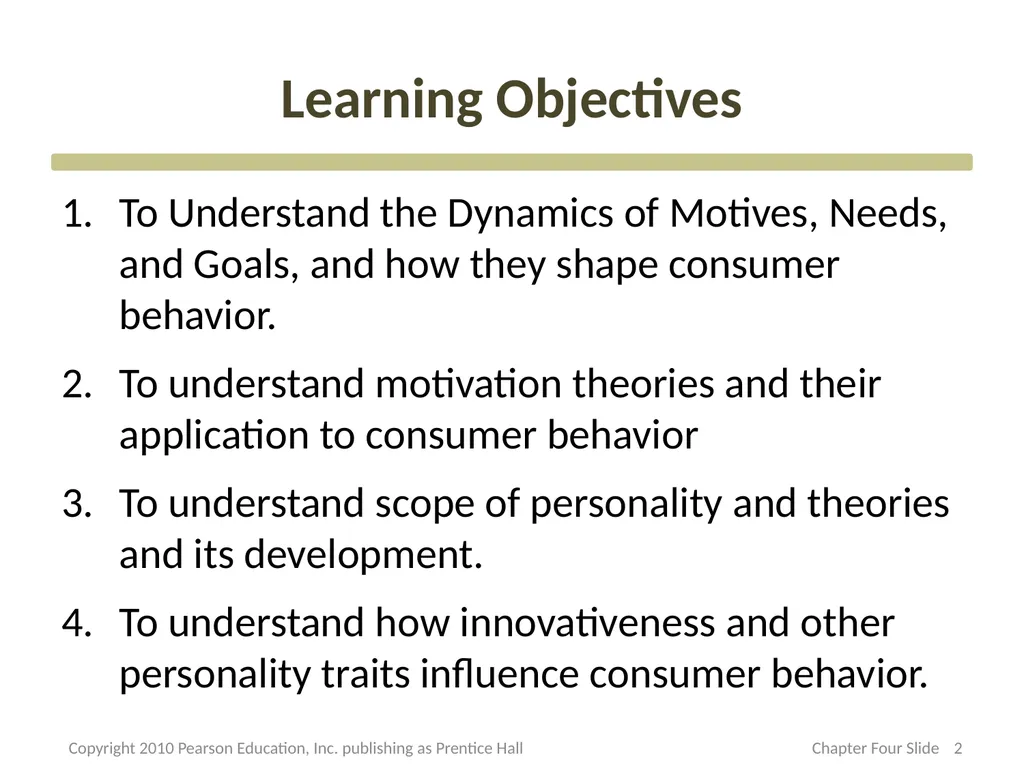
Learning Objectives To Understand the Dynamics of Motives, Needs, and Goals, and how they shape consumer behavior.
To understand motivation theories and their application to consumer behavior
To understand scope of personality and theories and its development.
To understand how innovativeness and other personality traits influence consumer behavior. 2 Chapter Four Slide Copyright 2010 Pearson Education, Inc. publishing as Prentice Hall<br>
To understand motivation theories and their application to consumer behavior
To understand scope of personality and theories and its development.
To understand how innovativeness and other personality traits influence consumer behavior. 2 Chapter Four Slide Copyright 2010 Pearson Education, Inc. publishing as Prentice Hall<br>
03
Learning Objectives (Continue…) To understand personification of products and brands and its strategic applications.
To understand self-image and its impact on consumer behavior. s 3<br>
To understand self-image and its impact on consumer behavior. s 3<br>
04
Motivation as a Psychological Force Motivation is the driving force within individuals that impels them to act. 4 Copyright 2010 Pearson Education, Inc. publishing as Prentice Hall Chapter Four Slide<br>
05
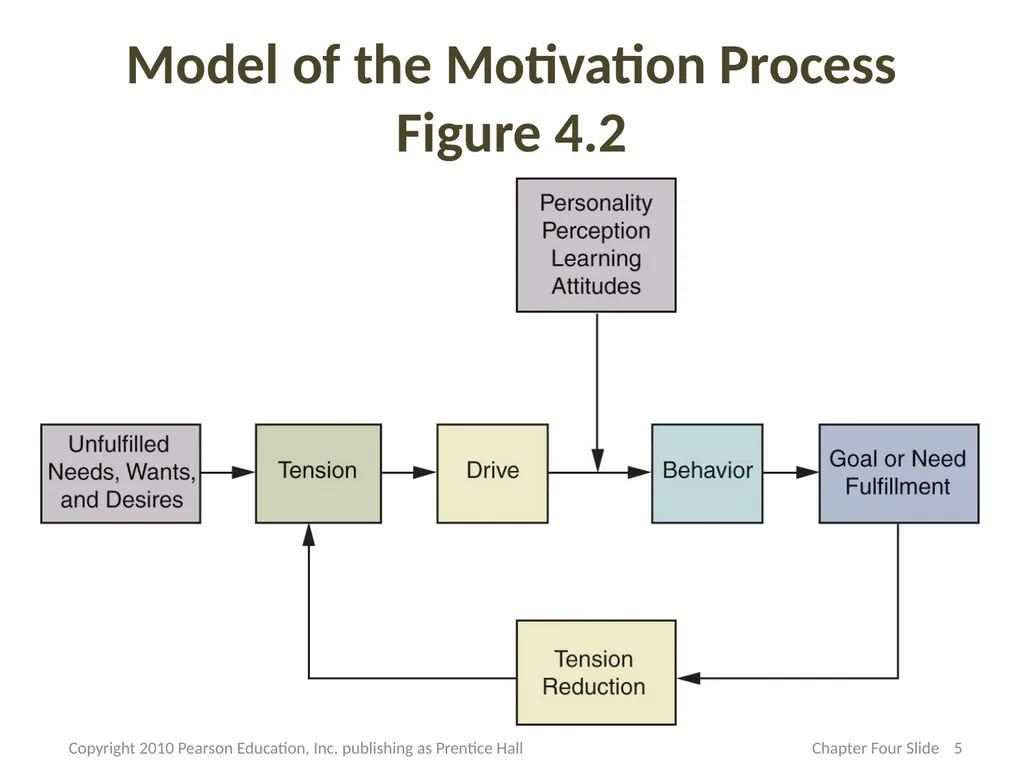
Model of the Motivation Process
Figure 4.2 5 Copyright 2010 Pearson Education, Inc. publishing as Prentice Hall Chapter Four Slide<br>
06
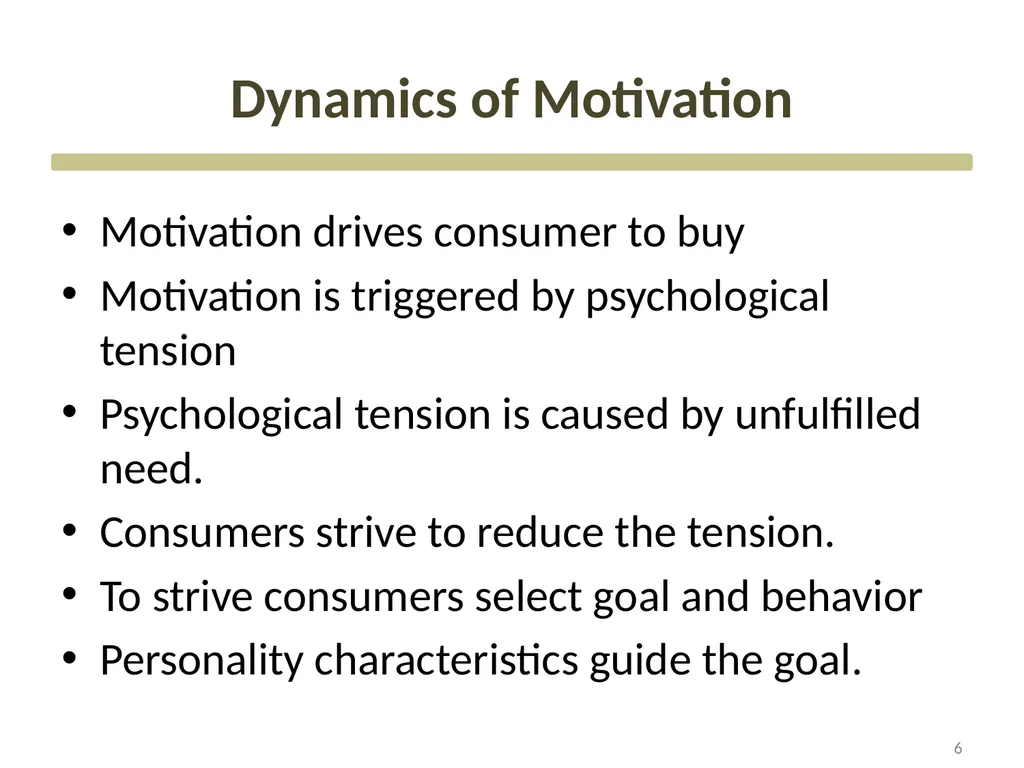
Dynamics of Motivation Motivation drives consumer to buy
Motivation is triggered by psychological tension
Psychological tension is caused by unfulfilled need.
Consumers strive to reduce the tension.
To strive consumers select goal and behavior
Personality characteristics guide the goal. 6<br>
Motivation is triggered by psychological tension
Psychological tension is caused by unfulfilled need.
Consumers strive to reduce the tension.
To strive consumers select goal and behavior
Personality characteristics guide the goal. 6<br>
07
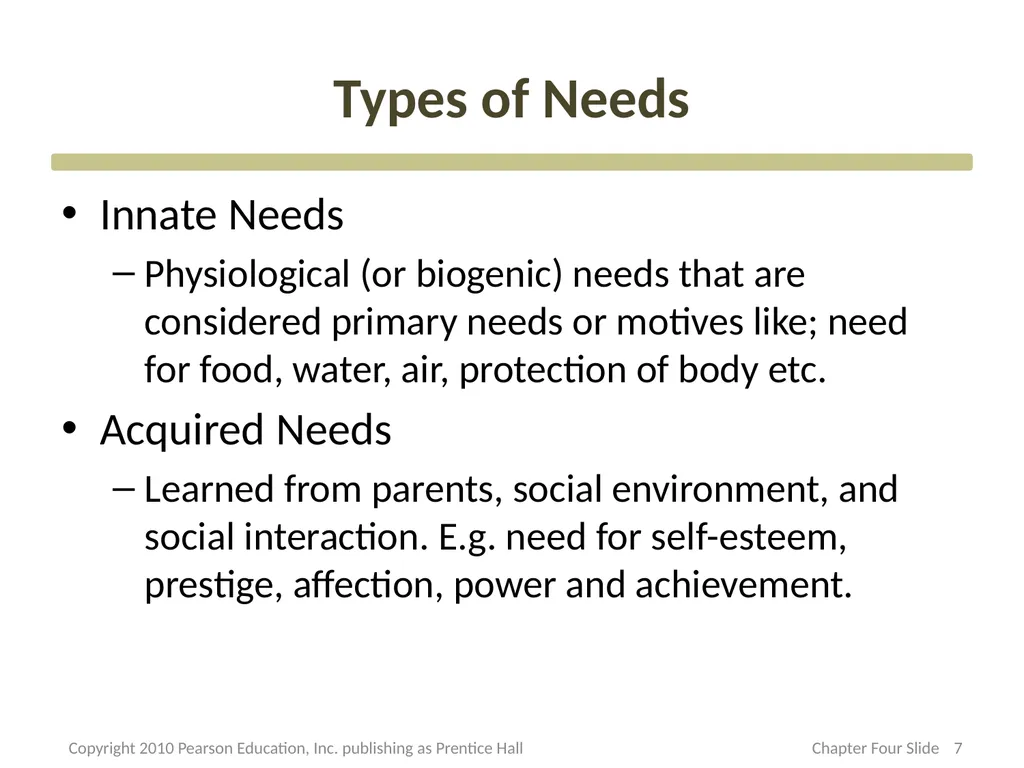
Types of Needs Innate Needs
Physiological (or biogenic) needs that are considered primary needs or motives like; need for food, water, air, protection of body etc.
Acquired Needs
Learned from parents, social environment, and social interaction. E.g. need for self-esteem, prestige, affection, power and achievement. 7 Copyright 2010 Pearson Education, Inc. publishing as Prentice Hall Chapter Four Slide<br>
Physiological (or biogenic) needs that are considered primary needs or motives like; need for food, water, air, protection of body etc.
Acquired Needs
Learned from parents, social environment, and social interaction. E.g. need for self-esteem, prestige, affection, power and achievement. 7 Copyright 2010 Pearson Education, Inc. publishing as Prentice Hall Chapter Four Slide<br>
08
Types of Needs Both types of needs affect our buying decision
Example:
Shelter is basic need
Satisfied by purchasing home.
What types of home to buy is shaped by psychological, learned needs. 8<br>
Example:
Shelter is basic need
Satisfied by purchasing home.
What types of home to buy is shaped by psychological, learned needs. 8<br>
09
Goals Goals are outcomes that consumer seek in order to satisfy physiological or psychological needs 9 Copyright 2010 Pearson Education, Inc. publishing as Prentice Hall Chapter Four Slide<br>
10
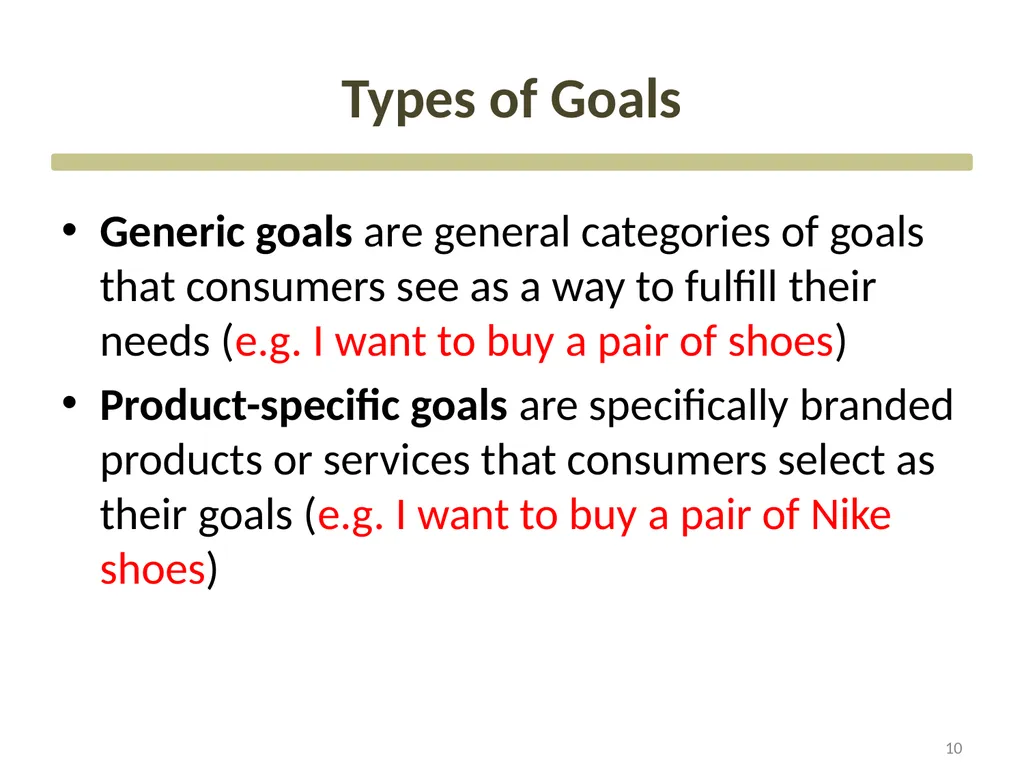
Types of Goals Generic goals are general categories of goals that consumers see as a way to fulfill their needs (e.g. I want to buy a pair of shoes)
Product-specific goals are specifically branded products or services that consumers select as their goals (e.g. I want to buy a pair of Nike shoes) 10<br>
Product-specific goals are specifically branded products or services that consumers select as their goals (e.g. I want to buy a pair of Nike shoes) 10<br>
11
The Selection of Goals The goals selected by an individual depend on their:
Personal experiences
Physical capacity
Prevailing cultural norms and values
Goal’s accessibility in the physical and social environment 11 Copyright 2010 Pearson Education, Inc. publishing as Prentice Hall Chapter Four Slide<br>
Personal experiences
Physical capacity
Prevailing cultural norms and values
Goal’s accessibility in the physical and social environment 11 Copyright 2010 Pearson Education, Inc. publishing as Prentice Hall Chapter Four Slide<br>
12
Class activity What are three generic goals you have set for yourself in the past year?
What are three product-specific goals you have set in the past year?
How were these goals selected? Was it personal experiences, physical capacity, or prevailing cultural norms and values? 12 Copyright 2010 Pearson Education, Inc. publishing as Prentice Hall Chapter Four Slide<br>
What are three product-specific goals you have set in the past year?
How were these goals selected? Was it personal experiences, physical capacity, or prevailing cultural norms and values? 12 Copyright 2010 Pearson Education, Inc. publishing as Prentice Hall Chapter Four Slide<br>
13
The Dynamics of Motivation Needs are never fully satisfied
New needs emerge as old needs are satisfied
People who achieve their goals set new and higher goals for themselves 13 Copyright 2010 Pearson Education, Inc. publishing as Prentice Hall Chapter Four Slide<br>
New needs emerge as old needs are satisfied
People who achieve their goals set new and higher goals for themselves 13 Copyright 2010 Pearson Education, Inc. publishing as Prentice Hall Chapter Four Slide<br>
14
Types and Systems of Needs Abraham Maslow’s hierarchy of needs
A trio of needs 14 Copyright 2010 Pearson Education, Inc. publishing as Prentice Hall Chapter Four Slide<br>
A trio of needs 14 Copyright 2010 Pearson Education, Inc. publishing as Prentice Hall Chapter Four Slide<br>
15
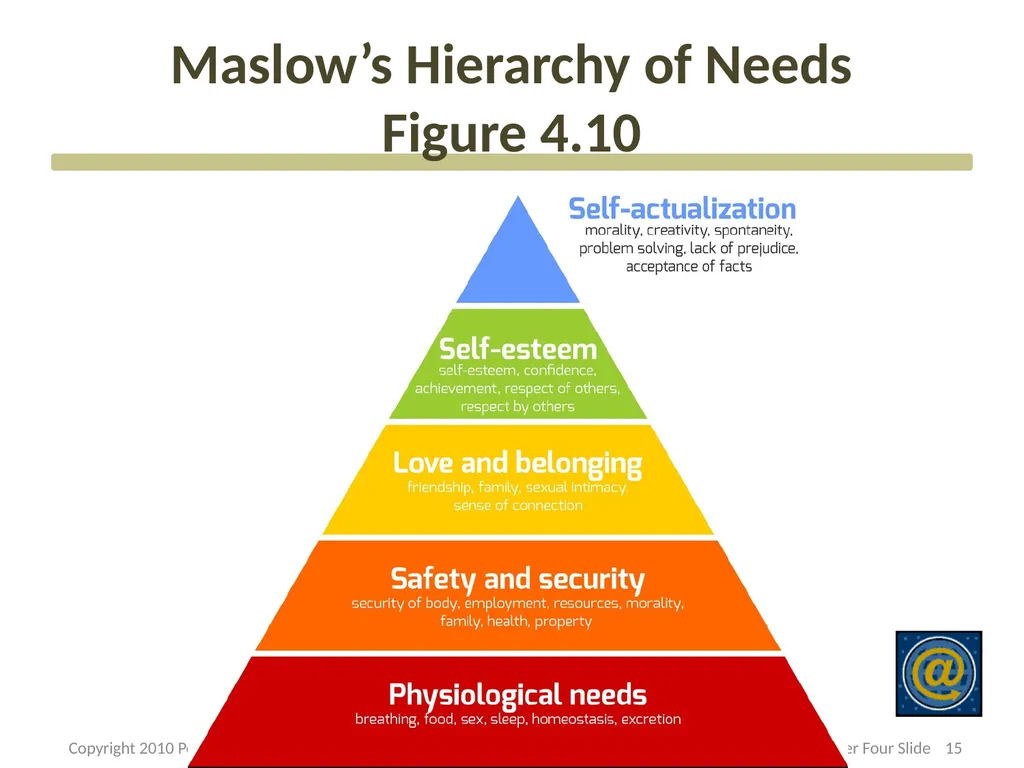
Maslow’s Hierarchy of Needs
Figure 4.10 15 Copyright 2010 Pearson Education, Inc. publishing as Prentice Hall Chapter Four Slide<br>
16
Personality-Defined. The inner psychological characteristics that both determine and reflect how a person think and act.
Inner-characteristics: specific qualities, attributes, traits, factors, and mannerisms 16 Copyright 2010 Pearson Education, Inc. publishing as Prentice Hall Chapter Five Slide<br>
Inner-characteristics: specific qualities, attributes, traits, factors, and mannerisms 16 Copyright 2010 Pearson Education, Inc. publishing as Prentice Hall Chapter Five Slide<br>
17
Personality Individual’s personality influences product choices. 17<br>
18
Nature of Personality Personality reflects individual differences.
Personality is consistent and enduring.
Personality may change
Major life event, gradual maturing process. 18<br>
Personality is consistent and enduring.
Personality may change
Major life event, gradual maturing process. 18<br>
19
Class activity How would you describe your personality?
How does it influence products that you purchase? 19 Copyright 2010 Pearson Education, Inc. publishing as Prentice Hall Chapter Five Slide<br>
How does it influence products that you purchase? 19 Copyright 2010 Pearson Education, Inc. publishing as Prentice Hall Chapter Five Slide<br>
20
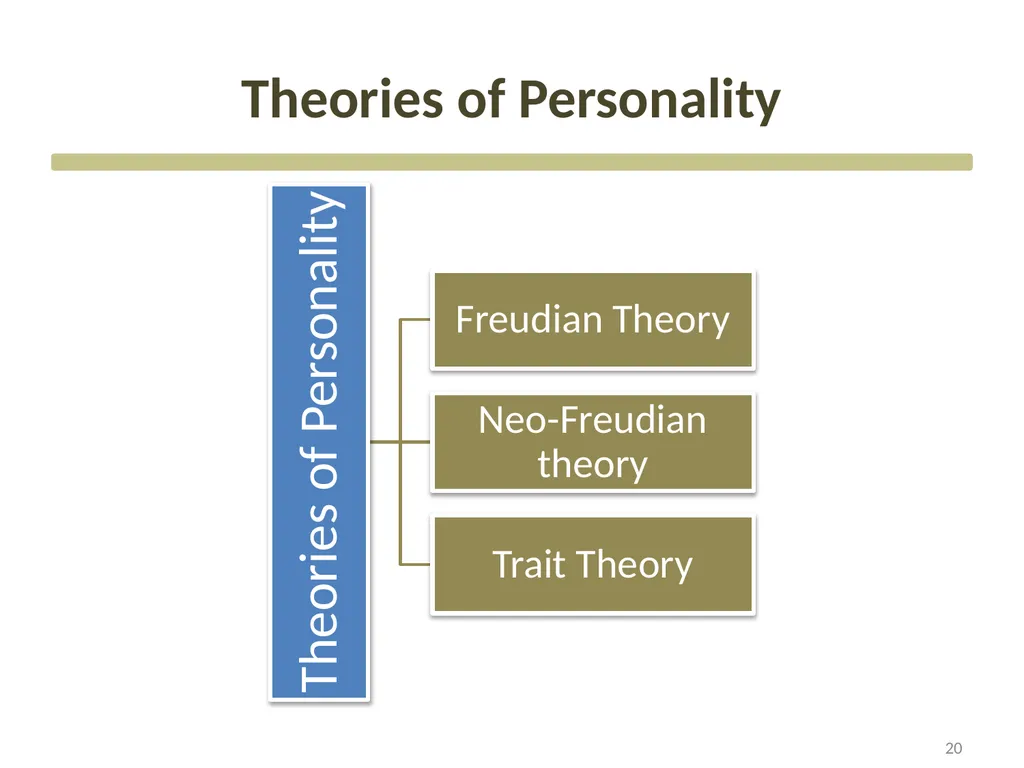
Theories of Personality 20<br>
21
Freudian Theory Unconscious needs or drives are at the heart of human motivation
Human personality consist of three interacting systems: Id, Ego, and Super ego 21<br>
Human personality consist of three interacting systems: Id, Ego, and Super ego 21<br>
22
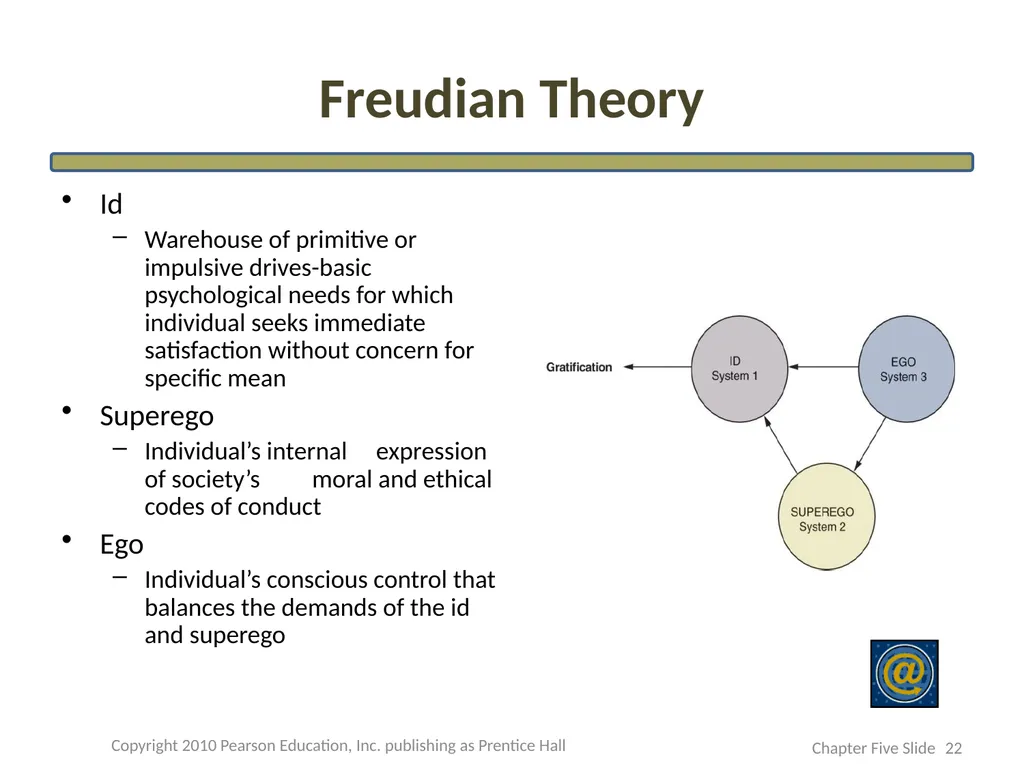
Freudian Theory Id
Warehouse of primitive or impulsive drives-basic psychological needs for which individual seeks immediate satisfaction without concern for specific mean
Superego
Individual’s internal expression of society’s moral and ethical codes of conduct
Ego
Individual’s conscious control that balances the demands of the id and superego Copyright 2010 Pearson Education, Inc. publishing as Prentice Hall 22 Chapter Five Slide<br>
Warehouse of primitive or impulsive drives-basic psychological needs for which individual seeks immediate satisfaction without concern for specific mean
Superego
Individual’s internal expression of society’s moral and ethical codes of conduct
Ego
Individual’s conscious control that balances the demands of the id and superego Copyright 2010 Pearson Education, Inc. publishing as Prentice Hall 22 Chapter Five Slide<br>
23
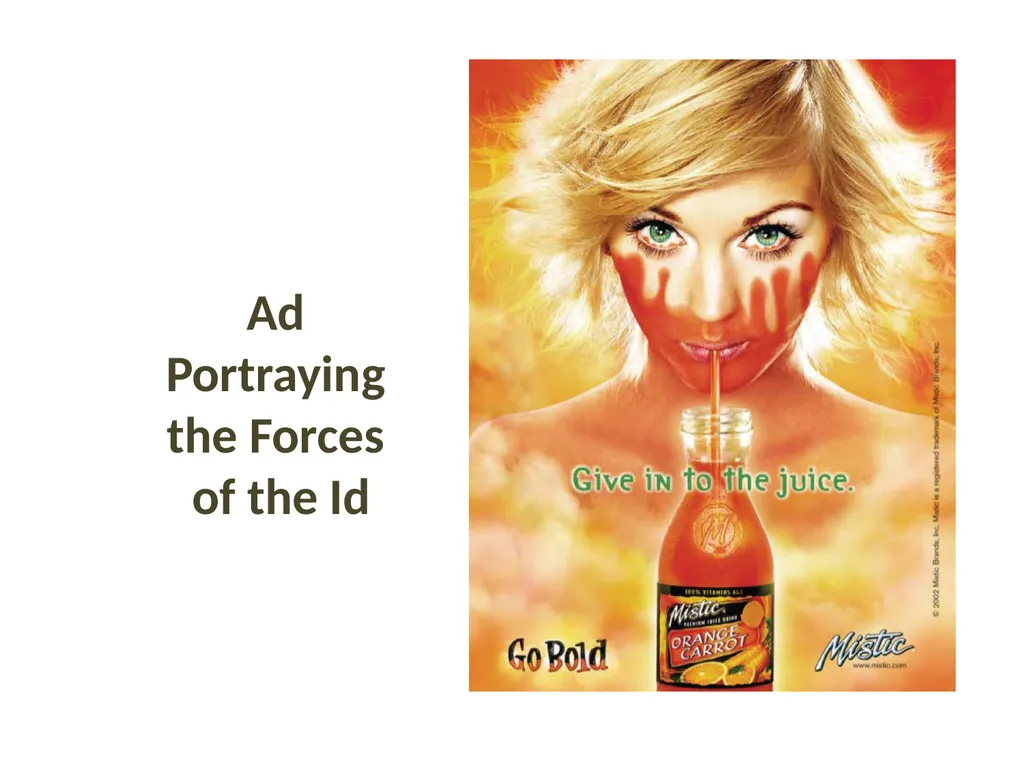
Ad
Portraying
the Forces
of the Id<br>
24
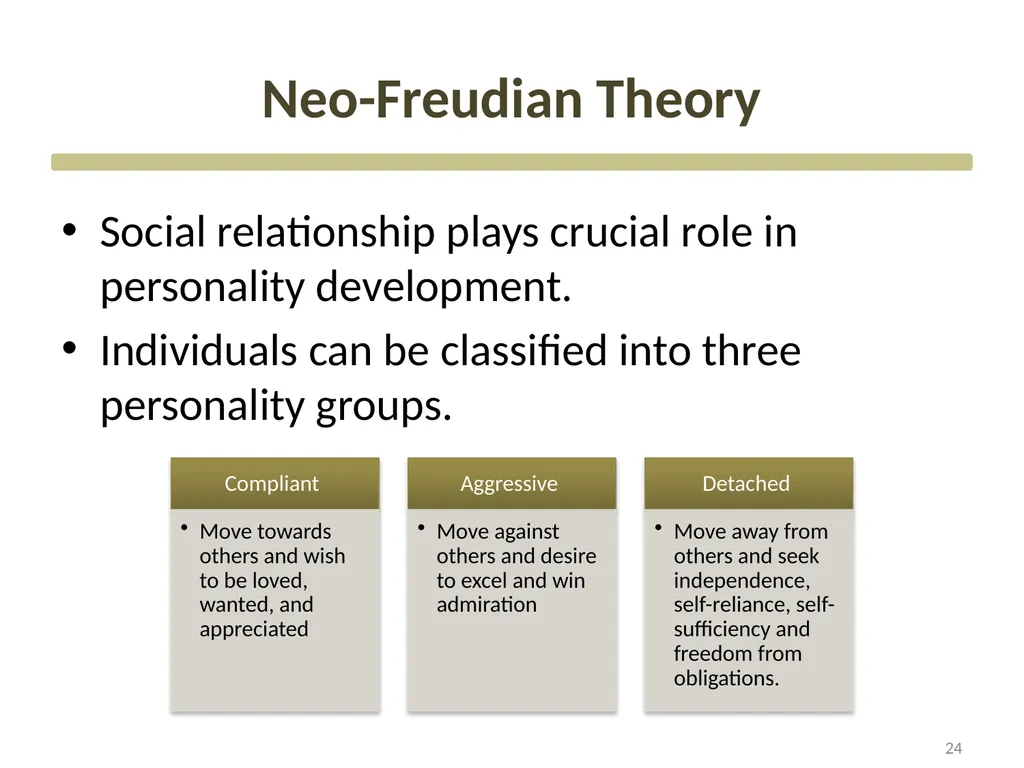
Neo-Freudian Theory Social relationship plays crucial role in personality development.
Individuals can be classified into three personality groups. 24<br>
Individuals can be classified into three personality groups. 24<br>
25
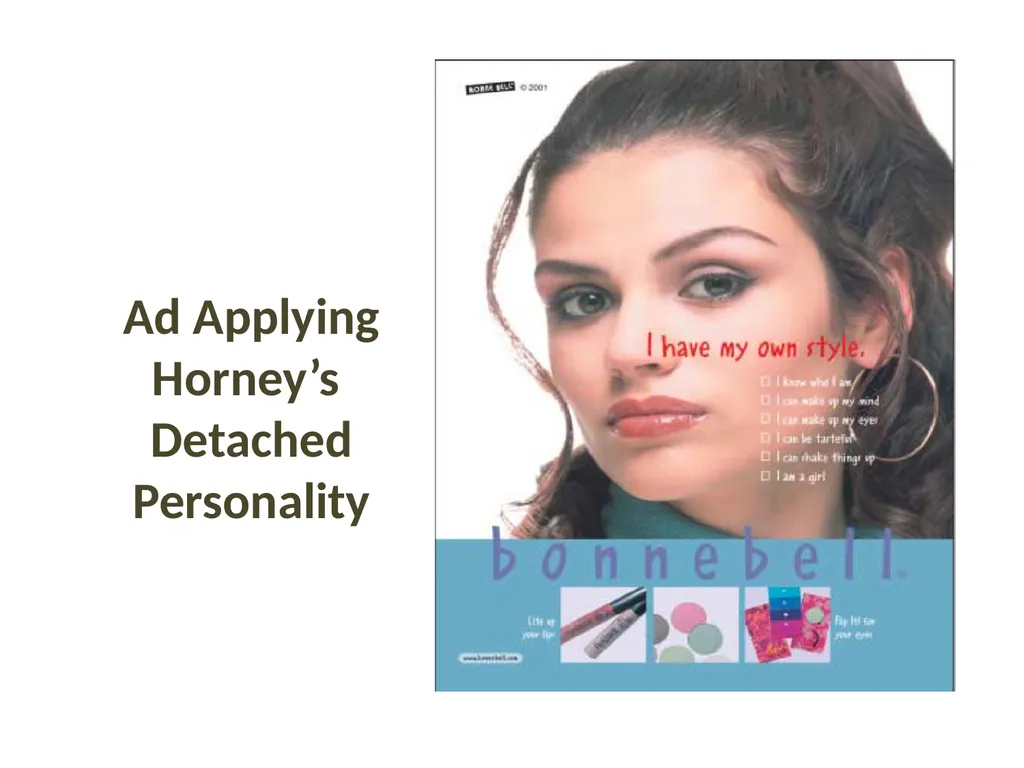
Ad Applying
Horney’s
Detached
Personality<br>
26
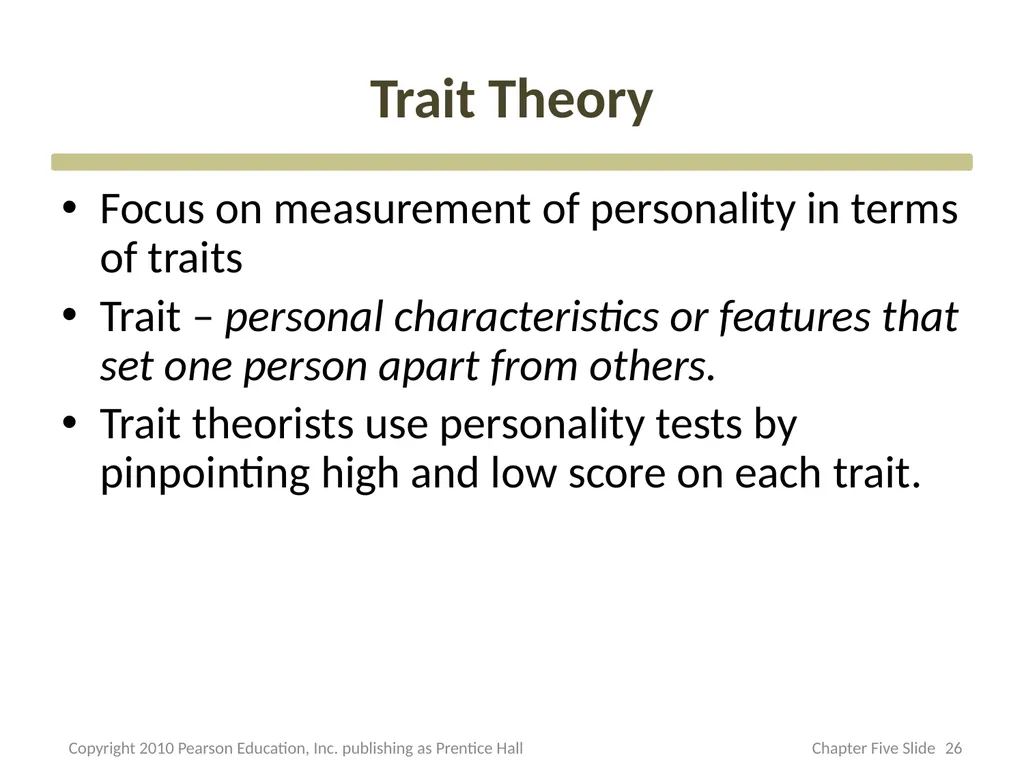
Trait Theory Focus on measurement of personality in terms of traits
Trait – personal characteristics or features that set one person apart from others.
Trait theorists use personality tests by pinpointing high and low score on each trait. 26 Copyright 2010 Pearson Education, Inc. publishing as Prentice Hall Chapter Five Slide<br>
Trait – personal characteristics or features that set one person apart from others.
Trait theorists use personality tests by pinpointing high and low score on each trait. 26 Copyright 2010 Pearson Education, Inc. publishing as Prentice Hall Chapter Five Slide<br>
27
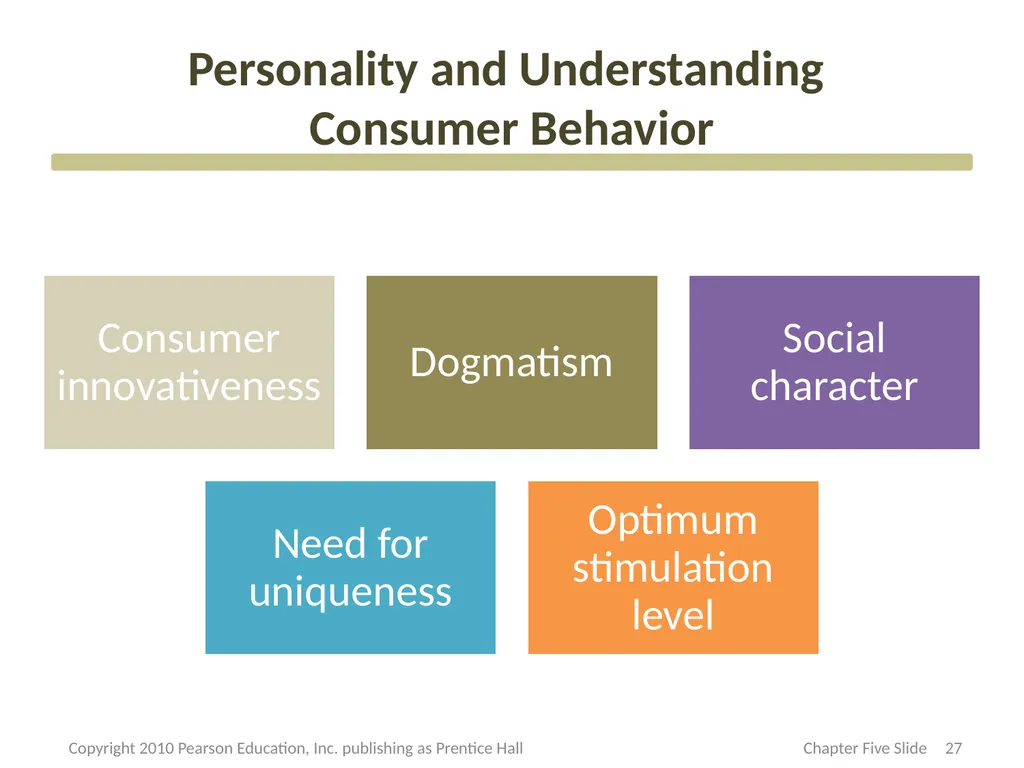
Personality and Understanding
Consumer Behavior 27 Copyright 2010 Pearson Education, Inc. publishing as Prentice Hall Chapter Five Slide<br>
28
Consumer Innovativeness Willingness to adopt and open to new ideas or products, and first to try new products
Further broken down for hi-tech products
Global innovativeness
Domain-specific innovativeness
Check your innovativeness
https://www.youtube.com/watch?v=cDboYz-0NJw 28 Chapter Five Slide Copyright 2010 Pearson Education, Inc. publishing as Prentice Hall<br>
Further broken down for hi-tech products
Global innovativeness
Domain-specific innovativeness
Check your innovativeness
https://www.youtube.com/watch?v=cDboYz-0NJw 28 Chapter Five Slide Copyright 2010 Pearson Education, Inc. publishing as Prentice Hall<br>
29
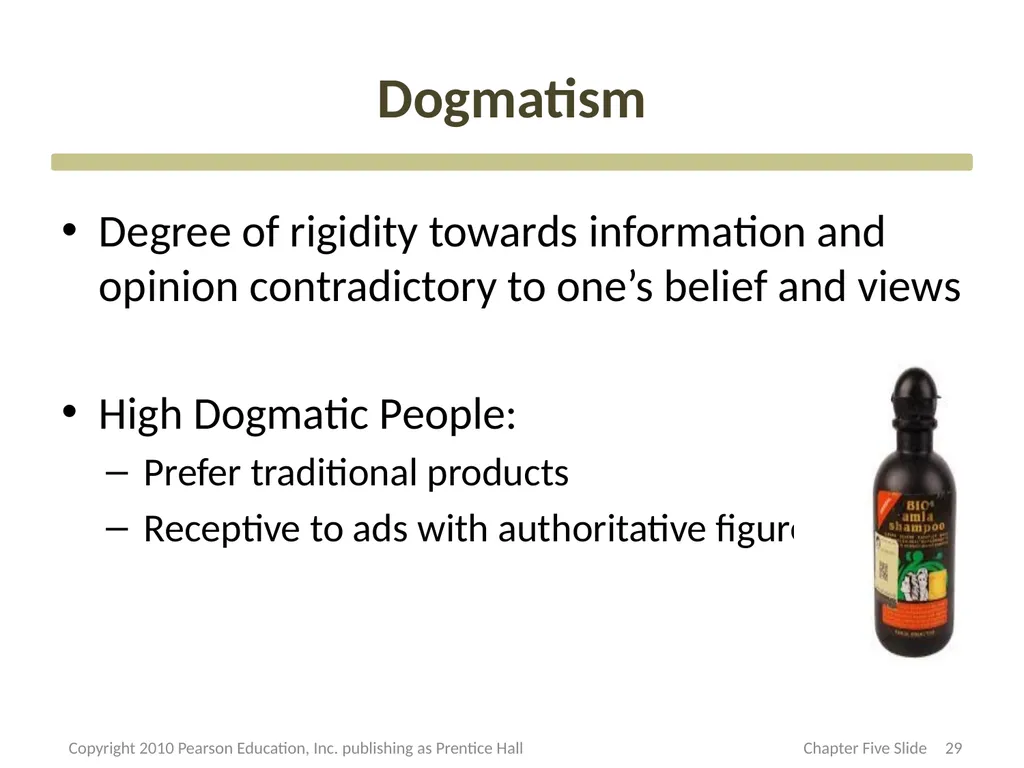
Dogmatism Degree of rigidity towards information and opinion contradictory to one’s belief and views
High Dogmatic People:
Prefer traditional products
Receptive to ads with authoritative figure 29 Chapter Five Slide Copyright 2010 Pearson Education, Inc. publishing as Prentice Hall<br>
High Dogmatic People:
Prefer traditional products
Receptive to ads with authoritative figure 29 Chapter Five Slide Copyright 2010 Pearson Education, Inc. publishing as Prentice Hall<br>
30
Low Dogmatic People Consider unfamiliar or opposing belief.
Receptive to ads with factual difference, product benefits, and product usage information.
Shan Foods – "Khana With a Modern Touch"
Traditional View: Cooking should always be from scratch, using age-old recipes. 30<br>
Receptive to ads with factual difference, product benefits, and product usage information.
Shan Foods – "Khana With a Modern Touch"
Traditional View: Cooking should always be from scratch, using age-old recipes. 30<br>
31
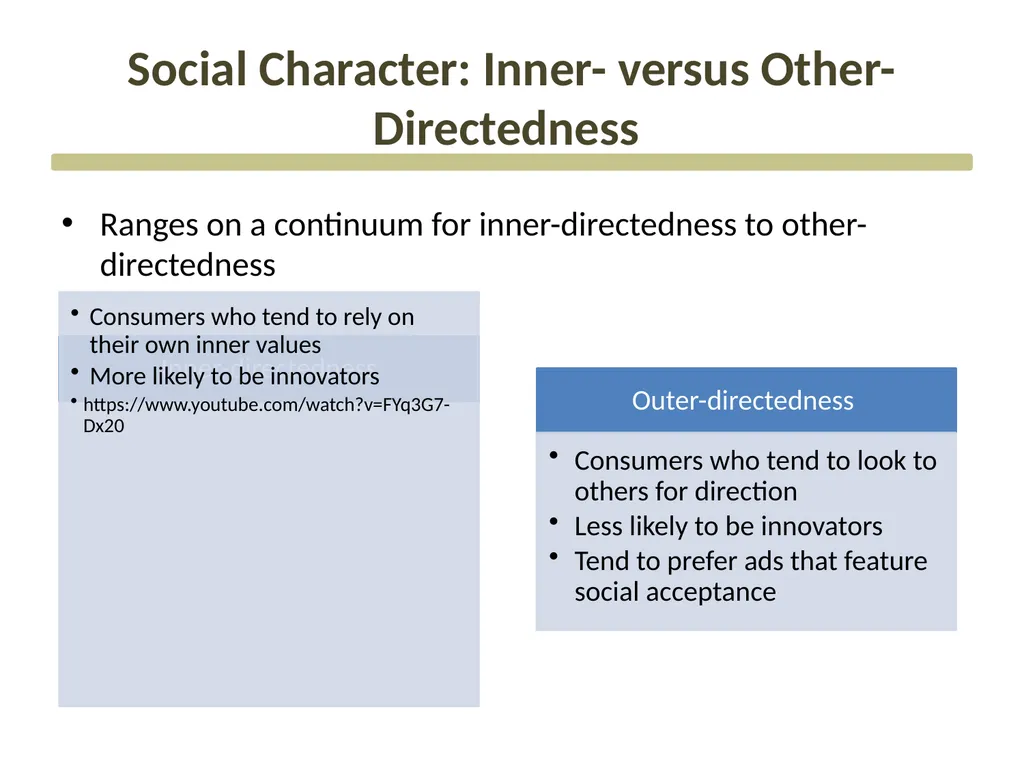
Social Character: Inner- versus Other-Directedness Ranges on a continuum for inner-directedness to other-directedness<br>
32
Need for Uniqueness Consumers who avoid conforming to expectations or standards of others
Or
Consumers' need for uniqueness is defined as an individual's pursuit of differentness relative to others. Copyright 2010 Pearson Education, Inc. publishing as Prentice Hall 32 Chapter Five Slide<br>
Or
Consumers' need for uniqueness is defined as an individual's pursuit of differentness relative to others. Copyright 2010 Pearson Education, Inc. publishing as Prentice Hall 32 Chapter Five Slide<br>
33
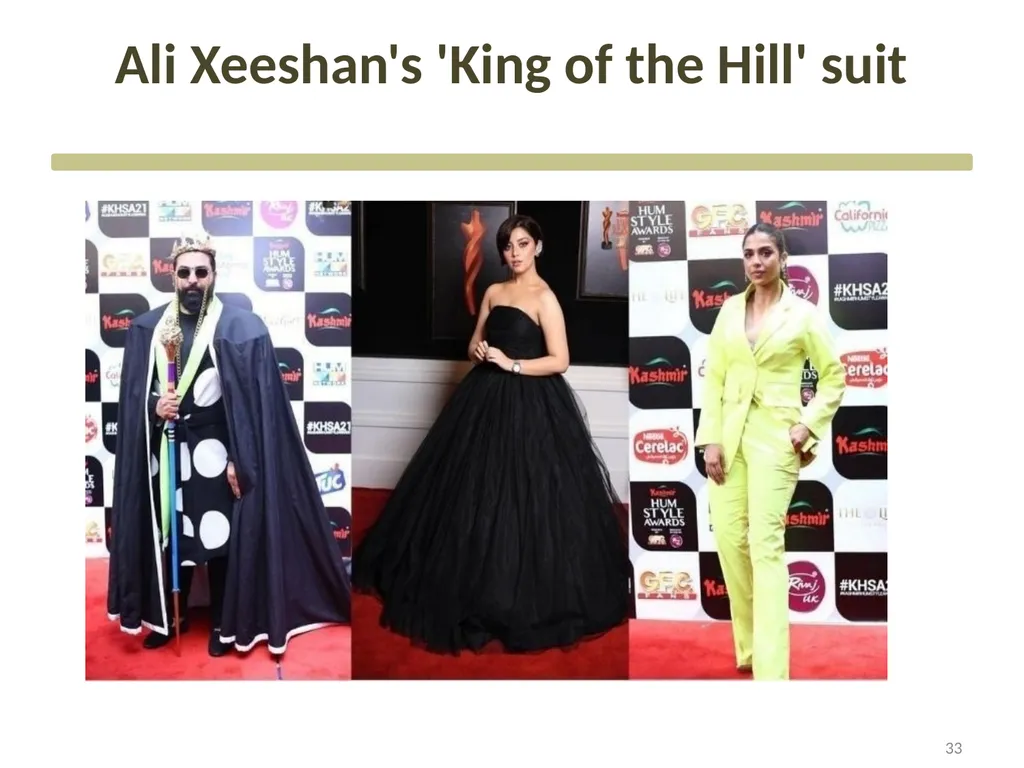
Ali Xeeshan's 'King of the Hill' suit 33<br>
34
Need for Uniqueness Adopt new products and brands quicker than others
Avoid buying mainstream products
Prefer creative products 34<br>
Avoid buying mainstream products
Prefer creative products 34<br>
35
Optimum Stimulation Level (OSL) Degree to which people like novel, complex, and unusual experiences (High OSL) or prefer simple, uncluttered, and calm experience (Low OSL).
Relationship of OSL and lifestyle.
High OSL
Willing to take risk, try new products
Experiment with their personal appearance
Enhance their individuality Copyright 2010 Pearson Education, Inc. publishing as Prentice Hall 35 Chapter Five Slide<br>
Relationship of OSL and lifestyle.
High OSL
Willing to take risk, try new products
Experiment with their personal appearance
Enhance their individuality Copyright 2010 Pearson Education, Inc. publishing as Prentice Hall 35 Chapter Five Slide<br>
36
36<br>
37
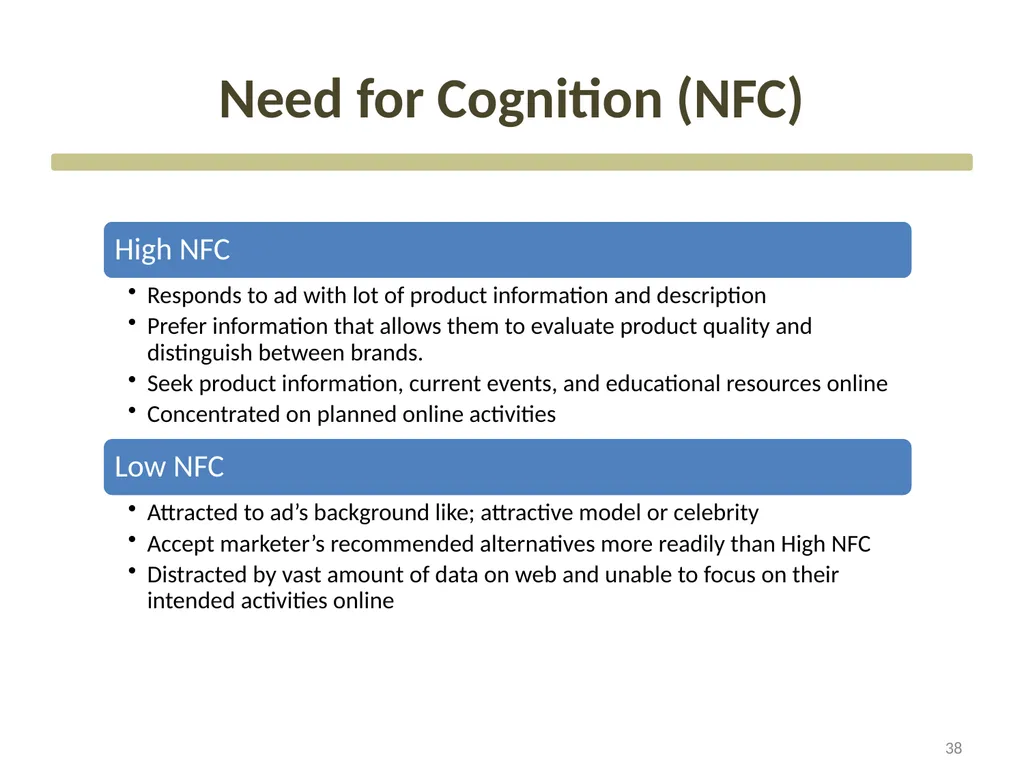
Need for Cognition (NFC) A person’s craving for enjoyment of thinking
Individual with high NFC more likely to respond to ads rich in product information and description
. 37 Copyright 2010 Pearson Education, Inc. publishing as Prentice Hall Chapter Five Slide<br>
Individual with high NFC more likely to respond to ads rich in product information and description
. 37 Copyright 2010 Pearson Education, Inc. publishing as Prentice Hall Chapter Five Slide<br>
38
Need for Cognition (NFC) 38<br>
39
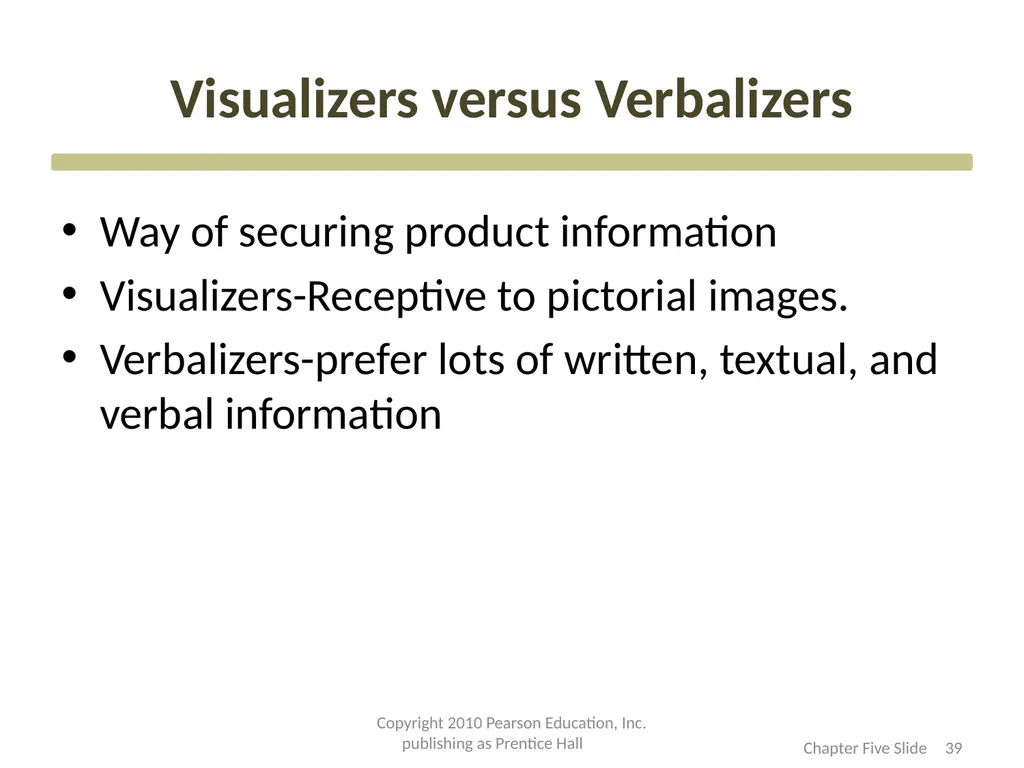
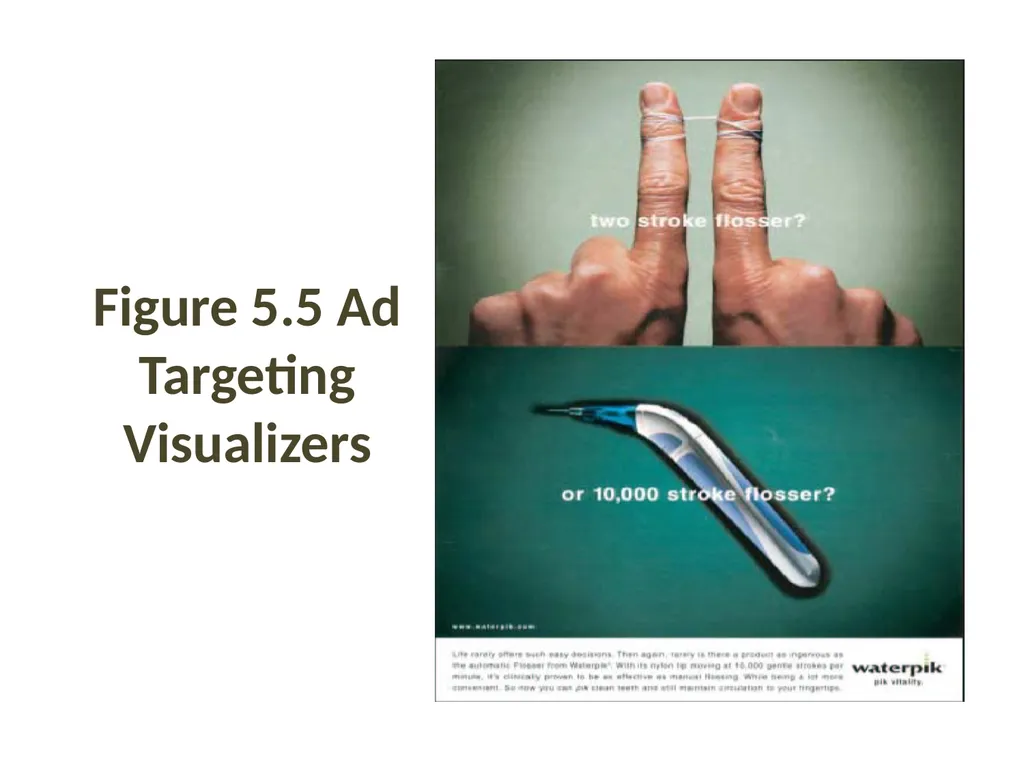
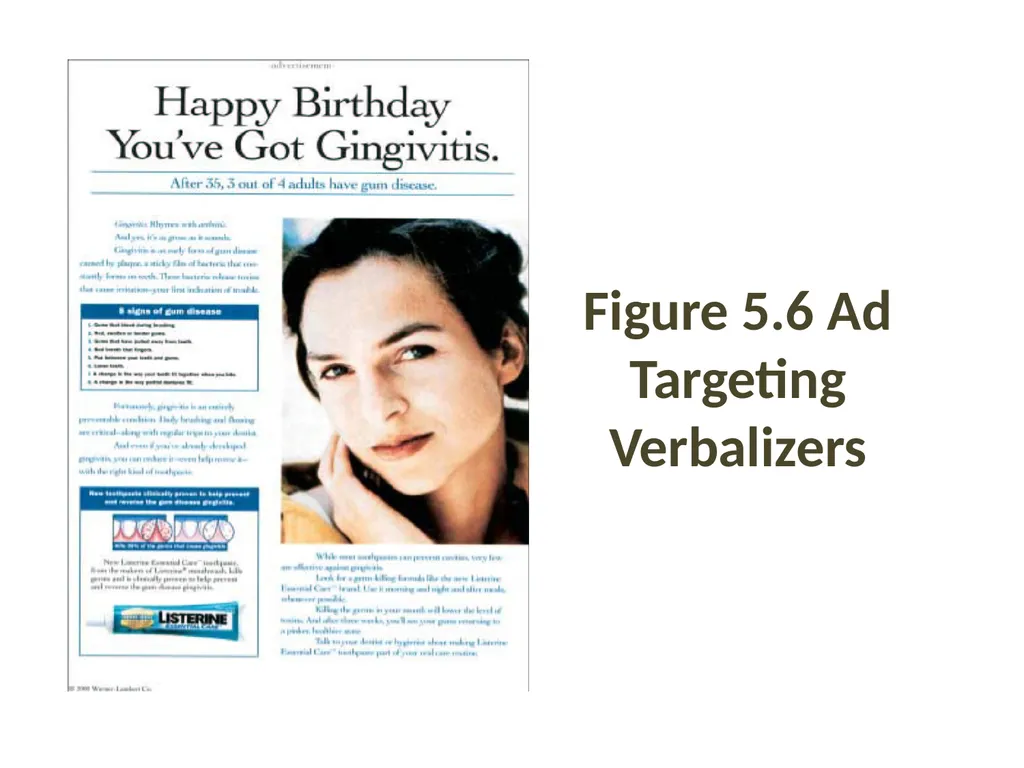
Visualizers versus Verbalizers Way of securing product information
Visualizers-Receptive to pictorial images.
Verbalizers-prefer lots of written, textual, and verbal information Copyright 2010 Pearson Education, Inc. publishing as Prentice Hall 39 Chapter Five Slide<br>
Visualizers-Receptive to pictorial images.
Verbalizers-prefer lots of written, textual, and verbal information Copyright 2010 Pearson Education, Inc. publishing as Prentice Hall 39 Chapter Five Slide<br>
40
Figure 5.5 Ad Targeting Visualizers<br>
41
Figure 5.6 Ad Targeting Verbalizers<br>
42
Discussion Question What advertising media (print, television, Internet, salesperson, POP display, newspaper, radio) is good for a person with a high NFC? 42 Copyright 2010 Pearson Education, Inc. publishing as Prentice Hall Chapter Five Slide<br>
43
Consumer Ethnocentrism and Cosmopolitanism Ethnocentric consumers feel it is wrong to purchase foreign-made products because of the impact on the economy
A cosmopolitan orientation would consider the word to be their marketplace and would be attracted to products from other cultures and countries.
Consumer Knowledge and Ethnocentrism 43 Copyright 2010 Pearson Education, Inc. publishing as Prentice Hall Chapter Five Slide<br>
A cosmopolitan orientation would consider the word to be their marketplace and would be attracted to products from other cultures and countries.
Consumer Knowledge and Ethnocentrism 43 Copyright 2010 Pearson Education, Inc. publishing as Prentice Hall Chapter Five Slide<br>
44
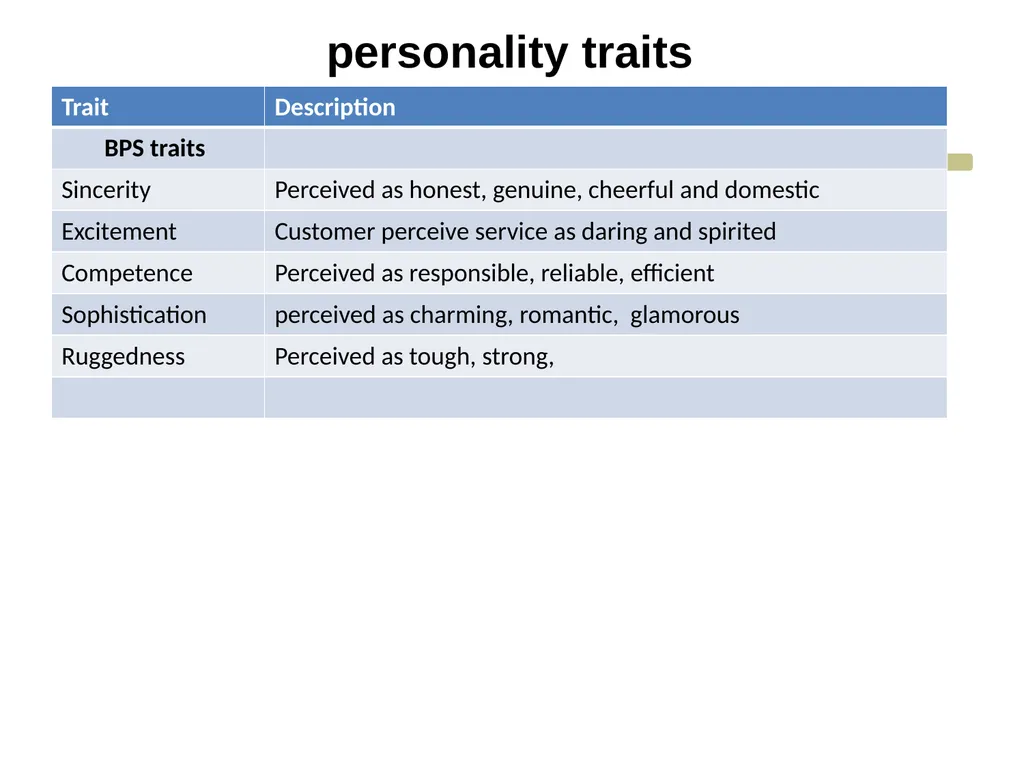
Product and Brand Personification Consumers attribute human traits or characteristics to a brand
Brand personality provides an emotional identity for a brand<br>
Brand personality provides an emotional identity for a brand<br>
45
personality traits<br>
46
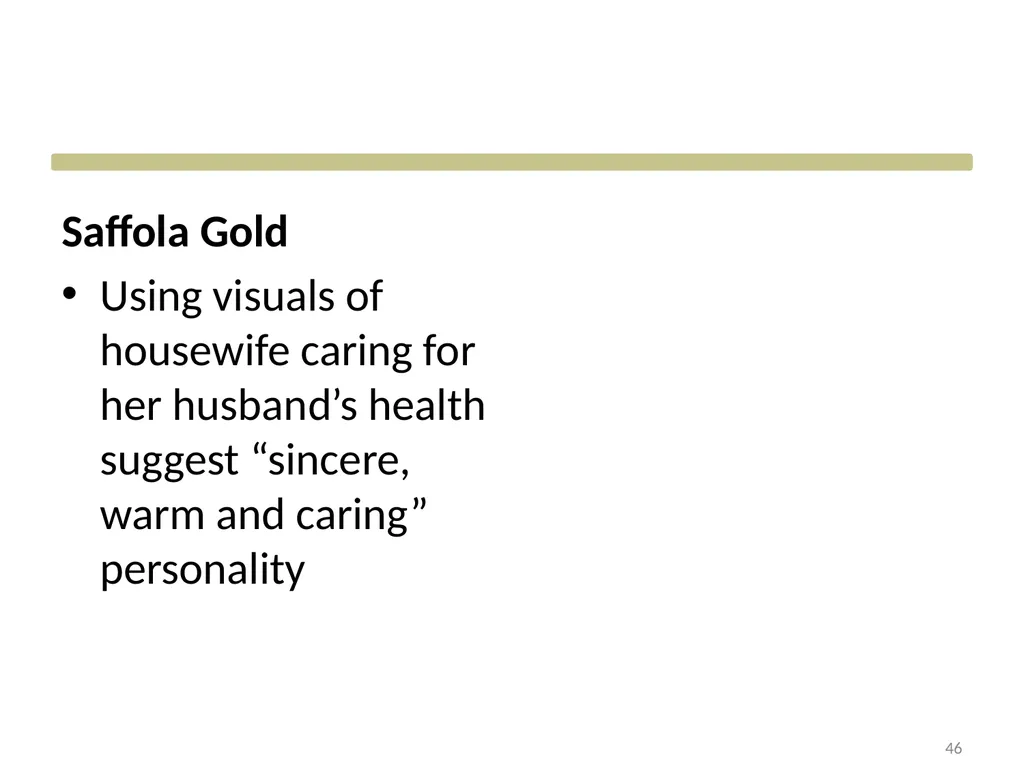
Saffola Gold
Using visuals of housewife caring for her husband’s health suggest “sincere, warm and caring” personality 46<br>
Using visuals of housewife caring for her husband’s health suggest “sincere, warm and caring” personality 46<br>
47
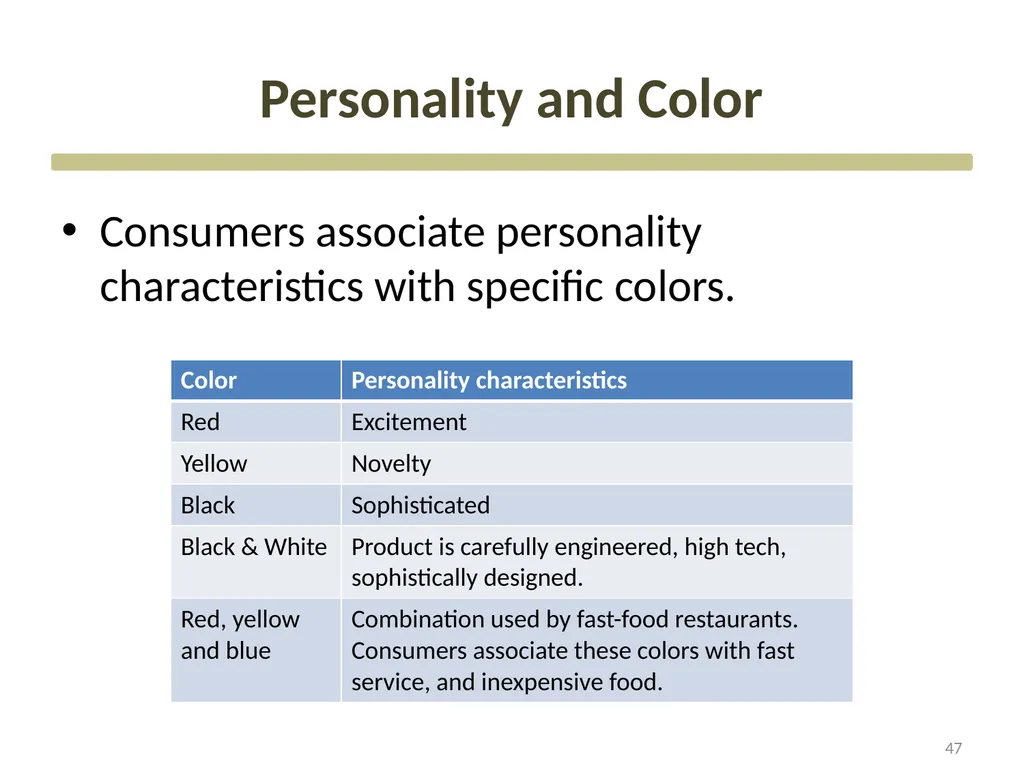
Personality and Color Consumers associate personality characteristics with specific colors. 47<br>
48
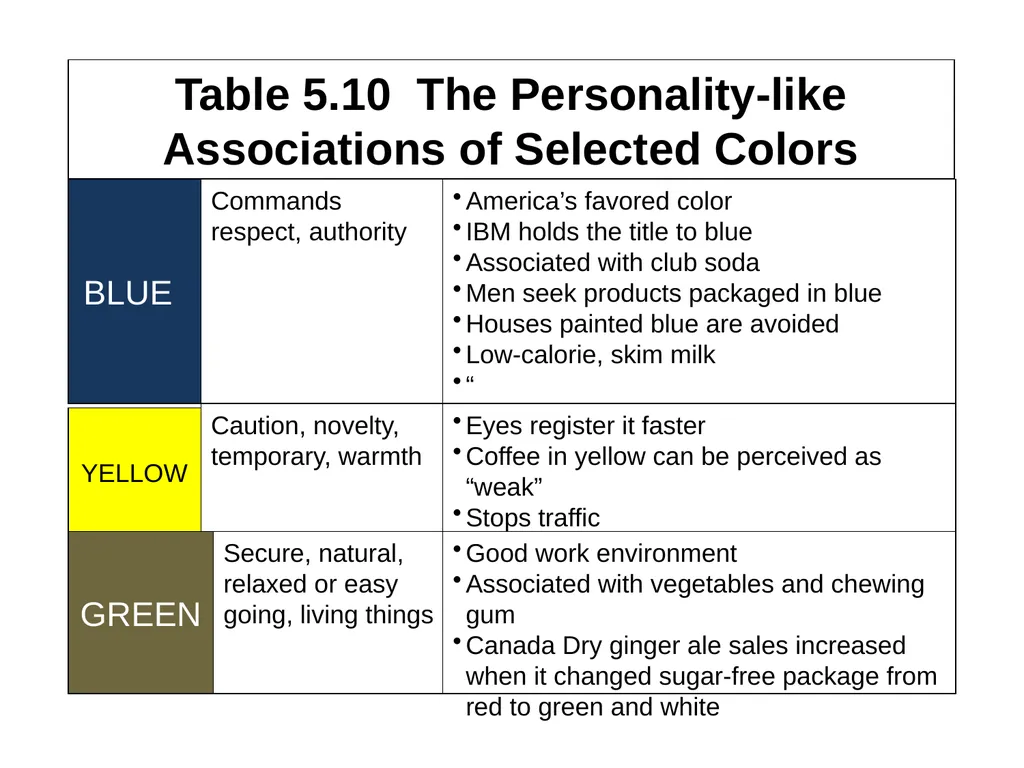
Table 5.10 The Personality-like Associations of Selected Colors<br>
49
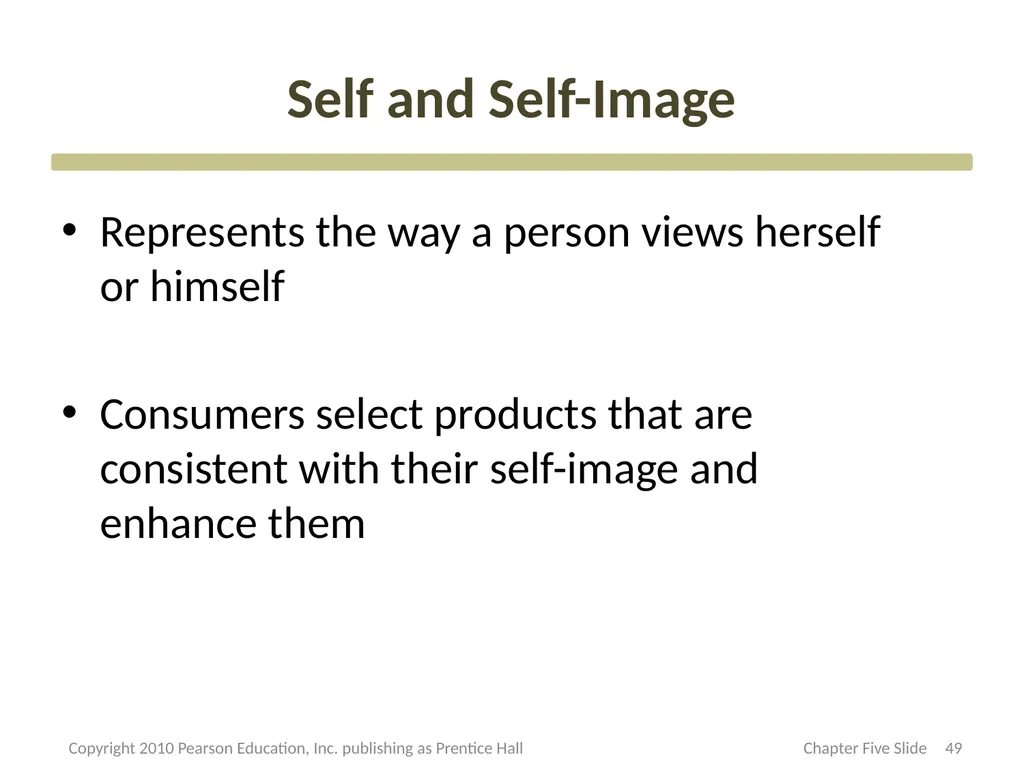
Self and Self-Image Represents the way a person views herself or himself
Consumers select products that are consistent with their self-image and enhance them 49 Copyright 2010 Pearson Education, Inc. publishing as Prentice Hall Chapter Five Slide<br>
Consumers select products that are consistent with their self-image and enhance them 49 Copyright 2010 Pearson Education, Inc. publishing as Prentice Hall Chapter Five Slide<br>
50
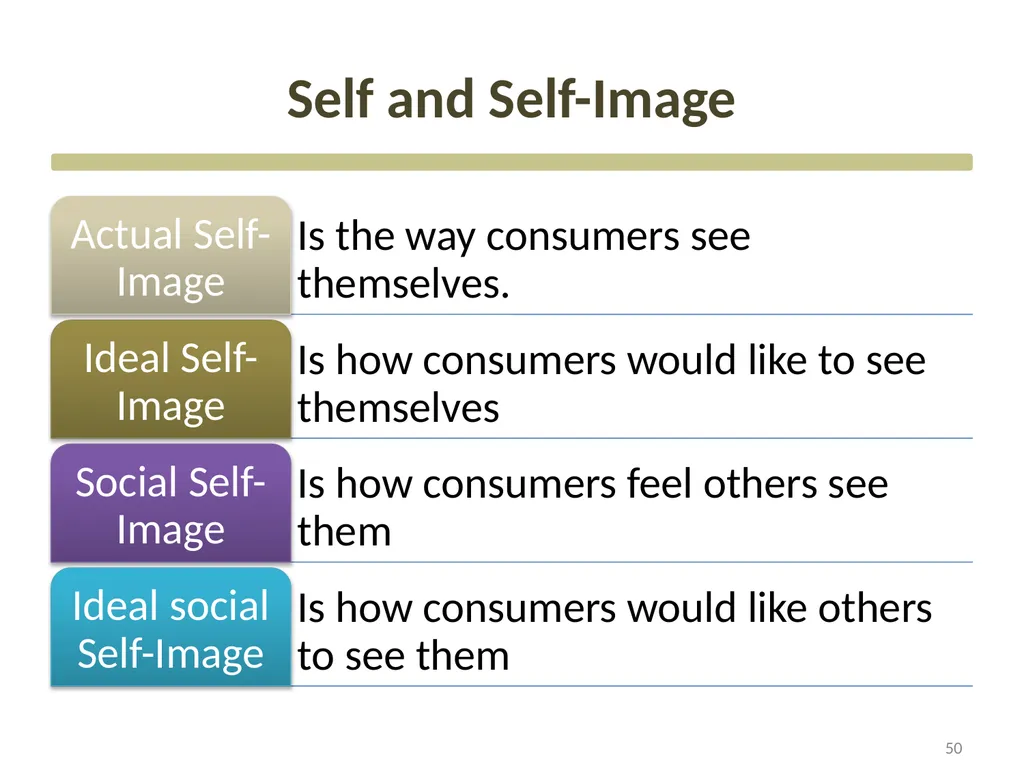
Self and Self-Image 50<br>
51
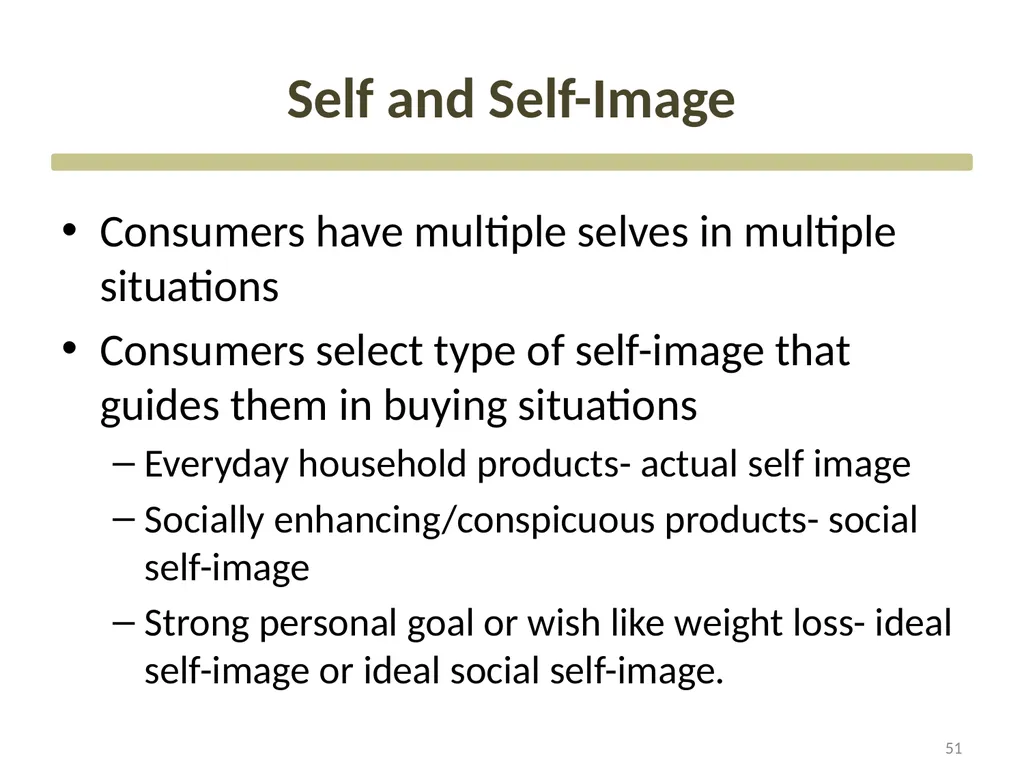
Self and Self-Image Consumers have multiple selves in multiple situations
Consumers select type of self-image that guides them in buying situations
Everyday household products- actual self image
Socially enhancing/conspicuous products- social self-image
Strong personal goal or wish like weight loss- ideal self-image or ideal social self-image. 51<br>
Consumers select type of self-image that guides them in buying situations
Everyday household products- actual self image
Socially enhancing/conspicuous products- social self-image
Strong personal goal or wish like weight loss- ideal self-image or ideal social self-image. 51<br>