
WORKPLACE VIOLENCE PREVENTION REGULATIONS EMPLOYER
EM
Published · 22 slides · 0 views

1 / 1
Description
WORKPLACE VIOLENCE PREVENTION REGULATIONS EMPLOYER TRAINING Opening Slide Layout Division of Safety Health WHO IS COVERED BY THIS REGULATION? State agencies Political subdivisions of the State (County, City, Town, Village) Fire
Related Topics
Share
Embed code
Download this presentation From Below
"WORKPLACE VIOLENCE PREVENTION REGULATIONS EMPLOYER" is the property of its rightful owner. Permission is granted to download and print the materials on this website for personal, non-commercial use only, and to display it on your personal computer provided you do not modify the materials and that you retain all copyright notices contained in the materials. By downloading content from our website, you accept the terms of this agreement.
Presentation Transcript
01
WORKPLACE VIOLENCE PREVENTION REGULATIONS
EMPLOYER TRAINING Opening Slide Layout Division of Safety & Health<br>
EMPLOYER TRAINING Opening Slide Layout Division of Safety & Health<br>
02
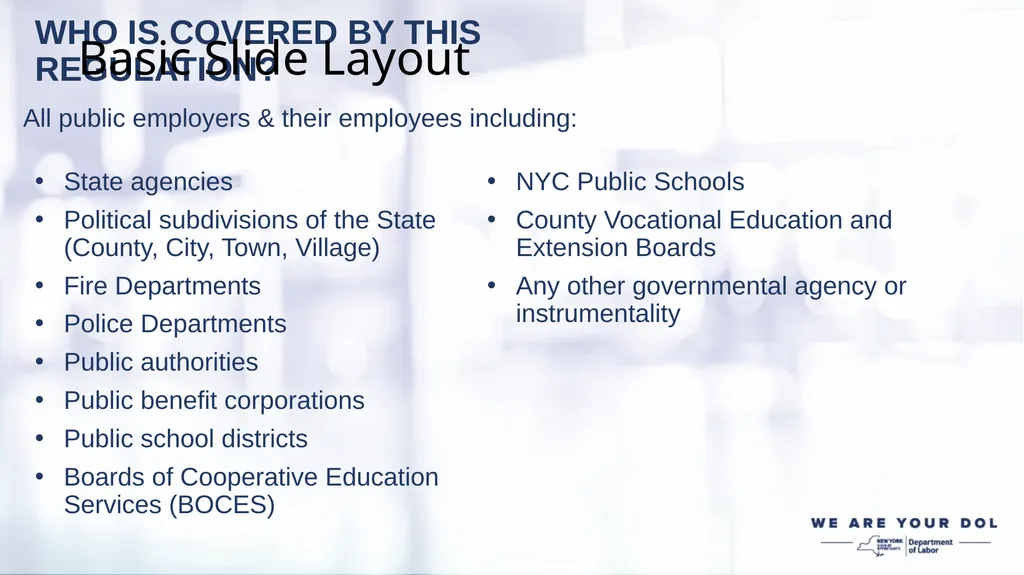
WHO IS COVERED BY THIS REGULATION? State agencies
Political subdivisions of the State (County, City, Town, Village)
Fire Departments
Police Departments
Public authorities
Public benefit corporations
Public school districts
Boards of Cooperative Education Services (BOCES)
NYC Public Schools
County Vocational Education and Extension Boards
Any other governmental agency or instrumentality Basic Slide Layout All public employers & their employees including:<br>
Political subdivisions of the State (County, City, Town, Village)
Fire Departments
Police Departments
Public authorities
Public benefit corporations
Public school districts
Boards of Cooperative Education Services (BOCES)
NYC Public Schools
County Vocational Education and Extension Boards
Any other governmental agency or instrumentality Basic Slide Layout All public employers & their employees including:<br>
03
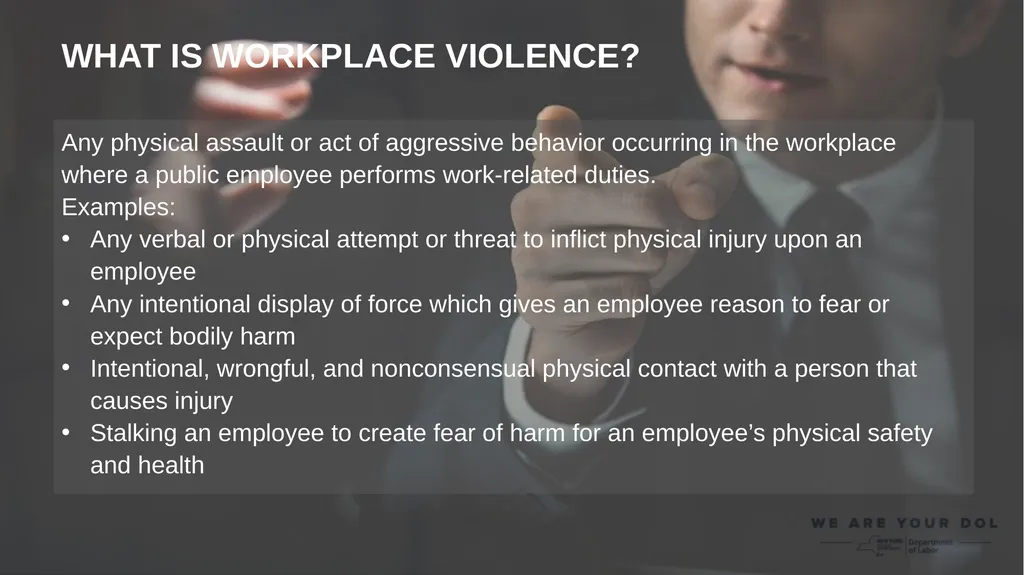
WHAT IS WORKPLACE VIOLENCE? Any physical assault or act of aggressive behavior occurring in the workplace where a public employee performs work-related duties.
Examples:
Any verbal or physical attempt or threat to inflict physical injury upon an employee
Any intentional display of force which gives an employee reason to fear or expect bodily harm
Intentional, wrongful, and nonconsensual physical contact with a person that causes injury
Stalking an employee to create fear of harm for an employee’s physical safety and health<br>
Examples:
Any verbal or physical attempt or threat to inflict physical injury upon an employee
Any intentional display of force which gives an employee reason to fear or expect bodily harm
Intentional, wrongful, and nonconsensual physical contact with a person that causes injury
Stalking an employee to create fear of harm for an employee’s physical safety and health<br>
04
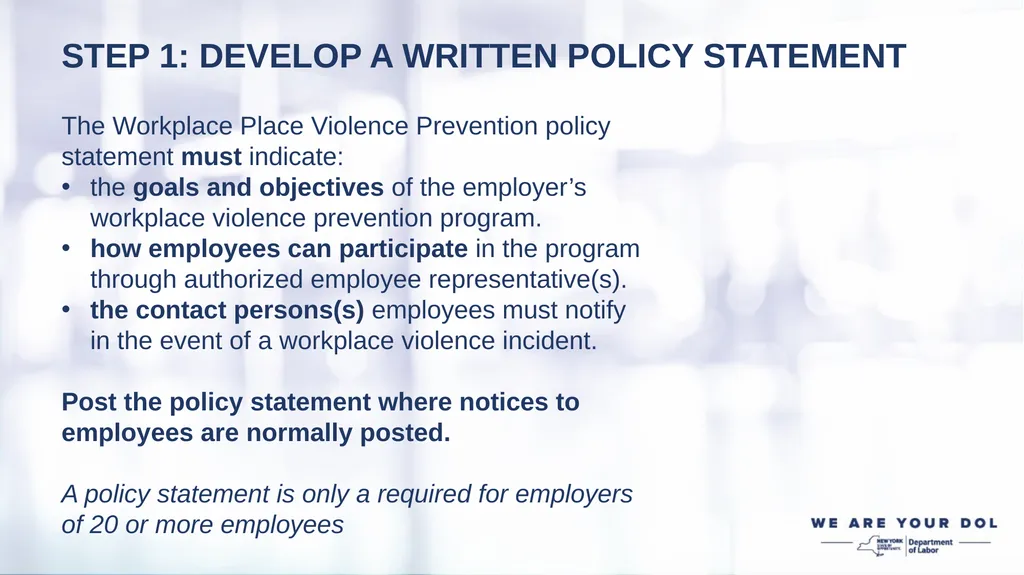
STEP 1: DEVELOP A WRITTEN POLICY STATEMENT The Workplace Place Violence Prevention policy statement must indicate:
the goals and objectives of the employer’s workplace violence prevention program.
how employees can participate in the program through authorized employee representative(s).
the contact persons(s) employees must notify in the event of a workplace violence incident.
Post the policy statement where notices to employees are normally posted.
A policy statement is only a required for employers of 20 or more employees<br>
the goals and objectives of the employer’s workplace violence prevention program.
how employees can participate in the program through authorized employee representative(s).
the contact persons(s) employees must notify in the event of a workplace violence incident.
Post the policy statement where notices to employees are normally posted.
A policy statement is only a required for employers of 20 or more employees<br>
05
STEP 2: CONDUCT A RISK EVALUATION AND DETERMINE RISK FACTORS Record Examination:
Examine any records of workplace violence incidents in the past year.
Identify patterns in the type and cause of injuries
Record examples include:
injury and illness documentation (SH 900, SH 900.1 and SH 900.2)
workplace violence incident reports
workers’ compensation reports
disciplinary reports
union grievances and record of threats<br>
Examine any records of workplace violence incidents in the past year.
Identify patterns in the type and cause of injuries
Record examples include:
injury and illness documentation (SH 900, SH 900.1 and SH 900.2)
workplace violence incident reports
workers’ compensation reports
disciplinary reports
union grievances and record of threats<br>
06
STEP 2: CONDUCT A RISK EVALUATION AND DETERMINE RISK FACTORS (cont.) Assessment of Administrative Risk Factors:
Assess relevant policies, work practices, and work procedures that may impact the risk of workplace violence.<br>
Assess relevant policies, work practices, and work procedures that may impact the risk of workplace violence.<br>
07
STEP 2: CONDUCT A RISK EVALUATION AND DETERMINE RISK FACTORS (cont.) Evaluation of the Physical Environment:
Evaluate the physical workplace to determine the presence of factors that may place employees at risk of workplace violence.
Allow for employees to participate in the evaluation through a authorized employee representative.
Examples of physical workplace risk factors:
Duties that involve mobile workplace assignments
Working alone or in small numbers
Exchanging money with the public
Handling internal employee disputes
Areas of previous security problems
Working in public settings (e.g., Social Service workers, police officers, fire fighters)<br>
Evaluate the physical workplace to determine the presence of factors that may place employees at risk of workplace violence.
Allow for employees to participate in the evaluation through a authorized employee representative.
Examples of physical workplace risk factors:
Duties that involve mobile workplace assignments
Working alone or in small numbers
Exchanging money with the public
Handling internal employee disputes
Areas of previous security problems
Working in public settings (e.g., Social Service workers, police officers, fire fighters)<br>
08
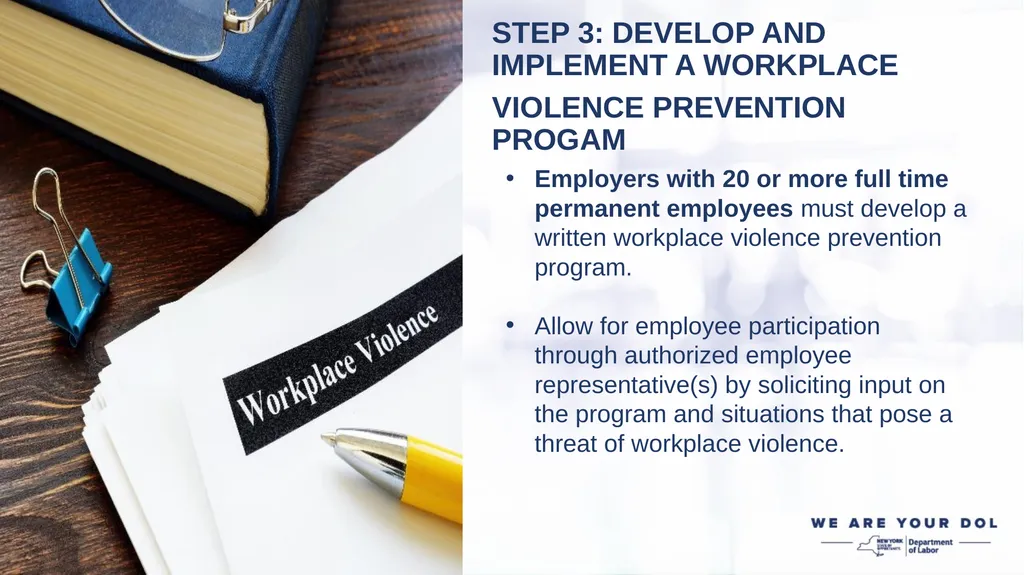
STEP 3: DEVELOP AND IMPLEMENT A WORKPLACE
VIOLENCE PREVENTION PROGAM Employers with 20 or more full time permanent employees must develop a written workplace violence prevention program.
Allow for employee participation through authorized employee representative(s) by soliciting input on the program and situations that pose a threat of workplace violence.<br>
VIOLENCE PREVENTION PROGAM Employers with 20 or more full time permanent employees must develop a written workplace violence prevention program.
Allow for employee participation through authorized employee representative(s) by soliciting input on the program and situations that pose a threat of workplace violence.<br>
09
REQUIREMENTS OF THE WORKPLACE VIOLENCE PREVENTION PROGRAM (Step 3 cont.) The Workplace Violence Prevention Program must include:
A list of risk factors identified in the workplace risk evaluation
The methods the employer will use to prevent the incidence of workplace violence. The employer must list the safeguard they have implemented to address each risk factor. Examples:
Training to increase employee awareness of the signs/effects of workplace violence
Increased security
Additional lighting<br>
A list of risk factors identified in the workplace risk evaluation
The methods the employer will use to prevent the incidence of workplace violence. The employer must list the safeguard they have implemented to address each risk factor. Examples:
Training to increase employee awareness of the signs/effects of workplace violence
Increased security
Additional lighting<br>
10
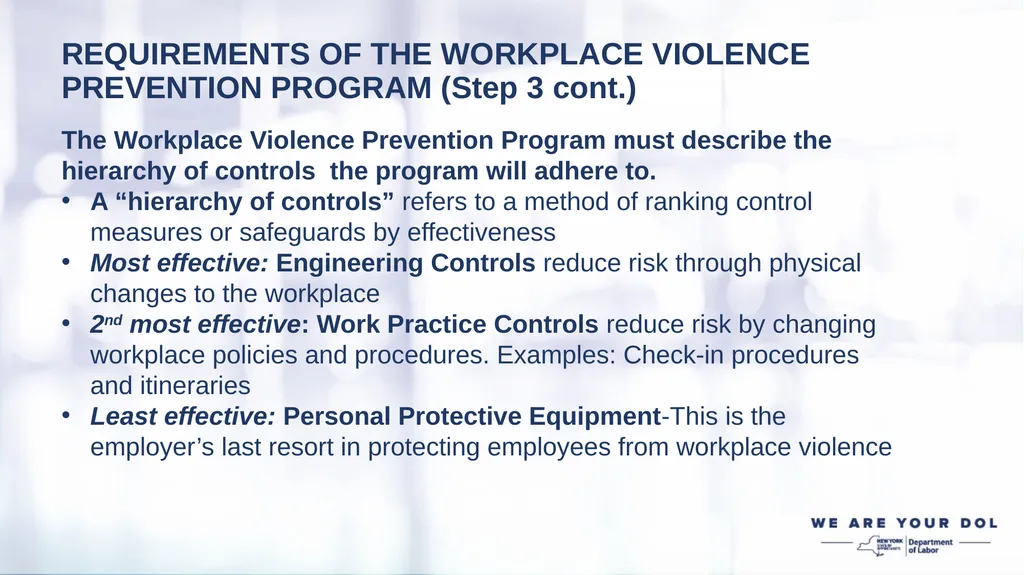
REQUIREMENTS OF THE WORKPLACE VIOLENCE PREVENTION PROGRAM (Step 3 cont.) The Workplace Violence Prevention Program must describe the hierarchy of controls the program will adhere to.
A “hierarchy of controls” refers to a method of ranking control measures or safeguards by effectiveness
Most effective: Engineering Controls reduce risk through physical changes to the workplace
2nd most effective: Work Practice Controls reduce risk by changing workplace policies and procedures. Examples: Check-in procedures and itineraries
Least effective: Personal Protective Equipment-This is the employer’s last resort in protecting employees from workplace violence<br>
A “hierarchy of controls” refers to a method of ranking control measures or safeguards by effectiveness
Most effective: Engineering Controls reduce risk through physical changes to the workplace
2nd most effective: Work Practice Controls reduce risk by changing workplace policies and procedures. Examples: Check-in procedures and itineraries
Least effective: Personal Protective Equipment-This is the employer’s last resort in protecting employees from workplace violence<br>
11
REQUIREMENTS OF THE WORKPLACE VIOLENCE PREVENTION PROGRAM (step 3 cont.) The Workplace Violence Prevention Program must include:
The methods and means the employer will use to address each hazard identified in the evaluation of the workplace
A system designed and implemented by the employer to report any workplace violence incidents
A written outline or lesson plan for employee training
A plan for to review the workplace violence incidents report at least once a year and evaluate the how effective employers safeguard have been at reducing the risk workplace violence
.<br>
The methods and means the employer will use to address each hazard identified in the evaluation of the workplace
A system designed and implemented by the employer to report any workplace violence incidents
A written outline or lesson plan for employee training
A plan for to review the workplace violence incidents report at least once a year and evaluate the how effective employers safeguard have been at reducing the risk workplace violence
.<br>
12
STEP 4: DEVELOP AND IMPLEMENT A WORKPLACE VIOLENCE INCIDENT REPORTING SYSTEM Employer must develop and implement a system for reporting incidents of workplace violence. Incident reports must contain:
Workplace location where incident occurred
Time of day/shift when incident occurred
A detailed description of the incident, including events leading up to the incident and how the incident ended
Names and job titles of involved employees
Name or other identifying information of other individual(s) involved
Nature and extent of injuries arising from the incident
Names of witnesses<br>
Workplace location where incident occurred
Time of day/shift when incident occurred
A detailed description of the incident, including events leading up to the incident and how the incident ended
Names and job titles of involved employees
Name or other identifying information of other individual(s) involved
Nature and extent of injuries arising from the incident
Names of witnesses<br>
13
STEP 4: DEVELOP AND IMPLEMENT A WORKPLACE VIOLENCE INCIDENT REPORTING SYSTEM (cont.) For incidents of workplace violence where privacy is of concern, the name of the employee who was the victim should be replaced with “PRIVACY CONCERN CASE”
The following are privacy concern cases:
An injury or illness to an intimate body part or the reproductive system;
Mental illness;
HIV infection;
Needle stick injuries and cuts from sharp objects that are or may be contaminated with another person’s blood
an injury or illness resulting from sexual assault
In addition, any employee who was the victim of an incident of workplace violence can voluntarily and independently ask for their name to be removed from the workplace violence incident report.<br>
The following are privacy concern cases:
An injury or illness to an intimate body part or the reproductive system;
Mental illness;
HIV infection;
Needle stick injuries and cuts from sharp objects that are or may be contaminated with another person’s blood
an injury or illness resulting from sexual assault
In addition, any employee who was the victim of an incident of workplace violence can voluntarily and independently ask for their name to be removed from the workplace violence incident report.<br>
14
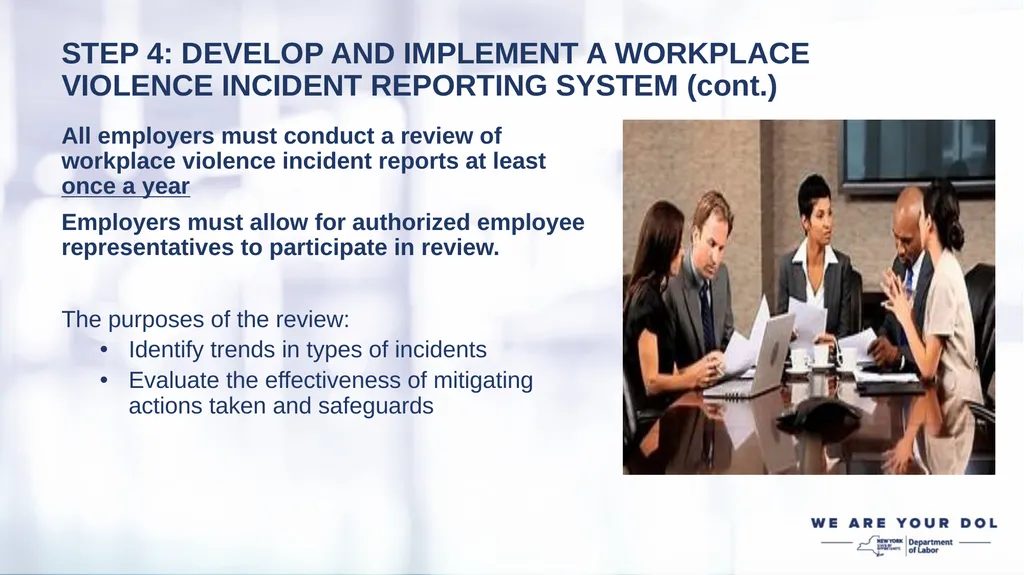
STEP 4: DEVELOP AND IMPLEMENT A WORKPLACE VIOLENCE INCIDENT REPORTING SYSTEM (cont.) All employers must conduct a review of workplace violence incident reports at least once a year
Employers must allow for authorized employee representatives to participate in review.
The purposes of the review:
Identify trends in types of incidents
Evaluate the effectiveness of mitigating actions taken and safeguards<br>
Employers must allow for authorized employee representatives to participate in review.
The purposes of the review:
Identify trends in types of incidents
Evaluate the effectiveness of mitigating actions taken and safeguards<br>
15
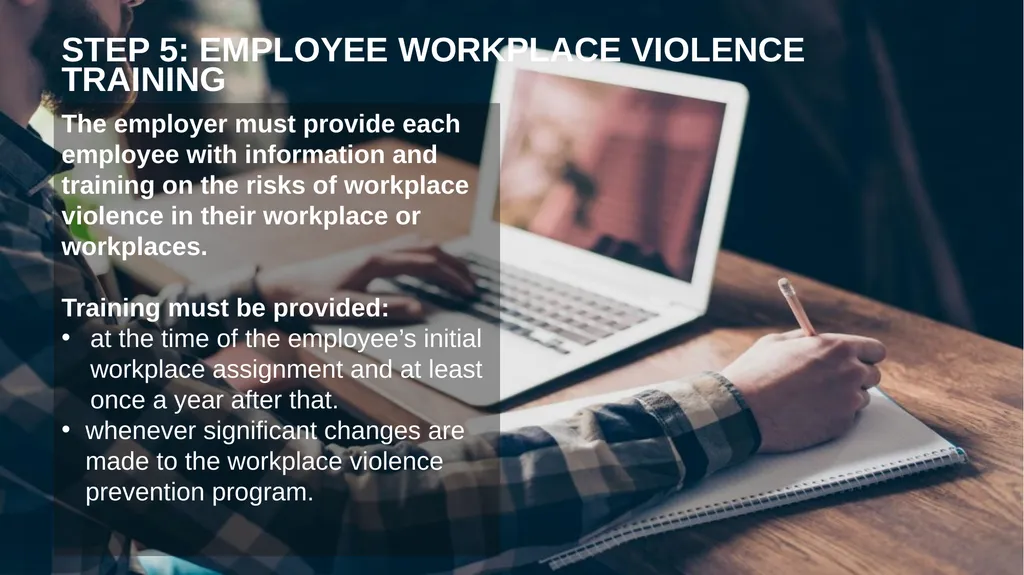
STEP 5: EMPLOYEE WORKPLACE VIOLENCE TRAINING The employer must provide each employee with information and training on the risks of workplace violence in their workplace or workplaces.
Training must be provided:
at the time of the employee’s initial workplace assignment and at least once a year after that.
whenever significant changes are made to the workplace violence prevention program.<br>
Training must be provided:
at the time of the employee’s initial workplace assignment and at least once a year after that.
whenever significant changes are made to the workplace violence prevention program.<br>
16
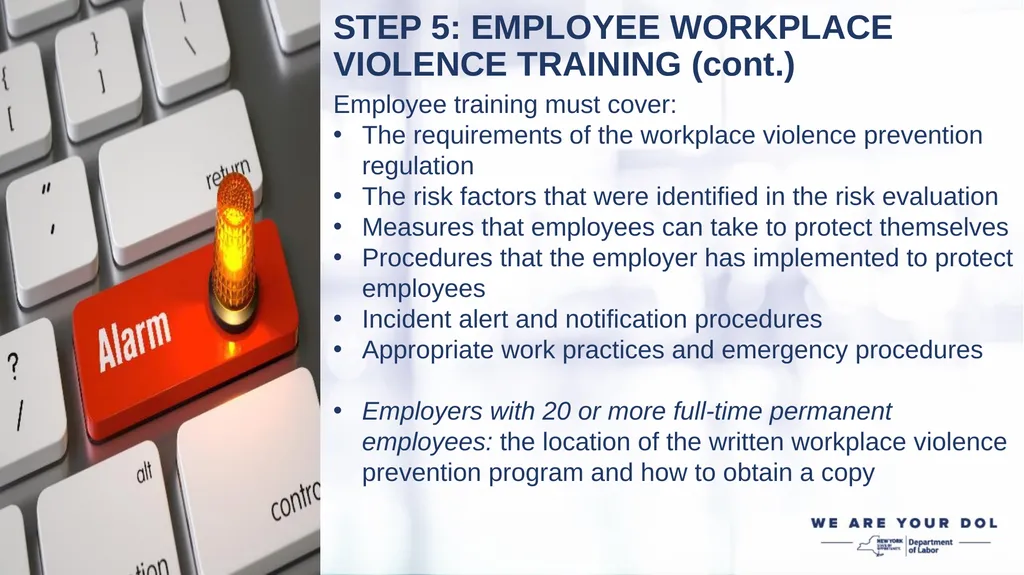
STEP 5: EMPLOYEE WORKPLACE VIOLENCE TRAINING (cont.) Employee training must cover:
The requirements of the workplace violence prevention regulation
The risk factors that were identified in the risk evaluation
Measures that employees can take to protect themselves
Procedures that the employer has implemented to protect employees
Incident alert and notification procedures
Appropriate work practices and emergency procedures
Employers with 20 or more full-time permanent employees: the location of the written workplace violence prevention program and how to obtain a copy<br>
The requirements of the workplace violence prevention regulation
The risk factors that were identified in the risk evaluation
Measures that employees can take to protect themselves
Procedures that the employer has implemented to protect employees
Incident alert and notification procedures
Appropriate work practices and emergency procedures
Employers with 20 or more full-time permanent employees: the location of the written workplace violence prevention program and how to obtain a copy<br>
17
VIOLATIONS OF THE WORKPLACE VIOLENCE PREVENTION LAW Any employee or their authorized employee representative must inform their supervisor in writing if they believe:
a serious violation of the employer’s workplace violence prevention program exists
Imminent danger of workplace violence exists
They must allow the employer a reasonable opportunity to correct the violation or cause of imminent danger.<br>
a serious violation of the employer’s workplace violence prevention program exists
Imminent danger of workplace violence exists
They must allow the employer a reasonable opportunity to correct the violation or cause of imminent danger.<br>
18
VIOLATIONS OF THE WORKPLACE VIOLENCE PREVENTION LAW An employee or representative is NOT required to inform their supervisor in writing of a violation if they believe in good faith:
They, themselves, another employee, or patient is imminent danger
And they do not believe informing their supervisor will result in corrective action.<br>
They, themselves, another employee, or patient is imminent danger
And they do not believe informing their supervisor will result in corrective action.<br>
19
VIOLATIONS OF THE WORKPLACE VIOLENCE PREVENTION LAW After a reasonable opportunity has passed and the employee or the authorized employee representative still believes:
a serious violation of the workplace violence prevention program exists
an imminent danger exists
The employee or authorized employee representative may submit a written request for an inspection by filing a complaint with the Public Employee Safety and Health (PESH) bureau at the Department of Labor’s Division of Safety and Health<br>
a serious violation of the workplace violence prevention program exists
an imminent danger exists
The employee or authorized employee representative may submit a written request for an inspection by filing a complaint with the Public Employee Safety and Health (PESH) bureau at the Department of Labor’s Division of Safety and Health<br>
20
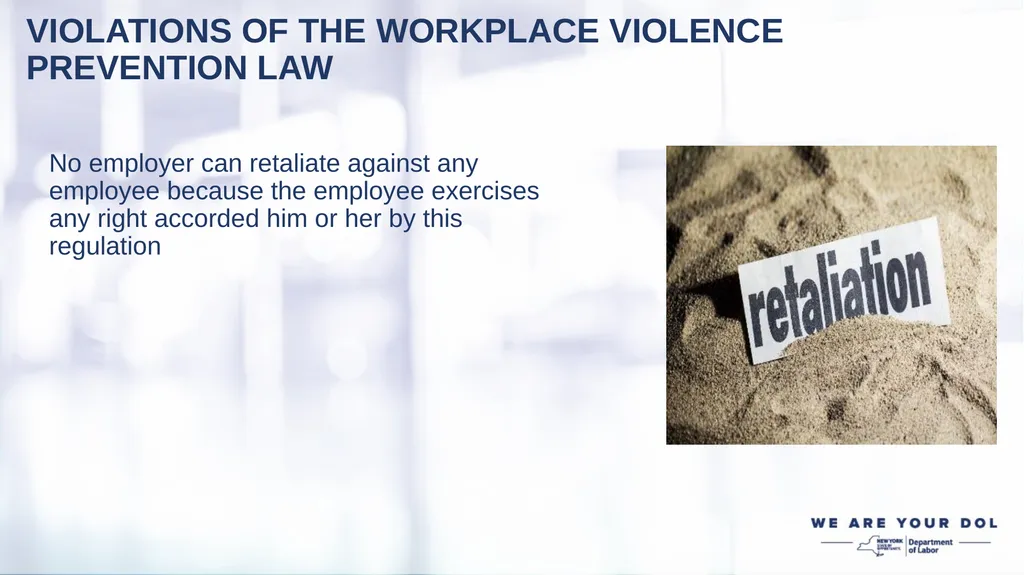
VIOLATIONS OF THE WORKPLACE VIOLENCE PREVENTION LAW No employer can retaliate against any employee because the employee exercises any right accorded him or her by this regulation<br>
21
ADDITIONAL INFORMATION NYS DOL is here to help employers through this process.
For additional information on recordkeeping or workplace violence prevention, or to request free and confidential consultation assistance, please use the contact information on the PESH Consultation Fact Sheet available here: https://dol.ny.gov/system/files/documents/2023/11/p206_12-10-20.pdf
For additional information on the PESH bureau see the PESH website here: https://dol.ny.gov/safety-and-health
Our workplace violence website provides additional information including FAQs and templates employers. It is available here: https://dol.ny.gov/workplace-violence-prevention-information<br>
For additional information on recordkeeping or workplace violence prevention, or to request free and confidential consultation assistance, please use the contact information on the PESH Consultation Fact Sheet available here: https://dol.ny.gov/system/files/documents/2023/11/p206_12-10-20.pdf
For additional information on the PESH bureau see the PESH website here: https://dol.ny.gov/safety-and-health
Our workplace violence website provides additional information including FAQs and templates employers. It is available here: https://dol.ny.gov/workplace-violence-prevention-information<br>
22
THANK YOU! Chapter Title Slide Layout Sue Blodgett
Assoc. Safety and Health Inspector
New York State Department of Labor
Public Employee Safety and Health (PESH)
Harriman State Office Campus
Building 12, Room 158, Albany NY 12240
P: (518) 457-5508 | Fax: (518) 485-1150
C: (518) 331-1430
www.labor.ny.gov | susan.blodgett@labor.ny.gov<br>
Assoc. Safety and Health Inspector
New York State Department of Labor
Public Employee Safety and Health (PESH)
Harriman State Office Campus
Building 12, Room 158, Albany NY 12240
P: (518) 457-5508 | Fax: (518) 485-1150
C: (518) 331-1430
www.labor.ny.gov | susan.blodgett@labor.ny.gov<br>